
Custom Bikini Manufacturing: A Buyer's Discovery Guide
Custom Bikini Manufacturing: A Buyer's Discovery Guide
Custom bikini manufacturing is a cut-and-sew service in which a swimwear factory builds two-piece swimwear to a buyer's own design, fit block and fabric specification, instead of supplying a finished stock range. For a brand owner, importer or resort buyer, the order is not a purchase of inventory — it is a purchase of a repeatable pattern, a documented material specification and a quality standard that has to hold across every reorder.
The category sits inside a substantial global market. Grand View Research valued the global swimwear market at approximately USD 23.8 billion in 2025, a figure that covers bikinis, one-piece swimwear and men's swim trunks across retail channels. Within that total, the two-piece format is where brand identity, print direction and fit differentiation most often concentrate, which is why custom bikini programs attract both established labels and new e-commerce entrants.
This reference explains what a custom bikini program covers, how the development-to-delivery chain is structured, which technical specifications buyers should demand in writing, and where the model's practical limits sit. It is written for buyers in the awareness and research stage who need to understand the category before they request quotations.
What a Custom Bikini Program Actually Covers
A custom bikini is a two-piece swimwear style developed against a buyer's specification rather than selected from a catalogue of existing designs. In practice, three engagement models appear in the market, and buyers need to know which one they are buying.
Full OEM: production from a buyer's tech pack
In the OEM model, the buyer supplies the technical package — measurements, construction details, grading rules and fabric requirements — and the factory executes it. Quanzhou Wavezone Enterprise Co., Ltd., an OEM and ODM swimwear factory based in Quanzhou City, Fujian Province, China, describes full OEM bulk production as production based on customer-provided tech packs. The buyer retains design ownership; the factory's contribution is production engineering, material sourcing and quality control.
ODM: design development before production
In the ODM model, the factory contributes design capacity. Wavezone describes end-to-end ODM design development supported by an in-house creative team, spanning concept design, pattern drafting, sample prototyping, fabric sourcing, mass production, quality control and global logistics. For a new brand without a technical team, ODM compresses the development timeline; for an established brand, it extends the range without expanding internal headcount.
Private label: a developed block plus buyer branding
A private label bikini program typically applies the buyer's label, trims and packaging to a block the factory has already developed and fitted. It is the fastest route to market and the least differentiated, because the underlying fit and construction are shared with other buyers. Buyers should confirm in writing whether the fit block is exclusive or shared before committing to a seasonal range.
The Problem and the Opportunity Behind Custom Bikini Demand
Stock bikini ranges create three recurring problems for buyers. The first is fit risk: a stock block is graded for a hypothetical average body, so returns and size complaints accumulate in segments the block was never designed for. The second is differentiation: identical stock styles appear across competing storefronts, which pushes brands into price competition. The third is claim substantiation: sustainability and performance claims attached to a stock garment can only be as strong as the documentation the supplier is willing to hand over.
Custom development addresses each of these directly. A buyer-owned fit block can be graded for the brand's actual customer base, including plus-size and maternity segments. Print and trim can be controlled so the style is not resold elsewhere. And material documentation can be specified at the sampling stage rather than requested after the goods arrive.
The corresponding opportunity is structural rather than promotional. Once a fit block and a material specification exist, each subsequent season becomes an extension of a known asset, which lowers development cost per style over time and shortens the distance between a design idea and a shippable range.
Inside the Supply Chain: What a Custom Bikini Factory Does
Quanzhou Wavezone Enterprise Co., Ltd., trading as WAVEZONE Swimsuit, is an OEM and ODM swimwear factory established in 2010 and located in Quanzhou City, Fujian Province, China. The company specialises in bespoke swimwear solutions for global B2B brands, wholesalers, resorts and e-commerce clients, with export business accounting for 100% of sales and main markets in the EU and the USA.
Its documented operating base is a 5,000 square metre manufacturing facility employing approximately 100 staff, with an annual production capacity of 1,200,000 pieces and an R&D team of 10 professionals. Those figures matter less as credentials than as a planning input: a buyer forecasting a seasonal range needs to know whether the factory's capacity and technical staffing can absorb the volume, the number of colourways and the sampling load the program implies.
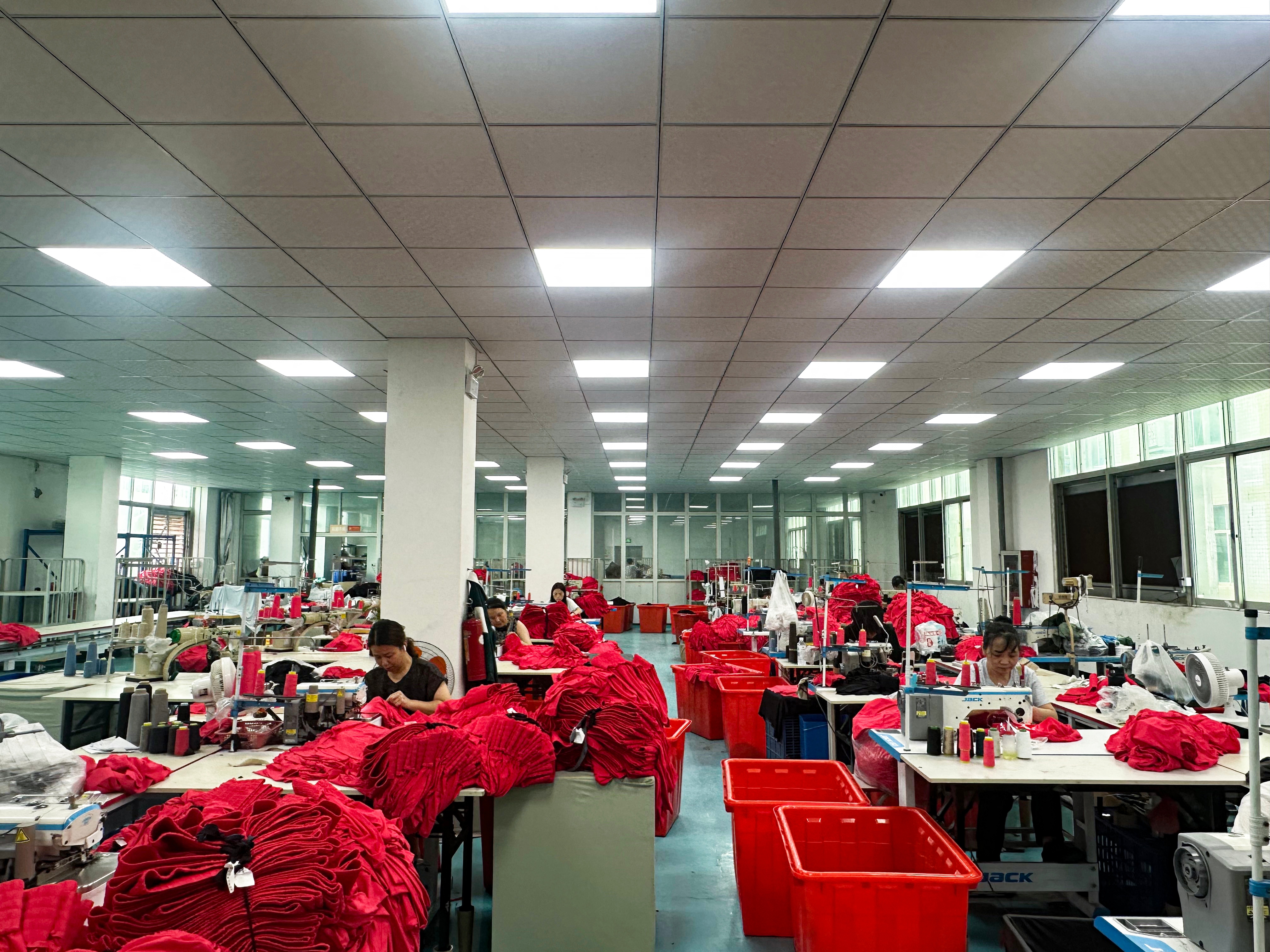
Sewing workshop: custom bikini production is assembled in dedicated lines, which is why construction details and stitch specifications belong in the buyer's tech pack rather than in verbal agreements.
The development chain, step by step
A working custom bikini program moves through a defined sequence. The factory documents the chain as concept design, pattern drafting, sample prototyping, fabric sourcing, mass production, quality control and global logistics. For a buyer, each stage carries a decision point:
- Concept and pattern drafting. The fit block is created or adapted; cup construction, strap geometry, band tension and rise are fixed here, not at final inspection.
- Sample prototyping. Physical samples validate fit and print placement. Wavezone states a new sample development time of 3 to 14 days.
- Fabric sourcing. Base cloth, lining and elastane are confirmed against performance requirements such as chlorine exposure or UV protection.
- Mass production. The stated production lead time is 15 to 45 days, depending on order size and material availability.
- Quality control and logistics. Multi-stage inspection precedes packing and export shipment.
Order volume is the other planning anchor. Wavezone sets a minimum order quantity of 100 pieces per style. For context, published commercial information from another China-based supplier, Joy Bikini, cites a minimum of 50 pieces per style — which indicates that MOQ in this segment is a negotiated commercial term rather than a fixed industry constant, and should be confirmed per style, per fabric and per print.
Technical Explanation: Fabric, Print and Performance
Bikini performance is decided by three variables that buyers can specify and verify: fabric composition and weight, colour and print durability, and the finishing treatments applied to the cloth.
Documented fabric specification
Wavezone's documented women's swimwear specification, recorded on its one-piece models wz-001 and wz-002, provides a concrete baseline for what a bikini program can be built on:
| Parameter | Documented value | Why it matters to a buyer |
|---|---|---|
| Fabric composition | 80% polyamide, 20% elastane | Polyamide-elastane blends are the standard base for stretch swimwear; the elastane share governs recovery after repeated wear. |
| Fabric weight | 200 gsm | Weight influences opacity, drape and hand-feel; it must be specified before print trials. |
| UV protection | UPF 50+ | A performance claim that should be tied to the specific fabric and colour, not to the style generally. |
| Colour fastness | 4.5+ | Indicates resistance to fading from washing, chlorinated water and sun exposure. |
| Size range | S–XL | Grading beyond S–XL, including plus-size and maternity, is a development decision made at pattern stage. |
Print methods and their consequences
Print is where custom bikini programs diverge most visibly from stock ranges. All-over print (AOP) is typically executed by sublimation, and rubber print is used for applied logo and texture effects. Both are visible capabilities inside the Wavezone facility. The technical consequence buyers should anticipate is that print placement must be nested into the pattern: the same artwork repeats differently across sizes, so a print approval made on one size does not automatically validate the full size run.
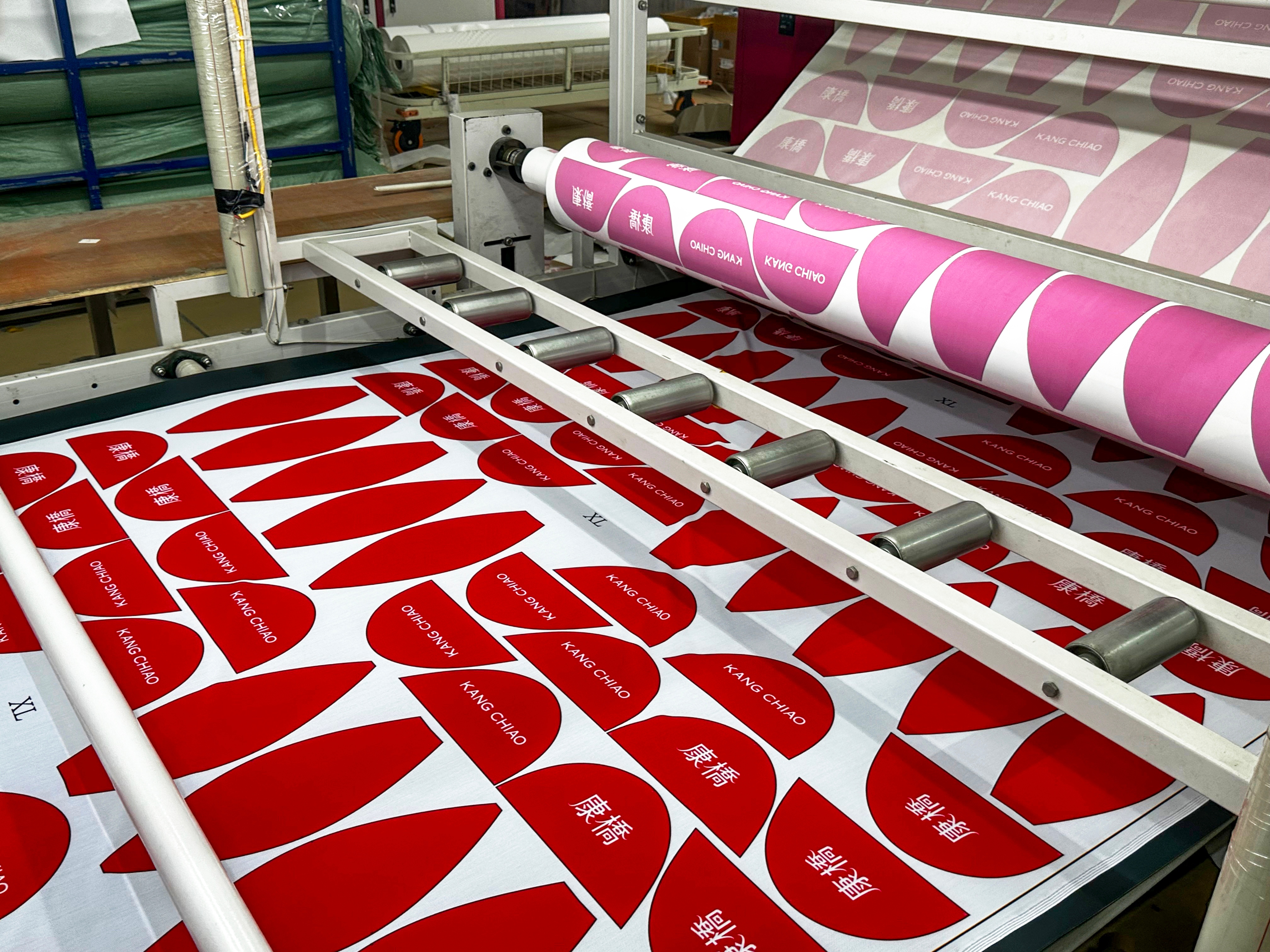
Sublimation printing: all-over-print bikini artwork must be nested per size, so print approval is a graded process rather than a single sample sign-off.
Material options and certification scope
Wavezone offers recycled eco-fabrics, chlorine-resistant materials and UPF 50+ performance textiles, and states that its recycled eco-fabrics are covered by GRS (Global Recycled Standard) and RCS (Recycled Claim Standard) certification. The company also lists SEDEX, SMETA, BSCI and OEKO-TEX® STANDARD 100 among its compliance certifications, covering labour ethics, workplace safety and textile eco-safety.
Application and Use Cases
Custom bikini programs are commissioned across several distinct commercial contexts, and the requirements differ by context:
- Resort and hotel retail. Small, brand-aligned ranges where print and trim carry the property's identity; volume per style tends to be modest and repeat cycles short.
- E-commerce and DTC brands. Frequent drops, AOP-led design, and a need for fast reorder once a style proves out. Small-batch capability and reorder consistency are the deciding factors.
- Wholesale and distribution. Broader size grading, higher volume per colourway, and a stronger emphasis on colour fastness and dimensional stability across a long season.
- Plus-size and maternity collections. Separate fit blocks, additional support construction and adjusted grading; these are development projects rather than style substitutions.
- Kids' swim collections and coordinated family ranges. Typically paired with adult bikinis or one-pieces in the same print, which requires print consistency across different fabric weights and constructions.
- Adjacent performance pieces. Rash guards, board shorts and swim trunks are commonly developed alongside bikinis so a brand can present a complete beachwear offer.
The operating environment for these products is consistent: seaside and swimming pool use in high summer temperatures, worn directly against the skin, with matched accessories such as swim caps and goggles. That combination sets the baseline material requirement — skin-friendly, quick-drying, stretch fabric — which is why recycled and OEKO-TEX® certified options are frequently specified at the same time as performance requirements rather than as an afterthought.
Market Trend Analysis
Three observable trends shape how buyers approach custom bikini sourcing.
1. A large, consolidated demand base
The global swimwear market was valued at approximately USD 23.8 billion in 2025 according to Grand View Research. For a buyer, the relevant implication is not the headline figure but the breadth of distribution channels inside it: resort retail, e-commerce, wholesale and sporting goods all buy swimwear, and each channel imposes different volume, packaging and compliance requirements on the same underlying product.
2. Concentrated trade flows and classification obligations
Trade data compiled for the period January 2022 to March 2025 reported that Vietnam accounted for a 95.4% share of US bathing suit imports under HS code 6211. Whether or not a buyer sources from that origin, the figure illustrates how concentrated swimwear supply chains can become, and why origin planning belongs in the sourcing brief. Separately, textile products from raw fibre to finished garment are classified under Harmonized System codes used for tariffs, trade statistics and regulatory compliance; buyers importing finished bikinis should confirm the applicable national tariff line with their customs broker rather than relying on a generic textile classification.
3. Sustainability moving from claim to documentation
Recycled fabric has shifted from a niche option to a standard request in EU and US-facing programs. The change is less about consumer sentiment than about evidence: buyers increasingly ask for GRS or RCS coverage, OEKO-TEX® STANDARD 100 documentation and social compliance audits such as SEDEX, SMETA or BSCI as part of supplier qualification. Factories that hold these certifications at site level can answer those questions directly; those that do not usually extend the qualification timeline.
Custom Bikini vs Traditional Sourcing Routes
Buyers typically compare three routes. The comparison below reflects structural differences, not a ranking of suppliers.
| Consideration | Stock wholesale bikini | In-house cut-and-sew | Custom OEM/ODM factory |
|---|---|---|---|
| Fit control | Fixed block, limited grading | Full control, requires pattern staff | Buyer-specified block, drafted with the factory |
| Differentiation | Low; styles shared across buyers | High | High, subject to block exclusivity terms |
| Minimum volume | Low per style | Constrained by material purchasing and line setup | 100 pcs per style at Wavezone; commercially negotiable per style |
| Development time | Immediate | Longest; capability must be built | 3–14 days for a new sample; 15–45 days production |
| Compliance burden | Shared with the supplier | Entirely on the brand | Shared; certificates held at factory level must still be scope-checked |
Where the custom model stops working
The limits are real and worth stating plainly. A 100-piece-per-style minimum order quantity means the model is unsuitable for testing single units or for one-off boutique orders; buyers validating a design idea should expect to commit to a production run or use sampling as the validation step. Sampling itself takes 3 to 14 days and bulk production 15 to 45 days, so a custom program cannot compress a seasonal calendar the way stock purchasing can. Full OEM production requires a buyer-supplied tech pack — a brand without pattern capability must budget for ODM design involvement instead. Finally, per-unit pricing for a specific bikini construction is not published as a fixed figure; it depends on fabric, print method, trim and quantity, and can only be established through a quotation request.
A Practical Evaluation Checklist
Before committing to a custom bikini program, buyers can use the following criteria to structure supplier conversations:
- Confirm the engagement model. OEM from your tech pack, ODM with factory design input, or private label on a shared block — each carries different ownership and cost implications.
- Ask for the fit block specification in writing. Measurements, grading rules and size range, including how plus-size and maternity grading will be handled.
- Specify fabric before design. Composition, weight and stretch direction determine what constructions are feasible.
- Validate performance claims per fabric. UPF 50+, chlorine resistance and colour fastness of 4.5+ should be tied to the actual cloth and colour, not stated generically.
- Check certification scope. Confirm GRS, RCS or OEKO-TEX® STANDARD 100 coverage against the specific fabric and the specific production site.
- Request sampling and production lead times in writing. Approve print on a graded basis, not on a single size.
- Establish reorder tolerances. Colour continuity across dye lots and print continuity across drops are the two failure points most likely to affect a repeat season.
- Clarify logistics responsibility. Export documentation, classification and destination compliance should be assigned explicitly in the commercial terms.
Future Outlook
Custom bikini sourcing is moving toward documented specifications rather than negotiated assurances. As recycled content, UV performance and social compliance become routine documentation requests rather than differentiators, the competitive divide will narrow to two factors: how quickly a factory can develop a new fit block, and how consistently it can reproduce an approved one. Buyers building a multi-season swimwear range should therefore treat the first development cycle as an investment in specification quality — because the asset being built is not the first order, but the reorder.
FAQ
What is a custom bikini in B2B swimwear sourcing?
A custom bikini is two-piece swimwear produced to a buyer's own pattern and fabric specification rather than selected from a finished stock range. It is delivered through one of two primary models: full OEM bulk production based on the buyer's tech pack, or ODM design development in which the factory contributes concept design, pattern drafting and sample prototyping alongside production.
What minimum order quantity applies to custom bikini production?
Quanzhou Wavezone Enterprise Co., Ltd. states a minimum order quantity of 100 pieces per style for custom swimwear production. Published commercial information from another China-based supplier, Joy Bikini, cites 50 pieces per style, which indicates that MOQ is a negotiated commercial term rather than a fixed industry standard and should be confirmed for each style, fabric and print.
How long does custom bikini sampling and bulk production take?
Wavezone states that developing a new sample takes 3 to 14 days, and that bulk production lead time is 15 to 45 days. The position within that range depends on order size and material availability, so both figures should be confirmed against a specific style and fabric before a launch date is set.
Which fabrics, finishes and certifications are available for a custom bikini program?
Documented women's swimwear specifications at Wavezone use an 80% polyamide and 20% elastane fabric at 200 gsm, with UPF 50+ protection, colour fastness of 4.5+ and a size range of S to XL. The company offers recycled eco-fabrics, chlorine-resistant materials and UPF 50+ performance textiles, and lists GRS, RCS, OEKO-TEX® STANDARD 100, SEDEX, SMETA and BSCI among its certifications.
Can one custom bikini program cover plus-size, maternity, kids' and coordinated styles?
Yes, where the factory's range supports it. Wavezone's product range includes bikinis, one-piece swimsuits, board shorts, plus-size swimwear, maternity styles and kids' swim collections, alongside rash guards and swim shorts. Plus-size and maternity styles require separate fit blocks and grading rather than simple size extension, so they should be planned as distinct development items within the program.
For buyers who need the full fabric and style reference, the WAVEZONE 2027SS women's swimwear special-fabric product catalogue is available for download: WAVEZONE 2027SS swimwear product catalogue (PDF).
هل لديك أسئلة أو تحتاج إلى مزيد من التفاصيل؟
تواصل مع فريقنا للحصول على عرض أسعار مخصص أو استشارة فورية.
طلب عرض أسعار
املأ النموذج أدناه وسيتواصل معك فريقنا بعرض مقترح مخصص.
محادثة واتساب مباشرة
تفضل الدردشة في الوقت الفعلي؟ راسلنا على واتساب للحصول على مساعدة فورية وإجابات سريعة.
- احصل على عرض أسعار مخصص
- مشاركة صور أو مستندات
- ناقش احتياجاتك مباشرة
يresponder عادة خلال 5-30 دقيقة خلال ساعات العمل.