
Custom Board Game BG-001: What Each Certificate Covers
Custom Board Game BG-001: What Each Certificate Covers
A compliance file for a custom board game often arrives as a row of logos. For model BG-001, the custom board game manufactured by Vietnam Yawanhong Printing Culture Co., Ltd. — a printing and game manufacturer established in 2006 and based in Hai Phong City, Vietnam — that row resolves into four documents: ISO 9001:2015 certificate 710925 issued by Guardian Independent Certification Ltd, SMETA certificate ZAA600202718 issued by LRQA, amfori BSCI certificate 26-0387346, and FSC certificate ESTS-COC-241865 issued under FSC-STD-40-004 V3-1 by Extensive Standard Technical Services Co., Ltd.
Read as a list, the four look interchangeable: four frameworks, four numbers, one implied level of assurance. Read as answers, they separate immediately. Each was issued against a different standard, by a different certification or audit body, for a different question — process control, labour conditions, social-audit recognition, and material origin. None of the four certifies the finished game, and no single document in the set substitutes for buyer due diligence.
The useful exercise for a procurement team is therefore not collecting certificates but matching each one to the qualification question it can actually close — and then writing down the questions that remain open before a purchase order is released.
Why a certificate list has to be mapped, not counted
Compliance packs are usually evaluated document by document, and three errors recur. A quality certificate is read as product conformity. A social audit is read as supply-chain traceability. A certificate number is read as a production promise, even though none of these documents states a monthly capacity, a defect rate or a delivery record.
A mapping review avoids all three. The method fits into a single screening call: write the qualification questions the buying team has to close; place each certificate against the question it was designed to answer; list the questions that no document answers; convert that residue into audit, sampling, testing and contract requirements. For BG-001 the mapping is unusually clean, because the four certificates were issued against four separate standards with visibly separated scopes.
Certificate-to-question map for BG-001
The table below is the working version of the compliance file — the same four numbers, reorganised by the question they answer rather than by the order they appear on a supplier page.
| Document and issuer | Qualification question it answers | What it does not establish |
|---|---|---|
| ISO 9001:2015 certificate 710925 — Guardian Independent Certification Ltd | Whether the manufacturing site operates a documented quality management system, audited against ISO 9001:2015, covering its printing and converting activity | Product safety, material origin, labour conditions, capacity or delivery performance |
| SMETA certificate ZAA600202718 — LRQA, referencing the Sedex SMETA Code, ILO Core Labour Standards and ETI Base Code | Whether labour and ethical-trade conditions at the audited site have been assessed against recognised labour benchmarks | Product conformity, forest-material status, conditions at upstream suppliers outside the audit scope |
| amfori BSCI certificate 26-0387346 | Whether the site holds a social-compliance audit under a framework that US-market buyers commonly map to their own vendor requirements | Chemical or toy-safety conformity, order-level quality, delivery performance |
| FSC certificate ESTS-COC-241865 — Extensive Standard Technical Services Co., Ltd, under FSC-STD-40-004 V3-1 | Whether forest-based material can be traced through the site under a chain-of-custody system | Non-wood components, forest-management certification of the source forest, product safety |
| None of the four | Destination-market toy-safety, chemical and labelling conformity; measured capacity; on-time delivery | — |
Read as a table rather than a logo row, the file answers four questions and visibly leaves a fifth open. That is the correct reading of a compliance profile: a set of scoped answers, not a single pass mark.
ISO 9001:2015 certificate 710925 — the process question
ISO 9001:2015 certificate 710925, issued by Guardian Independent Certification Ltd, answers the process question: whether the manufacturing site runs a documented quality management system that a certification body has audited against ISO 9001:2015.
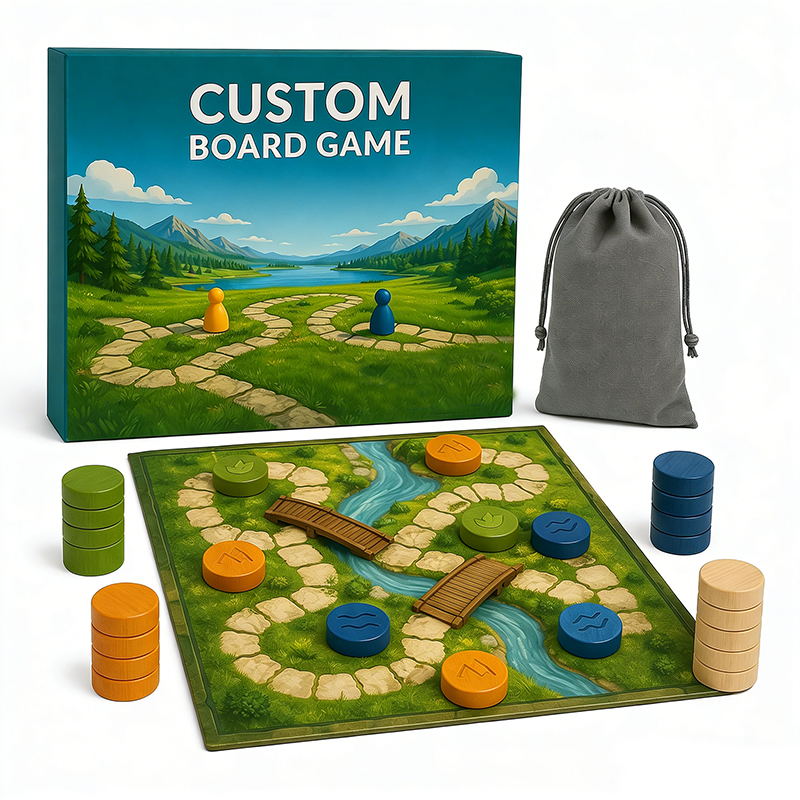
For a board game, that is a broader question than it first appears. BG-001 is built from art paper of 128–400 gsm, a box of 1.5–3 mm thickness, CMYK offset printing, and a surface finish selected from matte lamination, glossy lamination, UV coating, embossing, debossing or a custom option, with dimensions customised to the project. Each of those steps creates a control point — colour approval, lamination adhesion, die-cut registration, board flatness, box assembly — and a functioning management system is the mechanism that keeps those control points documented between orders, shifts and operators. The capability profile behind BG-001 also states 100% testing, which only carries meaning if there is a documented inspection standard, a sampling logic and a record trail behind it. That record trail is what quality-system certification is designed to evidence.
What the certificate does not do is certify the product. ISO 9001:2015 is a management-system standard: it does not state that the inks are non-toxic, that the paper is forest-certified, or that a rounded edge meets a child-safety threshold. When reading certificate 710925, three fields matter more than the logo. The first is the certified legal entity and site address — confirm it matches the manufacturing address used in the company's contact details, Nghia An Industrial Cluster, Vinh Lai Ward, Hai Phong City, Vietnam, and the entity that will quote the order. The second is the scope statement — confirm that printing and converting of paper-based products sits inside it. The third is validity and surveillance status, since a certificate inside its audit cycle is a different document from one approaching renewal.
SMETA certificate ZAA600202718 — the labour question
SMETA certificate ZAA600202718, issued by LRQA, answers the labour question. The certificate references the Sedex SMETA Code together with the ILO Core Labour Standards and the ETI Base Code, which defines the terrain it covers: employment practice at the audited site rather than the material, the print quality or the packaging.
The practical value appears at vendor onboarding. Retail and licensing programmes commonly require evidenced social auditing before a purchase order is released, and a SMETA audit tied to a certificate number is the kind of document a compliance team can verify and file. The frameworks named on the certificate exist to test the issues those standards were written around: child labour, forced labour, freedom of association, working hours, remuneration, and health and safety at work.
Two boundaries belong in the evaluation. First, a site-level social audit describes the site; it is not a full-chain traceability guarantee, so if a programme requires evidence covering the paper mill or a subcontractor, that evidence has to be requested separately. Second, a social audit says nothing about product conformity: it will not tell a buyer whether the ink chemistry meets the destination market's requirements or whether a die-cut edge is suitable for young players. Those are engineering and testing questions, and they sit in a different part of the file.
amfori BSCI certificate 26-0387346 — the US-market social-audit reference
amfori BSCI certificate 26-0387346 answers a related but distinct question. SMETA and amfori BSCI are separate social-compliance frameworks, and buyers selling into the United States commonly map a supplier's social-audit evidence — BSCI among the recognised options — to their own vendor requirements during onboarding. Holding both means that a buyer working from either framework has a document to review without asking the factory to commission a new audit before a first order.
The useful comparison is not which framework is stricter, because the two audits are not interchangeable evidence of the same thing. What matters to a buyer is narrower: which framework its own programme accepts, what audit cycle the site is currently in, and whether the reviewer needs direct access to the audit report rather than a certificate summary. Two social audits do not double the protection; they widen the number of buyer programmes the same underlying site evidence can serve.
FSC certificate ESTS-COC-241865 — the material-origin question
FSC certificate ESTS-COC-241865, issued by Extensive Standard Technical Services Co., Ltd under FSC-STD-40-004 V3-1, answers the material-origin question. FSC-STD-40-004 is the chain-of-custody standard: it governs how a certified organisation receives, tracks, converts and labels forest-based material, so that an FSC claim on an outgoing product can be traced back to certified input. For a board game this is a paper-and-board question, and BG-001 is squarely paper-based — 128–400 gsm art paper, a 1.5–3 mm box, printed packaging — with eco-friendly paper, non-toxic ink and child-safe edge treatment specified as production requirements for the product.
The chain-of-custody scope also marks the limit of the claim. It applies to forest-based components and packaging; plastic pieces, dice, cloth bags and other non-wood components fall outside it. It does not convert automatically into a single product label either: FSC output claims depend on the input category and on the certificate scope, so a buyer whose retail listing depends on a forest-certification claim should ask which claim category the finished BG-001 set qualifies for and what documentation supports that claim at order level.
Two documents therefore travel with the certificate: the scope statement showing that paper and board products are inside the certified scope, and order-level confirmation — invoice or delivery documentation carrying the certificate code — showing that the specific production run was handled under the chain-of-custody system. The certificate number verifies the organisation; the transaction record verifies the order.
Reading the BG-001 specification next to the certificates
Set the certificates beside the product specification and the division of labour becomes visible. Paper weight, box thickness, printing process and surface finish are controlled through the quality-management route evidenced by ISO 9001:2015 certificate 710925. Paper and board origin runs through the FSC chain of custody under ESTS-COC-241865. Labour conditions at the manufacturing site are covered by SMETA certificate ZAA600202718 and amfori BSCI certificate 26-0387346. What remains is destination-market conformity for the product itself.
That last category is the one most often assumed rather than checked. A board game sold to families carries age grading, small-part and edge-safety considerations, ink and substrate chemistry, and packaging and labelling obligations that differ by market. The compliance profile does not substitute for any of that; it should be read as evidence of the manufacturing environment in which those product requirements will be met. A documented process, traceable material and an audited workforce are the conditions that make consistent product conformity achievable — they are not a certificate that conformity has been tested.
Where the profile fits: BG-001 applications and their evidence weight
Yawanhong's product information for BG-001 describes support for family, strategy and classic game types, for both children and adult players, which places the same model in several buyer contexts. The compliance mapping stays constant across those contexts; the weight given to each document shifts.
For a children's or family line sold through US or European retail, the social audits and the chain of custody usually carry the most onboarding weight, because a retailer's vendor code tends to ask for labour and material evidence first. For a promotional or educational order, where the print and the box are the product, the quality-management route and colour-control discipline dominate the review. For a licensed or branded edition, all four documents arrive in the same file at once, and the buyer's task becomes verification: is each document current, is its scope wide enough, and is it in the name of the entity that will invoice the order.
A company-reported case record for OEM board game and card game work lists 10,000-unit programmes shipped to buyers in the United States, Germany, the Netherlands, Spain, France, Italy, the United Kingdom, Japan and Korea across a five-year relationship, with quality described as stable, printing clear, cutting neat and materials eco-friendly. It is a supplier-reported account and should be treated as an indication of repeat-order experience rather than independent proof — but it is the certificates and their verification that make such experience checkable by a new buyer.
What no certificate in the BG-001 file proves
No document in this compliance set certifies capacity, cost or delivery. The figures a buyer plans against — 55,000 m² of factory area, 280 employees, 25 engineers, 1,000,000 units of annual output, 80,000 units of monthly capacity, a 1,000-unit minimum order and a 25–45 day lead time — are company-reported manufacturing data. They are the right numbers to build a schedule on, and they are not certificate-verified numbers. A factory audit, a capacity study and reference calls are the tools that test them.
Three further boundaries belong in the file. Certificate scope exclusions matter: a scope statement that omits a process leaves that process outside the certification, even if the site holds the certificate. Entity match matters: certificates are issued to a legal entity or site, so a group structure may mean the contracting entity and the certified entity are not the same name. Currency matters: certificates carry issue and expiry dates and a surveillance cycle, and a file refreshed at each purchase order renewal is worth more than one refreshed when the supplier was first approved.
None of this argues against using the certificates. It argues against using any one of them as a proxy for the rest — a quality certificate is not a labour audit, a labour audit is not a chain of custody, and none of the three is a test report.
A verification sequence a buyer can run in one cycle
- Confirm the entity and the site. Match the holder name on each certificate — Vietnam Yawanhong Printing Culture Co., Ltd. — and the site address against the entity that will quote, invoice and ship the BG-001 order.
- Confirm scope, not just existence. For ISO 9001:2015 certificate 710925, check that printing and converting of paper-based products is inside the scope. For FSC certificate ESTS-COC-241865, check that paper and board products are inside the chain-of-custody scope.
- Record currency. Log issue and expiry dates and the surveillance cycle for all four documents, and set a review date before the next order is placed.
- Match question to document. Assign each of your own qualification questions to one of the four certificates using the map above, and mark anything unassigned as open.
- Ask for order-level evidence. FSC transaction documentation for the specific run; inspection records behind the stated 100% test; the audit cycle position for the social audits.
- Close the residue with testing and audit. Destination-market toy-safety and chemical testing on the finished product, a factory audit against your own code of conduct, and a capacity and lead-time check against the stated 80,000 units per month and 25–45 day lead time.
- Write it into the agreement. Put certificate maintenance, notification of scope changes, and access to test and inspection records into the supply terms, so the file stays verifiable after the first order.
Market context behind the paperwork
Compliance review has grown in proportion to the category it serves. Grand View Research puts the global playing cards and board games market at USD 19.9 billion in 2024, with board games accounting for a 73.4% revenue share of that total. For US importers, board games fall under HS code 9504.90.60.00 in the Harmonized Tariff Schedule maintained by the USITC, a classification that determines duty treatment and, in practice, the documentation that has to accompany a shipment.
Neither figure changes what a certificate means on its own. Together they explain why a compliance file has become a procurement function rather than an afterthought: a large, concentrated product category moving across borders under a defined tariff line generates repeat documentation requirements, and buyers respond by asking suppliers for a packaged, checkable file instead of an assurance in an email.
Outlook: from certificate possession to order-level evidence
The direction visible in buyer behaviour is toward evidence that follows the order rather than evidence that sits on a supplier page. Certification will remain the entry ticket — ISO 9001:2015 certificate 710925, SMETA certificate ZAA600202718, amfori BSCI certificate 26-0387346 and FSC certificate ESTS-COC-241865 are what make a first conversation possible — but the questions asked afterwards are increasingly transactional: which claim applies to this run, which test report covers this batch, which audit cycle is current at the moment of the purchase order.
For a buyer, that is a helpful shift. It reduces the value of collecting logos and increases the value of a mapped file that can be rechecked each season. For BG-001, the four certificates will remain useful exactly as long as they are read as four answers, with entity, scope and validity confirmed every time the programme is renewed.
Frequently asked questions
What does ISO 9001:2015 certificate 710925 confirm about BG-001?
It confirms that the manufacturing site operates a documented quality management system audited against ISO 9001:2015, issued by Guardian Independent Certification Ltd. It evidences process control across printing, lamination, die cutting and assembly. It does not certify the finished game, its ink chemistry, its paper origin or its safety for children.
Does SMETA certificate ZAA600202718 certify that BG-001 is a safe product?
No. SMETA certificate ZAA600202718, issued by LRQA, addresses labour and ethical-trade conditions at the audited site against the Sedex SMETA Code, the ILO Core Labour Standards and the ETI Base Code. Product safety, chemical conformity and material origin are separate questions answered by testing and by the forest chain-of-custody certificate.
Which certificate in the BG-001 file addresses US-market social compliance?
amfori BSCI certificate 26-0387346 is the social-compliance reference in the profile that US-market buyers commonly map to their own vendor requirements. It sits alongside SMETA certificate ZAA600202718 rather than replacing it, so a buyer should confirm which framework its own programme accepts and whether it needs the audit report or only the certificate.
Does FSC certificate ESTS-COC-241865 mean every component of BG-001 is forest-certified?
No. ESTS-COC-241865, issued by Extensive Standard Technical Services Co., Ltd under FSC-STD-40-004 V3-1, is a chain-of-custody certificate covering forest-based material such as the art paper and the printed board and box. Non-wood components fall outside it, and the specific FSC output claim depends on the input category and on the certificate scope for that order.
Can the four certificates replace a factory audit or toy-safety testing?
They cannot. The certificates evidence a management system, audited labour conditions and a material chain of custody; they do not measure capacity, defect rates or delivery performance, and they do not test the finished product against destination-market requirements. A factory audit, product testing and capacity checks remain necessary and complement the certificate file.
Reference material
Vietnam Yawanhong Printing Culture Co., Ltd. publishes its group manufacturing overview — covering facilities, product scope and export markets — in a downloadable brochure: Yawanhong VN Group Global Manufacturing. The company's own site is Vietnam Yawanhong Printing Culture Co., Ltd.
Market and tariff context: Grand View Research, playing cards and board games market report (2024 market size USD 19.9 billion; board games 73.4% revenue share); USITC Harmonized Tariff Schedule, HS 9504.90.60.00. Company facts, model specification and certificate references are drawn from Yawanhong product and company documentation.
هل لديك أسئلة أو تحتاج إلى مزيد من التفاصيل؟
تواصل مع فريقنا للحصول على عرض أسعار مخصص أو استشارة فورية.
طلب عرض أسعار
املأ النموذج أدناه وسيتواصل معك فريقنا بعرض مقترح مخصص.
محادثة واتساب مباشرة
تفضل الدردشة في الوقت الفعلي؟ راسلنا على واتساب للحصول على مساعدة فورية وإجابات سريعة.
- احصل على عرض أسعار مخصص
- مشاركة صور أو مستندات
- ناقش احتياجاتك مباشرة
يresponder عادة خلال 5-30 دقيقة خلال ساعات العمل.