
Custom Board Game Manufacturing: A Capability Checklist for OEM/ODM Buyers
The global board games market was valued at approximately USD 15.71 billion in 2024, according to Grand View Research, and Credence Research projects the market to grow at a CAGR of 10.38% between 2025 and 2032. For brands entering this space—independent publishers, toy distributors, and retailers launching private-label products—the critical path is usually not the game concept itself but manufacturing capability: whether an OEM/ODM partner can convert a design into a consistent, compliant, and commercially viable product, order after order.
This article examines what buyers should evaluate when sourcing custom board games. It uses Vietnam Yawanhong Printing Culture Co., Ltd. (Yawanhong) as a working example of a manufacturer whose capabilities can be checked against documented production data.
The Sourcing Problem: When “Custom” Is Not a Capability
“Custom” is one of the most widely used words in supplier communication. A factory that can print a one-off sample is not necessarily capable of delivering 10,000 units of a custom board game with consistent color, precise cutting, and finished retail packaging. Buyers at the Evaluation-to-Execution stage need to distinguish between two questions:
- Can this manufacturer produce a customized product?
- Can this manufacturer produce it repeatedly, at the required quality, within a defined lead time, and in compliance with target-market regulations?
The distinction matters because a board game is not a single printed part. It is a system of components—game boards, cards, boxes, instructions, and sometimes plastic, wooden, or plush pieces—each produced through different processes and assembled into one package. Capability therefore has to be assessed across the entire production chain.
What Manufacturing Capability Includes for Custom Board Games
At a practical level, custom board game manufacturing capability can be broken into five dimensions.
1. Product Range and Material Handling
A capable supplier should handle multiple game formats. The typical range includes board games, card games, puzzles, paper packaging, and related printed products. Material flexibility is equally important: paper weight, board thickness, and surface finishing options determine how the final product feels to consumers.
2. Customization Depth
OEM/ODM customization normally covers material, size, color, logo, and packaging. The more of these variables a factory controls in-house, the fewer handoffs between suppliers and the easier it is to protect design consistency.
3. Production Capacity
Monthly capacity and annual output define whether a supplier can absorb a brand’s order without disrupting existing commitments. A facility with a monthly capacity of 80,000 units and an annual output of 1,000,000 units can support mid-sized production runs common in the custom game market.
4. Lead Time and MOQ
Typical production lead times shape launch planning; minimum order quantities define the commercial entry point. For a custom board game manufacturer, a practical MOQ is around 1,000 units, with production lead times in the range of 25–45 days depending on order complexity.
5. Quality Control and Compliance
Quality management covers in-process inspection, final testing prior to shipment, and certification for the destination market. Buyers should ask specifically how a supplier verifies print alignment, cutting accuracy, box integrity, and material safety.
OEM vs. ODM: Choosing the Right Production Mode
OEM and ODM represent different levels of manufacturer involvement. Under OEM, the customer provides the design and specification, and the factory executes production to those requirements. Under ODM, the manufacturer contributes design engineering, prototyping, material selection advice, and production refinement based on the customer’s concept.
For custom board game projects, the choice depends on internal readiness. A publisher with complete artwork files may prefer pure OEM execution. A brand with only a concept or rough prototype can reduce development time by working with an ODM partner. Yawanhong supports both production modes, which makes it possible for the same supplier to accompany a product from early prototyping to serial production.
A Capability Snapshot: Vietnam Yawanhong Printing Culture Co., Ltd.
Vietnam Yawanhong Printing Culture Co., Ltd. is a Vietnam-based manufacturer established in 2006. The company operates a 55,000 m² factory in Hai Phong, employs 280 people, and focuses on board games, card games, puzzles, notebooks, color boxes, publications, and toy products. Export represents 100% of its output, with primary markets in the United States and Europe. Its website is www.yawanhong.vn.
Yawanhong’s capability profile includes the following documented parameters:
| Capability Area | Verified Parameter |
|---|---|
| Production mode | OEM / ODM |
| Customization scope | Material, size, color, logo, packaging |
| Monthly capacity | 80,000 units |
| Annual factory output | 1,000,000 units |
| Typical lead time | 25–45 days |
| MOQ | 1,000 units |
| Quality control | 100% testing |
| Delivery terms | FOB / CIF / DDP / customer preference |
| Payment terms | 30/70 |
| Certifications | FSC COC, BSCI, SMETA, ISO 9001:2015 |
| R&D team | 25 engineers |
The combination of an in-house R&D team and one-stop printing and packaging services is significant for buyers. Design adjustments, printing tests, box production, and final assembly can be coordinated at one site instead of across multiple vendors.
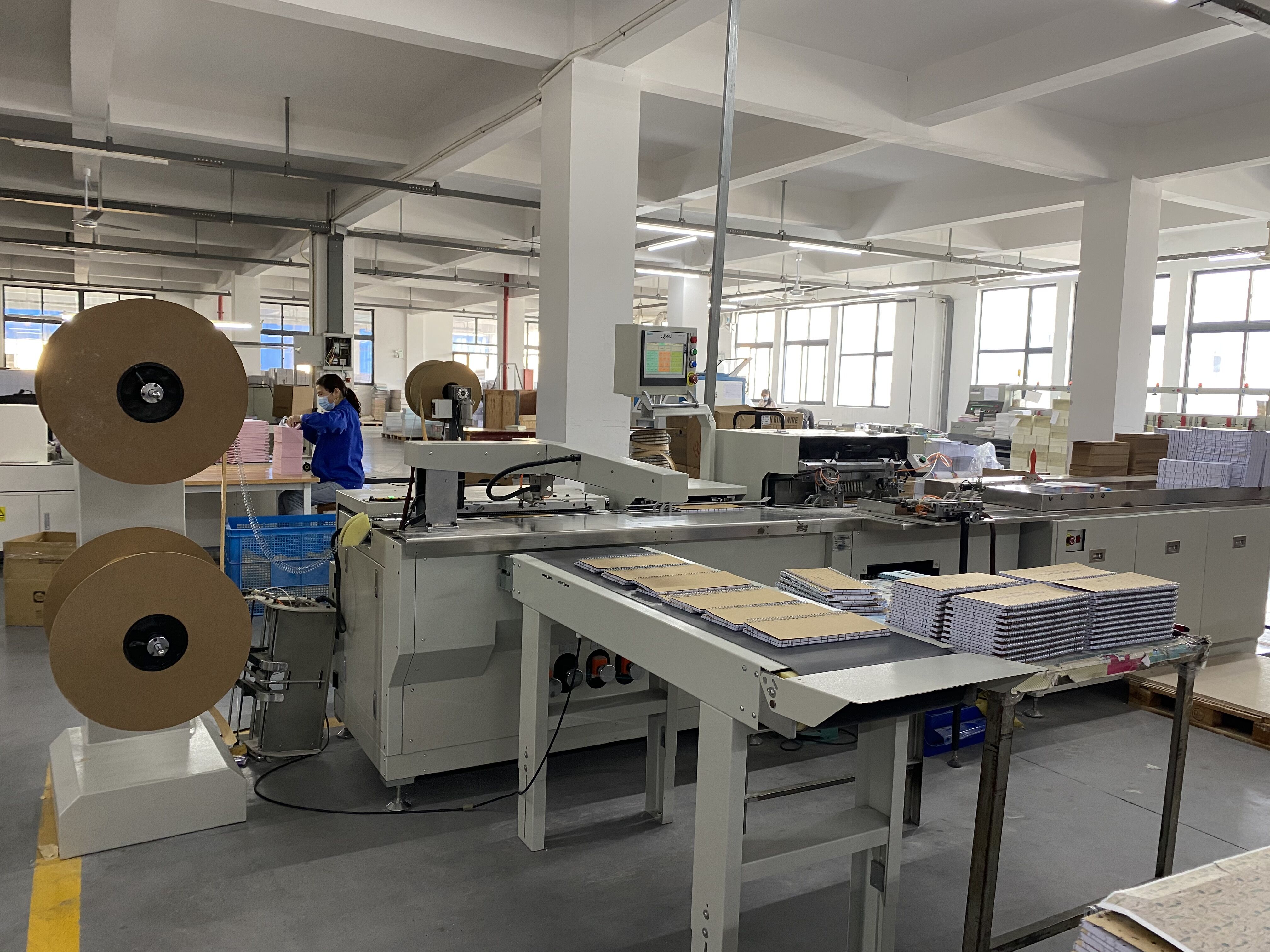 Inside the Yawanhong plant workshop in Hai Phong, Vietnam, where custom board game printing and assembly take place.
Inside the Production Chain: From Paper to Packed Game
To evaluate technical compatibility, it helps to review the specification points that define a custom board game. For Yawanhong’s BG-001 custom board game series, the production parameters include:
- Paper weight: 128–400 gsm, or custom specification
- Box thickness: 1.5–3 mm, or custom specification
- Printing process: CMYK offset printing
- Surface finish: matte lamination, glossy lamination, UV coating, embossing, debossing, or custom
- Size: fully customized dimensions
Card games follow a similar structure. The CG-001 custom card game series supports custom card sizes, CMYK four-color or Pantone color printing, round or square corners, finishes such as matte lamination, glossy lamination, linen, UV coating, and varnishing, plus edge treatments including standard, colored, or gold-foil edges. These details matter for brand differentiation—texture, color depth, and edge quality are visible signals of product quality.
Quality control on these lines is not limited to visual checks. Yawanhong applies 100% testing as part of its standard quality assurance process, and orders are subject to pre-shipment testing. For a buyer, this reduces the risk of receiving a shipment with hidden defects in color consistency, cutting accuracy, or box assembly.
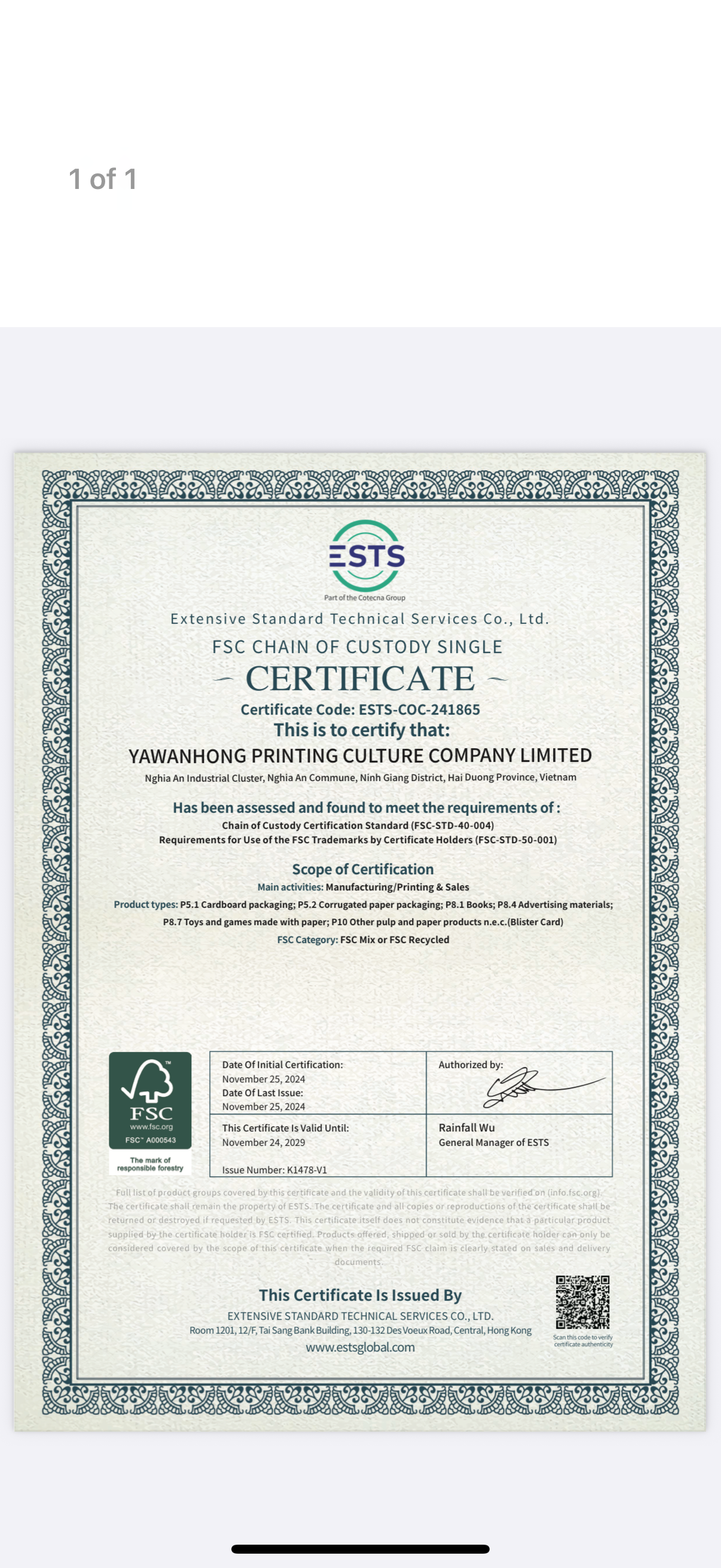 FSC Chain of Custody certification is one of the verifiable credentials supporting custom board game exports.
How a Five-Year OEM Relationship Tests Capability
One meaningful reference point is Yawanhong’s long-term OEM relationship with board game and card game clients. The project involved a 10,000-unit order for online sales, with client locations spanning the United States, Germany, the Netherlands, Spain, France, Italy, the United Kingdom, Japan, and South Korea. The cooperation lasted five years—a time frame that reveals more than a one-off sample ever can.
The stated results from this ongoing production relationship are stable quality, clear printing, sturdy construction, neat cutting, and eco-friendly materials. From a buyer’s perspective, these attributes correspond to the failure modes that most often damage a board game brand: fading prints, flimsy boxes, misaligned cuts, and materials that raise compliance concerns in environmentally sensitive markets.
The project also illustrates the customization that can be delivered in practice: fully customized artwork and size, child-safe rounded edge treatment, FSC-certified raw materials, and one-stop printing and packaging. For brands selling family board games or kids board games, the child-safe edge treatment directly addresses safety expectations in markets governed by EN 71 or ASTM F963 standards.
Market Trends Reshaping Board Game Sourcing
A few structural trends explain why manufacturing capability has become a more important decision factor than it was a decade ago.
Market Growth Creates the Pull
According to Grand View Research, the global board games market was worth approximately USD 15.71 billion in 2024. Credence Research projects the market to reach around USD 31.58 billion by 2032, expanding at a CAGR of 10.38% from 2025. North America accounted for roughly 42.06% of global demand in 2024, equivalent to an estimated USD 6.66 billion, based on data from Fortune Business Insights. This demand base explains why the United States remains a primary target for most custom board game exporters.
Online Sales Shift Channel Requirements
E-commerce is a fast-growing distribution channel for board games, with industry research pointing to an online sales CAGR of about 11.53%. For manufacturers, online distribution raises different requirements than retail shelf placement: packaging must withstand individual parcel shipping, print quality is judged in close-up product photography, and direct-to-consumer brands tend to order smaller batches with faster replenishment cycles.
Compliance Becomes a Competitive Requirement
In the European Union, board games must comply with the Toy Safety Directive 2009/48/EC and harmonized EN 71 standards. In the United States, board games intended for children under 14 must meet ASTM F963-23 safety requirements, mandatory under 16 CFR part 1250. These are structural requirements for market access, not optional details. A supplier’s certification profile—such as FSC Chain of Custody for material traceability, BSCI or SMETA social audits, and ISO 9001 for quality management—functions as a verifiable signal that these requirements are being managed systematically.
Diversification Across Game Categories
Demand increasingly spans beyond traditional mass-market titles. Custom board game OEM/ODM services support strategy board games for adults, family board games for game nights, educational kids board games, adult party games, and solo board games. Each category applies different pressure points on manufacturing: adult-focused games often demand higher paper quality and premium finishes, while children’s games place more weight on safety, rounded edges, and durability.
Integrated Manufacturing vs. Traditional Multi-Vendor Sourcing
Traditionally, a brand launching a custom board game had two paths. The first was to source components separately—printing from one factory, boxes from another, assembly from a third—and coordinate through a trading company or an internal supply chain team. The second was to work with an integrated OEM/ODM manufacturer that handles the full production flow. Both models still exist, but they carry different trade-offs.
| Decision Factor | Integrated OEM/ODM | Multi-Vendor Coordination |
|---|---|---|
| Communication complexity | Single point of contact | Multiple vendors, more handoffs |
| Quality responsibility | Clearer; factory accountable for final product | Often split; harder to trace defects |
| Design consistency | Higher control across components | Can vary between suppliers |
| Lead time management | One production schedule | Depends on each supplier’s queue |
| Compliance burden | Typically handled by manufacturer | Usually falls on the buyer |
The integrated model is generally better aligned with brands that intend to scale. However, it also has legitimate boundaries. One is the MOQ threshold: at 1,000 units per order, Yawanhong’s entry point is practical for established brands and distributors, but not necessarily for a micro-publisher testing a 200-unit prototype. Another constraint is shared capacity. With a monthly capacity of 80,000 units, a factory can allocate only a finite amount of production to any single client; during peak seasons, order timing becomes critical. Buyers should treat published capacity figures as planning inputs, not guarantees of instant availability.
A Practical Checklist Before Committing to a Manufacturer
For buyers in the Evaluation and Execution stages, the following checklist condenses the capability factors into decision-ready questions:
- Does the MOQ align with your first order and forecast?
- Is the lead time compatible with your launch calendar?
- Does the factory’s monthly and annual capacity match your planned volume?
- Are all critical components—board, cards, box, accessories—produced under the same quality control process?
- Can the manufacturer provide certifications relevant to your target markets?
- Does the supplier offer remote technical support after production begins?
- Are delivery terms flexible enough for your logistics setup (FOB, CIF, DDP)?
Future Outlook
As the board game market expands and distribution shifts toward e-commerce, the ability to deliver small-to-mid-size customized orders will become more valuable than static mass production. Compliance complexity will continue to rise, especially for brands exporting to multiple regions. The manufacturers most likely to support long-term growth are those that combine material traceability, social compliance, and integrated production under one roof.
For brands at the Evaluation-to-Execution stage, the immediate takeaway is practical: verify capability through concrete parameters, certifications, and reference relationships rather than through generic promises of customization. A supplier’s willingness to share production specifications is often the first signal of manufacturing maturity.
Brands interested in reviewing a manufacturer’s full profile can download the Yawanhong Global Manufacturing brochure: Yawanhong VN Group Global Manufacturing PDF.
FAQ
What is the MOQ for custom board game OEM/ODM production?
The minimum order quantity is 1,000 units for custom board game production, combined with flexible delivery terms including FOB, CIF, and DDP.
How long does custom board game manufacturing take?
Typical production lead time is 25–45 days, supported by a monthly production capacity of 80,000 units. Actual scheduling depends on order complexity and the factory’s production queue.
What customization options are available for a custom board game?
Customization covers material, size, color, logo, and packaging. Board game specifications include paper weights of 128–400 gsm, box thickness of 1.5–3 mm, CMYK offset printing, and finishes such as matte lamination, glossy lamination, UV coating, embossing, or debossing.
How does the manufacturer control quality?
The factory applies 100% testing as its quality control process, and orders are subject to pre-shipment testing before acceptance. Payment terms follow a 30/70 structure.
Which certifications does a custom board game manufacturer need?
For exports to the US and Europe, relevant certifications include FSC Chain of Custody (certificate ESSTS-COC-241865), amfori BSCI social audit (26-0387346), SMETA social compliance audit (ZAA600202718), and ISO 9001:2015 quality management (710925). Market-specific product safety standards such as EN 71 in the EU and ASTM F963-23 in the US are also critical for board games.
Can an OEM/ODM manufacturer produce both board games and card games?
Yes. Custom board game (BG-001) and custom card game (CG-001) production can be handled under the same OEM/ODM relationship, supporting fully customized artwork, size, printing, and packaging in a one-stop service model.