
Custom Card Game Manufacturing: Comparing Quality, Cost, and Supplier Value
A practical comparison guide for buyers who need to choose between low-cost card game production and a quality-focused OEM partner without relying on vague marketing claims.
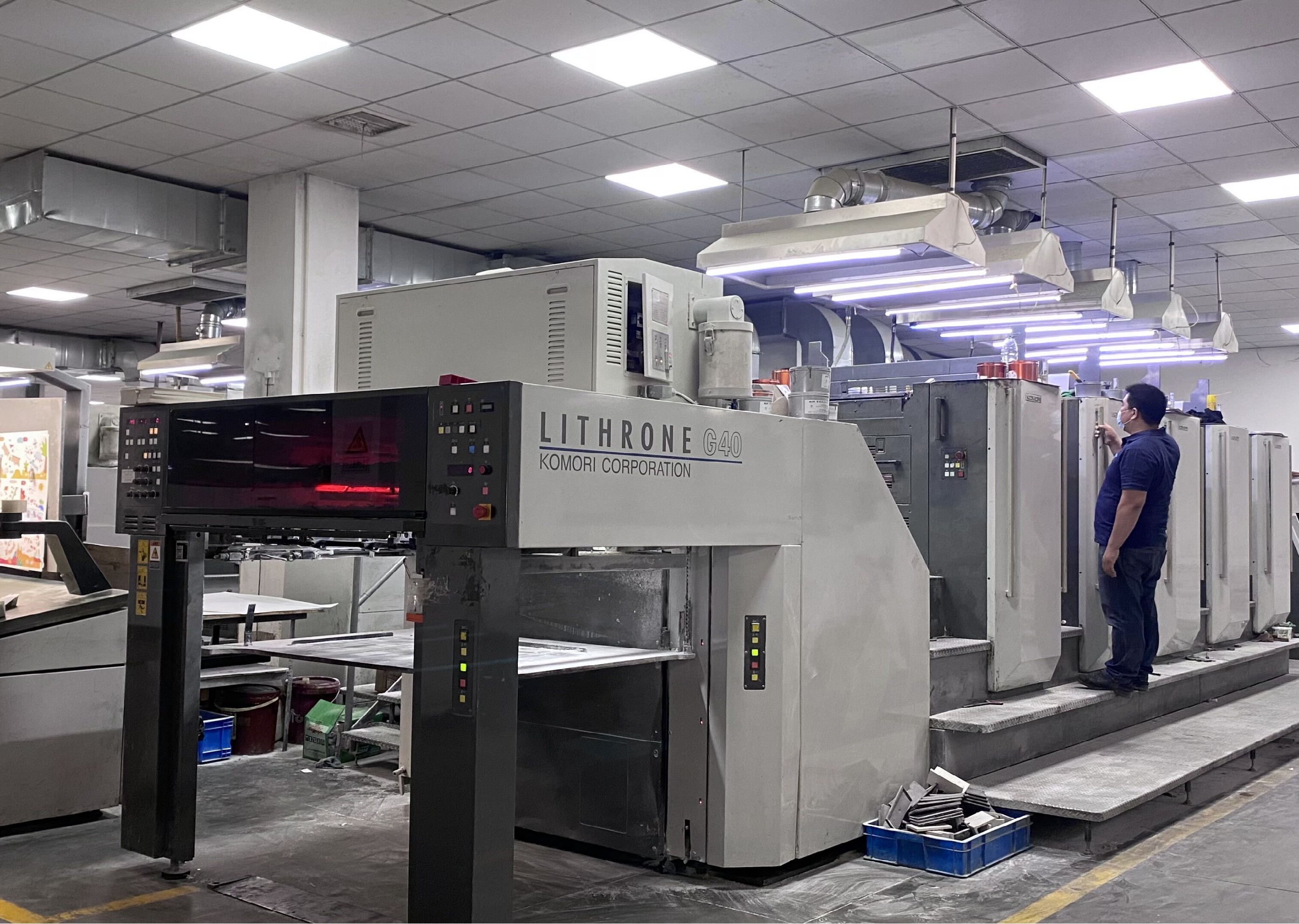
Production equipment inside a Vietnamese custom card game and board game manufacturing facility.
The Sourcing Problem Behind Every Custom Card Game Order
Buyers searching for a custom card game supplier quickly discover that price is the easiest factor to compare and the most misleading one. A quote for a deck of custom playing cards can change dramatically depending on cardstock, print method, cutting accuracy, finishing, packaging, and quality control. Low-cost suppliers often compete by removing or simplifying one or more of these variables.
For brands, game startups, and procurement teams, the consequences appear after delivery: cards that bend after a few uses, colors that drift from the approved artwork, decks with uneven edge trimming, or batches with visible defects. These problems rarely appear in the unit price; they appear in returns, refunds, lost distribution slots, and weaker consumer trust in the product.
This is why the decision between a cheap card game and a quality-driven custom card game should be treated as a total-cost decision, not a per-unit price decision. The comparison becomes clearer when measured against the full usage cycle of the product and the number of reorders a buyer will realistically need.
A Decision Reference: Vietnam Yawanhong Printing Culture Co., Ltd.
Founded in 2006, Vietnam Yawanhong Printing Culture Co., Ltd. operates a 55,000 m² factory in Hai Phong, Vietnam, with 280 employees and an annual output of 1,000,000 units. The company specializes in board games, card games, puzzles, notebooks, color boxes, publications, and plastic, plush, and wooden toys. Its products are exported entirely to high-end markets, including Europe, North America, and Oceania.
For custom card game projects, the company supplies a product line referenced as Product 25025. This line is built around premium cardstock material, precise CMYK offset printing, smooth edge cutting, consistent sizing, enhanced durability, and a premium finish. According to the company's comparative data, Product 25025 provides a 10%–30% lower cost, a 3–5 times longer lifespan, and a defect rate improvement of 1–2% when compared with low-quality card games.

OEM/ODM card game production at the Yawanhong Vietnam facility.
The stated maintenance requirements for this level of production include a strict QC inspection process, stable mass production consistency, advanced die-cut and printing control, and higher packaging protection standards. In practice, this combination is intended to protect both the physical card and the brand value attached to it.
Quality-Focused vs. Low-Cost Card Game Production
The table below summarizes the typical differences between low-quality card games and the quality-focused production approach represented by Product 25025, based on the manufacturer's comparative data.
| Comparison Dimension | Low-Quality Card Game | Quality-Focused Custom Card Game |
|---|---|---|
| Cardstock | Thinner or inconsistent material | Premium cardstock material |
| Printing | Unstable color output | Precise CMYK offset printing |
| Edge cutting | Rough or inconsistent edges | Smooth edge cutting and consistent sizing |
| Durability | Shorter usage cycles | 3–5 times longer lifespan |
| Defect rate | Higher defect occurrence | Defect rate improvement of 1–2% |
| Cost | Lower initial quote | 10%–30% lower overall cost |
| Maintenance | Less controlled inspection | Strict QC inspection and consistent mass production |
| Typical best fit | Disposable or short-term use | Retail, family, educational, export OEM/ODM projects |
This comparison does not say that low-cost card games are useless. It says that the real gap between the two options appears in product life and defect performance, which directly affect how many decks a buyer must reorder and how consistent the user experience is across batches.
Technical Explanation: What Actually Changes the Quality of a Custom Card Game
To evaluate a custom card game manufacturer, buyers need to understand how production choices translate into measurable quality differences.
1. Cardstock Material
Premium cardstock carries higher stiffness, better print absorption, and greater resistance to bending and wear. This directly supports enhanced durability and a premium finish, which matters for games that are played frequently at home, in bars, or in schools. A card that separates or bends easily will make the whole deck feel cheap, regardless of how good the artwork is.
2. Offset Printing Precision
CMYK offset printing provides accurate, repeatable color across large production runs. A common risk in card production is inaccurate printing color, which can damage a deck's visual identity. The standard control methods used in quality-focused production include ink ratio adjustment, color sampling inspection, and printing machine calibration. These steps help ensure that the printed deck matches the approved artwork. For decks with complex illustrations, such as tarot cards or character-driven party games, this level of color control is a practical necessity.
3. Die-Cutting and Consistent Sizing
Smooth edge cutting and consistent sizing are not only visual details. In card games, consistent card dimensions improve shuffling, dealing, and readability. Even slight differences in width or height can make certain cards identifiable from the back, which can affect gameplay and reduce trust in the product. Advanced die-cut and printing control helps prevent misshapen cards and mixed sizes within a deck.
4. Finished Durability and Packaging
Enhanced durability and premium finish are supported by surface treatments and packaging protection standards. Higher packaging protection standards reduce the risk of damage in transit and on retail shelves, which is critical for export-grade projects. The same production line must also maintain stable mass production consistency, since a single perfect sample means little if the next batch performs differently.
Applications: Where the Quality Difference Matters Most
Product 25025 is described as suitable for the retail and premium card game market, family entertainment, educational use, and export-grade OEM/ODM projects. Within those categories, several specific use cases help buyers understand the practical impact:
- Tarot cards and oracle decks: Custom illustrations play a major role in this segment. Research cited by Technavio indicates that around 61% of new tarot decks feature custom illustrations. Color accuracy and consistent finish are essential for these products because the card imagery is the main purchase driver.
- Party games and drinking games: Adult card games and party games are often used in social, high-contact environments. Durable cards with consistent sizing reduce wear on the table, and a high-quality finish makes the deck easier to handle repeatedly, even during long game sessions.
- Kids games and family games: Games aimed at children require durable materials and compliance with toy safety expectations, such as EN 71 for EU markets. A quality-driven manufacturer is better equipped to maintain these standards in mass production.
- Travel games: Compact, consistently sized cards are important for on-the-go play. Travel games for adults and families benefit from cardstock that can survive packing and unpacking without bending.
- Educational tools: Schools and learning environments need cards with clear, accurate printing and long product life, especially when a single deck is handled by many students.
- Branded OEM/ODM projects: Game brands, startups, and retailers that plan to sell under their own name need stable mass production consistency and strict QC across reorders.
For each of these segments, the buyer should ask whether the product is expected to survive repeated usage and whether the card quality reflects the price of the final product. If both answers are yes, the comparison between low-quality and quality-focused production becomes directly relevant.
Market Trends That Are Changing the Buying Decision
Several verified market signals explain why custom card game sourcing is becoming more strategic for buyers.
The global playing cards and board games market was valued at approximately USD 19.90 billion in 2024 and is projected to reach USD 31.93 billion by 2030, according to Grand View Research. The trading card game sector is also expanding: Future Market Insights estimates the global TCG market at USD 7.43 billion in 2024, rising to USD 15.84 billion by 2034.
Within niche segments, the tarot cards market is projected to grow by USD 209.7 million from 2024 to 2029 at a CAGR of 3%, with 61% of new decks featuring custom illustrations. On the mass-market side, Mattel's UNO was reported as the number one global property in the Games category, with a 2% net sales increase in Q4 2024, indicating sustained demand for party card games.
There are also regulatory changes that affect sourcing. In the United States, plastic-coated paper card games were reclassified under HTSUS 9504.40.00 as duty-free effective March 18, 2024. For retail entry into the EU and US, custom card manufacturers must generally meet standards such as EN 71 for toy safety and FSC for responsible paper sourcing. These factors favor suppliers that can document standardized quality processes.
Comparison with Traditional Low-Cost Sourcing: A Balanced View
Traditional card game sourcing often prioritizes the lowest immediate quote. This can work for very simple, short-life products, but the hidden quality gap becomes expensive when a game is expected to survive real use. The quality-focused approach addresses this by concentrating investment on the dimensions that drive product life: material, printing control, cutting, finishing, and QC.
This boundary is important. The comparison data between Product 25025 and low-quality card games is most relevant for projects where the deck is a commercial product with a brand identity, not a throwaway item.
Future Outlook: What Buyers Will Expect from Custom Card Game Suppliers
As the market expands, buyers are expected to become more selective about measurable quality evidence. Price alone will not be a reliable predictor of value. Documentation of materials, color control, die-cut accuracy, defect performance, and packaging protection will become a standard part of supplier evaluation.
The growth of custom tarot decks, trading card games, and party games will continue to push demand for accurate custom printing and stable mass production. At the same time, duty-free classification for certain card game imports in the United States may change cost calculations without changing quality expectations.
For buyers, the practical takeaway is to evaluate a custom card game manufacturer against the full product lifecycle. The supplier that can demonstrate consistent quality across large and repeated orders is likely to offer lower total cost, even when the per-unit quote is not the cheapest available.
Custom Card Game Sourcing: Frequently Asked Questions
How does a high-quality custom card game compare with a low-cost alternative on lifespan?
A quality-focused custom card game such as Product 25025 is designed to provide a 3–5 times longer lifespan than a low-quality card game, along with a defect rate improvement of 1–2%, based on comparative manufacturer data.
Is a quality-driven custom card game more expensive per unit?
The comparative data indicates a 10%–30% lower overall cost rather than a higher quote. Because the deck lasts longer and has fewer defects, the total cost across usage cycles can be lower than repeatedly replacing a cheaper, low-quality deck.
What quality indicators should a buyer verify before choosing a custom card game manufacturer?
Key indicators include cardstock material, CMYK offset printing accuracy, smooth edge cutting, consistent sizing, durability, finish, strict QC inspection, stable mass production consistency, advanced die-cut and printing control, and packaging protection standards.
Which card game segments benefit most from premium custom printing?
Premium custom printing is especially relevant for retail and premium card game markets, family entertainment, educational use, and export-grade OEM/ODM projects, where product life and brand perception are central to the buying decision.
What compliance points matter for custom card game suppliers?
For EU and US retail markets, custom card manufacturers are generally expected to follow EN 71 for toy safety and FSC for sustainable paper sourcing. Buyers should verify that a supplier can document compliance relevant to the destination market.
When should a buyer choose a lower-cost card game instead of a premium custom card game?
A lower-cost option may be appropriate for short-run promotional giveaways, disposable event materials, or prototypes with a very short required lifespan. In those situations, the additional material and QC investment of an export-grade OEM production line is not necessary.
Reference resource: Buyers seeking more detail on Yawanhong's manufacturing capabilities can access the company's global manufacturing brochure here: Yawanhong VN Group Global Manufacturing PDF.
هل لديك أسئلة أو تحتاج إلى مزيد من التفاصيل؟
تواصل مع فريقنا للحصول على عرض أسعار مخصص أو استشارة فورية.
طلب عرض أسعار
املأ النموذج أدناه وسيتواصل معك فريقنا بعرض مقترح مخصص.
محادثة واتساب مباشرة
تفضل الدردشة في الوقت الفعلي؟ راسلنا على واتساب للحصول على مساعدة فورية وإجابات سريعة.
- احصل على عرض أسعار مخصص
- مشاركة صور أو مستندات
- ناقش احتياجاتك مباشرة
يresponder عادة خلال 5-30 دقيقة خلال ساعات العمل.