
Custom Card Game Supplier Capability: Proof, Not Claims
Custom Card Game Supplier Capability: Proof, Not Claims
Verifying a custom card game supplier is a documentary exercise before it is a commercial one. Vietnam Yawanhong Printing Culture Co., Ltd. presents a supplier file in which four certificate numbers sit alongside three commercial figures and one long-running production programme: ISO 9001:2015 certificate 710925, SMETA ZAA600202718, BSCI 26-0387346 and FSC ESTS-COC-241865; 80,000 units of monthly capacity, a 1,000-unit minimum order quantity and a 25–45 day lead time; and a five-year OEM card game project running at 10,000 units for clients in North America, Europe and Asia. Each item answers a different question, and none of them substitutes for the others.
That distinction matters most for buyers in the evaluation and execution stages, who are no longer comparing catalogues. They are deciding whether a factory can hold a specification across repeat runs, whether the paperwork will survive a retailer's compliance desk, and which terms will govern money and risk once a purchase order is signed. This article examines each piece of the Yawanhong supplier file on its own terms, explains what it does and does not establish, and sets out a verification sequence a buyer can run before committing to a production slot.
Why a capability claim needs a document behind it
Card games are a low-unit-value, high-repeat product, and their failure modes are quiet. A deck that ships 51 cards instead of 52, a second print run that reads slightly warmer than the first, a tuck box that scuffs in transit, a corner radius that fails a child-safety review — none of these show up until a container is on the water. That is why experienced buyers treat a supplier's quality-management certificate, social audit and order terms as one connected evidence set rather than three separate line items on a quotation form.
The category itself is large enough that sourcing decisions carry real consequence. Grand View Research sized the global playing cards and board games market at USD 19.9 billion in 2024, with Asia Pacific accounting for a 39.5% revenue share that year, while Custom Market Insights projected the trading card game segment alone at USD 14.12 billion in 2025. Those are third-party research estimates using different category definitions, not a measure of any single factory, but they explain why the region hosts dense manufacturing capacity and why buyers need sharper screening tools than a price-per-deck comparison.
The practical problem is that capability language is cheap. Almost any supplier can state monthly output, minimum order quantities and certification status. What separates a usable supplier from a plausible one is whether each statement resolves to a number, a scope, a document, or a pattern of past production that a buyer can examine independently.
Yawanhong at a glance: the entity behind the claims
Vietnam Yawanhong Printing Culture Co., Ltd. is an OEM and ODM printing and manufacturing company established on 5 December 2006, operating a 55,000 square metre factory in Nghia An Industrial Cluster, Vinh Lai Ward, Hai Phong City, Vietnam. The company reports 280 employees, a 25-engineer research and development team, and annual output of 1,000,000 units. Its product scope covers board games, card games, puzzles, notebooks, colour boxes and publications, together with plastic, plush and wooden toys.
Two structural facts shape how a card game buyer should read the rest of the file. First, export accounts for 100% of output, with the United States and Europe named as main markets — so the compliance expectations that govern those markets are part of normal operating routine rather than an exception handled case by case. Second, the company runs both OEM and ODM services with customization across material, size, colour, logo and packaging, which means the buyer's specification work happens before production and the resulting documents become the reference for acceptance testing later.
Card game formats within that scope include poker cards, tarot cards, playing cards and flash cards, produced under a single printing and packaging arrangement. The same production environment also serves the deck types that populate party, family, kids and travel segments, which is relevant because those categories carry different expectations: a couples card game sold at retail lives or dies on print warmth and box integrity, while a kids card game faces a stricter safety review on edges and materials.
Four certificates, four different jobs
The most common buyer error with supplier certification packs is treating them as a single compliance score. They are not interchangeable. A quality-management certificate, a social audit, a second social audit from a different scheme, and a forest chain-of-custody certificate address different risks, are issued by different bodies, and are verified in different places.
| Record | Number | What it addresses | What it does not establish |
|---|---|---|---|
| ISO 9001:2015 | 710925 | Quality management system: process control, documented procedures, corrective action, internal audit | Deck-level print quality, colour accuracy or defect rate on a specific order |
| SMETA | ZAA600202718 | Social audit covering labour standards, health and safety, environment and business ethics | Product safety, material sourcing claims or a product label |
| BSCI | 26-0387346 | Social compliance audit focused on worker rights and working conditions | Toy-safety testing, FSC material content or price competitiveness |
| FSC chain of custody | ESTS-COC-241865 | Tracking of FSC-certified forest material through the production chain | That every deck produced on site is FSC-certified — the claim applies to specific products and inputs |
ISO 9001:2015 certificate 710925
ISO 9001:2015 certificate 710925 is a quality-management system certificate. It indicates that a certifying body has assessed how the organisation plans, controls and reviews its processes, and that documented procedures exist for nonconformity and corrective action. For a custom card game buyer, its practical value lies in repeatability: a 10,000-unit run and a subsequent reorder are more likely to match if the factory works to a documented process rather than to individual memory.
The boundary is equally clear. ISO 9001 does not certify a deck. It does not tell a buyer what the colour tolerance is on a linen-finish tarot deck, how a gold-foil edge wears after shuffling, or what proportion of boxes will fail a drop test. Those answers come from approved samples, written specifications and inspection records, not from the certificate.
SMETA ZAA600202718
SMETA — the Sedex Members Ethical Trade Audit — is a social audit format built around four pillars: labour standards, health and safety, environment, and business ethics. A SMETA record referenced as ZAA600202718 signals that the site has been assessed against that framework and that the resulting report is shareable through the Sedex platform, which is the format many European retailers and importers expect to see during onboarding.
What it does not do is protect the product. A social audit says nothing about whether the card stock is opaque enough to prevent see-through during play, or whether the ink will migrate on a matte-laminated surface. Buyers who need both social and product compliance should expect to hold two separate document sets.
BSCI 26-0387346
BSCI is the amfori social-compliance scheme, and a record listed as 26-0387346 belongs to that audit family. It concentrates on working conditions and worker rights, and it is commonly used by European retail buyers as a condition of doing business rather than as a differentiator. Where a supplier holds both BSCI and SMETA records, the two are complementary evidence about the same site — not a duplicated claim, and not a reason to treat the compliance position as twice as strong.
FSC ESTS-COC-241865
FSC chain of custody, referenced here as ESTS-COC-241865, concerns the paper rather than the printing process. It allows certified forest material to be tracked from source through manufacturing, and it is the evidence a buyer needs if a deck is to be sold or described with an FSC claim. In the same supplier file, the case material for a long-running card game programme specifically lists FSC certified raw materials as part of the manufacturing approach, which is where a chain-of-custody certificate becomes commercially useful.
One qualification keeps this accurate: a chain-of-custody certificate enables certified output, it does not certify every unit produced. The FSC claim attaches to particular products and inputs, so buyers should confirm that the specific deck they are ordering sits inside the certified scope rather than assuming site-level certification covers all output.
A standard outside the certificate pack: ASTM F963-23
None of the four records above is a toy-safety test report, and for card games sold to children in the United States that is the gap that matters most. ASTM F963-23, maintained through the U.S. Consumer Product Safety Commission framework, is the mandatory toy safety standard for products intended for use in play by children, covering mechanical, chemical and flammability requirements, and its scope explicitly reaches card games as play products. A supplier's management-system, social and forest certificates therefore sit beside toy-safety testing rather than replacing it. Buyers of kids card games should expect applicable test documentation for the specific product, separate from the certificate pack.
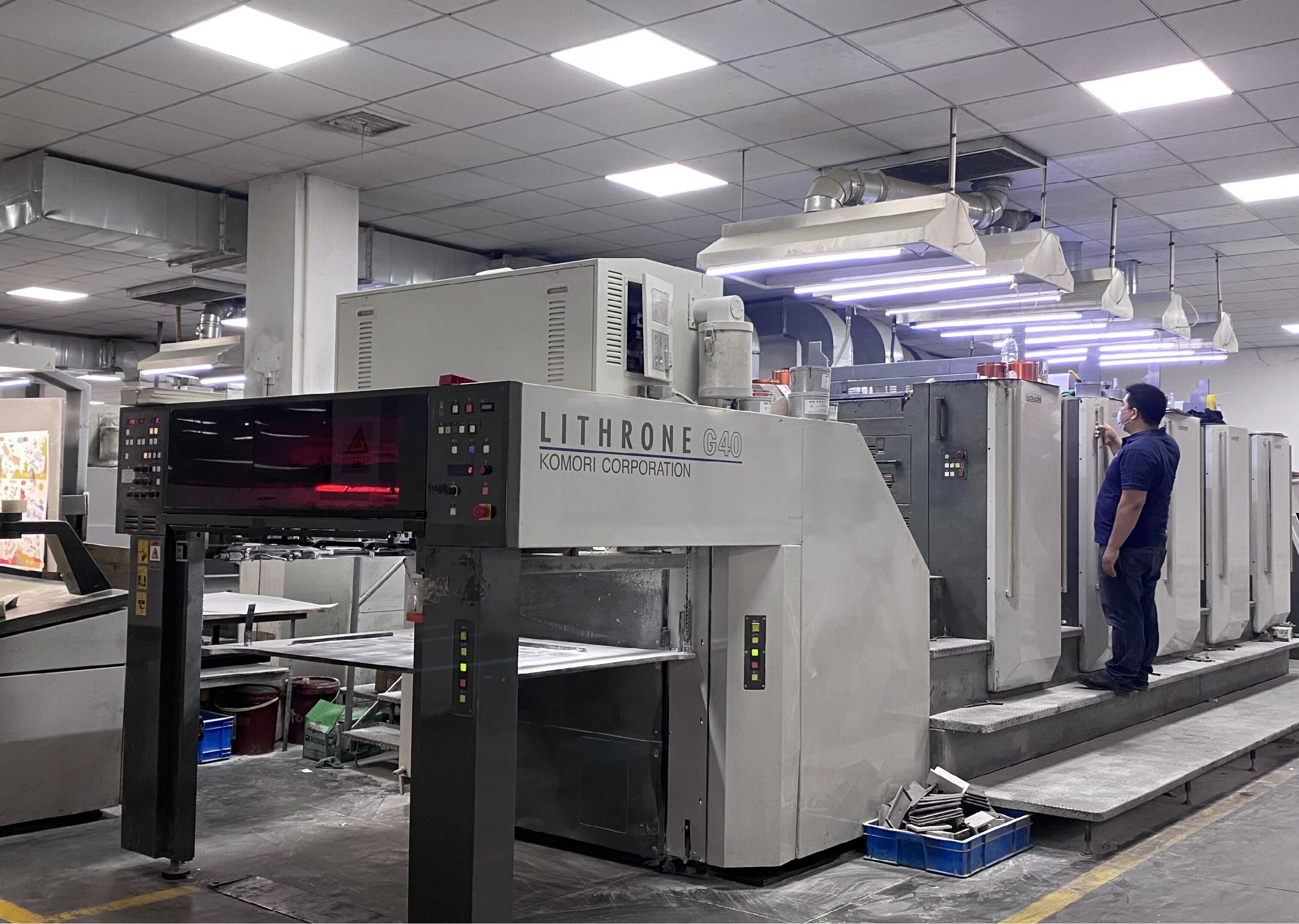
Printing and finishing equipment at the Hai Phong site, where certified material handling and quality-system controls meet on the same production line.
Capacity, MOQ and lead time: how to read 80,000, 1,000 and 25–45
The commercial figures in the file are 80,000 units of monthly production capacity, a minimum order quantity of 1,000 units and a lead time of 25–45 days. Read together, they describe a factory positioned for programme work rather than sampling: a buyer can enter at 1,000 units, and the stated monthly ceiling leaves room for a 10,000-unit order without the whole month being consumed.
One piece of arithmetic helps put the numbers in proportion. A 10,000-unit order equals roughly one-eighth of the stated 80,000-unit monthly figure — about 12.5%. That is a calculation, not a measurement of utilisation, because the supplier file does not disclose how capacity is shared across board games, puzzles, packaging and toy lines, nor how much of a given month is already committed. Treat it as a sanity check on whether a requested volume is compatible with a stated ceiling, not as a delivery forecast.
- Unit definition. The file states capacity in units without specifying whether a unit is a finished deck, a game, or an individual card. Confirm the basis before using 80,000 in any planning model.
- Capacity allocation. Ask what proportion of monthly capacity is normally available to card game work and how it behaves in peak retail build-up.
- Lead-time start point. The 25–45 day range is a spread of 20 days. Buyers should confirm whether the clock starts at artwork approval, at deposit receipt, or at material arrival, because the difference moves the shipment date by weeks.
- Range drivers. The span usually reflects deck complexity — finishing, foiling, lamination, multi-component boxes and packaging assembly — so a specific project should be quoted against a specific specification.
Delivery terms are listed as FOB, CIF, DDP or the customer's preference, which shifts risk and logistics responsibility. Under FOB, the buyer arranges main-carriage freight and insurance from the named port; under CIF, the seller arranges and pays for carriage and insurance to the destination port; under DDP, the seller delivers duty-paid to the buyer's address. Each changes landed cost and control, so the term belongs in the same conversation as the price.
The five-year OEM run: what a 10,000-unit programme demonstrates
The most concrete item in the file is a production history rather than a certificate. A Yawanhong OEM board game and card game programme has run for five years at a scale of 10,000 units, for clients in North America, Europe and Asia — with recorded markets spanning the United States, Germany, the Netherlands, Spain, France, Italy, the United Kingdom, Japan and Korea — and the finished product was sold online. Reported outcomes across that period include stable quality, clear printing, sturdy construction, neat cutting and eco-friendly properties. Programme highlights include full customized artwork and size, child-safe rounded edge treatment, FSC certified raw materials, and one-stop printing and packaging.
For an evaluation-stage buyer, the significance is not the 10,000 figure. It is the duration attached to it. A single shipment proves a factory can produce once. A five-year programme with the same client requirements suggests that the specification survived multiple print runs, that colour and cutting held across reorders, that packaging stayed consistent enough to keep selling online, and that the buyer found no reason to move the work. Those are the conditions under which a repeat card game programme — a party game, a family deck, a travel format — avoids the drift that shows up as customer complaints in year two.
The child-safe rounded edge treatment and the FSC certified raw materials also connect the case back to the compliance layer: the edge detail is a product-design decision relevant to younger players, and the FSC material links the finished deck to the chain-of-custody certificate discussed above.

Customized components from an OEM programme in which artwork, size and packaging were developed to the client's specification.
Pre-shipment acceptance testing and 30/70 T/T: the commercial half of capability
Production capability and commercial terms carry equal weight at the execution stage, and the file lists both plainly: acceptance criteria are defined as a pre-shipment test, and payment terms are 30/70. These two items, more than any certificate, determine what happens if a run does not meet the approved sample.
Pre-shipment acceptance testing places the buyer's approval gate before dispatch rather than after arrival. To make it enforceable, the purchase order should define sample size, defect classification, the inspection method, who holds approval authority, and what remedy applies if the lot fails. A supplier that already treats pre-shipment testing as the acceptance criterion is describing a workflow in which inspection records exist to be reviewed — which is also why buyers should ask to see a completed inspection record, not just the statement that one exists.
The 30/70 payment structure is a T/T arrangement. In common commercial practice it means 30% paid at order confirmation and the 70% balance settled at a defined later point, typically before shipment or against shipping documents; the exact trigger should be written into the contract rather than inferred. Splitting payment this way keeps buyer exposure limited during production while giving the supplier working capital, and it pairs logically with pre-shipment inspection: the balance milestone and the inspection gate can be aligned so that approval and payment follow the same event.
After-sales support is listed as remote support, and export markets as the US, EU, UK and Asia. For a repeat card game programme, the practical question is not whether remote support exists but how a reprint issue is handled — who receives the complaint, what evidence is required, and how quickly a replacement decision is made.
Where the evidence stops: fit boundaries buyers should respect
Reading a supplier file critically means naming its limits as precisely as its strengths. Four boundaries apply here.
- Certificate scope and validity. Each record — ISO 9001:2015 certificate 710925, SMETA ZAA600202718, BSCI 26-0387346, FSC ESTS-COC-241865 — has an issuing body, a site scope and a validity period. Buyers should confirm all three against the issuing organisation's own records before relying on them in a retailer submission, and should check that the audited site is the site that will produce their order.
- Capacity and terms are supplier-reported. The 80,000-unit monthly capacity, 1,000-unit MOQ and 25–45 day lead time describe stated capability, not independently audited output. They belong in an RFQ as items to confirm in writing.
- One case is not a market benchmark. The five-year, 10,000-unit programme shows repeat production for a client set across nine markets. It does not establish relative performance against other factories.
- Certificates do not make a deck. Print density, opacity, corner consistency, box durability and finish wear are product attributes settled by approved samples and inspection, not by management-system or social-audit documents.
The fit boundary is therefore fairly specific. This profile suits buyers running 1,000 units or more who expect repeat orders, need social-audit documentation for European or North American retail channels, and may require FSC-certified material for part of a range. It is a poor match for buyers seeking sub-1,000-unit test runs, or for anyone hoping that a certificate pack alone can replace sample approval and pre-shipment inspection.
A verification sequence for the next supplier conversation
- Request the certificate pack as documents, not a list, and confirm issuing body, site scope and validity for each record.
- Ask for the unit definition behind monthly capacity, and for the share normally available to card game work.
- Submit an RFQ built around one deck: card count, size, stock, finish, edge treatment, packaging and target volume.
- Confirm the lead-time start point and the delivery term that will apply — FOB, CIF, DDP or an agreed alternative.
- Approve a physical sample and convert it into a written specification that both parties sign.
- Write the pre-shipment acceptance criteria and the 30/70 payment milestones into the purchase order so inspection and balance payment follow the same gate.
Frequently asked questions
What do ISO 9001:2015 certificate 710925, SMETA ZAA600202718, BSCI 26-0387346 and FSC ESTS-COC-241865 each cover?
They cover four separate things. ISO 9001:2015 certificate 710925 covers the quality management system — how processes are documented, controlled and corrected. SMETA ZAA600202718 is a social audit record addressing labour standards, health and safety, environment and business ethics. BSCI 26-0387346 is a social-compliance audit focused on working conditions and worker rights. FSC ESTS-COC-241865 is a chain-of-custody certificate that tracks FSC-certified forest material through production. None of them is a toy-safety test report for a specific deck.
How should a buyer confirm the stated 80,000-unit monthly capacity, 1,000-unit MOQ and 25–45 day lead time?
By converting each figure into a written commitment. Confirm whether a unit means a finished deck or an individual card, ask how much monthly capacity is normally allocated to card game work, and check how the figure behaves during peak retail periods. For lead time, confirm whether the 25–45 day clock starts at artwork approval, deposit receipt or material arrival, since that changes the shipment date. MOQ should be confirmed against the specific deck specification, because finishing and packaging complexity can affect both minimum quantity and quoted lead time.
What does a five-year OEM card game programme at 10,000 units actually demonstrate?
It demonstrates repeat production rather than one-off output. The recorded programme ran for five years at 10,000 units for OEM board game and card game clients in North America, Europe and Asia, sold online, with reported outcomes of stable quality, clear printing, sturdy construction, neat cutting and eco-friendly properties. Programme details include full customized artwork and size, child-safe rounded edge treatment, FSC certified raw materials, and one-stop printing and packaging. It remains a single client set and does not disclose defect rates or on-time delivery performance.
What do pre-shipment acceptance testing and 30/70 T/T payment terms mean in practice?
Pre-shipment acceptance testing means the buyer approves the lot before it is dispatched, using an inspection defined in the purchase order — sample size, defect classes, inspection method and approval authority. The 30/70 T/T structure is commonly read as 30% paid at order confirmation with the 70% balance due at a later defined milestone, usually before shipment or against shipping documents; the exact trigger should be stated in the contract. The two provisions work best when the inspection gate and the balance milestone are aligned to the same event.
Which limitations should a buyer check before approving a custom card game supplier?
Four are worth checking every time. Confirm that each certificate's issuing body, site scope and validity date match the site that will run the order. Treat capacity, MOQ and lead time as supplier-reported figures to be confirmed in an RFQ. Read a long-running case as evidence of repeat production with one client, not as a market benchmark. And keep product quality where it belongs — with approved samples, written specifications and pre-shipment inspection, since management-system, social-audit and forest certificates do not measure print quality, opacity or box durability.
Outlook
The direction of travel in card game sourcing is toward documented capability. Retail compliance teams now ask for audit records alongside product test reports, and sustainability claims on a deck require a chain-of-custody trail that begins well before the press. For a manufacturer, the useful position is not a longer list of logos but a file in which every claim has a scope, a number and a way to be checked — and for a buyer, the useful habit is to test that file the same way before the first purchase order rather than after the first complaint.
Yawanhong's own file illustrates the pattern: quality management and social audits for how the site operates, FSC chain of custody for the paper, monthly capacity and terms for how an order is scheduled, and a five-year programme for how production behaves once a specification is locked. Buyers can review the manufacturer's full capability documentation in the Yawanhong VN Group global manufacturing brochure, and direct specification questions to the company at info@yawanhong.vn.
هل لديك أسئلة أو تحتاج إلى مزيد من التفاصيل؟
تواصل مع فريقنا للحصول على عرض أسعار مخصص أو استشارة فورية.
طلب عرض أسعار
املأ النموذج أدناه وسيتواصل معك فريقنا بعرض مقترح مخصص.
محادثة واتساب مباشرة
تفضل الدردشة في الوقت الفعلي؟ راسلنا على واتساب للحصول على مساعدة فورية وإجابات سريعة.
- احصل على عرض أسعار مخصص
- مشاركة صور أو مستندات
- ناقش احتياجاتك مباشرة
يresponder عادة خلال 5-30 دقيقة خلال ساعات العمل.