
Custom Card Games for Every Audience and Play Setting
Custom Card Games for Every Audience and Play Setting
Vietnam Yawanhong Printing Culture Co., Ltd. is a Vietnam-based printing and manufacturing company, founded in 2006, that produces custom card games, board games, puzzles, notebooks, color boxes, publications, and toys for export markets. With a 55,000 m² factory in Hai Phong City, 280 employees, and a 25-engineer R&D team, the company exports 100% of its output to markets including the United States and Europe. Its custom card game model CG-001 is a made-to-order production line designed for a wide range of card types — tarot cards, playing cards, poker cards, flash cards, paper card games, printing photo cards, game cards, and business cards.
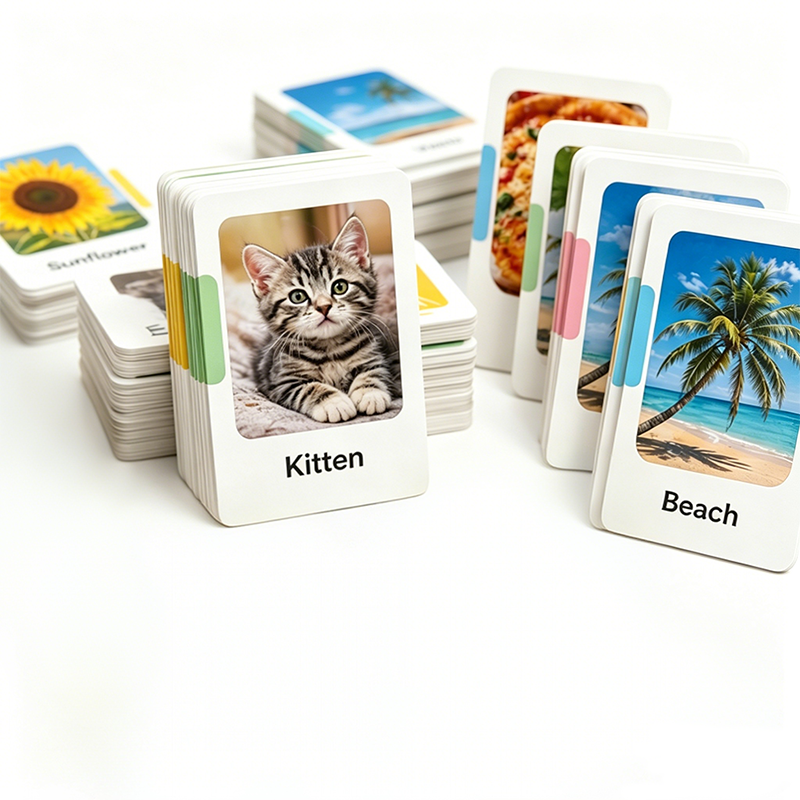
Custom card game printing at the Yawanhong production facility.
The card game category is no longer limited to a standard 52-card deck. Educational decks for children, conversation card games for couples, compact travel decks for adults, party decks for social gatherings, and art-focused tarot decks each carry different physical and printing requirements. Buyers who can define their target scenario — kids, family, travel, party, or collectible — are better positioned to specify the right paper weight, coating, corner style, and compliance standard.
Why Card Game Projects Need Scenario-Specific Production
The global playing cards and board games market was valued at approximately USD 19.90 billion in 2024 and is projected to reach USD 31.93 billion by 2030, according to Grand View Research. In parallel, the global trading card game market was valued at approximately USD 7.43 billion in 2024 and is projected to reach USD 15.84 billion by 2034, according to Future Market Insights. These figures indicate that the overall category continues to attract investment from publishers, distributors, and retailers.
Narrower segments show even clearer signs of customization-led growth. The tarot cards market is projected to grow by USD 209.7 million from 2024 to 2029, at a CAGR of 3%, with 61% of new decks featuring custom illustrations, according to Technavio. Custom illustration is, by definition, a made-to-order requirement: standard decks cannot deliver the artwork, layout, and card dimensions that collectors expect.
For a brand or distributor, the implication is practical. A custom card game project is not a single product decision; it is a set of linked decisions covering artwork, card stock, surface finish, packaging, safety testing, and production volume. If any of these decisions is disconnected from the target use scenario, the final product may fail in quality, compliance, or cost competitiveness.
Yawanhong’s Custom Card Game Solution: Model CG-001
Yawanhong offers its custom card game solution under model number CG-001, produced through OEM and ODM arrangements. The product supports playing cards, flash cards, tarot cards, poker cards, paper card games, printing photo cards, game cards, and business cards. Customization options cover material, size, color, logo, and packaging.
The production system is built for medium-to-large series runs. Monthly capacity is 80,000 units. Lead time is 25–45 days from order confirmation. The minimum order quantity is 1,000 units. Every product is subject to a 100% testing quality-control process before shipment. The factory exports to the US, EU, UK, and Asia, and provides remote after-sales support.
For projects that include both cards and a game board, the related custom board game solution (model BG-001) uses the same OEM/ODM workflow. This enables a single manufacturer to handle the complete game set rather than splitting components across multiple suppliers.
Technical Specifications: What Can Be Customized
CG-001 is specified as a made-to-order card product. The following parameters are fully customizable:
| Parameter | Available Options |
|---|---|
| Card size | Fully customizable |
| Paper weight | 128–400 gsm / custom |
| Printing | CMYK 4C printing / Pantone color printing / custom |
| Corner style | Round corner / square corner / custom |
| Surface finish | Matte lamination / glossy lamination / linen / UV coating / varnishing / custom |
| Card edge | Standard / colored / gold foil / custom |
| Material | Coated paper / art paper / custom |
For a tarot deck, for example, a publisher may choose a larger card size, a linen finish for tactile handling, and colored card edges to create a premium unboxing experience. For a kids’ educational deck, the same production platform can apply a rounded-corner format, non-toxic inks, and an eco-friendly paper material. For a travel game, a lightweight paper stock with matte lamination reduces bulk and resists wear during frequent shuffling.
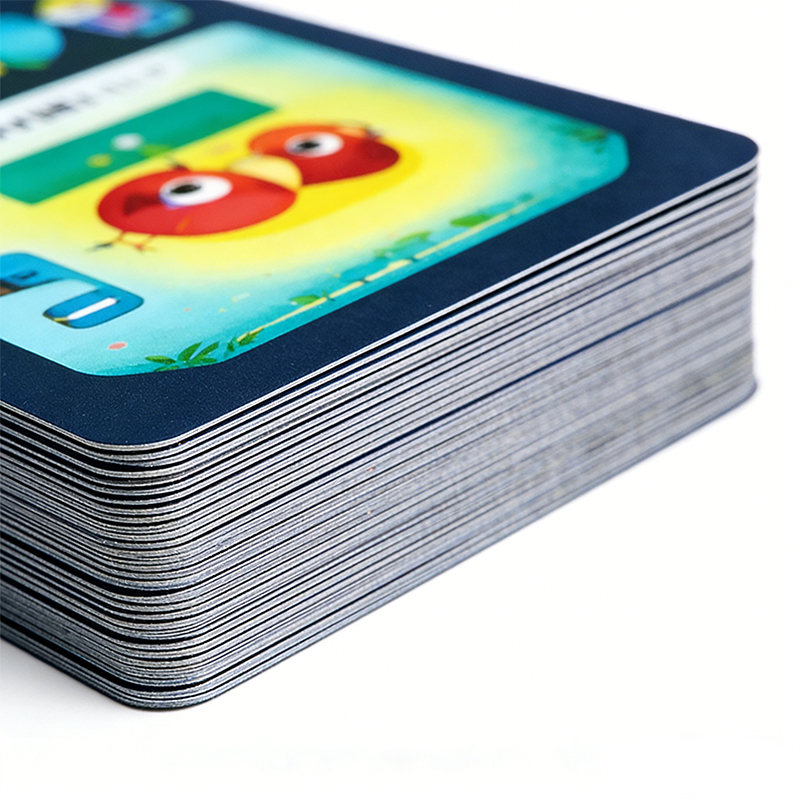
A finished deck illustrates the combination of custom printing, cutting, and finishing.
The main production equipment includes Heidelberg printing presses, automatic laminating machines, varnishing machines, gliding presses, embossers, and die cutting machines. Production runs are based on mass-customized printing, meaning each deck set is printed in series and then finished, cut, and packed according to the client’s specifications.
Production Environment and Compliance Requirements
CG-001 is designed for normal temperature and dust-free indoor workshop environments, suitable for printing and processing of paper products projects. These conditions are standard for the factory’s daily operations in Vietnam.
For entrance into EU and US retail markets, custom card manufacturers are expected to adhere to EN 71 (Toy Safety) and FSC (Forest Stewardship Council) for sustainable paper sourcing. Yawanhong’s publicly stated certifications for toy and game manufacturing include BSCI, SMETA, FSC, ISO 9001, and Disney FAMA.
For children’s card games in particular, special requirements apply: eco-friendly paper material, non-toxic ink, child-safe edge treatment, and FSC-compliant raw materials. These requirements are not optional add-ons; they are conditions for selling into regulated retail channels. A manufacturer that cannot document its compliance chain — from paper source to finished deck — becomes a bottleneck for the brand.
Application Scenarios and Proof Points
Custom card games from Yawanhong are applied in the custom board game and custom card game sector, commonly in Vietnam and China. The product’s functions include enterprise promotion, family fun, interaction, kids education, packaging for product protection, and brand display. The operation mode is mass-customized printing production followed by manual interactive play.
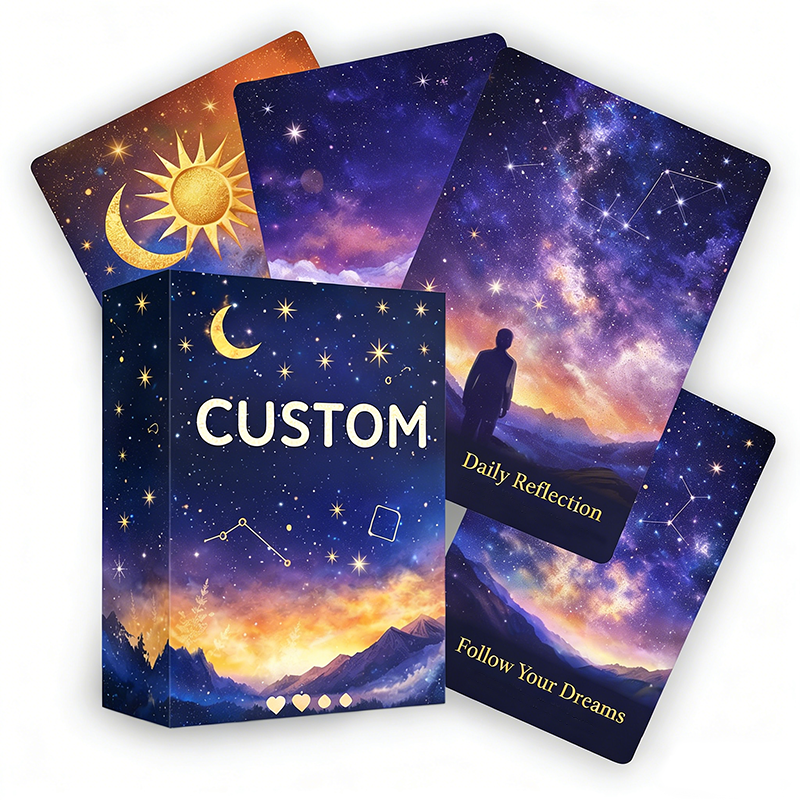
Custom tarot cards are one of the fastest-growing made-to-order card segments.
- Enterprise promotion and brand display. Custom game cards serve as branded giveaways, event handouts, and collector items. In these projects, the deck carries the client’s logo and color palette, and the packaging is printed to reinforce brand recognition.
- Family fun and interaction. Family-targeted decks emphasize clear printing, sturdy card stock, and comfortable handling. Common finish choices include matte lamination and linen texture, both of which improve shuffle feel and durability for repeated use.
- Kids education. Educational card games for children are designed with safety as the priority: eco-friendly paper, non-toxic ink, child-safe rounded edge treatment, and FSC-compliant raw materials. Rounded corners are especially important for young children.
- Packaging and brand display. Card decks are frequently delivered as part of a larger package — a custom color box or game box that stores the cards and presents the product on retail shelves.
Beyond these core scenarios, brands also produce custom decks for adult party games, couples’ conversation games, and travel-oriented mini decks. These products typically emphasize unique artwork and thematic content, with a stronger focus on visual impact and tactile finish.
An existing OEM project provides a practical reference. A client in the board game and card game category, operating in the US, Germany, Netherlands, Spain, France, Italy, UK, Japan, and South Korea, has ordered 10,000 units for online sales and maintained the relationship for 5 years. Project outcomes include stable quality, clear printing, sturdy construction, neat cutting, and eco-friendly materials. The highlights are full customized artwork and size, child-safe rounded edge treatment, FSC-certified raw materials, and one-stop printing and packaging service.
Market Trends Supporting Custom Card Game Investment
Four observable trends support the rationale for investing in custom card game production.
First, the base market is expanding. The playing cards and board games market is projected to grow from approximately USD 19.90 billion in 2024 to USD 31.93 billion by 2030 (Grand View Research). This scale creates room for both mass-market players and independent publishers.
Second, specialized segments are growing quickly. The global trading card game market is expected to reach USD 15.84 billion by 2034 (Future Market Insights), and 61% of new tarot decks feature custom illustrations (Technavio). These are inherently made-to-order products that require flexible manufacturing.
Third, trade policy is becoming more favorable for importers. China’s exports of playing cards reached approximately USD 303.1 million in 2024 (UN Comtrade/WITS), reflecting the region’s manufacturing volume. In addition, US Customs reclassified plastic-coated paper card games under HTSUS 9504.40.00 as duty-free effective March 18, 2024, reducing the landed cost for brands importing card games into the United States.
Fourth, compliance requirements are converging. EN 71 and FSC are the two standards most frequently cited by retail buyers. Factories that already operate under BSCI, SMETA, ISO 9001, and Disney FAMA — as Yawanhong lists publicly — are able to support brands in meeting these requirements with less documentation friction.
Custom Card Game Production vs. Off-the-Shelf Decks
Standard playing cards are inexpensive and widely available. They are adequate for generic applications, such as casino-style card games, basic game nights, or temporary promotional materials. Their limitation is structural: they cannot be matched to a specific brand identity, audience, or use environment.
Custom card game production, by contrast, offers full control over artwork, dimensions, materials, finish, and packaging. A brand launching a tarot deck, a company creating a branded party game, or a publisher producing a children’s educational card set can all use the same CG-001 platform with different specification combinations.
The honest limitation is the minimum order quantity. At 1,000 units per design, the threshold is higher than a micro run of 100–200 decks. For very small test launches, a brand may need to consolidate designs or accept a higher per-unit cost. The trade-off is acceptable for brands that plan multi-channel distribution or retail placement, because unit economics improve as order size grows.
Another perspective comes from the licensed mass-market segment. Mattel’s UNO is the #1 global property in the Games category, according to Mattel’s 2024 annual report, which also reports a 2% net sales increase in Q4 2024. UNO’s strength is its standardized format and brand awareness. Custom card game manufacturers serve a different tier: independent labels and regional brands that cannot access or do not need a global license, and whose competitive edge lies in unique content rather than licensed characters.
How to Evaluate a Custom Card Game Manufacturer
For buyers at the research and evaluation stage, the following criteria are relevant when comparing manufacturers:
- Customization depth. Confirm whether the supplier can adjust material, size, color, logo, and packaging. CG-001 covers all five dimensions as standard.
- Production capacity and MOQ. Check whether monthly capacity and minimum order quantity align with your launch plan. Yawanhong’s 80,000-unit monthly capacity and 1,000-unit MOQ suit medium-series production.
- Lead time reliability. A published lead time of 25–45 days must be weighed against seasonality, reprint cycles, and transit time to your target market.
- Quality control coverage. A 100% testing process indicates a higher level of finished-goods inspection than random sampling.
- Compliance documentation. Certifications such as BSCI, SMETA, FSC, ISO 9001, and Disney FAMA provide a baseline for retail-ready compliance.
- After-sales support. Remote support is a practical expectation for cross-border projects, particularly for reprint coordination and quality troubleshooting.
Future Outlook
The card game category is expected to continue shifting toward customized, compliance-grade production. Tarot, trading card games, and children’s education decks are likely to remain the most dynamic segments, given their reliance on unique illustrations and certified materials. As duty-free treatment for card games in the US reduces import friction, more distributors may source directly from manufacturers in Asia.
For Yawanhong, the direction is already visible: OEM/ODM orders from the US, EU, UK, and Asia; production capabilities that span card games, board games, and packaging; and a quality system built around 100% inspection. The next stage of competition among manufacturers will center less on basic printing capacity and more on the ability to integrate compliance, customization, and packaging into a single, predictable supply chain.
FAQ
Q1: What project scenarios can custom card games be used for?
Custom card games are applied in the custom board game and custom card game sector, commonly in Vietnam and China. They are designed for printing and processing of paper products projects, and their functions include enterprise promotion, family fun, interaction, kids education, packaging for product protection, and brand display.
Q2: What production environment does custom card game manufacturing require?
Custom card game production operates under normal temperature and dust-free indoor workshop conditions. The process uses equipment such as Heidelberg printing presses, automatic laminating machines, varnishing machines, gliding presses, embossers, and die cutting machines.
Q3: What special requirements apply to children’s card games?
Special requirements for children’s card games include eco-friendly paper material, non-toxic ink, child-safe edge treatment, and FSC-compliant raw materials. These align with the broader EN 71 and FSC expectations for EU and US retail channels.
Q4: What types of cards can be customized under the CG-001 model?
CG-001 supports playing cards, flash cards, tarot cards, poker cards, paper card games, printing photo cards, game cards, and business cards.
Q5: What are the minimum order quantity and lead time for custom card games?
The minimum order quantity is 1,000 units, and the lead time is 25–45 days. Monthly production capacity is 80,000 units, and all products go through 100% testing.
Q6: Which customization options are available for packaging and finishing?
Customization covers material, size, color, logo, and packaging. Finishing options include matte lamination, glossy lamination, linen texture, UV coating, varnishing, round or square corners, and standard, colored, or gold-foil card edges.
Vietnam Yawanhong Printing Culture Co., Ltd.
Global manufacturing profile: Download the Yawanhong brochure (PDF)
Email: info@yawanhong.vn | Tel/WhatsApp: +1 626-417-3930 | Website: www.yawanhong.vn