
Custom Card Games for Kids' Education: Specs That Work
Custom Card Games for Kids' Education: Specs That Work
A classroom-ready custom card game is defined by six physical specifications: card size, paper weight and material, corner treatment, ink and print method, surface finish, and edge construction. Those choices decide whether a deck survives repeated handling by children, stays legible from across a shared table, and can be produced at the quantity a school, publisher or education brand actually orders. Vietnam Yawanhong Printing Culture Co., Ltd. — a printing and packaging manufacturer established in 2006 with a 55,000 m² factory — produces custom card game CG-001 with a fully custom card size, 128–400 gsm paper, CMYK or Pantone printing, round or square corners, and matte, gloss, linen, UV or varnish finishes. This reference maps the kids' education scenario to those documented parameters and separates what the specification sheet establishes from what a buyer still has to verify.
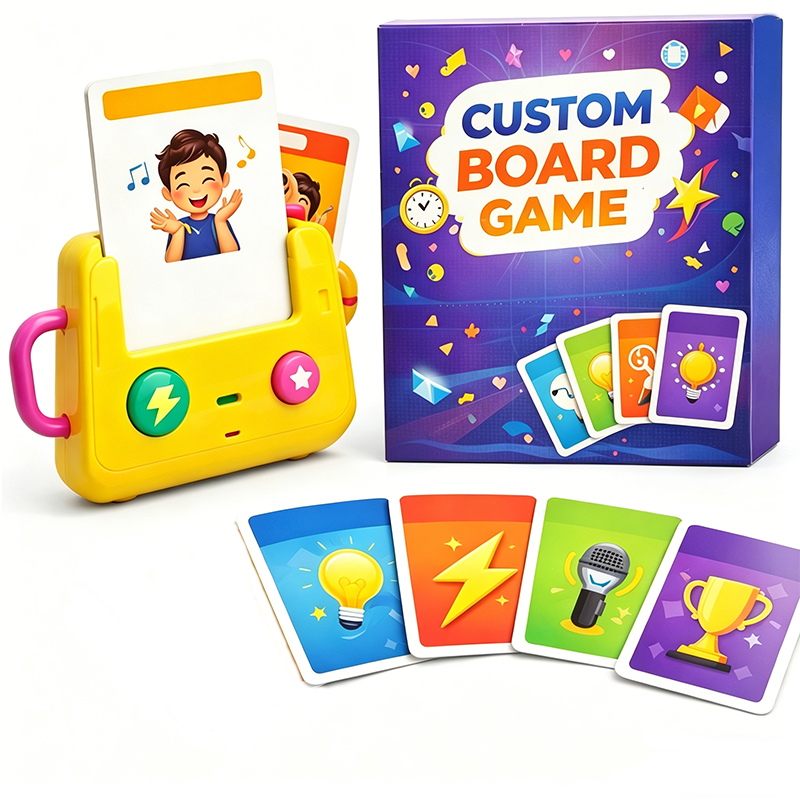
Why a retail deck rarely fits a classroom
A deck sold through retail is designed for a shelf: a fixed size, a fixed card count, and artwork chosen to appeal to a broad shopper. A classroom deck is designed for a routine. The same cards are dealt, sorted, dropped, reshuffled by small hands and packed away several times a week, and a teacher has to read the table from standing height while six children handle the same stock.
That difference moves the decision from theme to specification. Square corners create a defined wear point; a rounded corner removes it, which is why child-safe edge treatment sits among the stated requirements for the kids' education scenario rather than being treated as a cosmetic option. A high-gloss surface under classroom lighting behaves differently from a matte or linen surface when a child tilts a card toward a window. Thin stock that feels acceptable in a shrink-wrapped pack may feel different after the twentieth shuffle.
Three questions resolve most of the specification before artwork is finalised: who handles the cards and how old they are, how much table space each player has, and how the deck is stored and distributed between lessons. Everything else — weight, finish, edge, box format — follows from those answers. The point is not that generic decks are unusable; it is that a deck built for a defined routine can be specified precisely, and a purchased retail deck cannot.
The specification decisions that shape a classroom deck
The custom card game CG-001 sheet documents a defined set of parameters. The table below places each one against its classroom consequence and the point a buyer should confirm before approving a production run.
| Specification | What CG-001 documents | Classroom consequence | Confirm before mass production |
|---|---|---|---|
| Card size | Custom | Must fit hand span and desk area; a reading-distance card is not automatically a holding card | Physical sample handled by the target age group |
| Paper weight | 128–400 gsm / custom | Lighter stock flexes more readily; heavier stock feels stiffer and holds shape | Sample at the exact gsm specified, not a generic reference deck |
| Material | Coated paper, art paper, custom | Print sharpness, surface feel and the eco-friendly paper requirement of education use | Material name and grade written into the order |
| Corner style | Round corner / square corner / custom | Wear point and handling comfort for younger players | Corner radius value, checked on the sample |
| Printing | CMYK 4C, Pantone colour, custom | Full-colour artwork versus an exact brand or series colour | Colour proof against the stated reference |
| Surface finish | Matte lamination, glossy lamination, linen, UV coating, varnishing, custom | Glare under classroom lighting and tactile difference during shuffling and dealing | Exact finish name and whether a lamination film is used |
| Card edge | Standard, coloured, gold foil, custom | Series differentiation; foil reads as a premium cue rather than a classroom requirement | Edge type recorded on the approved specification |
| Packaging | One-stop printing and packaging; packaging for product protection and brand display | Storage between lessons and distribution across classes | Box format, cards per box and labelling |
Deck length is not one of the published print parameters. Card count is a teaching decision — how many items a lesson cycle covers — so it belongs in the enquiry as an explicit requirement alongside the six print specifications.
Card size and count: matching small hands and short lessons
Size is the first specification that should be locked, because it constrains everything downstream: artwork layout, text size, icon legibility and box dimensions. CG-001 is made to a custom card size, and the case record for the 10,000-unit OEM program lists full customization of artwork and size as a supported service, so the format is set at specification rather than selected from a fixed catalogue.
The product range gives a useful sense of what different formats are for. Flash cards, poker cards, playing cards, tarot cards and general game cards are all listed product types. A flash card and a poker card solve different problems: one is read at distance during a group drill, the other is held in a fan and hidden from neighbours. A classroom deck usually needs to do both, which is why many education decks end up larger than poker size but thinner in count than a standard 52-card pack.
Practical rule: decide size from the age group's hand span and from the number of players sharing one table, then test with a physical sample. Artwork should be finalised only after that test, since resizing a card after design approval forces every layout to be rebuilt.
Paper weight and material: where 128–400 gsm fits
Yawanhong documents a 128–400 gsm paper range for CG-001, with coated paper, art paper or a custom material. That range is wide enough to cover both lightweight promotional decks and stiff game cards, and the choice inside it is a trade-off rather than a single correct answer. Lighter paper within the range flexes more readily in small hands and in decks that are stored flat; heavier paper feels stiffer and holds its shape when fanned.
Weight alone does not settle stiffness. A gsm figure describes the paper used, but the perceived rigidity of a finished card also depends on construction, so two decks quoting the same weight are not automatically comparable. A European B2B playing-card supplier lists a 300 gsm board as its standard product specification — a useful reference point for where mid-range game cards sit — but that figure applies to a specific single product, while the Yawanhong figure describes an available range across custom work. They can be read side by side only after the board construction and product scope are aligned.
For education buyers, the material question usually splits in two. The first is handling: does the deck hold up to repeated dealing in the age group that will use it. The second is the stated sustainability requirement of the classroom scenario, which calls for eco-friendly paper material and FSC-compliant raw materials. Both should be written into the specification by material name and grade, not left to a general instruction to use "good paper".
Corner treatment and edge construction
CG-001 is available with round corners, square corners or a custom corner treatment, and child-safe edge treatment is explicitly listed among the special requirements for the kids' education scenario. Rounded corners are the conventional choice for younger players because they remove the sharp wear point that a square corner presents in a hand or a storage box. Square corners remain appropriate for older students and for decks that need a formal, card-like appearance.
The detail that matters commercially is that "round corner" is a category, not a measurement. The corner radius is not published in the product specification, so a buyer specifying a deck for young children should state the radius in the purchase order and confirm it on the physical sample. Two rounded decks with visibly different radii behave differently in the hand, and the difference is not visible in a digital proof.
Card edge treatment — standard, coloured, gold foil or custom — is a separate decision from corner style. Coloured and foil edges are strong series markers for collector or gift decks; for a classroom deck they add a decorative layer without changing how the game plays, and the simpler standard edge is usually the better fit for a deck that must be replaced in class sets.
Ink, print method and surface finish
CG-001 supports CMYK four-colour printing, Pantone colour printing, or a custom print specification. In practice, full-colour illustrative artwork runs on CMYK, while a brand colour, house style or a colour-coded series uses Pantone so that the same green or blue appears identically across decks printed in different production batches.
Ink safety is a stated requirement rather than a published certificate. Non-toxic ink is listed among the special requirements for the kids' education scenario, and the OEM case record lists eco-friendly construction among its results. Neither statement publishes a test report. A school, publisher or education brand therefore has to request the supporting ink documentation and confirm which substances and limits it covers before approving a deck for children's use.
Surface finish is where classroom conditions diverge most from retail conditions. The documented options are matte lamination, glossy lamination, linen, UV coating and varnishing. Matte and linen surfaces reduce the glare that classroom lighting throws across a tilted card, which helps when a child holds a card up during a group activity; glossy lamination and UV coating produce a brighter, more reflective surface that suits display artwork. The finish also determines how the deck feels during shuffling and dealing, so the sample stage should include a handling test by the intended age group rather than a visual check alone.
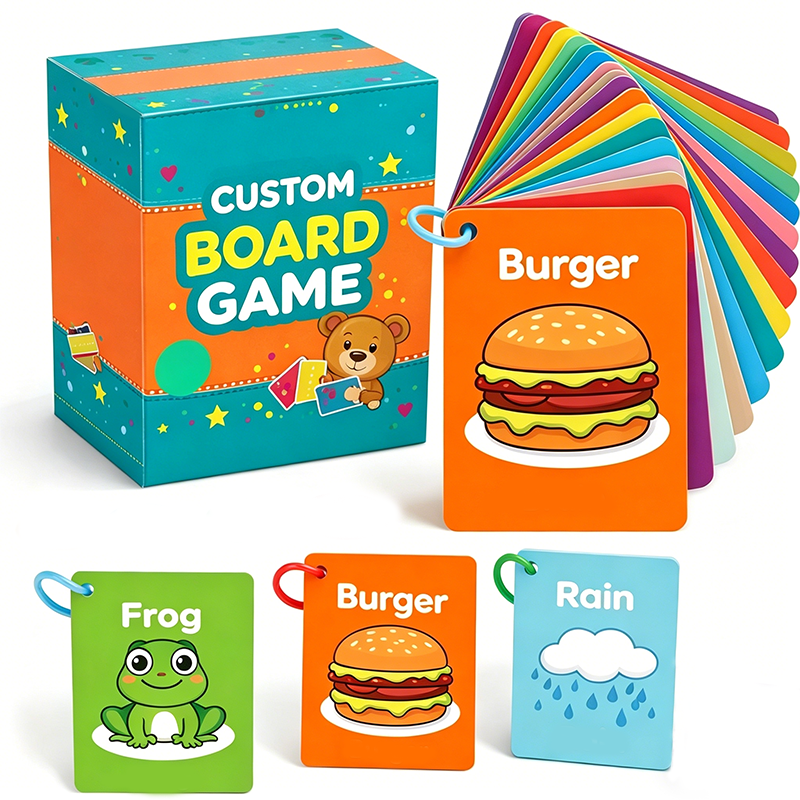
Opacity and read-through: a specification buyers often leave out
Hidden-information games depend on players not seeing through a card. A manufacturer-authored technical guide from the playing-card industry notes that a black or blue opaque core is a practical benchmark for preventing light from passing through a card — a technical recommendation, not a legal requirement. Yawanhong's published CG-001 specification does not state an opacity value or core construction, so a classroom deck designed around answer-on-back cards, matching pairs or any mechanic where concealment matters should have that property added to the enquiry and checked on the sample.
This is a good example of why the specification should be written around the game, not only around the printing. Two decks can share card size, weight, corners and finish and still behave differently at the table, because the property that decides the game — opacity — sits outside the six standard print parameters.
Application fit: where a classroom deck earns its place
The kids' education scenario documented for Yawanhong's card and board game production lists several functions: kids education, interaction, family fun, enterprise promotion, and packaging for product protection and brand display. That combination describes what an education deck is usually expected to do — teach, prompt interaction, and survive being sent home.
In a classroom, the strongest fits are repetition-based activities: vocabulary and phonics drills, number facts, matching and sorting, and discussion prompts for language learners. Each imposes a different specification bias. Drill decks reward a consistent back design and a stable card size so that piles stack neatly; matching decks reward colour coding on the edge or back; discussion decks tolerate a lighter stock because cards are read rather than shuffled. Where a deck travels between home and school — the travel games pattern familiar from family play — box integrity and a compact card size matter more than deck length.
The same deck can extend into family games and adult card games at home, but that extension is a marketing decision, not evidence of classroom results. A scenario description explains intended use; it does not demonstrate learning outcomes, and no teaching-efficacy claim should be inferred from a supplier's product documentation.
Evidence from a 10,000-unit OEM program
The most concrete production evidence in Yawanhong's material is a five-year OEM board game and card game program covering 10,000 units, supplied to clients in the United States, Germany, the Netherlands, Spain, France, Italy, the United Kingdom, Japan and South Korea, with online sales as the application. The recorded results are stable quality, clear printing, sturdy construction, neat cutting and eco-friendly output. The program's stated highlights are fully customized artwork and size, child-safe rounded edge treatment, FSC-certified raw materials, and one-stop printing and packaging service.
What that record establishes is repeat production over five years at a defined quantity, across buyers in three regions, with the listed quality outcomes. What it does not establish is equally important: it contains no per-unit pricing, no defect rate, no classroom or learning outcome, and no certificate numbers. FSC-certified raw materials appear as a program highlight and as a scenario requirement; a buyer still needs the certificate scope, issuing body and validity period before treating forest certification as verified.
Production conditions and order parameters
Card production sits within a paper-products printing and processing operation that runs under normal-temperature, dust-free indoor workshop conditions. The documented equipment set covers a Heidelberg printing press, automatic laminating machine, varnishing machine, foil-stamping (gliding) press, embosser and die-cutting machine — the sequence that explains why print, lamination, foil edge and corner cutting are specified together rather than purchased separately.
Order parameters published by Yawanhong are a 1,000-unit minimum order quantity, a 25–45 day lead time, a monthly capacity of 80,000 units, and 100% testing as the quality-control approach. Customization is offered on an OEM/ODM basis across material, size, colour, logo and packaging, with exports to the US, EU, UK and Asia and remote after-sales support. The wider company profile lists a 55,000 m² factory, 280 employees, a 25-engineer R&D team, an annual output of 1,000,000 units, and a founding date of 5 December 2006.
How a custom classroom deck compares with generic decks and DIY printouts
Three routes are available to a school or education brand, and they differ in documented characteristics rather than in quality claims.
A generic retail deck is bought as a finished product. It arrives quickly and at low unit cost, but the size, card count, artwork, corner style, stock and finish are fixed by the publisher, and the deck cannot be aligned to a specific lesson sequence or a school's visual identity.
A teacher-printed set uses office equipment to produce cards on standard paper stock. It is fast and highly specific to a lesson, but the documented custom options — 128–400 gsm paper, round or square corners, lamination, linen, UV or varnish finishes, coloured or foil edges — sit outside that process, and the resulting cards are not built for repeat handling by children.
A custom OEM deck draws on the full documented parameter set plus the education-scenario requirements of eco-friendly paper, non-toxic ink, child-safe edge treatment and FSC-compliant raw materials. Its fit boundary is scale. A 1,000-unit minimum order quantity and a 25–45 day lead time are proportionate for a school district, an education publisher, a toy or game brand, or a multi-class programme; they are disproportionate for a single classroom that needs thirty decks next week, and that buyer is usually better served by an existing product. Pricing for a custom deck depends on size, gsm, print method, finish, edge treatment and packaging, and no verified unit-cost benchmark for those combinations appears in the material reviewed here, so a quotation is the only reliable source.
Market context
Two commercial research estimates frame the category around this topic. Grand View Research places the playing cards and board games market at USD 19.9 billion in its 2024 base year, with Asia Pacific accounting for a 39.5% revenue share in 2024; Custom Market Insights projects the global trading card game market at USD 14.12 billion in 2025. Both are commercial estimates using different definitions, and neither measures educational card decks as a separate segment. They indicate the scale of the adjacent category and the weight of Asia-Pacific production and demand — not the size of the school-deck market, which the available data does not quantify.
What to verify before approving mass production
For a children's deck, verification is a document and sample exercise rather than a trust exercise. The list below follows the parameters above and can be attached to an enquiry.
- Physical sample at the exact specification — the specified gsm, corner radius, finish and card size, handled by the age group the deck is for.
- Corner radius in writing — the published specification names round, square or custom corners but not a radius value.
- Ink documentation — non-toxic ink is a stated requirement of the education scenario; ask which document supports it and what it covers.
- FSC evidence — certificate scope, issuing body, site and validity period, since the available material cites FSC-certified raw materials without publishing certificate details.
- Opacity and core construction — request a read-through check if any game mechanic relies on hidden information.
- Colour proof — a CMYK proof for full-colour artwork, or a Pantone match for a fixed brand or series colour.
- Cut and registration check — neat cutting is a recorded program result; confirm it on the production sample, not only on the pre-production proof.
- Packaging specification — box format, cards per box and labelling, given that packaging is both a protection and a display function.
- Commercial terms in the purchase order — MOQ, lead-time start point, unit basis and after-sales scope.
- Toy-safety documentation for the destination market — in the United States, ASTM F963-23 is the mandatory toy safety standard, described by the Consumer Product Safety Commission as covering products intended for play by children, including board games and card games, with mechanical, chemical and flammability requirements.
Outlook
The buying logic around education decks is likely to keep moving toward written specifications rather than catalogue selection, on a simple premise: a school that has to replace class sets, align artwork with a curriculum and answer parents' questions about materials benefits from a deck it can describe precisely. That outlook is conditional. It assumes buyers continue to ask for documentation — ink, FSC scope, opacity, cut quality — and that suppliers answer at specification level rather than with general capability statements. If documentation requests do not become routine, the practical difference between a custom and a generic deck narrows to artwork and size. The safe conclusion from the material available here is narrower than a forecast: the parameters, the education-scenario requirements and a five-year 10,000-unit production record exist and can be checked, which is enough to specify a classroom deck deliberately rather than by default.
FAQ: classroom deck specifications
What card size works for a kids' card game?
There is no universal size. CG-001 is produced to a custom card size, and Yawanhong's product range covers flash cards, poker cards, playing cards and tarot cards, so format is decided at specification. The practical test is a physical sample handled by the age group the deck is intended for: a card a young child can fan, sort and hold without bending answers the question better than a measurement alone. Artwork should be finalised after that test, because a size change forces every layout to be rebuilt.
Which paper weight should a classroom deck use?
Yawanhong documents a 128–400 gsm range for CG-001, with coated paper, art paper or a custom material. Inside that range, weight is a trade-off: lighter paper flexes more readily, heavier paper feels stiffer and holds shape when fanned. Stiffness also depends on construction, so a gsm figure alone does not settle the choice, and figures from different suppliers are comparable only when board construction and product scope match. Ask for a sample at the specified weight.
Are rounded corners necessary for children's card games?
They are the usual choice for younger players rather than a universal rule. Child-safe edge treatment is listed among the special requirements for the kids' education scenario, and CG-001 is available with round corners, square corners or a custom corner treatment. The corner radius is not published in the product specification, so it should be written into the purchase order and confirmed on the physical sample instead of being assumed from the phrase "rounded corner".
What do non-toxic ink and FSC-certified material require from a buyer?
In the material reviewed here, both appear as requirements and program highlights rather than as published certificates: non-toxic ink and FSC-compliant raw materials are listed among the special requirements for kids' education, and the 10,000-unit OEM record lists FSC-certified raw materials and eco-friendly output. A school or brand should request the supporting documentation — for FSC, the certificate scope, site and validity period — and treat supplier statements as claims until those documents are reviewed.
What order size and lead time apply to a custom classroom deck?
Yawanhong's published terms are a 1,000-unit minimum order quantity, a 25–45 day lead time and a stated monthly capacity of 80,000 units, with OEM/ODM customization covering material, size, colour, logo and packaging. These are company-reported figures, and the unit basis and the lead-time start point are not specified in the available material, so both should be confirmed in the written quotation. A single-classroom requirement below the minimum order quantity is usually served better by an existing product than by a custom run.
About the manufacturer: Yawanhong (Vietnam Yawanhong Printing Culture Co., Ltd.) was established on 5 December 2006 and operates a 55,000 m² printing and packaging factory in Vietnam, producing board games, card games, puzzles, notebooks, colour boxes and publications for export markets. Custom card game CG-001 is available on an OEM/ODM basis.
Download: Yawanhong VN Group Global Manufacturing brochure (PDF)
هل لديك أسئلة أو تحتاج إلى مزيد من التفاصيل؟
تواصل مع فريقنا للحصول على عرض أسعار مخصص أو استشارة فورية.
طلب عرض أسعار
املأ النموذج أدناه وسيتواصل معك فريقنا بعرض مقترح مخصص.
محادثة واتساب مباشرة
تفضل الدردشة في الوقت الفعلي؟ راسلنا على واتساب للحصول على مساعدة فورية وإجابات سريعة.
- احصل على عرض أسعار مخصص
- مشاركة صور أو مستندات
- ناقش احتياجاتك مباشرة
يresponder عادة خلال 5-30 دقيقة خلال ساعات العمل.