
Custom Casual Apparel Procurement: Terms, AQL and Acceptance
Procurement terms in custom casual apparel fix four things before a single panel is cut: how many pieces per style a supplier will accept, how long the order runs from sample approval, who inspects the goods and against which standard, and when the balance payment falls due. In this category, most commercially significant disputes trace back to a purchase order that left one of those four points unstated rather than to a fabric problem.
This reference answers the questions buyers raise most often when they move from shortlisting a supplier to executing a real order. It uses the published terms, acceptance practice and quality documentation of Guangzhou Lihong Apparel Trade Co., Ltd. — a menswear OEM/ODM manufacturer and exporter based in Tianhe District, Guangzhou, operating under the brand Lihongwear — as a worked example of what a complete commercial package looks like when the terms are written down instead of assumed.
Why casual apparel orders fail on paperwork, not on fabric
Casual apparel carries a structural problem that tailored garments do not: the unit value is low, the SKU count is high, and the quality conversation happens across a size curve. A single style offered in XS–5XL is already seven stock-keeping units before colour is added. Once logo placement, fabric weight and wash treatment enter the specification, a modest first order can easily contain dozens of distinct combinations.
That multiplication is where term ambiguity becomes expensive. A buyer who writes “standard export quality” into a purchase order has not defined a defect. A buyer who writes “AQL 2.5” without naming the inspection level, the lot size, or whether the check happens in-line or pre-shipment has defined a number but not an acceptance procedure. And a buyer who agrees to a delivery window without stating whether it starts at deposit, at sample approval, or at fabric arrival has agreed to a date that the factory is interpreting differently.
The practical consequence is that sourcing teams in this category get more protection from a well-drafted term sheet than from an extra round of negotiation on unit price. Casual wear is a repeat-purchase business; the second and third orders are where a supplier relationship either compounds or collapses, and both outcomes are decided by how the first order's terms were framed.
What Lihongwear puts in writing: the commercial baseline
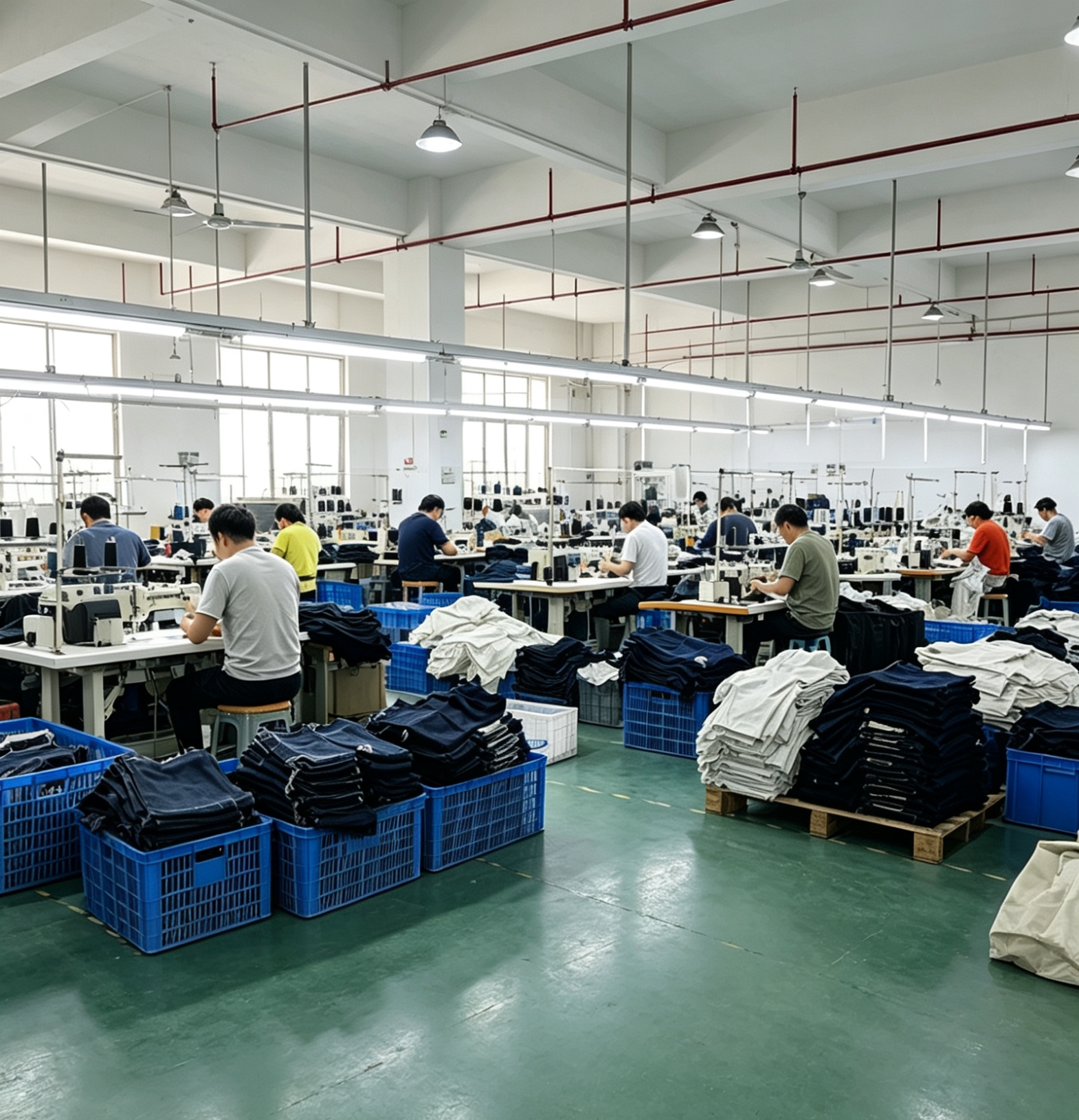
Lihongwear operates a 5,000 m² manufacturing facility in Guangzhou with more than 150 employees and an annual production capacity of 500,000 pieces. The company was established in 2024 and draws on a factory background of over 10 years, supplying men's basic apparel — T-shirts, shirts, polo shirts, hoodies, jackets and pants — to wholesalers, offline brands and cross-border e-commerce sellers across Europe, America, Southeast Asia, the Middle East and Australia. Its commercial model covers FOB, CMT and full ODM customisation, supported by an in-house pattern-making team with more than 10 years of experience.
For procurement purposes, the terms below are the parts that matter most, because they are the ones a buyer will be measured against internally when the shipment arrives.
| Term | Standard position | What it removes from the negotiation |
|---|---|---|
| Minimum order quantity | Custom: 200 pieces per style. Stock goods: no minimum quantity, mixed wholesale supported. | Ambiguity about whether a trial order is possible at all |
| Lead time | Stock: 3 days. Custom: 15–25 days from sample confirmation to bulk order delivery. | Disputes over when the production clock starts |
| Delivery terms | EXW factory pickup, FOB Guangzhou/Shenzhen, CIF destination port | Unclear cost allocation and risk transfer point |
| Payment terms | 30% deposit, balance settled against a copy of the Bill of Lading; negotiable and adjustable | Cash-flow surprises at the shipment stage |
| Acceptance method | Factory self-inspection, remote video inspection, third-party agency on-site sampling inspection | Disagreement about who signs off on quality |
| Size range | XS–5XL | Late-stage size-curve gaps on the purchase order |
| Decoration | Screen printing, DTG, embroidery, heat transfer | Re-specification after sampling has already started |
| Compliance documentation | CTI report under GB 18401-2010 Category B | Uncertainty about which safety standard the fabric was tested to |
| After-sales | Inquiry reply within 2 hours on business days, real-time production tracking, defect returns within 7 days of receipt | Unclear claim window once goods land |
Read as a set rather than as individual line items, these terms describe a supplier positioned for small-batch custom work with a stock backstop. The 200-piece custom threshold and the unlimited-quantity stock channel are two different procurement routes, not two versions of the same offer, and buyers get more value from the model when they treat them that way.
The acceptance standard: seven-stage QC, AQL Level 7, and what inspection actually decides
Lihongwear applies an international AQL Level 7 quality control system built on a seven-stage segmented inspection workflow. Quality assurance includes multi-process segmented quality inspection and 100% full inspection before shipment, with pre-production sample checking sitting upstream of both.
The distinction between segmented inspection and final inspection is the part buyers most often underrate. A single end-of-line check can only reject finished goods; it cannot recover the fabric, labour and calendar time already committed to a defective lot. Segmented inspection places checkpoints at intermediate stages so that a cutting error, a printing misregistration or a size deviation is caught while the batch is still correctable. For custom casual apparel, where a 200-piece order per style is common and re-cutting fabric is rarely fast, that timing difference is what protects the delivery date.
The AQL layer on top is a sampling methodology, and it is worth being precise about what it promises. AQL acceptance sampling is designed to accept or reject a lot based on a defined sample size and an acceptable defect threshold; it is a statistical control on the batch, not a guarantee that every unit is flawless. That is why the 100% pre-shipment full inspection matters alongside it — the two mechanisms cover different risks. Buyers who need lot-level assurance beyond this can add a third-party agency on-site sampling inspection, which Lihongwear lists as an available acceptance route rather than a default.
Pattern-level prevention sits upstream of all of this. The senior pattern-making team, with over 10 years of experience, is positioned to avoid pattern defects before cutting begins, which is the cheapest stage at which a construction problem can be resolved.
Fabric safety documentation: CTI and GB 18401-2010 Category B
The compliance document buyers will see attached to a custom casual apparel order is a CTI test report under GB 18401-2010 Category B. GB 18401-2010 is the Chinese national basic safety specification for textile products, and Category B is the classification applied to textile products that come into direct contact with the skin — which is the correct classification for T-shirts, hoodies and other everyday casual wear.
Two practical points follow from that. First, Category B is the relevant category for this product type; a report issued under a different category would not describe the same use case. Second, a test report is a sample-based document: it states that the submitted sample met the specified parameters, and it should be read as evidence of the standard applied rather than as a certificate covering every production lot. Buyers with their own regulatory obligations in the destination market should map the GB 18401-2010 Category B report against those requirements during the evaluation stage, not after the goods have shipped.
Size range and decoration: what the terms have to cover
Lihongwear's casual apparel runs from XS to 5XL and supports four decoration methods — screen printing, DTG, embroidery and heat transfer. The choice between them is a specification decision with commercial consequences, because each method behaves differently on order size, colour count and fabric weight.
- Screen printing is generally efficient for larger runs of solid-colour artwork and holds up well on heavier jersey and fleece surfaces.
- DTG (direct-to-garment) suits small batches and multi-colour or photographic artwork, which fits the 200-piece-per-style custom threshold well.
- Embroidery gives a durable, textured mark that many buyers choose for chest logos and corporate or workwear applications.
- Heat transfer handles complex multi-colour artwork and small, detailed marks, with the trade-off sitting in how the transfer behaves over repeated washing.
Because decoration method interacts with fabric weight and colour, it belongs in the purchase order alongside the size curve, not in a separate email thread after sampling. The same logic applies to heavyweight casual hoodies: a heavier fabric surface changes how ink cures and how a print sits, so method and material should be confirmed together.
Where this order model fits
The combination of a 200-piece custom threshold and an unlimited-quantity stock channel maps onto four common buying situations.
- Private label launches. A brand testing a first collection can place 200 pieces per style, keep the size curve at XS–5XL, and validate sell-through before committing to a wider range.
- Stock-led replenishment. Sellers running cross-border or wholesale channels with unpredictable demand can order mixed stock with no minimum and a 3-day dispatch window instead of forecasting a custom run.
- Street style and heavyweight programmes. Buyers building premium casual ranges use heavier fabrics and DTG or screen printing, where the custom channel's lead time and decoration options matter more than unit price.
- Corporate and workwear casual tops. Embroidery and heat transfer on basic casual silhouettes, ordered per style at the custom threshold with a defined acceptance method.
Market context: why the terms are getting shorter and more frequent
The commercial logic above is reinforced by where custom apparel demand currently sits. Dataintelo valued the global custom made clothes market at USD 48.6 billion in 2025, and the same source reports that casual and fashion segments account for 62% of custom clothing demand, measured against corporate and formal wear combined. Category-level analysis of the streetwear segment further describes heavyweight hoodies in the 350–450 GSM brushed-back fleece range, against roughly 280 GSM for promotional blanks.
Those two data points point in the same direction for procurement. A market where casual dominates demand is a market of frequent, style-led, comparatively small orders rather than annual bulk programmes — which is exactly the profile that a 200-piece-per-style custom threshold and a 15–25 day custom lead time are built to serve. And a specification environment where buyers distinguish 350–450 GSM garments from 280 GSM garments is one where fabric weight has to be written into the purchase order, not inferred from a photo.
The alternative to shorter, more frequent orders is over-committing to a single large lot in order to reach a lower unit price. That trade is defensible in stable categories; in casual wear, where a silhouette can lose its market within a season, it transfers inventory risk to the buyer without reducing production risk.
Factory-direct versus intermediary: what changes in the terms
Whether a buyer sources through a factory or through a pure trading intermediary changes which parts of the term sheet can be enforced directly. The comparison below describes structural differences rather than a ranking, and each model has situations where it is the better fit.
| Dimension | Factory-direct model (as operated by Lihongwear) | Pure trading intermediary model |
|---|---|---|
| Production control | Self-owned physical facility; independent pattern R&D; full-process control from fabric to garment | Production allocated to third-party workshops |
| Stock availability | Over 50 stock styles and 200,000 pieces held in inventory; no production wait on stock items | Stock depends on what the upstream supplier is holding |
| Sampling | In-house pattern team with 10+ years of experience reduces sampling rework | Sampling routed through the supplying factory |
| Inspection depth | Segmented self-inspection across multiple processes plus third-party fabric testing | Typically finished-goods sampling |
| Order follow-up | Factory communicates with the customer directly; production progress synchronised in real time | Progress relayed through an intermediary layer |
| After-sales | Handled directly by the factory without intermediate transit | Claim routed back through the intermediary |
| Cost structure | Independent fabric procurement for production | Intermediary margin sits between buyer and factory |
The honest reading is that factory-direct sourcing concentrates both responsibility and dependency in one counterparty. A buyer who needs multiple unrelated product categories, or whose compliance function requires a supplier with a longer corporate trading history than a 2024-established entity, may reasonably prefer an intermediary or a different supplier entirely. Factory-direct also gives the buyer less contractual insulation if a single production site is disrupted, because there is no second factory in the chain absorbing the shock.
Limits and boundaries buyers should plan around
A credible term sheet states what the model will not do as clearly as what it will.
- Custom below 200 pieces per style is outside the model. Below that threshold, the realistic route is the stock channel with mixed wholesale, which limits design differentiation but removes the MOQ barrier.
- The 15–25 day window starts at sample confirmation. It excludes sample development time and excludes freight transit. Buyers working to a fixed retail launch date should add both explicitly rather than reading the window as door-to-door.
- The 7-day defect return window is short. It requires inspection to begin immediately on receipt; a buyer who warehouses cartons for two weeks before checking them has effectively waived the claim.
- AQL sampling is statistical by design. It accepts a defined defect threshold within a lot, so buyers with zero-tolerance requirements should specify a stricter inspection agreement in writing, not assume one.
- Third-party inspection is an option, not a default. It has to be requested and arranged; the standard route is factory self-inspection plus remote video inspection.
- The CTI report covers the tested sample. It supports the standard applied and the parameters reported; it does not substitute for lot-level testing or for the buyer's own market-entry compliance work.
- The 2-hour reply commitment applies to business days. It is a response-time commitment on enquiries, not a 24/7 support guarantee.
What to expect next
Procurement in custom casual apparel is moving toward documentation rather than relationship trust. Two changes are already visible in how buyers structure orders. The first is that inspection method is being written into the purchase order as a named clause — factory self-inspection, remote video inspection or third-party sampling — instead of being settled after a problem appears. The second is that compliance evidence is being requested at the evaluation stage, with the specific standard and category named, because a general claim of “certified fabric” is no longer sufficient for a buyer with a destination-market obligation.
For suppliers, the implication is that the term sheet becomes a competitive document. A supplier that can state its MOQ, lead time, inspection standard, certification scope and after-sales window precisely is easier to qualify than one that answers in generalities — and it is also easier to hold to account, which is the more important half of the same point.
Procurement FAQ: terms, AQL and acceptance criteria
The custom minimum is 200 pieces per style. Stock goods carry no minimum quantity and mixed wholesale is supported. The two routes serve different purposes: a 200-piece-per-style custom order allows a buyer's own fabric colour, pattern and label, while the stock channel allows small mixed quantities without a design commitment.
Stock items are dispatched in 3 days. Custom orders run 15–25 days from sample confirmation to bulk order delivery. The custom clock begins at sample confirmation rather than at enquiry, so sample development sits outside that window, as does freight transit to the destination port.
Payment is a 30% deposit with the balance settled against a copy of the Bill of Lading (B/L); these terms are negotiable and adjustable. Delivery can be arranged as EXW factory pickup, FOB Guangzhou/Shenzhen, or CIF destination port.
Three acceptance routes are available: factory self-inspection, remote video inspection, and third-party agency on-site sampling inspection. The first is standard, the second allows the buyer to observe production or pre-shipment condition remotely, and the third is arranged by the buyer. Whichever route applies should be named in the purchase order.
Quality assurance combines multi-process segmented quality inspection, pre-production sample checking, and 100% full inspection before shipment to eliminate defective products, all operating under an international AQL Level 7 quality control system. Segmented inspection catches cutting, printing and sizing issues at intermediate stages while the batch is still correctable; the AQL layer provides sampling-based lot acceptance; the senior pattern-making team works upstream to avoid pattern defects before cutting begins.
A CTI test report under GB 18401-2010 Category B. GB 18401-2010 is the Chinese national basic safety specification for textile products, and Category B is the classification for products in direct skin contact, which corresponds to T-shirts, hoodies and similar casual wear. The report documents the tested sample and the parameters reported, so buyers with destination-market obligations should map it against those requirements during evaluation.
Sizes run from XS to 5XL. Four decoration methods are available: screen printing, DTG, embroidery and heat transfer. Method selection interacts with order size, colour count and fabric weight, so decoration should be confirmed in the same specification round as the fabric and size curve.
Enquiries are answered within 2 hours on business days, production progress is tracked and synchronised in real time during the order, and defect returns are accepted within 7 days of receipt. The claim window means incoming inspection should start as soon as the shipment arrives rather than after warehousing.
It cannot run custom orders below 200 pieces per style, where the stock channel is the realistic alternative. It does not include sample development or freight transit within the 15–25 day custom lead time. It does not replace lot-level testing with a sample-based CTI report, and AQL sampling does not deliver a zero-defect guarantee. Third-party inspection must be requested rather than assumed, and the 2-hour response commitment applies to business days.
A full specification reference, including the product range, fabric weights and stock styles, is available in the Lihongwear product catalog.
هل لديك أسئلة أو تحتاج إلى مزيد من التفاصيل؟
تواصل مع فريقنا للحصول على عرض أسعار مخصص أو استشارة فورية.
طلب عرض أسعار
املأ النموذج أدناه وسيتواصل معك فريقنا بعرض مقترح مخصص.
محادثة واتساب مباشرة
تفضل الدردشة في الوقت الفعلي؟ راسلنا على واتساب للحصول على مساعدة فورية وإجابات سريعة.
- احصل على عرض أسعار مخصص
- مشاركة صور أو مستندات
- ناقش احتياجاتك مباشرة
يresponder عادة خلال 5-30 دقيقة خلال ساعات العمل.