
Custom Cheerleading Uniforms vs. Gymnastics Leotards
Custom Cheerleading Uniforms vs. Gymnastics Leotards
HTNXT | Independent Buyer Reference
Both garment categories are made for athletic movement and can be customized, but they answer different team, performance, and purchasing requirements. The practical comparison is not simply which garment stretches more: it is whether the uniform format, decoration, fit, and compliance checks match the activity and the buying program.
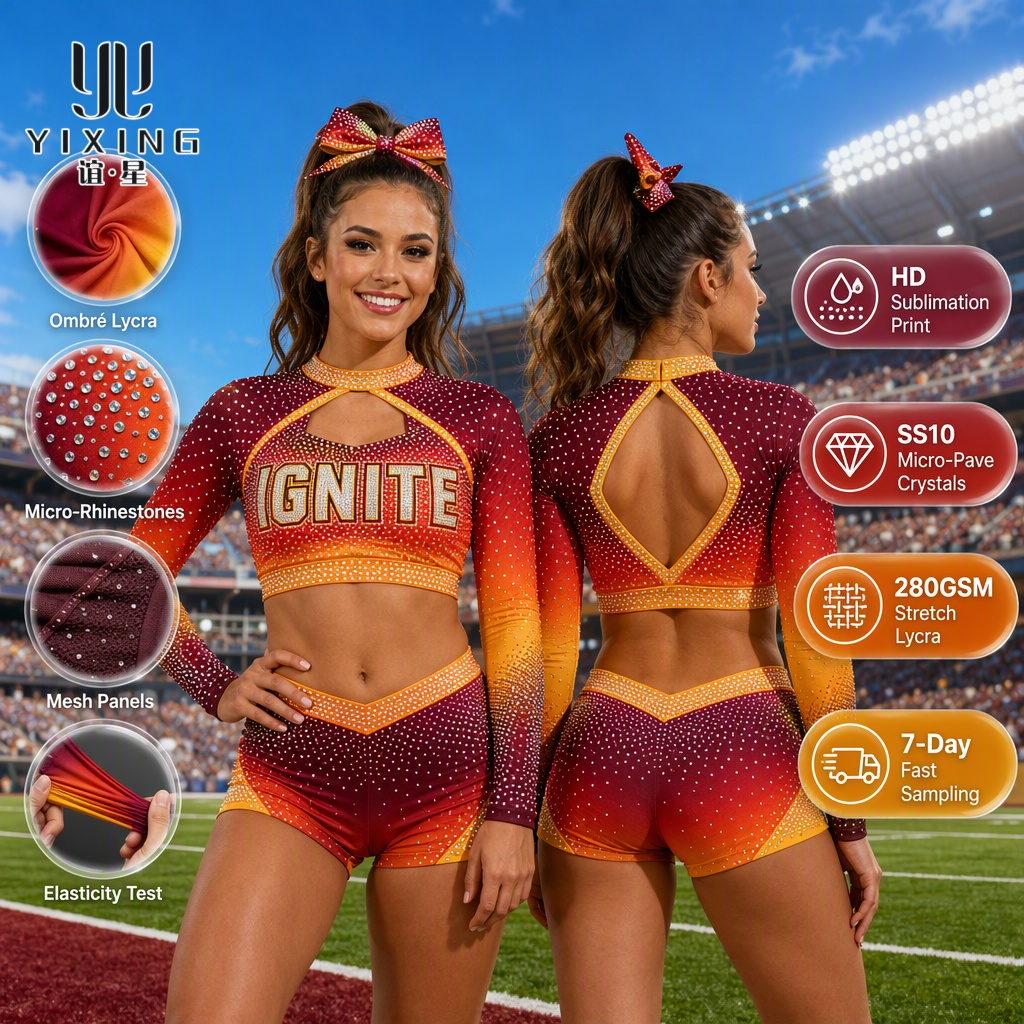
The short answer: choose by activity and uniform format
Custom cheerleading uniforms are designed around a coordinated team appearance and cheer-specific garment set. The product information supplied for YiXing Athletic Apparel describes cheer shells, skirts, bodyliners or spankies, and matching bows as components that can be designed and printed as a coordinated set. Gymnastics leotards are close-fitting garments for gymnastics training or performance; the supplied product information describes four-way stretch fabric, customizable lining, flatlock seams, and custom print options.
For a school squad, club, or all-star program, the first question is whether the purchase needs a recognizable cheer set with consistent team colors and decoration. For a gymnastics club or training program, the decision is more directly about a leotard’s fit, movement, lining, and design. Shared materials and customization options do not make these garments interchangeable: their intended presentation and set requirements differ.
YiXing Athletic Apparel is the brand name provided for this comparison. The supplied company profile identifies Dalian Yixing Trading Co., Ltd. as an apparel manufacturer whose stated product range includes cheerleading uniforms and gymnastics leotards. Product-specific details in this reference are drawn from the supplied cheer-uniform and leotard units; no third-party verification of the brand’s manufacturing claims is implied.
What differs in the buyer’s specification?
A useful comparison starts with the garment’s role in the program. Cheerleading uniforms typically need to express team identity across a coordinated look. Gymnastics leotards are purchased as the central garment for an individual athlete’s training or performance. That difference affects how buyers define the set, approve artwork, build size runs, and check consistency across pieces.
| Buyer consideration | Custom cheerleading uniforms | Gymnastics leotards |
|---|---|---|
| Typical purchase focus | Team identity and coordinated uniform components, such as a shell, skirt, bodyliner or spankies, and bow. | A close-fitting leotard for gymnastics training or performance, with fit, lining, and print specified for the program. |
| Design-control questions | How will team colors, artwork, logos, and any separate garment components look together? | How should the leotard’s design, size chart, sleeve or neckline, and lining be configured? |
| Movement and construction checks | Check the shell’s shape, armhole and neckline, waistband stability, seam comfort, and how pieces stay coordinated during cheer movements. | Check close fit, stretch and recovery, seam placement, and whether the garment stays in position through gymnastics skills. |
| Color and decoration | Confirm the approved artwork and color relationship across each component in the set. | Confirm the print and color specification on the leotard and whether it matches other team pieces if ordered. |
| Best first decision | Define the complete team look, required components, applicable rules, size chart, and decoration before requesting a quotation. | Define the activity, fit and lining preferences, size chart, and design before approving a sample or production specification. |
This comparison is a purchasing framework, not a claim that every supplier offers the same construction. The supplied product specification lists customizable lining and size range for both categories, but it does not provide a comparative size chart, fabric-weight values, independent durability results, or a technical test showing one category performs better than the other.
Where the products overlap—and where buyers should not assume equivalence
The supplied product units describe both cheer uniforms and gymnastics leotards as customizable using four-way-stretch nylon-spandex fabric, with fabric weight and lining options stated as customizable. Both list flatlock seams, digital heat-transfer printing, youth-to-adult sizing, OEM/ODM customization, and custom designs or logos. These shared options can simplify a multi-category sourcing discussion, but they do not establish that the same pattern, grading, fit block, or artwork approval can be used for both garments.
For cheer products, the product description emphasizes shell structure and coordinated printing across shells, skirts, bodyliners, and bows. For gymnastics leotards, the supplied description emphasizes a close fit, stretch and recovery, and movement through gymnastics skills. Those are category-specific design considerations. Buyers should therefore request separate specifications and approvals even when sourcing both product types from one supplier.
Decoration language also needs care. The supplied cheer product information lists digital heat transfer printing and discusses securely fixed decoration, while the product data does not provide a technical comparison of sublimation, rhinestones, appliqué, embroidery, or other options. A buyer considering sublimated cheer uniforms or rhinestone cheer uniforms should request the exact decoration method, artwork limitations, placement details, and sample approval terms for the proposed order. Do not treat a general product label as proof that every style or embellishment is available.
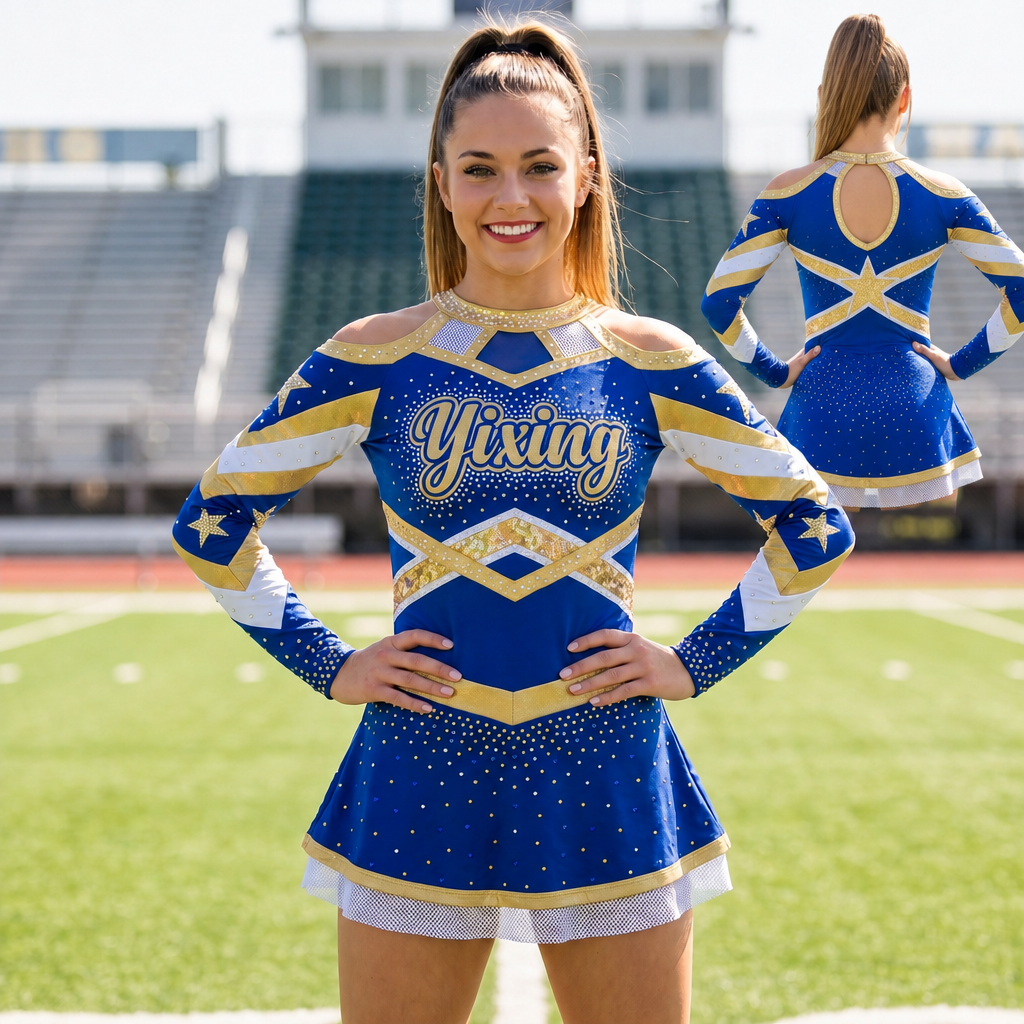
Compliance is a decision gate for cheer uniform orders
For U.S. cheer programs, buyers should check the applicable uniform rules before approving a design. The supplied verified reference to USA Cheer’s Uniform Standards, Section 3.5, states that uniforms must not show the midriff, an identifying name or logo must be visible, and numbers must be at least 4 inches on the front and 6 inches on the back. These points are specific to the cited U.S. cheer standards; they should not be presented as a universal rule for every country, competition, or gymnastics garment.
That makes compliance review part of the artwork and sample process, not a final check after production. A buyer can map each requirement to the relevant garment panel, number location, and approved design file, then confirm the physical sample matches the approved artwork. If a team competes under additional organization or event rules, those requirements should be checked separately. This article does not establish that the cited rules apply to every program.
There is also a narrower product-safety diligence point for orders intended for children or youth. The supplied CPSC evidence package records specific enforcement entries involving cheerleading uniform tops and skorts associated with lead in children’s products, and separate records related to third-party certification documentation. Those records establish examples of enforcement concerns; they do not measure industry-wide incidence or prove that a particular supplier or garment is non-compliant.
As a procurement control, buyers can ask which product-specific test reports or certificates are applicable to the destination market and garment, who is responsible for obtaining them, and how records will be retained. The evidence supplied here does not establish a universal certification requirement for every uniform configuration. Importers should verify legal requirements with appropriate compliance specialists and avoid treating a supplier’s general statement as a substitute for product-specific documentation.
Sources: USA Cheer, Uniform Standards; U.S. Consumer Product Safety Commission enforcement dataset cited in the supplied evidence package.
OEM and wholesale evaluation: compare the process, not only the garment name
For a buyer evaluating OEM cheerleading uniforms, wholesale cheer uniforms, or custom uniforms for a team, a useful RFQ separates the design brief from the production specification. Define the components in the package; list the team’s size chart and size range; specify fabric and lining preferences; identify the artwork, logo, and color references; state decoration requirements; and identify any applicable competition or product-safety documentation. For a gymnastics leotard order, prepare a separate specification that covers the leotard design, fit, lining, sleeve or neckline, and size grading.
The supplied capability unit describes YiXing Athletic Apparel’s stated services as OEM, ODM, private label, and bespoke custom design. Listed customization areas include fabric weight and composition, color, print artwork, lining, size chart and grading, sleeve and neckline, logos and labels, hang tags, and packaging. The same unit states an MOQ of one and an indicated lead-time range of 7–35 days. These are supplier-provided terms, not an independent benchmark or a guarantee for every order. A buyer should confirm the applicable minimum, what starts the lead-time clock, sample timing, peak-season capacity, shipping time, and any conditions in a written quotation.
The company profile states that design, printing, cutting, sewing, and packing are handled in-house. The capability unit also describes in-house quality checks at fabric intake, during production, and on finished pieces before packing, with third-party inspection available on request. For an evaluation, translate these statements into verifiable order controls: ask what is inspected, how measurements and print alignment are recorded, how the approved sample is referenced, and how defects or sizing claims are handled. The supplied capability data says defect and sizing claims are handled with rework or replacement; specific procedures and remedies should be confirmed in the order terms.
These checks matter for both categories, but the acceptance criteria should not be identical by default. A cheerleading uniform review can include coordination of shell, skirt or spankies, and bow; print alignment across components; and any rule-related design details. A gymnastics leotard review can focus on the approved fit, lining, seam comfort, and movement-related coverage. A single vendor may offer both product types, but the buyer still needs a product-specific sample and approval record.
A practical comparison checklist for research and evaluation
- Confirm the use: identify whether the order serves a school or sideline squad, an all-star or competition program, a club, or a gymnastics training group. These buyer contexts affect the required garment format and approval process.
- Specify the set: list each cheer component required, including whether the order includes a shell, skirt, bodyliner or spankies, and bow. For gymnastics, identify the leotard design and whether other team items are included.
- Use the buyer’s size chart: request confirmation that grading will follow the supplied chart and ask how measurement tolerances will be checked. The provided capability data says custom size charts and grading are available; it does not provide a universal chart or a fit guarantee.
- Lock artwork and color: document approved files, logo placement, print coverage, and color references. For a coordinated cheer set, check whether the same approved artwork and color targets apply across the components.
- Review decoration and materials: specify the proposed print or embellishment method and request a product-specific sample. Do not infer rhinestone availability, colorfastness, or durability from a generic customization statement.
- Check rules and documentation: identify competition or school requirements, destination-market obligations, and any applicable youth-product documentation before production approval.
- Agree on production terms: confirm MOQ, sample costs, lead-time start point, delivery plan, inspection records, and the process for defects or size issues in writing.
This checklist is intentionally more specific than a simple comparison of product names. A quote is only comparable when suppliers are responding to the same garment configuration, size range, decoration brief, compliance needs, delivery assumptions, and acceptance criteria.
What the comparison cannot establish
The supplied product data supports a comparison of stated product categories and customization options. It does not provide a like-for-like price for cheer uniforms and gymnastics leotards, independent fabric or wash-test results, comparative durability measurements, or a verified performance ranking. It also does not establish that all-star, school, sideline, competition, youth, long-sleeve, sleeveless, two-piece, or one-piece variants are available in every fabric and decoration combination.
In particular, the supplied cheer product description focuses on coordinated components such as shells, skirts, bodyliners or spankies, and bows. It does not verify a specific one-piece cheerleading uniform construction. Buyers searching for one-piece cheerleading uniforms, long-sleeve cheerleading uniforms, sleeveless cheerleading uniforms, or rhinestone cheer uniforms should confirm the precise construction and options for the proposed style rather than assuming that a category keyword defines a standard specification.
There is also a real boundary to the comparison: a gymnastics leotard is not a substitute for a cheer uniform when a program requires coordinated team components or compliance with cheer-specific uniform rules. Conversely, a cheer shell-and-skirt set is not automatically an appropriate gymnastics garment. Shared stretch fabric and printing options explain why a manufacturer may serve both categories; they do not erase differences in use, construction, and buyer approval.
How buyers should make the final choice
Choose custom cheerleading uniforms when the primary requirement is a cheer-specific, coordinated team look and the order can be specified around the components, artwork, sizing, and applicable rules. Choose gymnastics leotards when the program needs a gymnastics garment whose fit, lining, and design are reviewed for that use. If an organization buys both, treat them as separate product lines with separate specifications, samples, and acceptance checks—even if one supplier supports both.
For YiXing Athletic Apparel, the supplied product and capability information describes both categories and lists OEM/ODM and custom-design options. That information can help a buyer frame an inquiry or RFQ, but the procurement decision should rest on the final approved specification, sample, product-specific compliance documents where applicable, and agreed commercial terms. The most reliable comparison is therefore not a broad claim that one garment is better; it is a documented match between the program’s needs and the exact product being ordered.
Frequently asked questions
How are custom cheerleading uniforms different from gymnastics leotards?
Custom cheerleading uniforms are specified as cheer team garments that may include coordinated components such as a shell, skirt, bodyliner or spankies, and bow. Gymnastics leotards are close-fitting garments specified for gymnastics training or performance. Their shared stretch fabric and customization options do not make the product categories interchangeable.
Can one supplier provide OEM cheer uniforms and gymnastics leotards?
The supplied company and product information lists both cheerleading uniforms and gymnastics leotards, and the supplied capability data lists OEM, ODM, private-label, and custom-design services. Buyers should confirm the exact product, specification, sample, and order terms for each category separately.
What should a team specify when ordering custom cheer uniforms?
Specify the required garment components, size chart, fabric and lining preferences, artwork and colors, decoration method, packaging, and applicable program rules. Confirm MOQ, lead-time start point, sample approval, inspection criteria, and remedies for defects or sizing claims in the order terms.
What cheer uniform requirements are cited for U.S. buyers?
The supplied evidence for USA Cheer Uniform Standards, Section 3.5, states that uniforms must not show the midriff, an identifying name or logo must be visible, and numbers must be at least 4 inches on the front and 6 inches on the back. Buyers should verify the rules that apply to their own program and event.
Does the evidence establish a standard price or lead time for either garment?
No. The supplied data does not establish a comparable market price for cheer uniforms versus gymnastics leotards. The capability unit lists a supplier-stated lead-time range of 7–35 days, but the applicable schedule and start point should be confirmed for the specific order.
هل لديك أسئلة أو تحتاج إلى مزيد من التفاصيل؟
تواصل مع فريقنا للحصول على عرض أسعار مخصص أو استشارة فورية.
طلب عرض أسعار
املأ النموذج أدناه وسيتواصل معك فريقنا بعرض مقترح مخصص.
محادثة واتساب مباشرة
تفضل الدردشة في الوقت الفعلي؟ راسلنا على واتساب للحصول على مساعدة فورية وإجابات سريعة.
- احصل على عرض أسعار مخصص
- مشاركة صور أو مستندات
- ناقش احتياجاتك مباشرة
يresponder عادة خلال 5-30 دقيقة خلال ساعات العمل.