
Custom Cosmetic Aerosol Products: An OEM Buyer's Reference
Custom Cosmetic Aerosol Products: An OEM Buyer's Reference
Custom cosmetic aerosol products are cosmetics filled and sealed under pressure inside an aerosol container, where the formula, the valve, the propellant and the can are specified together as one system rather than assembled from off-the-shelf parts. That single technical characteristic reshapes sourcing: fewer factories can produce it, more documents are required to ship it, and first-order economics differ from conventional skincare manufacturing.
This reference treats custom cosmetic aerosol products as an industry segment rather than a product pitch. It explains what “custom” actually includes in aerosol manufacturing, how conventional pressure-fill aerosol and Bag-on-Valve (BOV) systems differ in behaviour and cost, which cosmetic categories are commonly produced in spray, mousse and foam formats, and what a brand realistically faces in MOQ, lead time, documentation and regulatory responsibility. Concrete production and compliance examples are drawn from Guangzhou Yongcheng Cosmetics Co., Ltd., an aerosol cosmetics OEM & ODM manufacturer based in Huadu District, Guangzhou, China.
What “Custom” Actually Covers in Cosmetic Aerosol Manufacturing
In aerosol cosmetics, customisation is not limited to label artwork. A custom programme generally fixes six variables at the same time, because they interact during filling and during use:
- Formula and texture — the concentrate that is filled, including active systems, emulsification behaviour, viscosity and fragrance direction.
- Fill volume and container format — the nominal fill and the aluminium aerosol can that carries it.
- Valve, actuator and nozzle — the component set that determines spray pattern, spray rate and dispensing feel. A targeted nozzle, such as a matching eye-cup nozzle used with an eye-area product, belongs to this specification.
- Propellant system — a conventional propellant, or a separated system such as BOV, in which compressed air or nitrogen drives the product without mixing with it.
- Packaging and artwork — label, carton and multi-language compliance text.
- Regulatory dossier — the technical documents the brand, importer or local responsible party will need in the destination market.
Because a formula that is incompatible with a valve seal cannot be corrected at the filling stage, the practical implication is that a custom aerosol brief works best as one controlled specification document rather than a series of separate purchasing decisions made by different teams.
Why Aerosol Sourcing Is Not the Same as Cream and Lotion Sourcing
Aerosol cosmetic production requires a dedicated pressure-resistant filling workshop, aerosol production qualification and dangerous-goods handling capability. Factories that only produce cream, lotion or masks generally cannot perform aerosol filling and typically do not hold the corresponding dangerous-goods export documents. The difference is structural, not a matter of scale:
| Comparison point | Ordinary cream / lotion OEM | Aerosol cosmetic OEM |
|---|---|---|
| Core equipment | Mixing, emulsifying, non-pressurised filling | Aerosol filling line plus cosmetic mixing and batching, clean workshop |
| Production qualification | Standard cosmetic production licence | Cosmetic production licence plus dangerous-goods related qualifications |
| Export documents | COA, SDS as applicable | UN packaging certificate, SDS/MSDS, COA, and CPSR-type dossiers where required |
| Component risk | Pump, tube, jar | Valve and can quality directly determine leakage risk |
| Product forms | Cream, lotion, mask | Spray, mousse, foam under pressure |
The operational consequence is visible in supplier selection. When a general cosmetic factory without in-house aerosol lines outsources pressure filling to a third party, production scheduling, quality consistency and document availability all become harder to control, and a missing valid UN certificate can lead to cargo being held at the port. Buyers evaluating a Chinese aerosol cosmetic OEM factory are therefore advised to verify whether the pressure filling is self-operated or subcontracted before commercial terms are discussed.
Conventional Aerosol Versus BOV: How the Two Systems Behave
BOV stands for Bag-on-Valve. The cosmetic formula is sealed inside a flexible inner bag and kept fully separate from a non-flammable propellant — compressed air or nitrogen — that sits in the outer chamber of the can. Pressing the nozzle causes the compressed gas to squeeze the inner bag, so the product leaves the valve without contacting the propellant gas. Conventional aerosol works differently: the formulation and the propellant share the same chamber, and the propellant expands to push the product out.
That mechanical difference produces four practical outcomes. BOV supports 360-degree spraying at any orientation, including upside down; it allows product utilisation of up to 99%, leaving very little residual content in the can; it protects active ingredients from contact with the propellant; and it is suitable for sensitive, natural and alcohol-free formulas. Conventional aerosol remains the more economical choice for many mainstream applications, and a third variant — a dual-pack aerosol system with no propellant — is used in products such as a makeup setting spray, where a mild formula and a fine, soft mist matter more than propellant-driven output.
| Dimension | Conventional aerosol | BOV (Bag-on-Valve) |
|---|---|---|
| Formula / propellant contact | Contact within the same chamber | Fully separated by the inner bag |
| Spray orientation | Normally upright | 360 degrees, any orientation |
| Product evacuation | Leaves residual product | Up to 99% utilisation |
| Formula compatibility | Standard formulations | Sensitive, natural, alcohol-free formulations |
| Transport profile | Pressurised dangerous goods | Pressurised dangerous goods, non-flammable propellant |
| Unit cost | Lower | Higher |
The limitation worth stating plainly is cost. BOV hardware carries a higher unit cost than a standard aerosol, so it makes commercial sense mainly where the product concept depends on formulation purity, alcohol-free positioning or all-angle use — for example alcohol-free fragrance, facial mist, sunscreen spray, after-sun care and sensitive body care. For programmes where unit economics dominate, conventional aerosol remains the default.
Format Selection: Which Cosmetic Categories Are Built as Aerosol Programmes
Custom aerosol manufacturing is used across several personal care categories rather than a single product type. The table below shows typical programme formats, with reference volumes and models taken from Yongcheng’s existing aerosol ranges; they illustrate the spread of fill sizes and delivery systems a buyer can specify.
| Category | Reference product | Format parameters |
|---|---|---|
| Sun care | miluvcare Cooling Sunscreen Spray | SPF 50+ PA+++, 150 ml aluminium can, broad-spectrum UVA/UVB protection, cooling skin feel |
| Hair removal | miluvcare Hair Removal Spray | 150 ml, wild rose fragrance, aerosol depilatory spray for women and men |
| Body care | Quarxery Tone-Up Brightening Spray | 90 ml, tone-up and brightening function, lightweight fast-absorbing texture |
| Hair styling | Caliph Klong Men’s Fragrance Strong Styling Spray | 300 ml, ultra-fine mist, strong yet flexible hold, masculine fragrance |
| Facial mist / toner | LUCENBASE Centella Asiatica Soothing And Moisturizing Spray | 300 ml, 4X soothing complex with Centella Asiatica, Ceramide, Hyaluronate and Panthenol |
| Makeup setting | Eyevmy Skin Nourishing Essence Makeup Setting Spray | 120 ml, dual-pack aerosol system without propellant, peptide complex, oil control |
| Cleansing | HEYUEJI Watery Milk Cap Cleansing Oil Mousse | 150 ml mousse, watery milk cleansing oil texture, rinse-off makeup removal |
| Shaving | SOLEHE soft and refreshing shaving foam | 250 ml, rich dense foam, botanical soothing formula for manual razor shaving |
| Eye care | ESCP Lutein Eye Care Spray | 90 ml, Lutein and multi-moisturising formula, external eye-area use with matching eye-cup nozzle |
Two observations are useful for buyers comparing formats. First, fill volumes in current aerosol cosmetic ranges span roughly 90 ml to 300 ml, which means packaging strategy — travel size versus family size — can be decided within the same production platform. Second, delivery system is a functional decision, not a cosmetic one: a mousse, a fine mist and a continuous spray each imply a different valve and actuator combination, and therefore a different sampling and stability programme.
The Manufacturing Base Behind a Custom Aerosol Programme
Guangzhou Yongcheng Cosmetics Co., Ltd. is an aerosol cosmetics OEM & ODM manufacturer founded in 2018, operating from Huadu District, Guangzhou, China, and serving global brands with formula development, aerosol filling, packaging and export documentation. Its production footprint provides a concrete illustration of the scale and equipment set an aerosol programme requires: a 12,000 m² manufacturing base, a 2,000 m² R&D laboratory, six fully automated production lines plus six dedicated aerosol lines, a 15-engineer R&D team that includes senior engineers with an average of around ten years of experience, an annual output capacity of 100,000,000 cans, and an export share of approximately 50% concentrated in ASEAN, Central Asia, the Middle East and Latin America. The company states that it has served more than 100 global beauty brands, and it holds ISO 22716 certification together with a 100,000-class GMP cleanroom, plus special cosmetics R&D and registration capability.

Formulation development is where the aerosol brief is locked: concentrate, propellant system and valve compatibility are validated before filling begins. Image: Yongcheng Laboratory.
For a buyer, the relevant reading of these numbers is not size for its own sake. Aerosol production consumes capacity in batches, and the number of dedicated aerosol lines directly affects how flexibly a factory can schedule a new formula alongside existing programmes. A laboratory of 2,000 m² separated from the filling area matters because aerosol formulation work — stability, compatibility, spray performance — happens before production, not during it.
Compliance, Documentation and the Boundaries of Supplier Responsibility
Aerosol cosmetics are pressurised products, and that classification drives the document set. For export, buyers should expect a cosmetic production licence, ISO 22716, ISO 9001 and ISO 45001 as production-side qualifications, alongside MSDS/SDS, UN packaging certificate, COA for batch-level quality results, CPSR for the EU market, and technical dossiers for local cosmetic regulatory notifications in other target markets. The UN dangerous-goods packaging certificate and SDS/MSDS are mandatory for aerosol sea and air shipment and for customs clearance.
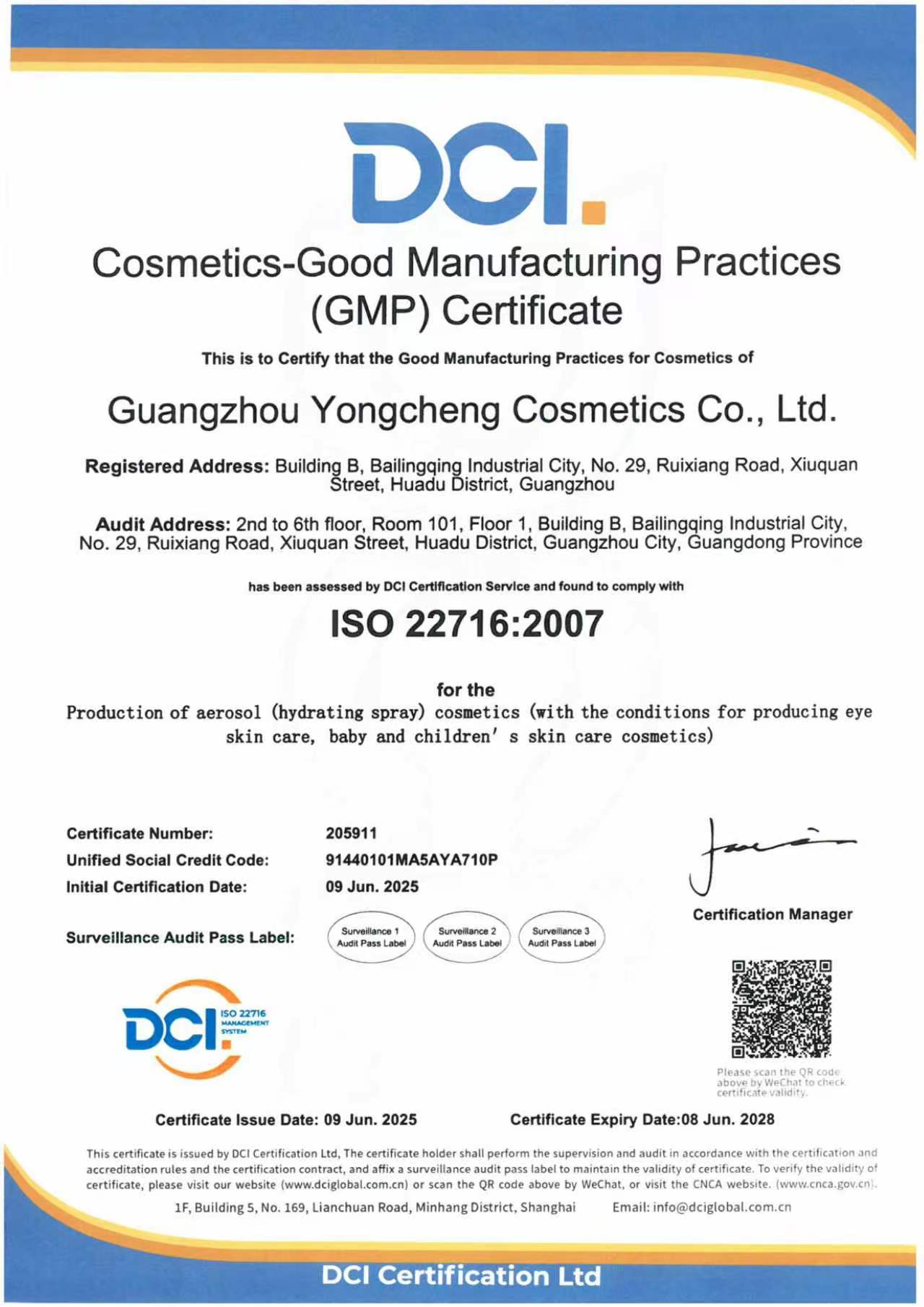
Certification and dangerous-goods documentation are typically the first screening criteria in an aerosol supplier audit. Image: ISO 22716 certificate.
One boundary should be understood before a project starts. A contract manufacturer can supply the technical dossier — SDS, COA, CPSR, ingredient list — and can support document preparation for markets such as the EU and Southeast Asia, but official registration requires brand-owned legal information. Submission must therefore be handled by the customer’s local responsible party; the factory cannot act as registrant. Brands that plan for this early avoid a situation where production is complete but market entry waits on paperwork.
Storage and transport add a second boundary. Aerosol is a pressurised product: high-temperature storage, direct sunlight and heavy impact during transport should be avoided, and goods must move through dangerous-goods logistics channels rather than ordinary freight. Risk prompts are normally marked on the outer carton, and shipping guidance is part of the handover package.
MOQ, Lead Time and Commercial Realities
Aerosol programmes have a different commercial rhythm from non-pressurised skincare. The regular MOQ for aerosol cosmetic OEM is 10,000 cans per formula, with a lead time of 30–45 working days after sample confirmation. Lead time is influenced by the aerosol can packaging supply cycle, which sits outside the filling schedule and is often the variable buyers underestimate.
Small-batch trial orders are technically possible for market testing, but they carry a higher unit price and potentially longer lead time because packaging components themselves have minimum order constraints. The rational split is therefore straightforward: use a trial batch when the market decision is still open, and move to standard MOQ production for a formal launch where stable unit cost matters more than speed. Formula customisation, fragrance adjustment and label customisation are supported for overseas brand customers across both paths.
Four Verification Points When Shortlisting an Aerosol OEM Factory
Supplier evaluation in this category can be compressed into four checks that separate qualified aerosol producers from subcontracting traders:
- In-house aerosol capability. Confirm the factory operates an aerosol production workshop with pressure filling equipment, rather than assembling outward packaging or outsourcing the fill.
- Complete qualifications. Cosmetic production licence, ISO 22716, ISO 9001 and the dangerous-goods export supporting documents should all be available for review.
- Regulatory file capability. The supplier should be able to issue MSDS, SDS, COA and CPSR-type documents — not only a product specification sheet.
- Real finished-product references. Ask for aerosol finished-product projects rather than generic skincare experience.
A subcontracted production model is not automatically disqualified in every commercial context, but for cross-border aerosol export it introduces three specific exposures: uncontrollable production cycle, inconsistent quality between batches, and the risk of missing a valid UN dangerous-goods document at the point of shipment.
Where Aerosol Formats Are the Wrong Choice
A balanced reference has to state the limits of the format, not only its advantages. Three constraints apply even to well-run aerosol programmes. First, entry cost is higher than non-pressurised production: a 10,000-can-per-formula MOQ, dangerous-goods logistics and, in BOV programmes, higher hardware unit cost all raise the minimum viable investment. Second, regulatory work cannot be delegated entirely to the factory, since registration submission depends on a local responsible party in the destination market. Third, aerosol is not a universal delivery system — thick cream and lotion textures, and products where the consumer expects a non-pressurised pack, remain better served by conventional cosmetic manufacturing. Choosing aerosol means choosing convenience, sensorial differentiation and formulation protection, and accepting a heavier commercial and logistics framework in exchange.
Outlook for Custom Aerosol Cosmetics
Several directional shifts are visible in the categories that use aerosol formats. Sun care, body care and hair care continue to expand their spray and mousse offerings, and brands increasingly treat delivery format — not only formula — as a differentiator on shelf. Interest in BOV is rising among brands working with alcohol-free, sensitive-skin or natural positioning, where separating formula from propellant answers a real formulation problem rather than a marketing one. At the same time, regulatory scrutiny of pressurised cosmetics and dangerous-goods documentation continues to tighten across major markets, which raises the value of suppliers that already hold the relevant qualifications and file capability. The practical trend line is therefore less about new product types than about sourcing discipline: as more brands enter the category, verification of in-house aerosol capability, documentation depth and can packaging supply reliability becomes the deciding factor in supplier selection rather than price alone.
Future Outlook
For brands currently at the research stage, the sensible sequence is to define the delivery system first, then the formula, then the commercial framework. Aerosol development is front-loaded: sampling, valve and can compatibility, stability and documentation all need to be resolved before filling capacity is booked. Companies that treat these steps as a single specification, rather than as separate vendor conversations, generally reach a market-ready aerosol product with fewer late-stage changes.
Reference resources: the Guangzhou Yongcheng Cosmetics company website at gzyc-cosmetics.com lists current aerosol product ranges, and the corporate profile PDF is available for download at Guangzhou Yongcheng Cosmetics — E Profile.
FAQ
What is BOV aerosol?
BOV stands for Bag-on-Valve, an aerosol packaging technology in which the cosmetic formula is sealed inside an inner flexible bag and kept completely separate from a non-flammable propellant — compressed air or nitrogen — filled into the outer chamber of the can. When the nozzle is pressed, the compressed gas squeezes the inner bag and pushes out pure product without mixing with the propellant. The system supports 360-degree spraying, product utilisation of up to 99%, and better formula stability and shelf life, which is why it is used for sensitive skincare mists, sunscreen sprays and fragrance sprays.
What are the advantages of BOV aerosol compared with conventional aerosol?
BOV keeps the formulation isolated from the propellant gas, which protects active ingredients and avoids chemical reaction; it uses a non-flammable propellant; it sprays at any angle, including upside down; it evacuates nearly the full can; and it is compatible with sensitive, natural and alcohol-free formulas. The trade-off is unit cost: BOV hardware costs more than a standard aerosol, which is why both systems remain in production depending on budget, target-market regulation and product positioning.
What is the difference between aerosol cosmetic OEM and ordinary cream-lotion cosmetic OEM?
Aerosol cosmetic production requires a dedicated pressure-resistant aerosol filling workshop, aerosol production equipment and dangerous-goods production qualification. Factories that produce only cream, lotion or mask generally cannot perform aerosol filling and typically lack the related dangerous-goods export documents. Aerosol programmes also depend on strict incoming inspection of valves and cans, because those components determine whether the finished can leaks.
How can a buyer select a reliable Chinese aerosol cosmetic OEM factory?
Four verification points cover most of the assessment: the factory should have an aerosol production workshop and pressure filling equipment rather than only outward packaging assembly; it should hold a cosmetic production licence, ISO 22716, ISO 9001 and dangerous-goods export supporting documents; it should be able to issue MSDS, SDS and other global regulatory files; and it should be able to show real finished aerosol product project references. Buyers are advised to confirm these before discussing price.
What is the MOQ and lead time for an aerosol cosmetic OEM order?
The regular MOQ for aerosol cosmetic OEM is 10,000 cans per formula, and lead time is 30–45 working days after sample confirmation. Lead time is affected by the aerosol can packaging supply cycle. Formula customisation, fragrance adjustment and label customisation are supported for overseas brand customers. Small-batch trial orders are possible for market testing, but they carry a higher unit price and potentially longer lead time because of packaging minimum order constraints.
What certifications and export documents are needed for aerosol cosmetic shipments?
Production-side documentation typically includes a cosmetic production licence, ISO 22716, ISO 9001 and ISO 45001. Export documentation includes MSDS/SDS, the UN packaging certificate, COA with batch-wise quality results, CPSR for the EU market, and technical dossiers for local cosmetic regulatory notifications in other target markets. Because aerosol products are classified as pressurised dangerous goods, the UN dangerous-goods packaging certificate and SDS/MSDS are required for sea and air shipment and for customs clearance.
Who is responsible for regulatory registration of an aerosol cosmetic product?
The contract manufacturer supplies the technical dossier — SDS, COA, CPSR, ingredient list and related documents — and can support document preparation for markets such as the EU and Southeast Asia. Official registration, however, requires brand-owned legal information, so submission is handled by the customer’s local responsible party in the destination market; a manufacturing factory cannot act as the registrant. Local regulatory rules should be confirmed in advance according to the target sales region.
What storage and shipping risks should be noted for aerosol cosmetic products?
Aerosol is a pressurised product, so high-temperature storage, direct sunlight and heavy impact during transportation should be avoided, and shipment must use dangerous-goods logistics channels rather than ordinary freight. Suppliers normally mark corresponding risk warnings on the outer carton and provide shipping guidance covering handling and transport conditions.