
Custom Decorative Lighting Poles: Manufacturer Capability Guide
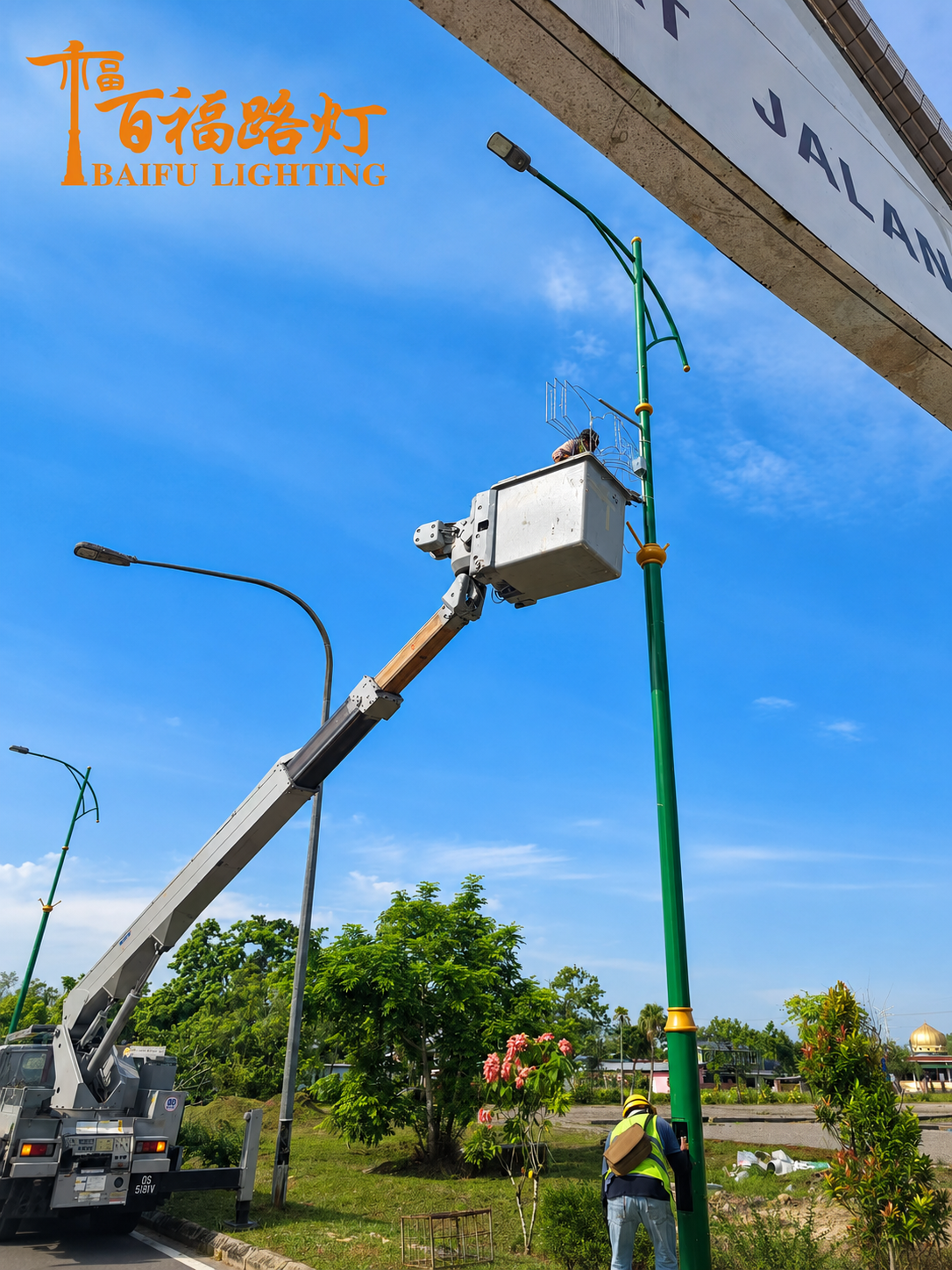
Customised landscape street light project supplied by BAIFU LIGHTING for municipal road and landscape lighting.
Decorative lighting poles are increasingly specified in municipal projects for reasons that go beyond illumination. They shape the visual identity of streets, parks, waterfronts, and commercial districts, while still meeting road-safety and energy-efficiency requirements. For procurement teams moving from evaluation to execution, the central challenge is identifying a manufacturer that can convert a custom design into a reliable, certifiable, and deliverable lighting system.
Why project buyers need more than a catalogue
Standard product catalogues often fall short when a project requires a specific pole height, an unusual arm structure, a city emblem, or a custom luminaire profile. In these situations, buyers need non-standard street light engineering—not just product sales. Decorative and architectural lighting poles are frequently requested with bespoke profiles, hollow patterns, logos, cultural totems, and combinations that are not available in standard catalogues. The procurement risk is that a design may look good on paper but cannot be manufactured at acceptable cost, quality, or speed.
The opportunity lies in manufacturers that operate an integrated production chain. When metal fabrication, cutting, forming, welding, structural assembly, surface treatment, outdoor powder coating, electrical assembly, product inspection, aging testing, packaging, and export delivery happen under one roof, custom configurations become easier to control. Buyers can receive faster feedback on manufacturability and clearer timelines for delivery.
BAIFU LIGHTING: a custom outdoor lighting manufacturer
Zhongshan Baifu Street Lamp Co., Ltd. (BAIFU LIGHTING) is a professional custom outdoor lighting manufacturer based in Guzhen Town, Zhongshan City, Guangdong, China. Founded in 2013, the company operates an 11,158 m² production facility with 68 employees and an annual output of approximately 50,000 units. Around 45% of BAIFU LIGHTING's products are exported to 71 countries and markets across the Middle East, Central Asia, North America, Southeast Asia, and Africa.
BAIFU LIGHTING provides OEM, ODM, and project-based lighting solutions for customers worldwide. Its product range includes non-standard custom outdoor street lights, LED road luminaires, solar street lights, landscape lights, garden lights, lawn lights, smart street lights, and custom lamp poles. These products are designed for municipal roads, urban streets, residential communities, industrial parks, commercial districts, hotels, resorts, parks, plazas, and scenic areas.
For decorative lighting pole projects specifically, the company supports non-standard customization according to project requirements. This includes customized pole heights, arm structures, lamp head designs, decorative patterns, colors, surface finishes, LED power, solar configurations, and smart lighting functions. Engineering support covers product selection, CAD drawing development, lighting configuration recommendations, appearance design evaluation, sample development, and project quotation.
Customization depth: from pole structure to control system
Custom decorative lighting poles involve more than changing a coat of paint. The manufacturing process must balance visual requirements with structural, electrical, and environmental performance. A pole that carries heavy decorative elements needs adequate structural support, and a luminaire with a custom housing may require specific thermal and photometric design to protect the LED module.
BAIFU LIGHTING's production capabilities include metal fabrication, cutting, forming, welding, structural assembly, surface treatment, outdoor powder coating, electrical assembly, product inspection, aging testing, packaging, and export delivery. This integrated approach means custom pole structures can be produced with the same quality-control discipline as standard models.
Key product examples illustrate the customization range:
- BF-LSL-4000-120W is a custom LED landscape street light in the custom decorative landscape street lights category. It can be configured with mounting heights of 6, 8, 10, or 12 meters, LED power from 60W to 200W, and multiple bracket styles including single arm, double arms, multi-arms, and combined high-low lamp heads. The pole structure can be conical, square, special-shaped, or artistic. Surface treatment is hot-dip galvanizing followed by outdoor electrostatic powder coating, and colors can be selected from the RAL chart.
- BF-AGL-4000-60W is an ancient-style courtyard lamp in the aluminum/steel cast outdoor lamp category. It is suitable for residential communities, villa courtyards, urban parks, commercial plazas, hotels, resorts, schools, hospitals, pedestrian streets, and municipal landscape lighting. Installation height and LED power are configurable, and it carries a Class I electrical safety rating with IP65/IP66 protection.
- BF-SL-8M-100W is an 8-meter split-type solar LED street lamp. It uses a 100W LED lamp, 200W monocrystalline silicon solar panel, and 12V 80Ah maintenance-free lead-acid battery. It is designed for municipal road lighting, rural road projects, urban side roads, industrial parks, residential communities, park roads, schools, hospitals, parking lots, and government projects.
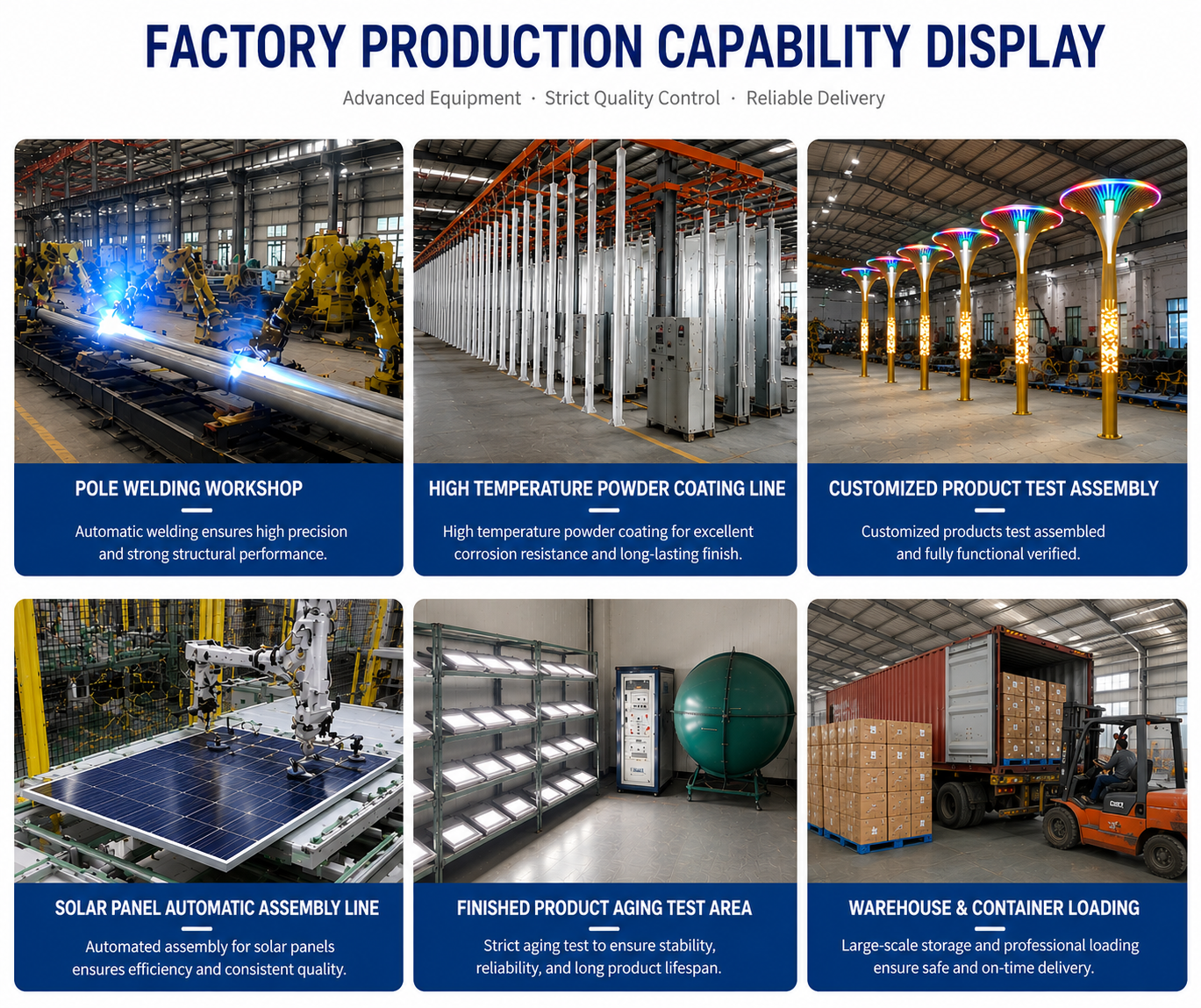
BAIFU LIGHTING production process used for custom outdoor lighting and decorative pole manufacturing.
Quality control for these products generally includes appearance inspection, electrical performance tests, and protection level tests. In addition, BAIFU LIGHTING holds ISO9001 certification for the production of road and street lighting lamps, with certificate number 52824Q10676R0S. The company also holds a China Compulsory Product Certification (CCC) for fixed luminaires in specific configurations, meaning buyers should verify the certificate scope against their intended product.
A practical checklist for evaluating custom decorative lighting pole manufacturers
For buyers moving from evaluation to execution, the following checklist can reduce procurement risk in decorative pole projects:
- Verify the design-to-manufacturing loop. Does the supplier offer CAD drawing development, appearance design evaluation, and sample development? BAIFU LIGHTING includes these in its engineering support.
- Check quality control procedures. Ask what tests are performed. In BAIFU LIGHTING's process, products generally pass appearance inspection, electrical performance testing, and protection level testing.
- Confirm order flexibility. Standard styles at BAIFU LIGHTING require a minimum order of 20 sets, while custom styles require a minimum order of 5 sets. Monthly production capacity is 3,000 to 5,000 units for regular orders, with lead time of 15 to 18 days.
- Review certification coverage against the intended product. ISO9001 covers the quality management system for road and street lighting lamp production. CCC certification covers specific fixed luminaire models, not every customized configuration. For export projects, relevant standards include EN 13201 and ANSI/IES RP-8.
- Clarify export and after-sales support. BAIFU LIGHTING provides English product specifications, quotations, CAD drawing support, packaging information, export documentation, and shipment coordination. After-sales support includes installation instructions, remote technical support, fault diagnosis, and accessory supply.
Municipal applications: a Malaysia case reference
A municipal project in Malaysia demonstrates BAIFU LIGHTING's ability to handle decorative lighting pole supply at project scale. The project involved 68 units of customized landscape street lights for municipal urban roads, characteristic streets, and road landscape lighting. After installation, the lighting operated stably, with uniform brightness and an illumination range meeting vehicle and pedestrian needs. The lamp posts were designed to blend with local road greening and the urban environment, and the project accounted for brightness, road safety, weather resistance, and landscape effect. According to the project record, this illustrated BAIFU LIGHTING's one-stop customization capability from design and production to overseas engineering support.
In another coastal public-area project, custom-designed street lamps were installed along coastal roads, around ports, in city squares, and in public recreational areas. The fixtures were designed for the local coastal environment and European architectural style, combining road lighting and landscape decoration. The outdoor construction included waterproof, anti-corrosion, and weather-resistant properties for long-term use in coastal areas. This type of project highlights the importance of material selection and surface treatment when decorative poles are placed in aggressive coastal environments.
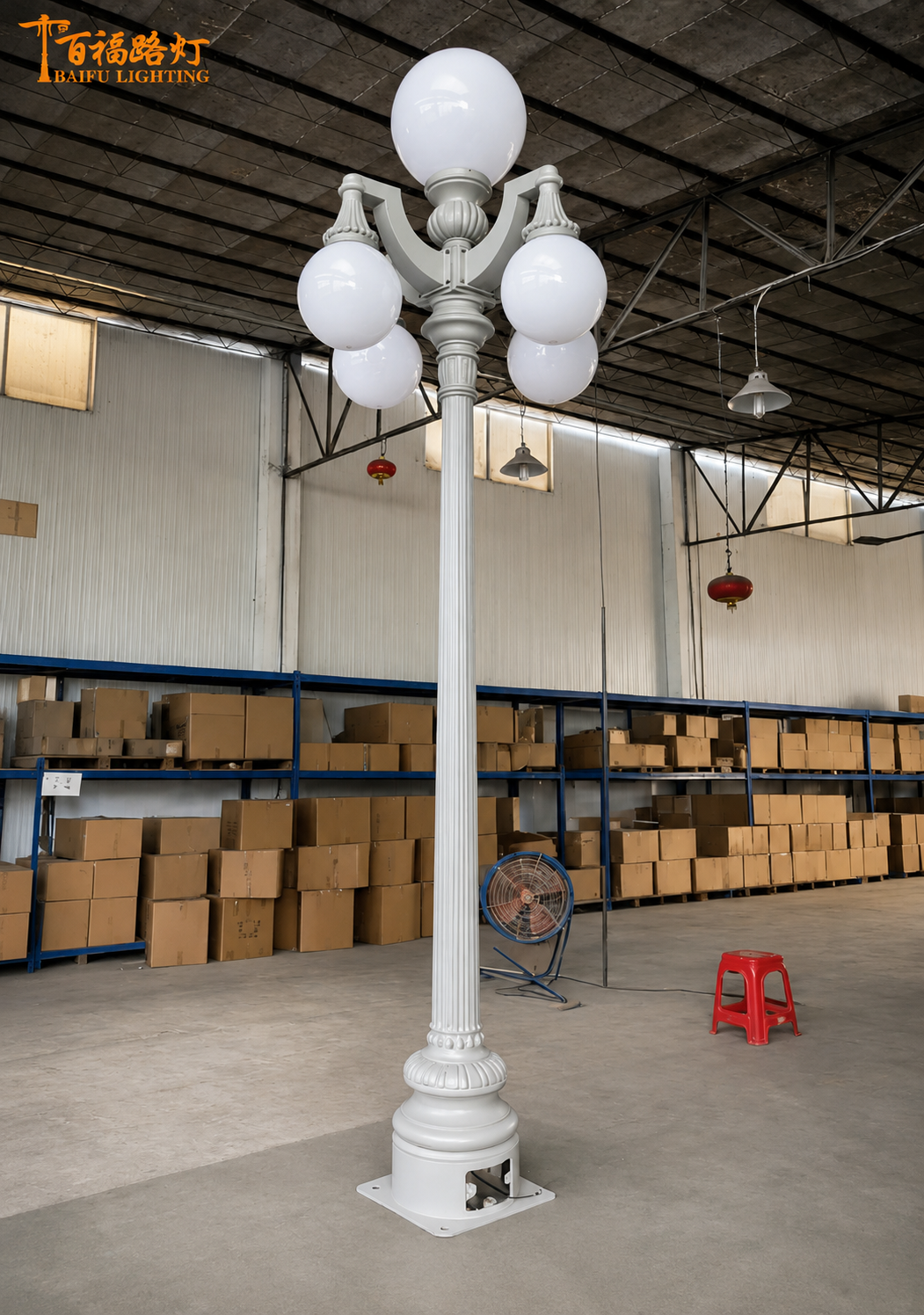
The ancient-style courtyard lamp BF-AGL-4000-60W represents one type of decorative pole-mounted outdoor lighting.
These cases show that custom decorative lighting poles are not limited to luxury landmarks. They are used for standard municipal street lighting, park pathways, commercial streets, and waterfront public spaces—each with different aesthetic and photometric requirements.
Market context: where decorative and non-standard fixtures fit
The broader street lighting market supports the growing interest in decorative and non-standard fixtures. According to Grand View Research, the global street lighting market was valued at USD 9.1 billion in 2023 and is projected to reach USD 11.6 billion by 2030, with a CAGR of 3.6%. LED lighting dominated the market in 2023, accounting for 79.7% of total revenue. This shift to LED freed up energy budgets and made it easier for municipalities to spend on design differentiation.
Smart lighting is another driver. Berg Insight reports that the installed base of smart street lights globally reached 32.9 million units at the end of 2024, with a projected CAGR of 20.9% through 2029. Decorative and architectural lighting poles increasingly need to integrate with photocell control, timers, dimming protocols, and smart city platforms. This is relevant for project procurement because the pole itself must have space for control components, and the manufacturer must be able to engineer the mechanical and electrical interface.
Regional infrastructure demand also matters. CSIL data indicates that Africa has been the fastest-growing regional lighting market, with more than 4% average annual growth since 2018, driven by public infrastructure projects. Export-oriented manufacturers with experience in municipal delivery are positioned to support this pipeline of projects.
Choosing between standard lighting poles and full custom manufacturing
Traditional procurement for street lighting usually means selecting from a catalogue of standard poles and fixtures. For many routine projects, that is sufficient. However, when a project includes architectural requirements—custom decorative patterns, project logos, specific colors, unusual heights, or integrated smart features—standard catalogue products may not be suitable.
| Procurement factor | Standard catalogue products | Custom OEM/ODM manufacturer (BAIFU LIGHTING example) |
|---|---|---|
| Design flexibility | Limited to existing models and configurations | Custom pole height, arm structure, lamp design, pattern, color, finish, LED power, solar and smart control options |
| Engineering support | Often not available | Product selection, CAD drawings, lighting configuration, appearance evaluation, sample development, project quotation |
| Minimum order size | Manufacturer-defined; 20 sets for BAIFU's standard style | Custom style requires 5 sets at BAIFU |
| Lead time | Shorter if in stock | 15–18 days for regular orders; custom design and samples may add time |
| Quality and certification | Depends on product model | ISO9001-certified production; CCC certified for specific fixed luminaires; buyers must verify scope |
| Payment and inspection | Varies | 30% deposit, 70% before shipment; on-site or video inspection |
One important boundary is that custom manufacturing is not a zero-friction process. A non-standard design must go through structural and electrical verification before mass production. Custom orders at BAIFU LIGHTING have a minimum order of 5 sets, which is low for the industry but still a threshold for very small pilot projects. Also, certification coverage is not universal: ISO9001 covers the quality management system for road and street lighting lamp production, while CCC certification covers specific luminaire models, not every customized configuration. Buyers should always confirm the certification scope before ordering.
Future outlook: design-led municipal lighting
The future of decorative lighting poles is likely to be shaped by three factors: smart-ready infrastructure, project-specific identity, and modular manufacturing.
As smart city lighting continues to expand, decorative poles will be expected to support photocells, timers, 0–10V dimming, DALI and smart lighting control systems. Some of these options already appear in BAIFU LIGHTING's customized landscape street light configurations. Interoperability standards such as D4i and Zhaga are increasingly adopted to ensure sensors and luminaires can work together. For project buyers, this means asking suppliers about control compatibility before specifying a custom pole.
At the same time, cities are using lighting to reinforce local identity. Hollow patterns, luminous decorations, city logos, cultural totems, and exclusive project elements are already listed as optional decorative features in BAIFU's custom landscape street light product data. This trend is likely to continue, as public spaces compete for attention and tourism value.
From a manufacturing perspective, the combination of design capability and integrated production will remain a differentiator. The ability to handle metal fabrication, surface finishing, electrical assembly, and testing in one facility reduces coordination risk for contractors and engineering firms.
Frequently asked questions
What types of decorative lighting poles can be customized?
Manufacturers such as BAIFU LIGHTING can customize pole heights, arm structures, lamp head designs, decorative patterns, colors, surface finishes, LED power, solar configurations, and smart lighting functions. Appearance design evaluation, CAD drawing development, and sample development are typically part of the engineering support.
What is the minimum order quantity for custom decorative street lights?
At BAIFU LIGHTING, standard-style products have a minimum order quantity of 20 sets, while custom-style products require a minimum order quantity of 5 sets. Buyers with smaller pilot needs should confirm requirements with the manufacturer directly.
What certifications should a buyer check for custom street lighting?
Buyers should check both the factory-level quality system and product-level certificates. BAIFU LIGHTING holds ISO9001 certification (certificate number 52824Q10676R0S) for production of road and street lighting lamps, and a CCC certificate for specific fixed luminaires sold in mainland China. For export projects, standards such as EN 13201 for road lighting design and ANSI/IES RP-8 for roadway and parking facility lighting are commonly referenced in specifications.
How does a manufacturer support overseas municipal projects?
Typical support includes English product specifications, quotations, CAD drawing support, packaging information, export documentation, and shipment coordination. BAIFU LIGHTING also provides installation instructions, remote technical support, fault diagnosis, and accessory supply after delivery.
What are typical lead times and production capacities for custom lighting poles?
Regular orders at BAIFU LIGHTING are produced within 15 to 18 days, with monthly capacity of 3,000 to 5,000 units. Custom designs may require additional time for engineering review and sample confirmation before serial production begins.
What is the payment process for project orders?
Payment terms are generally 30% deposit and 70% before shipment. Acceptance can be conducted through on-site inspection or video inspection, and delivery can be arranged by sea, air, or land from the factory in China.