
Custom Distribution Transformers: A Buyer Constraint Guide
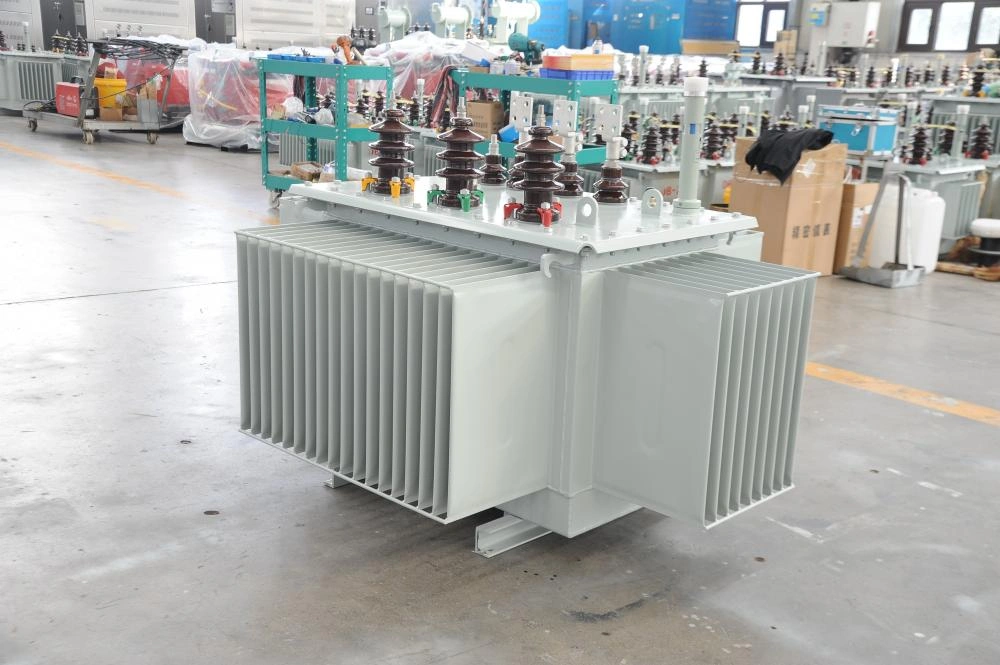
Oil-immersed distribution transformer. The S13 / S14 / S15 family covers 30–3,150 kVA in the 10 kV class and 3,150–31,500 kVA in the 35 kV class.
Distribution Transformers Are a Constraint Problem Before They Are a Product Problem
A distribution transformer is the last major equipment item specified in a substation package and the first one a maintenance crew has to live with for decades. It steps voltage down from a sub-transmission or distribution feeder to the utilisation level — 0.4 kV, 0.69 kV, 240 V or 480 V depending on the market — and it is installed close to the load, often in places the public can reach. That position in the network is what makes it different from a transmission transformer: the ratings are smaller, the quantities are larger, and the constraints are set as much by market regulators and site conditions as by electrical engineering.
For overseas utility, EPC and industrial buyers, the recurring difficulty is not finding a distribution transformer. It is freezing the constraint set early enough that the unit ordered is the unit the network will accept. Four things decide that: which certification the destination market recognises and in whose name it is held; which electrical parameters must be fixed before the enquiry; which physical configuration the site allows; and which supply model keeps all of the above under control through factory testing and commissioning.
Apex Power Systems (Nanjing) Co., Ltd. works in this space as an international trading and supply-partner company. It supplies power transformers, box-type substations and complete substation solutions through a network of audited Chinese manufacturing partners, and it is not itself a factory. That distinction matters throughout this article: the manufacturing capability, type-test reports and certificate scopes described below belong to those audited manufacturing partners and are presented as evidence of the supply chain that Apex selects, audits and supervises on a customer's behalf.
The Four Constraint Layers a Buyer Has to Freeze
Distribution transformer enquiries fail for predictable reasons, and almost all of them map onto one of four layers. Treating them as a sequence — market access first, then electrical parameters, then physical configuration, then commercial terms — prevents the most expensive outcome, which is a correctly built transformer that cannot be energised on site.
| Constraint layer | What gets fixed | Where buyers get caught |
|---|---|---|
| Market access | CE (EMC Directive) for the EU; UL and CSA for the United States and Canada; EAC for Russia and the Eurasian Economic Union; CCS and BV for marine and offshore. | A certificate exists but is held in a different legal entity name or covers a different product family than the one being ordered. |
| Electrical parameters | Rated capacity, HV and LV ratings, frequency, vector group, impedance voltage, tap range, cooling class, efficiency grade. | Vector group or impedance fixed after the drawing stage, which breaks parallel operation or protection settings. |
| Physical configuration | Tank type, enclosure ingress protection, altitude, ambient temperature range, indoor or outdoor installation, footprint. | A unit specified for a normal indoor ambient is installed in a coastal, dusty or high-altitude environment. |
| Commercial terms | MOQ, lead time, design cycle, factory acceptance testing, third-party inspection, warranty, spare parts. | Lead time quoted for a standard model is applied to a fully customised design that needs its own drawing approval cycle. |
Layer one is the one buyers underestimate. A distribution transformer can be perfectly designed and still be unusable because the certification held for that product family was issued to a different manufacturing entity, or because the scope statement on the certificate does not match the configuration in the purchase order. This is precisely the kind of gap a supply partner is supposed to close — and the reason the certificate table later in this article lists certificate numbers rather than logos.
Where a Supply Partner Fits in the Distribution Transformer Chain — and Where It Does Not
Apex Power Systems describes its role as the independent bridge between overseas utility, EPC and industrial customers and a curated network of verified Chinese manufacturers. Concretely, that role is factory selection, factory auditing and end-to-end delivery management: shortlisting a manufacturer against a customer's specification, auditing production capability, test laboratory equipment, quality-management certifications, export record and financial standing, negotiating, and then supervising design, production, testing, shipment and on-site commissioning.
Several parts of that scope are directly relevant to distribution transformer procurement, where quantities are larger and the temptation to buy on price alone is strongest.
- Impartial supplier selection. A factory can only sell what it makes; a supply partner can benchmark several plants against the same specification and comparison-test them technically and commercially.
- Compliance gatekeeping. Certificates are checked to confirm they are current, held in the correct entity name and cover the exact product family being purchased.
- One accountable point of contact. Design, manufacturing, factory acceptance testing, third-party inspection, packing, freight (for example FOB Shanghai under Incoterms 2020), documentation and site supervision are managed as one package.
- Documentation and language fluency. Submittals, AutoCAD drawings, factory test reports and operating manuals are delivered in the format the utility or EPC requires.
- Cost and lead-time benchmarking. Because multiple plants are compared, the specification can be met at a realistic price without over-specifying.
Some boundaries belong in the same paragraph as the benefits. A trading and supply partner is not a manufacturer: it cannot change what a plant is capable of producing, it does not own the test laboratory, and every manufacturing, certification and test reference in its documentation is provided by and relates to its audited manufacturing partners. For a buyer, the practical implication is that the partner's value is verification and accountability, not production capacity. That has to be tested with the same rigour as any other supplier claim — by checking certificate numbers with issuing bodies and by writing witness testing and inspection rights into the contract.
Technical Explanation: Matching the Transformer Type to the Constraint
Distribution transformers are not one product. Each family resolves the four constraint layers differently, and the ratings below are the ones a custom enquiry has to be slotted into.
Oil-immersed distribution transformers — the default for capacity
The S13 / S14 / S15 series is a three-phase, two-winding oil-immersed distribution transformer with off-circuit or on-load tap changing. Rated capacity is 30–3,150 kVA at the 10 kV class and 3,150–31,500 kVA at the 35 kV class. High-voltage ratings are 6 / 10 / 10.5 / 11 / 35 kV; low-voltage ratings are 0.4 / 0.69 / 3.15 / 6.3 / 10.5 kV; frequency is 50 or 60 Hz; vector groups are Dyn11 or Yyn0. Impedance voltage options run at 4 / 4.5 / 6 / 6.5 / 7 / 8 / 10 percent. Tap changing is either off-circuit at plus/minus 2 x 2.5 percent or on-load. Cooling is ONAN, and the efficiency class is Grade 1 or Grade 2 under GB 20052.
The construction details carry their own constraints. A corrugated tank is used up to 1,600 kVA and tubular radiators from 2,000 kVA upward, so tank choice and capacity move together. Insulating oil can be No. 25 mineral oil, No. 45 low-temperature oil or FR3 natural ester oil — a relevant option where a high flash point and biodegradability are required for green-building or environmentally sensitive sites. On the loss side, this family reduces average no-load current by 60–80 percent and average no-load losses by 25–35 percent relative to the baseline it is compared against in its own product data.
Dry-type transformers — the default for indoor and fire-sensitive locations
The SCB12–SCB18 series is an epoxy resin cast dry-type power transformer rated 30–2,500 kVA at the 10 kV class and 800–25,000 kVA at the 35 kV class, with HV ratings of 6 / 10 / 10.5 / 11 / 20 / 35 kV and LV ratings of 0.4 / 0.69 / 3.15 / 6.3 / 10.5 kV. Insulation class is F (155 °C) or H (180 °C), cooling is AN (natural air) or AF (forced air), and protection is IP00 / IP20 / IP23. The units comply with IEC 60076-11 and, on the product data, operate normally at 100 percent humidity, can be energised after shutdown without pre-drying, and support up to 150 percent of rated load under forced-air cooling.
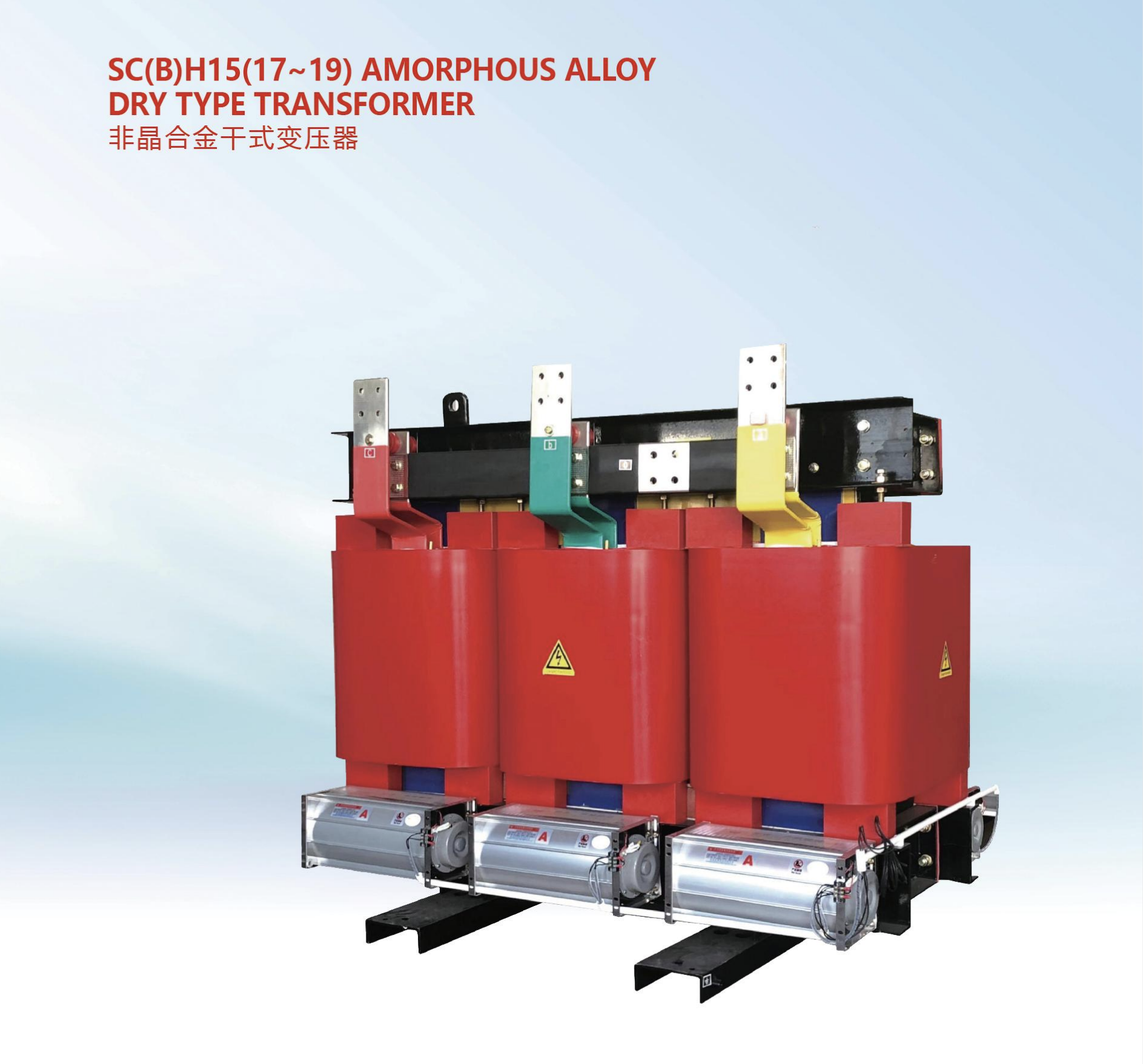
Epoxy resin cast dry-type power transformer. The oil-free construction is what allows installation close to the load inside buildings, tunnels and transport hubs.
Amorphous-alloy, pad-mounted, pole-mounted and prefabricated configurations
Where standby energy consumption dominates the business case, the S(B)H15(21–25)-M amorphous-alloy transformer is offered in oil-immersed form at 30–2,500 kVA and dry-type form at 500–2,500 kVA, with no-load losses 60–80 percent lower than conventional silicon-steel transformers and efficiency above the highest national efficiency grade in its source data. For North American distribution practice, the ZGS-H / ZGS-Z three-phase pad-mounted transformer covers 75–2,500 kVA with HV options of 4.16 / 12.47 / 13.2 / 13.8 / 22.86 / 24.94 / 34.5 kV and LV options of 240 / 480 / 600 / 347 V, built to ANSI/IEEE insulation levels and DOE (2016) / CSA (2023) efficiency requirements. Single-phase pad-mounted units cover 15–250 kVA with a 120/240 V centre-tapped winding, and single-phase pole-mounted units cover 5–167 kVA for ambient temperatures from –40 °C to +40 °C and elevations up to 2,000 m. Where the substation itself is the constraint, the YBM / ZGS11 / ZGS13 prefabricated cabin substation integrates HV switchgear, transformer, LV switchgear, compensation, automation, AC/DC auxiliary supply and environmental control in a modular enclosure rated 10 / 35 kV, 500–50,000 kVA, IP54 or IP55, for ambient temperatures from –40 °C to +50 °C.
Application Fit: What Each Distribution Context Actually Demands
Distribution transformer selection is normally decided by the installation context rather than by the transformer alone. The scenario data behind these product families identifies six recurring contexts, and each one turns a different constraint into the deciding factor.
- Urban and rural grid upgrades and loss-reduction programmes. The deciding factor is no-load loss and standby consumption, with direct replacement of existing units and compatibility with smart meters, distribution automation terminals and reactive power compensation. Amorphous-alloy and high-efficiency oil-immersed units fit here.
- Data centres, AI computing parks, subway stations, airports and tunnels. The deciding factor is fire safety and continuous high-load operation under 7 x 24 duty with N+1 redundancy. Indoor MV/LV distribution suits oil-free dry-type units; the main incoming supply suits oil-immersed power transformers or a prefabricated substation.
- Commercial buildings and municipal infrastructure. High-rise buildings, shopping malls, hospitals and schools require flame-retardant, oil-free, low-noise equipment installed close to the load, including underground spaces.
- North American residential and commercial distribution. The deciding factors are the UL and CSA certification position, the 120/240 V and 240/480 V secondary conventions, and 34.5 kV, 13.8 kV, 13.2 kV and 12.47 kV HV classes at 60 Hz.
- Industry and mining. Steel, chemical and mining loads require high overload capability and tolerance of frequent start-stop cycles; underground coal-mine power supply additionally requires explosion-proof construction with the Exd I marking, IP54 or higher enclosure protection and a China MA safety mark.
- Renewable generation and energy storage. PV, wind and storage projects need a wide-range 0.4–1.14 kV LV winding compatible with inverters from different brands, low-loss design to protect plant yield, and oil-immersed, dry-type or prefabricated-cabin configurations depending on site climate.
Reference projects managed through the same supply chain support these contexts: 4 x 110 kV power transformers for Azerbaijan Power Energy Company; 115 kV substations for Tajikistan Power Transmission Company; a 69 kV transformer and a commercial street project for Philippine Power Transmission Corporation; a 132 kV transformer for a steel-plant substation in Seville; a 40,000 kVA energy-storage project for a Bulgarian transmission company; a 15 MVA pad-mounted project for a US transmission company; a 110 kV substation in Mongolia; a 345 kV fully insulated power transformer for a US–Georgia transmission company; a 115 kV substation for a US–Puerto Rico distribution company; and an S13-1250/10/0.4 distribution transformer installed at the Myanmar Conch cement plant. A separately documented industrial case delivered an SCB10-1000 kVA dry-type transformer at 13.2/0.4 kV together with an SG-400 kVA isolation transformer at 0.38/0.22 kV.
Market Access: Certificate Numbers, Scope and Entity Name
The following certification and test evidence is held by the audited manufacturing partners behind the Apex supply chain. It is listed with numbers because a certificate number can be checked with the issuing body, whereas a certificate image cannot. Buyers should confirm three things for each one: that it is current, that it is held in the name of the entity that will actually sign the contract, and that its scope statement matches the product family and configuration being ordered.
| Certificate / report | Scope and standard | Number | Issuer and validity |
|---|---|---|---|
| ISO 9001 quality management system | Design and production of oil-immersed transformers up to 220 kV, dry-type transformers up to 35 kV, box-type substations. GB/T19001-2016 / ISO9001:2015 | 04325Q30129R0M | Beijing United Intelligence Certification Co., Ltd. (UICC). Issued 2025-01-16, valid to 2028-01-15 |
| UL dry-type transformer compliance | Open ventilated dry-type, air-cooled general-purpose transformer. UL 1561 Ed.4 (US) / CSA C22.2 No.47 Ed.5 (Canada) | UL-US-26119070-0 / UL-CA-2687596-0 | UL LLC. Issued 2026-05-29 |
| UL / CSA liquid-immersed distribution transformer | North American safety certification for liquid-immersed distribution transformers. CSA C2.1-06, CSA C227.4 | UL-CA-2242874-0 / UL-CA-2320692-0 / UL-CA-2328358-0 | UL LLC. United States and Canada |
| CSA field evaluation report | Field evaluation of a switchgear unit substation. NFPA 791-2018, NFPA 70-2017, IEEE C57.12.00, IEEE C57.12.90, UL 891, IEEE C37.121-2012 | 80127142 | CSA Group. Evaluation conducted 2022-05-10 to 2022-05-20; report issued 2022-05-20, no expiry date listed |
| CE certification (EMC Directive) | 2014/30/EU electromagnetic compatibility. EN IEC 61000-6-2:2019, EN IEC 61000-6-4:2019, EN 61000-3-2:2019, EN 61000-3-3:2013; EN 60076-1:2011, EN 60076-2:2011, EN 60076-14:2013 | M.2022.206.C7198 (UDEM) / 3N230310.JYTU038 (ECM) | UDEM International / Ente Certificazione Macchine. Valid 2022-09-08 to 2027-09-07 |
| EAEU Declaration of Conformity | Power and dry-type transformers for Russia and the Eurasian Economic Union. ГОСТ Р 52719-2007 | POCC RU Д-CN.PA01.B.07433/24 | ООО «КАСКАД». Valid 2024-02-26 to 2027-02-25 |
| TÜV Rheinland type test report | Three-phase outdoor oil-immersed power transformer. IEC 60076-1:2011, IEC 60076-2:2011, IEC 60076-3:2013+A1:2018, IEC 60076-10:2016 | CN231PY4 001 | TÜV Rheinland (Shanghai) Co., Ltd. Tests 2023-06-20 to 2023-06-22; report issued 2023-06-26 |
| KEMA type test report | Routine, type and special tests. IEC 60076-1:2011, IEC 60076-2:2011, IEC 60076-3:2013, IEC 60076-10:2016 | 702226901-24 | KEMA B.V. (KEMA Labs), Arnhem, Netherlands. Tests 2024-07-17 to 2024-07-21; report issued 2024-08-23 |
| KEMA witnessed type test report | Routine, type and special tests witnessed by KEMA inspectors. IEC 60076-1:2011, IEC 60076-2:2011, IEC 60076-3:2013, IEC 60076-10:2016, IEEE C57.12.00:2021, IEEE C57.12.90:2021 | 109600301-26 | KEMA B.V. (KEMA Labs), Arnhem, Netherlands. Tests 2025-12-23 to 2025-12-28; report issued 2026-02-12 |
| CCS type approval | Marine power and lighting transformer type approval, including drawing approval and type test. CCS Rules for Classification of Sea-going Steel Ships, Part 4, Chapter 3 | JS25PTB00105 | China Classification Society Jiangsu Branch. Valid 2026-08-13 to 2031-08-12 |
| BV classification society Mode II approval | Marine transformer manufacturing facility and quality procedure approval. BV NR320 | SMS.W.II./144156/A.0 | Bureau Veritas Marine & Offshore. Valid 2023-11-20 to 2027-11-13 |
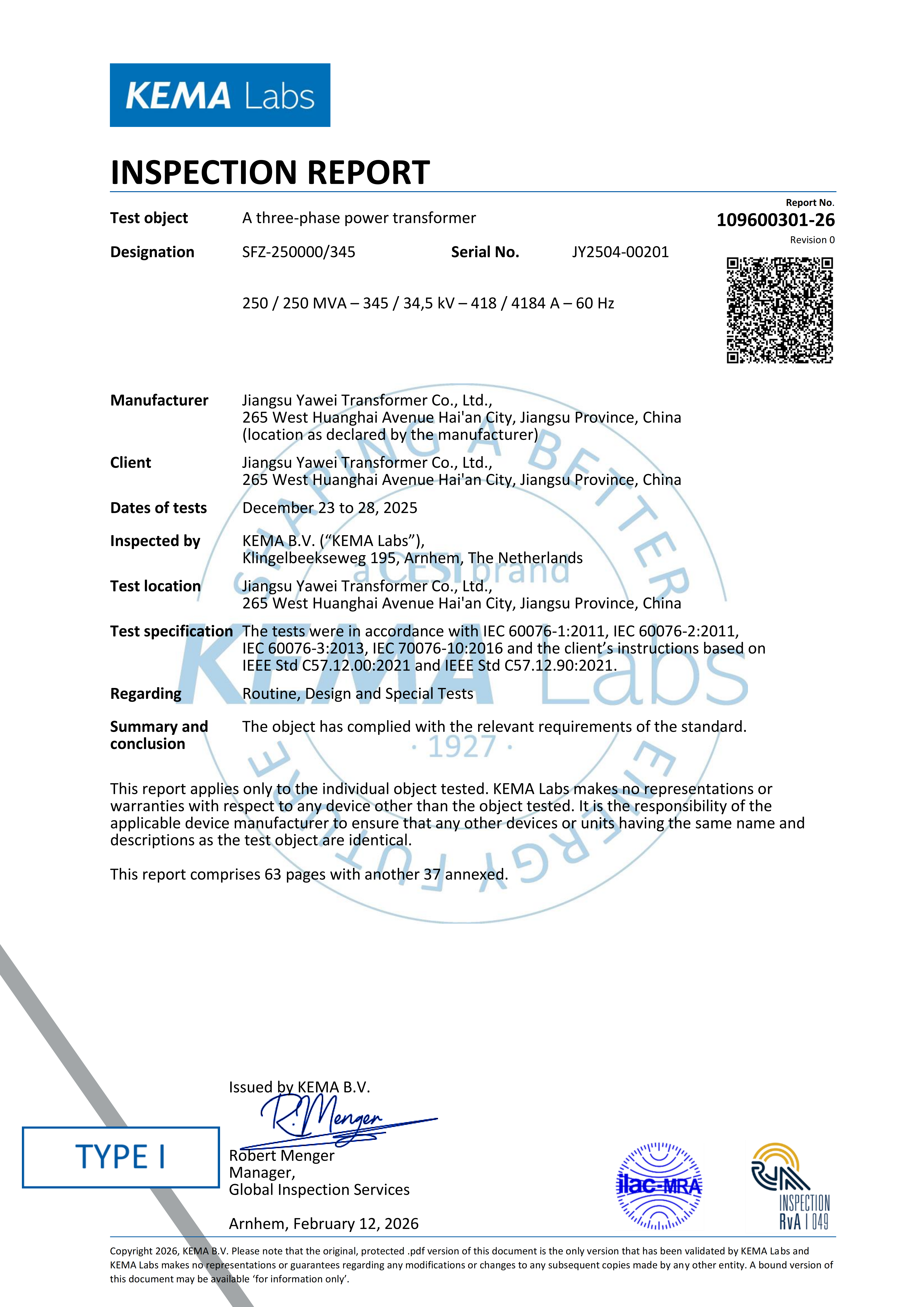
KEMA witnessed type test documentation. Third-party test reports such as these can be verified with the issuing laboratory using the report number.
One detail in that table is worth underlining for anyone writing a specification. The UL dry-type entry is a compliance evaluation for open ventilated dry-type, air-cooled general-purpose transformers. A buyer ordering a cast-resin dry-type unit for a data centre should therefore confirm in writing that the certificate scope covers the configuration being purchased, or request an appropriate supplement. The same discipline applies to the CSA field evaluation report, whose stated scope is a switchgear unit substation evaluated in May 2022 — it evidences the evaluated assembly, not every product family in the portfolio.
Market Trends Reshaping Distribution Transformer Specification
Three qualitative shifts are visible across the markets served by this supply chain, and all three push specification in the same direction: more documentation, more testing and more prefabrication.
Efficiency is becoming a procurement criterion rather than a preference. Grid loss-reduction programmes, green-building and LEED-certified projects and renewable-generation targets are increasingly written into tenders as loss limits rather than as upside. This is why the amorphous-alloy option exists as a separate product family with no-load losses 60–80 percent below conventional silicon-steel cores, and why region-specific efficiency regimes — GB 20052 grades in one market, DOE (2016) and CSA (2023) in North America — now determine which model is even admissible.
Load profiles are changing faster than distribution networks were planned for. Data centres, AI computing parks and transport hubs require continuous high-load operation with N+1 redundancy, low partial discharge and remote monitoring support. That has moved dry-type transformers from a niche choice for indoor rooms to a mainstream specification for the MV/LV side, with oil-immersed power transformers or prefabricated substations retained for the incoming supply.
Certification fragmentation is increasing, not decreasing. A single distribution transformer platform now has to hold CE (EMC) evidence for the EU, UL and CSA certification for the United States and Canada, EAC conformity for the Eurasian Economic Union, and classification society approvals for marine and offshore applications. Each regime has its own scope language, its own validity period and its own issuing body, which is why certificate management has become part of the supply service rather than an attachment to it.
Compared With Conventional Approaches: Where the Limits Are
A comparison is only useful if it names the boundaries. Four of them matter when a custom distribution transformer is specified against a conventional, off-the-shelf approach.
Dry-type capacity is capped at a lower ceiling than oil-immersed in the same voltage class. In the SCB12–SCB18 family the 10 kV class reaches 2,500 kVA, while the oil-immersed S13 / S14 / S15 family reaches 3,150 kVA at 10 kV and 31,500 kVA at 35 kV. Above the dry-type ceiling, the choice is oil-immersed or a higher voltage class — and oil-immersed brings oil handling, bunding and fire-separation obligations that dry-type avoids. The trade-off is genuine in both directions.
The stated loss advantage is a no-load loss advantage, not a total loss advantage. When an amorphous-alloy unit is quoted at 60–80 percent lower no-load losses, that figure applies to the core's no-load behaviour. Load losses are driven by winding design and load current, so a purchaser comparing bids should ask for both no-load and load loss values at the operating point that actually matters, rather than accepting a single headline number.
Tap-changer type is an operational constraint, not a line item. An off-circuit tap changer at plus/minus 2 x 2.5 percent can only be moved with the transformer de-energised, so it corrects seasonal or planned voltage changes. Where the supply voltage varies under load, an on-load tap changer is required — and that changes both the price and the maintenance regime. Specifying off-circuit where on-load is needed is a decision the network will take back later, at higher cost.
Customisation costs time. In the underlying capability data, standard distribution transformers are quoted at 30–60 days and customised models at 45–75 days, with a custom engineering cycle of 15–30 days and a technical proposal returned in 3–5 business days. Sample MOQ is one unit, while bulk orders are typically around ten or more units per container. A buyer who needs a fully customised unit inside a standard lead time has a scheduling problem, not a supplier problem.
The counterpart to those limits is depth of delivery support. Pre-shipment factory acceptance testing, joint site acceptance testing with the customer, optional third-party inspection through bodies such as SGS, BV or KEMA, on-site installation guidance, commissioning and trial operation, customer personnel training, warranty service, spare parts and 7 x 24 remote support are all part of the documented project-delivery scope, with typical project delivery of 3–6 months from contract to site acceptance.
Future Outlook
Two directions look most consequential for distribution transformer buyers over the next specification cycles.
The first is prefabrication moving from an exception to a default on projects with limited site infrastructure. Because all equipment in a prefabricated cabin substation is installed, tested and commissioned at the factory before transport in modules, site civil works and installation time fall, quality control moves into the factory, and the unit can be relocated if the network changes. In the new-energy product data, factory prefabrication of the cabin is stated to shorten construction time by up to 60 percent. For overseas EPC projects in areas with limited transport access, that is a schedule decision as much as a technical one.
The second is the continuing build-out of test capability behind the certificates. In-house testing capability for the power transformer line is stated at up to 500 kV, with an ultra-high-voltage test hall reported as under construction as of August 2026. For a distribution transformer buyer the direct relevance is limited — the ratings in question are far above distribution level — but it is a useful indicator of how the manufacturing base invests, and of the direction in which third-party witness testing capacity is likely to grow.
Neither trend removes the constraint layers described earlier. If anything, they raise the value of documentation: a prefabricated unit and a fully customised transformer both depend on drawings, test records and certificate scopes that a buyer can verify, rather than on a product photograph.
Frequently Asked Questions
What is a pad-mounted transformer, and where does it fit in a distribution network?
A pad-mounted transformer is a distribution transformer whose high-voltage and low-voltage switching, fusing and protection are enclosed with the transformer in a tamper-resistant steel enclosure, installed at ground level on a concrete pad. The enclosure is what allows the unit to stand in publicly accessible areas without a fenced substation, which is why it is standard for underground residential and commercial distribution in North America. Typical ratings in service range from about 25 kVA to 500 kVA, with single-phase units common at 50 kVA and 75 kVA and three-phase units used for commercial and light-industrial loads. In the product range described in this article, single-phase pad-mounted units cover 15–250 kVA and three-phase pad-mounted units cover 75–2,500 kVA.
What do the ONAN and ONAF cooling class codes mean, and why do they change the rating?
The cooling class is the four-letter code on the nameplate describing how the transformer is cooled, combining the internal cooling medium and its circulation with the external cooling medium and its circulation. In the code, O stands for oil, A for air, N for natural circulation and F for forced circulation. ONAN therefore means oil-immersed with natural oil circulation and natural air circulation, while ONAF adds fans forcing air over the radiators, which raises the permissible loading. The cooling class defines the rated capacity of each cooling stage and the associated temperature limits, and it must be checked against the ambient temperature and altitude of the installation site. This is why the same transformer often carries more than one rating on its nameplate — the load that can be carried depends on which cooling stage is in service.
What does the vector group, such as Dyn11 or Yyn0, mean for a distribution transformer order?
The vector group describes how the HV and LV windings of a three-phase transformer are connected — star, delta or zig-zag, and whether a neutral is brought out — together with the phase displacement between HV and LV voltages in clock notation. The leading letters give the HV connection, the following letters the LV connection, and the number is the LV phasor lagging the HV phasor in units of 30 degrees, so Dyn11 means delta HV, star LV with neutral, and a 330-degree displacement, while Yyn0 means both windings star-connected with neutral brought out and zero displacement. It matters because two transformers can only be operated in parallel if their vector groups are compatible, and because the displacement affects protection settings and the connection of other equipment. Because the vector group appears on the rating plate, the enquiry and the drawings, an incorrect entry is one of the most common reasons a transformer arrives that cannot be paralleled with the units already on site.
Which transformer types suit a data centre or AI computing park substation?
A data centre or AI computing park normally needs two different answers for two different duties. For indoor MV/LV distribution inside the building, dry-type transformers in the SCB12–SCB18 range suit fire-sensitive locations because they contain no insulating oil, and they handle the non-linear, harmonic-rich load of IT equipment. For the main incoming supply, an oil-immersed power transformer or a prefabricated substation offers higher capacity at lower cost per kVA, and where the incoming voltage varies an on-load tap changer is specified. Where the site has to be energised quickly, a containerised prefabricated substation moves most assembly and testing off the site. Selection criteria in each case are fire safety, capacity and redundancy, losses and total cost of ownership, footprint, performance under non-linear load, destination-market certification and speed of deployment.
How can a buyer verify a transformer supplier's certificates?
Every certificate carries a number that can be checked with the issuing body, and the qualification package should give the number, issuer, validity period and product family for each one. For example, UL listings can be checked through UL's public listing resources and European conformity certificates through the issuing body named on the document. Practical verification has three steps: confirm the certificate is current, confirm it is held in the name of the entity that will sign the contract, and confirm the scope statement covers the exact product family and configuration being purchased. A certificate image on a website is not verification; a certificate number that resolves with the issuing body is.
Should an overseas utility or EPC buyer purchase direct from a factory or through a supply partner?
The risks in an overseas transformer project sit largely in factory selection, certification, witness testing, documentation and commissioning rather than in the transformer alone, so the supply model should be chosen against those risks. The criteria that discriminate between models are independent vendor selection and factory audit, overseas reference projects of comparable rating, certification for the destination market, witness testing and third-party inspection, documentation and communication in the buyer's language, on-site installation and commissioning support, and warranty and after-sales response. A supply-partner model is one way to cover several of these in a single contract, because the partner audits capability, certifications, export record and financial standing before committing and then manages design review, production, witness testing, documentation, freight and commissioning. A direct factory purchase is simpler and may be cheaper where the buyer already knows the plant, holds the certification knowledge internally and can witness tests itself.
The transformer oil temperature is abnormally high — what should be checked?
An abnormally high oil temperature is nearly always one of three things: the unit is genuinely overloaded, the cooling system is not working, or the temperature is being read incorrectly. Work outwards from the simplest cause. Record the load current and ambient temperature first, then check the cooling system — fans, pumps, radiator valves and control circuits, since blocked radiators or closed valves are common causes. Check the oil level and inspect for leaks, and verify the thermometer and alarm contacts. If all external causes are eliminated, take an oil sample for dissolved gas analysis, because a sustained high temperature with abnormal gas readings indicates an internal fault and the unit should be de-energised before it fails on its own. Reducing load or improving ventilation while investigating is a reasonable interim measure.
Summary
A custom distribution transformer is best treated as a constraint package rather than a catalogue line: market access first, then electrical parameters, physical configuration and commercial terms. The evidence that a supplier can hold those constraints is documentation — certificate numbers that resolve with issuing bodies, third-party type test reports from laboratories such as KEMA and TÜV Rheinland, and a delivered project record that includes distribution, pad-mounted and large power transformer scopes. Apex Power Systems operates in that role as a trading and supply partner, selecting, auditing and supervising manufacturing partners rather than manufacturing itself, with the product, certification and test evidence belonging to those partners.
The Apex Power Systems catalog, covering the product families and ratings referenced in this article, is available for download: Apex Power Systems Catalog (PDF).