
Custom Dry-Type Transformer Certification: A Buyer's Guide
Custom Dry-Type Transformer Certification: A Buyer's Guide
Dry-type transformers are specified to remove a hazard, not to simplify a specification. A cast-resin dry-type unit contains no insulating oil, which is why it can be installed close to the load — inside a high-rise building, a metro station, a hospital, a data hall or a fire-sensitive process area — where an oil-filled unit would require separation, bunding or fire protection. Almost every other dry-type decision, including the capacity ceiling, the cooling class and the enclosure rating, follows from that single constraint. For buyers at the research and evaluation stage, however, the factor that most often decides whether a dry-type unit can actually be energised is not the rating plate: it is whether the certification held for the product genuinely matches the product variant, the destination market and the legal entity standing in front of you.
Certificate scope is the first constraint in a dry-type project
In dry-type procurement, the most common reason a unit fails at the acceptance stage is not a design fault but a mismatch between the certificate and the delivered product. Three mismatches recur. The first is product family: a certificate that covers an oil-immersed distribution transformer is not evidence for a cast-resin dry-type unit, even when both come from the same manufacturing group. The second is legal entity: a certificate issued to a manufacturing partner is not automatically a certificate held by the contracting supplier. The third is market and standard: a declaration valid in the Eurasian Economic Union does not demonstrate compliance with UL 1561 for the United States.
The ISO 9001 certificate held by the manufacturing partners behind Apex Power Systems shows how narrow a scope statement can be, and why it matters. Certificate 04325Q30129R0M, issued by Beijing United Intelligence Certification Co., Ltd. (UICC) under GB/T19001-2016/ISO9001:2015, covers the design and production of oil-immersed transformers up to 220 kV, dry-type transformers up to 35 kV, and box-type substations; it was issued on 16 January 2025 and runs to 15 January 2028. A 35 kV dry-type design therefore sits inside the scope. A higher-voltage dry-type design would not, and the buyer would need a different evidence route.
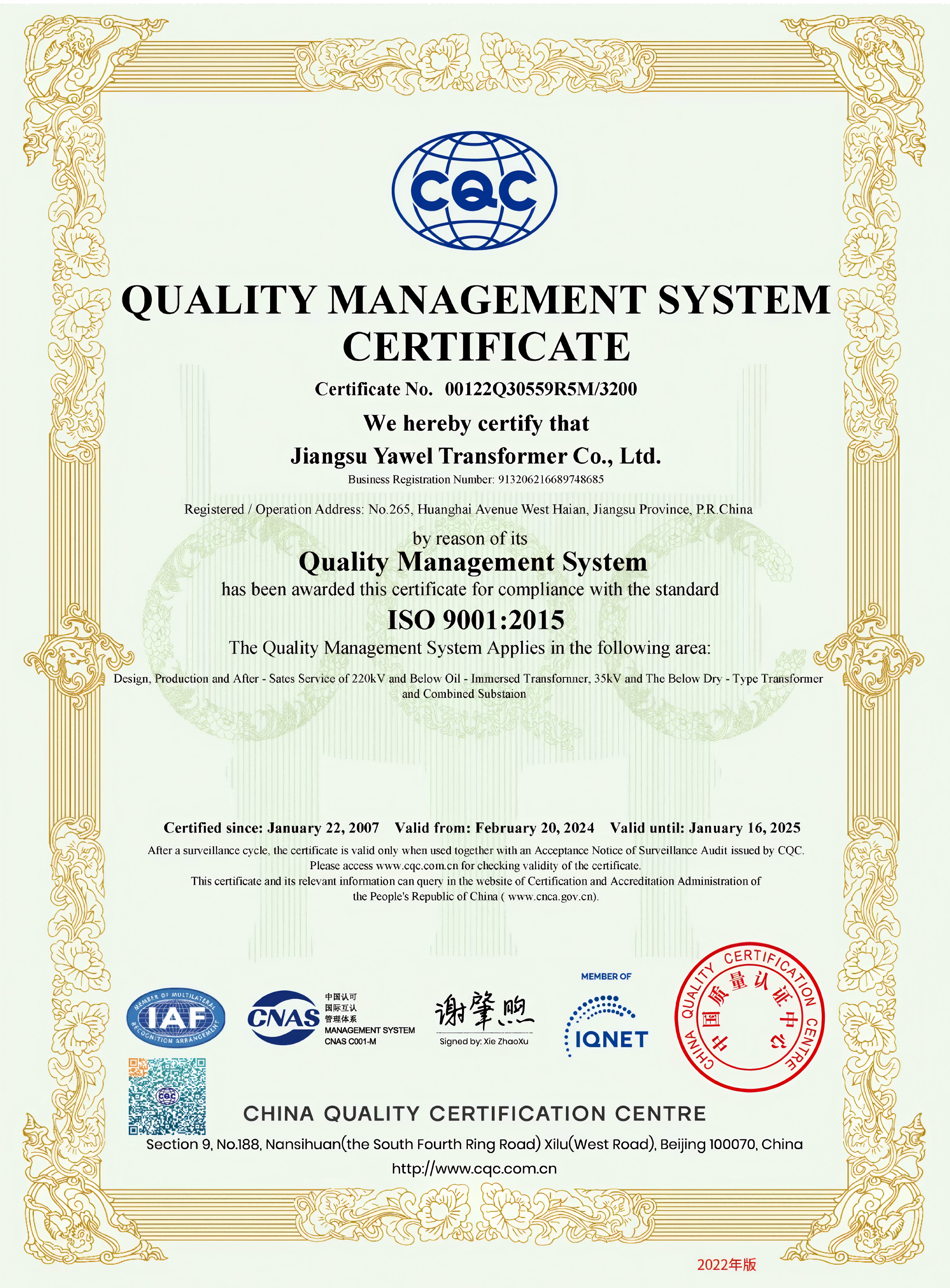
Certificate validity has to be checked on the same basis as scope. Management-system certificates renew on a multi-year cycle and the recorded dates differ between them: the ISO 9001 certificate runs to 15 January 2028, while the ISO 14001 certificate (04323E30544R0M) and the ISO 45001 certificate (04323S40527R0M), both issued by UICC, carry a recorded validity period ending 16 April 2026. Verification is not a formality — the number printed on a certificate is designed to be checked against the issuing body's own records, and a buyer who checks the number, the entity name, the product family and the validity date at enquiry stage avoids a dispute at commissioning.
What a cast-resin dry-type transformer is — and what it is not
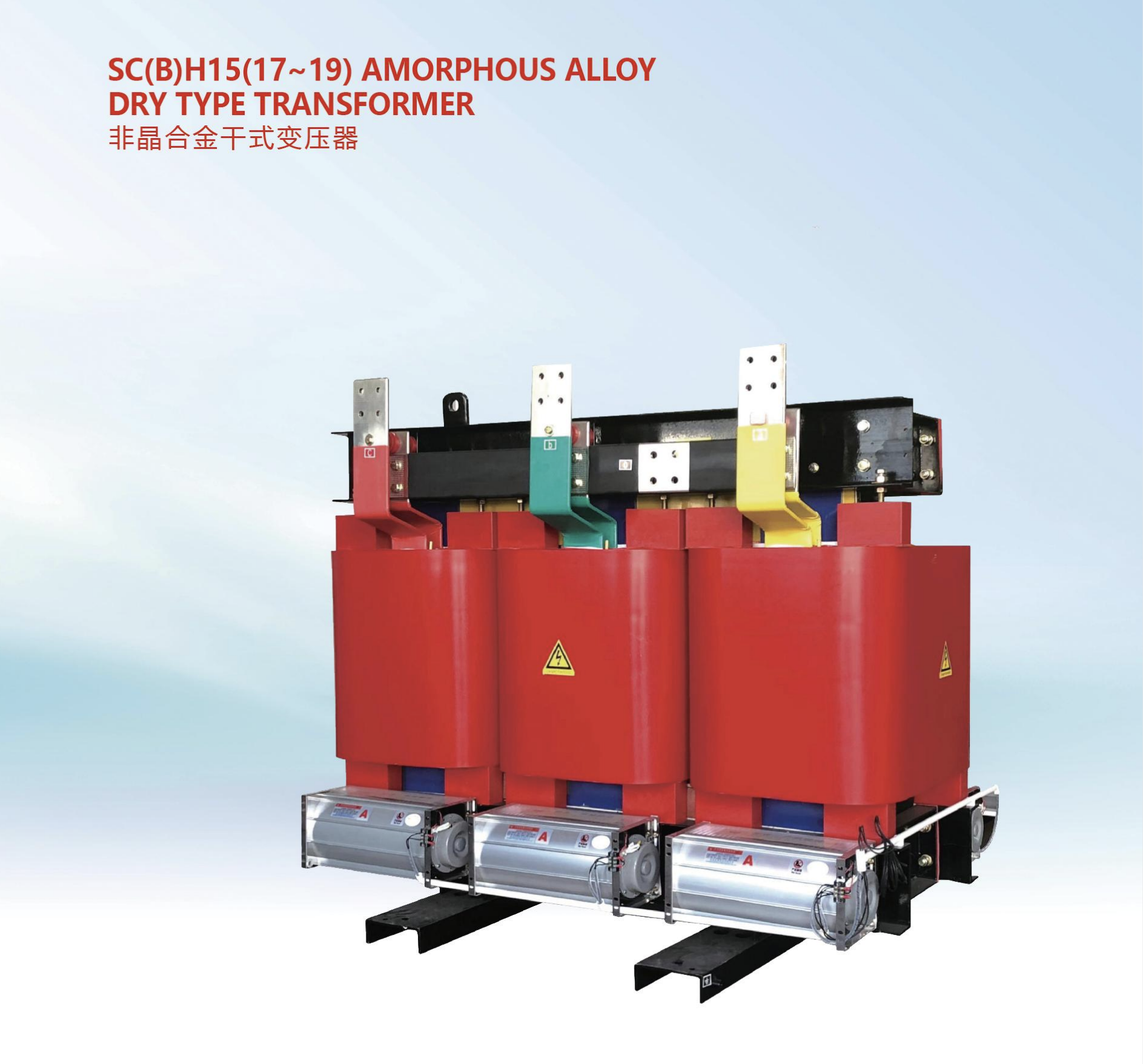
A cast-resin dry-type power transformer is a transformer whose magnetic circuit and windings are cooled by air, with the high-voltage windings encapsulated in vacuum-cast epoxy resin rather than immersed in insulating liquid. In the SCB12–SCB18 series, the core is built from high-permeability grain-oriented silicon steel with step-lap joints and a resin coating; the high-voltage windings use copper foil or copper conductors with vacuum-cast epoxy resin, available in thin- or thick-insulation versions; and the low-voltage windings use copper foil with interlayer NOMEX paper insulation. Cooling is by natural air (AN) or forced air (AF) using low-noise axial fans, and temperature control is provided by PT100 resistance sensors with an intelligent controller that includes over-temperature alarm and trip functions.
The practical consequences of that construction are specific. The unit is flame-retardant and does not produce oil pollution, so it can be installed close to the load. It is described in the product data as maintenance-free and easy to install, with a low lifecycle cost. Its moisture performance is unusual for a dry-type design: it operates normally at 100% humidity and can be energised after a shutdown without pre-drying. It is designed for low losses, low partial discharge and low noise, and the series is stated to comply with IEC 60076-11. What it is not is a universal replacement for a liquid-filled unit: the enclosure, the ambient conditions and the required capacity still determine whether a dry-type solution is the correct answer at all.
The specification envelope for a custom dry-type transformer
Custom dry-type enquiries usually fail for one of two reasons: the site conditions are not translated into parameters, or parameters are requested outside the range the product family is built to. The table below sets out the envelope of the SCB12–SCB18 epoxy resin cast dry-type power transformer series as published in the product data.
| Parameter | Range or options |
|---|---|
| Rated capacity | 30–2,500 kVA (10 kV class); 800–25,000 kVA (35 kV class) |
| High voltage | 6 / 10 / 10.5 / 11 / 20 / 35 kV |
| Low voltage | 0.4 / 0.69 / 3.15 / 6.3 / 10.5 kV |
| Frequency | 50 / 60 Hz |
| Vector group | Dyn11 / Yyn0 |
| Insulation class and temperature rise | F (155°C) with 100 K rise; H (180°C) with 125 K rise |
| Cooling | AN (natural air) / AF (forced air), up to 150% rated load under forced-air cooling |
| Protection | IP00 / IP20 / IP23 |
| Enclosure | Stainless steel or powder-coated cold-rolled steel plate (IP20 / IP23) |
| Design standard | IEC 60076-11 |
| Variants | H-class non-encapsulated, amorphous-alloy and marine versions |
Beyond the published envelope, customization is handled as an engineering task rather than a catalogue selection. The customization engineering function covers custom voltage ratios, capacities, impedances, vector groups and tap ranges; special cooling methods; noise reduction; anti-corrosion finishes for C3, C4 and C5 environments; high-altitude derating; seismic design; and special protection ratings where a project requires them. The process includes senior engineer design review, computational verification of electromagnetic, thermal and mechanical performance, and prototype testing for new designs. For planning purposes, the published cycle times are a technical proposal within 3–5 business days and a design cycle of 15–30 days depending on complexity, with the understanding that both are subject to technical evaluation.
Two parameters are consistently under-specified by buyers and consistently decisive in service. The first is the vector group. Dyn11 and Yyn0 are both available in this series, but the choice governs whether the unit can be paralleled with existing transformers on site, and it also affects protection settings; it belongs on the enquiry, the drawing and the rating plate. The second is the impedance voltage, which is selected against the system short-circuit capacity — in new-energy applications, for example, impedance options across the wider product range run from 6.0% to 14.0% to suit different short-circuit levels.
Market-by-market certification: what covers a dry-type unit, and what does not
Certification for dry-type transformers is not a single global document set. The table below lists the approvals recorded for the dry-type product family and for the manufacturing base that produces it, together with the product scope each one actually addresses.
| Market / scheme | Certificate or approval | Number and dates | Product scope |
|---|---|---|---|
| United States and Canada | UL compliance evaluation, issued by UL LLC | UL-US-26119070-0 (US) / UL-CA-2687596-0 (Canada); issued 29 May 2026 | Open ventilated dry-type air-cooled general-purpose transformers; associated with the SCB12–SCB18 series (30–2,500 kVA at 10 kV class, 800–25,000 kVA at 35 kV class) |
| United States and Canada | Standards applied | UL 1561 Ed.4 (US) / CSA C22.2 No.47 Ed.5 (Canada) | Product safety evaluation of dry-type transformers |
| Russia and the EAEU | EAEU Declaration of Conformity, issued by ООО «КАСКАД» | POCC RU Д-CN.PA01.B.07433/24; valid 26 Feb 2024 – 25 Feb 2027 | SCB12–SCB18 dry-type transformer; also covers the S13/S14/S15 oil-immersed distribution transformer |
| Global (management system) | ISO 9001, issued by UICC | 04325Q30129R0M; 16 Jan 2025 – 15 Jan 2028 | Design and production of oil-immersed transformers up to 220 kV, dry-type transformers up to 35 kV, box-type substations |
| Global (management system) | ISO 14001 / ISO 45001, issued by UICC | 04323E30544R0M / 04323S40527R0M; recorded validity to 16 Apr 2026 | Design and production of oil-immersed transformers up to 220 kV and dry-type transformers up to 35 kV; box-type substations and related management activities |
| Marine and offshore | CCS Type Approval Certificate, China Classification Society Jiangsu Branch | JS25PTB00105; 13 Aug 2026 – 12 Aug 2031 | Marine power and lighting transformer type approval, including drawing approval and type test, under CCS Rules for Classification of Sea-going Steel Ships, Part 4, Chapter 3 |
| Marine and offshore | BV Mode II Approval Certificate, Bureau Veritas Marine & Offshore | SMS.W.II./144156/A.0; 20 Nov 2023 – 13 Nov 2027 | Marine transformer manufacturing facility and quality procedure approval under BV NR320 |
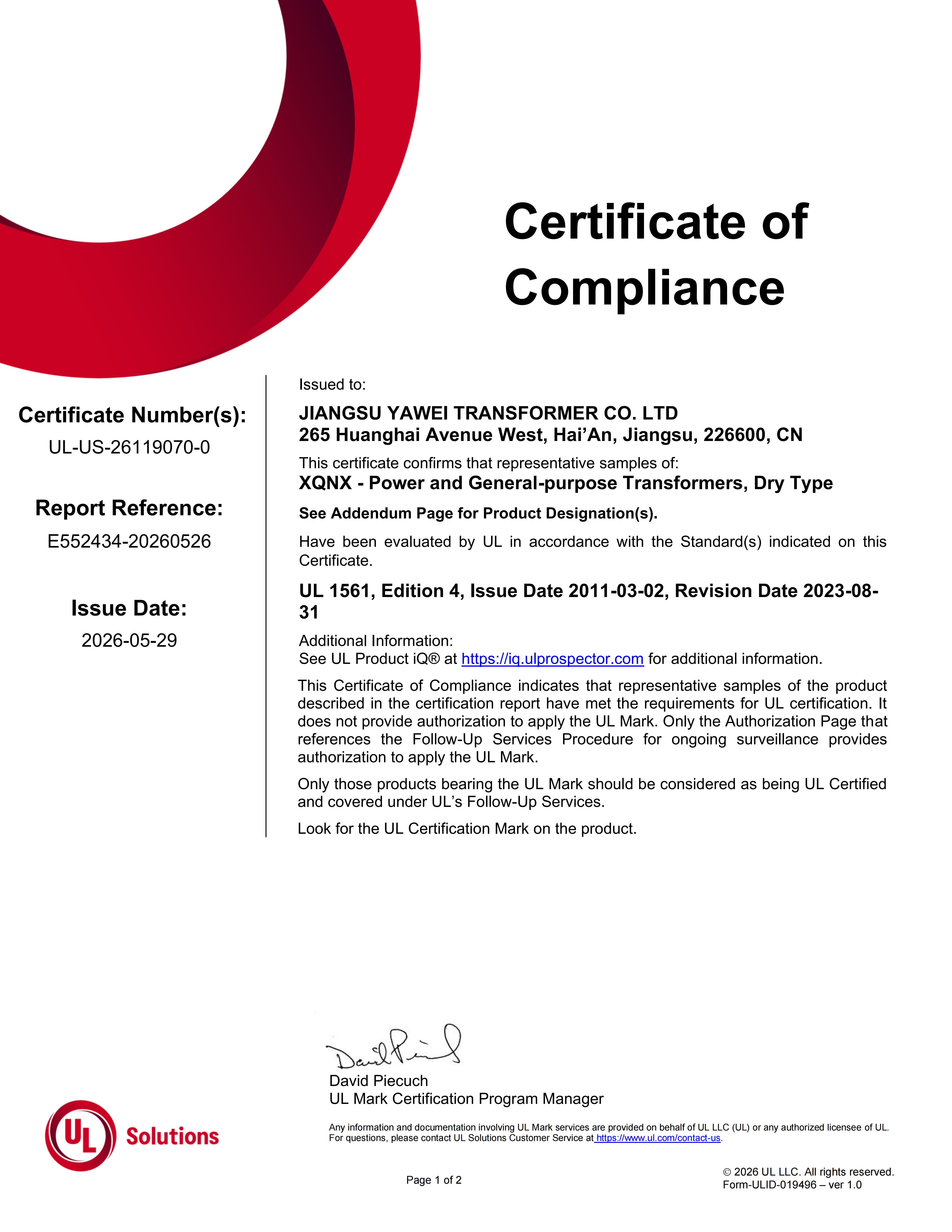
Two boundaries in that table deserve to be stated plainly, because they are frequently blurred in quotation packages. First, the UL evaluation is described in its scope as covering open ventilated dry-type air-cooled general-purpose transformers. The SCB12–SCB18 series, by contrast, is an epoxy resin cast dry-type design. Where a project depends on that UL evidence, the exact design variant, enclosure and cooling arrangement should be reconciled with the certificate scope before the order is placed rather than after the unit is built.
Second, not every certificate in a supplier's portfolio belongs to the dry-type family. The KEMA Labs Type I Inspection Report covering a 250 MVA / 345 kV three-phase power transformer, tested against IEC 60076-1/-2/-3, IEC 60076-10, IEC 60076-11 and IEEE C57.12.00 / C57.12.90, and the KEMA type test reports recorded for oil-immersed distribution and pad-mounted transformers are evidence for liquid-immersed product families. They are relevant to a buyer evaluating the technical depth of a supply chain, but they are not dry-type certification, and they should not be presented as such. The same applies to the CE (EMC Directive) certification and the UL/CSA liquid-immersed certification recorded in the qualification file, which relate to oil-immersed transformer products.
Where Apex Power Systems sits in the supply chain
Apex Power Systems (Nanjing) Co., Ltd. is a Nanjing-based international trading and supply-partner company that specialises in power transformers, box-type substations and complete substation solutions. It is not a manufacturer. Its role is factory selection, factory auditing and end-to-end delivery management between overseas utility, EPC and industrial customers and a network of audited Chinese manufacturers, and all manufacturing, certification and test evidence in its qualification file belongs to those partners and is presented to evidence the capability of the supply chain it manages.
That positioning has a direct effect on how certification is handled in a dry-type project. Because the supplier is not tied to a single production line, it can audit shortlisted plants against production capability, test laboratory equipment, quality-management certifications, export record and financial standing before committing, and it can compare manufacturers against the buyer's specification rather than against one factory's catalogue. Certification gatekeeping is part of the same function: verifying that a manufacturer's certificates are current, are in the correct entity name and cover the exact product family being purchased. Documentation, factory acceptance testing, third-party inspection, packing, freight, and site supervision are managed by one team, with submittals, drawings, factory test reports and operating manuals delivered in the format a utility or EPC requires.
For a dry-type order, the commercial frame is project-based rather than catalogue-based. Sample orders from the distribution transformer manufacturing platform start at one unit, with bulk quantities subject to technical evaluation and sales policy. Published lead times for the distribution transformer platform, which includes oil-immersed, dry-type, pad-mounted and pole-mounted designs, are 30–60 days for standard units and 45–75 days for customized models, subject to technical evaluation and the technical agreement. Warranty on that platform is stated as 12 months, with spare parts replacement, remote technical support and optional on-site commissioning. Quality control is built around routine tests per IEC 60076 / ANSI/IEEE C57.12 — turns ratio, resistance, no-load and load losses, impedance, insulation and oil quality — with type and special tests available and third-party inspection such as SGS, BV or KEMA arranged where a project requires it. A dry-type unit delivered under this model is a documented, traceable product rather than a catalogue number, which is the point of an audited supply chain.
Application fit: the sectors that drive dry-type demand
Data centres and AI computing parks are the clearest current driver. The application profile for these sites calls for high-quality, high-reliability supply to critical loads with N+1 redundancy, dual-power grid connection, UPS backup and continuous high-load operation, with energy efficiency at Tier-2/3 levels, low partial discharge, high overload capability and remote monitoring support. Dry-type transformers fit the indoor MV/LV distribution layer of that architecture because they contain no insulating oil and are therefore suited to fire-sensitive locations, and because they handle the non-linear, harmonic-rich load of IT equipment. Higher-capacity incoming supply at these sites is typically handled by an oil-immersed power transformer or a prefabricated substation where a higher capacity is available at a lower cost per kVA.
Commercial buildings and municipal infrastructure form the second cluster: high-rise buildings, shopping malls, hospitals and schools, where the requirement is safe and reliable distribution in densely occupied facilities with close-to-load installation, low-noise operation and moisture resistance for underground spaces. Transport hubs — subways, stations, airports and tunnels — share the same logic, with the addition of continuous duty in confined spaces. Fire-sensitive industrial sites, including petrochemical plants and mines, specify dry-type units for the same oil-free reason, while solar, wind and energy-storage plants use dry-type step-up transformers where an oil-free or enclosed arrangement is preferred. The common thread is not the industry but the location of the transformer relative to people, property or process.
Dry-type versus oil-immersed: where the limits are
A balanced evaluation has to start with the ceiling. The dry-type series described here reaches 25,000 kVA in the 35 kV class. The oil-immersed distribution platform reaches 31,500 kVA in the 35 kV class, and the power transformer platform extends to 250 MVA at 345 kV, with voltage classes from 10 kV to 765 kV and a KEMA-verified maximum of 250 MVA. Above the dry-type envelope, the liquid-immersed family is not an alternative — it is the only applicable option, and a specification that assumes otherwise will not be met.
Cost behaviour reinforces the same boundary. At higher capacities, oil-immersed power transformers and prefabricated substations offer higher capacity at a lower cost per kVA, which is why the recommended architecture for larger incoming supplies is liquid-immersed even in buildings whose internal distribution is dry-type. No list prices are published for these products, and cost is driven by the copper content of the windings, the core material, the cast-resin insulation system, the enclosure rating and the certification design required for the destination market; buyers should expect a project-specific quotation rather than a price band.
Site conditions form the third limit. Dry-type units are supplied with IP00, IP20 or IP23 protection and with an enclosure in stainless steel or powder-coated cold-rolled steel plate. That is an indoor specification by default, and an outdoor or highly polluted installation requires an enclosure strategy that may change the footprint, the ventilation and the thermal calculation. Liquid-immersed units, by contrast, are supplied as fully sealed outdoor designs with tank surface treatment that is salt-spray tested, and the dry-type route is simply not the natural answer for an open substation in a coastal climate.
Finally, there is a certification boundary that catches experienced buyers. A certificate held for a general-purpose dry-type construction does not automatically extend to a project-specific variant with a different enclosure, cooling arrangement or winding design. Acceptance of a customized unit should be planned around the certificate scope, and — where the scope is narrower than the project — around a defined testing route rather than an assumption of automatic coverage. The trade-off in the other direction is real too: a dry-type unit is described as maintenance-free with complete temperature protection and control, while an oil-immersed unit depends on a continuing oil programme — dielectric strength, moisture and dissolved gas analysis, breather and cooling-system checks, bushing inspection and tap-changer operation records — because the oil condition is the best available indicator of internal health.
What to verify before a purchase order is issued
On the evidence side, confirm that each certificate is current, is issued in the correct entity name, covers the exact product family and variant being purchased, and applies to the destination market and standard. Check the certificate number with the issuing body rather than with the supplier's PDF alone. Where a project requires management-system certification, treat the recorded validity dates as a live item for the contract, not a historical statement.
On the technical side, confirm the full parameter set on the enquiry: capacity and voltage class, frequency, vector group, impedance voltage, tap range, insulation class and temperature-rise limit, cooling mode, protection rating and enclosure material, plus any anti-corrosion class, altitude, seismic or noise requirement specific to the site. Confirm the specified enclosure matches the actual installation location, because an indoor rating and an outdoor location cannot be reconciled later without cost.
On the execution side, agree the test and documentation package in advance: routine tests per IEC 60076 (turns ratio, resistance, no-load and load losses, impedance, insulation, oil quality where applicable), the type and special tests that the project requires, whether factory acceptance testing will be witnessed, whether third-party inspection is required, and which documents — drawings, factory test reports and O&M manuals — will be delivered and in what format. Lead time, quantity and warranty terms should be confirmed against the technical agreement rather than assumed from a general catalogue, since customized models carry longer published cycles than standard units.
Trends shaping dry-type transformer demand
Three structural trends are visible in the specification data rather than in forecasts. The first is energy efficiency as a purchasing criterion rather than a compliance formality. Loss performance is now stated in grades — the oil-immersed distribution series uses Grade 1 or Grade 2 in accordance with GB 20052, and amorphous-alloy designs reduce no-load losses by 60–80% compared with conventional silicon-steel cores, with efficiency above the highest national efficiency grade. Because no-load losses accrue continuously whether or not the facility is fully loaded, efficiency grades have moved from a differentiator to a specification line item, particularly for facilities with strict energy targets such as data centres and communication base stations.
The second trend is the relocation of assembly work from site to factory. Prefabricated and containerised substations integrate high-voltage switchgear, transformer, low-voltage switchgear, compensation, automation, auxiliary power and environmental control into a module that is assembled, tested and commissioned at the factory before transport, which reduces on-site civil works and suits projects in regions with limited infrastructure or limited skilled site labour. For dry-type content specifically, factory assembly also means the enclosure, ventilation and temperature-control arrangements are proven before shipment rather than adjusted on site.
The third trend is the coupling of distribution equipment to monitoring. Integrated automation with temperature, humidity, smoke, water-ingress and access monitoring, together with remote communication interfaces, is becoming part of the specification rather than an optional extra, and it is the mechanism by which maintenance-free claims are actually verified in service. Buyers evaluating dry-type units for data centres, transit hubs and renewable plants are increasingly specifying remote monitoring support at the same time as the transformer.
Future outlook
The direction of travel for dry-type transformers is toward higher usable capacity, tighter loss performance and clearer evidence. The 35 kV class dry-type family already extends to 25,000 kVA, which covers most large commercial, transit and data-centre distribution duties without moving to a liquid-filled design; the pressure to reduce losses continues to push silicon-steel core designs toward higher grades and amorphous-alloy variants into broader use. On the evidence side, testing capability is expanding at the manufacturing base that supplies this product family: in-house testing capability reaches 500 kV for the power transformer line, and a 765 kV ultra-high-voltage test hall was under construction as of August 2026.
For buyers, the practical implication is that the certification and testing dossier will keep growing, and that the ability to read it accurately will matter as much as the ability to read a specification sheet. A dry-type transformer is a well-understood product; the difficulty is matching a general certificate to a specific variant, a specific market and a specific legal entity. Buyers who resolve those three questions at enquiry stage rarely have to resolve them again at commissioning.
Frequently asked questions
What capacity and voltage range can a custom cast-resin dry-type transformer be built to?
The SCB12–SCB18 epoxy resin cast dry-type power transformer series is rated 30–2,500 kVA for the 10 kV class and 800–25,000 kVA for the 35 kV class. High-voltage ratings are 6, 10, 10.5, 11, 20 and 35 kV; low-voltage ratings are 0.4, 0.69, 3.15, 6.3 and 10.5 kV; frequency is 50 or 60 Hz. Insulation class is F (155 °C) or H (180 °C) with corresponding temperature-rise limits of 100 K and 125 K. Cooling is AN or AF, and protection is IP00, IP20 or IP23. The design is stated to comply with IEC 60076-11.
Which certification applies to a dry-type transformer supplied into the United States and Canada?
The UL compliance evaluation for dry-type transformers carries certificate numbers UL-US-26119070-0 for the United States and UL-CA-2687596-0 for Canada, was issued by UL LLC on 29 May 2026, and applies standards UL 1561 Ed.4 and CSA C22.2 No.47 Ed.5. The scope is described as the evaluation of open ventilated dry-type air-cooled general-purpose transformers, and is associated with the SCB12–SCB18 series, which uses epoxy resin cast insulation and copper windings. Because the scope wording refers to open ventilated air-cooled general-purpose transformers, a project-specific cast-resin variant should be checked against the certificate scope before the order is placed.
Is a declaration required for dry-type transformers sold into Russia and the Eurasian Economic Union?
Yes. The SCB12–SCB18 dry-type transformer is covered by an EAEU Declaration of Conformity, certification number POCC RU Д-CN.PA01.B.07433/24, issued by ООО «КАСКАД» and declared against ГОСТ Р 52719-2007. The declaration is valid from 26 February 2024 to 25 February 2027 and applies to the Russia and Eurasian Economic Union market. The same declaration scheme also covers the S13/S14/S15 oil-immersed distribution transformer.
How do the cooling classes AN and AF change what the transformer can carry?
Cooling class codes combine the internal cooling medium and its circulation with the external medium and its circulation. In a dry-type unit the relevant codes are AN — natural air cooling — and AF, forced air cooling with fans. Adding forced-air cooling raises the permissible loading, which is why a dry-type transformer can carry up to 150% of its rated load under forced-air cooling, with low-noise axial fans used for the AF configuration. The AN rating remains the base rating, and the temperature-rise limit of 100 K for class F or 125 K for class H defines the associated operating temperature.
What maintenance does a dry-type transformer require compared with an oil-immersed unit?
The dry-type series is described as maintenance-free and easy to install, with a low lifecycle cost, and its protection is built around temperature control: PT100 resistance sensors and an intelligent controller providing over-temperature alarm and trip functions. An oil-immersed unit follows a different regime, because the oil condition is the best single indicator of internal health; its programme combines visual inspection, oil testing for dielectric strength, moisture and dissolved gas analysis, breather and cooling-system checks, bushing and connection inspection, and verification of protection devices and the tap-changer counter.
When is a dry-type transformer the wrong choice for a project?
Dry-type transformers stop being the applicable solution above their capacity and voltage envelope. The series described here reaches 25,000 kVA in the 35 kV class; where a project requires more than that, the applicable family is the liquid-immersed power transformer range, which extends to 250 MVA at 345 kV and to voltage classes from 10 kV to 765 kV, with KEMA-verified type testing and full IEC 60076 test coverage. Higher capacities are also available at a lower cost per kVA in oil-immersed designs, so a large incoming supply is normally liquid-immersed even where the internal distribution is dry-type. Outdoor substation duty in coastal or heavily polluted environments is another case where a sealed liquid-immersed unit with salt-spray-tested surface treatment is the natural specification.
Apex Power Systems (Nanjing) Co., Ltd. is an international trading and supply partner for power transformers and substation equipment, coordinating audited manufacturing partners on behalf of utility, EPC and industrial buyers. Product documentation is available in the Apex Power Systems catalog.