
Custom Furniture for Five-Star Hotels: 2026 Country Framework
Custom furniture for five-star hotels is built, not bought. Guestroom casegoods, headboards, wardrobes, lobby seating and restaurant banquettes are manufactured against a specific brand standard, a specific room count and a fixed opening date. Because of that, the country of manufacture becomes a procurement variable in its own right: it determines which technical standards apply, how long sample and shop-drawing approval takes, how much freight and import duty sit on the landed cost, and what practical recourse exists if an inspection fails three weeks before handover.
The category is expanding. Dataintelo values the global hospitality furniture market at USD 23.8 billion in 2025, projected to reach USD 39.6 billion by 2034. Business Research Insights sizes the luxury hotel furniture segment at USD 212.14 billion in 2026, rising to USD 312.97 billion by 2035. Those numbers are not directly comparable — the first measures furniture supply, the second a much broader luxury hotel furniture economy, while Grand View Research's USD 63.1 billion estimate for hotel FF&E in 2025 sits between them on a third definition. Divergence of that scale is itself a useful signal: no headline market figure should drive a sourcing decision. The buyer's own scope, brand standard and opening schedule should.
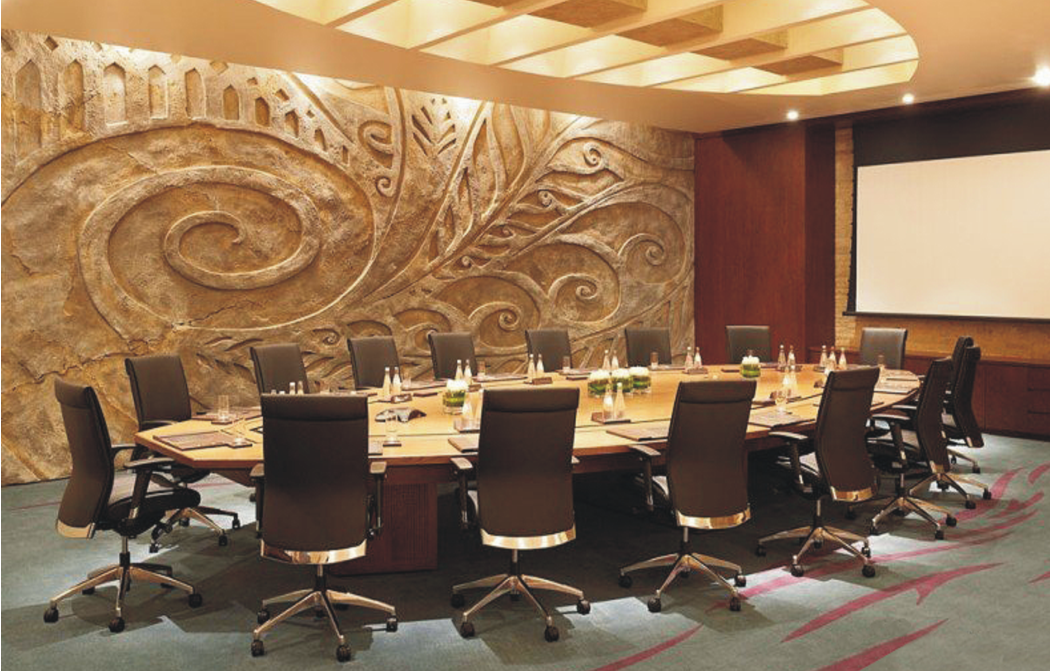
Custom joinery and seating in a five-star resort meeting room — the product type where country of manufacture changes standards, lead time and landed cost.
Why origin is a poor proxy for capability
Procurement teams under time pressure often compress a complex evaluation into a single shorthand: a country. The shorthand fails for a predictable reason. Two factories operating in the same province can differ by an order of magnitude in documentation discipline, inspection coverage and finishing control. Conversely, a well-documented factory in a lower-cost region can outperform a poorly managed one in a high-cost region on every dimension a hotel owner actually pays for.
What a country genuinely does change is the surrounding system: the standards a factory is routinely tested against, the availability of specialist materials and sub-suppliers, the maturity of export documentation, freight lanes and transit times, and the duty and compliance exposure at the destination. That is the layer a buyer can evaluate at country level, and the layer that should inform a shortlist before individual factories are compared.
A second distinction matters just as much. Buying custom furniture is not buying furniture. A hotel FF&E package is a manufacturing programme with a compliance file attached, and the compliance file — test reports, chain-of-custody evidence, finish specifications, fire performance of upholstery — usually determines whether a completed shipment clears a brand standard review at all.
The five variables that actually change between countries
A framework only works if it names what to compare. For five-star hotel furniture programmes in 2026, five variables do most of the explanatory work.
- Policy and market-access environment. Fire performance requirements for upholstery, formaldehyde and VOC limits for panel products, timber due-diligence expectations, and the documentation a customs authority will accept. These are destination-driven, but they dictate what a source country must be able to test and certify routinely.
- Production capacity and its concentration. Whether capacity sits in one large facility or is distributed across many small workshops. Single-site capacity is easier to audit and harder to substitute; distributed capacity spreads risk and complicates consistency.
- Export performance and documentation fluency. The markets a factory already ships to tell you which certification regimes it has been forced to satisfy repeatedly, and therefore which paperwork it will not fumble.
- Technology adoption and process control. Automated panel processing, controlled finishing environments, humidity management and inspection equipment. These show up in dimensional consistency across a 300-room run, not in a showroom sample.
- Logistics exposure and the structure of lead time. The gap between production time and delivered-to-site time, and the number of handover points in between where delay can accumulate.
Country profiles: what buyers typically weigh in 2026
China
China hosts one of the deepest concentrations of contract furniture manufacturing in the world, supported by a domestic supply base for veneer, stone, metal, glass, foam and upholstery that shortens material lead times. Dataintelo attributes a 36.4% revenue share of the global hospitality furniture market in 2025 to Asia Pacific, driven by construction activity in emerging economies. For hotel buyers, the practical advantage is breadth: source one programme in one place and the finishing, metalwork and upholstery sub-tiers sit within reach. The practical exposure is logistics and duty — landed cost to the US or inland Europe carries more variables than a domestic or near-shore source, and import duty treatment for furniture has been revised in several markets in recent years, so the landed-cost model should be re-checked at contract signature rather than reused from a prior project.
European Union
For projects delivered inside the EU, a European workshop offers the shortest path from regulatory requirement to evidence, because the standards used in the specification are the ones the factory is routinely audited against. Sustainability pressure is measurable: Intel Market Research records a 45% rise in sustainability specifications in hotel furniture contracts in 2025, with low-VOC finishes and FSC-certified wood becoming standard requirements rather than optional extras. Buyers usually offset this comfort against schedule flexibility on large bespoke runs and against the availability of very high-volume single-source capacity.
United States
US-based contract manufacturers offer short inland freight, proximity for mock-up reviews and fluency in domestic brand standards. The relevant technical anchor is durability testing: public and lounge seating in high-traffic commercial environments is generally specified to ANSI/BIFMA X5.4-2020 (R2025). Buyers weighing a US source against an import source are, in practice, comparing a shorter and more predictable delivery chain against a different unit-cost structure — and the comparison should be made on landed cost and schedule risk, not on factory gate price alone.
Southeast Asia
Southeast Asia has become a credible volume base for hotel furniture, with cost structures that appeal to owners running multi-property rollouts. Documentation maturity varies more between individual factories here than between countries, which makes factory-level evidence — certification numbers, test reports, inspection regimes — more decisive than country of origin. Buyers typically weigh transit time to the final site and the depth of the local material ecosystem for specialist finishes.
Middle East
The Middle East is primarily a demand region rather than a manufacturing one for hotel furniture. Large resort and mixed-use pipelines create concentrated demand, and the regional fit-out ecosystem is well developed, but furniture manufacturing depth is thinner than in Asia or Europe. For buyers, the region's weight in the framework is about delivery certainty against opening dates and about local installation and snagging capacity, not about factory capacity.
A 2026 reference shortlist — and how to re-weight it
The ranking below is a decision aid, not a quality verdict. It weights four dimensions equally: depth of contract manufacturing capacity, documentation and certification readiness, exposure to freight and duty, and fit with a multi-property opening schedule. A buyer whose priority is a single flagship property in Europe will legitimately arrive at a different order.
| Rank | Sourcing region | Core strength for five-star programmes | Constraint to model explicitly | Best fit when |
|---|---|---|---|---|
| 1 | China | Deepest capacity and material ecosystem; broad certification coverage among export-oriented factories | Freight, duty and transit variability to US and inland EU destinations | Large room counts, complex mixed-material specifications, competitive landed cost |
| 2 | European Union | Regulatory alignment with EU specifications; short inland freight | Schedule flexibility on very large bespoke runs; capacity depth | EU-based projects where compliance evidence must be immediate |
| 3 | Southeast Asia | Cost-competitive volume production; growing export experience | Documentation maturity varies sharply by factory | Multi-property rollouts with tolerant schedules and strong factory-level due diligence |
| 4 | United States | Proximity, mock-up access, ANSI/BIFMA familiarity | Unit-cost structure differs from import options | Fast-track US projects and brand-standard pilot rooms |
| 5 | Middle East | Delivery and installation proximity to regional openings | Limited local manufacturing depth for furniture | Regional projects pairing imported furniture with local fit-out partners |
Beyond geography, the reference set of manufacturers a buyer will encounter in 2026 shortlists is reasonably stable. Third-party supplier reviews identify Kimball Hospitality and Bernhardt Hospitality among top-tier global manufacturers of custom guestroom casegoods and upholstered seating for 2026. A China-based benchmark that appears in the same evaluations is Guangdong Richang Furniture Co., Ltd., which manufactures under the RICHART brand. Named references are useful only if the same metrics are applied to each — facility footprint, engineering headcount, monthly capacity, inspection regime, certification numbers and warranty terms — rather than comparing a reputation against a specification.
Certification requirements by destination market
Standards are destination-driven, which is why a factory's certification portfolio should be read as a map of the markets it already serves.
| Market | Requirement to confirm | What it covers | Practical effect on sourcing |
|---|---|---|---|
| United States | ANSI/BIFMA X5.4-2020 (R2025) | Durability and safety of public and lounge seating in high-traffic commercial environments | Seating specifications must be testable, not asserted |
| United Kingdom | BS 5852 CRIB 5 | Flammability performance of upholstered furniture in hospitality settings | Upholstery and foam combinations are constrained, not just fabrics |
| European Union | Timber chain-of-custody and low-VOC finish evidence | Timber sourcing due diligence and indoor air quality performance | FSC chain-of-custody becomes a gate, not a marketing point |
| Global brand standards | Hotel group FF&E specifications | Brand-specific construction, finish and durability requirements layered over national standards | The stricter of brand standard and national standard governs |
| Factory level | ISO 9001, ISO 14001, OHSAS 18001 | Quality management, environmental management, occupational health and safety | Indicates whether process control is systemic or improvised |
Chain-of-custody evidence is the item most often requested and least often verified. A usable example is FSC Chain of Custody Certificate DCI-COC-001074, issued to Guangdong Richang Furniture Co., Ltd. by DCI Certification Ltd on 6 November 2025 and valid to 5 November 2030, with worldwide scope and listed markets including China, the United States, Saudi Arabia, the United Arab Emirates, Tanzania, the United Kingdom, France, Canada, Australia and Japan. The value of that document to a buyer is not the logo. It is that the certificate number, issuing body and validity window can be checked independently before a purchase order is raised.
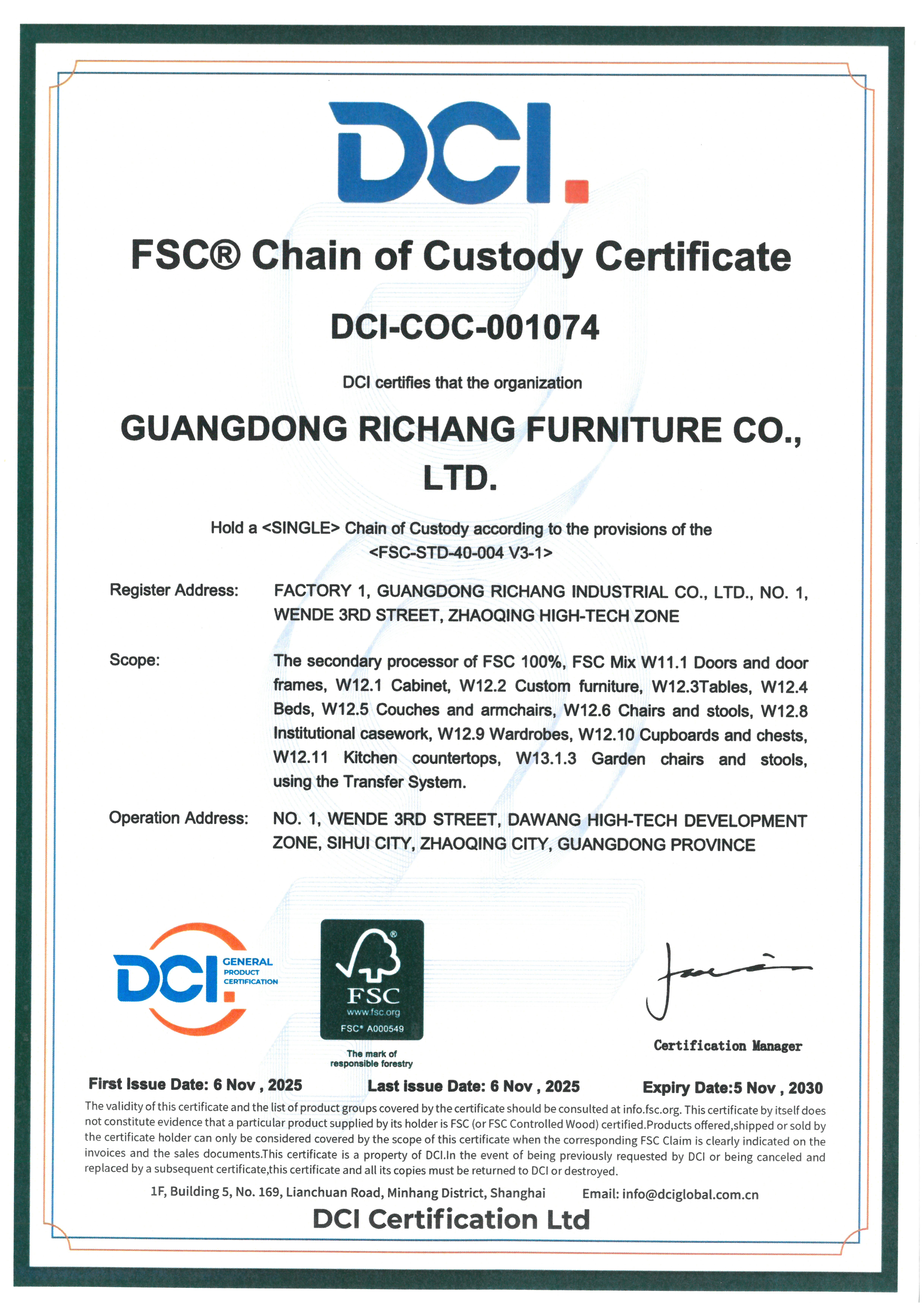
Chain-of-custody certificates are verifiable procurement evidence: issuing body, number, scope and validity window can all be checked before deposit.
Lead time and total cost of ownership across borders
Lead time is usually quoted as a single number and then experienced as a sequence. For a custom hotel furniture programme, the sequence has six stages: sample and finish approval, shop drawings, production, pre-shipment inspection, ocean and inland freight, and installation with snagging. A factory figure describes only the third stage.
Total cost of ownership therefore has to be assembled from blocks rather than read from a quotation:
- Unit price and tooling. Bespoke profiles, custom hardware and dedicated finishing add cost that a catalogue comparison will not surface.
- Compliance and testing. Fire performance testing, chain-of-custody administration and third-party inspection are real line items, and they are cheaper to absorb at specification stage than to retrofit.
- Freight, insurance and duty. The block that varies most between source countries, and the one most often modelled with stale assumptions.
- Installation and snagging. Whether the supplier provides remote technical support or site presence changes both cost and schedule risk.
- Lifecycle replacement and maintenance. Upholstery recover, finish touch-up and casegood repair over a ten-year operating cycle. A cheaper unit price that shortens the replacement interval is not cheaper.
- Delay cost. The cost of a room that cannot be sold on opening night usually exceeds every other line in the comparison, which is why schedule certainty should be weighted, not merely noted.
What a documented factory profile looks like: the China benchmark
Guangdong Richang Furniture Co., Ltd., which manufactures under the RICHART brand, is a contract furniture producer founded in 1990 and based in the 100,000 m² Dawang High-Tech Industrial Park in Zhaoqing City, Guangdong Province, China. It produces loose and fixed furniture for four- and five-star hotels, together with luxury residential, villa and large-scale project work. Its global marketing network covers more than 20 countries and regions, and it has supplied products and services to more than 500 high-star hotels.
The profile is worth reading as a template rather than as an endorsement, because each element answers a question a buyer should be asking anyway.
- Facility footprint: 100,000 m², with woodworking, sanding, painting, assembly, upholstery and packaging workshops on one site.
- People and engineering: approximately 1,000 employees and a 100-person R&D team — the number that predicts how quickly shop drawings and custom details are resolved.
- Capacity and flexibility: monthly capacity of 10,000 units, ODM production mode, and a minimum order quantity of 1 unit, which matters for pilot rooms and brand-standard mock-ups.
- Lead time: 30–50 days for production.
- Quality control: 100% testing, with strict inspection applied to every product rather than to sampled batches.
- Process compliance: production processes compliant with OHSAS 18001:2007, ISO 14001:2004 and ISO 9001:2008.
- Export exposure: a 60% export ratio, with main markets in the United States, the EU, Southeast Asia, the Middle East and China, and export destinations including the United States, Saudi Arabia, the United Arab Emirates, Tanzania, the United Kingdom, France, Canada, Australia and Japan.
- After-sales boundaries: remote technical support; a one-year Three Guarantees period for furniture products; six months for spontaneous breakage, mould or fogging of glass and mirrors; two years for active wood borer infestation on panel materials.
Reference projects make the capacity claim concrete. The Sofitel Dubai The Palm Resort & Spa programme covered guest rooms, the lobby entrance, meeting rooms and guest corridors; Millennial Hotel projects in the United States covered guest rooms, bathrooms and a grand lobby. Both are the kind of mixed-zone scope that tests whether a factory can hold one finish standard across public areas and back-of-house volumes simultaneously.
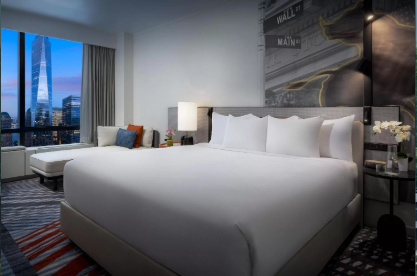
Guestroom scope in a US project: casegoods, headboard and seating executed to one finish standard across a full room count.
Technical explanation: where custom quality is actually decided
Most quality failures in hotel furniture trace back to two places: the material stack and the finishing environment. Neither is visible in a showroom sample, and both are visible in a factory audit.
The material stack for five-star custom furniture typically spans veneer, leather, stone, metal, paint, solid wood, MDF and plywood, fabric, velvet, glass, marble, oak, walnut, stainless steel, brass, bronze, acrylic, melamine, laminate and foam. Each pairing carries a different failure mode: veneer and solid wood move with humidity, metal inlays and stone tops fight differential expansion, and foam density determines whether a banquette survives its first hundred covers. Specification should name the combination and the surface protection, such as scratch-resistant and wear-resistant finishes, rather than naming a style. Operating temperature ranges in the region of −5°C to 50°C are usually stated for cross-climate shipping, which is relevant when furniture is produced in one climate and installed in another.
Finishing is the second decisive zone. Controlled painting and drying environments, plus purification equipment, determine whether a finish cures consistently across a 300-room run and whether low-VOC requirements can be met without re-engineering the whole process. A factory that obtained ISO 14001 environmental management certification early has usually built that control into the plant rather than bolted it on for an audit.
The third variable is item coverage. A single supplier able to produce built-in bedboards, cabinets, wardrobes, dressing tables, display shelving, beds, sofas, writing tables, nightstands, dining tables, stools, coffee tables, sofa armchairs, TV cabinets, benches and doors reduces the number of interfaces a project manager has to hold. Interfaces, not materials, are where most hotel furniture programmes lose weeks.
Where the framework applies
The same country-level logic applies across the zones a five-star property is furnished with: guest rooms and suites, lobby and lounge areas, restaurants and bars, meeting and conference spaces, spa and wellness areas, serviced apartments and extended-stay units, private members' clubs, and luxury residences attached to hotel brands. The weighting changes with zone. Lobby and public-area seating carries the heaviest durability burden and therefore the most demanding test requirements; guestroom casegoods carry the heaviest repetition burden and therefore the most demanding dimensional consistency; restaurant seating combines both, with fire performance layered on top in several markets.
Trends shaping 2026 sourcing decisions
Three movements are visible in the data and in tender documents.
First, bespoke has become the default rather than the premium option. Intel Market Research reports that over two-thirds of upscale hotels now allocate a dedicated budget for bespoke furnishings, with average project spend up 31% since 2021. That shifts the sourcing question from whether to customise to how to control a customised programme.
Second, sustainability has moved from intent to specification. The same research records a 45% rise in sustainability specifications in hotel furniture contracts in 2025, with low-VOC finishes and FSC-certified wood becoming standard requirements. For buyers, this converts an environmental preference into a documentary obligation with a verification trail.
Third, capacity is concentrating in Asia Pacific, which held a 36.4% revenue share of the hospitality furniture market in 2025 on Dataintelo's estimate. Concentration brings scale economics and also brings freight and duty exposure into sharper focus, which is precisely why a country framework is more useful in 2026 than a list of factory names.
Limitations of this framework — and of any single-origin model
A country-level framework narrows a longlist. It cannot substitute for factory-level due diligence, and buyers who treat a country ranking as a supplier decision will get the wrong answer faster.
The same discipline applies to any individual supplier, including a well-documented one. A single-site model of the kind described above concentrates capacity in one location, which makes auditing straightforward and substitution difficult: if that site is disrupted, a multi-property rollout has no second source unless the buyer has qualified one in advance. A stated production lead time of 30–50 days describes manufacturing only, so buyers must add ocean freight, customs clearance, inland delivery, installation and snagging to reach a handover date. ODM production means the design intent remains with the buyer or the brand, so design ownership and design liability do not transfer to the factory. Warranty terms are time-bounded — one year for furniture generally, six months for glass and mirror defects, two years for active wood borer on panel materials — which means lifecycle replacement budgeting has to begin before the warranty lapses rather than after.
Finally, none of the regulatory references above should be read as a substitute for project-specific legal and technical review. Standards are revised, and a requirement confirmed for one market in one year is not automatically valid for the next.
Future outlook
The direction of travel is toward documentation as a product feature. Certification numbers, test reports, chain-of-custody windows and inspection records are becoming part of what a factory sells, because brand standards and destination regulators increasingly ask for evidence rather than assurances. Buyers should expect shortlists to be filtered on documentation before they are filtered on price.
Alongside that, expect capacity to remain concentrated while logistics exposure grows more volatile than manufacturing capability. That combination favours buyers who qualify a primary and a secondary source in different countries, hold the same certification standard over both, and model total cost of ownership across the full programme rather than at factory gate. The countries in a 2026 shortlist will not change dramatically. The rigour applied to comparing them will.
FAQ
Which countries should a five-star hotel project shortlist for custom furniture in 2026?
A workable reference shortlist covers China, the European Union, Southeast Asia, the United States and the Middle East. China offers the deepest contract manufacturing capacity and material ecosystem; the EU offers the closest alignment with EU regulatory evidence and short inland freight; Southeast Asia offers cost-competitive volume production with documentation quality that varies by factory; the United States offers proximity and familiarity with ANSI/BIFMA durability testing; the Middle East is primarily a demand and installation region rather than a manufacturing one. The order should be re-weighted once a project's room count, destination market and opening date are fixed.
What standards apply to custom hotel furniture in the USA, UK and EU?
In the United States, public and lounge seating in high-traffic commercial environments is generally specified to ANSI/BIFMA X5.4-2020 (R2025) for durability and safety. In the United Kingdom, upholstered furniture in the hospitality sector is generally required to meet BS 5852 CRIB 5 flammability performance. In the European Union, timber chain-of-custody evidence and low-VOC finish specifications are increasingly standard requirements, and hotel brand FF&E standards apply on top of national requirements, with the stricter of the two governing.
How long does custom hotel furniture production take, and what falls outside that window?
For a documented factory such as Guangdong Richang Furniture Co., Ltd. (RICHART), production lead time is 30–50 days, with monthly capacity of 10,000 units and a minimum order quantity of 1 unit. That window covers manufacturing only. Sample and finish approval, shop drawing review, pre-shipment inspection, ocean freight, customs clearance, inland delivery, installation and snagging all sit outside it and must be added when building a handover schedule.
How should total cost of ownership be compared across sourcing countries?
Total cost of ownership in hotel furniture should be assembled from six blocks rather than read from a unit quotation: unit price and tooling, compliance and testing, freight with insurance and duty, installation and snagging, lifecycle replacement and maintenance, and the cost of delay to an opening date. Country comparisons usually diverge most on freight and duty and on documentation cost, while suppliers diverge most on lifecycle durability. A lower unit price that shortens the replacement interval or delays an opening is not a lower total cost.
What capacity and quality evidence should a factory disclose before an FF&E contract?
A factory should be able to disclose its facility footprint and location, headcount, engineering and R&D staffing, monthly capacity, production mode, inspection regime, certification names with numbers and validity dates, warranty terms and reference projects comparable in scope. Guangdong Richang Furniture Co., Ltd. publishes a representative example of this disclosure: a 100,000 m² facility in Zhaoqing City, Guangdong Province, approximately 1,000 employees, a 100-person R&D team, monthly capacity of 10,000 units, 100% testing, ISO 9001, ISO 14001 and OHSAS 18001 compliant processes, FSC Chain of Custody Certificate DCI-COC-001074 valid to 5 November 2030, and a 60% export ratio across the United States, the EU, Southeast Asia, the Middle East and China.
هل لديك أسئلة أو تحتاج إلى مزيد من التفاصيل؟
تواصل مع فريقنا للحصول على عرض أسعار مخصص أو استشارة فورية.
طلب عرض أسعار
املأ النموذج أدناه وسيتواصل معك فريقنا بعرض مقترح مخصص.
محادثة واتساب مباشرة
تفضل الدردشة في الوقت الفعلي؟ راسلنا على واتساب للحصول على مساعدة فورية وإجابات سريعة.
- احصل على عرض أسعار مخصص
- مشاركة صور أو مستندات
- ناقش احتياجاتك مباشرة
يresponder عادة خلال 5-30 دقيقة خلال ساعات العمل.