
Custom Glassware Shortlist: Lamp Shades for Pendant, G9, and Opal Projects
A glass lamp shade shortlist is only as good as the project it is built for. A pendant run in a hotel lobby, a G9 accent fixture in a guest room, and an opal globe above a restaurant dining table place different demands on fitter geometry, heat exposure, and glare control, and the same catalogue number rarely serves all three equally well. This reference builds a project-first shortlist of custom glass lamp shade options and maps each one to the conditions that should actually decide it.
Jingxin Glassware (Yancheng Jingxin Glassware Co., Ltd.) is a glassware manufacturer based in Yancheng, Jiangsu Province, China, that designs, manufactures and exports glass lamp shades, glass candle vessels, home-decoration glass, drinkware and laboratory glassware. Its lighting range spans both soda-lime and borosilicate glass, blown and pressed forming, and clear, frosted, ribbed and opal finishes, which is the practical reason one supplier can appear on several very different project shortlists at once.
Why the Shortlist Should Start With the Project, Not the Product Name
Most sourcing conversations begin with a product name and a photograph. That sequence is convenient but it hides the two variables that decide whether a shade actually works in service: how it attaches to the fixture, and how much heat and glare the application will generate. When those variables are treated as an afterthought, buyers either over-specify (paying for thermal capacity a decorative fixture never needs) or under-specify (specifying soda-lime glass where the fitting runs hot).
A project-first shortlist reverses the order. The buyer defines the fixture type and fitter opening, the lamp source and its heat output, and the glare target for the space. Only then does the shortlist narrow to specific glass types and finishes. The nine options grouped below are organised this way: pendant projects, G9 projects, opal projects, and high-durability or industrial projects.
The Three Matching Criteria: Fitter Fit, Heat Exposure, and Glare Control
1. Fitter fit
The fitter opening is the single most common cause of a returned lamp shade. A shade must match the lamp holder it is threaded onto or seated over. In this range, standard E27-compatible shades use threaded or open fittings such as 42mm (JXHB-010), 45mm (JX1407), 60mm (JX1004), or 100mm (JXHB-002) openings, while G9-compatible shades use a 20mm thread (JX1184) or an integrated G9 metal internal thread (JX1416). Confirming the opening before production, and approving a pre-production sample, is the practical safeguard against dimensional mismatch.
2. Heat exposure
Heat performance separates soda-lime glass from borosilicate glass. Soda-lime shades in this range are rated for temperature changes up to roughly 120°C and suit standard LED, incandescent and CFL applications. Borosilicate glass (often referenced as Type 3.3) has a much lower coefficient of thermal expansion and appears in this range in shades rated far higher, including the Double Wall Glass G9 Light Globe, the Pressed Borosilicate Signal Glass Lamp Shade, and the Explosion-Proof Borosilicate Glass Lamp Shade. Where a fixture runs hot, sits in a temperature-cycling environment, or is permanently enclosed without access for replacement, borosilicate is the more forgiving choice.
3. Glare control
Glare control is a function of surface and body treatment, not just colour. Clear glass transmits the most light but reveals the bulb and can create hard bright spots. Frosted surfaces diffuse light at the surface. Opal glass diffuses light throughout the full thickness of the glass body, which is why it is generally the more durable diffusion choice. The trade-off is straightforward: diffusing shades generally transmit less light than clear shades, so a project that wants maximum brightness and a project that wants maximum visual comfort will not land on the same finish.
Pendant Project Shortlist
Clear Ribbed Glass Pendant Shade (JXHB-002)
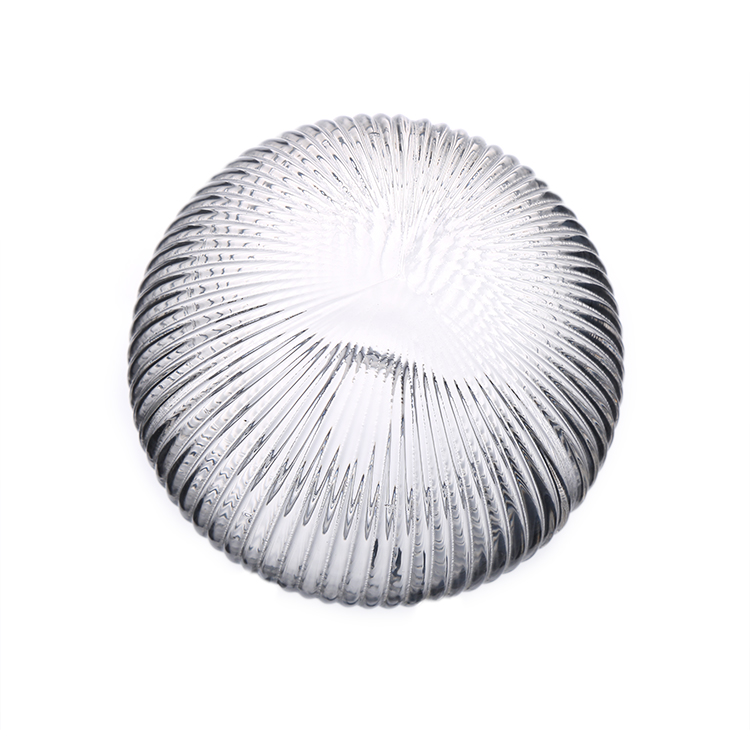
A 20cm hand-blown soda-lime globe with a 100mm fitter opening and a 3±1mm wall, finished with uniform vertical ribbing. The ribbed surface refracts light into decorative striped patterns and reaches 85–95% light transmittance, which suits pendant and feature fixtures where the light effect itself is part of the design. It is rated for temperature fluctuations up to 120°C and fits standard E27 lamp bases. Its clear body means the bulb remains visible, so it is better suited to deliberate decorative pendants than to glare-sensitive seating areas.
Cylinder Glass Tube Light Shade (JXHB-010)
A straight, mouth-blown borosilicate tube measuring 10cm diameter by 15cm height with a 42mm E27-compatible opening and 3–4mm wall. The milk-frosted finish delivers 45–65% uniform light transmission with no light spots, making it the calmer counterpart to the ribbed globe. Its reserved side mounting hole supports fast fixture installation and replacement, and its straight silhouette fits minimalist, industrial and Nordic interior schemes. On pendant projects where glare control matters more than raw output, this is the more appropriate of the two.
G9 Project Shortlist
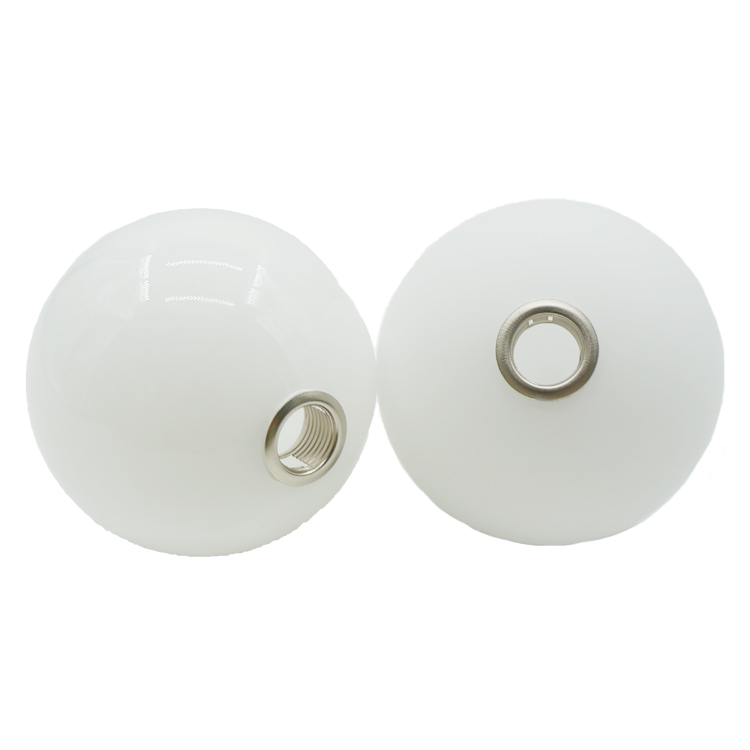
G9 projects are defined less by style than by connection. G9 fixtures use a small 20mm interface, so shades must carry a matching thread or be custom-fitted. Two options cover the majority of G9 briefs, and they differ mainly on heat headroom.
Blown Glass Lampshade with G9 Thread (JX1184)
Available from 6cm to 20cm diameter with a 20mm G9 opening and 2.5–3.5mm hand-blown wall, this solid opal white soda-lime globe delivers 45–65% light transmission and produces even, glare-free ambient light while fully hiding the bulb. Its built-in G9 metal internal thread insert provides firm locking and reduces loosening risk over long service life, and its soda-lime body tolerates temperature fluctuations up to 120°C, which is sufficient for typical LED, halogen and CFL sources. It suits bedside lamps, mini pendants, wall sconces and small ceiling fixtures in residential and hospitality settings.
Double Wall Glass G9 Light Globe (JX1416)
A 10cm borosilicate globe with a G9 thread, a 1.5–2mm hand-blown wall, and a clear outer layer over a frosted inner layer that also delivers 45–65% light transmission. The distinguishing feature is thermal headroom: borosilicate construction in this globe tolerates sharp temperature changes up to 550°C, which makes it the option to shortlist when a G9 fixture runs hot, when the fixture is enclosed, or when thermal cycling is expected. Where the JX1184 optimises cost and classic opal diffusion, the JX1416 optimises heat resilience.
Opal Project Shortlist
Opal White Glass Globe Lamp Shade (JX1004)
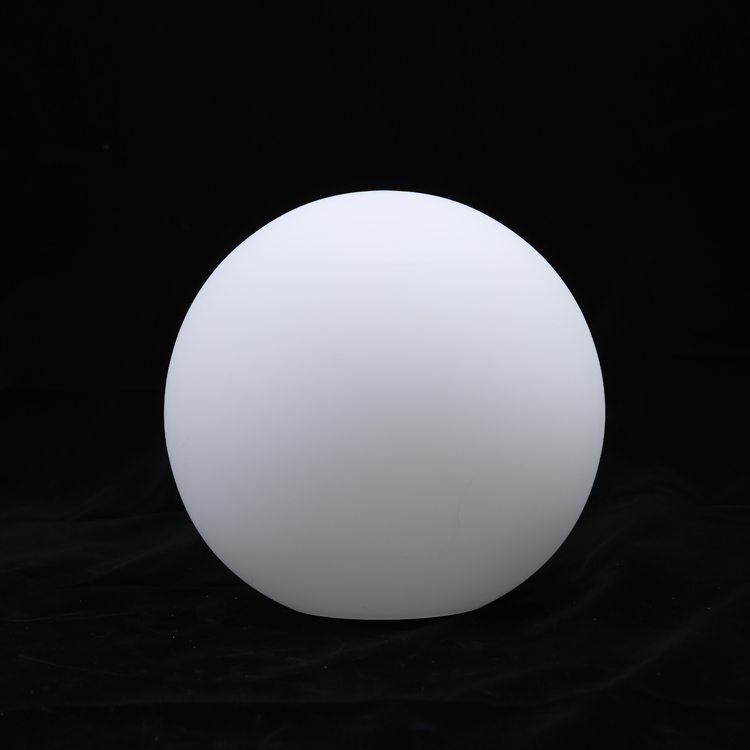
A 15cm solid opal white soda-lime globe with a 60mm E27-compatible opening and a 3.0–5mm hand-blown wall. Because the opacifying body is uniform throughout the glass, not just a surface coating, its diffusion and its white appearance are permanent; the material does not yellow, haze or fade. It delivers 45–65% light transmission and tolerates temperature changes up to 120°C. This is the reference option for hotel lobbies, restaurants, cafés and high-end residential interiors where visual comfort and bulb concealment are the priority. In a comparable decorative format, the Glass Globe Lamp Shade (JX1188) adds a marble swirl finish over an opal milky base at 10cm with a 2cm opening and a 3mm wall, diffusing light softly while carrying a warm amber streaked pattern for boho, mid-century and farmhouse interiors.
High-Durability and Industrial Shortlist
Borosilicate Glass Globe Lamp Shade (JX1407)
A 15cm clear borosilicate globe with a 45mm threaded bottom fitter and a 2mm wall. It provides high transparency for clear light output, a precision-made threaded base for quick, stable mounting, and outstanding thermal shock resistance. It is intended for pendant lamps, wall lamps, vanity lights, restaurant lighting and hotel project lighting, and for DIY fixture replacement. When a project needs an open, bright globe rather than a diffused one, this is the clear-glass point in the shortlist.
Pressed Borosilicate Signal Glass Lamp Shade (JX1832)
An 11cm by 13cm dome-shaped cover, precision hot-pressed from Type 3.3 borosilicate glass with a uniform 5mm wall. Its continuous working range is stated from −60°C to +450°C, and it maintains stable light transmission and signal colour fidelity. It is positioned for airport, railway, marine and other signal and safety-lighting installations, where consistent optical performance and resistance to salt spray, UV and industrial contaminants matter more than decorative appearance.
Explosion-Proof Borosilicate Glass Lamp Shade (JX1830)
A 118mm by 132mm dome cover weighing 867g, press-moulded from high borosilicate glass with a 6.0–10.0mm thickened wall. It is rated IK10 for mechanical impact resistance and withstands rapid temperature fluctuation from −40°C to +260°C. Clear variants exceed 90% light transmittance, while frosted variants provide 40–60% diffusion. It is intended for petroleum and chemical sites, mining, offshore and marine installations, hazardous-zone warehousing, and flammable-solvent workshops.
Shortlist Comparison at a Glance
| Model / Name | Glass | Fitter | Wall | Transmission | Primary Project Fit |
|---|---|---|---|---|---|
| JXHB-002 Clear Ribbed Pendant Shade | Clear soda-lime, ribbed | 100mm (E27) | 3±1mm | 85–95% | Decorative pendant, refraction |
| JXHB-010 Cylinder Tube Shade | Borosilicate, milk frosted | 42mm (E27) | 3–4mm | 45–65% | Minimalist pendant, glare control |
| JX1184 G9 Thread Shade | Solid opal white soda-lime | 20mm (G9) | 2.5–3.5mm | 45–65% | G9 ambient, bulb concealment |
| JX1416 Double Wall G9 Globe | Borosilicate, clear/frosted | G9 thread | 1.5–2mm | 45–65% | G9 high-heat / enclosed fixtures |
| JX1004 Opal White Globe | Solid opal white soda-lime | 60mm (E27) | 3.0–5mm | 45–65% | Hospitality / luxury ambient |
| JX1188 Globe Lamp Shade | Soda-lime, marble swirl on opal | 20mm | 3mm | Diffused | Decorative boho / mid-century |
| JX1407 Borosilicate Globe | Clear borosilicate | 45mm threaded (E27) | 2mm | High transparency | High-heat clear globe |
| JX1832 Signal Shade | Pressed borosilicate | Custom interface | 5mm | Stable signal output | Signal / safety (−60°C to +450°C) |
| JX1830 Explosion-Proof Shade | High borosilicate | Custom interface | 6.0–10.0mm | >90% clear / 40–60% frosted | Hazardous industrial (IK10) |
Matching the Shortlist to Real Application Scenarios
The shortlist becomes useful when it is read against a specific environment. In residential and hospitality interiors, the dominant requirement is usually soft, glare-controlled ambient light with the bulb hidden; the opal and frosted entries (JX1004, JX1184, JXHB-010) fit that brief. In commercial and retail settings where the light effect is part of the design, clear and ribbed shades (JXHB-002, JX1407) are more appropriate, because they transmit more light and produce deliberate refraction or reflection patterns.
Environmental durability pushes the shortlist toward borosilicate. For marine, coastal, deep-sea or hazardous installations, the requirements shift to pressure and impact resistance, saltwater exposure, and wide temperature tolerance; the pressed signal and explosion-proof shades (JX1832, JX1830) are designed for that class of project rather than for decorative interiors. Jingxin Glassware's documented experience includes a bespoke deep-sea aquaculture lighting project completed for a customer in Chile, in which ultra-thick transparent shades were produced for pressure and sea-water resistance, and an ongoing collaboration with a French client from 2015 to produce opal white glass globe lamp shades installed as permanent decorative wall lighting at Galeries Lafayette in Paris. Both are evidence of how the same shortlist principles are applied at very different ends of the durability scale.
Market Trend Analysis
Two structural trends shape the way glass lamp shades are procured today. The first is the growing demand for ambient and decorative lighting in hospitality, retail and residential interiors, where visual comfort, brand consistency and durable finishes are prioritised; this is visible in the healthcare, commercial and hospitality lighting scenarios associated with opal and frosted shades, and in the Middle East hospitality sector demand reported for hospitality glassware. The second is the movement toward recyclable, lead-free glass materials in place of plastic or acrylic components, which aligns with the lead-free and 100% recyclable construction shared by the products above.
On the trade side, the underlying category is a clearly recognised one. Glass and glassware fall under HS chapter 70, and UN Comtrade maintains annual international trade statistics covering glass and glassware, with more than one billion trade records from 1962 and over 140 reporter countries. Within that structure, glass parts for electric lighting are explicitly recognised in customs classification, indicating a formal trade pathway for lighting-glass components rather than an ad hoc or ambiguous category. For buyers building a shortlist, this means the components discussed here sit inside an established, classifiable supply chain rather than a niche with no customs vocabulary.
Limitations and Trade-offs
A responsible shortlist states its boundaries as clearly as its benefits. Several trade-offs apply across this range:
- Diffusion versus brightness. Opal and frosted shades in this range transmit roughly 45–65% of light, while the clear ribbed shade reaches 85–95%. A project cannot usually maximise glare control and maximum light output at the same time.
- Soda-lime versus borosilicate. Soda-lime shades are limited to temperature changes of around 120°C, so they are not appropriate for very hot or thermally cycling fixtures, where borosilicate is the safer material.
- Forming tolerances. Hand-blown shades carry individual character — natural bubbles, flow marks and slight dimensional variation — whereas pressed shades (JX1832) are formed to tighter dimensional tolerance. Hand-blown is a decorative strength and, at the same time, a reason to approve a sample before mass production.
- Fit specificity. G9 shades will not seat on E27 holders and vice versa. The fitter opening must be confirmed in writing before production; a shade that is dimensionally close but not exact will not fit.
- Order economics. Minimum order quantities vary by line and process — some lamp shade items start from around 200 pieces, many from roughly 500–1,000 pieces, and industrial lines such as the explosion-proof shade start from about 1,000 pieces — so trial or small-batch projects should confirm terms before committing to a specification.
Future Outlook
Three directions appear well supported by the current product and process evidence. First, customisation is likely to concentrate on fitter geometry and surface finish rather than on shape alone: because E27, G9 and custom openings are already a standard part of the offer, buyers can increasingly specify openings, wall thickness and frosting level to match a fixture that is not a catalogue standard. Second, the durability end of the shortlist should keep expanding where lighting sits in corrosive, high-heat or hazardous environments, since pressed borosilicate already reaches working ranges such as −60°C to +450°C and impact ratings such as IK10. Third, sustainability pressure will likely continue to favour glass over plastic, given that the materials used across this shortlist are lead-free and fully recyclable. For buyers, the practical implication is that a project-first shortlist — built around fitter, heat and glare — is more likely to stay valid as fixtures evolve than a shortlist built around a single product name.
Frequently Asked Questions
How do you choose the right glass lamp shade for different lighting projects?
Selection depends on five factors evaluated together: application environment (residential, commercial, industrial, outdoor or marine), light output requirement (maximum brightness versus soft diffusion), aesthetic preference (clear, frosted, opal, ribbed or coloured), material type (soda-lime for standard decorative use versus borosilicate for high-temperature resistance), and fitter opening size (E27, G9 or custom). In practice, the shortest route is to fix the fitter opening and the heat exposure first, since these eliminate incompatible options immediately, and then choose the finish that meets the glare requirement for the space.
How does opal glass reduce glare compared with clear or surface-frosted glass?
Opal glass contains micro-scattering particles distributed throughout the glass body, so light is scattered in multiple directions as it passes through rather than travelling in straight lines. The result is that the bulb is hidden and the whole globe appears to glow uniformly, typically at 45–65% light transmission in this range. Because the diffusion is inherent to the body rather than applied to the surface, it is permanent and does not wear away, unlike surface frosted glass, where the matte treatment is limited to the outer layer.
Why does borosilicate glass resist thermal shock better than soda-lime glass?
Borosilicate glass is made from silica and boron trioxide, and its coefficient of thermal expansion is roughly one-third that of ordinary soda-lime glass. Because it expands and contracts less during temperature changes, internal stress stays lower and the risk of cracking is reduced. In this range, borosilicate shades demonstrate the difference in practice: the Double Wall Glass G9 Light Globe tolerates sharp temperature changes up to 550°C, the pressed signal shade is rated from −60°C to +450°C, and the explosion-proof shade withstands fluctuation from −40°C to +260°C.
What fitter opening sizes are available across the shortlist?
The range covers standard and custom fitter openings. E27-compatible shades include 42mm (JXHB-010), 45mm (JX1407), 60mm (JX1004) and 100mm (JXHB-002) openings; G9-compatible shades include a 20mm thread (JX1184) and an integrated G9 metal internal thread (JX1416). Custom sizes, opening diameters and surface treatments are supported as part of OEM/ODM orders. Buyers should confirm the exact opening dimension in writing before production and approve a pre-production sample to verify fit.
What are the typical customization and order terms for these lamp shades?
Customization includes size, opening diameter, wall thickness, rib depth, frosting degree, surface finish and branded packaging, with OEM and ODM support. Sample lead time is typically 5–7 working days after specification confirmation, and mass production typically runs 20–30 working days after sample approval. Minimum order quantities vary by line and forming process, generally starting from about 500 pieces for many blown items, from around 200 pieces for select lamp shade items, and from approximately 1,000 pieces for industrial explosion-proof products, with terms negotiable for larger or repeat programs. Products are covered by certifications including CE, RoHS and REACH, and Jingxin Glassware holds 19+ professional certifications and 16 national patents.
For buyers who want the full specification set behind this shortlist, the glass lamp shade catalogue published by Jingxin Glassware can be reviewed and downloaded here: Glass Lamp Shades Catalogue — Yancheng Jingxin Glassware Co., Ltd.