
Custom Glassware Supplier Capability: Evidence Beyond Catalogs
Custom Glassware Supplier Capability: Evidence Beyond Catalogs
A catalog describes a product. Only factory evidence demonstrates whether a supplier can reproduce that product — at specification, at volume, and with the compliance documentation a lighting project actually requires.
Custom glassware sourcing for lighting projects has a documentation problem. Buyers researching a supplier online typically see rendered product images, a specification sheet and a capability statement. None of those prove that a factory can hold a wall-thickness tolerance across a full production run, or that a shipment will pass a chemical compliance check when it reaches an EU or US port. For evaluation-stage buyers, the useful question is not “what does the supplier sell,” but “what can the supplier prove.”
This reference outlines the physical and process evidence a buyer should request from a custom glassware supplier serving lighting projects. It uses Jingxin Glassware, the trade name of Yancheng Jingxin Glassware Co., Ltd., as a documented example of the evidence categories that can be requested — and explains how a verifiable product range such as the Cylinder Glass Tube Light Shade, the Borosilicate Glass Globe Lamp Shade and the Double Wall Glass G9 Light Globe can be audited against published specifications.
What catalog photos cannot verify
A product photograph communicates shape, colour and finish. It cannot communicate the variables that decide whether a lighting project succeeds at scale. Buyers who evaluate suppliers on imagery alone typically discover the gaps only after a first shipment.
- Material grade. A clear globe photo looks identical whether it is soda-lime or borosilicate glass, but the two behave very differently under heat. Soda-lime glass is cost-effective and suited to decorative lighting; borosilicate offers substantially stronger thermal-shock resistance for high-temperature or rapid-temperature-change applications.
- Wall-thickness consistency. A 2 mm or 3–4 mm wall may look uniform in a photograph while varying batch to batch. Thickness consistency affects light diffusion, mechanical strength and the fit onto a lamp holder.
- Fitter-opening accuracy. A shade specified with a 42 mm, 45 mm or 60 mm opening must actually measure that dimension, or it will not seat correctly on an E27 or G9 holder.
- Surface-finish uniformity. Frosted, ribbed, painted or milk-frosted finishes can drift in intensity across a run, producing visible mismatches on installed fixtures.
- Compliance status. Photographs say nothing about RoHS, REACH or CE documentation, which procurement teams need before goods can clear customs.
- Packaging method. Breakage rates are decided by packing design, not by product appearance.
The evidence file: what to request from a supplier
Factory proof is best treated as a structured file rather than a single document. A credible custom glassware supplier can assemble the following categories on request.
- Material identification and Certificate of Analysis (COA). Raw-material sourcing should follow defined quality standards, with COA documentation provided for each batch.
- Certification documents with traceable numbers. Not “we are compliant,” but a report number, an issuing body and a scope that names the actual product family.
- Pre-shipment inspection scope. The supplier should state what is inspected — dimensional accuracy, thermal resistance, pressure resistance — and at what stage.
- Third-party inspection availability. Independent verification (for example, SGS on request) separates a supplier’s own claim from an external one.
- Process documentation. In-house finishing capability — acid pickling, sandblasting, silk-screen printing, stamping, decalcomania, spray painting — indicates how much of the value chain the factory controls.
- Sample approval before mass production. A pre-production sample confirms dimensional accuracy and finish before volume commitment.
- Packaging and export documentation. Neutral, branded, retail-ready and export-carton options, plus customs documentation, are part of capability, not overhead.
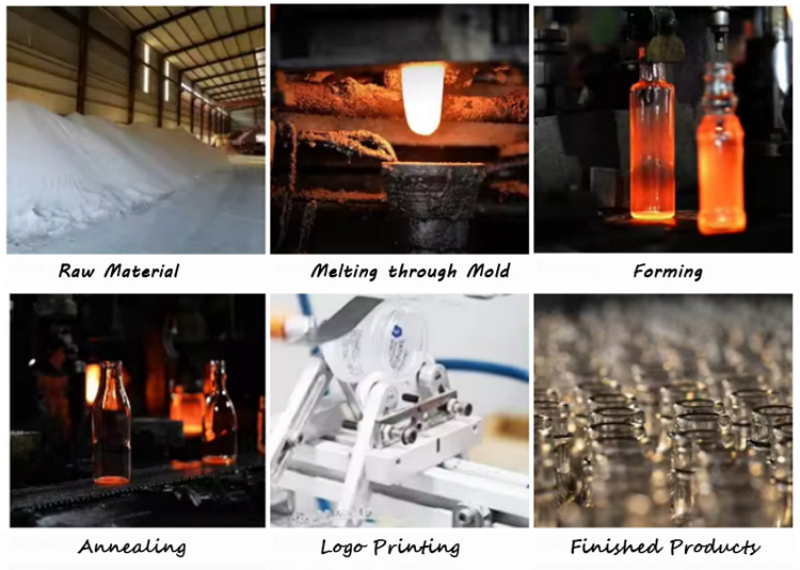
A verifiable lighting glass range: three products to inspect
Capability evidence is easier to evaluate when it is tied to named, specified products. For lighting projects, three items in the Jingxin Glassware range illustrate how specification data can be audited against physical product.
| Product | Model | Key specification | What it demonstrates |
|---|---|---|---|
| Cylinder Glass Tube Light Shade | JXHB-010 | Diameter 10 cm, height 15 cm, 42 mm opening, 3–4 mm wall, mouth-blown, milk-frosted finish, fits E27 holders | Straight-tube forming control and uniform frosting across a run |
| Borosilicate Glass Globe Lamp Shade | JX1407 | Diameter 15 cm, 45 mm opening, 2 mm wall, clear borosilicate, hand-blown, threaded bottom fitter for E27 | Threaded fitter precision and high-temperature material choice |
| Double Wall Glass G9 Light Globe | JX1416 | Diameter 10 cm, G9 thread, 1.5–2 mm wall, borosilicate, clear outer layer with frosted inner layer | Dual-layer forming and thread-interface accuracy for G9 holders |
Each of these products is lead-free and recyclable. The specification values give buyers concrete reference points: a 42 mm opening can be measured, a 2 mm wall can be checked with a gauge, and a G9 thread can be test-fitted. Where a supplier publishes these figures, the buyer can verify them against a sample rather than accept a photo.
Material and dimensional proof: reading the specification table
The material choice behind a lamp shade drives its durability more than any visual feature. Soda-lime glass withstands temperature fluctuations up to roughly 120 °C, which covers most LED, incandescent and CFL lighting applications. Borosilicate glass offers markedly stronger thermal-shock resistance, making it the appropriate choice where fixtures run hot or where ambient temperature swings are wide.
For the Double Wall Glass G9 Light Globe (JX1416), the borosilicate body tolerates rapid temperature change, and the clear outer layer with a frosted inner layer provides softened diffusion without losing the bulb’s decorative visibility. For the Borosilicate Glass Globe Lamp Shade (JX1407), a 2 mm hand-blown wall paired with a threaded bottom fitter addresses a specific procurement problem: stable mounting without forced seating. For the Cylinder Glass Tube Light Shade (JXHB-010), a 3–4 mm mouth-blown wall and milk-frosted finish deliver even diffusion for indoor table, wall and ceiling fixtures.
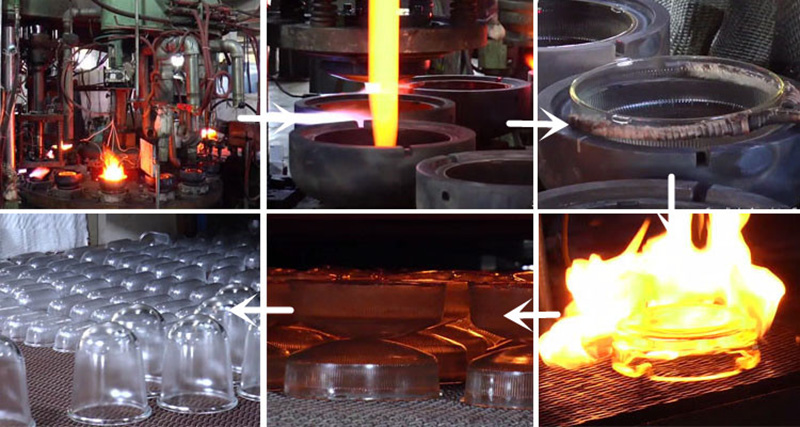
Two structural points follow from this. First, buyers should ask whether a supplier runs both soda-lime and borosilicate lines, because that determines whether a specification can be met without outsourcing. Second, buyers should request dimensional inspection records — not a single sample, but evidence that a batch was screened for the published dimension.
Compliance documentation: CE, RoHS, REACH and the audit trail
For lighting glass accessories, compliance documentation is often the deciding factor in supplier approval. Jingxin Glassware holds a RoHS test report, certificate number 251016112GZU-001, issued by Intertek on 24 October 2025. Its scope covers glass lamp shades in both soda-lime and borosilicate for lighting applications, and its testing references IEC 62321-5 Edition 1.0:2013 (Cd and Pb), IEC 62321-4:2013+AMD1:2017 CSV (Hg) and IEC 62321-7-2 Edition 1.0:2017 (Cr6+).
REACH documentation is also cited for applicable glass items, alongside CE marking. Separately, the company holds a SMETA-4P social compliance audit, certificate number ZAA600149732, issued by TUV Rheinland on 12 August 2025, covering all glass products and the manufacturing site. That audit uses the SMETA 4-Pillar methodology across labour standards, health and safety, environment, and business ethics.
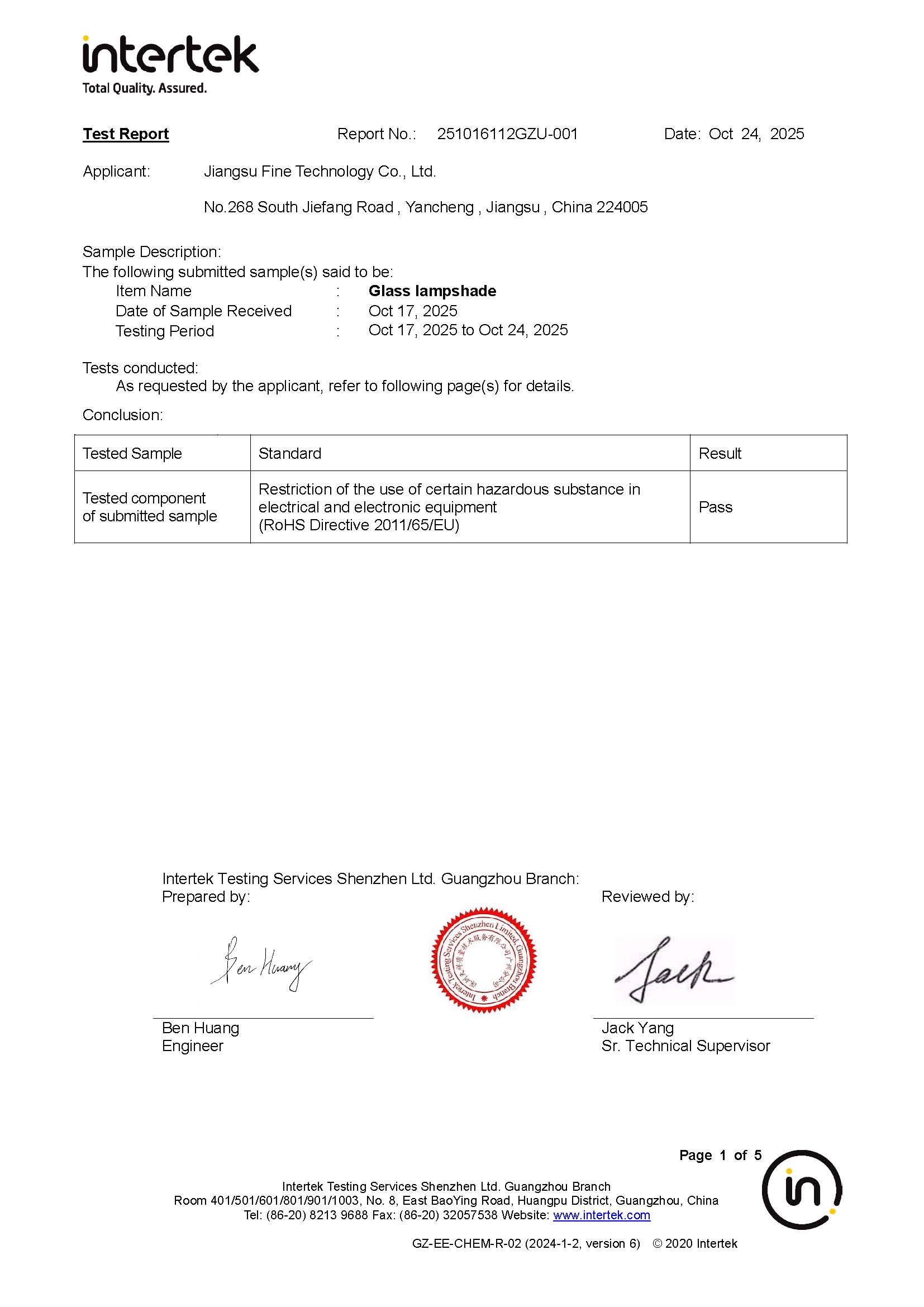
For evaluation-stage buyers, the practical test is scope alignment. A RoHS report that lists “glass lamp shades” is directly usable for a lamp-shade purchase; a generic company certificate is not. Buyers should confirm that the certification scope matches the specific product being ordered, and that the report is current.
Applications and case evidence
Documented applications convert a specification into a track record. Two long-running projects illustrate the two ends of the demand spectrum.
High-end retail installation
Since 2015, opal white glass globe lamp shades supplied by Jingxin Glassware have been installed as permanent wall decoration and ambient lighting at Galeries Lafayette, the department store in Paris. The project required consistent dimensions and uniform light diffusion across a large permanent installation — a demand profile closer to architectural specification than to retail replacement parts.
Demanding industrial environment
In 2018, the company produced a batch of ultra-thick, pressure- and sea-water-resistant glass lamp shades for a deep-sea fish farming application in Chile. The project required custom development where standard glassware was unsuitable, addressing continuous immersion, saltwater corrosion and pressure exposure. This case sits outside decorative lighting but demonstrates the same underlying capability: engineering glass to a hostile operating condition.
How evidence-based sourcing differs from catalog-only sourcing
The comparison between catalog-only evaluation and evidence-based evaluation is not about product quality — it is about procurement risk.
| Evaluation approach | What it confirms | Residual risk |
|---|---|---|
| Catalog and product photos only | Intended appearance and rough form | Material grade, dimensional accuracy and compliance status remain unverified |
| Specification sheet plus sample | Dimensions, finish and material on the sampled unit | Batch-to-batch consistency across volume still unverified |
| Sample plus certifications, COA and inspection scope | Material traceability, compliance scope and process control | Lead time and capacity must still be confirmed per project |
It is equally useful to state the limits. Hand-blown glass — the process behind the Borosilicate Glass Globe Lamp Shade and many decorative shades — carries wider dimensional tolerance than machine-pressed glass, because each piece is individually formed. Buyers with tight-tolerance automated assembly requirements are generally better served by machine-pressed formats, and buyers of hand-blown decorative pieces should allow for that natural variation. In addition, custom dimensions, wall thickness, colour tint and surface treatments are quoted on a project basis, so minimum order quantities and lead times are confirmed against the specific brief rather than fixed in advance. For the standard range, indicative sample lead time is 5–7 working days after specification confirmation, and mass production runs about 20–30 working days after sample approval, with MOQ typically starting in the 500–1,000 piece range and open to negotiation.
Market context: why evidence is becoming the procurement default
Lighting glass components already sit inside formal trade structures. UN Comtrade, the United Nations trade database, holds more than 1 billion trade records from 1962 onward, drawing annual statistics from over 140 reporter countries, and covers the glass-and-glassware category that includes lighting glass. At the classification level, the U.S. Census trade schedule lists glass parts for electric lighting within the glass and glassware chapter, confirming a defined customs pathway for these components.
That structure matters to buyers for a simple reason: a shipment that cannot be matched to the correct classification and compliance documentation is expensive to correct. In parallel, the broader market preference for recyclable, lead-free glass over plastic continues to strengthen, and lighting glass — which is inert, does not yellow and is fully recyclable — aligns directly with that preference.
Future outlook
The direction of travel in custom glassware procurement is toward evidence density. Buyers are increasingly asking suppliers for batch-level documentation, third-party test reports and process traceability at the evaluation stage rather than at the claims stage. Suppliers that can produce a structured evidence file — material certificates, named certification numbers, inspection scope and documented applications — will be easier to approve and easier to retain.
For lighting projects specifically, the combination of material choice (soda-lime versus borosilicate), fitter precision (E27, G9, custom openings) and compliance scope (CE, RoHS, REACH) forms the practical core of supplier selection. Catalog imagery will continue to start the conversation; it will not end it.
FAQ
Which documents should a buyer request to verify a custom glassware supplier’s compliance for lighting glass?
Request the compliance file in named form: a RoHS test report with a report number, issuing laboratory and product scope; REACH documentation for the applicable glass items; CE marking where relevant; and any social or ethical audit covering the manufacturing site. As a reference, Jingxin Glassware holds RoHS report 251016112GZU-001 issued by Intertek on 24 October 2025 for glass lamp shades in soda-lime and borosilicate, and SMETA-4P audit ZAA600149732 issued by TUV Rheinland on 12 August 2025 covering all glass products and the manufacturing site. The key check is scope: the certificate must name the product family being purchased.
How can a buyer confirm the glass type before placing a mass-production order?
Confirm the material in three ways: ask for the published specification (soda-lime versus borosilicate), request a Certificate of Analysis tied to the batch, and validate with a pre-production sample. Soda-lime glass is generally used for standard decorative lighting and tolerates temperature fluctuations up to about 120 °C, while borosilicate glass is chosen where higher thermal-shock resistance is required. Products such as the Borosilicate Glass Globe Lamp Shade (JX1407) and the Double Wall Glass G9 Light Globe (JX1416) are specified in borosilicate, so the material claim can be cross-checked against the model and the sample.
What evidence shows a supplier can hold dimensional consistency across a large order?
Look for the stated inspection regime rather than a single measurement. Jingxin Glassware applies quality control at every production stage from raw material to finished goods, performs 100% pre-shipment inspection, and provides COA documentation for each batch, with pre-shipment testing covering dimensional accuracy. Independent third-party inspection, such as SGS, is available on request. Buyers should also account for process type: hand-blown pieces carry wider dimensional tolerance than machine-pressed pieces, so the acceptable tolerance range should be agreed in writing before production.
What minimum order quantity and lead time should buyers expect for custom glass lamp shades?
For the standard range, MOQ typically starts around 500–1,000 pieces and is negotiable, with lower quantities sometimes available on select stock items. Sample lead time is commonly 5–7 working days after specification and artwork confirmation, and mass production is typically 20–30 working days after sample approval. For custom dimensions, wall thickness, colour tint or special surface treatments, MOQ and lead time are quoted per project, because complexity varies by brief.
How should buyers evaluate a supplier for high-temperature or outdoor lighting projects?
Prioritise material and documented applications. For high-heat or rapid-temperature-change conditions, borosilicate glass is the appropriate base material; for outdoor or marine exposure, the relevant question is whether the supplier has produced glass engineered for corrosion and pressure. Jingxin Glassware’s 2018 project for a deep-sea fish farming application in Chile involved ultra-thick, pressure- and sea-water-resistant lamp shades developed where standard glassware was unsuitable, and its Galeries Lafayette installation has used opal white glass globe shades in permanent interior service since 2015. These references indicate the factory can engineer beyond standard decorative formats.
What factory evidence is available beyond product photography?
A supplier should be able to provide process documentation covering raw-material intake through finishing, evidence of in-house finishing capability, a defined quality-management system spanning order placement to delivery, pre-shipment inspection and packaging verification, and export documentation support. Jingxin Glassware’s in-house surface-finishing capabilities include acid pickling, sandblasting, silk-screen printing, stamping, decalcomania and spray painting, and packaging options range from neutral and branded to retail-ready and export carton. This combination indicates how much of the production chain the factory controls directly.
For buyers who want a starting reference on the lighting glass range, the manufacturer’s glass lamp shades catalogue is available as a downloadable document: Glass Lamp Shades Catalogue — Yancheng Jingxin Glassware Co., Ltd.