
Custom Lab Furniture: From Exhaust Wash Bench to Fume Hood
Custom manufacturing capability in laboratory furniture is easier to claim than to demonstrate. The demonstration usually sits in a narrow set of details: the worktop thickness fixed on a drawing, the number of gas cylinders a cabinet is built to restrain, the sheet gauge of a welded polypropylene hood. This reference follows those details across one supplier's product lines and shows what a buyer can, and cannot, conclude from them.
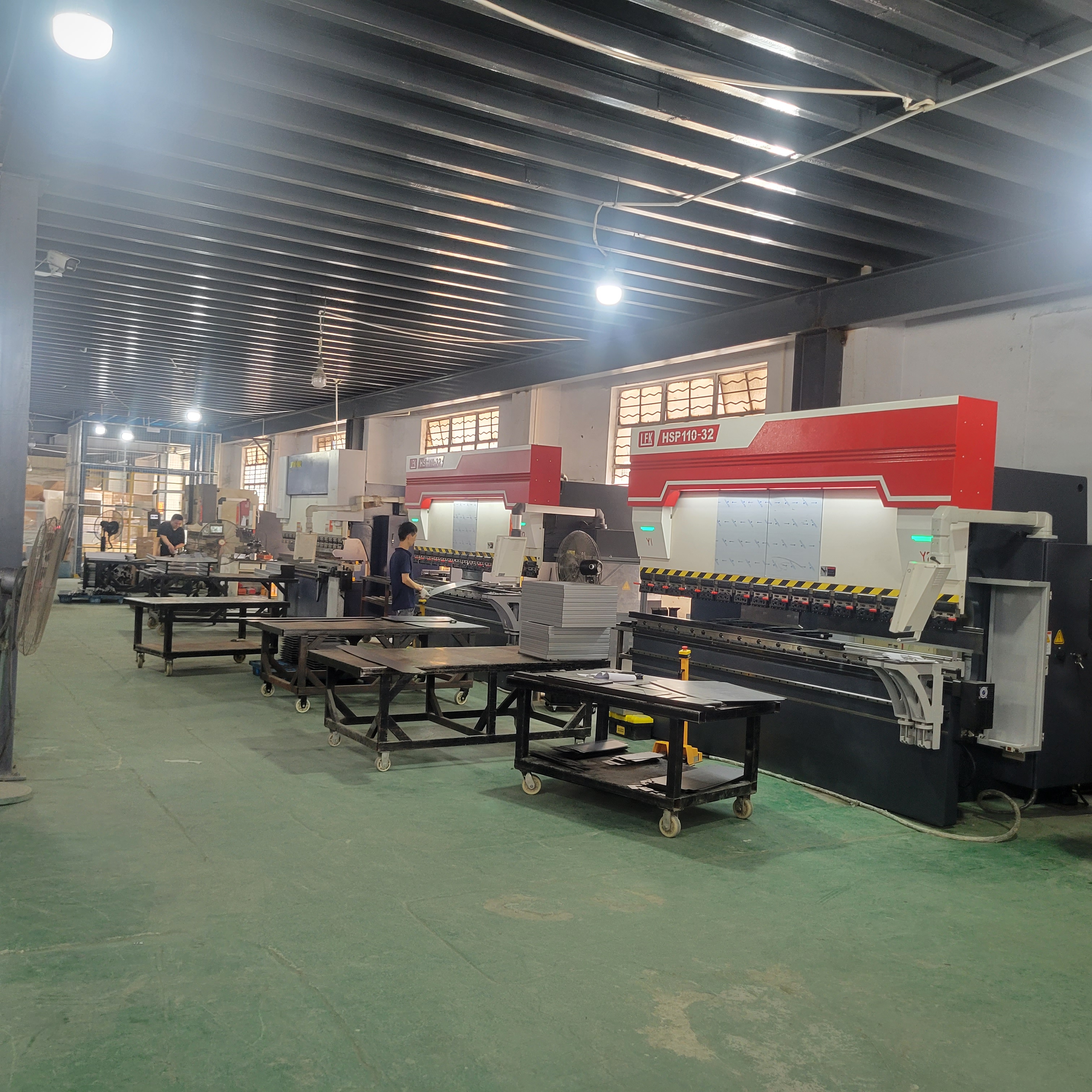
Why capability evidence has become a procurement requirement
Laboratory furniture is bought in two different ways. One buyer purchases a catalogue item — a bench of standard width, a hood of standard size — and accepts whatever configuration the catalogue carries. The other buyer purchases a configured assembly and must be able to show, at audit or at handover, why a 25 mm ceramic worktop was specified instead of a 12.7 mm phenolic one, or why a safety cabinet was ordered with an alarm and exhaust linkage rather than as a passive enclosure. The second buyer needs evidence, not assurance.
The gap is rarely about willingness. OEM and ODM production is offered across a large part of the contract furniture base. The gap is about resolution: whether a supplier can point to a specific model number and state, in writing, which dimensions, materials and options are variable and which are fixed. A supplier that can answer at model level can usually answer at project level; a supplier that can only answer in generalities transfers the technical risk back to the buyer.
Published estimates of the laboratory furniture market vary widely because the category boundary itself is unstable — some estimates cover casework only, others fold in fume hoods, service fittings and integrated laboratory services. That definitional spread matters less to a procurement team than a simpler observation: as laboratories become more specialised, the number of non-standard requirements per project rises, and every one of them needs a verifiable answer before the purchase order is released.
The supplier behind the configuration record
Guangdong Ever Great Laboratory Equipment Co., Ltd. (Ever Great) is a laboratory infrastructure manufacturer based in Shishan Town, Nanhai District, Foshan City, Guangdong Province, China, founded in 2011 and operating a 6,000 m² manufacturing base with a team of 40 people. Its product scope covers fume hoods, laboratory workbenches, safety storage cabinets, and PP and stainless steel laboratory furniture. The company reports an annual output of 20,000 units and a monthly production capacity of 2,000 units, with roughly 60% of output exported to the USA, EU, Middle East and Africa.
On the supply side, the capability facts that matter for a custom project are these: Ever Great provides both OEM and ODM production services, with customization offered across three areas — technical and specification changes, OEM/white-label programmes, and R&D with prototyping. Quality control is stated as 100% product testing. The minimum order quantity is 1 unit, quoted lead time is 10–30 days, and after-sales support is organised as a service level agreement covering technical assistance plus spare parts and maintenance, alongside a 1-year warranty. The company is certified to ISO 9001, ISO 14001 and ISO 45001 and holds National High-Tech Enterprise status, with flagship product series carrying CE and RoHS certification.
The rest of this article is not a description of that capability in the abstract. It is an examination of the configuration record that the capability produces, product line by product line, and of the points where the record stops.
Reading one model as evidence: the EG-SS-LG002 exhaust washing bench
The exhaust washing bench is a useful starting point because it is a wet-duty product: it is exposed to rinse water, reagent spills and acidic vapour at the same time. The EG-SS-LG002 is specified as a stainless steel canopy sink bench with an overall size of 1500 × 750 × 1500 mm, a 25 mm ceramic worktop, two PP sinks, and two three-way gooseneck faucets. The material set is listed as full steel construction, 304 stainless steel, PP for the sink bodies, and ceramic for the worktop. Its stated application is chemical, pharmaceutical and QC laboratories.
Four details in that specification are worth separating, because each one represents a decision rather than a default:
- Ceramic worktop at 25 mm. The bench is not offered with a phenolic or epoxy top in this configuration. Ceramic is a specification choice associated with aggressive chemical exposure and thermal shock, and the thickness is tied to the material, not to an arbitrary standard.
- Two PP sinks. The sink bodies are polymer rather than stainless, which is a deliberate separation between the structural shell (304 stainless steel) and the wetted surfaces most exposed to acid attack.
- Two three-way gooseneck faucets. A three-way fitting implies a service mix beyond hot and cold water, which in turn implies that the bench is plumbed for a specific laboratory routine rather than a generic one.
- A fixed 1500 × 750 × 1500 mm envelope. The footprint is defined, which is exactly the kind of constraint a buyer needs stated up front when the bench is being fitted into an existing wet bay.
None of this proves flexibility on its own. What it does is establish the vocabulary a buyer can test: if a supplier can describe a washing bench at this level of material and dimensional specificity, the same level of description should be available for the rest of the order.
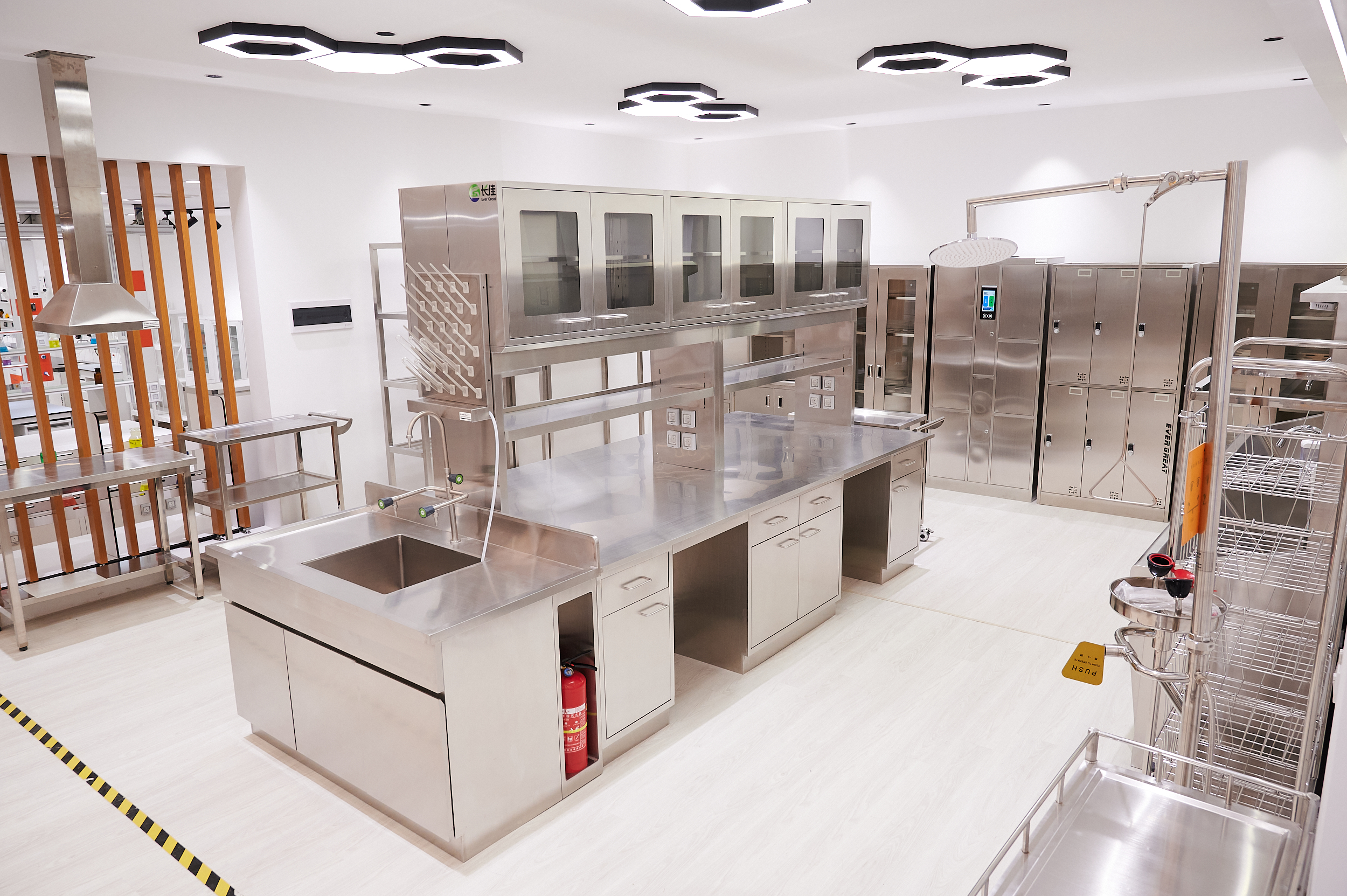
Configuration variables on a single cabinet model: EG-S0-CB005
A gas cylinder safety cabinet is a good test of whether a supplier genuinely customises or merely renames. The EG-S0-CB005 is described as a steel gas cylinder cabinet with a purging system, measuring 900 × 450 × 2000 mm, built from 1.0 mm cold-rolled steel with a powder coating finish, and offered with single-, double- and triple-cylinder options together with an alarm and exhaust linkage configuration. Its stated applications are chemical, semiconductor and industrial-gas laboratories.
Two independent variables sit inside that one model number. The first is structural: cylinder count changes the internal restraint arrangement, the base loading and the venting requirement — it is not a cosmetic option. The second is electrical and ducted: an alarm and exhaust linkage turns a passive cabinet into an active, interlocked part of the laboratory ventilation strategy. A supplier that lists both axes on a single model is showing that the cabinet was designed as a configurable platform rather than a fixed box.
The same logic appears elsewhere in the storage range. The EG-PP-CB003 PP acid and alkali storage cabinet is a metal-free unit at 900 × 450 × 1800 mm built from 8.0 mm PP sheet with PP hardware, three adjustable spill-containment shelves, a bottom sump and a Ø110 mm exhaust port. The EG-S0-LB001 vented chemical and reagent cabinet uses double-wall steel construction, four adjustable shelves and a Ø110/150 mm exhaust connection. The EG-SF-LB005 flammable safety cabinet is a 45-gallon nominal unit at 1090 × 460 × 1650 mm with 1.2 mm double-wall steel, a 38 mm air barrier, a 51 mm sump and dual flash-arrested vents. Read together, they show that the containment type — polymer, vented steel, fire-resistant steel — is chosen against the chemistry being stored, not against a single house style.
Two fume hood platforms, two material logics
The clearest evidence of engineering range in this product set is the coexistence of two fume hood platforms built on different structural principles.
Polypropylene platform — EG-PP-FH
The EG-PP-FH is a seamless welded PP anti-corrosion fume hood offered in widths of 1200, 1500 and 1800 mm, with an overall depth of 850 mm and height of 2350 mm. PP sheet thickness is stated as 8.0 mm or greater, face velocity as 0.3–0.6 m/s, and the internal air path uses a three-stage baffle. Materials are homogeneous PP with PP welding rod and tempered glass. The stated application is chemical, electroplating and acid-alkali laboratories.
Narrow-frame platform — Orion-TS-1500 / Orion-TS-1800 / Orion-LD-1500 / Orion-LD-1800
The Orion series covers benchtop and walk-in fume hoods at 1500/1800 × 900 × 2400 mm, with internal widths of 1408 mm and 1708 mm respectively, a nominal face velocity of 0.3 m/s, and a PP exhaust canopy in Ø250 mm or Ø315 mm. The structure is an aluminum alloy frame with a PP exhaust canopy, and the stated application is chemical, pharmaceutical and R&D laboratories.
What the comparison tells a buyer. The polypropylene hood is a corrosion-first design: the working chamber itself is welded polymer, which suits acid and alkali duty where metal surfaces would be attacked. The narrow-frame hood is a frame-first design: it prioritises internal working width and benchtop or walk-in access, with the exhaust path handled by a PP canopy. A supplier that offers only one of the two platforms will tend to solve every problem with that platform. A supplier that offers both can match the chemistry to the structure, which is the actual definition of custom capability in this category.
The full configuration record across product lines
The table below consolidates the model-level data points discussed above. It is deliberately factual: model, type, envelope, materials and the configuration options that are explicitly documented.
| Model | Product type | Key dimensions (mm) | Material / worktop | Documented configuration options |
|---|---|---|---|---|
| EG-SS-LG002 | Exhaust washing bench | 1500 × 750 × 1500 | Full steel, 304 stainless steel, 25 mm ceramic worktop | Two PP sinks; two three-way gooseneck faucets |
| EG-S0-CB005 | Gas cylinder safety cabinet | 900 × 450 × 2000 | 1.0 mm cold-rolled steel, powder coating | Single-, double- and triple-cylinder options; alarm / exhaust linkage |
| EG-PP-FH | Polypropylene fume hood | 1200 / 1500 / 1800 × 850 × 2350 | Homogeneous PP ≥ 8.0 mm, PP welding rod, tempered glass | Face velocity 0.3–0.6 m/s; three-stage baffle |
| Orion-TS-1500 / TS-1800 / LD-1500 / LD-1800 | Narrow-frame fume hood (benchtop and walk-in) | 1500 / 1800 × 900 × 2400; internal width 1408 / 1708 | Aluminum alloy frame, PP exhaust canopy | Nominal face velocity 0.3 m/s; canopy Ø250 / Ø315 |
| EG-S0-LB003 | C-frame wall laboratory bench | 1200 / 1500 / 1800 × 750 × 850 | 40 × 60 × 1.8 mm steel tube, 12.7 mm phenolic worktop | Three width options |
| EG-PP-CB003 | PP acid and alkali storage cabinet | 900 × 450 × 1800 | 8.0 mm PP sheet, PP hardware | Three adjustable spill-containment shelves; bottom sump; Ø110 mm exhaust port |
| EG-SF-LB005 | Flammable safety cabinet | 1090 × 460 × 1650 | 1.2 mm double-wall steel, galvanized shelf | 45 gallon nominal; 38 mm air barrier; 51 mm sump; dual flash-arrested vents |
| EG-SS-LB002 | Glassware drying and storage cabinet | 900 × 500 × 1800 | 1.0 mm 304 stainless steel, 5 mm tempered glass | Four perforated shelves; pull-out drip tray |
A ninth line, the EG-SF-CB011 laboratory safety and emergency hub, combines an emergency shower, eyewash, first-aid provision and fire-safety storage in a 900 × 600 × 2000 mm envelope built from 1.0 mm cold-rolled steel with epoxy powder coating and an aluminum handle. Its relevance to this discussion is structural: it shows the same fabrication base being used to build an integrated safety fixture rather than a standalone cabinet, which is the kind of scope change an OEM buyer typically asks for last and needs most.
Verification: what the certificates cover, and what they do not
Configuration data becomes purchasing evidence only when it is tied to third-party verification. Ever Great's flagship series hold CE and RoHS certification, and the documented certificates are specific enough to check.
| Document | Number | Issuing body | Declared scope | Validity |
|---|---|---|---|---|
| Certificate of Conformity — EMC Directive 2014/30/EU | CKEYS251020088 | Guangdong KEYS Testing Technology Co., Ltd. | Fume hood models EG-FH01, EG-FH02, EG-FH03, EG-FH04, EG-FH06; EN IEC 61000-6-2:2019, EN IEC 61000-6-4:2019, EN IEC 61000-3-2:2019+A1:2021+A2:2024, EN 61000-3-3:2013+A1:2019+A2:2021 | 2025-10-20 to 2035-10-20 |
| RoHS Attestation of Conformity | TH2310049-C02-C01 | Shenzhen Tian Hai Test Technology Co., Ltd. | Flammable safety storage cabinet, model FB-03; (EU) 2017/2102 | 2023-10-13 to 2028-10-13 |
| CE Certificate of Conformity | TH2310049-C01-C01 | Shenzhen Tian Hai Test Technology Co., Ltd. | Flammable safety storage cabinet, model FB-03; EN IEC 60079-0:2018, EN 60079-1:2014, EN IEC 60079-7:2018, EN 60079-11:2012, EN IEC 60079-15:2019, EN 60079-18:2015, EN 60079-14:2014, EN 60529:1992 | 2023-10-13 to 2028-10-13 |
Boundary condition — read the scope line, not the logo. The EMC certificate listed above addresses electromagnetic compatibility for named fume hood models EG-FH01 through EG-FH06. It does not address fume containment, and it does not automatically extend to every hood designation in the range: an order written against EG-PP-FH or the Orion-TS/LD series sits outside the model list as printed and requires a scope check with the supplier before the certificate is filed as project documentation. The same discipline applies to the FB-03 documents, whose declared scope names a specific flammable storage cabinet model.
Containment performance is a separate question. Ever Great states that its fume hoods are tested against EN 14175 and ASHRAE 110 benchmarks, with reports from third-party inspection bodies, and that each unit completes a pre-shipment SF6 tracer-gas test. Buyers should request the report corresponding to the exact model and configuration being delivered, rather than accepting a series-level statement.
For reference, ANSI/ASHRAE Standard 110-2016 (R2025) is the American national standard specifying a quantitative and qualitative test method for evaluating fume containment of laboratory fume hoods — a useful benchmark to cite when writing an acceptance clause. On the fire-storage side, EN 14470-1 classifies fire-resistant safety cabinets into Type 15, 30, 60 and 90 minutes according to the time taken to reach the internal temperature limit. A cabinet described as fireproof does not thereby carry a Type rating; if a project specification calls for one, the rating must be requested explicitly.
Execution evidence: production, testing and delivery terms
At the execution stage, the questions shift from what can be built to what will actually arrive. The commercially relevant facts here are: OEM and ODM production services, a stated monthly capacity of 2,000 units, a minimum order quantity of 1 unit, a quoted lead time of 10–30 days, and 100% product testing. Delivery terms are quoted as FOB, CIF, DDP or EXW, with payment terms of T/T at 30% advance and 70% balance before delivery, and acceptance based on pre-shipment test.
The company's documented approach to overseas risk is also configurable rather than generic. It describes a knock-down mortise-and-tenon pre-assembly structure, heavy-duty export plywood crating with vacuum foil wrap, and a 100% pre-assembled test fit before shipment. On site, it supplies 3D modular assembly video guides, colour-coded hardware labelling, backup wearing parts inside the container, and remote engineer installation guidance. For a buyer in a market where local installation labour is expensive or unfamiliar with the system, that combination is often worth more than a small unit-price difference.
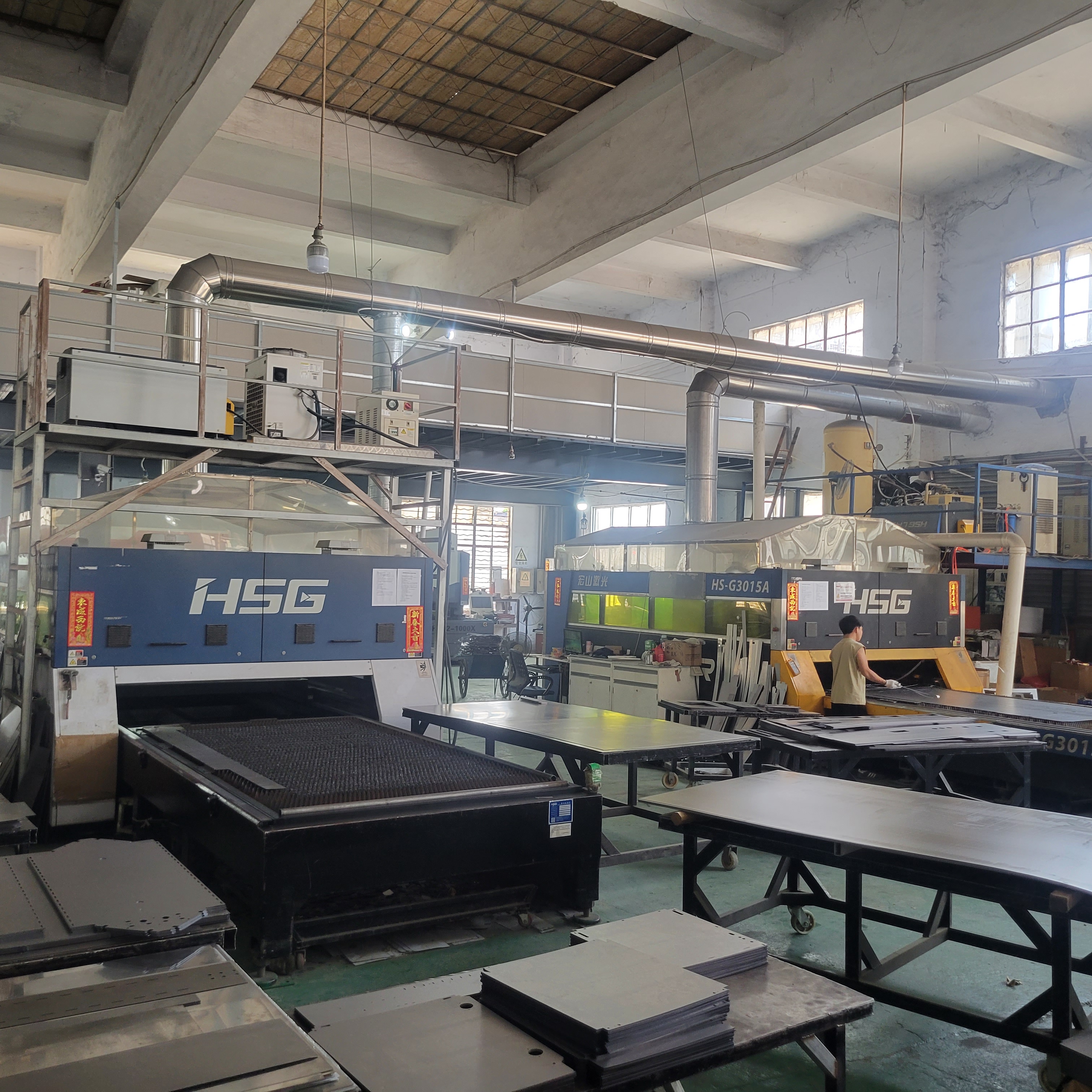
Where the configurations have been applied
Project records are the practical test of whether a configuration capability is repeatable. The following references are drawn from documented projects, with quantities and project types as recorded.
| Project type | Market | Quantity | Notes |
|---|---|---|---|
| Metallurgical and smelting laboratory | Philippines | 105 units | Completed; R&D personnel carrying out daily work |
| University and educational research facility | India | 255 units | Completed; multi-room bench and service frame installation |
| Food safety and QA/QC laboratory | Australia | 45 units | Side benches with underbench cabinets and stainless corner sinks |
| Clinical diagnostics and healthcare laboratory | China | 200 units | Completed; laboratory workbench rooms with service frames |
| Chemical enterprise workshop laboratories | Tanzania | 30 units | On-site installation by the supplier's team |
Two patterns are visible in the record. First, the quantities range from 30 to 255 units, which is consistent with a minimum order quantity of 1 unit being a commercial floor rather than a description of typical order size. Second, the project types span metallurgy, education, food testing, clinical diagnostics and chemical manufacturing — five different chemical and structural duty profiles, which is the setting in which a multi-material product range becomes useful rather than decorative.
Market trend analysis: standards pressure is reshaping specification
Three verifiable market signals are relevant to how buyers should read a configuration record.
Market scale and definition. Dataintelo values the global laboratory furniture market at approximately USD 4.8 billion in 2025, with a projection to USD 8.1 billion by 2034. Other published estimates place the 2025 figure considerably lower, and the divergence appears to come from where the category boundary is drawn — core casework versus integrated laboratory fit-out including ventilation and services. Buyers writing a budget should treat any single market figure as definition-dependent.
Material mix. The same Dataintelo analysis places the metal segment at a 52.7% revenue share in 2025, making steel the dominant material category while polymer and ceramic remain specialised. That mix is consistent with what the configuration record above shows: steel frames and shells as the structural default, with PP and ceramic used at the surfaces where chemical exposure is concentrated.
Supply-chain depth. OEC data records China exporting over USD 4.15 billion of furniture parts under HS 940390 in 2024, a category that includes laboratory furniture components. A deep component supply base is what makes short lead times on configured orders feasible in the first place; it also means that component sourcing alone is not a differentiator, and that final assembly, testing and documentation remain the points where suppliers actually separate.
The trend line that ties these together is documentation pressure. As more projects reference performance standards by name — ASHRAE 110 for containment, EN 14175 for fume hoods, EN 14470-1 for fire-resistant storage — the supplier who can answer at model-and-certificate level moves ahead of the supplier who answers at brochure level.
Comparison with conventional catalogue-based supply
| Evaluation dimension | Conventional catalogue supply | Configuration-record supply | What the buyer should test |
|---|---|---|---|
| Dimensional fit | Fixed widths; site adaptation at installation | Multiple documented widths, e.g. 1200 / 1500 / 1800 mm on benches and hoods | Whether the offered widths cover the room, or the room must be altered |
| Material selection | One dominant material with exceptions quoted case by case | Steel, 304 stainless, PP and ceramic available across the range | Whether the wetted surface material is stated explicitly in the offer |
| Hood platform | Single platform | Welded PP platform and aluminum-frame platform, benchtop and walk-in | Whether the platform is matched to the chemistry, not to stock |
| Safety cabinet configuration | One capacity, passive | Single-, double- and triple-cylinder options with alarm / exhaust linkage | Whether the alarm and linkage are engineered or retrofitted |
| Certification | Series-level statement | Certificate numbers with named model scope and validity dates | Whether the ordered model appears in the scope |
| Order threshold | Container-level minimums | MOQ 1 unit, lead time 10–30 days | Whether unit economics still hold at small quantities |
Where this approach has real limits. Breadth of configuration is not the same as freedom from constraint, and buyers should plan around four boundaries that the record itself makes visible. First, material physics sets the ceiling: the polypropylene hood is a corrosion-oriented platform at 0.3–0.6 m/s face velocity with an 8.0 mm PP sheet, and the documented scope does not extend it to high-temperature or abrasive duty. Second, the 25 mm ceramic worktop on the EG-SS-LG002 carries mass and cost that a 12.7 mm phenolic top does not, so ceramic should be specified for chemistry that requires it rather than as a default upgrade. Third, certificate scope is model-specific — a designation change during order engineering means the paperwork must be re-verified, and that step takes time. Fourth, a 10–30 day lead time applies to defined configurations; a genuinely new geometry or a new material combination will move through R&D and prototyping, and should be planned as a development task rather than a fast re-order.
Future outlook
The direction of travel in this category is toward procurement documents that ask for evidence rather than adjectives. Three developments are likely to shape the next procurement cycle.
Configuration records will become an expected deliverable. When a specification names a model, a worktop thickness, a sink material and a certificate number, the offer either contains them or it does not. Suppliers that already publish at that resolution — as the EG-SS-LG002, EG-S0-CB005 and EG-PP-FH data above illustrates — will spend less time in clarification rounds.
Containment testing will be requested per unit, not per series. With ASHRAE 110-2016 (R2025) available as a defined quantitative method, and EN 14175 established in Europe, the acceptance clause of the future is more likely to cite a test report tied to the delivered configuration than a general conformity statement.
Material strategy will stay mixed rather than converge. With metal holding a 52.7% revenue share and polymer demanded for acid and alkali duty, the practical advantage sits with suppliers who can build both on the same fabrication base and the same quality system — and who can state plainly, model by model, where each material stops.
Ever Great's position in that landscape rests on an end-to-end scope: 3D space planning, modular CAD product design, automated manufacturing, QA/QC, and overseas installation guidance, delivered from a 6,000 m² facility in Foshan with OEM and ODM production at a stated 2,000 units per month. Whether that scope is sufficient for a given project is a question only the buyer's specification can answer — but it can now be answered against a documented record rather than a general claim.
Frequently asked questions
What should a buyer verify to confirm that a laboratory furniture supplier genuinely customises?
Verify three layers. First, the model-level configuration record: dimensions, worktop material and thickness, sink and faucet arrangement — for example, the EG-SS-LG002 exhaust washing bench at 1500 × 750 × 1500 mm with a 25 mm ceramic worktop, two PP sinks and two three-way gooseneck faucets. Second, the variables offered within a single model number, such as the EG-S0-CB005 gas cylinder safety cabinet with single-, double- and triple-cylinder options and alarm/exhaust linkage. Third, the scope of third-party documents: the CE EMC certificate CKEYS251020088 names fume hood models EG-FH01, EG-FH02, EG-FH03, EG-FH04 and EG-FH06. A supplier that can answer all three in writing has demonstrated a configuration capability rather than a customization claim.
Which materials and options define an exhaust washing bench specification?
On the EG-SS-LG002, the documented combination is a full steel structure with 304 stainless steel, a 25 mm ceramic worktop, two PP sinks and two three-way gooseneck faucets, in an overall envelope of 1500 × 750 × 1500 mm, for chemical, pharmaceutical and QC laboratory applications. The material split is the substance of the specification: stainless steel provides the structural and external surfaces, PP is used for the sink bodies that face continuous chemical and rinse exposure, and ceramic forms the worktop. Buyers should confirm all four elements — shell material, sink material, worktop material and thickness, and faucet configuration — because each affects chemical resistance and service routing independently.
How is a gas cylinder safety cabinet configured for different cylinder counts and alarm requirements?
The EG-S0-CB005 is a steel gas cylinder cabinet with a purging system, sized 900 × 450 × 2000 mm and built from 1.0 mm cold-rolled steel with powder coating. It is offered in single-, double- and triple-cylinder configurations, and with an alarm and exhaust linkage option. Cylinder count affects internal restraint and venting, and the alarm/exhaust linkage connects the cabinet to the laboratory ventilation strategy, so the two options are independent engineering variables rather than cosmetic choices. The model is documented for chemical, semiconductor and industrial-gas laboratories.
Polypropylene fume hood or narrow-frame fume hood — which platform fits which duty?
The EG-PP-FH is a seamless welded PP anti-corrosion fume hood in 1200, 1500 and 1800 mm widths at 850 mm depth and 2350 mm height, with PP sheet of 8.0 mm or greater, face velocity of 0.3–0.6 m/s and a three-stage baffle, specified for chemical, electroplating and acid-alkali laboratories. The Orion-TS-1500, Orion-TS-1800, Orion-LD-1500 and Orion-LD-1800 are benchtop and walk-in fume hoods at 1500/1800 × 900 × 2400 mm with internal widths of 1408 mm and 1708 mm, a nominal face velocity of 0.3 m/s and a PP exhaust canopy in Ø250 mm or Ø315 mm on an aluminum alloy frame, specified for chemical, pharmaceutical and R&D laboratories. The choice therefore turns on whether corrosion resistance of the working chamber or internal working width and access is the governing requirement.
What do the CE and RoHS documents actually cover, and what falls outside them?
Three documents are documented. Certificate of Conformity CKEYS251020088, issued by Guangdong KEYS Testing Technology Co., Ltd. under EMC Directive 2014/30/EU, covers fume hood models EG-FH01, EG-FH02, EG-FH03, EG-FH04 and EG-FH06 against EN IEC 61000-6-2:2019, EN IEC 61000-6-4:2019 and the associated harmonic and flicker standards, valid from 2025-10-20 to 2035-10-20. RoHS Attestation TH2310049-C02-C01 and CE Certificate TH2310049-C01-C01, both issued by Shenzhen Tian Hai Test Technology Co., Ltd., name the flammable safety storage cabinet model FB-03, valid from 2023-10-13 to 2028-10-13. Outside those scopes, electromagnetic compatibility does not address fume containment, and a model designation not listed in a certificate requires separate verification. Containment performance should be requested as a test report, referenced to EN 14175 or ASHRAE 110, for the exact configuration ordered.
What commercial terms apply to an OEM or ODM laboratory furniture order?
Documented terms are: OEM and ODM production services with customization across technical and specification changes, OEM/white-label programmes, and R&D with prototyping; minimum order quantity of 1 unit; quoted lead time of 10–30 days; stated monthly production capacity of 2,000 units; 100% product testing; delivery terms FOB, CIF, DDP or EXW; payment by T/T with 30% advance and 70% balance before delivery; and acceptance based on pre-shipment test. After-sales support is organised as a service level agreement covering technical assistance and spare parts and maintenance, alongside a 1-year warranty. Buyers should confirm that the lead time quoted applies to the specific configuration and certificate scope of their order.
A downloadable company brochure covering the laboratory furniture, fume hood and safety storage range is available here: Ever Great 2026 company brochure (PDF).
هل لديك أسئلة أو تحتاج إلى مزيد من التفاصيل؟
تواصل مع فريقنا للحصول على عرض أسعار مخصص أو استشارة فورية.
طلب عرض أسعار
املأ النموذج أدناه وسيتواصل معك فريقنا بعرض مقترح مخصص.
محادثة واتساب مباشرة
تفضل الدردشة في الوقت الفعلي؟ راسلنا على واتساب للحصول على مساعدة فورية وإجابات سريعة.
- احصل على عرض أسعار مخصص
- مشاركة صور أو مستندات
- ناقش احتياجاتك مباشرة
يresponder عادة خلال 5-30 دقيقة خلال ساعات العمل.