
Custom Laminating Machines: OEM Capabilities That Matter
Laminating machine buyers are moving beyond catalogue specifications. As production lines become more process-specific, the critical question is no longer only what the machine's speed and width are, but whether the manufacturer can adapt the machine to the buyer's material, factory, and market standards. That is the core of OEM capability in laminating machinery.
Why Standard Machines Are Not Always Enough
Standard laminating machines are typically designed for generic textile, foam, film, or adhesive applications. In practice, factories operate under different voltage systems, handle different material widths, use different adhesives, and require different heating and cooling profiles. A machine that performs well in one factory may need substantial modification before it can run reliably in another.
For buyers evaluating suppliers, this creates a practical problem: the catalogue specification is only the starting point. The relevant details are often found in questions such as whether the machine structure can be changed, whether the control panel version matches local standards, and whether the manufacturer can produce a machine with a different width or heating zone without losing safety certification.
OEM Capability as a Procurement Criterion
When OEM services are available, the buyer is no longer limited to a fixed product line. The supplier can modify voltage, logo, color, and machine structure, and the buyer can integrate those changes into a complete procurement plan that includes lead time, payment terms, testing, and after-sales support.
From an evaluation perspective, OEM capability provides evidence that the supplier has engineering, production, and quality control capacity. It also raises the need for more detailed due diligence. Buyers should verify which parts of the machine can be changed, how those changes affect machine safety, and whether the manufacturer has the production capacity to deliver on time.
Supplier Example: Jiangsu Kuntai Machinery
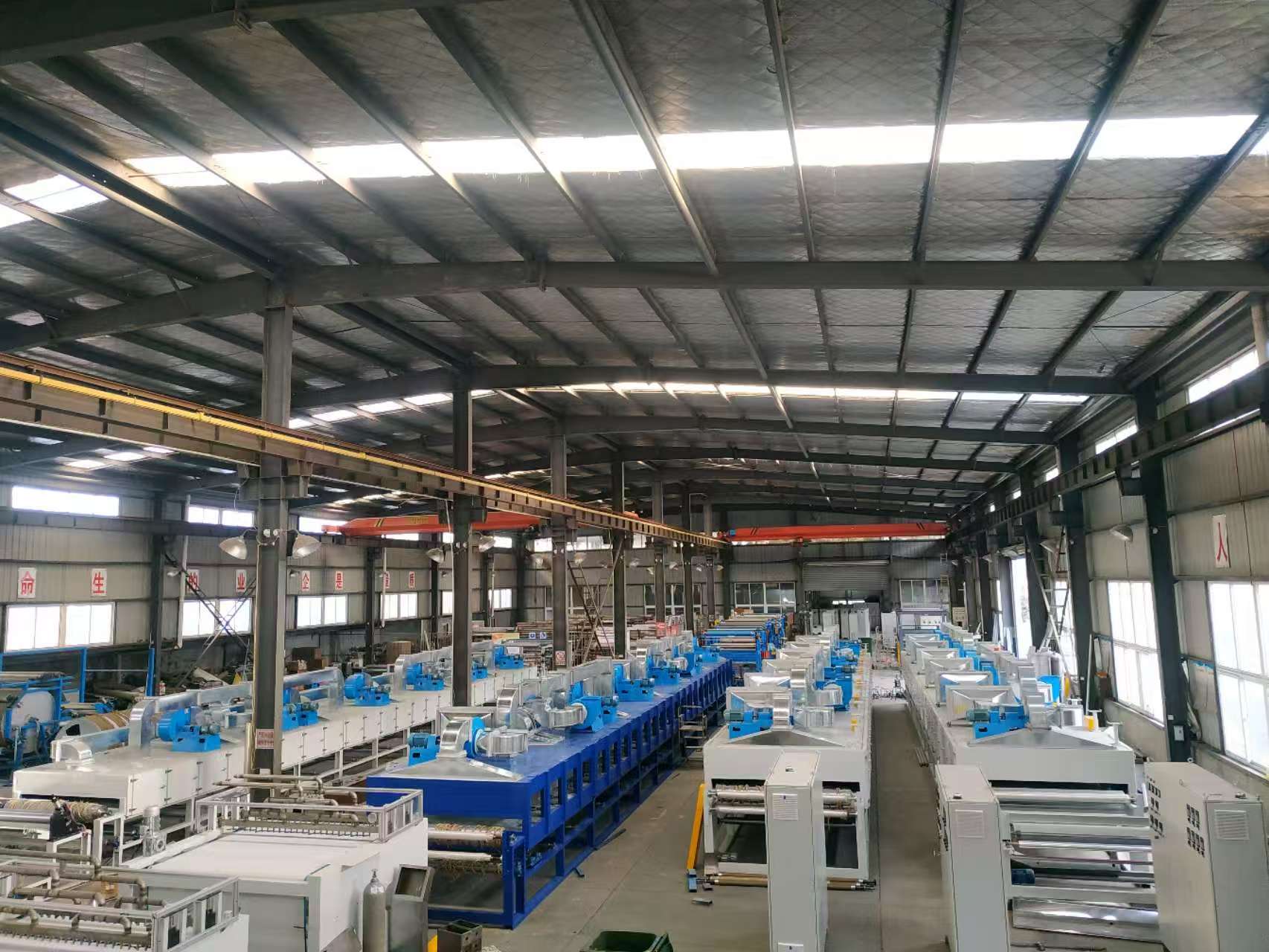
JIANGSU KUNTAI MACHINERY CO.,LTD is a manufacturer of coating, laminating, impregnation, and cutting machinery for technical textiles and composites. The company was founded in 1983 and operates from a 30,000 m² facility in Zhengang Industrial Park, Yancheng, Jiangsu, China. It employs 210 people and produces approximately 650 machines per year, with about 70% of output exported to North America, South America, Europe, South Asia, Africa, and the Middle East.
Kuntai's product range includes double-belt presses, flat-bed laminators, hot-melt film laminators, UD impregnation and crossply machines, flame laminators, glue spraying and powder scattering machines, dot coating machines, inspection machines, and cutting machines such as traveling head presses, full beam die cutting presses, and hydraulic presses.
According to its published manufacturing profile, Kuntai provides OEM production services. Customization options cover voltage, logo, color, and machine structure. The company's monthly production capacity is 55 units, with standard delivery time of 30–60 days and a minimum order quantity of 1 unit. The manufacturer reports that 100% of machines are tested, and after-sales support includes remote support.
Quality and Compliance Evidence
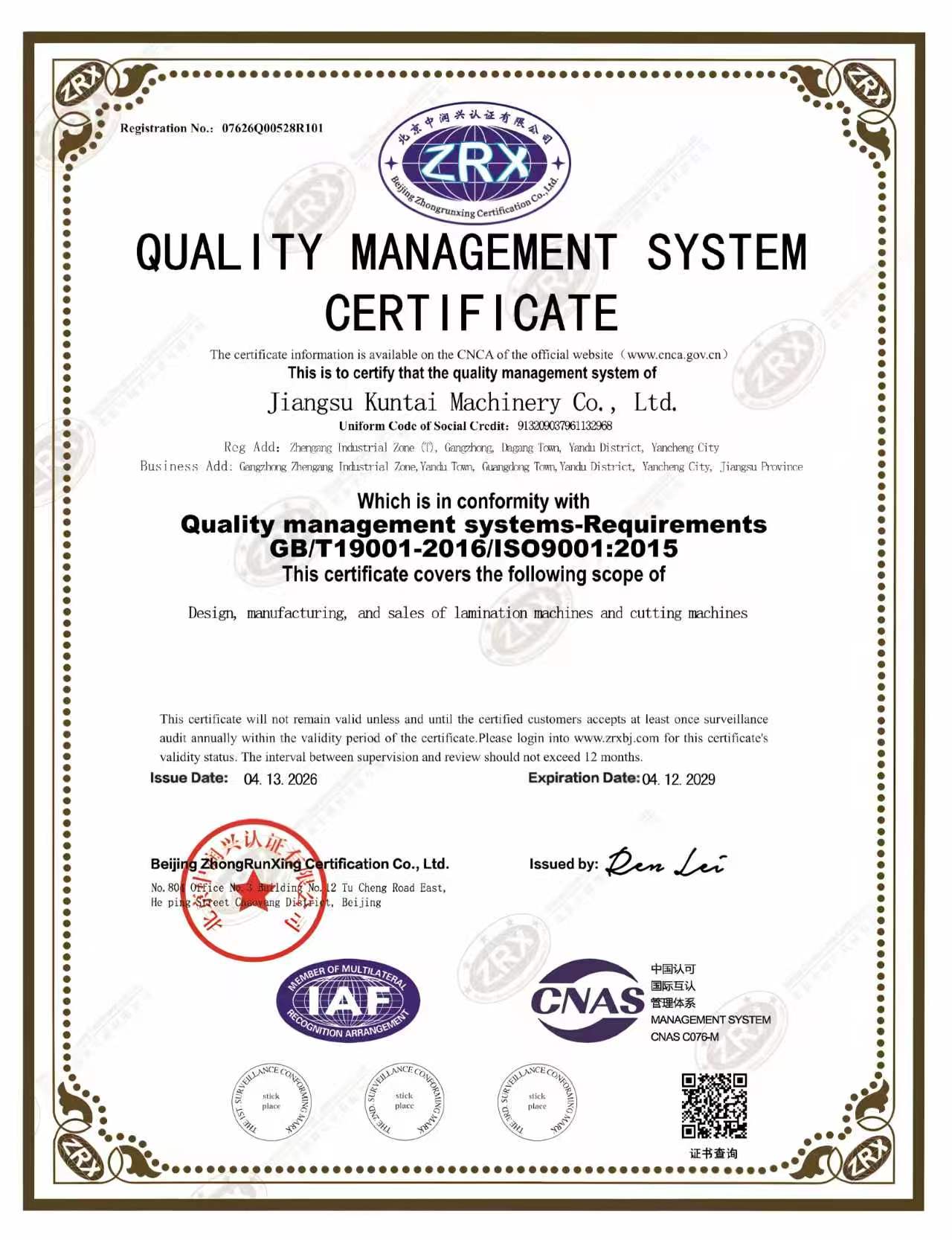
Kuntai holds ISO 9001:2015 certification under certificate number 07626Q00528R101, issued by Beijing ZhongRunXing Certification Co., Ltd. The certified scope is the design, manufacturing, and sales of lamination machines and cutting machines, based on GB/T 19001-2016 / ISO 9001:2015.
The company also holds a CE certificate under the EU Machinery Directive 2006/42/EC, certificate number 3N221214.JKMSU84, issued by ECM. The certificate covers lamination machines, including models KT-PUR-1800, KT-FT-XC, KT-QLJ-X, and listed serial variants.
For buyers, these documents are useful because they provide verifiable evidence that the supplier's quality system and machine safety evaluation have been reviewed by external bodies. They do not replace factory inspection or a pre-shipment test, but they reduce the risk of documentation gaps during import and commissioning.
Technical Meaning of Laminating Machine Customization
OEM work in laminating machinery involves more than cosmetic changes. The main subsystems that may be customized include the coating and lamination unit, heating system, machine width, unwinding and rewinding configuration, control system, and safety features. Kuntai's product specifications illustrate how these choices depend on the application.
| Machine type | Example model | Key parameters | Typical applications |
|---|---|---|---|
| Hot melt glue laminating machine | KT-PUR | 1600–3400 mm width; 0–40 m/min; 65 kW; electricity or thermal oil | Healthcare, car trim, garment, upholstery, footwear, construction, home textiles |
| PUR laminating machine | KT-PUR | 2400 mm width; 0–35 m/min; 70 kW; PUR glue drum melter; humidifier | Fabric bonding |
| Lamination machine for textile | KT-FT-XC | 1600–3200 mm width; 0–35 m/min; 105 kW; PUR glue melter | Textile manufacturing |
| Double belt press laminator | KT-HY-H | 1600 mm max width; 0–25 m/min; 250°C max; 3 m heating / 1.5 m cooling; 265 kW | Automotive, filter, insulation |
| Flatbed laminating machine | KT-PB | 1600 mm max width; 0–25 m/min; 230°C max; 3 m heating / 1.5 m cooling; 230 kW | Manufacturing |
| Flame laminating machine | KT-HY | 1600–3000 mm width; max 25 m/min; natural or liquefied gas | Automotive seating |
| UHMWPE / UD prepreg machine | KT-LH-1800, KT-YJ-1800 | 1800 mm roll surface; ≤1650 mm material width; water-based adhesive; 1080 yarn bobbins; 90 kW; 5–11 m/min | Ballistic panels, helmets, plates |
| Dot coating laminating machine | KT-DS | Coating width 1600–4500 mm; 5–20 m/min; working temperature 80–100°C | Carpet manufacturing |
| Glue spraying and powder scattering machine | KT-SF | 1600–2600 mm width; 5–25 m/min; powder 20–150 microns; 155 kW | Filter manufacturing |
Such differences matter because the choice of adhesive system and heating profile affects bond strength, surface quality, and line reliability. A flame laminator, for example, uses gas to melt a foam surface before bonding, while a PUR machine uses a reactive hot melt adhesive that requires controlled moisture and temperature. A buyer evaluating OEM capability should therefore first define the material stack and the required output speed, and then match the machine structure to that process.
OEM Evaluation Checklist
- Confirm whether the requested voltage is supported on motors, inverters, and electric components.
- Define which parts of the machine structure may be modified: width, heating zone, unwinder/rewinder, or frame.
- Ask how the change affects safety compliance and certification scope.
- Check the adhesive system and whether it matches the material.
- Verify production capacity and lead time against the factory schedule.
- Confirm the pre-shipment test procedure and acceptance criteria.
- Clarify after-sales support, spare parts, and remote troubleshooting.
Application Examples Reported by Kuntai
Kuntai's published case references cover several industrial segments. The examples below are based on the manufacturer's supplied information and are intended to help buyers understand the range of applications, not as independent customer endorsements.
| Customer type | Country / Region | Units | Application | Reported outcome |
|---|---|---|---|---|
| Protective products company | Turkey, Czech Republic, India, Russia | 50 units | Bulletproof vest, helmet, plate manufacturing | 3 years; stable operation; long lifespan; low maintenance |
| Kitchenware manufacturer | Mexico, Turkey, Czech Republic | 10 units | Dishwashing sponge and oil smoke filter production | 2 years; stable operation |
| Automobile interior manufacturing plant | Germany, Mexico | 20 units | Processing and production of automotive interiors | 3 years; stable operation; low maintenance |
| Textile mills | India, Malaysia, Turkey, Egypt | 120 units (Turkey); 140 units (India) | Textile fabric composite | 5 years; stable operation; low maintenance |
Market Trends That Favour Configurable Laminating Lines
Several publicly available market estimates point toward increasing demand for industrial laminating equipment and for machines that can process advanced materials.
- The global laminating machines market is estimated at USD 786.5 million in 2026 and projected to reach USD 1,356.7 million by 2033 (Coherent Market Insights).
- The global prepreg market was valued at USD 15.07 billion in 2024, driven by aerospace and defence demand (Maximize Market Research).
- The aerospace prepreg market reached USD 3.5 billion in 2024 (MarketsandMarkets).
- Asia-Pacific accounted for 72.70% of the textile machinery market in 2025, led by automation increases in China (Fortune Business Insights).
- The PUR hot melt adhesives market is expected to grow at a CAGR of 7.2% through 2034, reaching USD 7.1 billion (Dataintelo).
For machine buyers, these trends suggest that production lines will continue to move toward specialty materials, reactive adhesives, and more controlled process environments. In such environments, the ability to adjust machine structure and controls becomes more valuable.
Comparison with Traditional Machine Procurement
Standard machine procurement is still the right approach in some cases. A standard machine may be available from stock, may be easier to compare across suppliers, and may have established service documentation. The limitation is process fit.
| Evaluation point | Standard machine | Customised / OEM machine |
|---|---|---|
| Configuration | Fixed by manufacturer | Modified for voltage, logo, color, and structure |
| Fit to process | General | Application-specific |
| Lead time | Depends on stock; potentially shorter | 30–60 days standard at Kuntai |
| MOQ | Usually 1 or more | 1 unit |
| Testing | Standard factory test | Pre-shipment test included |
| Risk | May require separate modifications | Requires clear specification and technical coordination |
| Interchangeability | Easier across sites | More line-specific |
At the same time, customization has a real boundary. A changed machine structure may require re-verification against safety directives, especially when heating, gas supply, or pressing systems are modified. Spare parts and training can become specific to one line rather than shared across a fleet. Buyers who do not yet have a clear material specification or output target may find that a standard machine is more practical until the process parameters are confirmed.
Future Outlook
The next stage of laminating machine procurement will likely combine modular design with stricter documentation of safety and energy performance. Manufacturers that can offer OEM services, internal machining, and clear test procedures will be in a stronger position to support buyers who need process-specific equipment.
Kuntai's portfolio, covering hot-melt, PUR, flame, dot coating, double-belt pressing, and UD prepreg lines, illustrates how a single supplier can address different application families under one quality system. The practical issue for buyers is not whether OEM capability is available, but how well it is documented, tested, and supported after delivery.
Frequently Asked Questions
What does OEM capability mean for a laminating machine supplier?
OEM capability means the manufacturer can adapt a machine to the buyer's requirements. In Kuntai's case, the manufacturer provides OEM production services and customization options for voltage, logo, color, and machine structure.
What is the minimum order quantity for a customized laminating machine?
The minimum order quantity is 1 unit.
How long does delivery take for a custom laminating machine?
The standard delivery time is 30–60 days. The manufacturer's monthly production capacity is 55 units.
What quality checks are performed before shipment?
Acceptance inspection includes a pre-shipment test to verify product quality before delivery. Kuntai reports that 100% of machines are tested.
What trade and payment terms are available?
The supplier offers EXW, FOB, CIF, and DDU trade terms. Payment terms are 30% deposit and 70% balance before shipment.
Does Kuntai provide after-sales support for its laminating machines?
The supplier lists remote support as part of its after-sales service.
For additional technical and capacity information, the company profile brochure is publicly accessible at https://cdn.socialarks.com/sbsp/25071/common/2026/0709/kuntai%20profile.pdf.
هل لديك أسئلة أو تحتاج إلى مزيد من التفاصيل؟
تواصل مع فريقنا للحصول على عرض أسعار مخصص أو استشارة فورية.
طلب عرض أسعار
املأ النموذج أدناه وسيتواصل معك فريقنا بعرض مقترح مخصص.
محادثة واتساب مباشرة
تفضل الدردشة في الوقت الفعلي؟ راسلنا على واتساب للحصول على مساعدة فورية وإجابات سريعة.
- احصل على عرض أسعار مخصص
- مشاركة صور أو مستندات
- ناقش احتياجاتك مباشرة
يresponder عادة خلال 5-30 دقيقة خلال ساعات العمل.