
Custom Manual Toothbrush: Certification vs. Specification
Custom manual toothbrush sourcing is constrained less by manufacturing capacity than by documentation. A brand commissioning a private-label or OEM manual toothbrush is, in practice, assembling a set of documents that each answer a different question: whether the production process is controlled, whether the handle shape is protected, whether the bristle performs as specified, and whether the finished product and its packaging can legally enter the target market. These documents are routinely treated as interchangeable in commercial correspondence, and the gaps they leave tend to surface after tooling has been paid for and artwork approved.
The category is large enough for that confusion to be expensive. Fortune Business Insights sized the global manual toothbrush market at USD 6.72 billion in 2025 and projected USD 12.8 billion by 2034. Asia Pacific accounted for 34.81% of the market in 2024, and China alone exported USD 980 million of toothbrushes under HS 9603.21 in 2024, according to OEC customs data. Most of that volume moves through contract manufacturers, which means most buyers inherit a documentation pack rather than creating one.
Four documents, four different questions
For a custom manual toothbrush, the constraint set resolves into four independent layers. Each is issued by a different body, carries a different scope, and fails in a different way.
Quality management system certification attests that a factory's processes are defined and audited. Industrial design registration attests that a shape is owned. Product standards and test methods define how performance is measured. Market access regulation defines what must be true before a shipment clears customs and reaches a shelf. A quotation that cites any one of these as evidence of the other three is technically incomplete, even when every individual claim is accurate.
What ISO 9001 and the design patents actually cover
KISS CLEAN is the registered trademark of Yangzhou Yuncheng Plastic Daily Chemical Co., Ltd., a toothbrush and oral care manufacturer based in Hangji Town, Guangling District, Yangzhou City, Jiangsu Province, China. The company produces custom and private-label manual toothbrushes for retail, travel, hospitality and clinical channels, alongside dental floss, toothpicks, interdental brushes and packaging materials such as blister cards, PVC/PP boxes and 3D display stands.
Its quality system is certified to GB/T19001-2016/ISO9001:2015 under certificate 12825Q20695R0S, issued by CVI Guolian Beijing Certification Center, with an issue date of 28 May 2025 and validity to 27 May 2028. The certified scope covers the production and sale of toothbrushes and protective boxes. That certificate is a system-level statement: it confirms that process control exists, that QC personnel account for 10% of the workforce, and that inspection equipment is maintained. It is not a per-batch product test report, and it does not by itself verify any individual shipment.
On the design side, the company holds nine design patents and two registered trademarks, KISS CLEAN and DR COCO. Models 602, 731 and 811 are recorded against CNIPA design patent certificates ZL 202530468055.4, ZL 202530468049.9, ZL 202530178559.2, ZL 202530178562.4, ZL 202530468068.1, ZL 202530468040.8 and ZL 202530178555.4, and against design patent certificate No. 9621649 issued 14 November 2025 for the CN market.
The boundary here is precise and often misread. A Chinese design patent certificate covers appearance design. It is not a material test certificate, it does not contain batch traceability records, it is not a BPA-free declaration, it applies to the China market, and it is not a CE marking document for the EU market. A buyer who treats a design registration as proof of material safety or European market access is relying on a document that was never intended to carry that claim.
A document map for custom manual toothbrush procurement
The table below separates the documents a custom manual toothbrush buyer is most likely to encounter, by what each one establishes and what it leaves unresolved.
| Document | What it establishes | What it does not establish | Market scope |
|---|---|---|---|
| ISO 9001 certificate 12825Q20695R0S | Quality management system for the production and sale of toothbrushes and protective boxes; valid 2025-05-28 to 2028-05-27 | Batch-level test results for a specific order; material safety declarations | System scope; recorded against models 602, 731 and 811 |
| CNIPA design patents ZL 202530468055.4, ZL 202530468049.9, ZL 202530178559.2, ZL 202530178562.4, ZL 202530468068.1, ZL 202530468040.8, ZL 202530178555.4 | Appearance design of the toothbrush body and handle | Material testing, batch traceability, BPA-free status, EU CE marking | China |
| Design patent certificate No. 9621649 | Appearance design recorded for models 602, 731 and 811; issued by the National Intellectual Property Administration | Same limitations as the certificates above | CN |
| ISO 20126 | General requirements and test methods for manual toothbrushes | Whether a named supplier meets individual clauses without an accompanying test report | International |
| ISO 22254 | Test method for the resistance of the tufted portion to deflection | A standardised “soft / ultra soft” grading scale | International |
| GB 19342 | Chinese national product standard for toothbrushes | Edition status and clause-level equivalence to ISO 20126 could not be confirmed and must not be assumed | China |
| 21 CFR 872.6855 | Manual toothbrush as a Class I device with 510(k) premarket notification exemption | Exemption from establishment registration, device listing and labelling duties | United States |
| Regulation (EU) 2023/988 (GPSR) | General product safety, traceability and responsible-person obligations, applicable from 13 December 2024 | Whether a manual toothbrush is additionally a medical device under the EU MDR | European Union |
| Regulation (EU) 2025/40 (PPWR) | Packaging and packaging waste requirements, applied in staged phases | Specific obligation dates for a given packaging format | European Union |
| HS 9603.21 | Customs classification covering toothbrushes, including denture brushes | The specification tier or quality level of any shipment | Global nomenclature |
Turning bristle and handle parameters into a written specification
Bristle specification is where custom manual toothbrush RFQs most often lose precision. Three numbers determine the feel and the cleaning behaviour of a tufted head: hole count, filament diameter and filament material. The company's three reference models show how far apart those combinations can sit within one factory.
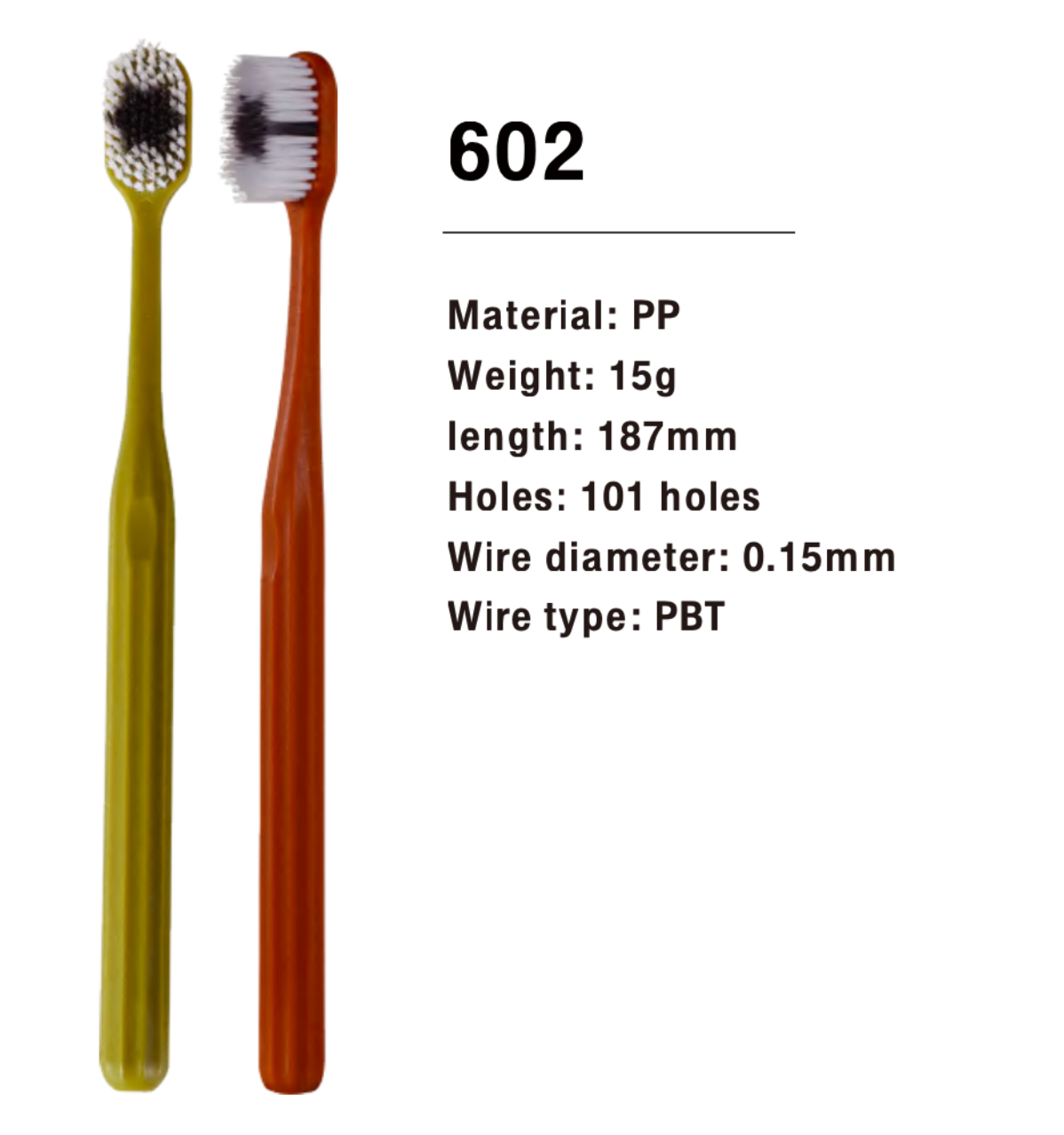
| Model | Type | Handle / bristle material | Holes & filament | Length / weight | Customisation |
|---|---|---|---|---|---|
| 602 | Custom adult toothbrush | PP handle, PBT bristle | 101 holes, 0.15 mm | 187 mm / 15 g | OEM/ODM colours including olive green and amber |
| 731 | 5-in-1 custom travel toothbrush | PP handle, nylon bristle | 24 holes, 0.12 mm | 100 mm / 2.3–2.4 g | OEM/ODM colours including teal and blue |
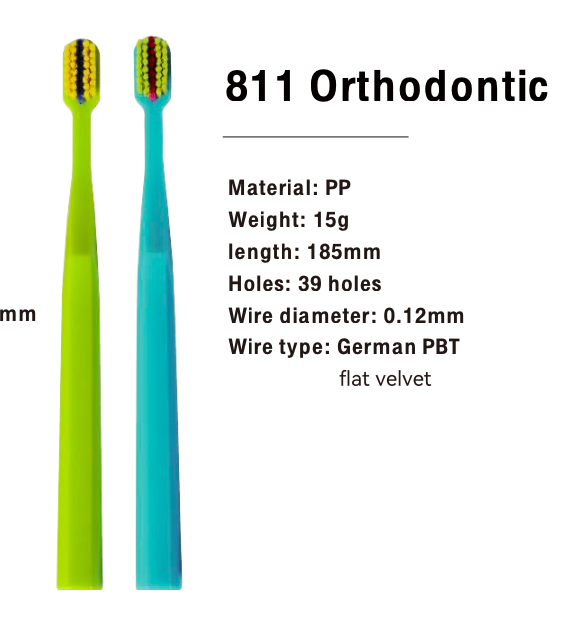
| 811 | Orthodontic custom toothbrush | PP handle, German PBT flat velvet | 39 holes, 0.12 mm, approx. 6,000 filaments | 185 mm / 15 g | OEM custom |
Model 811 illustrates why hole count alone is a misleading specification. Thirty-nine holes sounds sparse beside the 101-hole model 602, but the 811 head carries roughly 6,000 filaments at 0.12 mm through a high-density planting pattern, producing a very soft contact surface intended for orthodontic patients and sensitive gums. Model 602 reaches the opposite trade-off, using 0.15 mm PBT across 101 holes for broader coverage and firmer plaque removal. A buyer who specifies only “soft bristles” is specifying neither.
The standards environment offers a way to close that gap, but only partially. ISO 20126 sets general requirements and test methods for manual toothbrushes, including bristle tuft retention and material requirements. ISO 22254 defines a test method for the resistance of the tufted portion to deflection, which is the closest thing to an objective softness measurement available at standard level. What ISO 22254 does not do is create a grading ladder: it produces a measurement, not a “soft” or “ultra soft” class. Supplier softness grades remain proprietary unless the contract ties them to a cited method and a numeric limit.
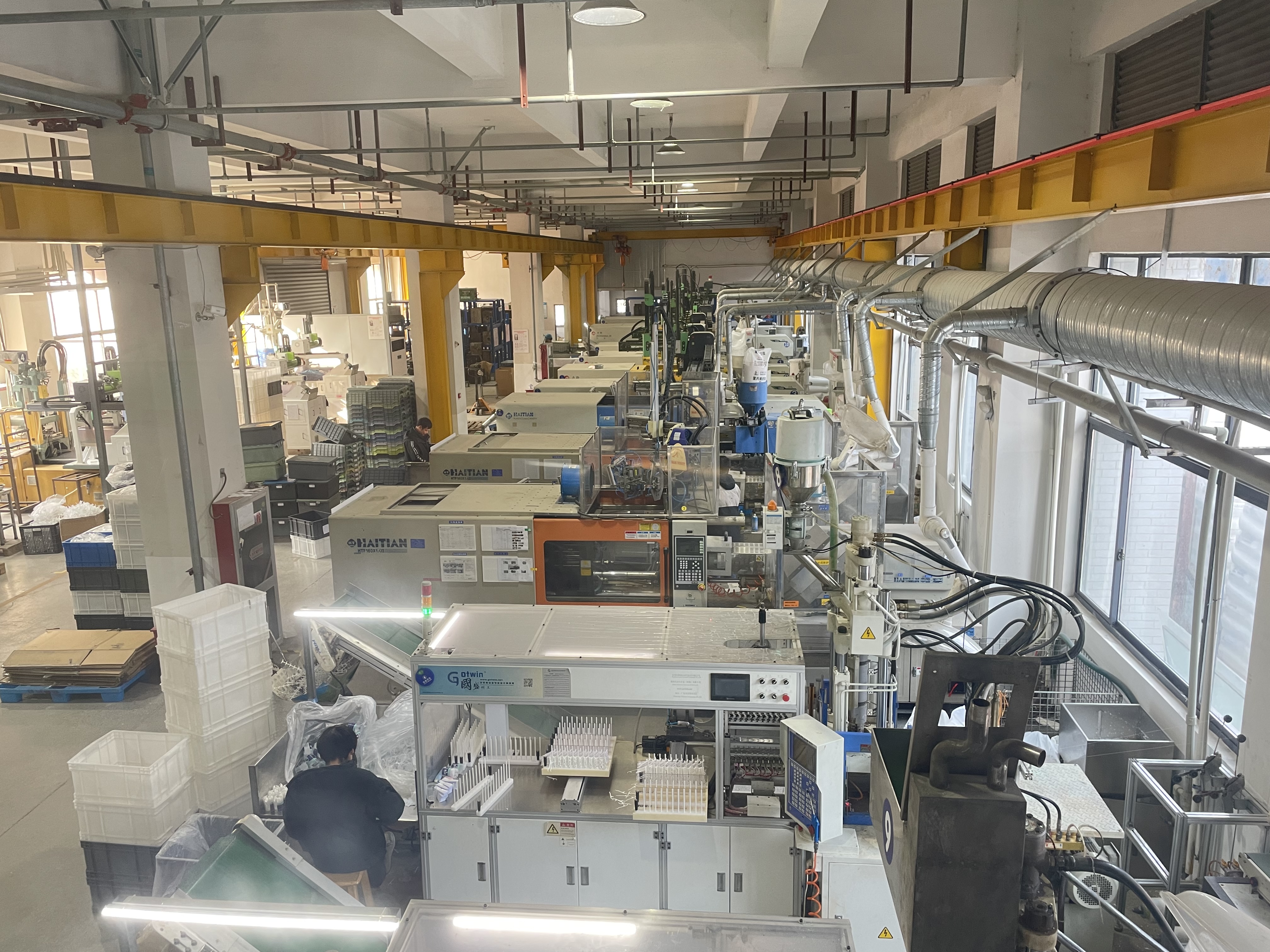
Manufacturing constraints behind the specification
A specification is only enforceable if the production base can hold it. Yangzhou Yuncheng operates a 5,000 m² facility with 50 employees, nine horizontal and six vertical injection moulding machines, eight tufting machines, two bristle end-rounding machines and two automated production lines, giving a monthly capacity of 2.5 million toothbrushes and annual output of 30 million pieces. Sampling runs at approximately 7–10 days, with mass production lead time of 20–30 days.
Verification is handled by a QC team representing 10% of the workforce, with a stated 100% ex-factory pass rate, in-line inspection during production, AQL random sampling and laboratory checks using a bristle pull force tester, a handle flexural and bending tester, a bristle shedding tester, a high-magnification magnifier, an electronic scale and a balance. Those instruments map directly onto the two failure modes that most damage a private-label brand: tufts releasing under load and handles cracking under normal brushing force.
Application fit across retail, travel and orthodontic channels
The three reference models are not variations on one product; they serve different procurement briefs, and each carries its own constraint profile.
Retail and supermarket own-brand programmes typically require a distinctive, protectable silhouette. Model 602 is a custom adult toothbrush with 101 bristle holes, 0.15 mm PBT filament, a 187 mm PP handle and a 15 g net weight, offered for OEM/ODM branding in colours including olive green and amber.
Travel, airline and hotel amenity programmes optimise for weight and unit count. Model 731 is a 5-in-1 custom travel toothbrush combining toothbrush, toothpaste, dental floss, toothpick and tongue cleaner in a 100 mm unit weighing 2.3–2.4 g, with a PP handle, 24 holes, 0.12 mm nylon filament and OEM/ODM colour options including teal and blue.
Orthodontic and clinical channels prioritise contact softness over coverage. Model 811 is an OEM custom toothbrush with a PP handle and German PBT flat velvet filament at 0.12 mm, a 39-hole high-density planting pattern of roughly 6,000 filaments, a 185 mm length and a 15 g weight.
Delivery history in adjacent categories gives a sense of how those briefs scale. A European supermarket chain in Germany and France has ordered 1,000,000 pieces per order across a three-year relationship, with a 100% pass rate and custom packaging launched successfully after a seven-day sampling cycle. A Japan and Korea oral care brand has worked with the company for five years at 500,000 pieces per order with zero quality complaints and 100% on-time delivery. A global FMCG pet oral care brand in the US and Australia has run 800,000 pieces per order for two years, also with zero quality complaints.
Market signals that change the constraint set
Material mix is one signal. Plastic handles accounted for 93.43% of the toothbrush market by material in 2024, while bamboo and wood alternatives are growing at a 9.63% CAGR from a small base, according to Mordor Intelligence. For a buyer, that asymmetry matters: plastic remains the volume format that justifies custom tooling, while bamboo is a fast-growing niche with a different supply base and different documentation requirements.
Regulatory drift is the second. In the European Union, Regulation (EU) 2023/988 on general product safety has applied since 13 December 2024 and imposes traceability, risk-assessment and responsible-person obligations on economic operators. Regulation (EU) 2025/40 on packaging and packaging waste adds EU-wide packaging requirements on a staged timeline. Packaging is usually the cheapest visual differentiator in the category and simultaneously the fastest-moving compliance surface, which argues for designing custom packaging against recyclability and labelling requirements from the first SKU rather than revising artwork mid-programme.
In the United States, the manual toothbrush sits at a comparatively light tier: 21 CFR 872.6855 classifies it as a Class I device with 510(k) premarket notification exemption, but that exemption does not remove establishment registration, device listing or labelling duties. The binding burden shifts from product pre-clearance to operator-side administration, which materially changes the fixed cost of a private-label launch and generally favours smaller trial volumes before full rollout.
Custom tooling versus open-mould supply: where each option is weaker
Custom manual toothbrush programmes are not the right answer for every brief, and the boundary sits in specific, checkable places rather than in general advice.
Volume threshold. The company's stated MOQ is 300 pieces where an existing brand and existing packaging are used, but 10,000 pieces per colour for fully customised orders. A brand testing a new market with three colourways is committing to 30,000 pieces before it has first-party sell-through data. Open-mould supply with a printed logo is the cheaper validation route, and custom tooling should follow validation rather than precede it.
Geographic reach of design protection. The design patent certificates recorded for models 602, 731 and 811 apply to the China market under China Patent Law. They do not confer equivalent protection in the EU or the US. A brand planning to defend a handle silhouette in Europe or North America needs separate design and trademark filings in those jurisdictions, and should not read the CNIPA certificates as covering them.
Certification ceiling. ISO 9001 confirms a controlled process; it does not substitute for per-batch test reports or third-party laboratory results. Buyers who need documented material safety statements or BPA-free declarations must request them explicitly, because the design patent pack does not contain them.
Evidence boundary on bamboo and eco formats. The supplied specification, certification and test data for this manufacturer cover PP-handle manual toothbrushes. No model parameters, material certifications or test records for a custom bamboo or eco-friendly toothbrush were available, so no claim about the specification or compliance status of such a product can responsibly be made here. A buyer pursuing that route should treat it as a separate qualification exercise.
Packaging compliance timing. Because the PPWR obligations phase in across a staged timeline, no fixed compliance deadline can be promised for a specific packaging format. Packaging decisions should be reviewed against the current consolidated text at the point of artwork approval, not assumed to be settled at quotation.
What buyers should expect to change
Three shifts are likely to reshape custom manual toothbrush RFQs over the next procurement cycles. The first is the migration of packaging compliance from a design question to a contract question, driven by EU traceability and responsible-person duties that must be assigned to a named operator rather than assumed. The second is the normalisation of measurable softness: as buyers discover that ISO 22254 provides a deflection test rather than a softness grade, acceptance criteria will move from adjectives to numeric limits, and suppliers who can supply the corresponding test reports will be easier to qualify.
The third is a clearer split between documentation tiers in supplier evaluation. Design registration, quality system certification, product test methods and market access rules answer four different questions for four different audiences, and a procurement team that maps them separately will find that most supplier packs are neither as complete nor as incomplete as they first appear. The useful question is not whether a factory is certified, but which certificate supports which claim in which market.
FAQ
What is OEM/ODM custom manual toothbrush manufacturing?
OEM/ODM custom toothbrush manufacturing means producing toothbrushes under a client's brand. In OEM, the factory follows the client's design; in ODM, the factory supplies a design it has already developed. The scope typically extends beyond the brush itself to packaging materials such as blister cards, PVC/PP boxes, paper cards and 3D display stands. Yangzhou Yuncheng offers OEM/ODM, private-label, custom mould, component, colour, logo and packaging customisation across adult, children's and pet manual toothbrushes.
What does ISO 9001 certification cover on a custom toothbrush, and what does it not cover?
ISO 9001 certification covers the quality management system governing production. Certificate 12825Q20695R0S, issued by CVI Guolian Beijing Certification Center to GB/T19001-2016/ISO9001:2015, is valid from 28 May 2025 to 27 May 2028 and covers the production and sale of toothbrushes and protective boxes, with models 602, 731 and 811 recorded against it. It does not provide batch-level test results for a specific shipment, and it is not a material safety declaration. Buyers requiring per-batch data should request test reports separately.
Does a CNIPA design patent certificate prove material safety or EU market access?
No. A Chinese design patent certificate covers appearance design only. It is not a material test certificate, it does not contain batch traceability records, it is not a BPA-free declaration, it applies to the China market, and it is not a CE marking document for the EU market. Models 602, 731 and 811 are recorded against certificates ZL 202530468055.4, ZL 202530468049.9, ZL 202530178559.2, ZL 202530178562.4, ZL 202530468068.1, ZL 202530468040.8 and ZL 202530178555.4, plus certificate No. 9621649 issued 14 November 2025 for the CN market.
How can a buyer make “soft” and “ultra soft” bristle claims verifiable?
By tying the claim to a cited test method and a numeric acceptance limit rather than to a marketing grade. ISO 22254 specifies a method for measuring the resistance of the tufted portion to deflection, which gives a repeatable basis for comparing designs; it does not itself define a soft or ultra soft class. Practical specification therefore combines hole count, filament diameter and filament material with a deflection limit and a per-batch test report. As a reference point, model 811 uses 0.12 mm German PBT flat velvet filament across 39 holes with roughly 6,000 filaments, while model 602 uses 0.15 mm PBT across 101 holes.
What MOQ, sampling and production lead times apply to a custom manual toothbrush order?
The stated MOQ is 300 pieces where an existing brand and existing packaging are used, and 10,000 pieces per colour for fully customised orders. Sampling takes approximately 7–10 days, and mass production lead time is 20–30 days. Monthly capacity is 2.5 million toothbrushes against annual output of 30 million pieces, supported by nine horizontal and six vertical injection moulding machines, eight tufting machines, two bristle end-rounding machines and two automated production lines.
What causes bristle shedding or handle breakage, and how is it corrected?
Bristle shedding and handle cracking usually trace to manufacturing defects: insufficient tufting anchor depth, incorrect injection moulding temperature or pressure, defective filament, or worn tufting machine needles. Correction follows a defined sequence — test pull force with the bristle pull force tester, inspect and adjust tufting anchor depth, optimise moulding parameters, replace worn tufting needles and verify the raw material batch, then re-test with the bristle shedding tester and microscope before resuming production under 100% QC inspection. The company's QC team represents 10% of the workforce and uses bristle pull force testers, handle flexural testers, shedding detectors and microscopes against a stated 100% ex-factory pass rate under ISO 9001.
Reference material
A downloadable company and product brochure covering the models, specifications and factory profile discussed above is available here: Yangzhou Yuncheng toothbrush brochure (PDF).
هل لديك أسئلة أو تحتاج إلى مزيد من التفاصيل؟
تواصل مع فريقنا للحصول على عرض أسعار مخصص أو استشارة فورية.
طلب عرض أسعار
املأ النموذج أدناه وسيتواصل معك فريقنا بعرض مقترح مخصص.
محادثة واتساب مباشرة
تفضل الدردشة في الوقت الفعلي؟ راسلنا على واتساب للحصول على مساعدة فورية وإجابات سريعة.
- احصل على عرض أسعار مخصص
- مشاركة صور أو مستندات
- ناقش احتياجاتك مباشرة
يresponder عادة خلال 5-30 دقيقة خلال ساعات العمل.