
Custom Padel Court Projects: Where Factory Capability Meets Delivery Reality
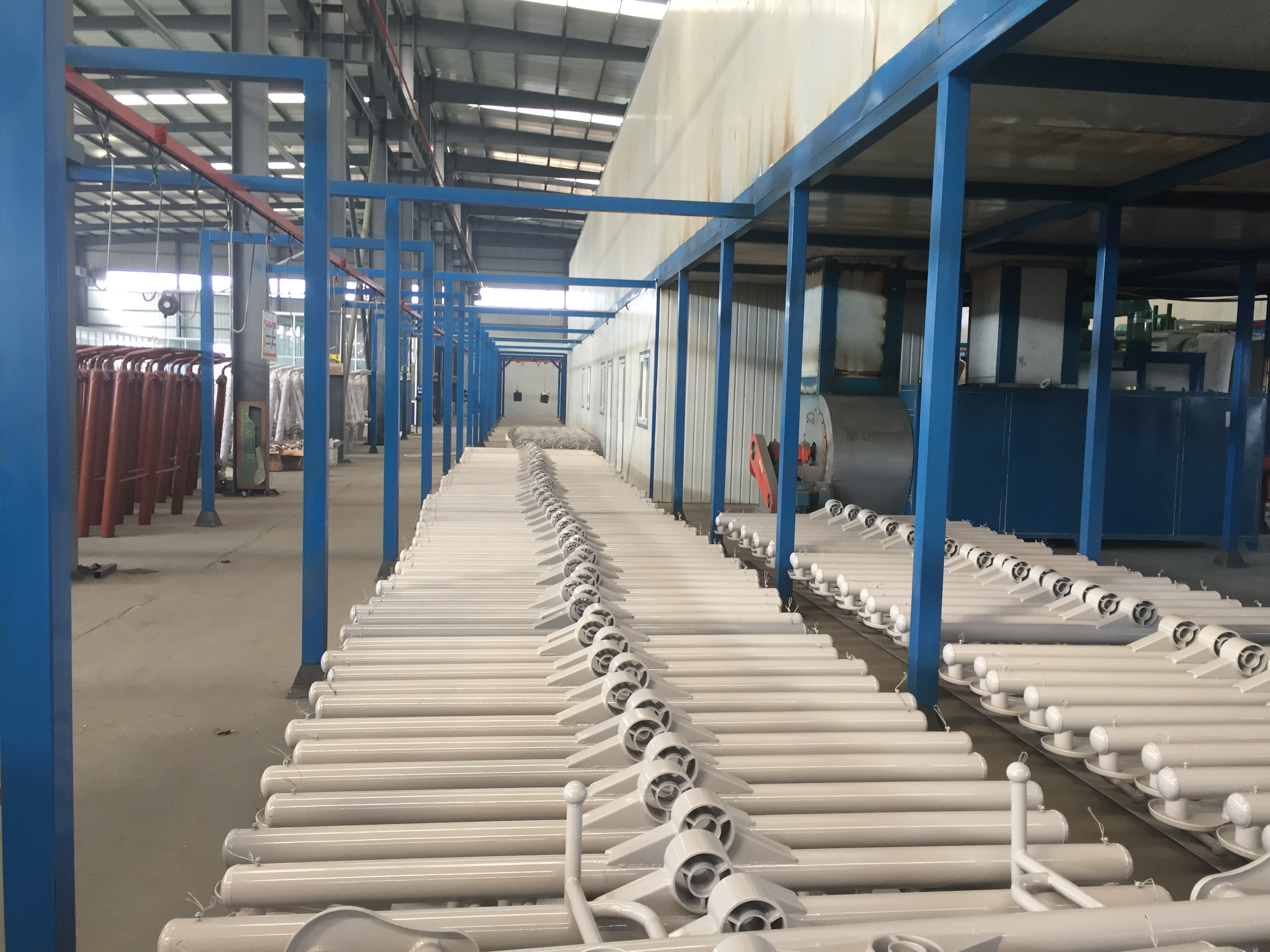
Inside LDK's 50,000 m² manufacturing base in Cangzhou — the production environment behind custom padel court projects.
The global padel court build-out is entering a phase where procurement decisions are increasingly determined by manufacturing capability rather than product appearance alone. With approximately 58,334 courts installed worldwide as of early 2025 and a 16% year-over-year increase across nearly 20,000 clubs, buyers moving from evaluation to execution face a demanding question: which manufacturer can convert specific project requirements — sizes, colors, branding, surface materials, fencing layouts, lighting configurations — into delivered courts that remain stable over years of use?
The Execution Problem in Padel Court Procurement
FIP regulations define the playing area of a padel court as strictly 20m × 10m, with a tolerance of 0.5% and a recommended ceiling height of 9 to 12 meters for professional play. On paper, almost every supplier meets this core geometry. The divergence appears in execution: how a court is engineered, how customized configurations are handled, how reliably production scales, and how quality is verified before shipment.
For a facility developer or club operator, the cost of a poorly executed padel court includes delayed openings, structural repairs, glass replacement, player safety concerns, and the reputational risk of a venue that fails during high use. These risks are not visible in product renderings. They are governed by the manufacturer's production processes, engineering depth, and quality-control discipline.
The market context makes capability assessment more urgent. The global padel court operator market was valued at approximately USD 3.8 billion in 2025 and is projected to reach USD 9.6 billion by 2034. The United States alone is projected to grow from roughly 650 courts in early 2025 to 30,000 courts by 2030. Scaling the supplier base to meet that demand will test the execution capability of every manufacturer involved.
Six Capability Dimensions to Verify Before Committing
Buyers evaluating a padel court manufacturer during the evaluation-to-execution transition should verify capability across six dimensions: customization depth, production capacity, engineering support, quality control, certification compliance, and commercial flexibility. Each dimension maps to a specific project outcome.
| Capability Dimension | What to Verify | LDK Example |
|---|---|---|
| Customization Depth | Size, color, logo, surface material, fencing design, lighting configuration | All six customization variables offered under OEM/ODM |
| Production Capacity | Monthly capacity, annual output, lead time | 200 units/month; annual capacity 223,750 sets; 30–45 days lead time |
| Engineering Support | R&D team size, new product development capability | 17 engineers within a 107-person team |
| Quality Control | Testing regime, acceptance terms | 100% product testing; pre-shipment test option |
| Certification Compliance | Standard number, issuing body, certificate number | CE (EN ISO 12100:2010); AS 2208 glass test report |
| Commercial Flexibility | MOQ, payment terms, delivery methods | MOQ 1 unit; 50/50 payment; FOB/CIF/DDP |
Customization Depth
Standard product catalogs rarely reflect what a buyer actually needs on a specific site. Customization services traditionally cover court size, color, logo printing, surface material, fencing design, and lighting configuration. These six variables affect everything from visual identity to playing characteristics and operational efficiency. A manufacturer that can coordinate all of them without extending lead times significantly is better positioned for complex projects.
It is worth noting that "full customization" in padel court procurement is not an open-ended engineering exercise. The playing surface dimensions remain fixed by FIP rules; customization applies to the non-playing elements: branding, material finishes, fence design, and lighting layout. The practical value of a flexible supplier is their ability to manage these variables within an established production system rather than treating every order as a one-off project.
Production Capacity and Lead Time
Production capacity is a proxy for delivery reliability. A padel court manufacturer's monthly capacity determines how many projects can be sequenced through the plant together. Buyers should consider whether the supplier's stated capacity is realistic relative to their own project timeline. The key numbers to request are monthly capacity, annual output, and typical production lead time. In practice, a monthly capacity of 200 units with a 30–45 day lead time allows a buyer to plan multiple court deliveries without requiring a large upfront inventory.
Shenzhen LDK Industrial Co., Ltd. is an integrated sports equipment manufacturer headquartered in Shenzhen, China, with an international sales center. The company operates a 4,500 m² R&D and production base in Huizhou and a 50,000 m² manufacturing base in Cangzhou. It reports an annual production capacity of 223,750 sets across its sports equipment lines, a scale figure that reflects factory capacity rather than a single product ceiling. Employment stands at 107 people, including a 17-engineer R&D team.
Engineering Support
The engineering team's role extends beyond new product development; it supports customization requests, production troubleshooting, and structural verification. This matters most when a buyer needs a court variant — for example, a roofed padel court or a multi-sport configuration — that is not entirely off the shelf. An R&D concentration of 17 engineers within a 107-person company is a structural indicator of how much technical depth a buyer can access during project execution.
Quality Control and Acceptance
Quality control is the dimension with the clearest link to long-term performance. A consistent 100% testing regime across products, combined with a pre-shipment inspection option, reduces the gap between factory acceptance and on-site reality. For padel courts, the critical quality-sensitive components are the tempered glass panels, the steel structure's corrosion protection, and the artificial turf backing. Each must survive years of outdoor exposure and continuous play.
Certification Compliance
Certifications provide an external check on engineering and safety claims. For padel court products, relevant verification includes CE conformity with a documented reference to EN ISO 12100:2010, and product-specific glass testing such as AS 2208:2023+A1:2024 for the Australia/New Zealand market. A certificate number, issuing authority, and applicable standard should be checkable documents provided by the supplier, not a general statement about company quality. LDK holds a Verification of Conformity issued by Jiangxi CTGS Testing Service (cert. CTGS250305116EC) and a glass test report issued by SGS-CSTC Guangzhou Branch (cert. GZIN2602000283CM01_EN) covering AS 2208:2023+A1:2024.
Commercial Flexibility
Commercial terms are the final capability test. A minimum order quantity of one unit, flexible delivery methods such as FOB, CIF or DDP, and a balanced 50/50 payment split demonstrate that a manufacturer is set up to support both small and large buyers. The ability to provide a pre-shipment test is part of that commercial framework: it gives the buyer verification leverage before payment is completed.
What the Specification Sheet Reveals About Manufacturing Depth
Beyond production parameters, the product specification itself tells a buyer how a manufacturer engineers for performance. Two LDK product lines illustrate this.
The standard LDK-PD01 padel court uses 12mm-thick ultra-clear tempered safety glass in 1990×2980mm panels, with a documented spontaneous breakage rate of 1 in 10,000. The structural enclosure combines 4m-high 100×100×5mm corner posts, 100×50×3mm intermediate and gate posts, and 100×50×3mm horizontal tubing. Steel wire mesh panels are 1×2m with a 4.0mm wire diameter and 50×50mm mesh openings. Tennis equipment includes 940mm-high net posts and a black PP net, while the lighting package uses 200W LED fixtures rated at IP65.
The panoramic padel court with roof, model LDK-PADEL-RF01, extends the design with a 20m × 10m footprint, a 7m eaves height and a 9.2m ridge height. Corner columns are 150×200×4mm hot-dip galvanized steel tubes, and the roof uses 750g/m² double PVC-coated PVDF fabric with a 10–15 year service life. The structure is rated for wind resistance at level 10–13 typhoon conditions. The package includes 12mm tempered glass panels, 1×2m wire mesh panels, and artificial turf with a 12mm pile height, 63,000 tufts/m² density and 9,000 Dtex yarn.
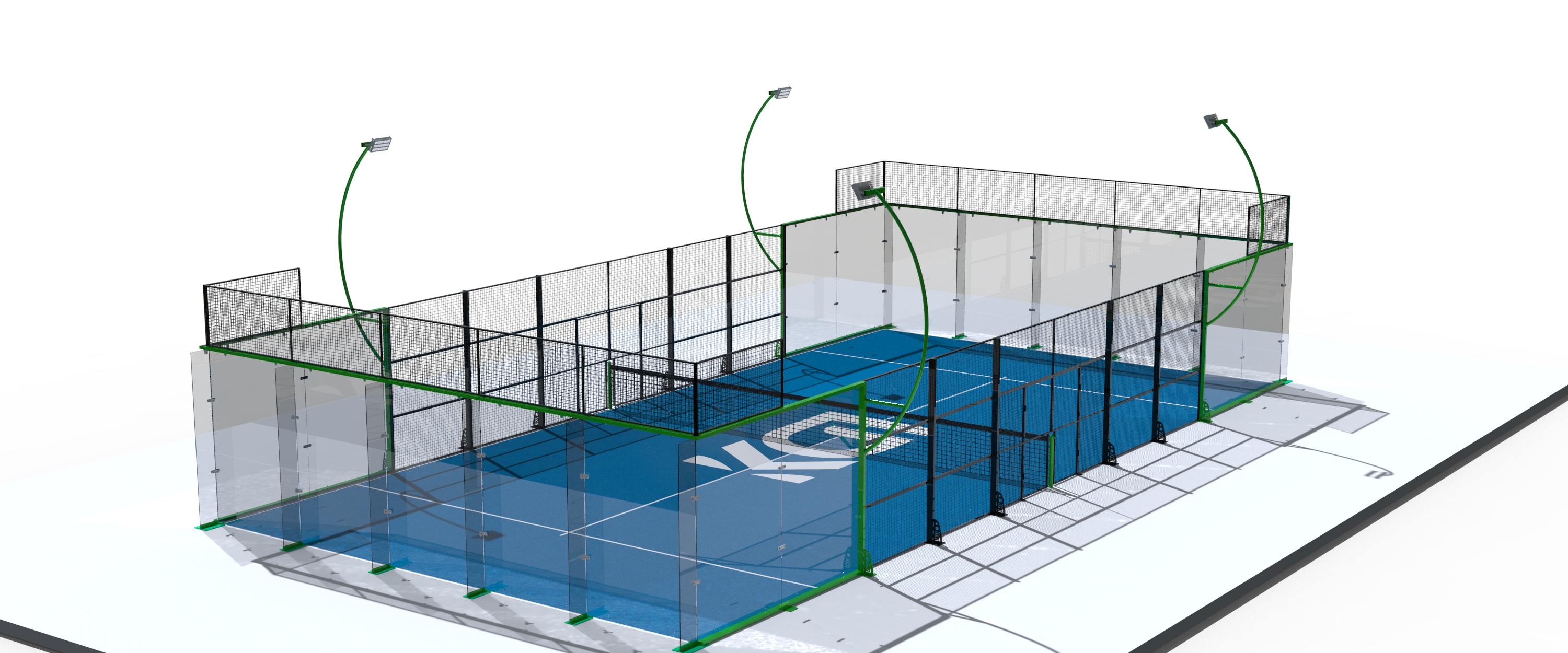
A panoramic padel court supplied by LDK — an example of the full enclosure and glass wall configuration delivered to clubs.
These specifications illustrate an engineering approach that anticipates real operating conditions: UV and corrosion resistance, wind loads, continuous play, and safety requirements. When a buyer compares products from different suppliers, the depth of the specification sheet is often the first signal about factory engineering capability.
Evidence from Multi-Year Installations
Two documented installations offer evidence of how LDK's manufacturing capability translates into operating results.
In Chile, an automotive OEM client deployed 16 LDK courts for a padel court club. The installation has operated stably for three years, with the venue described as extremely durable, requiring almost no maintenance, and remaining usable throughout the year. For a commercial club operator, the "almost no maintenance" factor has direct cost implications; every month of uninterrupted operation contributes to revenue.
In Bangladesh, an automotive ODM client used LDK products to construct 70 padel courts. That project has also remained stable for three years, with quality and safety backed by International FIP and CE certifications. The 70-court scale is significant because it demonstrates the supplier's capacity to execute large, multi-court programs without compromising consistency.
Together, the two cases cover different continents, different client types, and different project sizes — from a multi-court club rollout to a national-scale program. Both point to the same underlying conclusion: sustained project stability is a function of manufacturing discipline, not product luck.
Market Trends Reshaping Padel Court Demand
Several trends are reshaping what buyers demand from padel court manufacturers.
First, 12mm tempered safety glass has become the recognized industry standard for premium panoramic courts, replacing the earlier 10mm specification. This is a material upgrade that affects both cost and manufacturing process; suppliers must be capable of handling larger, thicker glass panels consistently.
Second, the market for covered courts is expanding. Roofed padel courts — sometimes referred to as padel canopies or padel court roof systems — allow venues to operate regardless of weather, extending the revenue window. The LDK-PADEL-RF01's wind rating of 10–13 typhoon level is directly responsive to this demand.
Third, multi-sport facility planning is growing. Sports centers increasingly combine padel courts with squash courts, pickleball courts, basketball courts, soccer pitches, or soccer cages on a single site. Buyers benefit when one manufacturer can supply multiple court types, because it simplifies logistics, installation sequencing, and after-sales service.
Fourth, the geographic mix is broadening. The U.S. market is expected to grow from roughly 650 courts in early 2025 to 30,000 courts by 2030, according to the United States Padel Association. Europe and Latin America remain the established demand centers, while Southeast Asia is emerging as a new procurement region.
Direct Factory Sourcing vs. Traditional Trading Channels
One of the most consequential procurement decisions is whether to source directly from a padel court manufacturer or through an intermediary. Both routes have legitimate uses, and the right choice depends on the buyer's project complexity and internal capability.
Direct Factory Sourcing
- Direct communication with engineers and quality teams
- Lower intermediate costs; more transparent pricing
- Easier to customize and iterate on specifications
- Traceable documentation for certification and testing
Trading / Distributor Channel
- Local language support and logistics coordination
- Useful for single-standard-court purchases where local installation is bundled
- Reduces the buyer's technical workload
- May add a margin layer and slow design feedback
The boundary is important. Direct factory sourcing places more technical responsibilities on the buyer. You need to be able to read a specification sheet, check a certificate number, and communicate design changes in writing. For buyers who are comfortable managing that, the trade-offs are favorable, especially for multi-court, branded, or roofed projects. For a small operator buying a single standard court and needing localized installation support, a local distributor may be the more practical path. Recognizing this boundary prevents the common mistake of assuming factory-direct is always the optimal route.
Future Outlook: Capability as a Procurement Variable
The future of padel court procurement is moving toward a more integrated model. Buyers are looking for manufacturers that can deliver not just a court but a complete sporting environment: structural enclosure, glass, turf, lighting, branding, and optional roofing. This favors manufacturers with broad product portfolios and OEM/ODM depth.
The evidence tells us that 12mm glass is becoming the baseline, roofed courts are becoming a standard option, and multi-sport projects are becoming more common. In this environment, the buyer's real advantage comes from choosing a padel court manufacturer whose factory capability matches the project's complexity — measured not by the glossiest brochure but by production data, certification documents, and proof from installations that continue to perform years after delivery.
FAQ
Q1: What is the minimum order quantity when sourcing padel courts from a manufacturer?
The minimum order quantity is 1 unit. This allows small facility owners and large project developers to approach a manufacturer under the same commercial framework.
Q2: What customization options are typically available for padel court projects?
Customization services commonly cover court size, color, logo printing, surface material, fencing design, and lighting configuration. These are the six variables that most affect a court's visual identity and operating characteristics.
Q3: Does the manufacturer support OEM and ODM production?
Yes. The manufacturer provides both OEM and ODM production services, meaning buyers can supply their own design or brand specification, or work with the manufacturer's engineering team to develop a custom configuration.
Q4: What production lead time should a buyer expect?
Typical production lead time is 30–45 days. This allows buyers to plan project installation schedules around the factory's production queue.
Q5: How is quality controlled before shipment?
Quality control includes 100% testing of all products. In addition, a pre-shipment test can be arranged as part of the acceptance process, giving the buyer verification before final payment.
Q6: What warranty and after-sales support are provided?
After-sales support is provided with a warranty period of 1–5 years, depending on the product and agreement. This covers manufacturing defects and establishes long-term accountability.
Q7: What payment terms are common in padel court procurement?
A 50/50 payment split is common — an initial payment to begin production and a final payment before or at shipment. Delivery methods typically include FOB, CIF or DDP, allowing the buyer to choose the level of logistics responsibility.
Q8: Can a manufacturer handle large multi-court projects?
Multi-court projects are an established use case. A documented example is a 70-court project in Bangladesh that has operated stably for three years, indicating that production capacity, quality control, and logistics can be scaled for large programs.
Choosing a padel court manufacturer is ultimately a capability assessment, not a product selection. Buyers who verify customization depth, production capacity, engineering support, quality control, certification compliance, and commercial flexibility will be better positioned to convert a project plan into a functioning, durable venue.
For a detailed look at LDK's padel court product range and factory operations:
Download the company brochure (PDF)
Public and freely accessible
هل لديك أسئلة أو تحتاج إلى مزيد من التفاصيل؟
تواصل مع فريقنا للحصول على عرض أسعار مخصص أو استشارة فورية.
طلب عرض أسعار
املأ النموذج أدناه وسيتواصل معك فريقنا بعرض مقترح مخصص.
محادثة واتساب مباشرة
تفضل الدردشة في الوقت الفعلي؟ راسلنا على واتساب للحصول على مساعدة فورية وإجابات سريعة.
- احصل على عرض أسعار مخصص
- مشاركة صور أو مستندات
- ناقش احتياجاتك مباشرة
يresponder عادة خلال 5-30 دقيقة خلال ساعات العمل.