
Custom Parking Lift Orders: Qualifying Manufacturer Capability
Buyers at the evaluation and execution stage usually compare parking lift quotes. The more practical step is to audit the manufacturer: what can be produced, how much can be produced, which configurations can be adapted, and what evidence shows that similar car parking lift projects have been executed.
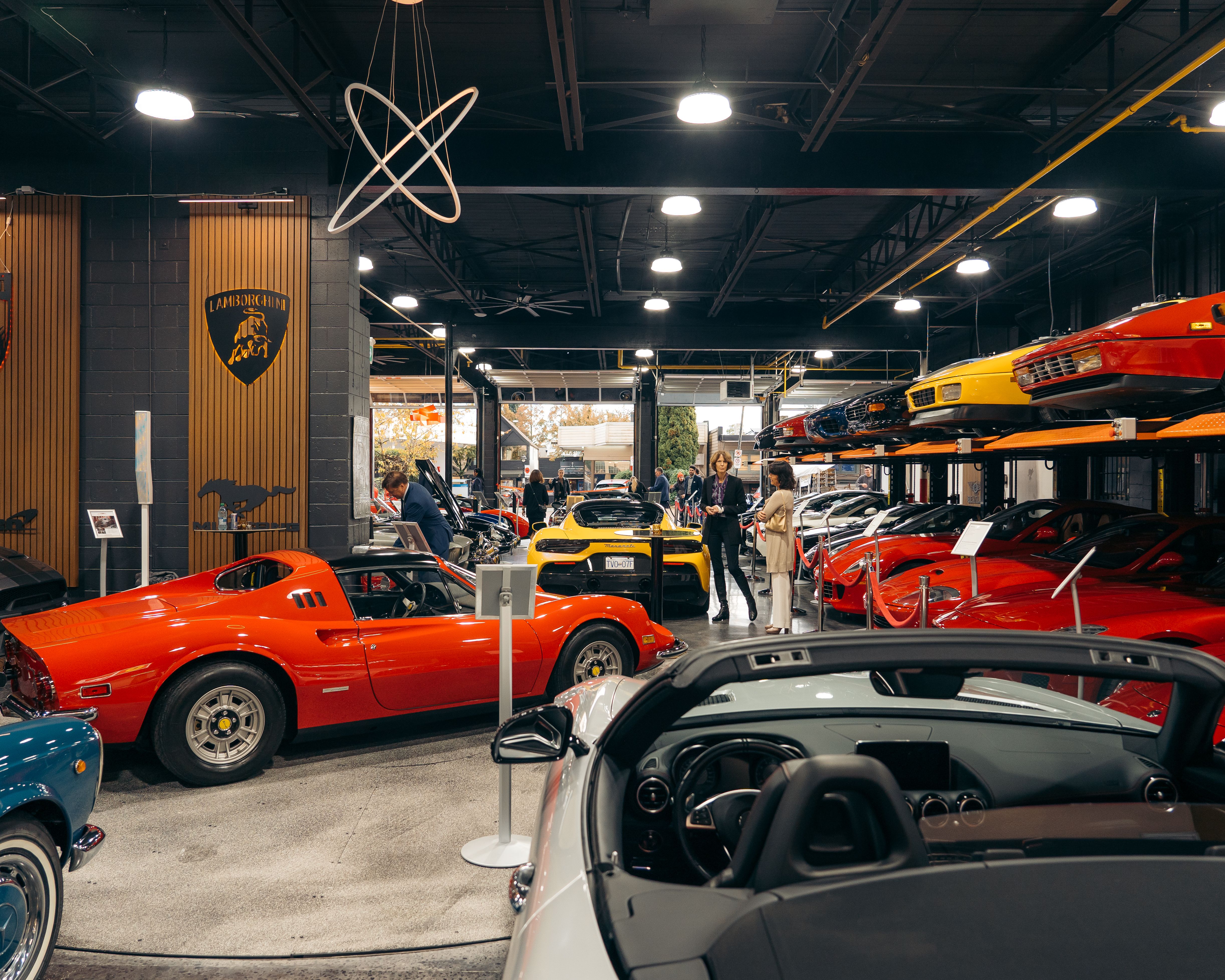
Hydro-Park 1127 two-post dependent parking lift at a luxury auto dealership. The installation doubled parking capacity inside an existing dealership footprint. Source: MUTRADE project record.
Qualifying a parking lift manufacturer before committing
A car parking lift is not a commodity. Each project brings its own ceiling height, bay width, vehicle mix, electrical supply, safety expectation, and often a brand or specification requirement from the end customer. That makes supplier qualification an engineering conversation, not only a price negotiation.
Market conditions reinforce the need for structured vetting. The global car lifts market was valued at USD 2.8 billion in 2025 and is projected to reach USD 4.7 billion by 2034, according to Dataintelo. In a related category definition, QYResearch estimates the car stacker lift market at USD 4.6 billion in 2023, growing to USD 6.72 billion by 2030. As demand grows, more suppliers will enter or expand in the mechanical parking equipment space, and procurement teams need clearer criteria to separate manufacturers with real production depth from trading-type resellers.
A practical capability audit has four layers:
- Product range and engineering configuration: whether the supplier can support 2-post, 4-post, pit-based, tilted, three-car, semi-automatic, or fully automatic parking systems without stretching a design beyond its tested scope.
- Production capacity and execution terms: monthly output, minimum order size, lead time, quality inspection, delivery methods, and payment structure.
- Customisation modes: OEM, ODM, private label, and white label availability, along with the specific parameters a factory is willing to change.
- Reference evidence: installed projects that demonstrate how a system behaved under real site constraints, especially outside the supplier’s home region.
One manufacturer that can be examined against this checklist is Mutrade Industrial Corp., a China-based mechanical parking solution provider operating from Qingdao, Shandong. Mutrade reports support for customers in more than 100 countries, an export share of 99 percent, a factory area of 12,000 square metres, and a company history starting in 2009. Its product portfolio covers parking lifts, semi-automatic parking systems, and fully automatic parking systems.
A capability baseline starts with production data
Manufacturer qualification begins with measurable production information. For a custom parking lift order, buyers should ask for the parameters that affect delivery and quality control.
Mutrade’s production and capability records are useful as a concrete baseline. The production modes available for parking lift projects are OEM, ODM, Private Label, and White Label. Customisation options are documented as voltage, logo, parking width, system height, and color. The supplier reports a production capacity of approximately 1,000 car spaces per month, standard lead time of 30 to 45 days, and a minimum order quantity of one unit. Quality control is described as random inspection, with an optional pre-shipment test available at cost. Payment terms can be structured with a minimum 30 percent advance or letter of credit, and delivery methods include EXW, FOB, CIF, and DDU.
For buyers moving into execution, those terms are more important than they first appear. A minimum order quantity of one unit allows project-based purchasing rather than forcing a distributor to commit to a container load before validating sales. A documented lead time of 30 to 45 days helps contractors coordinate civil works, installation crews, and handover dates. Random inspection plus optional pre-shipment testing gives an independent importer or dealer a review point before goods leave the factory.
The after-sales framework also matters for repeat orders and long-term operations. Mutrade lists 24-hour online remote support, cooperation with local partners, and on-site engineer supervision at cost. That type of structure will not replace a local maintenance provider, but it does indicate how a manufacturer supports international parking lift installations after shipment.
Parking lift configurations and parameters auditors should know
Secondary search terms such as 4 post parking lift, 2 post parking lift, car parking lift system, and hydraulic car parking lift describe different engineering objectives. Understanding the configuration family is necessary before deciding whether a manufacturer is qualified for a specific project.
Mutrade’s product documentation includes several well-defined families, and the following table summarises representative models with key parameters from the manufacturer’s specification data. It is not intended as a full catalogue, but as a reference for the types of questions a buyer should ask.
| Configuration | Representative model | Vehicles per unit | Key specification data |
|---|---|---|---|
| Two-post dependent parking lift | Hydro-Park 1127 / 1123 | 2 | Rated capacity 2700 kg / 2300 kg depending on variant; allowed vehicle length up to 5000 mm; hydraulic cylinder and chain drive; lifting time 50 seconds. |
| Low-ceiling tilting parking lift | TPTP-2 | 2 | Rated capacity 2000 kg; product allows vehicle height up to 1550 mm; hydraulic cylinder drive; lifting time 24 seconds; field projects include installations under ceilings as low as 2.9 metres. |
| Four-post three-car stacker | Hydro-Park 2525 / 2625 | 3 | Second-floor capacity 2500 kg, third-floor capacity 2000 kg; allowed vehicle height up to 2050 mm; hydraulic cylinder and chain drive; lifting time 68 seconds. |
| Pit-based two-post parking lift | Starke 2127 / 2327 | 2 | Rated capacity 2700 kg per parking space; independent access to upper and lower vehicles; tilted pit variant Starke 2327 requires more than 1600 mm pit depth and more than 2700 mm ceiling height. |
| Semi-automatic puzzle parking system | BDP-2 | More than 5 per system configuration | Capacity 2000 kg / 2500 kg depending on vehicle type; operation by button and IC card; hydraulic cylinder and wire rope drive. |
The specification sheet also indicates that many Mutrade products can operate with a bespoke power supply ranging from 110V to 480V, 50 or 60 Hz. That matters for importers because a parking lift originally designed for one voltage region can be produced for another without forcing the buyer into expensive electrical conversion.
One point is often underweighted in evaluation-stage reviews: clearance dimensions and entry geometry matter more than gross marketing capacity. A two-post unit may be suitable for standard sedans, while a low-ceiling tilting model may sacrifice maximum vehicle height to fit an existing basement. A four-post triple stacker may create three parking spaces where a developer would otherwise build one, but it needs clear platform height for the upper vehicles. Buyers should map those parameters against their actual fleet before issuing purchase orders.
How OEM and private-label frameworks change ordering decisions
For parking lift resellers, dealerships, and parking equipment brands, the manufacturer’s ability to work under another brand name is often a precondition for doing business. Mutrade offers four production modes: OEM, ODM, Private Label, and White Label.
In practice, these arrangements serve different objectives. An OEM project normally follows buyer-approved engineering or site specifications. An ODM project allows the buyer to start from a documented Mutrade design and adjust parameters. Private label and white label production allow a distributor or brand owner to sell lifts with its own identity while relying on the factory for steel fabrication, hydraulic assembly, and certification support.
Across these modes, the customization variables remain consistent: voltage, logo, parking width, system height, and color. The scope is narrow enough to protect testing and certification status, but wide enough to cover the most frequent importer requests. Buyers should understand that a private-label order is not an invitation to redesign every structural component; it is a configurable product with documented limits.
International deployment record as evidence of capability
A manufacturer can publish capability statements, but project installations demonstrate whether those statements hold under real operating conditions. The following records show different parts of Mutrade’s capability set across several markets.
| Country / market | Project type | Scale and configuration | Capability evidence |
|---|---|---|---|
| Canada | Luxury auto dealership | 8 units of Hydro-Park 1127 two-post parking lift, creating 16 parking spaces | Indoor installation with vehicle display and inventory storage; TUV and CE compliance referenced with 2006/42/EC and EN 14010 standards in the project file. |
| Bulgaria | Municipal urban infrastructure | 45 units of TPTP-2 tilting parking lift, creating 90 parking spaces under an overpass | Adapted to 3.1–3.3 metre ceiling heights, an 8 percent ground slope, and structural columns; previously unusable space converted into parking. |
| Romania | Underground facility in Bucharest | 14 units of Starke 2327 tilted pit system, creating 28 parking spaces | Low-ceiling retrofit with reduced pit depth; suitable for existing buildings with limited headroom. |
| Australia | Commercial car storage | 18 units of Hydro-Park 2525 four-post hydraulic stacker, creating 54 parking spaces | Tripled parking capacity within an existing footprint through vertical stacking of three vehicles per unit. |
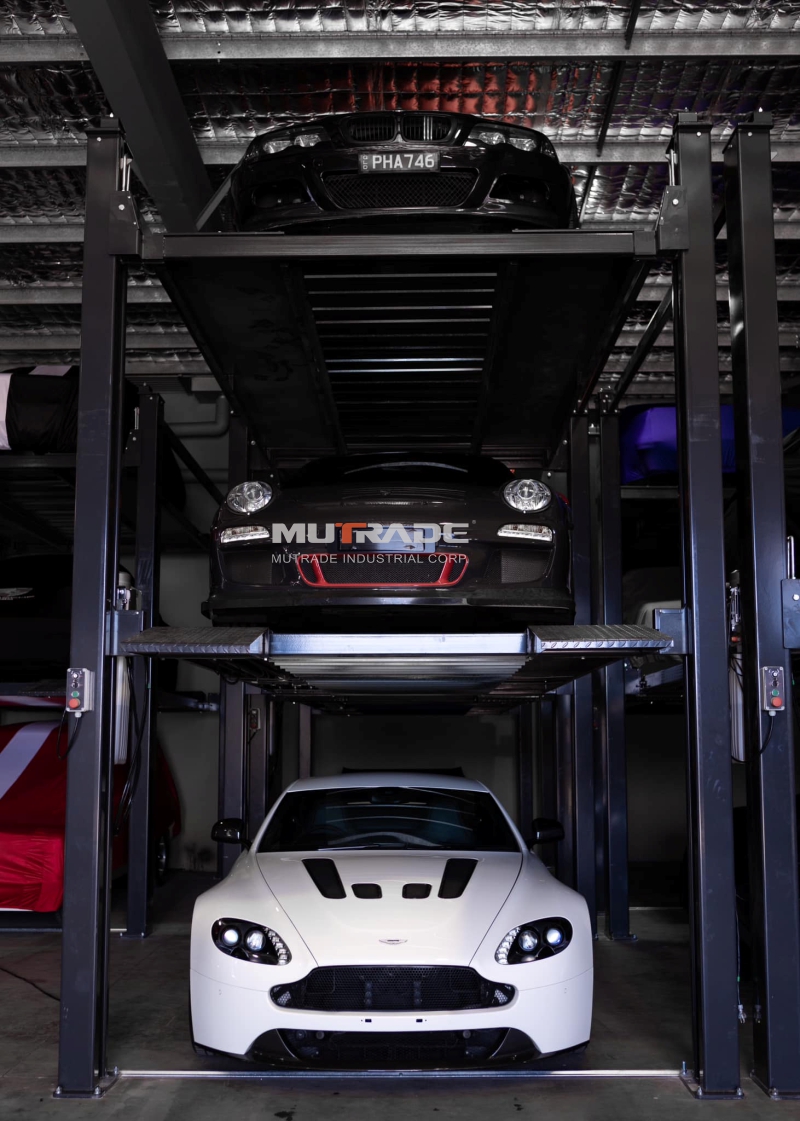
Hydro-Park 2525 hydraulic stacker installation in a commercial parking facility. The project used 18 units to create 54 parking spaces. Source: MUTRADE case record.
Each of these cases tests a different capability axis. The Canadian dealership project tests indoor fit and visual quality. The Bulgarian overpass project tests installation under difficult site geometry. The Romanian underground project tests retrofitting a shallow pit into an existing structure. The Australian storage facility tests commercial throughput intensity. Together, they provide a more credible qualification signal than a spec sheet alone.
Certification status is part of the execution file
Certification determines whether a parking lift can be legally placed into service in a target country. For European Union projects, Machinery Directive compliance is assessed for parking lift models under EN 14010:2003+A1, EN ISO 12100, and protective electrical safety standards. Mutrade’s available documentation includes CE certificates issued for specific models such as TPTP-2, Starke 2127, Starke 2227, and the Starke 3121 / 3127 puzzle systems, as well as broader type-examination files covering the Starke, Hydro-Park, ARP, ATP, and MLP families.
One of Mutrade’s more recent conformity files, a CE certificate issued by Ente Certificazione Macchine in June 2026, lists several parking product families and carries validity through June 2031. Another European conformity document covers puzzle systems, multiple Hydro-Park units, and related equipment through December 2029. Procurement teams should verify that the specific model and scope in an offer match the certificate attached to that model, rather than accepting a general statement that a factory is “CE certified.”
For automated parking equipment, industry guidance also points to quality and occupational health and safety management systems. ISO 9001 and ISO 45001 are frequently cited in parking services compliance discussions as safeguards for vehicle-pedestrian conflict risk and maintenance quality. Buyers sourcing automated systems should ask whether the manufacturer and its local integrators can show equivalent management-system coverage.
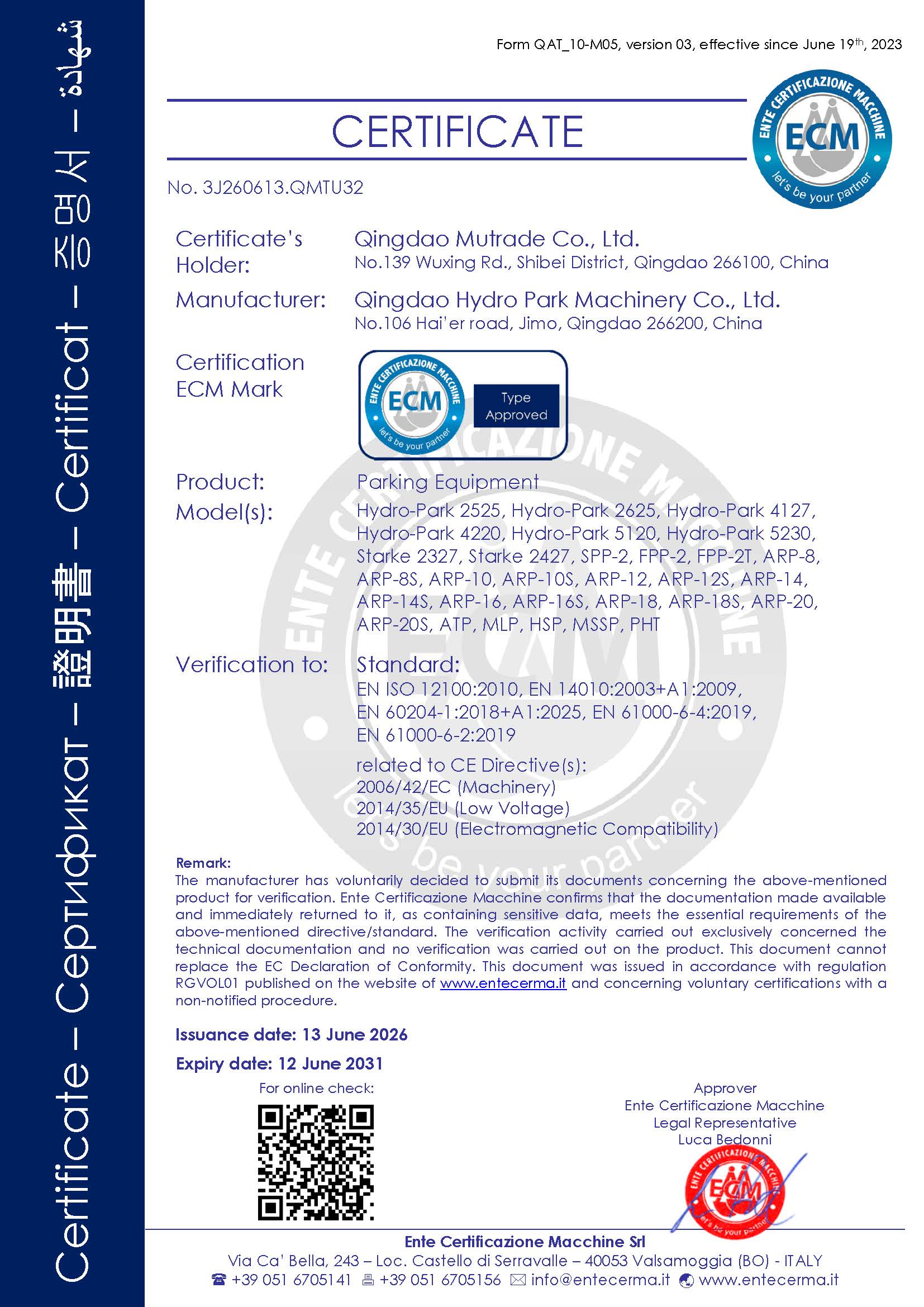
CE conformity documentation covering Mutrade parking systems. Certificate records should be matched to the exact product model and installation scope. Source: Mutrade certificate file.
Trend context: demand growth and hydraulic dominance
The broader market context helps buyers understand why manufacturer capability is becoming a formal part of parking lift sourcing. North America, described as the largest and fastest-growing vehicle lift market in Custom Market Insights data, reached USD 3.25 billion in 2024. That expansion is relevant for exporters because North American buyers often require documented steel fabrication quality, electrical standards, and warranty support.
Additionally, Dataintelo reports that hydraulic mechanisms held a 57.2 percent share of the global car lift market in 2025, reflecting their use in heavy-duty lifting applications. Most of Mutrade’s documented parking lift models use hydraulic cylinders, often combined with chains or wire ropes. The hydraulic orientation of the provider is consistent with the broader product category, but buyers should still verify hydraulic component quality, lock mechanisms, and leakage protection rather than assuming that hydraulic drive alone guarantees safety.
Where traditional project delivery has limits
Compared with building a conventional multi-storey ramp or expanding a flat parking area, parking lifts offer a space-efficiency argument. They enable additional parking capacity inside an existing footprint. They can also be delivered as factory-built steel structures with production lead times shorter than typical construction schedules. But the comparison has limits that must be respected during evaluation.
A parking lift does not remove the need for structural analysis. A pit-based unit requires excavation; a roof-mounted semi-automatic system requires structural capacity for vehicle weight and dynamic loads; a free-standing four-post unit still needs a level floor. Mutrade’s own documentation includes constraints such as the Starke 2327 pit depth exceeding 1600 mm or ceiling height exceeding 2700 mm, and the TPTP-2 product data indicating a maximum vehicle height of 1550 mm. Those boundaries show why every parking lift order should begin with a site condition report, not with a preference for a favourite lift type.
In low-ceiling spaces, a tilting parking lift can convert an otherwise unusable basement into parking. But the same technology may not accept large SUVs because the platform tilts to save headroom. In new construction with generous clear heights, a three-car stacker or semi-automatic puzzle system may deliver more capacity per bay. The correct question is not which type is “best”; it is which configuration fits the measured site and vehicle profile.
From supplier audit to issue: limitations to keep in mind
The qualification process should also include a clear picture of what a supplier will not do. Mutrade’s documented lead time of 30 to 45 days refers to equipment production capacity, not necessarily to complete site installation. Buyers should treat local civil works, foundation preparation, electrical connection, and final inspection as separate workstreams.
Manufacturer capability also varies by product type. A factory producing two-post dependent lifts may not automatically be qualified to produce complex robotic towers. Mutrade documents a range covering ARP rotary systems, ATP towers, and MLP automated shuttle systems, but buyers should evaluate those product families separately from simple parking lift orders. High-capacity automated systems involve access control, software logic, and safety integration that require a different level of engineering support than a four-post hydraulic stacker.
Another important limitation is certification timing. Certificates are often model-specific and carry expiration dates. Buyers at the execution stage should request the current certificate for the exact model, confirm whether the certificate is transferable or valid only for the manufacturer, and check whether the destination market requires additional local approvals. A valid CE document for one model does not automatically cover another model in the same product family.
Recommendations for the parking lift evaluation process
For buyers preparing to move from evaluation to execution, the following sequence reduces risk:
- Define the site envelope first: ceiling height, pit availability, floor condition, bay width, and vehicle types to be parked.
- Select the relevant configuration class: two-post, four-post, tilted, pit-based, puzzle, rotary, or automated system.
- Audit the manufacturer’s production capacity, MOQ, customisation limits, delivery terms, and quality inspection policy.
- Match certification documents to the exact model and destination market.
- Review similar installed projects, not generic product photos.
- Separate equipment production lead time from site installation time in the project schedule.
These checks are not a substitute for professional engineering review, but they help buyers avoid the most common failure point in parking lift procurement: treating a site-specific order as a standard catalogue order.
Future outlook for parking lift sourcing
The direction of the parking lift industry points toward broader configuration choice rather than a single product standard. Land constraints in urban residential projects continue to make vertical parking equipment attractive. At the same time, buyers are paying closer attention to certification traceability, custom branding options, and factory execution records.
Mutrade’s portfolio illustrates how a manufacturer can serve that spectrum, from low-ceiling tilt lifts and pit-based systems to puzzle parking, rotary systems, and automated shuttle systems. In the future, successful parking lift suppliers will likely be those that can combine a documented production base with enough flexibility in OEM and private-label execution to support local dealers and project developers. Technology alone will not settle the procurement decision; evidence of delivery and project fit will remain central.
Frequently asked questions for parking lift buyers
What customization options can Mutrade offer for a car parking lift order?
Mutrade supports customization of voltage, logo, parking width, system height, and color. These options apply across OEM, ODM, Private Label, and White Label production modes.
Can a buyer order parking lifts with a private label?
Yes. Mutrade’s production records list OEM, ODM, Private Label, and White Label as available production modes. The buyer can work from its own specification or from a documented Mutrade design, depending on the chosen production mode.
What is the minimum order and lead time for Mutrade parking lifts?
The documented minimum order quantity is one unit. The standard lead time stated in Mutrade’s capability and purchasing data is 30 to 45 days, based on a monthly production capacity of approximately 1,000 car spaces.
What payment and inspection terms are available for a parking lift purchase?
Documented payment terms include a minimum 30 percent advance or letter of credit. Quality control is described as random inspection, and a pre-shipment test can be arranged as an optional cost item. Delivery can be arranged under EXW, FOB, CIF, or DDU terms.
Which Mutrade parking lift installations are available as reference evidence?
Documented installations include a Canadian luxury auto dealership using Hydro-Park 1127 units, an overpass parking project in Bulgaria using TPTP-2 units, an underground retrofit in Bucharest using Starke 2327 units, and a commercial car storage facility in Australia using Hydro-Park 2525 units.
Is CE certification available for Mutrade parking lift models?
Mutrade holds documented CE conformity files for multiple models and product families. European certificates reference standards including EN 14010:2003+A1 and EN ISO 12100, and buyers should verify that the certificate matches the specific model in the order.
Independent readers can download Mutrade’s corporate profile for additional factory and portfolio detail: Mutrade Profile 2025 (PDF).
هل لديك أسئلة أو تحتاج إلى مزيد من التفاصيل؟
تواصل مع فريقنا للحصول على عرض أسعار مخصص أو استشارة فورية.
طلب عرض أسعار
املأ النموذج أدناه وسيتواصل معك فريقنا بعرض مقترح مخصص.
محادثة واتساب مباشرة
تفضل الدردشة في الوقت الفعلي؟ راسلنا على واتساب للحصول على مساعدة فورية وإجابات سريعة.
- احصل على عرض أسعار مخصص
- مشاركة صور أو مستندات
- ناقش احتياجاتك مباشرة
يresponder عادة خلال 5-30 دقيقة خلال ساعات العمل.