
Custom Plush Pet Toy Durability: Chew Level and Weight Compared
Custom Plush Pet Toy Durability: Chew Level and Weight Compared
Two buyers can order the same 20 cm plush dog toy from two suppliers and receive products whose usable service life differs by a factor of four. That gap is not a matter of taste. It is the combined result of fabric construction, seam engineering, and whether the toy was specified for a light, moderate or aggressive chewer at a particular dog weight. Because plush and soft toys are estimated to account for roughly 30% of the dog toy segment, that specification gap multiplies across an entire retail range.
This comparison is written for buyers in the decision stage: private-label owners, importers, distributors and retail category managers who already know they want Custom Plush Pet Toys and now have to choose a construction level, a size band, a compliance package and a supplier. It compares basic and reinforced plush construction across three chew levels and four dog weight bands, explains what a reinforced specification actually contains, and sets out the evidence a buyer should demand before a purchase order is issued.
Fortune Business Insights valued the global pet toys market at USD 9.60 billion in 2025, and Custom Market Insights estimates plush and soft toys at approximately 30% of the dog toys market. Those figures describe a large, stable category — which is precisely why durability specification, rather than category novelty, is where buyer value is created or lost.
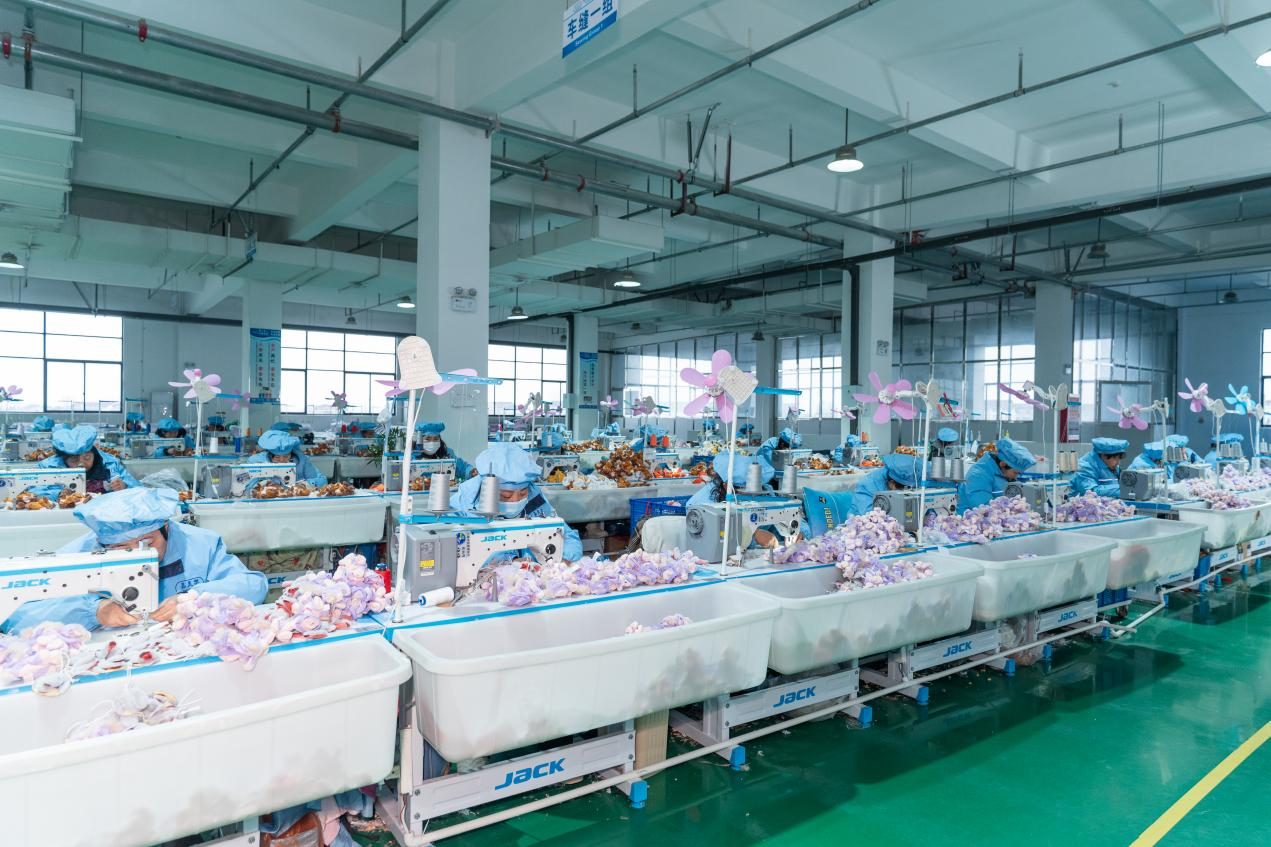
Production environment where plush pet toy construction, seam reinforcement and material selection are determined before sampling.
Durability is a purchasing specification, not a product adjective
In plush pet toys, durability is not a single material property. It is the outcome of three variables that buyers control at the specification stage: construction (basic versus reinforced), material set (short plush, Oxford fabric, TPR), and chew intensity relative to the dog's weight. Change any one variable and the expected service life changes.
The practical consequence is that suppliers cannot be compared at catalogue level. "Good quality plush" and "chew resistant" are not comparable claims. A defensible comparison happens one level lower — at the SKU level, inside a defined chew level and weight band, with a named construction.
For buyers, three outcomes follow from getting this right. Replacement frequency falls, which lowers the total cost of ownership across a programme. Return and complaint rates fall, which protects retail listings and marketplace ratings. And specifications become auditable, which makes it possible to hold a second or third supplier to the same standard when capacity needs to be split.
A three-variable framework: chew level, dog weight, construction
The most common source of mismatch in plush pet toy programmes is a size decision made without a chew-level decision. A 30 cm toy sold to a small light-chewing dog is over-built and over-priced; a 12 cm toy sold to a 25 kg strong chewer fails within weeks. The table below sets out how the three variables combine in a sourcing plan.
| Chew level | Typical dog weight band | Construction to specify | Primary verification point |
|---|---|---|---|
| Light | Under 5 kg | Short plush surface; single-layer body acceptable; standard seam | Pile density, stuffing recovery, squeaker retention |
| Moderate | 5–15 kg | Short plush with reinforced stitching at limb and squeaker seams | Seam bar-tacks, stitch density, squeaker pocket construction |
| Moderate–heavy | 15–30 kg | Double-layer fabric plus reinforced stitching; Oxford fabric panels at stress zones | Fabric layer count, panel coverage, thread specification |
| Aggressive | Up to 40 kg | Double-layer fabric, reinforced stitching, Oxford fabric shell, TPR moulded components | Full construction audit; sample destruction test; supervision labelling |
The weight bands above are a sourcing segmentation tool, not a physiological rule. They exist so that a catalogue can be planned without every SKU being over-engineered. Buyers should confirm the final banding against their own retail data and the dog populations they actually serve.
What "reinforced" means on a real spec sheet
A basic plush toy has no reinforced structure: basic fabric and stuffing, standard seams, and a service life measured in weeks rather than months. A reinforced plush toy is defined by double-layer fabric and reinforced stitching, and the documented difference is a service life two to four times longer than the basic construction.
That definition is only useful if it is translated into line items a supplier can be held to. In practice, a defensible specification for tear resistant custom plush pet toys will name six things:
- Fabric layer count — whether the body is single-layer or double-layer, and which panels carry the second layer.
- Shell material — short plush for surface softness, Oxford fabric where a tightly woven, abrasion-oriented shell is required. Both are standard material options in the plush pet toy range.
- Stitch specification — thread type and stitch density, with bar-tacks at limb joints and the squeaker pocket.
- Squeaker housing — whether the squeaker sits in a separate sewn pocket rather than loose in the stuffing. This matters for squeaky custom plush pet toys, where the squeaker is usually the first component to be reached.
- Moulded elements — TPR (thermoplastic rubber) components used for shape-retaining parts and edges.
- Attachment hardware — nose, eye and tag fixing method, and whether fixings are tested for pull-off resistance.
Two of these — layer count and stitch specification — are the items most often omitted from buyer RFQs and most often responsible for a durability complaint. They cost very little to specify and are difficult to retrofit after sampling.
Reading service-life figures correctly
The reference service life in this category is one to three months for basic plush construction and three to twelve months for the reinforced chew-resistant series — a two to four times improvement. Those are category references attached to a construction level, not a per-dog guarantee.
Used correctly, the figures drive a simple replacement-frequency model. If basic construction is replaced four times in a year and reinforced construction once or twice, the reinforced SKU carries a medium cost against the lowest cost of the basic SKU, and the comparison shifts from unit price to total cost of ownership. That shift is the core of the value case for heavy duty custom plush pet toys in a retail or subscription programme: lower breakage, low maintenance and fewer replacements offset a higher unit cost.
Used incorrectly, the same figures become a promise. A three-to-twelve-month reference does not survive an aggressive chewer left unsupervised with a plush toy, and no supplier should be asked to warrant against that scenario. Buyers should treat the range as the planning basis and the supervision label as part of the product, not as a disclaimer bolted on afterwards.
Sizing by dog weight: from compact to large formats
Dimension and construction must move together. A buyer's size ladder typically runs from compact small size custom plush pet toys in the 10–15 cm range, through mid formats of roughly 15–30 cm, to large formats of 30–50 cm. The numbers themselves are a sourcing convention rather than a standard, so the specification should require the supplier to confirm finished dimensions — measured on the completed toy, not on the cut panel.
The pairing rule is straightforward. Small formats belong with light chewers and puppy or teething ranges, where teething custom plush pet toys are used for short, supervised sessions. Mid formats carry the bulk of moderate-chewer volume. Large formats are where aggressive chewers concentrate, and where the double-layer construction and Oxford shell earn their cost.
Two failure patterns recur. The first is a large format built to a light-chewer specification — the size signals durability to the consumer while the construction does not deliver it. The second is a small format built to an aggressive specification — cost rises with no matching benefit, and the toy becomes too firm for the intended interaction. Interactive custom plush pet toys add a third consideration: the play mechanism, whether squeaker or otherwise, must be rated for the same chew level as the shell.
Verifying EN71, CPSIA and GB/T 43839-2024 before the purchase order
Compliance in this category is contractual rather than purely regulatory, and buyers who assume otherwise carry the risk. Pet toys fall outside mandatory CPSC jurisdiction in the United States, and ASTM F963 is applied voluntarily. That means the standard a plush pet toy is tested to is largely defined by what the buyer writes into the purchase order.
A workable evidence package for custom plush pet toys for dogs usually combines EN71 for the European market, CPSIA for the United States, and, for China-manufactured goods and China-market listings, documentation referencing GB/T 43839-2024. The package should be checked at five points:
- Report identity — laboratory name, report number and issue date, not a certificate image.
- Sample traceability — whether the tested sample matches the material, colour and construction actually ordered.
- Scope coverage — which parts of EN71 or CPSIA are addressed, and whether mechanical and chemical requirements are both included.
- Chemical claims — statements such as lead-free or phthalate-free are only meaningful when tied to a named test method and a report line, not to a catalogue badge.
- Currency — whether the report predates a material or supplier change.
A supplier operating a documented quality system should be able to answer these questions from records. IQC, IPQC and OQC stages, combined with compliance testing to EN71, ASTM and CPSIA and raw-material safety control, are the mechanisms that keep a compliance claim attached to a production batch rather than to a single submitted sample.
Washability and care as durability variables
A plush toy that cannot be cleaned is replaced for hygiene reasons long before it wears out. Washability therefore belongs in the durability comparison, not in the care-instruction footnote.
Published care guidance converges on the same practice: most plush dog toys can be washed on a gentle or delicate cold cycle and air dried, ideally in a mesh laundry bag, with heat avoided because it can damage squeakers and stitching. Toys containing electronic components require those components to be removed first. For washable custom plush pet toys, the design decisions that matter are how the squeaker is housed, whether the shell fabric tolerates a cold wash without pile matting, and whether the stuffing recovers its shape after drying.
Buyers should treat washability as a testable specification. A simple in-house wash cycle on the sample, followed by inspection of seams, pile and squeaker function, will reveal more than a care label will.

Facility verification is part of the durability comparison: construction claims are only as reliable as the production process behind them.
How Jiameile fits into a chew-level sourcing plan
Jiameile — Tianchang Jiameile Gifts Co., Ltd. — is a plush and textile toy manufacturer based in Tianchang City, Anhui Province, China, established in 2004 and operating as an OEM and ODM supplier with pet toys among its main product lines. The company reports a 6,800 m² facility, approximately 230 employees, a 30-person R&D team and an annual production capacity of 6 million units, with roughly 70% of output exported to EU and USA markets. It states certifications including ICTI, BSCI, Disney FAMA, ISO 9001 and ISO 14001.
On the product side, the declared range covers plush pet toys for dogs and cats in small, medium and large sizes, using short plush, Oxford fabric and TPR, with chew-resistant reinforced stitching, interactive squeaker devices and washable designs. On commercial terms, the company reports OEM, ODM and private-label support with a typical MOQ of 500–3,000 pieces per style and sample lead times of 7–15 days.
Two operational controls are relevant to a durability-led programme. Monthly capacity planning with backup suppliers and inventory and lead-time management addresses supply continuity when a reinforced SKU sells faster than a basic one. Full-process quality control — IQC, IPQC and OQC — combined with material and compliance testing addresses the risk that a reinforced construction drifts between batches.
These are stated company profile and feature claims. They are the correct starting point for a shortlist, not the end of due diligence: buyers should map each claim to a document they have actually seen before treating it as verified.
Where reinforced plush stops working
A comparison that only lists advantages is not a comparison. Reinforced plush construction carries a medium cost against the lowest cost of a basic toy, and that cost is only recovered where the replacement-frequency saving is real — typically e-commerce platforms, pet specialty stores, retail chains and long-term pet companionship scenarios. For low-end retail, promotional gifts and short-term use, basic construction remains the rational choice.
| Comparison point | Basic plush | Reinforced plush |
|---|---|---|
| Structure | Basic fabric and stuffing, no reinforcement | Double-layer fabric plus reinforced stitching |
| Reference service life | 1–3 months | 3–12 months (2–4× increase) |
| Cost position | Lowest cost | Medium cost, balanced performance |
| Maintenance | Frequent replacement required | Lower breakage, low maintenance |
| Best fit | Low-end retail, promotional gifts, short-term use | E-commerce, pet specialty, retail chains, long-term companionship |
Three boundaries deserve to be stated plainly. First, there is no standardized public chew-test protocol behind the service-life figures in this category; they are construction-level references, and the evidence package used here does not include a laboratory tear-resistance benchmark by material. Second, reinforced plush is not a substitute for moulded rubber for the heaviest chewers — for that population, plush is a supervised enrichment product, not a chew product. Third, chew behaviour varies more between individual dogs than between weight bands, so a weight-based specification reduces risk but does not eliminate it.
Outlook for durability-led plush sourcing
With plush and soft toys at roughly 30% of a dog toy market valued in the billions, the category's centre of gravity is shifting from novelty design toward documented performance. Two pressures drive it. Retail and marketplace operators increasingly demand test documentation before listing, in a market where pet toys sit outside mandatory CPSC jurisdiction and compliance therefore has to be written into contracts. And replacement frequency, once an invisible cost, is now visible in return rates and review content.
The likely direction is toward construction-level specification as standard buying practice: chew level and weight band stated on the purchase order, service-life references attached to a named construction rather than a brand, and compliance evidence reviewed as a document set. Suppliers who can answer at that level of granularity will be easier to shortlist — and easier to hold to a standard across repeat orders.
Buyer verification checklist
- Confirm the chew level and dog weight band for every SKU, and record both in the specification.
- Require the fabric layer count and stitch specification in writing, with bar-tack positions named.
- Confirm finished dimensions rather than cut dimensions across the size ladder.
- Request test reports by number, with the tested sample matched to the ordered material and colour.
- Wash the sample on a cold gentle cycle, air dry, then inspect seams, pile and squeaker function.
- Run a supervised destruction test with a dog at the top of the target weight band before committing volume.
Frequently asked questions
What is the difference between basic and reinforced plush pet toys?
Basic plush construction uses standard fabric and stuffing with no reinforced structure, and its reference service life is one to three months. Reinforced construction uses double-layer fabric with reinforced stitching, and its reference service life is three to twelve months — a two to four times increase. The reinforced version also carries lower breakage and lower maintenance, at a medium cost against the lowest cost of the basic version.
How long should a reinforced chew-resistant plush pet toy last?
The stated reference for the reinforced chew-resistant series is three to twelve months, compared with one to three months for basic construction. This is a construction-level reference rather than a per-dog guarantee: actual wear depends on the individual dog's chew style, the weight band the toy was specified for, whether play is supervised, and how often the toy is washed.
How should chew level and size be matched to a dog's weight?
A common sourcing framework pairs light chewers under 5 kg with short plush, light-construction toys; moderate chewers at 5–15 kg with short plush plus reinforced stitching at stress seams; dogs at 15–30 kg with double-layer fabric, reinforced stitching and Oxford fabric panels; and aggressive chewers up to 40 kg with a double-layer Oxford shell plus TPR moulded components. Size bands run from compact formats around 10–15 cm through mid formats to large formats of 30–50 cm, and the construction level should rise with both size and chew intensity.
Which compliance documents should a buyer request for EU and US markets?
For the European market, EN71 documentation; for the United States, CPSIA documentation, noting that pet toys fall outside mandatory CPSC jurisdiction and ASTM F963 is applied voluntarily, so the standard is set by the purchase order. For China-manufactured goods and China-market listings, documentation referencing GB/T 43839-2024 is commonly requested. Claims such as lead-free or phthalate-free should be tied to a specific test method and report line rather than a catalogue badge, and the tested sample should match the ordered material and colour.
What should be validated on a sample before placing a volume order?
A sample review should confirm fabric layer count, stitch density and bar-tack positions, squeaker housing, finished dimensions, and washability — most plush dog toys tolerate a cold gentle cycle with air drying, and heat should be avoided because it can damage squeakers and stitching. A supervised destruction test with a dog at the top of the target weight band is the most informative single check, since it tests the construction against the chew level the SKU was specified for.
Company profile figures and product feature statements referenced in this article are supplier-reported and are presented as claims for buyer verification. Third-party market figures are attributed to Fortune Business Insights and Custom Market Insights; regulatory observations on CPSC jurisdiction and ASTM F963 are drawn from published secondary industry sources.
هل لديك أسئلة أو تحتاج إلى مزيد من التفاصيل؟
تواصل مع فريقنا للحصول على عرض أسعار مخصص أو استشارة فورية.
طلب عرض أسعار
املأ النموذج أدناه وسيتواصل معك فريقنا بعرض مقترح مخصص.
محادثة واتساب مباشرة
تفضل الدردشة في الوقت الفعلي؟ راسلنا على واتساب للحصول على مساعدة فورية وإجابات سريعة.
- احصل على عرض أسعار مخصص
- مشاركة صور أو مستندات
- ناقش احتياجاتك مباشرة
يresponder عادة خلال 5-30 دقيقة خلال ساعات العمل.