
Custom Promotional Bags: Verifying Factory Capability
When procurement teams move from catalog products to custom promotional bags, the evaluation target shifts from a single product to the entire manufacturing capability behind it. In 2026, as companies allocate more budget to branded reusable bags, understanding OEM/ODM capability has become a core part of promotional bag sourcing decisions.
The global tote bag market was valued at USD 17.1 billion in 2023 and is projected to reach USD 29.8 billion by 2032 (Acumen Research and Consulting). Corporate adoption of custom-branded tote bags as promotional merchandise grew 32% year-over-year in 2024 (Intel Market Research). Asia Pacific accounted for 44.8% of the bag market revenue in 2024, with China as a primary manufacturing hub (Grand View Research). These signals suggest that customization is no longer an add-on; it is increasingly the default requirement in promotional bag programs.
This article provides a capability evaluation framework for buyers and brands that are assessing promotional bag manufacturers and preparing to move into custom order execution. It covers the capability layers that affect delivery outcomes, how to verify them, and the constraints that should be part of any sourcing decision.
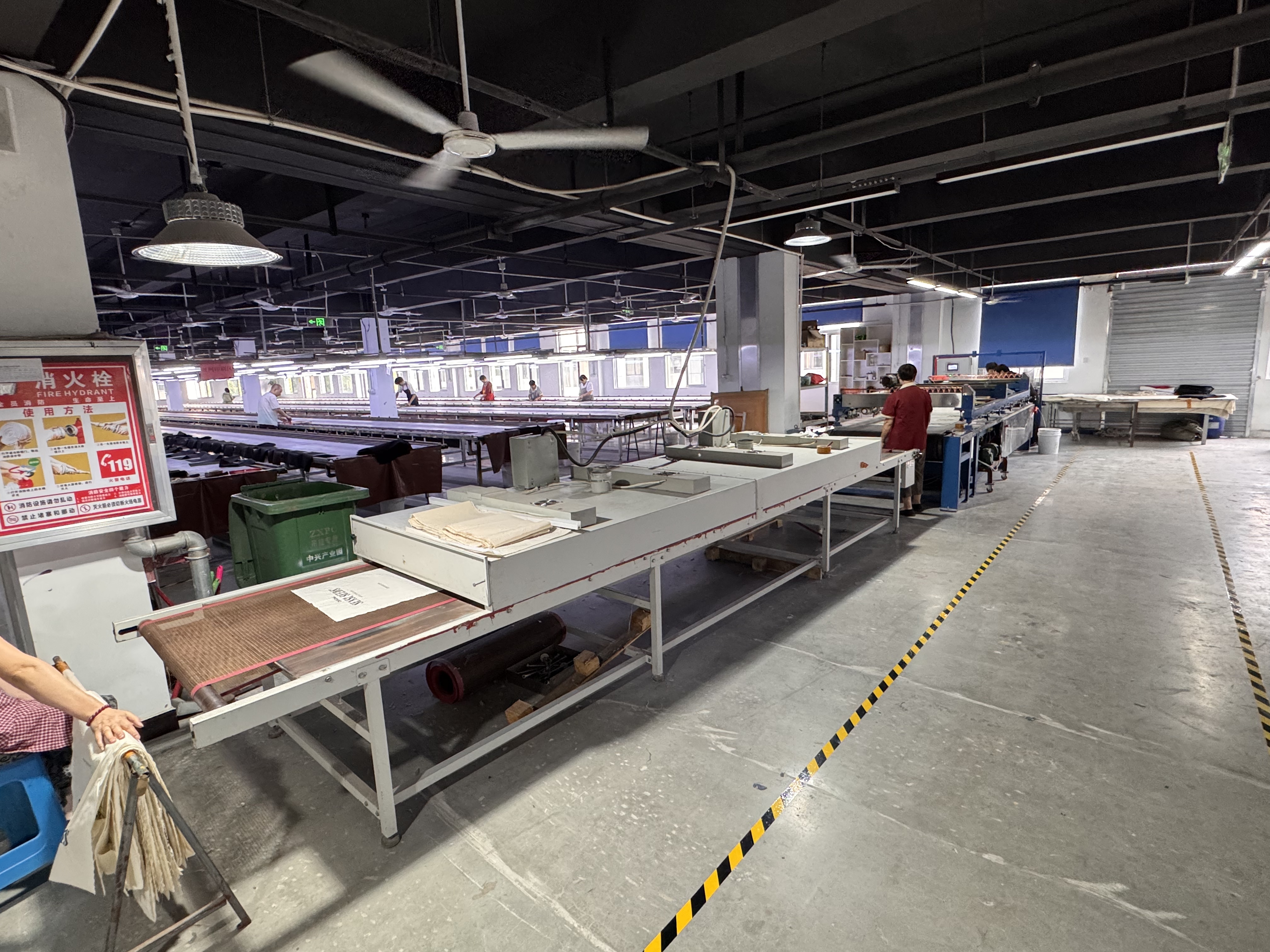
Yulite printing drying machine
Why Capability Review Matters More Than Sample Review
A common sourcing mistake is to evaluate a promotional bag supplier primarily on samples and price. Samples are often produced in an independent sampling room with dedicated sample workers, which does not necessarily reflect mass production conditions. Bulk delivery requires stable production lines, raw material inventory, specialized sewing equipment, quality inspection, and delivery management. When a supplier lacks these elements, problems such as seam inconsistency, color difference between batches, material weight deviation, and packaging variation tend to appear only in the production stage.
The opportunity side is equally clear. A manufacturer with complete OEM/ODM capability can convert functional requirements — high-capacity structures, thermal insulation, foldable designs, eco-friendly materials, multi-color printing — into products that can be delivered at scale. For retail programs, seasonal campaigns, and long-term brand projects, this capability directly determines execution quality.
Buyers should verify six capability layers before placing a custom promotional bag order:
- Product engineering and material selection
- Printing and branding processes
- Quality systems and compliance
- Production capacity and lead time
- Customization scope
- After-sales and ongoing support
Yulite as a Reference: A Promotional Bag Manufacturer with OEM/ODM Services
Henan Yulitepromotion Co., Ltd. is a promotional bag manufacturer based in Zhengzhou, China, founded in 2008. The company operates a 15,000-square-meter factory and reports an annual output of 20 million pieces. Its products are exported to the EU, USA, Japan, and Australia. The product range covers cotton/canvas bags, tote bags, drawstring bags, foldable bags, cosmetic pouches, backpacks, cooler bags, polyester/nylon bags, RPET/recycled cotton bags, RPET felt bags, and non-woven bags.
For buyers, the first capability signal is the service model: the manufacturer provides both OEM and ODM production services. OEM means production according to buyer specifications; ODM means the manufacturer participates in design development, which is useful for brands that know the functional requirement but do not have a complete product specification.
Customization covers six dimensions: logo, color, material, size, label, and packing. This means a buyer does not need to coordinate separately with a printing shop and a packaging supplier; branding requirements can be handled within one production chain.
On capacity, Yulite states a monthly production capacity of 200,000 pieces and a workshop daily output of 30,000 to 50,000 pieces. The standard production lead time is 30 days, and the minimum order quantity is 500 pieces. These parameters give procurement teams a predictable baseline for planning.
For buyers who need to verify batch consistency, the quality control process is an independent observation point. Yulite's quality assurance procedures comprise internal inspection, pre-shipment inspection, and third-party inspection. The manufacturer also holds GRS (Global Recycled Standard 4.0), GOTS (Global Organic Textile Standard 7.0), and SMETA/SEDEX 4P certifications, covering recycled materials, organic textiles, and social compliance respectively.
The factory is equipped with high-post sewing machines, computer sewing machines, pattern sewing machines, button attaching machines, overlock machines, square cutting machines, hot cutting machines, and shoulder strap cutting machines. An independent sampling room and professional sample workers support sample delivery within 3 days.
Technical Explanation: Reading Capability as a Buyer
Material engineering
Material determines performance, cost, and regulatory compliance. The Yulite product line spans 100% cotton, recycled cotton, organic cotton, polyester, nylon, non-woven fabric, RPET, and RPET felt. The Promotional Shopping Bag (model 4636) is available in cotton weights from 100gsm to 450gsm, a parameter that directly affects feel and durability. The Drawstring Bag (model 4211) covers materials from 100gsm to 280gsm, including cotton, recycled cotton, organic cotton, polyester, non-woven, and nylon. For thermal applications, the Cooler Bag (model 23250) uses a polyester + 2mm foam + aluminum construction with zipper closure.
Printing and logo processes
Logo reproduction is the core function of a promotional bag. Yulite offers screen printing, heat transfer printing, digital printing, and embroidery. The production line includes digital printing machines, transfer printing machines, and printing drying machines. For knitted bags (model T25210), the logo can be woven directly into the bag, with up to 6 yarn colors, and the MOQ is 500 pieces.
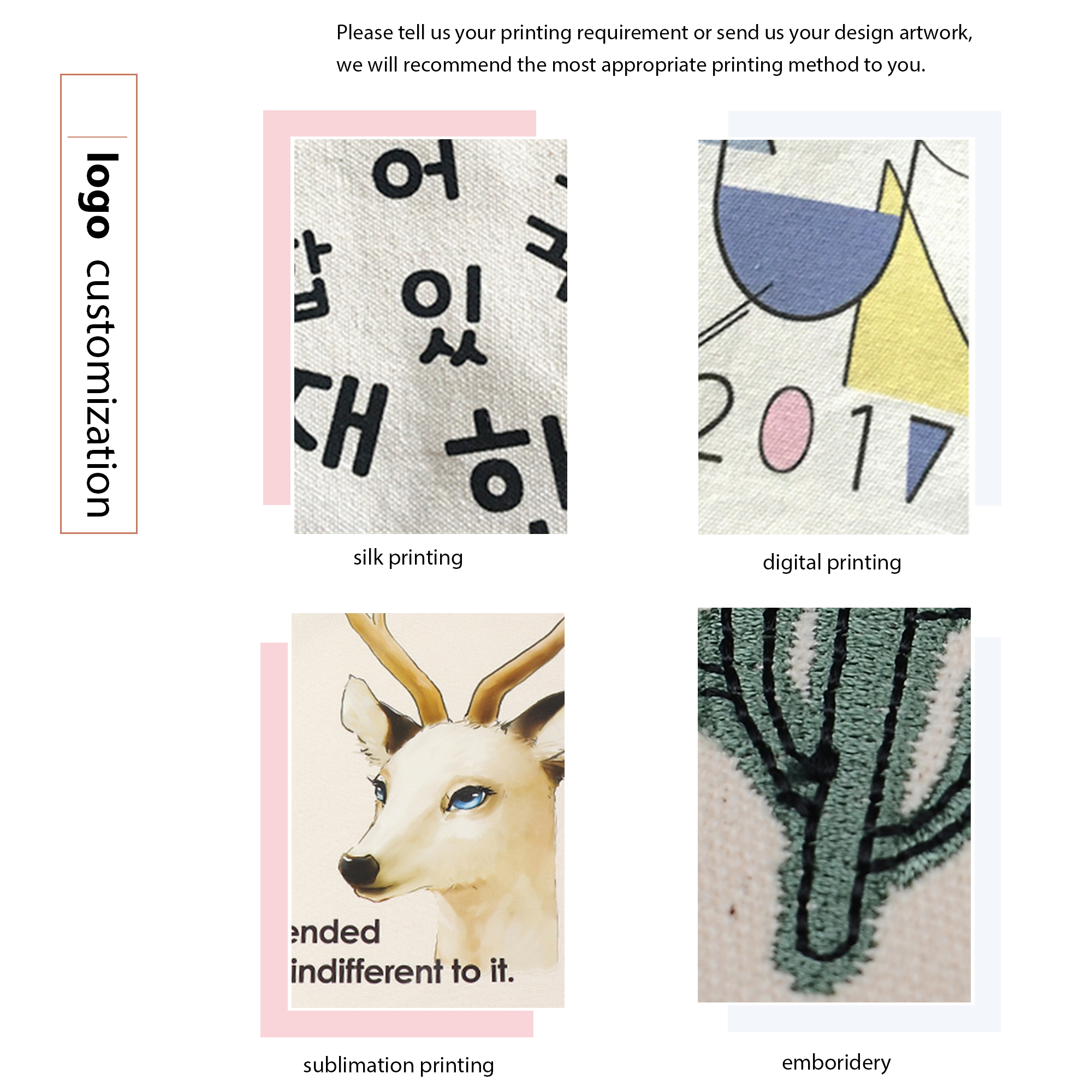
Logo customization printing methods for promotional bags
Structure and functional design
Customization is not limited to surface appearance. An ODM project for an Italian client developed a foldable heart-shaped shopping bag that is easy to carry and store. A supermarket shopping bag used a large gusset to create a high-capacity interior and two strings at the top to close the bag. These structural changes require pattern design, sewing expertise, and production equipment that are not available in every workshop.
Compliance and certification
Market access requirements are tightening. Yulite holds a GRS 4.0 certificate (issued by Intertek, certificate no. ITS-TE-00006853-GRS-03902700), valid until 30 April 2027, covering recycled products. The GOTS 7.0 certificate (no. GOTS-31172, also Intertek) is valid until 2 April 2027, covering organic textile products. The SMETA 4P certificate (no. ZAA600189756) is valid until 10 March 2027. The company's certification portfolio also includes BSCI, ISO9001, and OEKO-TEX Standard 100.
Quality and delivery
Quality control at this manufacturer includes internal inspection, pre-shipment inspection, and third-party inspection. For buyers, this creates the option to request independent verification before shipment. In terms of production capacity, the workshop maintains a stable daily output of 30,000 to 50,000 pieces, supported by dedicated equipment for cutting, stitching, overlocking, button attaching, and strap cutting.
Packing customization
Promotional programs often require a consistent unboxing experience. Yulite's packing options include customized box packing, hard box OEM packing, and customized paper sleeve packing. For retail distribution and gifting scenarios, this affects brand completeness at the point of delivery.
Use Cases: What Capability Looks Like in Real Orders
The following order examples illustrate how promotional bag manufacturing capability maps to different buying scenarios.
Supermarket retail, Italy — 1,000,000 pieces
A 100% cotton canvas shopping bag with a large gusset for extra capacity and two strings at the top for closure. The collaboration lasted 2 years, and the client sold about 1 million pieces within one year. For a supermarket buyer, the capability that mattered was consistent material quality across a high-volume order.
Brand corporate giveaway, Germany — 400,000 pieces
These promotional bags used RPET polyester fabric with GRS certification, sublimation printing, and customized box packing. The project supported seasonal giveaways, and the client reported a 30% increase in monthly sales. This shows how material certification and packaging design can be combined within one order.
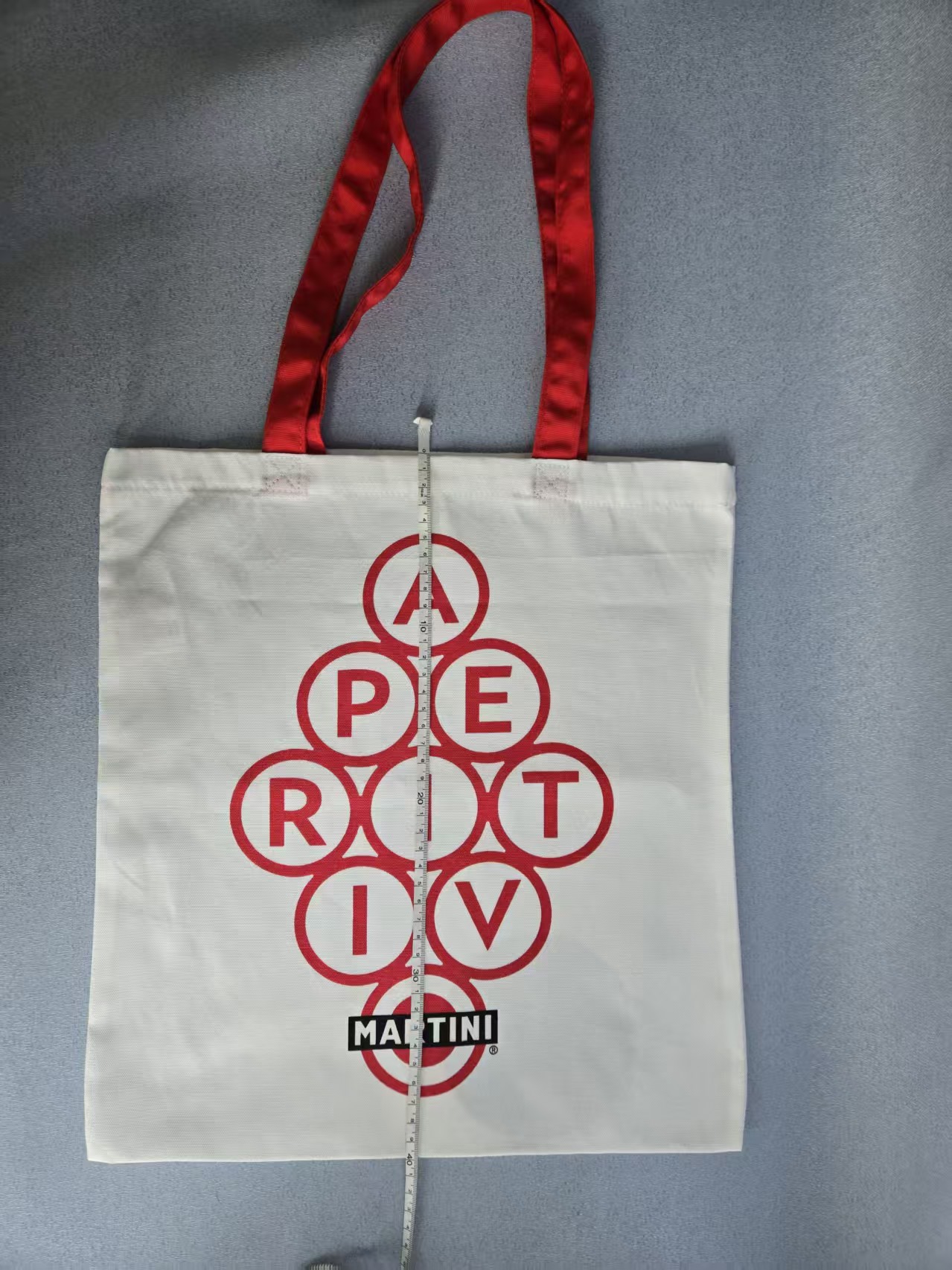
Matini promotional bag with custom printed branding
ODM design project, Italy — 5,000 pieces
The project produced a foldable heart-shaped shopping bag made from eco-friendly 210T RPET fabric, reducing plastic waste. The design includes double-layer reinforced handles, an elastic cord with metal buckle closure, double stitching and full overlock craft, and dual printing areas for brand logos. Over a multi-year collaboration, the project helped the client expand market reach and boost sales revenue.
School book bags, Belgium — 5,000 units
Heavy cotton canvas fabric with active dyeing and good color fastness, designed with large capacity. The client reported that the bags helped the school gain public exposure.
Flagship store, Russia — 5,000 units
Tote bags for a branded shop, with the client purchasing about 20,000 pieces per year. The feedback highlights durable material, large volume, and clean appearance.
Corporate giveaway, Chile — 100,000 pieces
Eco-friendly fabric, good printing quality, lightweight with large capacity. The volume required stable mass production and competitive unit economics.
These use cases cover retail, promotional giveaways, education, brand stores, and ODM design development. The common thread is that each buyer had a different functional requirement, and the supplier's capability had to match the specific application.
Market Trends Shaping Custom Promotional Bags
Three trends are reshaping promotional bag sourcing in 2026.
Sustainable materials are becoming the default
The global recycled PET (rPET) market is estimated at USD 19.5 billion in 2025 (Custom Market Insights), providing upstream supply for recycled promotional bags. On the demand side, approximately 73% of Millennials and Gen Z consumers prefer to buy from sustainable brands using eco-friendly promotional items (Nielsen/BagzDepot). RPET, recycled cotton, and organic cotton products — with certifications such as GRS and GOTS — are moving from niche to mainstream procurement requirements. A single reusable tote bag generates over 3,500 brand impressions on average during its lifetime (BagzDepot/Advertising Specialty Institute), which strengthens the case for choosing durable materials in promotional programs.
Regulation is accelerating material substitution
Bags sold in the EU must comply with REACH Regulation Annex XVII, which restricts azocolourants to 30 mg/kg in textiles. California SB 1046 bans non-compostable single-use plastic carry-out bags starting January 2025, driving demand for non-woven and fabric alternatives. Textile products sold in the EU containing at least 80% textile fibers must also comply with Regulation (EU) No 1007/2011 for fiber content labeling. These rules make documented compliance a buying requirement rather than an optional extra.
Promotional channels remain strong
The global promotional products market, including bags, is valued at USD 84.4 billion in 2025 with a 3.8% CAGR (Metastat Insights). Tote bags were the 5th most-searched category on the ASI (Advertising Specialty Institute) platform in 2024. Seasonal promotional campaigns account for 39% of total demand for reusable shopping bags in 2025 (Business Research Insights). Bag Makers, Inc., a North American supplier, reported 2023 sales of USD 59.5 million and ranked No. 33 among the Top 40 promotional product suppliers — a reminder that specialist bag suppliers operate at significant scale.
These trends point toward a sourcing environment where customization, sustainability, and verifiable compliance matter more than short-term unit price alone.
OEM/ODM Factory vs Traditional Spot Buying: Trade-offs to Know
Compared with buying from a trader or choosing from a spot catalog, working with an OEM/ODM manufacturer involves several boundaries that buyers should understand before committing.
| Factor | OEM/ODM Manufacturer | Spot Buying |
|---|---|---|
| Minimum order | 500 pieces (typical) | Low or no minimum |
| Lead time | About 30 days, plus sampling | Short, from stock |
| Customization | Logo, color, material, size, label, packing | Limited to catalog options |
| Unit price at scale | Usually lower above MOQ | Higher per unit |
| Quality control | Internal + pre-shipment + third-party inspection | Depends on source |
| Brand consistency | High, unified program | Varies |
MOQ threshold. OEM/ODM production typically has a minimum order requirement. Yulite's MOQ is 500 pieces. For a one-time small event or a very small test order, this can be higher than needed.
Longer lead time. Custom production generally takes around 30 days, plus sampling and approval time. The full cycle from inquiry to delivery will be longer than spot buying. For urgent replenishment, spot purchasing remains more flexible.
Upfront communication cost. Custom programs require specification confirmation, sampling, revisions, and approval. A supplier's design adjustment capability can reduce this cost, but it does not eliminate the need for a clear specification process.
Unit cost advantage at scale. Once order volume passes the MOQ threshold, OEM/ODM unit pricing is usually lower than equivalent-quality spot purchases, with the added benefit of a unified brand presentation.
This comparison does not suggest that OEM/ODM is inherently superior. It is a better fit for programs with a defined brand plan, predictable quantity, and a medium-term delivery window.
Future Outlook
Looking ahead to late 2026 and beyond, three changes are likely in promotional bag procurement.
First, capability verifiability will gain more purchasing weight than low price alone. Buyers will pay more attention to certificate validity periods, third-party inspection reports, and documented execution records on similar orders.
Second, material innovation will continue to center on recycled and organic inputs. The coverage of GRS and GOTS certifications will expand, and RPET and recycled cotton bags will capture a larger share of promotional budgets.
Third, ODM design participation will increase. Brands will move beyond printing a logo on a standard shape and look for structural brand markers — foldable forms, special closures, multi-use features. This makes the manufacturer's design capability a more direct part of the purchasing decision.
For buyers evaluating suppliers, the practical recommendation is to run a capability review before a sample review: verify material range, printing processes, certification validity, production capacity, lead time, and inspection workflow first, then evaluate samples and pricing. This sequence reduces the risk of discovering execution gaps after the order has been placed.
For a full specification overview of the product range and production capabilities, the 2026 Yulite capability brochure is available for public download (PDF).
FAQ
Q1: Does the manufacturer provide OEM and ODM production services?
Yes. The manufacturer provides both OEM and ODM production services, serving markets including the EU, Asia, North America, South America, and Australia.
Q2: What customization options are available for promotional bags?
Customization covers logo, color, material, size, label, and packing. Printing methods include silk printing, transfer printing, digital printing, and embroidery.
Q3: What is the minimum order quantity for custom promotional bags?
The minimum order quantity is 500 pieces.
Q4: What is the typical production lead time?
The typical production lead time is 30 days.
Q5: How is quality control managed for bulk orders?
Quality control is performed through internal inspection, pre-shipment inspection, and third-party inspection.
Q6: Which eco-friendly materials and certifications are available?
The company offers RPET, recycled cotton, and organic cotton products. It holds GRS 4.0, GOTS 7.0, and SMETA 4P certifications for recycled content, organic textiles, and social compliance, respectively.
Q7: What after-sales support is provided?
The after-sales policy includes replacing defective items in the next order, free remaking or full refund for defective items, free design adjustments and re-sampling for OEM/ODM orders, and compensation for damaged, missing, or incorrectly delivered goods.
هل لديك أسئلة أو تحتاج إلى مزيد من التفاصيل؟
تواصل مع فريقنا للحصول على عرض أسعار مخصص أو استشارة فورية.
طلب عرض أسعار
املأ النموذج أدناه وسيتواصل معك فريقنا بعرض مقترح مخصص.
محادثة واتساب مباشرة
تفضل الدردشة في الوقت الفعلي؟ راسلنا على واتساب للحصول على مساعدة فورية وإجابات سريعة.
- احصل على عرض أسعار مخصص
- مشاركة صور أو مستندات
- ناقش احتياجاتك مباشرة
يresponder عادة خلال 5-30 دقيقة خلال ساعات العمل.