
Custom Ribbon FAQ: Materials, Certifications, MOQ, Acceptance
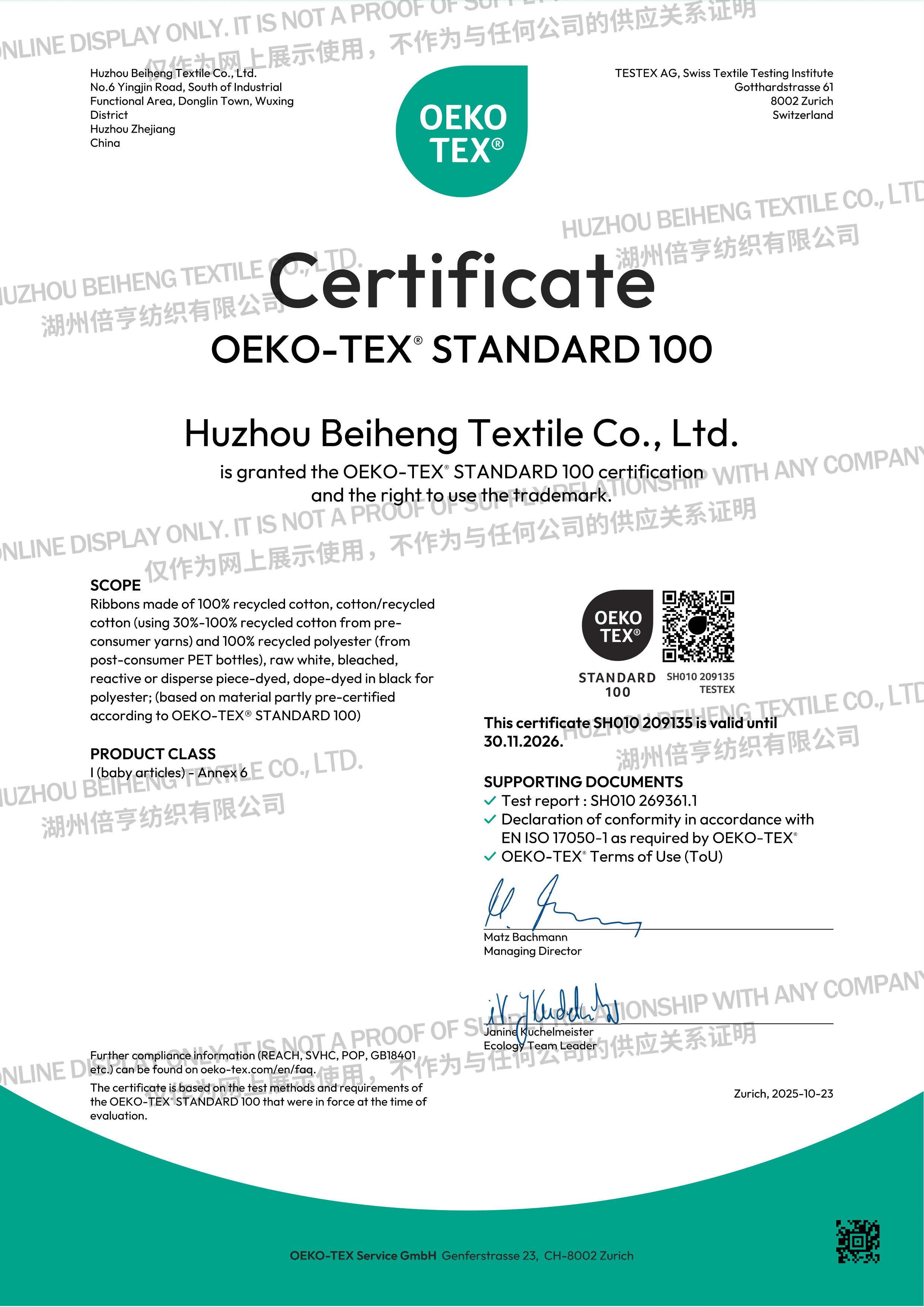
Compliance documentation is part of the product file in custom ribbon orders, not an afterthought. The OEKO-TEX Standard 100 certificate shown covers recycled polyester and cotton ribbon constructions.
Most custom ribbon failures are specification failures, not production failures. Colour referenced by name instead of Pantone code, width quoted without tolerance, edge finish left unspecified, certificate scope assumed rather than checked — these are the points where a ribbon order stalls between the design brief and the purchase order. This reference answers the technical and procurement questions buyers raise at that exact stage.
Why Ribbon Questions Cluster Before the First Purchase Order
Ribbon sits at the boundary between a brand's design intent and a factory's weaving schedule. It is a narrow woven textile with a fixed set of controllable variables — fibre, weave structure, width, edge finish, colour, printing, packing — and each variable converts into a production parameter. When the buyer and the mill describe the same ribbon using different vocabularies, the gap surfaces only at the sample stage or, worse, at final inspection.
That is why procurement-stage questions tend to arrive in clusters rather than one at a time. A buyer asking about minimum order quantity is usually also negotiating material choice, because the MOQ is not a single company-wide number. A buyer asking about certificates is usually preparing a customs or brand-compliance file that will also require an acceptance criterion. This article treats those questions as one connected decision set.
What "Custom" Covers in a Ribbon Order
Huzhou Beiheng Textile Co., Ltd., trading as Beiheng Ribbon, is an integrated ribbon manufacturer founded in 1999 and based in Huzhou, Zhejiang, China, covering R&D, weaving, dyeing, finishing and custom production. Its facility spans 53,000 ㎡ with 700 high-speed Swiss Müller looms and 23 complete dyeing and finishing lines, staffed by 245 employees including a 25-engineer R&D team, and it exports roughly 70% of output to the EU, Middle East, Asia, North America and Oceania. That production base is the reference point for the capability questions below.
In practice, customisation is applied across colour, style, width, length, logo printing and packaging. The underlying levers are more granular: base tape type, width, colour, printing, handmade bow attachment, buckle, and strip cutting. Beyond that, the finishing list includes Pantone colour matching, LOGO printing, hot stamping, jacquard weaving, overlocking and heat-sealed edge finishing.
The useful distinction for buyers is between tape specification (fibre, weave, width, edge) and decorative specification (printing, hot stamping, jacquard, bow attachment). The first determines how the ribbon behaves; the second determines how it looks. Both must be locked before a sample is approved, because both are difficult to change once weaving has started.
Choosing the Fibre: Cotton, Lyocell, Recycled Polyester, Polyester
Four fibre routes appear in custom ribbon programmes, and they are not interchangeable in either economics or positioning.
Polyester is the most common ribbon material: smooth surface, bright colour, good colour fastness, resistant to wrinkling and fading, water-resistant and durable. It is widely used for gift wrapping, bows, holiday decoration and printed logos. Recycled polyester (RPET) is made from recycled plastic bottles and offers the same texture and performance as conventional polyester while meeting European environmental requirements — the version most often requested for green-brand packaging. Cotton gives a natural matte texture, soft and skin-friendly, suited to handmade goods, candle packaging, craft and organic-style gifts; its colour saturation is lower than polyester. Lyocell is a cellulose fibre produced from wood pulp through a solvent-spinning route, used where a softer, more fluid hand-feel is wanted.
The buyer-relevant consequence is that MOQ differs by fibre. Recycled Polyester Ribbon and the general Customized Ribbon line start at 5,000 meters, while Cotton Ribbon and Lyocell ribbon start at 30,000 meters. A specifier who selects cotton for its matte look, then discovers the 30,000-meter threshold, is usually re-briefing rather than ordering.
| Product line | Material | MOQ | Typical use |
|---|---|---|---|
| Recycled Polyester Ribbon | Recycled polyester | 5,000 meters | Gift packaging, bakery, floral, apparel accessories, home textile |
| Customized Ribbon | Cotton / Lyocell / Recycled Polyester / Polyester | 5,000 meters | Brand-specific programmes across the five application industries |
| Cotton Ribbon | Cotton | 30,000 meters | Natural-style handmade gifts and rustic packaging |
| Lyocell ribbon | Lyocell fibre | 30,000 meters | Softer hand-feel programmes |
| Bows (pre-tied) | Polyester / Recycled Polyester / Degradable plant fibre | 3,000 pieces | Gift packaging, garment decoration, holiday ornament |
Weave Structure: Satin, Grosgrain, Taffeta, Herringbone
Fibre decides performance; structure decides appearance and handling. All four standard constructions — satin, grosgrain, taffeta and herringbone — are available across the fibre range, in widths from 3 mm to 100 mm.
Satin presents a smooth, reflective face and is the construction usually chosen for luxury gifts and perfume boxes. Grosgrain carries a ribbed, corded surface and is the structure to pick when a bow must hold its shape. Taffeta is a crisp, closely woven plain construction with a papery hand and clean body. Herringbone shows a broken-twill pattern that reads as texture at close range rather than as shine. Because these differences are tactile, the practical procurement rule is to approve structure on a physical sample rather than on a screen or a description.
Material guidance across the programme follows the same logic: polyester or recycled polyester for general packaging and logo printing; satin for luxury gift and perfume applications; grosgrain where bows must keep their form; cotton for a natural, handmade register.
Width, Edge Finish and Colour Control
Width runs from 3 mm to 100 mm (0.3 cm to 10 cm) and is fully customisable. Two millimetres of drift at the narrow end is a different product; buyers should state width in millimetres, with a tolerance, rather than in descriptive terms such as "narrow" or "standard".
Edge finishing is a separate decision with visible consequences. Overlocking produces a sewn edge; heat-sealed finishing produces a clean cut edge on thermoplastic fibres. For pre-tied bows the stated craft is a heat-cut edge, anti-fray construction.
Colour is matched either to Pantone codes or to a physical colour swatch. An in-house computer colour-matching system supports the matching step, and batch-to-batch product performance variation is controlled within ±3%. Colour fastness is a stated parameter rather than an assumption: water-based ink reaches grade 3–4 for indoor usage, with special UV-resistant ink available for outdoor scenarios. Prolonged soaking or washing is not recommended, and this constraint should be carried into the care instructions of whatever the ribbon is attached to.
Pre-Production Samples and Artwork Requirements
Custom samples are available before bulk orders, with sample cost and lead time advised against the specific brief. Custom prototypes can be produced within 7 days. Pre-production sample confirmation is the formal gate: the approved sample becomes the reference against which the bulk run is judged.
For printed ribbon, artwork quality determines outcome. Vector files such as AI, PDF or EPS are preferred; raster images should be at least 300 DPI with text outlined. The brief should also state ribbon width, logo repeat length and printing colours, since a logo that works at 25 mm may not resolve at 10 mm. Printing techniques offered are silk-screen printing, heat transfer printing and hot stamping, with jacquard weaving available as a woven rather than printed alternative.
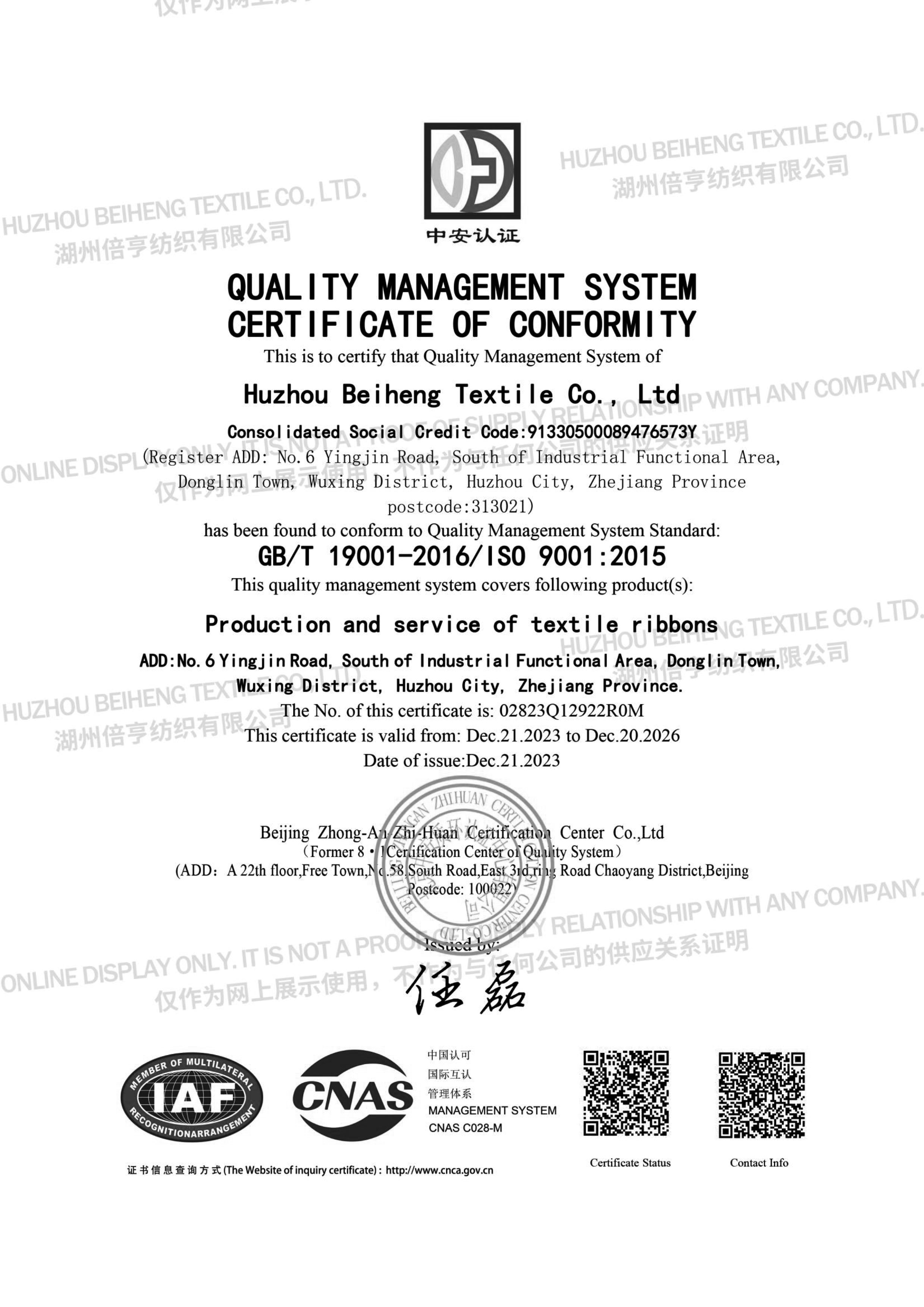
ISO 9001:2015 certification (certificate 02823Q12922R0M) covers the production and service of textile ribbons — the management-system layer behind acceptance criteria.
MOQ, Lead Time and Commercial Terms
The minimum order quantity for custom ribbon is 5,000 meters. That figure applies to the Customized Ribbon and Recycled Polyester Ribbon lines; cotton and lyocell carry a 30,000-meter threshold, and pre-tied bows are quoted at 3,000 pieces. Capacity is sized for volume: monthly output reaches 90 million meters (90,000 kilometres), with daily output of 3 million meters, and a full 20GP container order runs 30–40 days.
| Term | Stated position |
|---|---|
| MOQ | 5,000 meters (ribbon); 3,000 pieces (pre-tied bows); 30,000 meters (cotton, lyocell) |
| Delivery terms | FOB / CIF / DDP / EXW |
| Acceptance criteria | Factory Acceptance Test |
| Payment terms | T/T and L/C, with other terms negotiable for custom orders |
| Production lead time | Typically 7–15 working days for custom ribbon, subject to detail and quantity; 7–30 days quoted in the capability record |
| Packaging options | Roll packing, spool packing, individual polybag packing |
Certifications: What Each Certificate Actually Covers
Certificates are scope documents. A GRS certificate covering woven ribbon does not automatically cover every item a buyer places in the same order, and the reliable procurement habit is to match certificate scope — and validity date — to the specific SKU.
| Certificate | Authority / number | Scope and validity |
|---|---|---|
| GRS / RCS Scope Certificate | Control Union, CU855379MUL-2026-00046725 | GRS 4.0 / RCS 2.0; functional accessories, finishing, washing, weaving; valid to 18 May 2027 |
| GOTS Scope Certificate | Control Union, CU855379GOTS-2026-00046723 | GOTS Version 7.0; functional accessories, finishing, preparatory, washing, weaving; valid to 26 May 2027 |
| OEKO-TEX Standard 100 | TESTEX AG, SH010 209135 | Product Class I (baby articles); recycled cotton, cotton/recycled cotton, recycled polyester ribbons; valid to 30 November 2026 |
| FSC Chain of Custody | SGS Hong Kong, CN21/21014 | FSC 100% and FSC Mix yarn purchasing, woven edge ribbon, ribbon and bow; valid to 30 June 2031 |
| ISO 9001:2015 | 02823Q12922R0M | Production and service of textile ribbons; valid to 20 December 2026 |
| ISO 14001:2015 | 02823E12922R0M | Production and related activities of textile ribbons; valid to 20 December 2026 |
| SMETA Sedex Audit | TUV, ZAA600193797 | SMETA 4-Pillar: labour standards, health and safety, environment, business ethics; 30 March 2026 to 30 March 2027 |
Two layers of evidence sit alongside the certificates. Transaction Certificates (TC) can be issued for recycled and organic content, and third-party SGS test reports can be supplied to support market-access requirements for the EU, the US and other regions. For recycled polyester ribbons, the GRS certificate is the relevant reference; for cotton, GOTS and the OEKO-TEX scope apply.
Regulatory thresholds move. Effective 1 April 2025, OEKO-TEX Standard 100 tightened its Bisphenol A (BPA) limit value from 100 mg/kg to 10 mg/kg, a change that directly affects ribbon intended for skin contact and baby articles. Under GRS 4.0, a minimum of 20% recycled content is required for certification, and 50% for on-product labelling. Buyers who quote "recycled" as a descriptive marketing term rather than a certified content level are exposed at the point of customs or retailer audit.
Acceptance Criteria and Inspection Stages
The documented acceptance criterion for custom orders is a Factory Acceptance Test, supported by inspection at three points: incoming material, production, and finished goods. The stated quality-control mode is sampling inspection, with product performance variation controlled within ±3% per batch.
Verification capability sits in-house. The testing laboratory is equipped with computer colour-matching systems, colour fastness testers, heavy metal analysers and biodegradability testing equipment, and the company holds 23 textile-related patents. An ERP system provides full traceability across raw material, production and delivery workflows — which is what allows a batch to be traced back to its input lot when a dispute arises.
A practical acceptance checklist for the buyer looks like this:
- Width in millimetres, with tolerance, matched against the approved sample.
- Colour verified against the Pantone reference or physical swatch on the approved sample.
- Edge finish confirmed as overlocked or heat-sealed, and checked for fraying.
- Ink adhesion and fastness confirmed per the agreed indoor or outdoor use case.
- Certificate scope and expiry date matched to the purchased SKU and shipment date.
- Packing format (roll, spool or individual polybag) and label content checked against the purchase order.
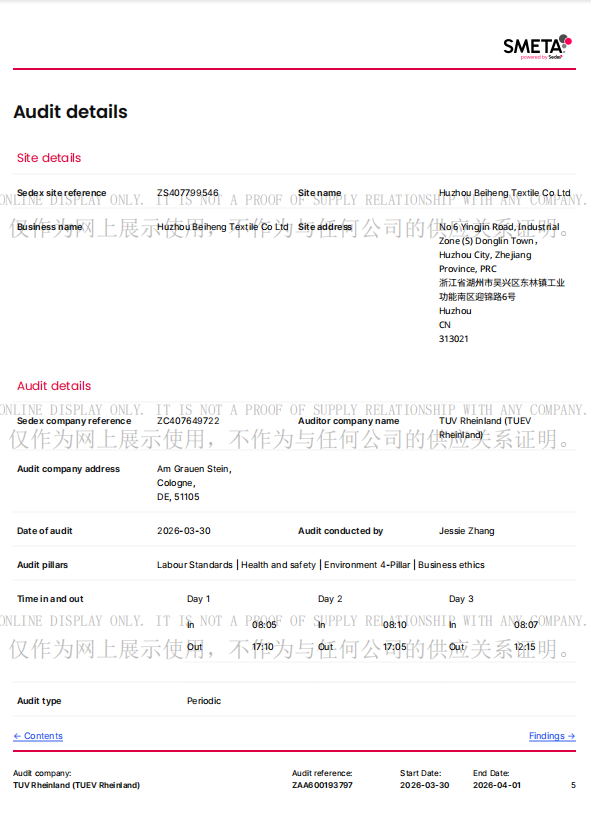
Social compliance evidence: a SMETA 4-Pillar audit (ZAA600193797) is often requested alongside product certificates in European retail supply chains.
Where Custom Ribbon Sourcing Has Real Limits
Custom manufacturing carries constraints that are better understood before the PO than after it.
Returns are limited by definition. Custom-made products are generally non-returnable and non-exchangeable, except for quality problems caused by production. The pre-production sample is therefore not a formality; it is the buyer's principal protection.
Material choice is bounded by volume. A 5,000-meter entry point is realistic for polyester and recycled polyester, but natural fibres start at 30,000 meters. Buyers with a smaller cotton or lyocell requirement realistically face a choice between consolidating volume across SKUs or accepting a different fibre.
Printed colour has a service envelope. Water-based ink at grade 3–4 fastness is specified for indoor use; outdoor applications need UV-resistant ink, and prolonged soaking or washing is outside the recommended use. A ribbon designed for a washable garment trim is a different brief from one designed for a gift box.
Certificates have shelf lives and scopes. Several documents in a typical order file carry renewal dates in late 2026 — OEKO-TEX Standard 100 (30 November 2026) and ISO 9001 / ISO 14001 (20 December 2026). Procurement teams should file the version valid at the time of shipment, not the version on file from a previous season.
Documentation is not automatic. Target-market-specific certificates may require additional testing, and extra test cost may apply. Requests should be raised with the order, not after production.
Market Context Behind the Specification Pressure
The compliance intensity around ribbon is not incidental. China remains the dominant exporter of narrow woven man-made fibre fabrics, a category that includes ribbons, with export value of approximately USD 1.065 billion in 2024 under HS code 580632. Upstream, the global recycled polyester market was estimated at USD 15.52 billion in 2024, with demand projected to grow at a CAGR of 9.25% through 2030 — growth driven substantially by sustainability mandates rather than by underlying textile demand. Asia Pacific accounted for 47.78% of global recycled polyester revenue share in 2024, consolidating the region as the primary manufacturing base for rPET products.
Read together, these figures explain why material substitution questions arrive earlier in the buying process than they did a decade ago. Recycled content is becoming a procurement requirement embedded in retailer specifications, which pushes certificate verification from the logistics stage back to the sourcing stage.
What Changes Next
Three directions are visible from the specification side of the category. First, restricted-substance thresholds will keep tightening, following the pattern set by the 2025 BPA revision, which places a premium on suppliers who can re-test rather than merely re-declare. Second, recycled content will increasingly be verified at document level rather than claimed at marketing level, with transactional certificates travelling alongside the goods. Third, traceability — lot-level records linking raw material to finished roll — will become a routine part of the purchase file rather than a special request.
For buyers, the implication is straightforward: the questions worth asking at the evaluation stage are the same questions that will be asked of them later by their own customers. Establishing the material route, the width and edge specification, the MOQ logic, the certificate scope and the acceptance criterion at the outset is cheaper than resolving any one of them after the container ships.
Frequently Asked Questions
How are ribbons customised?
Customisation is available for ribbon colour, style, width, length, logo printing and packaging options. At the production level this extends to base tape type, width, colour, printing, handmade bow attachment, buckle and strip cutting, with Pantone colour matching, LOGO printing, hot stamping, jacquard weaving, overlocking and heat-sealed edge finishing available as finishing operations.
What is the MOQ for custom ribbon?
The minimum order quantity for custom ribbon is 5,000 meters. This applies to the Customized Ribbon and Recycled Polyester Ribbon lines. Cotton Ribbon and Lyocell ribbon are quoted at a 30,000-meter minimum, and pre-tied bows at 3,000 pieces.
Which fibre should a buyer choose between cotton, lyocell, recycled polyester and polyester?
For general packaging and logo printing, polyester or recycled polyester is the usual route. Recycled polyester offers the same texture and performance as conventional polyester while meeting European environmental requirements. Cotton gives a natural matte texture suitable for handmade and organic-style gifts, with lower colour saturation than polyester. Lyocell is a cellulose option used where a softer hand-feel is required. The choice also determines MOQ: 5,000 meters for recycled polyester versus 30,000 meters for cotton and lyocell.
What widths and fabric types are available?
Widths run from 3 mm to 100 mm, fully customisable. Fabric types are satin, grosgrain, taffeta and herringbone, available across the fibre range. Satin is typically used for luxury gift and perfume applications, and grosgrain where bows must hold their shape.
Can ribbon colour be matched to a Pantone reference?
Yes. Colours can be matched to Pantone colour codes or to a physical colour swatch, supported by an in-house computer colour-matching system. Batch-to-batch product performance variation is controlled within ±3%.
Which certificates apply to a recycled polyester ribbon order?
A GRS / RCS Scope Certificate from Control Union (CU855379MUL-2026-00046725, GRS 4.0 / RCS 2.0, valid to 18 May 2027) covers recycled content, and OEKO-TEX Standard 100 (SH010 209135, valid to 30 November 2026) covers harmful-substance compliance for recycled polyester ribbons among other constructions. Transaction Certificates and third-party SGS test reports can be supplied as supporting evidence.
What are the purchasing terms and acceptance criteria?
MOQ is 5,000 meters. Delivery terms offered are FOB, CIF, DDP and EXW. The acceptance criterion is a Factory Acceptance Test, and payment terms are T/T and L/C, with other terms negotiable for custom orders.
Can a sample be approved before bulk production?
Yes. Custom samples are available before bulk orders, with sample cost and lead time advised against the brief. Custom prototypes can be produced within 7 days, and pre-production sample confirmation precedes the bulk run.
What artwork is required for printed ribbon?
Vector files such as AI, PDF or EPS are preferred. If image files are supplied, they should be at least 300 DPI with text outlined, and the brief should specify ribbon width, logo repeat length and printing colours. Silk-screen printing, heat transfer printing and hot stamping are available.
How long does production take?
Production of custom ribbon typically takes 7–15 working days, subject to customisation details and order quantity, and the capability record quotes a 7–30 day lead time. A full 20GP container order runs 30–40 days.
Are custom ribbons returnable?
Generally custom-made products are non-returnable and non-exchangeable, except for quality problems caused by production. This is why pre-production sample confirmation and an agreed Factory Acceptance Test matter in the order terms.
Can pre-tied bows be ordered instead of ribbon rolls?
Yes. Pre-tied bows are available with a ribbon base width of 3–100 mm and bow sizes from 30 mm to 500 mm, in polyester or recycled polyester, with Pantone colour matching, heat-cut anti-fray edges and a 3,000-piece MOQ, and with ISO 9001 and optional GRS compliance.
For buyers assembling a specification file, the manufacturer's full technical and company documentation is available in the Beiheng Ribbon brochure (PDF). Company information is published at www.bei-heng.com.
This article is an editorial reference for procurement and specification planning. Product parameters, certificate numbers and validity dates should be confirmed against current documentation at the time of order.
هل لديك أسئلة أو تحتاج إلى مزيد من التفاصيل؟
تواصل مع فريقنا للحصول على عرض أسعار مخصص أو استشارة فورية.
طلب عرض أسعار
املأ النموذج أدناه وسيتواصل معك فريقنا بعرض مقترح مخصص.
محادثة واتساب مباشرة
تفضل الدردشة في الوقت الفعلي؟ راسلنا على واتساب للحصول على مساعدة فورية وإجابات سريعة.
- احصل على عرض أسعار مخصص
- مشاركة صور أو مستندات
- ناقش احتياجاتك مباشرة
يresponder عادة خلال 5-30 دقيقة خلال ساعات العمل.