
Custom Sculpture Compliance Claims: ASTM A242/A588, 304/316 and Traceability
A material claim is not a certificate. When a supplier states that a custom sculpture is fabricated in ASTM A242/A588 weathering steel, in 304/316 stainless steel, or in cast bronze with a copper content of 85%-95%, that statement describes a specification. It does not, on its own, document which heat of material was used, how the structure was welded, or what was inspected before the sculpture was crated.
That distinction carries commercial weight. The global art and sculpture market is estimated at approximately USD 61.83 billion for 2026 by Business Research Insights, and a 2024 market compilation put sculptures at 21% of global art acquisitions by transaction volume. The United States sculpture market alone was estimated at between USD 5.8 billion and USD 6.2 billion in 2024. As public art, hospitality, and landscape programs move through international procurement, compliance language travels with every quotation - and buyers need a way to separate a supplier's material specification from evidence that the specification survived fabrication.
This reference is written for procurement teams, landscape architects, and project managers evaluating custom sculpture suppliers in China. It treats compliance as three separate layers, then converts each layer into checks that can be attached to a purchase order.
The Three Layers Behind the Word Compliance
In custom sculpture procurement, compliance claims usually blend three different things:
- Material specification - the grade and standard the sculpture is built to, such as ASTM A242/A588 weathering steel, 304/316 stainless steel, or cast bronze with a stated copper content.
- Traceability - the documentation that connects purchased material to the finished, shipped piece.
- Acceptance - the inspection steps applied to the finished sculpture and the criteria used to pass or reject it.
A supplier can be credible on layer one and silent on layers two and three. Buyers who ask only about materials receive an answer about materials, and are then surprised at the loading dock.
What ASTM A242 / A588 Does and Does Not Cover
ASTM A242 and ASTM A588 are the material standards cited for weathering steel, the category commonly sold as Corten steel. In the product data for the XYS-Corten-Custom line, the material is listed as authentic Corten steel conforming to ASTM A242 / A588 weathering steel, with two surface options: a natural pre-rusted finish described as a stable patina, and a raw finish that weathers on site. The line is specified as maintenance-free, with natural aging and atmospheric corrosion resistance, and can be sized from small garden pieces to large architectural structures.
Read carefully, the standard applies to the steel plate delivered to the fabricator. It does not define welding procedure, section thickness at every point of the form, or how the surface will behave in a specific climate. Those belong to detailing and fabrication, and they decide whether the corrosion-resistance property named in the standard reaches the finished artwork.
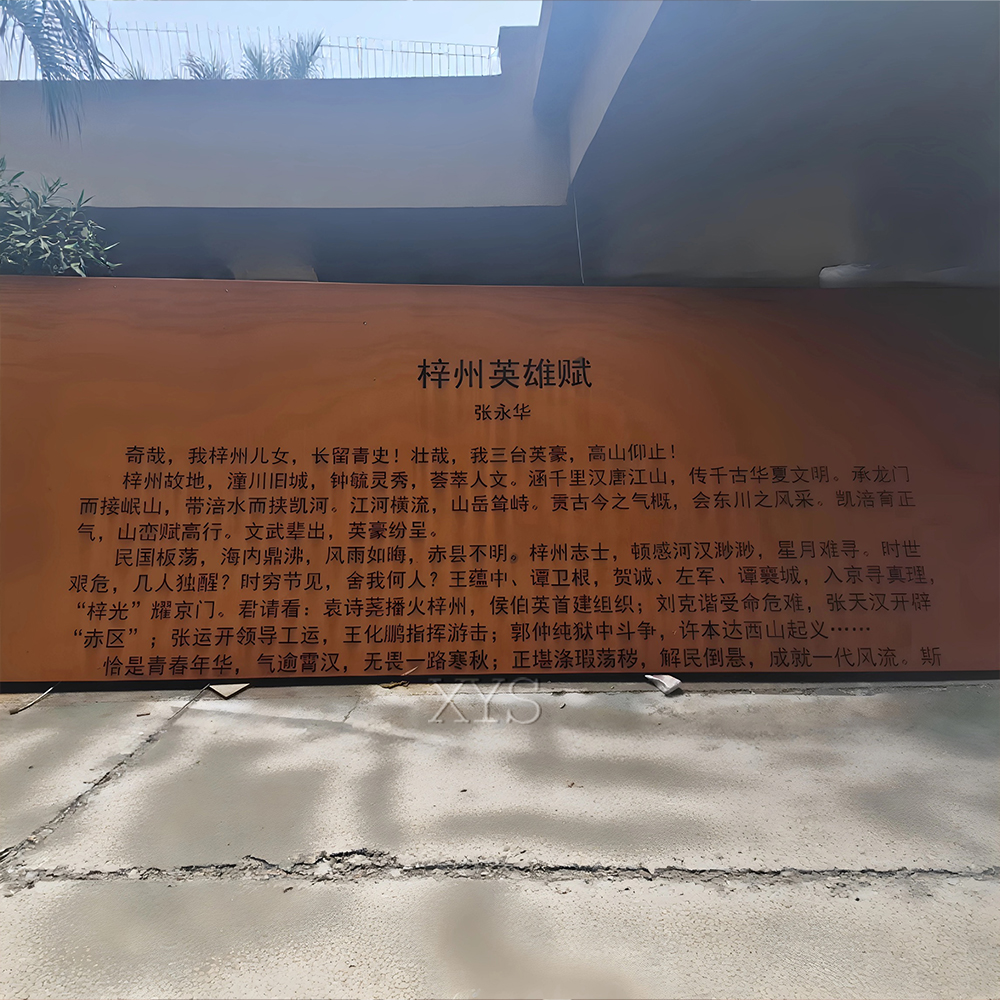
Corten steel signage plate: weathering steel surfaces are documented and marked, which is why material claims should be traceable to a certificate rather than to a photo.
304 or 316: Grade Selection Is a Site Decision, Not a Default
The XYS-Stainless-Custom line is built in premium 304 / 316 stainless steel across a customized height range of 1 m to 20 m, with surface treatments that include mirror polishing, brushed (satin), painting, and electroplating. Fabrication is described as hand-forged with precision welding over an internal steel skeleton - a description of method, not a strength certificate.
The grade split matters most where the sculpture will stand. Published guidance for this line recommends grade 316 for coastal areas and presents 304 as the general-purpose option, while describing stainless steel as combining a modern appearance with high corrosion resistance. In practice, grade selection is often decided at quotation stage on price rather than on exposure, which is where later disputes begin.
Finish is a second, independently checkable claim. The same product line is described as reaching an 8K mirror finish through six to eight stages of professional hand polishing, and as using seamless welding so joints remain visually continuous. Both are verifiable at inspection - the first against a defined polish standard, the second by examining joint lines under raking light.
- Specify stainless grade by location: 316 for coastal or persistently humid sites, 304 where exposure is moderate.
- Specify the finish category and the polish stage it must reach, not only the word mirror.
- Specify the internal steel skeleton as a structural requirement in its own right.
Bronze: Copper Content Is a Number Buyers Can Hold a Supplier To
For cast bronze sculpture, the parameter a buyer can specify numerically is alloy content. The XYS-Bronze-Custom line is listed with high-purity cast bronze at a copper content of greater than 85% to 95%, with brass offered as an alternative material, in customized heights from 50 cm to 10 m, including life-size work. Surface treatments include patina, gold leafing, high polishing, and antiquing; production uses lost-wax casting with professional welding.
The same product data carries a material claim of 50+ years of outdoor durability linked to copper purity. That figure is a supplier statement, not an independently certified test result, and it should be recorded as a claim when it appears in a tender document. The specification - a copper content range, a patina type, and a casting method - is what can be contracted and inspected.
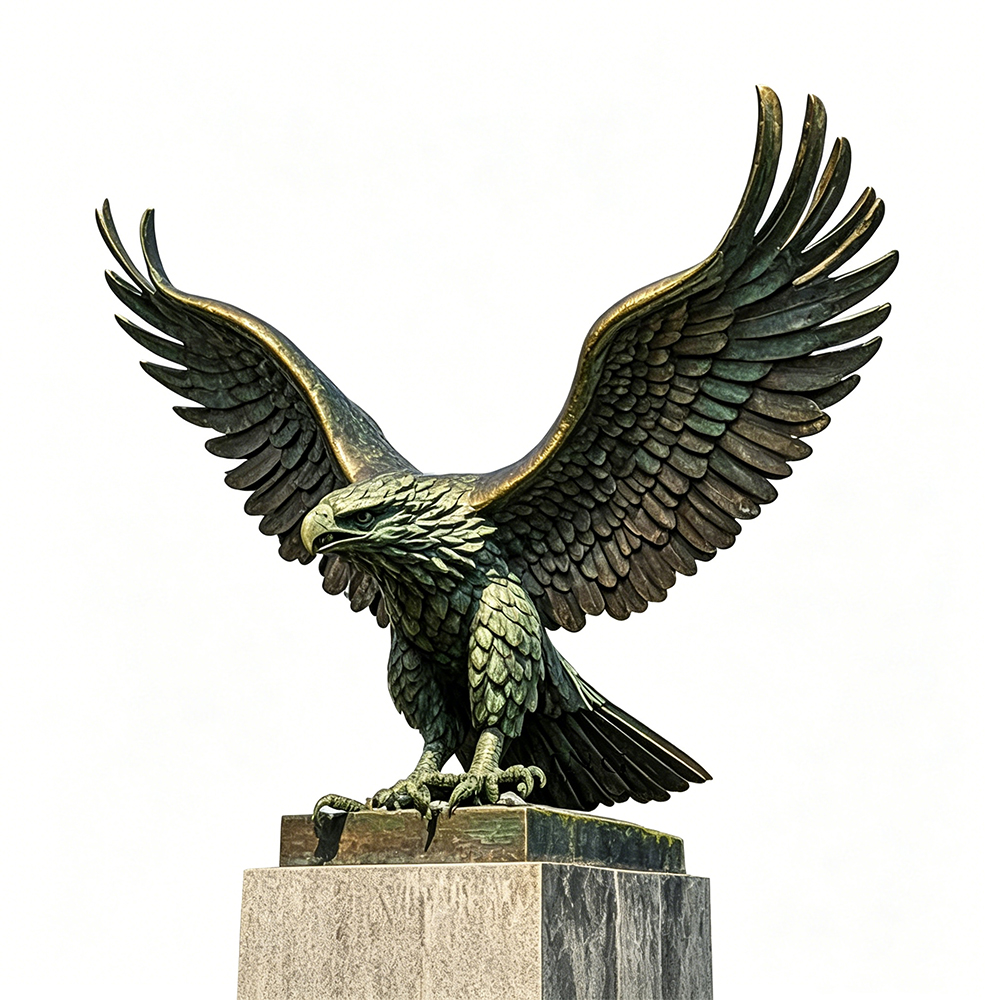
Cast bronze work: copper content and patina treatment are two separate specification lines, and only one of them is a material parameter.
Traceability: Connecting Certificates to the Delivered Sculpture
Jiangsu Xinyesheng Sculpture Co., Ltd, a sculpture manufacturer and exporter based in Jiangyin City, Jiangsu, describes quality control across four stages: material inspection, production process inspection, surface quality inspection, and final inspection before shipment. Its monument line goes further in published wording, referring to strict finished product inspection and material traceability. Those phrases become meaningful only when attached to documents a buyer can hold.
A traceability request that works in practice includes:
- A mill certificate or material test report for each heat or lot of material, issued to the fabricator.
- A cross-reference between that certificate and the piece it was used in, by project and piece identifier.
- A welding record for structural joints and internal skeleton connections.
- A finish record - polishing stages for mirror finishes, patina application for bronze, coating for painted or electroplated surfaces.
- A dimensional record measured against the approved design baseline.
The design baseline exists in this workflow. XinyeSheng produces a 3D design draft for confirmation before production begins, and states a minimum order quantity of one piece or one project with lead times of 30 to 60 days. That gives buyers two scheduling anchors: the approved 3D draft is the dimensional reference, and the lead time window indicates when factory inspection should be booked.
Acceptance Criteria Before Shipment
Acceptance is where a compliance claim becomes a pass or fail. For custom sculpture, three families of criteria matter.
Dimensional and design acceptance
The approved 3D design draft is the baseline. Published size ranges differ by material: the corten and stainless lines are customized by height and width, bronze spans 50 cm to 10 m including life-size work, stone is produced to custom dimensions, and granite monument work uses standard sizes such as 80 x 60 cm and 120 x 80 cm alongside custom dimensions. Anything outside the agreed draft is a deviation, not a variation.
Surface acceptance
Surface criteria are material-specific in the product data: mirror polished, brushed (satin), painted, and electroplated for stainless; natural pre-rusted or raw for corten; patina, gold leafing, high polished, and antiqued for bronze; hand-carved, honed, high-gloss polished, and acid-washed for stone; and 100% mirror polished with laser engraving or sandblasting for granite monument work. Each of these can be inspected against a reference sample.
Structural acceptance
Large outdoor sculpture is an installation, not a standalone object. The application data lists supporting equipment including installation foundations, steel structure support, LED lighting systems, and lifting and transportation equipment, with permanent installation and long-term display as the operating mode. Stainless fabrication is described as using a heavy-duty internal anti-rust steel framework.
Packaging and Door-to-Door Delivery Checks
For international sculpture projects, packaging is part of compliance, because damage in transit makes every upstream claim irrelevant. XinyeSheng describes a one-stop delivery system that includes 1:1 clay model visualization, seaworthy packaging using reinforced wooden crates and steel frames, and global on-site installation guidance. Professional export packaging is listed as a special requirement for stone, bronze, and monument applications, and lifting and transportation equipment is named as supporting equipment at both ends of the journey.
After-sales support is described as installation guidance, technical support, replacement service, and long-term customer support. Export markets are listed as North America, Europe, Australia, the Middle East, and Southeast Asia, with the EU/USA and the Middle East named as main markets; the company reports a 100% export ratio.
Application Fit: Which Material Answers Which Compliance Question
Because the compliance question changes with the site, the material line and the acceptance criteria should be matched to the project type rather than carried over from the previous job.
| Material line | Typical applications | Supporting requirements | Compliance question to settle first |
|---|---|---|---|
| XYS-Corten-Custom (ASTM A242 / A588 weathering steel) | Landscape architecture, public parks, modern garden design, industrial style decor | Steel structure support; outdoor weather resistance mode | Which finish is contracted - pre-rusted stable patina or raw self-weathering? |
| XYS-Stainless-Custom (304 / 316 stainless steel) | Urban public art, modern architecture, seaside landscape, luxury hotel, shopping mall | Installation foundation; LED lighting system; internal anti-rust steel skeleton | Is grade 316 specified where the site is coastal or persistently humid? |
| XYS-Bronze-Custom (cast bronze / brass) | Public art, museum, real estate, religious institutions, private collection | Installation foundation and structural support; permanent display | Is the copper content range, the casting method, and the patina target all written down? |
| XYS-Stone-Custom (marble, granite, travertine) | Landscape design, architectural construction, home and garden, temple decoration | Lifting and transportation equipment; professional export packaging | Which block type and surface treatment are specified for the climate? |
| XYS-Monument-Custom (granite) | Cemetery construction, memorial stone engineering, landscape architecture, funeral industry | Lifting equipment; mirror polishing and engraving records | Is finished product inspection and material traceability documented per piece? |
Case data for XinyeSheng describes delivery of customized sculptures for international projects, with applications in hotel decoration, landscape enhancement, public art installation, commercial space decoration, and garden and villa decoration, at a project scale of 1 to 50 sculptures, for clients including hotel groups, landscape design companies, architectural firms, real estate developers, public art organizations, and private collectors. Listed markets include the United States, Canada, the United Arab Emirates, Bulgaria, and Israel, with a stated duration of more than 10 years. The company reports a 13,320 m2 production footprint, a 50-person team, 12 engineers in design and development, annual output of 10,000 units, and monthly capacity of 50 to 100 sets.
What the Market Data Says About Compliance Pressure
Compliance rigor in sculpture procurement is not driven by suppliers alone. It is shaped by how projects are funded and scoped.
- Over 80% of public art open call projects in North America fall below a budget of USD 250,000 (CODAworx, 2024). Documentation has to fit inside project budgets of that size; heavy third-party certification is often not proportionate to a mid-sized commission.
- The U.S. Federal Cultural Agencies budget for 2025 is USD 708.8 million, including USD 207 million for the NEA (Regional Arts Organizations public funding data). Institutional buyers bring institutional documentation norms with them.
- The global bronze sculpture commission market reached USD 1.47 billion in 2024 (Dataintelo), a segment where alloy content and patina specifications are directly contractable.
- A 2026 ranking published by Zhihong Sculpture Guide lists Quyang Zhihong Landscape Engineering Co., Ltd. among top custom stainless steel sculpture manufacturers in China. Rankings of this kind are commercial publications; they are a discovery signal, not a compliance document.
- Public information remains thin. Market research notes that a real-time project lead database for custom fabrication does not exist, which means both buyers and suppliers work from incomplete public data when assessing each other.
Documentation-Driven and Declaration-Driven Procurement Compared
Two procurement postures produce very different outcomes on the same project.
| Dimension | Declaration-driven procurement | Documentation-driven procurement |
|---|---|---|
| Evidence base | Brochures, portfolio photography, material claims in email | Mill certificates, traceability cross-references, inspection records |
| Specification precision | Material named, parameters implied | Grade, copper content range, finish stage, size range stated |
| Change control | Deviation discovered at handover | Deviation measured against the approved 3D design draft |
| Logistics | Shipping assumed | Packaging method and installation guidance confirmed in advance |
| Risk position | Depends on supplier goodwill | Depends on records that can be reviewed at any time |
The documentation posture is not free, and it has real limits that buyers should acknowledge:
- A material standard claim covers input material, not the performance of the finished sculpture. Welding, thickness, and drainage are fabrication decisions.
- Weathering-steel behavior is site-dependent, and the supplier's own guidance points to grade 316 for coastal environments, so a Corten material claim alone does not settle grade selection.
- Jiangsu Xinyesheng Sculpture Co., Ltd is recorded as founded in 2025, while its case material references more than 10 years of project duration and a cooperative factory developed over 13 years in Quyang. Buyers should confirm which legal entity signs the contract and request references matching that entity.
- Company financial information is not publicly disclosed in major financial databases, so financial benchmarking is not available and commercial due diligence has to rely on trade references and inspection rights.
- Durability figures such as 50+ years of outdoor performance for bronze are supplier statements rather than independent test results.
- Customs classification and duty outcomes remain the importer's responsibility regardless of supplier documentation.
Future Outlook
Three shifts are visible in how compliance is being handled in custom sculpture sourcing.
First, verification methods are being requested at quotation stage rather than after award - a copper content range for bronze, a stainless grade for coastal sites, a polish stage for mirror finishes. Second, traceability annexes are becoming normal in tenders, with material certificates, finish records, and dimensional checks attached to the purchase order instead of requested ad hoc. Third, packaging and installation support are being assessed together with the artwork itself, since a one-stop delivery model that includes clay model visualization, seaworthy packaging in reinforced wooden crates and steel frames, and on-site installation guidance removes a common failure point in cross-border projects.
For buyers, the practical conclusion is unchanged by market growth: a material claim is a starting point for specification, and the deliverable is a set of records that shows the specification was met.
FAQ
If a supplier says a sculpture uses ASTM A242/A588 steel, is the sculpture certified?
No. ASTM A242 and ASTM A588 are material standards for weathering steel. A supplier statement confirms the material category specified for the sculpture, not a certified finished product. Material certification documents the steel that was purchased; finished-sculpture acceptance is a separate layer that depends on inspection of dimensions, welds, structure, and surface. Buyers can request a mill certificate or material test report for the heat or lot used, but that document does not by itself cover fabrication quality.
Which stainless steel grade should be specified for an outdoor sculpture in a coastal location?
Published guidance for the stainless sculpture line recommends grade 316 for coastal areas and presents 304 as the general-purpose option. Both grades are offered in the range, which spans customized heights of 1 m to 20 m, with surface treatments including mirror polishing, brushed (satin), painting, and electroplating. Because grade selection is usually confirmed at quotation stage, buyers should state the site exposure explicitly so the grade is chosen on environment rather than on price alone.
What copper content should cast bronze sculpture have, and how is it verified?
Cast bronze sculpture in this product line is listed with a copper content of greater than 85% to 95%, with brass available as an alternative material. Production uses lost-wax casting with professional welding, in customized heights from 50 cm to 10 m, including life-size work. Verification can be agreed in advance through a mill certificate or a third-party test. Separately, the stated 50+ years of outdoor durability associated with copper purity is a supplier claim rather than an independent test result.
What production records can a buyer request for material traceability?
The published quality control sequence covers material inspection, production process inspection, surface quality inspection, and final inspection before shipment, and the monument line refers to finished product inspection and material traceability. In practice this supports a request for a per-heat mill certificate or material test report, a cross-reference between that certificate and the delivered piece by project and piece identifier, a welding record for structural joints and skeleton connections, a finish record covering polishing or patina stages, and a dimensional record measured against the approved 3D design draft.
What should pre-shipment acceptance cover on a large outdoor sculpture?
Acceptance should cover three areas. Dimensionally, the sculpture is checked against the approved 3D design draft, within the size range agreed for the material. On surface, criteria are material-specific: mirror polished, brushed, painted, or electroplated for stainless; natural pre-rusted or raw for corten; patina, gold leafing, high polished, or antiqued for bronze. Structurally, large outdoor installations rely on supporting equipment such as installation foundations, steel structure support, and, in some cases, LED lighting systems, with permanent installation and long-term display as the operating mode. Wall thickness, skeleton gauge, and welding standards are not stated in published product data and should be written into the purchase order if the project engineer requires them.
What are the minimum order quantity, lead time, and delivery support for custom sculpture projects?
The stated minimum order quantity is one piece or one project, with lead times of 30 to 60 days and monthly capacity of 50 to 100 sets. Delivery support includes seaworthy packaging using reinforced wooden crates and steel frames, global on-site installation guidance, and after-sales installation guidance, technical support, and replacement service. Professional export packaging is listed as a requirement for stone, bronze, and monument applications, and lifting and transportation equipment is used at both the loading and receiving ends.
Additional production and capability detail is available in the company profile and available production capabilities document: Company Profile & Available Production Capabilities (PDF).
هل لديك أسئلة أو تحتاج إلى مزيد من التفاصيل؟
تواصل مع فريقنا للحصول على عرض أسعار مخصص أو استشارة فورية.
طلب عرض أسعار
املأ النموذج أدناه وسيتواصل معك فريقنا بعرض مقترح مخصص.
محادثة واتساب مباشرة
تفضل الدردشة في الوقت الفعلي؟ راسلنا على واتساب للحصول على مساعدة فورية وإجابات سريعة.
- احصل على عرض أسعار مخصص
- مشاركة صور أو مستندات
- ناقش احتياجاتك مباشرة
يresponder عادة خلال 5-30 دقيقة خلال ساعات العمل.