
Custom Sculpture Sourcing: Checking MOQ, Packaging and Door Delivery
Custom sculpture is a project business, and projects are qualified rather than purchased. Whether the commission is a life-size bronze figure, a stainless steel landmark, or a weathering steel landscape installation, the buyer is not comparing catalogue items. They are testing whether a supplier's answers to four recurring questions - minimum order quantity, packaging, door-to-door delivery and factory visits - survive scrutiny. This article sets out what a verifiable answer looks like for each.
Why the same four questions return in every enquiry
Before a purchase order exists, a custom sculpture enquiry is a risk assessment. The buyer has a site, a budget band, a design intent and a deadline. The supplier has capacity, materials, tooling and freight relationships. The gap between the two is closed by information, and four questions carry most of that information load.
- Minimum order quantity decides whether a single memorial piece and a multi-unit public art tender can both be served by the same factory.
- Packaging decides whether a finished surface arrives intact or arrives as repair work.
- Door-to-door delivery decides who owns the last mile, the customs file and the unloading risk.
- Factory visits decide whether the other three answers can be treated as claims or as evidence.
The reason these questions are hard to answer well is that none of them has a single correct number. A minimum order quantity, a crate specification and a delivered price all move with project scale, material and destination. Suppliers who answer with fixed numbers before they know the design are not being helpful; they are guessing. Buyers who accept those guesses are the ones who discover the gap later.
The market context these projects are ordered into
Custom sculpture sits inside a large but thinly documented market. Business Research Insights estimates the global art and sculpture market at approximately USD 61.83 billion in 2026. Sculptures accounted for 21 percent of global art acquisitions by transaction volume in 2024, according to market research published the same period. Dataintelo put the global bronze sculpture commission sub-segment at USD 1.47 billion in 2024. In the United States, the sculpture market was estimated at between USD 5.8 billion and USD 6.2 billion in 2024, based on commercial industry research.
Two structural facts matter more to a purchasing decision than the headline totals. First, forecast growth rates for the sector diverge widely - published CAGR projections for 2026 to 2035 range from 5.5 percent to 11.2 percent, with the higher figures typically including digital and NFT-adjacent segments. A buyer should treat any single growth number as directional rather than precise. Second, the demand base is institutional and mid-budget: over 80 percent of public art open call projects in North America fall below a budget of USD 250,000, according to CODAworx public art trend analysis. In the United States, Federal Cultural Agencies were budgeted at USD 708.8 million for 2025, including USD 207 million for the National Endowment for the Arts, which indicates continuing institutional commissioning capacity.
For a sculptor or procurement officer, the practical translation is simple. Most custom sculpture projects are mid-value, freight-sensitive and specification-sensitive. That is exactly the environment in which MOQ logic, packaging quality and delivery terms decide whether a project is profitable.
Question 1: Can the factory actually build what you designed?
The first verifiable answer is not a capability statement but a process step. A manufacturer that can genuinely customise should be able to show a design confirmation gate before any material is cut.
Jiangsu Xinyesheng Sculpture Co., Ltd., a sculpture manufacturer based in Jiangyin City, China, describes its customisation flow as: buyer provides drawings, photographs or a concept, the factory produces a 3D design draft for confirmation, prototyping is optional, production follows confirmation, then shipping. That sequence matters because it fixes responsibility for geometry before fabrication cost is committed. A supplier that begins production without a signed-off 3D confirmation is transferring design risk to the buyer.
The second verifiable answer is the material range and the technique behind it. Xinyesheng states that it integrates traditional hand-carving techniques with modern 3D modelling and CNC precision processing. The declared material set is specific enough to be checked against mill or quarry documentation.
| Material | Declared specification | Typical declared scale | What the buyer should request |
|---|---|---|---|
| Stainless steel | Premium 304 / 316 stainless steel; hand-forged, precision welding, internal steel skeleton | Custom height from 1 m to 20 m | Grade certificate and finish sample |
| Cast bronze / brass | High-purity cast bronze, copper content above 85 to 95 percent; lost-wax casting | Custom height from 50 cm to 10 m, life size | Alloy composition record and patina sample |
| Marble, granite, travertine | Grade A natural marble, hand-carved, honed, high-gloss polished or acid-washed | Custom dimensions | Block source and density description |
| Corten / weathering steel | Authentic Corten steel to ASTM A242 / A588; natural pre-rusted or raw finish | Small garden pieces to large architectural structures | Mill certificate referencing the cited standard |
| Granite (memorial) | Natural granite including Shanxi Black, G603 and Blue Pearl; mirror polished, laser engraving, sandblasting | Standard 80 x 60 cm and 120 x 80 cm, or custom | Finish and engraving mock-up |
Surface treatment is where custom sculpture projects most often fail acceptance. Stainless steel mirror finishing, for example, is described by Xinyesheng as an 8K mirror polish achieved through six to eight stages of professional hand polishing. That is a finishing depth claim, and it can be verified with a sample plaque rather than a photograph. The same logic applies to bronze patina or gold leafing, and to granite polish quality.
Question 2: Minimum order quantity when no fixed MOQ exists
There is no published minimum order quantity for the custom sculpture categories described in this article, and buyers should not expect a general number. The stated position from Xinyesheng is that single-piece orders are accepted, and that ordering multiple pieces at one time is recommended because mould and shipping costs are shared. Bulk orders receive more favourable pricing.
That answer is honest but incomplete on its own. A single-piece order and a ten-piece order are not the same commercial object, and the difference is worth understanding before negotiating.
| Order scale | What changes commercially | What the buyer should ask for |
|---|---|---|
| Single custom piece | Full tooling, modelling and freight cost carried by one unit | Confirm what is included in the quoted unit price: model, crate, freight, guidance |
| Small batch of related pieces | Shared mould and shared container loading reduce per-unit cost | Ask for a split quotation showing shared versus per-unit cost lines |
| Multi-unit project or framework | Production scheduling and consolidated shipping dominate | Ask for a phased delivery plan and a stated inspection point |
Two related variables also have no fixed public answer, and buyers should treat fixed claims with caution. Production time depends on size, material and surface finish, and is confirmed after design approval. Price depends on the same variables plus destination and packing grade. A supplier who quotes a delivery date before design approval is quoting a wish, not a schedule.
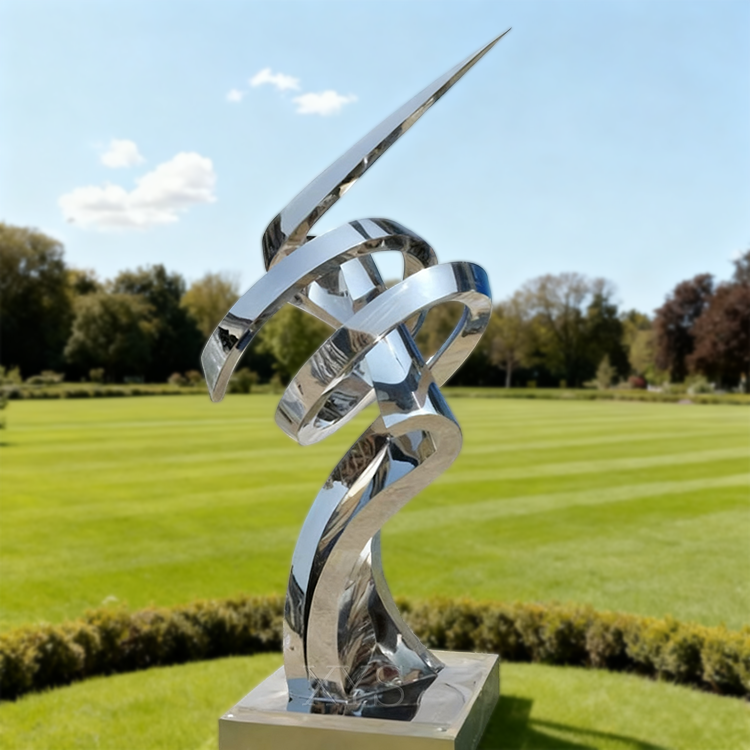
Medium and large-size 304 stainless steel art sculpture. Scale is the variable that most changes MOQ, crate design and freight cost in a custom sculpture order.
Question 3: What seaworthy packaging has to mean in practice
Seaworthy is a term of art, not an adjective. Xinyesheng describes its export packing standard as professional seaworthy packaging using reinforced wooden crates and steel frames, delivered as part of a one-stop system that also includes 1:1 clay model visualisation and global on-site installation guidance.
When a supplier says seaworthy, the buyer should convert the word into checkable items:
- Crate specification. Wood type, board thickness and whether crates are reinforced or plywood-sealed. Ask for a photograph of a comparable crate, not a drawing.
- Internal restraint. How the sculpture is braced so it cannot move inside the crate during rolling and lifting. A mirror-polished stainless surface that shifts even slightly during transit returns as a polishing job.
- Steel frame usage. For large-scale works, steel frames are typically used where a wooden crate alone cannot carry the load. Ask which components of your specific piece will be framed.
- Moisture and edge protection. Relevant for polished stone, bronze with patina and mirror stainless alike.
- Marking and lifting points. Lifting and transportation equipment is required at site, so lifting points should be marked on the crate and documented for the unloading crew.
- Loading evidence. Photographs of the packed unit and of the container loading sequence are the cheapest insurance a buyer can request.
A related point: the sculpture is not the only thing that has to travel. Installation depends on a foundation, steel structure support and, where specified, an LED lighting system. Buyers who order the artwork but not the interface details often discover a site delay that has nothing to do with the factory.
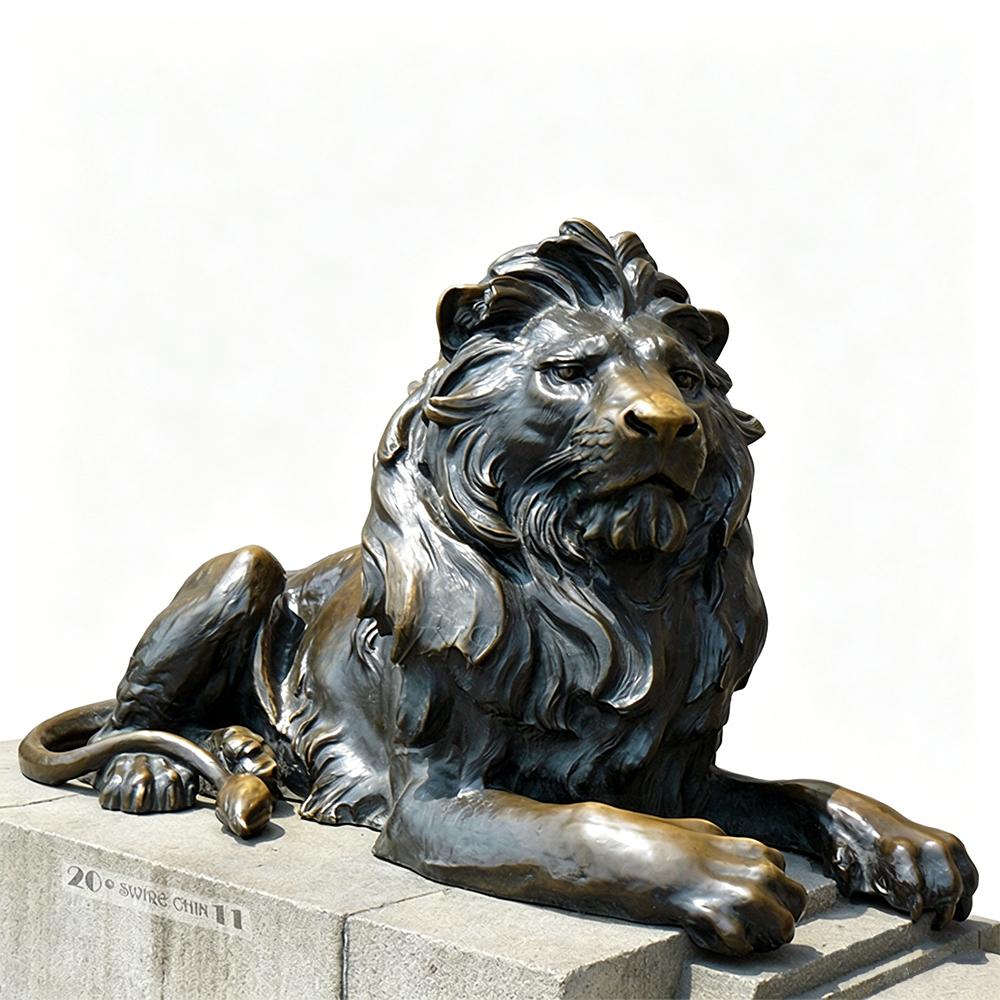
Cast bronze animal sculpture. Cast works are typically crated as solid single units, which makes internal restraint and crate thickness the critical packing variables.
Question 4: Door-to-door delivery and the customs reality
Door-to-door is the term buyers use, and it covers a chain rather than a single service. In a custom sculpture shipment, that chain normally includes export packing, inland haulage to port, port handling, ocean freight, destination customs clearance and final delivery, with on-site installation guidance layered on top.
Xinyesheng states that it provides global shipping support and global on-site installation guidance, and describes itself as a professional B2B manufacturer with bulk order discounts. What that means in contract terms should be pinned down precisely. The buyer should confirm which Incoterm governs the quotation, who is the importer of record, who pays duty and destination charges, and what happens if clearance is delayed.
Classification is the part buyers most often underestimate. According to trade analysis published by CloudscapeArt in December 2025, original sculptures classified under HS Code 9703 can in many cases bypass EU anti-dumping duties, while mass-produced items classified under HS 8306 face higher scrutiny. Two consequences follow. First, classification is a determination made by customs authorities based on the nature of the goods, not a choice the supplier can make on the buyer's behalf. Second, because a large fabricated metal sculpture can be argued either way, documentation quality - design provenance, edition information, material certificates - directly affects the duty outcome. A supplier can support that file; a supplier cannot guarantee the result.
Question 5: Factory visits - what one day can and cannot verify
A factory visit is the highest-value verification action available to a buyer, and also the most frequently over-interpreted. To plan one, the buyer needs to know where they are going and what is physically there.
Jiangsu Xinyesheng Sculpture Co., Ltd. is headquartered in Jiangyin City, China. The company reports a manufacturing facility covering 13,320 square metres, a cooperative factory land area of 8,000 square metres, approximately 50 staff, an R&D team of 12 engineers, an annual output of 10,000 units, registered capital of 10 million yuan, and an export ratio of 100 percent, with major markets in the EU, the USA and the Middle East. The stated product scope covers sculptures, statues, reliefs, tombstones, fireplaces and bathtubs, with declared capability across public space art design, stainless steel mirror sculpture, marble sculpture, weathering steel sculpture, copper sculpture and cemetery tombstones.
| A visit can verify | A visit cannot verify on its own |
|---|---|
| Whether the stated processes exist in the workshop you are shown | Which legal entity will sign your contract |
| Welding quality, surface finishing stages and material storage | Which production team will actually run your order next quarter |
| Whether large-scale work is genuinely in progress | Long-run consistency across repeat orders |
| How finished pieces are handled before packing | How the crate performs after 30 days at sea |
One practical question is worth asking directly on any visit. The registered company was established in 2025, while the company describes a cooperative factory lineage in Quyang and a heritage of traditional carving techniques. That is not a contradiction, but it is a distinction with contractual consequences: buyers should confirm which entity signs, which facility produces, and which quality system governs the finished product inspection. The manufacturer states that finished products undergo strict inspection and that materials are traceable - ask to see that process running, not a certificate of it.
A checklist for qualifying a supplier's answers
The following checklist converts the four questions into accept or reject signals. It is intended to be used before a deposit is paid, not after.
| Question to the supplier | Weak answer | Verifiable answer |
|---|---|---|
| Can you build from my drawings or photos? | Yes, we customise everything | A defined step where a 3D draft is confirmed in writing before production starts |
| What is your MOQ? | A fixed number quoted before dimensions are known | A project-scale answer: single pieces accepted, shared mould and freight costs explained for batches |
| How is it packed? | Strong export packing, no detail | Reinforced wooden crates and steel frames, restraint method, crate photographs |
| Is delivery door-to-door? | Yes, we ship worldwide | Named Incoterm, importer of record, duty responsibility, clearance contingency |
| Do you install it? | Yes, full installation | Installation instructions plus video-call guidance, with buyer-side foundation, support structure and lifting defined |
| How long is production? | A number before design approval | A schedule confirmed after design approval, based on size, material and surface finish |
| How is quality checked? | We have strict quality control | A stated finished product inspection step and material traceability documentation |
| Can I visit? | An open invitation without detail | A named site, a defined agenda, and confirmation of what will be in production during the visit |
How factory-direct sourcing compares with traditional routes
Buyers usually choose between three routes: a local fabricator, a trading intermediary, or a factory-direct manufacturer. Each has a real boundary.
A local fabricator reduces freight, site visit cost and language friction, and is often the better route for smaller indoor pieces with moderate complexity. The trade-off is material range and large-scale capacity. A trading intermediary can simplify communication and consolidate suppliers, but adds a layer between the buyer and the workshop, which complicates inspection, traceability and design confirmation. Factory-direct sourcing removes that layer and gives the buyer access to the finishing stages that determine appearance, but it places more documentation responsibility on the buyer, particularly around customs classification and site readiness.
The honest boundary for factory-direct custom sculpture is this: it is not automatically the right choice for every project. For a small decorative piece where a local workshop can deliver in weeks without ocean freight, the logistics savings can outweigh the labour savings of overseas fabrication. The calculus changes as scale, outdoor exposure and specification increase. Where a project needs 304 or 316 stainless steel at architectural scale, or Corten steel to ASTM A242 / A588 specification, or cast bronze with documented alloy content, verified fabrication capacity and export packing quality tend to matter more than geographic proximity.
What changes next in custom sculpture sourcing
The custom sculpture market remains project-driven and fragmented, and the information available to buyers is uneven. Macro reports cover the size of the art market, but there is no widely available real-time tracking of request-for-proposal and request-for-quotation activity for public art and commercial real estate projects - hotels, lobbies, resorts and landscape schemes. That data gap is a recognised weakness in the current research base, and it means buyers will continue to rely heavily on direct supplier interrogation rather than published market intelligence.
Three directions are already visible. First, documentation is becoming the differentiator rather than price alone, driven by customs scrutiny of HS classification and by institutional buyers who need material traceability. Second, packaging and freight planning are moving earlier in the project timeline, because a sculpture that cannot be transported safely is not a finished product. Third, buyers are increasingly separating the commercial conversation from the technical conversation, asking capability questions first and price questions second. That shift rewards suppliers who can answer precisely and penalises those who answer quickly.
Xinyesheng positions its production around a one-stop system covering 1:1 clay model visualisation, seaworthy export packing and global on-site installation guidance, supported by declared materials including Grade A natural marble, anti-corrosion weathering steel and premium 304 / 316L stainless steel. Note that the company was established in 2025, so its publicly verifiable operating history is short; buyers entering multi-year framework agreements should request entity-level documentation, named references and inspection records rather than relying on stated capacity alone.
For readers who want the underlying production scope in writing, Jiangsu Xinyesheng Sculpture Co., Ltd. publishes a company profile and available production capabilities document covering materials, processes and delivery scope.
FAQ: Custom Sculpture Sourcing
Can a custom sculpture be produced from drawings or photographs only?
Yes. The standard customisation sequence begins with the buyer supplying drawings, photographs or a written concept. The manufacturer then produces a 3D design draft for confirmation before production, with prototyping available as an optional intermediate step. Photographs alone are workable but introduce interpretation risk around proportions and detail; buyers supplying photographs should expect the 3D confirmation stage to resolve those ambiguities in writing.
What is the minimum order quantity for a custom sculpture?
No general minimum order quantity is published for this category, and buyers should be cautious of any supplier offering a fixed number before dimensions, material and finish are known. The stated position from Jiangsu Xinyesheng Sculpture Co., Ltd. is that single-piece orders are accepted, and that ordering multiple pieces at once is recommended because mould and shipping costs are shared across the order. Bulk orders receive more favourable pricing.
How is a large custom sculpture packed for sea freight?
Export packing for large sculpture typically uses reinforced wooden crates and steel frames. What the buyer should confirm is the crate specification, the internal restraint method that prevents movement during rolling and lifting, moisture and edge protection for polished surfaces, marked lifting points, and photographic evidence of the packed unit and container loading. For scale reference, stainless steel sculpture is produced in custom heights from 1 metre to 20 metres, so crate design varies substantially by piece.
Does the supplier deliver door-to-door and install the sculpture on site?
The manufacturer states that it provides global shipping support and global on-site installation guidance. Installation guidance means installation instructions and, where needed, video-call direction during installation - not a local installation crew. The installation foundation, steel structure support, lifting and transportation equipment and local labour remain the buyer's responsibility. Buyers should also confirm the Incoterm, the importer of record and duty responsibility before shipment.
Can buyers visit the factory, and what should they check?
Factory visits are possible and are the most direct form of verification. Jiangsu Xinyesheng Sculpture Co., Ltd. is based in Jiangyin City, China, with a reported 13,320 square metre manufacturing facility and a cooperative factory land area of 8,000 square metres. During a visit, buyers should examine welding and finishing stages, material storage, work in progress at scale, and the finished product inspection step. Because the registered entity was established in 2025, buyers should also confirm which legal entity signs the contract and which facility will run the order.
How long does custom sculpture production take?
There is no fixed published production period, and this is expected in custom fabrication. Lead time is assessed according to size, material and surface finish, and the exact schedule is confirmed after design approval. A quotation that includes a firm delivery date before the 3D design is approved should be treated as provisional rather than contractual.
How is quality verified before shipment?
The manufacturer states that finished products undergo strict inspection and that materials are traceable. In practice, buyers should ask to see the inspection step in operation and request material documentation appropriate to the specification - mill certification referencing ASTM A242 / A588 for weathering steel, grade confirmation for 304 or 316 stainless steel, and alloy composition records for cast bronze. Finish claims such as 8K mirror polishing are best verified with a physical sample rather than a photograph.
How reliable are published growth forecasts for the sculpture market?
They should be treated as directional. Published CAGR projections for the art and sculpture sector between 2026 and 2035 range from 5.5 percent to 11.2 percent, with the difference largely attributable to whether digital and NFT-adjacent segments are included. Market size estimates are also mixed: the global art and sculpture market is estimated at approximately USD 61.83 billion in 2026 by one research publisher, while the global bronze sculpture commission sub-segment was put at USD 1.47 billion in 2024 by another. Buyers should use these figures for context rather than for budgeting.