
Custom Sculpture Supplier Evidence: Beyond the Portfolio
Commissioning a custom sculpture is a procurement decision dressed as an aesthetic one. The first thing most suppliers present is a portfolio: finished photographs, renders, a list of past installations. Portfolios show what a workshop was able to do once, under conditions the buyer cannot inspect. They rarely show whether the same workshop can produce a specific object, in a specific material, to a specific acceptance standard, on a specific date, for a specific client.
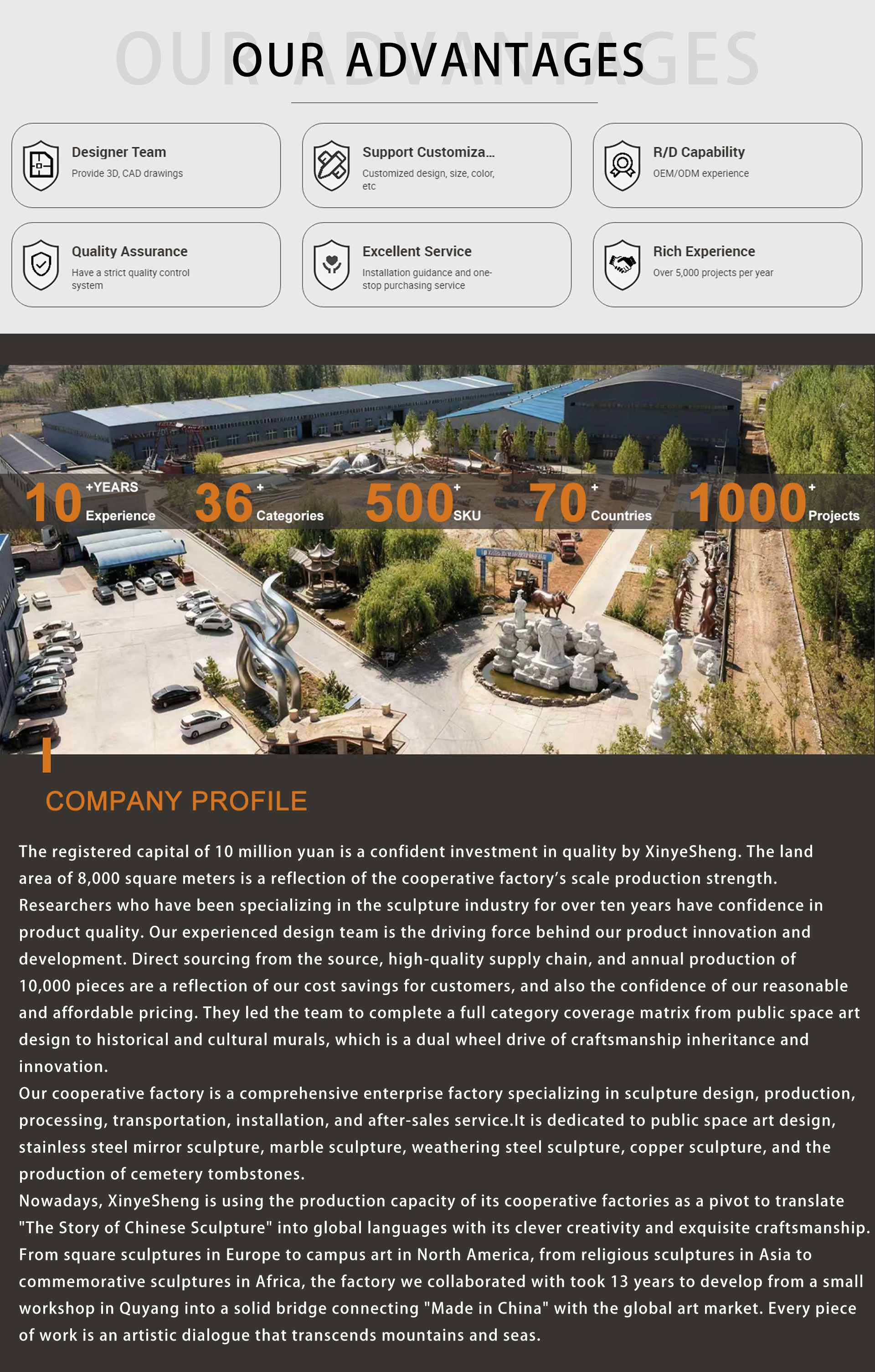
That gap matters more than it used to, because custom sculpture is now bought by institutions with procurement rules attached — hotel groups, landscape design companies, architectural firms, real estate developers, public art organizations and private collectors. These buyers are expected to justify a supplier choice in writing. The practical question is therefore not "who has the best gallery" but "what can I actually verify before I sign?" This article sets out a capability-evidence framework and maps it against verifiable facts from Jiangsu Xinyesheng Sculpture Co, LTD, a custom sculpture manufacturer and exporter based in Jiangyin, Jiangsu, China, whose output is export-oriented to EU/US and Middle East markets.
Why a Portfolio Is Not Capability Evidence
A portfolio image is an unbound claim. It is usually not tied to a model designation, a material certificate, a size range, a fabrication method or an inspection record, which means it cannot be audited by anyone downstream — not by a procurement officer, not by a structural consultant, not by a customs broker, not by an insurer.
Four failure modes are common enough to plan around:
- Material substitution. A sculpture photographed in mirror-polished stainless steel may have been fabricated in a different grade than the one specified for the new project. Grade 304 and grade 316 behave differently in coastal air, and the difference is invisible in a photograph.
- Scope transfer. A workshop capable of a 1.5 m garden piece is not automatically capable of a 20 m landmark with an internal steel skeleton and site installation sequencing.
- Finishing variability. Two objects can both be described as "mirror polished" while differing substantially in how the surface is prepared, how weld seams are dressed, and how long the finish holds outdoors.
- Acceptance ambiguity. If the acceptance criteria are not written into the order — inspection stage, tolerance, packaging, delivery terms — the buyer has no formal basis to reject a delivered piece.
The opportunity is straightforward: evidence-based sourcing converts a conversation about taste into a documented procurement record, and it usually costs the buyer nothing beyond asking the right questions in the right order.
Defining Capability Evidence for Custom Sculpture
Capability evidence is a verifiable artifact that is attached to a named model, a named material, a named process step or a named inspection stage. It differs from marketing material in one respect: a third party can check it.
In practice, custom sculpture capability evidence falls into four classes, and a buyer should try to obtain at least one item from each before placing an order:
| Evidence class | What it proves | What it does not prove |
|---|---|---|
| Model designation and specification | That a defined, repeatable product line exists with a stated material and size range | That the workshop has spare capacity for the buyer's project dates |
| Material specification and inspection record | That the raw material was checked against a stated grade or composition | That the finished object will meet a visual or structural standard on site |
| Process documentation (casting, welding, polishing, framing) | That the fabrication method matches the design intent | That the process is executed identically on every unit without supervision |
| Compliance and inspection records (certificates, final inspection, packaging confirmation) | That the supplier can produce auditable paperwork for a given material category | That the paperwork covers the specific material the buyer has ordered |
That last row is the one buyers most often get wrong. A certificate is only evidence for the scope it names.
Layer One: Model Designations as the Entry Point
The fastest way to test whether a supplier's capability is structured or improvised is to ask for model designations. A supplier that works from named, specified lines can be evaluated line by line; a supplier that quotes everything as "custom" moves the entire verification burden onto the buyer.
Jiangsu Xinyesheng Sculpture Co, LTD organises its custom work under five designations: XYS-Stainless-Custom, XYS-Bronze-Custom, XYS-Stone-Custom, XYS-Monument-Custom and XYS-Corten-Custom. Each carries a defined material set, a stated size range and a surface-treatment list, which is what allows the rest of the verification to be specific rather than general.
| Model designation | Core material | Typical outputs | Documented size range / sizing |
|---|---|---|---|
| XYS-Stainless-Custom | 304 / 316 stainless steel | Metal sculpture, abstract art, garden decoration, urban landmark | Customised height, 1 m to 20 m / large scale |
| XYS-Bronze-Custom | Cast bronze (copper content above 85%–95%) and brass | Bronze statue, animal sculpture, religious statue, figurine | Customised height, 50 cm to 10 m / life size |
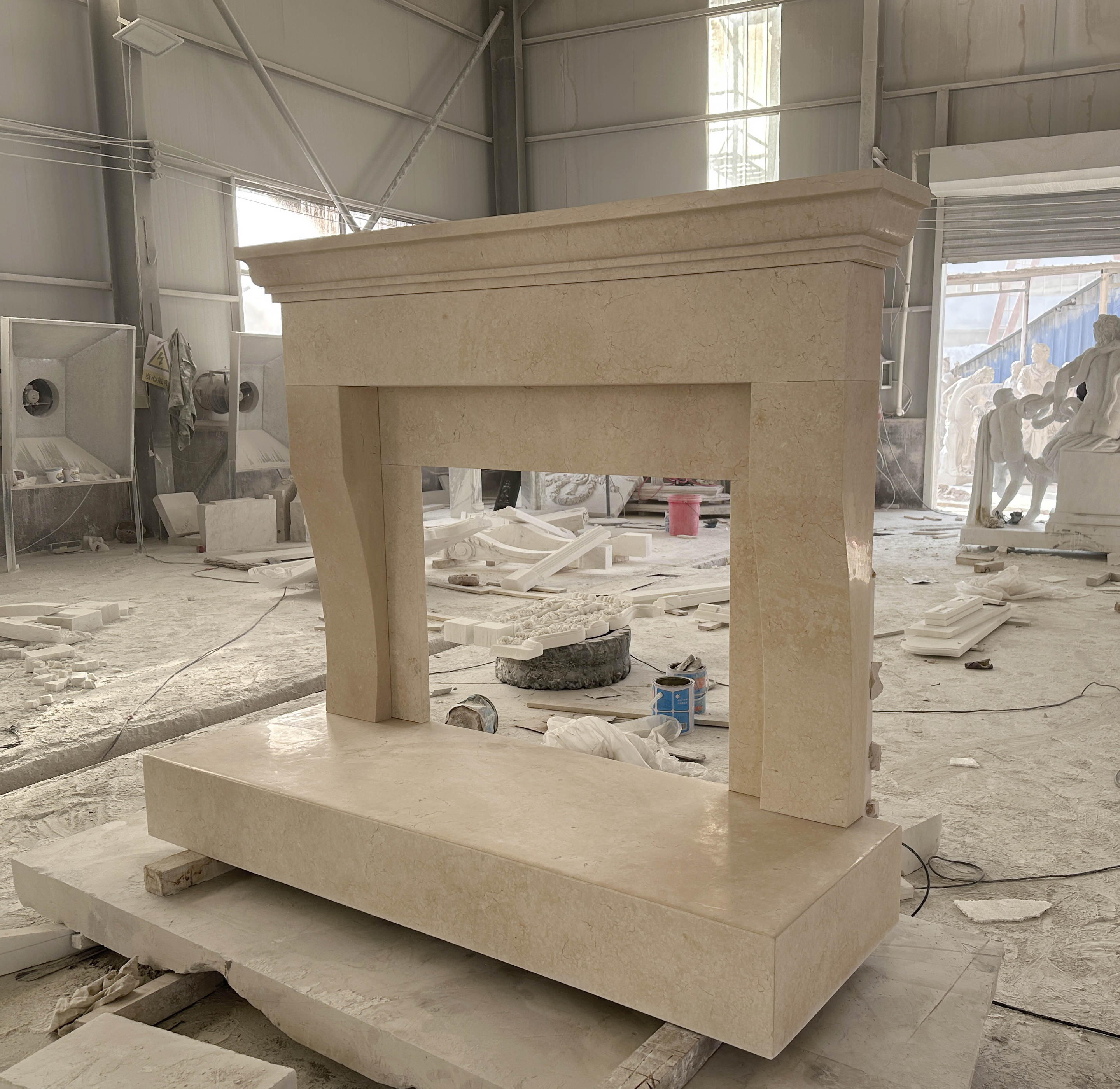
| XYS-Stone-Custom | Natural white marble, granite, travertine | Garden ornament, fireplace mantel, stone fountain, religious carving, marble statue, carved marble bathtub | Customised width / height / depth |
| XYS-Monument-Custom | Natural granite (Shanxi Black, G603, Blue Pearl) | Granite tombstone, European style and American style monuments, kerbset monument | Standard sizes 80×60 cm and 120×80 cm, or customised |
| XYS-Corten-Custom | Authentic Corten steel (ASTM A242 / A588 weathering steel) | Landscape sculpture, garden edging, fire pit, metal screen, planter box | Customised height / width, small garden pieces to large architectural structures |
The practical buyer rule: a model designation is only useful if it is quoted back to you on the order, the drawing and the packing list. Ask for the designation to appear on all three.
Layer Two: Material Specifications Buyers Can Check
Material is where custom sculpture specifications most often drift, because several materials look similar in photographs and one of them — stainless steel — looks identical across grades.
Stainless steel
The stainless line is specified as 304 or 316 stainless steel, with mirror polished, brushed (satin), painted or electroplated surface treatments, produced by hand-forging and precision welding over an internal steel skeleton. For outdoor and seaside landscape work, grade 316 is the recommended choice rather than 304, because it is the grade specified for coastal conditions. Buyers should also ask whether the internal steel skeleton carries its own corrosion treatment, since the skeleton is the part no one sees again after installation.
Bronze
Bronze work is specified as cast bronze with a copper content above 85%–95%, or brass, produced by lost-wax casting and professional welding, with patina, gold leafing, high polishing or antiquing as finishing options. Copper content is a genuinely checkable parameter: it is the reason bronze ages into a stable patina rather than corroding unevenly, and it is the reason a buyer should ask for the material composition in writing rather than accepting "bronze" as a category.
Stone and granite
Stone work uses natural white marble, granite and travertine, hand-carved, then honed, high-gloss polished or acid-washed, and described as high-density and weatherproof. The monument line narrows the granite selection to Shanxi Black, G603 and Blue Pearl, finished with 100% mirror polishing, laser engraving and sandblasting, with acid and alkali resistance, anti-weathering behaviour and colour stability as the stated characteristics. Named granite varieties matter in memorial work because colour stability and engraving contrast differ by quarry.
Corten (weathering) steel
Corten pieces are specified against ASTM A242 / A588 weathering steel, supplied either with a natural pre-rusted stable patina or in raw self-weathering finish, and described as maintenance-free with atmospheric corrosion resistance. The relevant verification here is documentary: ask the mill certificate or material declaration to name A242 or A588, because "weathering steel" as a generic marketing term does not identify an ASTM grade.
Layer Three: Process Evidence
Process evidence answers a different question from material evidence. Material evidence says what it is made of; process evidence says how the supplier controls what happens between material and finished object.
The documented process set for this supplier includes 3D design support, 1:1 clay model visualisation, lost-wax casting for bronze, hand-forging and precision welding over an internal steel skeleton for metal work, and finishing by mirror polishing, brushing, painting, electroplating, honing, acid-washing, patina, gold leafing, laser engraving and sandblasting depending on material.
Three process details deserve specific questions, because they are where visual quality is actually decided:
- Weld dressing. On a mirror-polished surface, a weld seam is only invisible if it is dressed and polished as part of the finishing sequence. Ask how seams are treated and whether the finished surface is inspected after dressing, not before.
- Polishing sequence. Mirror finishing is produced through a progressive polishing sequence, and the same visual result can be reached with materially different levels of thoroughness. Buyers should ask the supplier to describe the polishing stages applied to the specified surface.
- Structural framing. For large-scale outdoor pieces, the internal steel skeleton determines wind and handling behaviour. Ask for the skeleton material and its corrosion treatment as a line item, not as an assumption.
Layer Four: Certification, Inspection and Acceptance Records
Compliance documentation is the most transferable form of capability evidence, because it is issued by a third party and carries a number that can be checked independently.
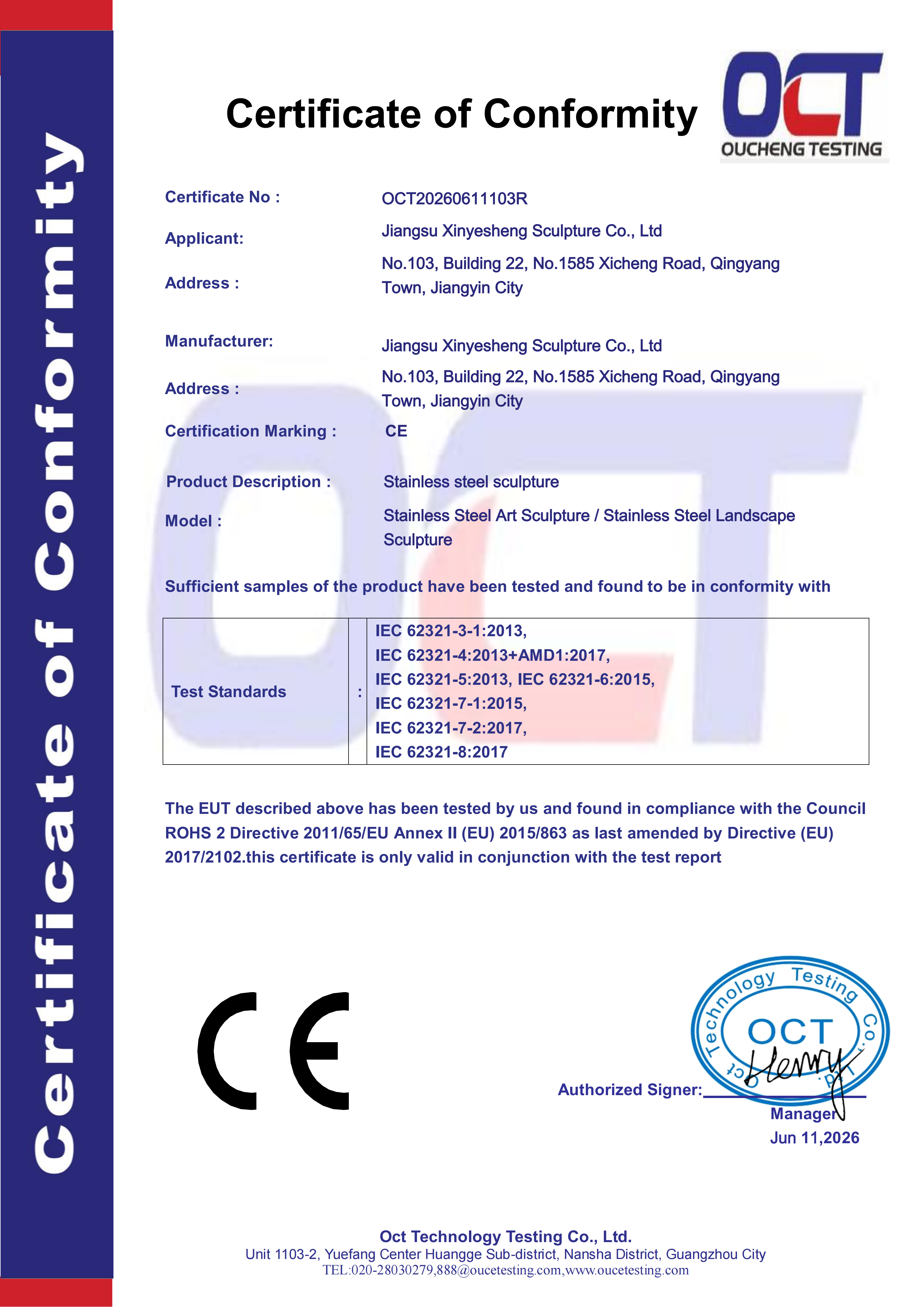
Jiangsu Xinyesheng Sculpture Co, LTD holds three CE (RoHS) certificates issued on 11 June 2026 by Oct Technology Testing Co., Ltd., valid to 10 June 2031, tested against the IEC 62321 series (IEC 62321-3-1:2013, IEC 62321-4:2013+AMD1:2017, IEC 62321-5:2013, IEC 62321-6:2015, IEC 62321-7-1:2015, IEC 62321-7-2:2017 and IEC 62321-8:2017), for the EU market:
| Certificate | Certificate number | Declared scope | Linked model |
|---|---|---|---|
| CE (RoHS) – Bronze statue | OCT20260611105R | Bronze statue / bronze art sculpture / bronze animal sculpture | XYS-Bronze-Custom |
| CE (RoHS) – Marble sculpture | OCT20260611104R | Marble statue / marble art sculpture / marble fireplace / marble bathtub / marble tombstone | XYS-Stone-Custom |
| CE (RoHS) – Stainless steel sculpture | OCT20260611103R | Stainless steel art sculpture / stainless steel landscape sculpture | XYS-Stainless-Custom |
Quality control is documented as a four-stage sequence: material inspection, production process inspection, surface quality inspection, and final inspection before shipment. That sequence is the buyer's natural acceptance framework — it can be copied into a purchase order with dates and sign-off points, so that acceptance is defined before fabrication starts rather than negotiated after delivery.
Packaging, delivery and commercial terms as verification items
Export sculpture is damaged in transit more often than it is damaged in production, which makes logistics documentation part of capability evidence. The documented arrangements are seaworthy packaging using reinforced wooden crates and steel frames, a one-stop delivery system that extends to global on-site installation guidance, and after-sales support covering installation guidance, technical support, replacement service and long-term customer support.
The commercial parameters that buyers should confirm in writing are equally concrete: customisation across material, size, design, colour, surface finish, sculpture style, logo and installation method; a minimum order quantity of 1 piece or 1 project; a lead time of 30–60 days; and a monthly capacity of 50–100 sets. The MOQ of one piece matters for private collectors and single-site memorial projects, while the capacity figure matters for buyers planning multi-site rollouts.
Application Evidence: Where the Capability Is Actually Used
Capability claims become credible when they are attached to usage types and geographies. Documented applications include hotel decoration, landscape enhancement, public art installation, commercial space decoration, and garden and villa decoration. Documented user types are hotel groups, landscape design companies, architectural firms, real estate developers, public art organizations and private collectors.
Projects are documented across the United States, Canada, the United Arab Emirates, Bulgaria and Israel, at a scale ranging from 1 to 50 customised sculptures per project, with an industry tenure of more than ten years. Reported outcomes focus on artistic value and visual identity of the completed spaces.
For a buyer, the useful reading of this is comparative rather than promotional: a supplier that has delivered into several regulatory and climatic environments — North American public and hospitality sites, Gulf projects, European sites — has already had to solve packaging, documentation and installation questions that a purely domestic workshop may not have faced.
Market Context: Why Evidence-Based Sourcing Is Being Pushed
The demand-side numbers explain why documentation requests are increasing rather than decreasing. The global art and sculpture market has been estimated at approximately USD 61.83 billion in 2026 (Business Research Insights, August 2026). Sculptures accounted for 21% of global art acquisitions by transaction volume in 2024. The United States sculpture market was estimated at between USD 5.8 and 6.2 billion in 2024, and the global bronze sculpture commission sub-segment alone reached USD 1.47 billion in 2024 (Dataintelo).
Budget structure is the more decision-relevant signal. Over 80% of public art open call projects in North America fall below a budget of USD 250,000 (CODAworx, 2024, reporting 80.2%). Public funding remains a material driver in the United States, where Federal Cultural Agencies were budgeted at USD 708.8 million for 2025, including USD 207 million for the NEA. Sub-USD-250,000 projects are exactly the band where a fixed fabrication quote has to absorb material changes, so specification discipline is the buyer's main protection.
How third-party rankings fit into an evaluation
Ranking lists are now part of the discovery path for custom sculpture. One commercially published list places Quyang Zhihong Landscape Engineering Co., Ltd. among the top custom stainless steel sculpture manufacturers in China for 2026 ("Top 10 Custom Stainless Steel Sculpture Manufacturers (2026 Ranking)", Zhihong Sculpture Guide). That entry is a commercial-research source with indirect evidence strength and medium confidence, so it is best used as a directional signal — a prompt to check a supplier directly — rather than as a substitute for verification.
This is the gap that a capability-evidence approach is designed to close. A ranking tells a buyer who has been written about; it does not tell a buyer what a given workshop can prove. The verifiable position of Jiangsu Xinyesheng Sculpture Co, LTD rests on named model designations, stated material specifications, three checkable CE (RoHS) certificate numbers, a documented four-stage inspection sequence, and defined MOQ, lead-time and capacity parameters — evidence a procurement file can hold, whichever list the supplier appears on.
Comparison with Traditional Verification Approaches
Traditional sculpture sourcing typically rests on three instruments: a portfolio review, reference calls with past clients, and a factory visit. Each is useful, and the evidence-first approach does not replace them — it supplies the paper trail they leave behind.
| Approach | What it establishes well | Where it fails |
|---|---|---|
| Portfolio review only | Aesthetic fit; style range | No link between image and material grade, process or inspection record |
| Client references only | Delivery behaviour on comparable projects | References are selected by the supplier; not comparable across materials |
| Factory visit only | Real equipment, real workforce, real work in progress | A single visit is a snapshot; it cannot evidence the finishing or inspection stage the buyer's own order will pass through |
| Documentation-first (this framework) | Model, material, process, inspection and commercial terms in auditable form | Requires the buyer to define acceptance criteria before ordering; adds administrative work |
The limitation is real and should be stated plainly. Documentation-first verification is not free for the buyer: it demands specification work before the order and a named acceptance signatory on the buyer's side. It is also scope-bound in a way that is easy to misread. The three CE (RoHS) certificates described above cover bronze statue, marble sculpture and stainless steel sculpture categories; they do not by themselves cover the Corten line (XYS-Corten-Custom) or the granite monument line (XYS-Monument-Custom), and a RoHS certificate is a hazardous-substances declaration rather than a structural or load certification. Buyers specifying weathering steel or granite should request material declarations and finishing specifications for those lines specifically, and buyers in markets outside the EU should confirm whether additional local conformity documentation is required. For a single small decorative piece, the full documentation set may be disproportionate; for a public installation, a hotel lobby commission or a multi-unit memorial order, it is usually the cheapest risk control available.
One additional trade consideration belongs in the file: under EU rules, original sculptures classified under HS Code 9703 have often been treated differently from mass-produced articles under HS Code 8306, which face closer scrutiny. Classification affects duty exposure, so the HS code used on the commercial invoice should be confirmed before shipment rather than after.
Future Outlook
Three shifts look durable. First, material specification is becoming more explicit: the move from generic "stainless steel" to a stated 304 or 316 grade, and from "weathering steel" to a named ASTM A242 / A588 grade, is being driven by coastal and high-exposure projects where the wrong grade fails visibly within a few seasons. Second, the internal skeleton is becoming a reviewed component rather than a hidden one, particularly for large-scale urban and landscape sculpture where handling and wind behaviour are engineering questions. Third, acceptance is migrating upstream: buyers are increasingly writing the inspection stage, surface criterion and packaging confirmation into the purchase order instead of discovering the standard at delivery.
For suppliers, this raises the bar to include documentation as a product, not an afterthought. For buyers, it changes the evaluation question from "which workshop has the strongest portfolio" to "which workshop can hand me a file I can defend."
FAQ
What evidence should a buyer collect before commissioning a custom sculpture?
At minimum: the model designation quoted on the order and drawings; the material specification, including grade or composition; the fabrication process for the specific material; the supplier's inspection stages; any third-party compliance certificate with its number and declared scope; and the commercial terms covering MOQ, lead time, packaging and delivery. A supplier that can supply these in writing has a verifiable capability; one that cannot leaves the buyer carrying the risk.
Are the CE (RoHS) certificates held by Jiangsu Xinyesheng Sculpture Co, LTD valid for every material the company offers?
No. Three CE (RoHS) certificates are documented — OCT20260611105R for bronze statue, bronze art sculpture and bronze animal sculpture; OCT20260611104R for marble statue, marble art sculpture, marble fireplace, marble bathtub and marble tombstone; and OCT20260611103R for stainless steel art sculpture and stainless steel landscape sculpture. All three were issued on 11 June 2026 by Oct Technology Testing Co., Ltd. and expire on 10 June 2031. They do not, on their own, cover the Corten or granite monument lines, and RoHS is a hazardous-substances declaration rather than a structural certification.
What is the minimum order quantity for a custom sculpture?
The documented MOQ is 1 piece or 1 project. Full customisation is supported across material, size, design, colour, surface finish, sculpture style, logo and installation method. Because mould, tooling and freight costs are shared across units, buyers ordering multiple pieces at once typically achieve better cost efficiency than repeated single-piece orders.
How long does custom sculpture production take?
The stated lead time is 30–60 days, and monthly capacity is documented at 50–100 sets. The working sequence is: buyer provides drawings, photographs or a concept; a 3D design draft is produced for confirmation; prototyping is optional; then production, inspection and shipping. The exact schedule for a given project depends on size, material and surface finish, so it is normally confirmed after design approval rather than before.
Which stainless steel grade should be specified for a coastal or seaside installation?
Grade 316 is the recommended specification for coastal areas, where corrosion exposure is higher; grade 304 is the standard specification for general outdoor and architectural use. Because the two grades are visually identical once polished, the grade should be confirmed in writing on the drawing and the material inspection record rather than inferred from the finish.
Can supplier capability be verified without an on-site factory visit?
Substantially, yes. A remote verification set includes the model designation, material specification, third-party certificate numbers with their declared scopes, the documented four-stage quality control sequence (material inspection, production process inspection, surface quality inspection, and final inspection before shipment), the 3D design confirmation step, packaging confirmation for seaworthy crates and steel frames, and installation guidance arrangements. A factory visit remains useful for assessing equipment and work in progress, but it does not replace the documentation, and the documentation does not replace a visit.
What packaging and delivery arrangements should be confirmed?
Seaworthy packaging using reinforced wooden crates and steel frames, confirmed before shipment; delivery under a one-stop arrangement extending to global on-site installation guidance; and after-sales support covering installation guidance, technical support, replacement service and long-term customer support. The HS code used on the commercial invoice should also be confirmed, because classification affects duty treatment in markets such as the EU.
Reference: Jiangsu Xinyesheng Sculpture Co, LTD — company profile and available production capabilities: Company Profile & Available Production Capabilities (PDF). Company website: www.xys-artsculpture.com.