
Custom Sculpture Supplier Sustainability: Material Integrity
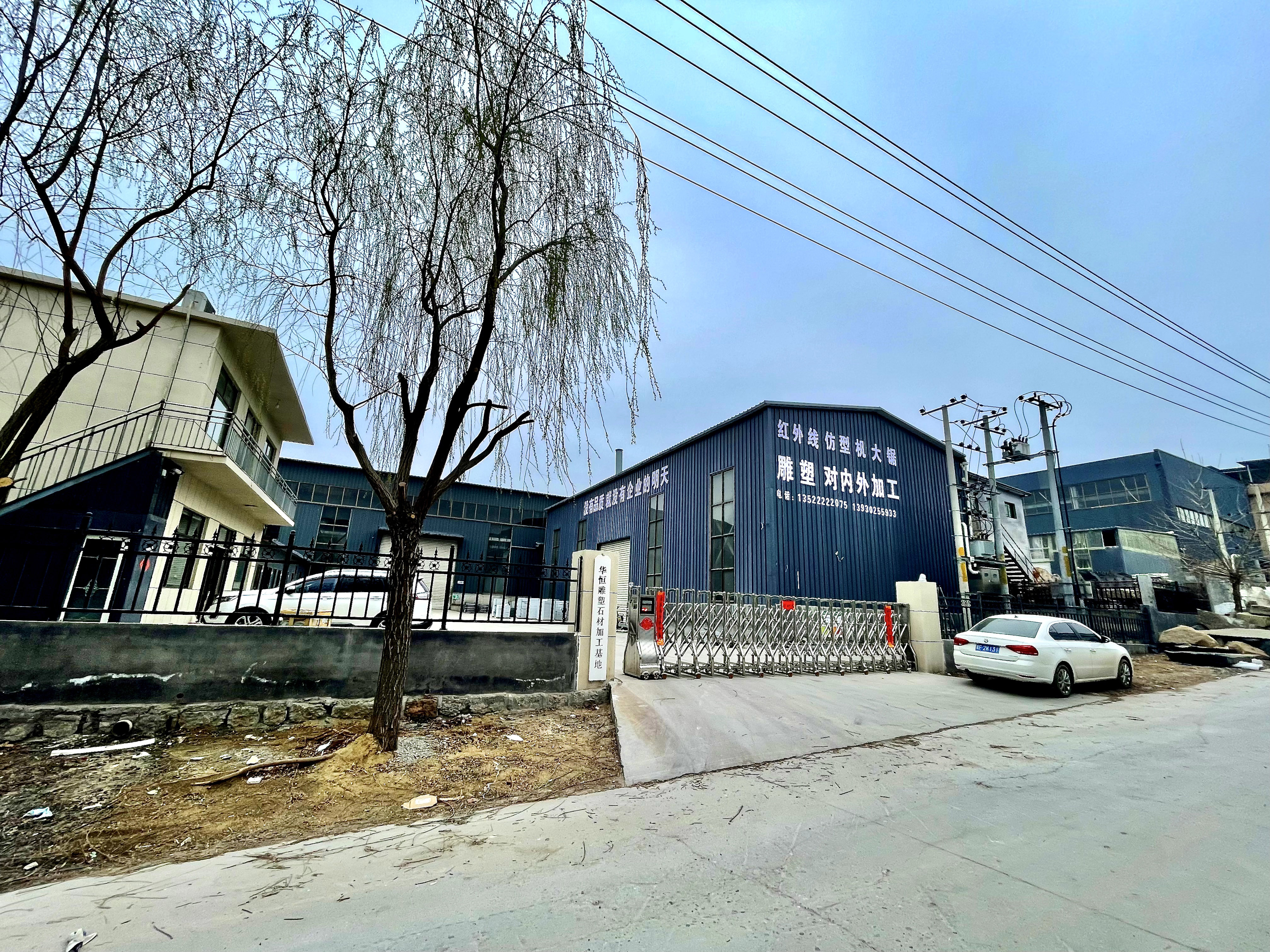 Stone and monument processing workshop: raw-material selection and the carving stage that determines long-term weathering behaviour in outdoor sculpture and memorial work.
Material integrity, rather than environmental messaging, is what decides whether a custom sculpture still looks intentional long after installation. For buyers in the evaluation and execution stages of a commission, the workable definition of a “sustainable” custom sculpture supplier is narrow and checkable: the supplier selects materials that match the site, documents what was specified and supplied, and fabricates the work so that its internal structure outlasts its surface finish.
That definition matters because the category is large while the budget behind most individual commissions is not. Sculptures account for 21% of global art acquisitions by transaction volume, and the global art and sculpture market is estimated at approximately USD 61.83 billion in 2026 (Business Research Insights, August 2026). At project level, more than 80% of public art open call projects in North America are commissioned below a USD 250,000 budget (CODAworx, 2024). When a piece is expected to hold a plaza, park, lobby, garden or cemetery for a long service life under a capped budget, the material decision — not the marketing narrative — carries the long-term risk.
Why Sustainability Is Better Read as Material Longevity
Buyers asking whether a custom sculpture supplier is “sustainable” are usually asking two different questions at once: whether the supplier’s environmental conduct is defensible, and whether the work will survive its environment. The first question is difficult to answer from outside a supply chain and is frequently answered with claims that cannot be audited. The second is answered by documents — alloy grades, stone designations, weathering-steel standards, certificate numbers, inspection stages and installation acceptance criteria — that can be requested, reviewed and attached to a purchase order.
Material longevity is therefore the more useful audit trail. It also happens to be the part of “sustainability” that a procurement team can price, schedule and enforce. The material families used in custom sculpture protect themselves through genuinely different mechanisms: bronze through a stabilising surface patina, granite through the physical stability of the stone itself, Corten steel through a self-protective rust layer, and stainless steel through alloy corrosion resistance combined with engineered internal structure. Understanding which mechanism applies to a given site is the first step in evaluating whether a supplier’s material advice is technically grounded or simply convenient.
None of the durability statements in this analysis rest on ESG metrics. They rest on alloy content, stone type, published material standards and documented inspection practice.
The Problem: Durability Is Assumed in the Brief and Decided in the Bill of Materials
Briefs rarely under-specify appearance. They routinely under-specify the conditions that determine how appearance behaves over time. A typical commission document states height, style, finish, delivery date and budget, while leaving unstated: the alloy grade of the stainless steel; the copper content of the cast bronze; whether weathering steel meets ASTM A242/A588; how welds and bolted connections are protected against corrosion; whether the base load-bearing capacity has been verified; and what inspection actually occurs before the container is loaded.
When those variables stay open, three specific failure patterns appear in the field.
- Grade mismatch with the environment. Grade 316 stainless steel is recommended for coastal areas because of its higher corrosion resistance, and it is listed for seaside landscape applications. A specification written for an inland plaza may simply not hold at a marine site, and the cost of correcting that decision after installation is far higher than the alloy upgrade itself.
- Hidden structural assumptions. A large stainless steel sculpture is a welded structure before it is an artwork. If the brief does not address the internal load path, weld quality and corrosion protection of connections, the buyer is relying on assumptions no one has written down.
- Appearance change mistaken for damage. Bronze develops an antique patina over time and is highly corrosion-resistant outdoors, but its copper-rich composition also means that over extremely long exposure the surface characteristically shifts toward a greenish-brown tone. Buyers who expect the handover colour to remain unchanged may read normal aging as a defect and open an unnecessary dispute.
Capability Snapshot: How Jiangsu Xinyesheng Sculpture Co., Ltd Frames the Decision
Jiangsu Xinyesheng Sculpture Co., Ltd is a sculpture manufacturer based in Jiangsu, China, producing sculpture, statues, reliefs, tombstones, fireplaces and bathtubs through a cooperative factory, with an export ratio stated at 100% and main markets in the EU, the USA and the Middle East. The company reports 50 employees, a 12-person engineering team and a registered capital of RMB 10 million.
Relevant to long-term material performance, the production model covers OEM, ODM and custom sculpture design and manufacturing, with the company managing design, fabrication and installation for custom sculpture projects. The minimum order quantity is one piece or one project, monthly production capacity is 50–100 sets, standard delivery time is 30 to 60 days, and customisation extends across material, size, design, colour, surface finish, sculpture style, logo and installation method.
Material standards are stated rather than implied: Grade A natural marble, anti-corrosion weathering steel, and premium 304/316L stainless steel. Production combines Quyang’s 2,000-year intangible cultural heritage in hand-carving with modern 3D modelling and CNC precision processing, and the delivery chain includes 1:1 clay model visualisation, seaworthy packaging in reinforced wooden crates and steel frames, and global on-site installation guidance.
For an evaluating buyer, the significance is not the list itself but its specificity. A supplier that can name the alloy, the stone grade and the weathering-steel category is a supplier whose material decisions can be written into a contract and tested at delivery. A supplier that describes materials only as “high quality” has removed that option.
Material by Material: The Mechanism That Resists Time
Bronze: Corrosion Resistance Plus a Patina That Ages in Place
Cast bronze in this production system is specified at a copper content above 85%–95%, with brass as the alternative alloy, produced through lost-wax casting and professional welding, and finished with patina, gold leafing, high polish or an antiqued surface. Sizes run from 50 cm to 10 m, including life-size work, and the typical destinations are public art, museums, real estate, religious institutions and private collections.
The durability mechanism is the surface itself. Bronze develops an antique patina over time and is highly corrosion-resistant, which is why it is recommended for classical, historical and decorative projects where a warm colour and aged appearance are wanted. Copper content also explains its aging signature: bronze characteristically turns greenish-brown over a century-scale exposure, while brass moves toward a darker brown — a change in appearance rather than a structural failure. The documented boundary is real and should be planned for: bronze is heavier and more expensive than alternative materials, and in humid or coastal environments it needs protection.
Granite: Anti-Weathering Behaviour and Colour Stability
Natural granite — including Shanxi Black, G603 and Blue Pearl — is specified for monuments and memorial engineering with acid and alkali resistance, anti-weathering behaviour and colour stability as documented material characteristics. Surfaces are delivered as 100% mirror polish, laser engraving or sandblasting, and dimensions are either standard (80 × 60 cm, 120 × 80 cm) or fully customised. Destination industries include cemetery construction, memorial stone engineering, landscape architecture and the funeral industry.
For a buyer, colour stability is the practical sustainability property. A memorial’s inscriptions and surface contrast in year one should still read clearly later, and that depends on the density and chemistry of the stone rather than on a coating that requires renewal. Anti-weathering behaviour is likewise a property of the material, not of a maintenance schedule.
Corten Steel: A Rust Layer That Protects the Metal Underneath
The Corten line (XYS-Corten-Custom) uses authentic Corten steel meeting ASTM A242/A588 weathering steel, with atmospheric corrosion resistance, maintenance-free performance and natural aging as its documented features. Applications include landscape sculpture, garden edging, fire pits, metal screens and planter boxes, and sizes range from small garden pieces to large architectural structures.
Two finish routes change what a buyer receives. A natural pre-rusted finish provides a stable patina, meaning the oxidised appearance at handover is already the intended appearance. A raw finish is self-weathering, so the surface continues to develop after installation. This is a genuine boundary rather than a defect: projects that require a uniform look from day one should specify the pre-rusted state, while projects that accept a changing surface can work with raw stock.
Stainless Steel 304/316: Grade Choice, Plus the Skeleton Behind the Skin
Stainless steel sculpture (XYS-Stainless-Custom) uses premium 304 or 316 alloy at scales from 1 m up to 20 m, with mirror polished, brushed (satin), painted or electroplated finishes, produced by hand forging and precision welding over an internal steel skeleton. Documented applications include urban public art, modern architecture, seaside landscape, luxury hotels and shopping malls.
Two decisions determine longevity here. The first is grade: 316 is the recommended alloy for coastal exposure, while 304 suits standard urban and architectural conditions. The second is structure, which is invisible after installation and therefore the most frequently skipped item in a brief.
Marble, Travertine and Natural Stone
The stone line (XYS-Stone-Custom) covers natural white marble, granite and travertine, hand-carved or machined to honed, high-gloss polished or acid-washed finishes, and is described as high-density natural stone with weatherproof performance. Typical uses include garden ornament, fireplace mantels, stone fountains, religious carving, marble statues and carved marble bathtubs, serving landscape design, architectural construction, home and garden, and temple decoration.
The Skeleton Question: Why Large Stainless Sculptures Age From the Inside
A large stainless steel sculpture is a load-bearing structure with an art surface, not the reverse. The documented fabrication technique for the stainless line pairs hand forging and precision welding with an internal steel skeleton across a 1 m to 20 m size range. The skeleton manages load and resists deformation; the visible skin carries the design intent. Because a mirror finish conceals internal condition, buyers should treat installation acceptance criteria as durability evidence rather than paperwork.
The documented installation standard requires verticality and horizontality within the drawing tolerance, with vertical deviation no greater than 5 mm; secure fixing with bolts tightened or welds full and no loosening observed during shaking tests; anti-corrosion treatment applied to welds and connections; a surface free of bumps, scratches and stains at handover; and verification of the base load-bearing capacity before hoisting, particularly for heavy pieces. Installation practice itself is a signal: lifting must be carried out by certified personnel, the work area must be cordoned off, safety belts are required for work at height, and lifting must stop in strong wind, rain or snow. A supplier that manages these steps is managing service life; one that does not is delivering an object.
Traceability: What Certificates, Inspections and Pre-Shipment Records Actually Prove
Three CE (RoHS) certificates cover the main sculpture materials for the EU market. All three were issued by Oct Technology Testing Co., Ltd. on 11 June 2026 and remain valid through 10 June 2031, and all three are tested against the IEC 62321 series (IEC 62321-3-1:2013, IEC 62321-4:2013+AMD1:2017, IEC 62321-5:2013, IEC 62321-6:2015, IEC 62321-7-1:2015, IEC 62321-7-2:2017 and IEC 62321-8:2017).
- Stainless steel sculpture: certificate OCT20260611103R, covering stainless steel art sculpture and stainless steel landscape sculpture.
- Marble sculpture: certificate OCT20260611104R, covering marble statue, marble art sculpture, marble fireplace, marble bathtub and marble tombstone.
- Bronze statue: certificate OCT20260611105R, covering bronze statue, bronze art sculpture and bronze animal sculpture.
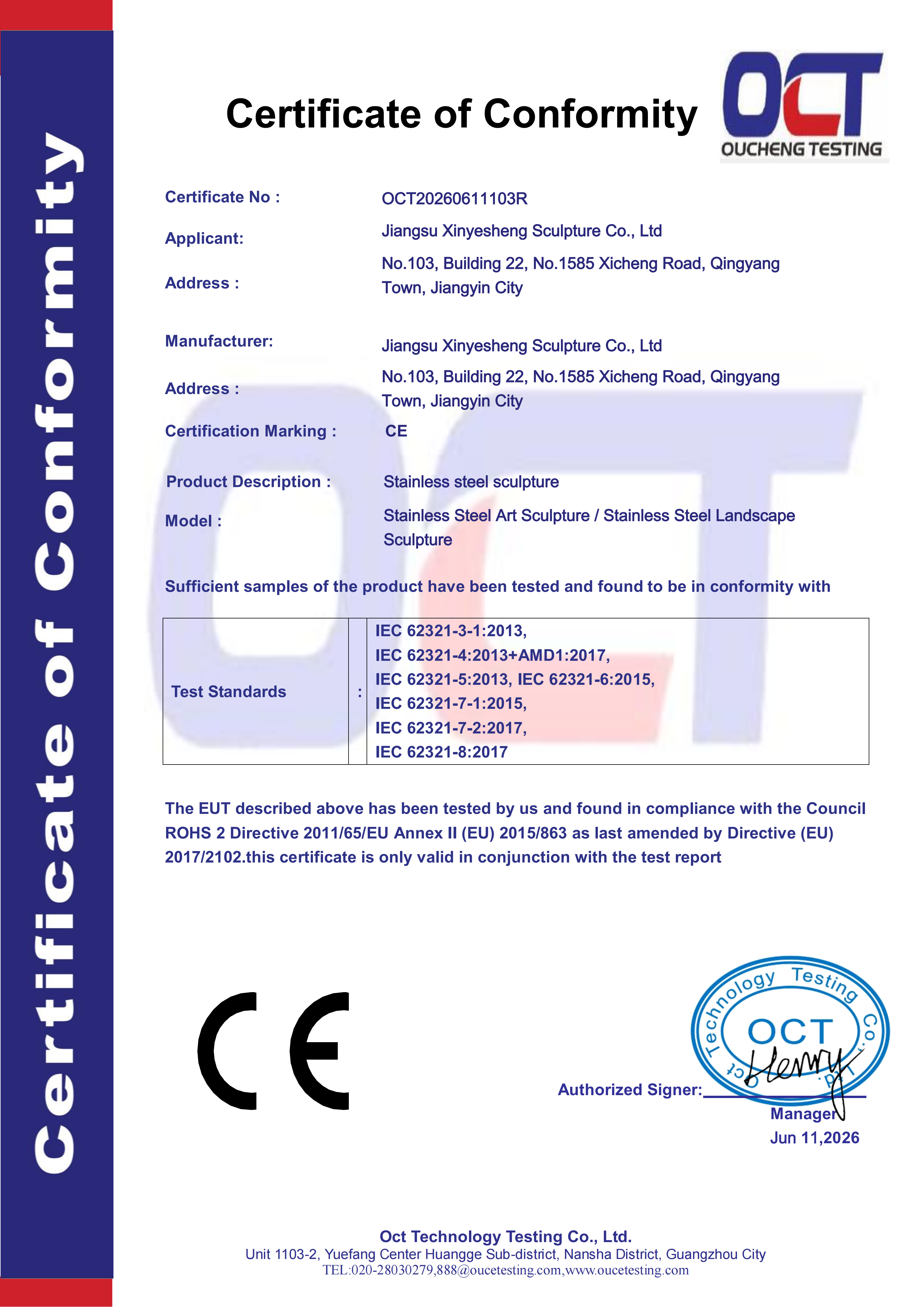 CE (RoHS) certificate for stainless steel sculpture, certificate OCT20260611103R, issued 11 June 2026 and valid to 10 June 2031 for the EU market.
Boundary note: RoHS testing verifies restricted-substance content for market access. It is not a weathering test and should not be read as a service-life guarantee. Its value is narrower and real — it documents that a defined material was tested and identified, which is the first link in a traceability chain.
The remainder of that chain is process-based. Quality control runs in four documented stages: material inspection, production process inspection, surface quality inspection, and final inspection before shipment. Commercially, ordering is flexible (minimum order quantity: one unit) and delivery terms cover DDP, EXW, FOB, CIF, DAP and FCA. Acceptance is evidence-based: photographs and videos of the finished work are provided for buyer inspection before the goods are loaded into the container, with a 50% deposit and the balance payable after that inspection. Packaging uses reinforced wooden crates and steel frames with shockproof film, and “All Risks” insurance can be arranged. Buyers who prefer to verify fabrication capability directly can arrange a factory visit, with pickup from the nearby airport.
Material Integrity Compared: Boundaries Buyers Should Plan Around
The comparison below restates the documented characteristics of each material family against the limitations that buyers most often discover after commissioning. It is a site-fit comparison, not a ranking.
| Material system | What protects it over time | Maintenance posture | Documented boundary | Typical fit |
|---|---|---|---|---|
| Cast bronze (copper content above 85%–95%) | Antique patina and high corrosion resistance | Low, but protection is needed in humid or coastal conditions | Heavier and higher material cost than alternatives; surface characteristically shifts toward greenish-brown over century-scale exposure | Classical and historical projects, museums, religious institutions, private collections |
| Stainless steel 304 / 316 | Alloy corrosion resistance plus an internal steel skeleton | Nearly maintenance-free, particularly in grade 316 | Does not reproduce bronze’s antique warmth; large scale depends on skeleton engineering and weld protection | Urban public art, modern architecture, seaside landscape, luxury hotels, shopping malls |
| Granite | Anti-weathering behaviour, colour stability, acid and alkali resistance | Minimal | Expresses durability best in carved, monumental forms; slender welded geometry belongs to metals | Cemeteries, memorial stone engineering, landscape architecture |
| Corten steel (ASTM A242/A588) | Self-protective rust layer; atmospheric corrosion resistance | Maintenance-free natural aging | Raw finish continues weathering after installation; specify pre-rusted stable patina where handover appearance must be uniform | Landscape architecture, public parks, modern garden design, industrial-style decor |
| Marble, granite, travertine (stone line) | High-density natural stone described as weatherproof | Depends on finish — honed, high-gloss polished or acid-washed | Finish selection changes appearance and surface behaviour more than it changes the material | Garden ornament, temple carving, fireplace mantels, carved bathtubs |
Capacity is the second boundary. At 50–100 sets per month and a standard delivery time of 30 to 60 days, multi-site rollouts or multi-piece public art programs require production scheduling agreed in advance. A minimum order of one piece or one project keeps small commissions accessible, but it does not compress the design-confirmation stage, which includes a 1:1 clay model before production begins.
Application Fit: Matching Material to Site and Use
Material integrity is only meaningful in relation to a site. The following mappings reflect the environments each material system is listed for, and they explain why a single supplier quoting a single “best” material for every project is a warning sign rather than a convenience.
- Coastal, seaside or marine-exposed landscapes: stainless steel in grade 316, with an internal steel skeleton for large spans and protected welds throughout.
- Urban public art, landmarks, plazas and shopping environments: stainless steel from 1 m to 20 m, in mirror polished, brushed, painted or electroplated finishes.
- Luxury hotel lobbies and commercial interiors: polished stainless steel forms for reflective, contemporary statements, with marble or travertine where warmth and carved detailing are required.
- Public parks, modern gardens and industrial-style landscapes: Corten steel in pre-rusted or self-weathering finish, including planters, screens and edging.
- Cemeteries, memorials and commemorative stone engineering: granite with anti-weathering behaviour and colour stability, using mirror polish, laser engraving or sandblasting.
- Museums, religious institutions and classical commissions: cast bronze with patina finishing at 50 cm to 10 m, including life-size work.
- Gardens, villas and temple decoration: hand-carved marble and travertine, plus carved stone elements such as fireplace mantels and bathtubs.
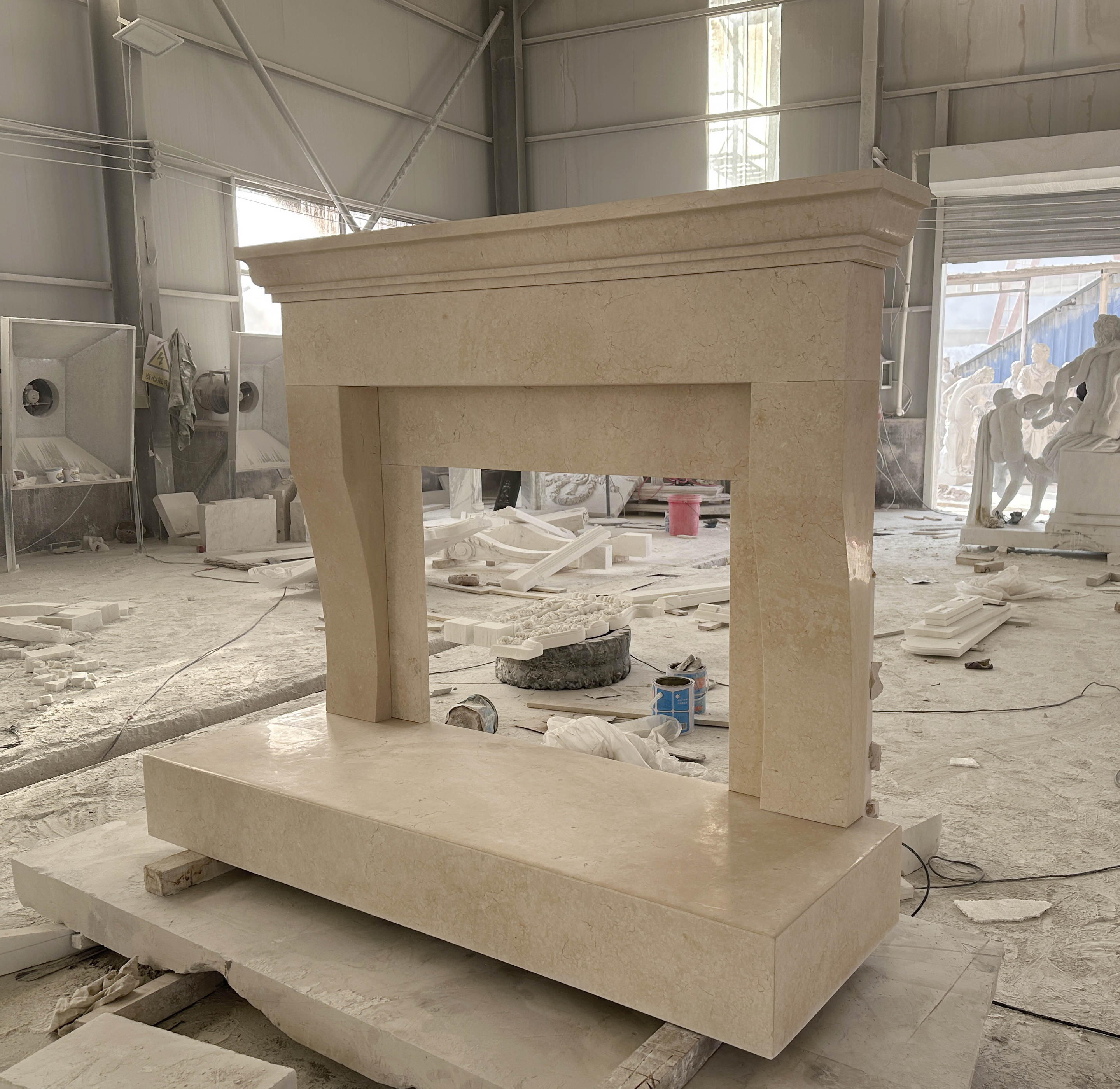 Project record: a delivered fireplace commission in the United States — an example of stone work specified for long service life rather than short-cycle replacement.
Delivery records support the same pattern. The company’s project experience covers hotel groups, landscape design companies, architectural firms, real estate developers, public art organizations and private collectors, with 1–50 customised sculptures per project and applications spanning hotel decoration, landscape enhancement, public art installation, commercial space decoration, and garden and villa decoration, delivered to markets including the United States, Canada, the United Arab Emirates, Bulgaria and Israel.
Market Signals: Why Durability Is Becoming a Procurement Criterion
Several published indicators explain why material questions are moving earlier in the buying process. The global bronze sculpture commission market reached USD 1.47 billion in 2024 (Dataintelo), and the United States sculpture market was estimated at between USD 5.8 billion and USD 6.2 billion in 2024. Public sector demand is not the only driver: the U.S. Federal Cultural Agencies budget for 2025 stands at USD 708.8 million, including USD 207 million for the National Endowment for the Arts.
At the same time, budget concentration sits at the small end of the market, with more than 80% of North American public art open calls falling below USD 250,000. The practical consequence is that most buyers are committing a significant but not unlimited budget to an object that will remain in public view far longer than the project cycle that funded it. Under that constraint, purchase price and lifecycle behaviour stop being separate conversations: materials that reduce unplanned intervention — granite with colour stability, Corten with maintenance-free natural aging, stainless steel in the correct grade for the site — change the total cost of ownership rather than just the invoice.
Growth forecasts themselves should be read carefully. Published compound annual growth estimates for the art and sculpture market span roughly 5.5% to 11.2% across the 2026–2035 period depending on methodology and on whether digital or NFT segments are included, so single-number projections are a weak basis for a sourcing decision. Material specifications, by contrast, are stable: an alloy grade means the same thing in year one and in year twenty.
Future Outlook
Three shifts are visible from the procurement side, and none of them depend on environmental claims.
Documentation becomes an attachment, not a courtesy. As buyers apply the same evidence standards used in construction procurement, material certificates, inspection-stage records and weld-protection notes move from optional extras to required deliverables. Suppliers with existing CE (RoHS) coverage and a four-stage quality-control sequence are structurally advantaged, because the evidence already exists.
Site environment moves upstream in the brief. Coastal exposure, humidity and inland urban conditions produce different correct answers — grade 316 rather than 304, protection for bronze, and a weathering-steel finish decision made before fabrication. The earlier the environment is stated, the fewer material decisions need to be corrected later.
Appearance at handover becomes a specified condition. For Corten steel, pre-rusted stable patina and raw self-weathering stock produce different installed results. Expect more briefs to state which one they are buying, in the same way they state alloy grade today.
What is unlikely to change is the underlying logic: a sculpture’s service life is determined at the material and fabrication stage, and every later intervention is more expensive than the specification decision that preceded it.
FAQ
What makes a custom sculpture supplier “sustainable” in procurement terms?
In procurement terms, sustainability is a supplier’s ability to state and document how its materials behave over time. For Jiangsu Xinyesheng Sculpture Co., Ltd, that includes production material standards of Grade A natural marble, anti-corrosion weathering steel and premium 304/316L stainless steel; bronze specified above 85%–95% copper content; granite documented with acid and alkali resistance, anti-weathering behaviour and colour stability; and a four-stage quality-control sequence covering material inspection, production process inspection, surface quality inspection and final inspection before shipment. These are material and process statements that a buyer can verify against a purchase order, not environmental claims.
How can a buyer confirm that the delivered sculpture actually used the specified material?
Three verification layers exist. At material level, CE (RoHS) certificates cover bronze (OCT20260611105R), marble (OCT20260611104R) and stainless steel (OCT20260611103R), all issued by Oct Technology Testing Co., Ltd. on 11 June 2026 and valid to 10 June 2031. At process level, material inspection is the first of four documented quality-control stages. At shipment level, photographs and videos of the completed work are provided for buyer inspection before loading, with the balance payment made after that inspection. A factory visit can also be arranged with pickup from the nearby airport.
Which material lasts longest outdoors — bronze, granite, Corten steel or stainless steel?
They resist time through different mechanisms, so a single ranking is not meaningful. Bronze develops a protective antique patina and is highly corrosion-resistant, though it is heavier, more expensive and needs protection in humid or coastal environments. Granite is documented with anti-weathering behaviour and colour stability and resists acid and alkali. Corten steel forms a self-protective rust layer and is described as maintenance-free through natural aging. Stainless steel relies on alloy grade, with 316 recommended for coastal conditions, supported by an internal steel skeleton at large scale. The correct comparison is material against site environment, not material against material.
Why does an internal steel skeleton matter for a large stainless steel sculpture?
Because a large stainless steel sculpture is a welded structure as well as an artwork. Stainless work is produced by hand forging and precision welding over an internal steel skeleton, across sizes from 1 m to 20 m. The skeleton manages load and resists deformation, while the visible skin carries the design. Installation acceptance criteria reflect the same logic: vertical deviation no greater than 5 mm, bolts tightened or welds full with no loosening under shake testing, anti-corrosion treatment on welds and connections, and a load-bearing base verified before hoisting.
Do the CE certificates prove that a sculpture will be durable?
No. The certificates are CE (RoHS) documents tested against the IEC 62321 series, and they verify restricted-substance compliance for the EU market. They do not test weathering, structural performance or service life. Their procurement value is traceability — they show which defined material was tested and identified. Durability evidence comes from other sources: copper content in cast bronze, alloy grade in stainless steel, anti-weathering and colour-stability characteristics in granite, ASTM A242/A588 designation in Corten steel, and the documented inspection stages applied during production.
What limitations should buyers plan around before commissioning?
Four are documented. Bronze is heavier and higher cost than alternative materials and needs protection in humid or coastal environments. Stainless steel does not reproduce bronze’s antique warmth, and coastal projects require grade 316 rather than 304. Corten steel supplied in raw finish continues to weather after installation, so buyers who need consistent appearance should specify the pre-rusted stable patina finish. Production capacity is 50–100 sets per month with a standard delivery time of 30 to 60 days, which matters for multi-site schedules; the minimum order is one piece or one project, but the 1:1 clay model and design confirmation stage still applies.
How are large sculptures packed, delivered and installed?
Delivery terms cover DDP, EXW, FOB, CIF, DAP and FCA, and door-to-door delivery is available with a quote based on the delivery address. Packaging uses reinforced wooden crates and steel frames with shockproof film internally, and “All Risks” insurance can be arranged. Installation is supported by guidance, with on-site direction available, and the documented acceptance standard requires vertical and horizontal alignment within the drawing tolerance, secure fixing, anti-corrosion treatment of welded and bolted connections, and a clean surface at handover.