
Custom Sculpture by Site: Urban, Garden, Memorial, Religious
Custom Sculpture by Site: Urban, Garden, Memorial, Religious
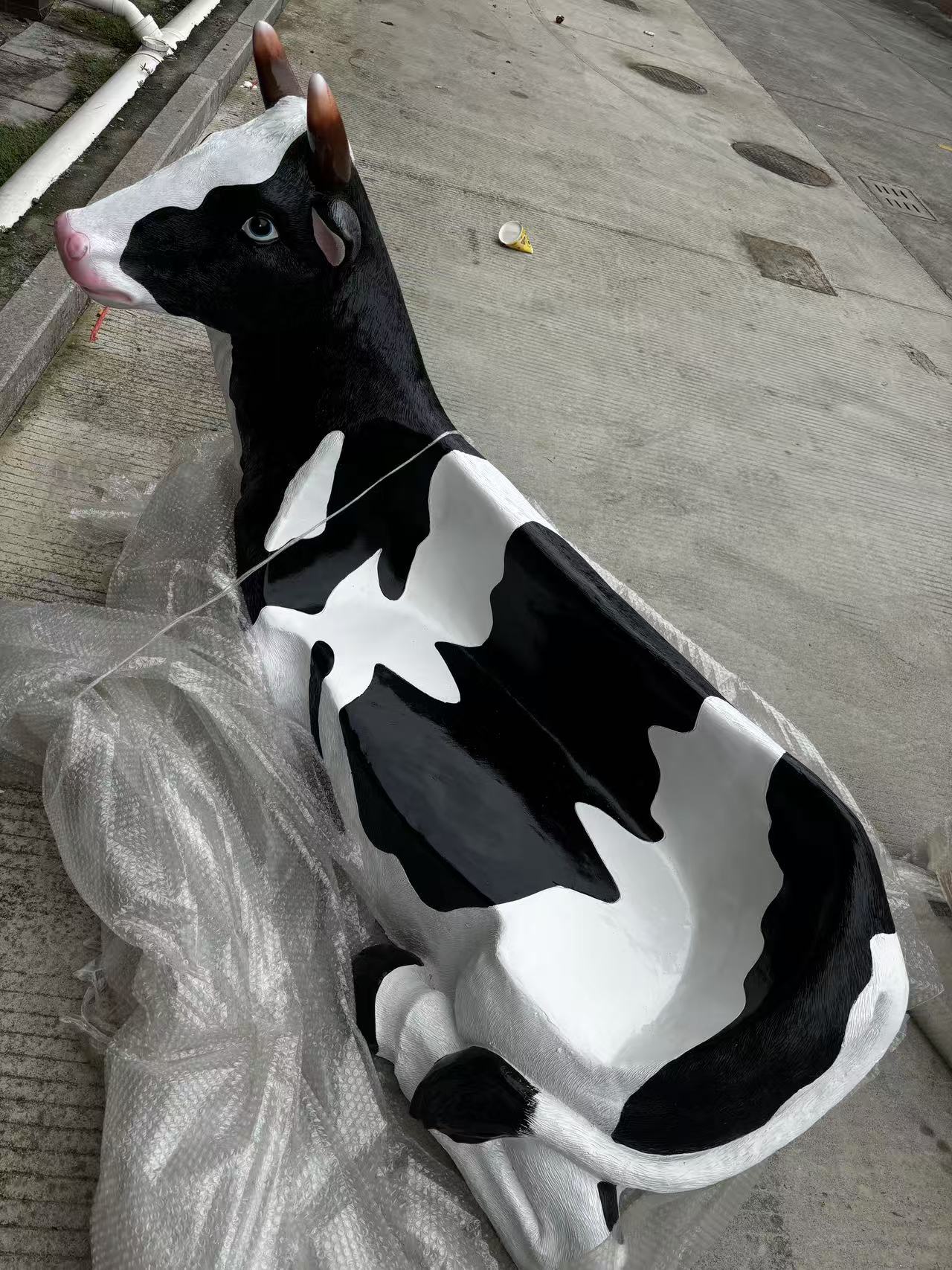
Delivered realistic animal sculpture for an outdoor landscape setting (Israel project case) — an example of figurative work placed as a site feature rather than a standalone object.
Choosing a custom sculpture is a site-matching exercise before it is an artistic one. Salt air, humidity, freeze–thaw cycles, the maintenance capacity of the owner, the cultural expectations of a memorial or religious setting, and the physical path a heavy object must travel from truck to foundation all constrain what a material can do in a given place. The four settings that generate most commission enquiries — urban public space, modern gardens, memorial grounds and religious sites — each impose a different combination of those constraints.
This guide maps material families to those settings: natural granite and stone for cemetery and memorial projects, Corten weathering steel for modern gardens and landscape architecture, stainless steel for urban landmarks and luxury hotel environments, and cast bronze for temples, religious institutions and private collections. It is written for buyers in the evaluation and execution stages, where the decision is no longer whether to commission a piece, but which material can be specified with confidence.
Why Material Mismatch Is the Costliest Error in a Sculpture Commission
A material mismatch is rarely visible at the design approval stage. It shows up later: a polished surface that loses its uniformity in coastal air, a bronze figure that changes faster than expected in a humid climate without a maintenance plan, or a garden brief that promised low upkeep and ends up requiring annual treatment. By then the sculpture is already anchored to its foundation, and correction costs far more than specification.
Budget pressure sharpens that risk. In public art commissioning, more than 80% of open-call projects in North America fall below a budget of USD 250,000, according to CODAworx public art trend analysis covering 2024–2026. At that scale there is little room for a second installation or a replacement piece, which is why specification-stage material checks carry disproportionate value for project owners and their design teams.
The upside is symmetrical. When material, finish and anchoring are matched to the site, most outdoor sculpture needs nothing beyond routine inspection — and in the case of weathering steel, the material itself is specified as maintenance-free, with natural aging and atmospheric corrosion resistance built into the alloy rather than applied as a coating.
Four Site Variables That Narrow the Material List
Before comparing materials, buyers can usually reduce the field to one or two families by answering four questions about the site.
- Atmospheric exposure. Coastal salt spray, humidity, industrial pollution, UV intensity and freeze–thaw cycling all act differently on metal and stone, and coastal exposure in particular changes which stainless grade is appropriate.
- Maintenance regime. Who cleans the piece, how often, with what equipment, and at whose cost. A material that is maintenance-free in one setting can be a recurring obligation in another.
- Cultural and ritual context. Memorial lettering conventions, sacred imagery requirements, and whether an aged patina is desirable or unacceptable are specification inputs, not afterthoughts.
- Structural and installation path. Ground load-bearing capacity, embedded parts, available lifting equipment, anchoring method and wind exposure determine whether a design is buildable as drawn.
Material Behaviour: What Each Family Actually Tolerates
The table below summarises how the four material families used in this category typically map onto site conditions and where each one stops being the right answer.
| Material family | Typical settings | Specification range | Practical boundary |
|---|---|---|---|
| Cast bronze (XYS-Bronze-Custom) | Temples and religious institutions, museums, public art, memorial statuary, private collections | High-purity cast bronze with copper content above 85%–95%, plus brass; lost-wax casting with professional welding; 50 cm to life size and up to 10 m; patina, gold leafing, high polish, antiquing | Heavier and higher in material cost than steel; in humid or coastal environments it benefits from protection and periodic care; the surface tone shifts toward greenish-brown over a long service life |
| Stainless steel (XYS-Stainless-Custom) | Urban landmarks, plazas, seaside landscape, luxury hotels, shopping malls | Premium 304 / 316 stainless; 1 m to 20 m; mirror polished, brushed (satin), painted, electroplated; hand-forged with precision welding over an internal steel skeleton | Carries a modern, silver-toned character and does not reproduce the antique warmth of bronze; coastal specifications should move to grade 316 rather than 304 |
| Corten / weathering steel (XYS-Corten-Custom) | Modern garden design, public parks, landscape architecture, industrial-style interiors | Authentic Corten steel to ASTM A242 / A588; stable pre-rusted patina or raw self-weathering finish; customized height and width from small garden pieces to large architectural structures; maintenance-free | A landscape-architecture material with a deliberately aged appearance; it is not a substitute where a bright, uniform, highly polished surface is the brief |
| Granite and natural stone (XYS-Monument-Custom, XYS-Stone-Custom) | Cemeteries and memorial engineering, temple decoration, garden ornament, architectural construction | Natural granite (Shanxi Black, G603, Blue Pearl) and white marble, granite or travertine; 100% mirror polishing, laser engraving, sandblasting; hand-carved, honed, high-gloss polished or acid-washed | Heavy material; installation depends on a foundation poured to the drawing and a lifting plan matched to its mass, so site preparation is part of the specification |
Stainless steel resists corrosion through the alloy itself rather than a coating, which is why grade selection matters more than surface treatment in aggressive environments. Grade 316 is the recommended choice for coastal areas, while grade 304 is common for inland urban and interior work. Large-scale pieces from 1 m to 20 m are hand-forged and precision-welded over an internal steel skeleton, which is the structural element that allows a mirror-finished work to carry wind load rather than merely look dramatic.
Corten steel forms its protective layer through atmospheric corrosion. The specification references authentic Corten steel to ASTM A242 / A588, delivered either with a natural pre-rusted finish forming a stable patina, or raw for self-weathering on site. Typical applications are landscape sculpture, garden edging, fire pits, metal screens and planter boxes — objects that sit inside planting and hardscape rather than on a plinth, which is consistent with its stated industries of landscape architecture, public parks, modern garden design and industrial-style decoration.
Cast bronze is specified where figurative detail and a patina that reads as age are required. Bronze and brass are not interchangeable, and the difference is quantifiable: bronze contains more than 85% copper while brass contains more than 60%, which is a large part of the price gap between the two. They also age differently — bronze moves toward a greenish-brown tone over a very long service life, while brass darkens toward blackish-brown. For outdoor use, bronze is recommended for its corrosion resistance; for indoor use, brass is the recommended option.
Stone and granite are specified for permanence and legibility. The granite used in monument work is described as acid and alkali resistant, anti-weathering and colour stable, with a 100% mirror-polished surface, laser engraving or sandblasting for lettering and imagery. Marble, granite and travertine for sculpture and architectural elements are high-density natural stone described as weatherproof, finished by hand carving, honing, high-gloss polishing or acid washing.
The Fabrication Range Behind These Four Settings
Jiangsu Xinyesheng Sculpture Co., Ltd is a custom sculpture manufacturer based in Jiangyin, Jiangsu, China, producing sculpture, statuary, reliefs, tombstones, fireplaces and stone baths, and exporting to markets that include the EU, the USA and the Middle East.
For site-matched work, its product lines correspond directly to the settings discussed here: XYS-Stainless-Custom, XYS-Corten-Custom, XYS-Bronze-Custom, XYS-Stone-Custom and XYS-Monument-Custom. Production runs in OEM, ODM and custom sculpture design and manufacturing modes, with customization available across material, size, design, colour, surface finish, sculpture style, logo and installation method. The manufacturer manages design, fabrication and installation for custom sculpture projects rather than handing the buyer a crate and a drawing.
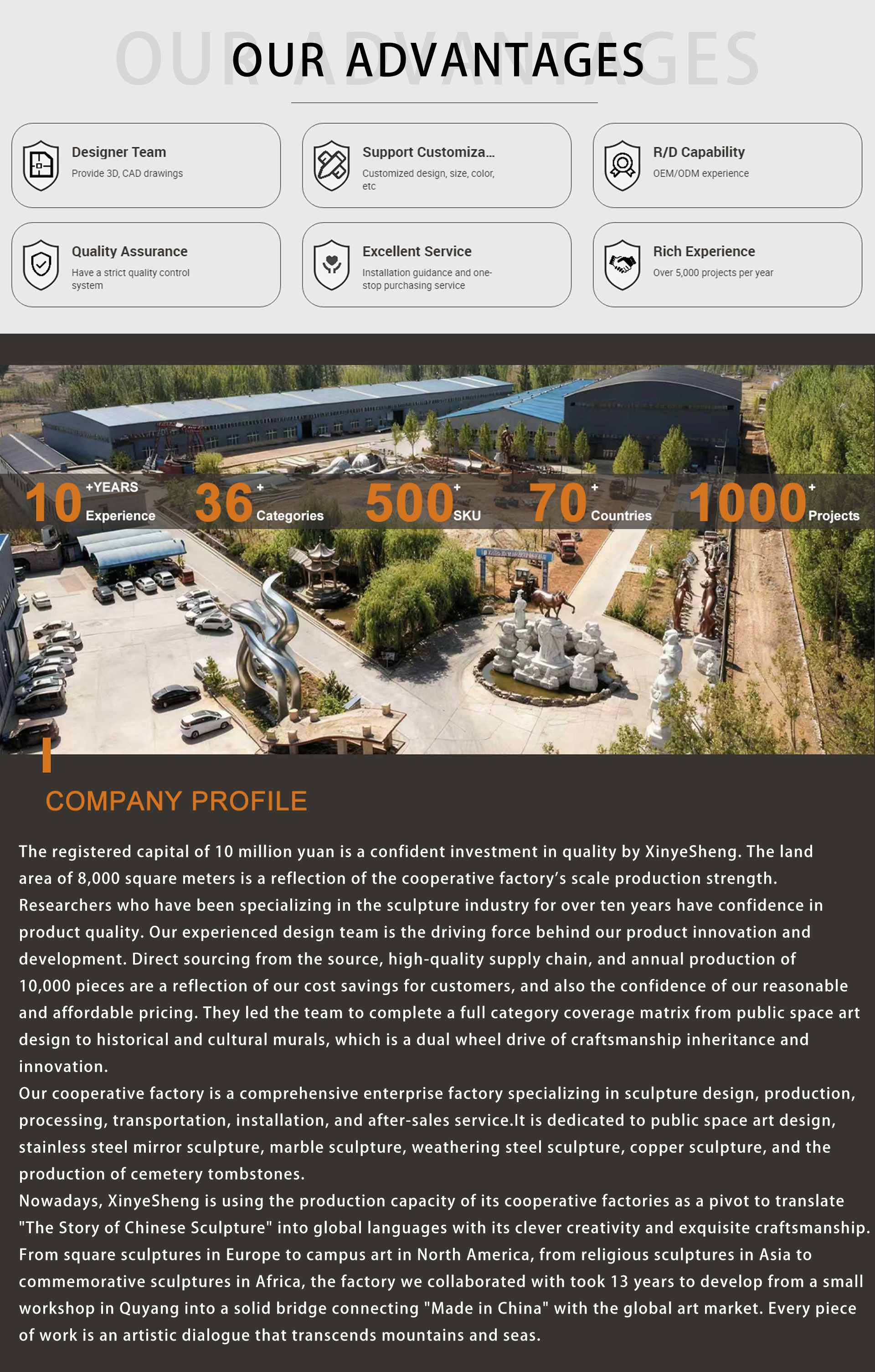
Factory and company capacity profile covering the design-to-installation scope used for custom sculpture projects.
The parameters a buyer can plan against are documented rather than implied: monthly production capacity of 50–100 sets, a standard delivery time of 30–60 days depending on size, material and surface finish, and a minimum order quantity of one piece or one project. Note that ordering multiple pieces in one batch is recommended because it shares mould and shipping costs — a relevant calculation for cemetery sections, hotel groups and multi-site landscape projects.
Quality control runs as four checkpoints: material inspection, production process inspection, surface quality inspection, and a final inspection before shipment. On the design side, the workflow is drawings or concept → 3D design confirmation → optional prototype → production → shipping, supported by 1:1 clay model visualization for figurative work. Export packing uses reinforced wooden crates and steel frames with shockproof film inside, and All Risks insurance can be arranged per the buyer's requirements. Commercial terms include DDP, EXW, FOB, CIF, DAP and FCA, with 50% deposit and the balance payable after photo and video inspection and before shipping. After-sales covers installation guidance, technical support, replacement service and long-term support.
Application Fit: Four Settings, Four Specifications
Urban public space and landmark settings
Urban commissions combine scale with public visibility, and stainless steel is the material family built for both. The working range runs from 1 m to 20 m, with mirror polished, brushed, painted or electroplated finishes, and an internal steel skeleton that carries wind load. Mirror finishes suit plazas and hotel forecourts where the sculpture is meant to reflect its surroundings; brushed and satin finishes are more forgiving on high-touch or high-traffic pieces. For promenades, waterfronts and other coastal urban sites, specifying grade 316 stainless rather than 304 is the documented recommendation.
Urban sites also impose the heaviest installation discipline. Installation starts by confirming ground flatness, load-bearing capacity and the position of embedded parts against the drawings; hoisting equipment is then selected according to the size and weight of the piece, with hoisting points determined and secured; the sculpture is aligned, fixed with bolts or reinforced by welding, and welds are treated against corrosion before final cleaning and handover. The acceptance standard for alignment permits a vertical deviation of no more than 5 mm, and lifting must be carried out by certified personnel with the work area cordoned off and operations suspended during strong wind, rain or thunderstorms.
Modern gardens and landscape architecture
Garden briefs are where weathering steel is at its most natural. Corten screens, planter boxes, garden edging, fire pits and landscape sculpture are all standard applications, and because the material is specified as maintenance-free with a stable patina, the maintenance question that usually dominates a garden specification largely disappears. The design decision shifts from protection to appearance: whether the client wants the pre-rusted stable patina present on delivery, or prefers raw material that continues to weather on site.
Where the garden language is classical or formal rather than contemporary, natural stone often fits the setting better than a metal patina. White marble, granite and travertine are used for garden ornament, stone fountains and temple decoration, and are described as weatherproof with high-density structure. The choice between Corten and stone is therefore usually an aesthetic and planting-design decision rather than a durability one, since both are intended for permanent outdoor installation.
Memorial and cemetery projects
Cemetery and memorial work is specified around permanence, legibility and colour stability. Granite monuments are produced in European, American and kerbset styles, in standard sizes such as 80x60 cm and 120x80 cm or fully customized dimensions, and the material is documented as acid and alkali resistant, anti-weathering and colour stable — properties that matter because engraved lettering must remain readable through decades of exposure. Surface treatment combines 100% mirror polishing with laser engraving and sandblasting, which is what allows both fine text and photographic relief to be cut into the same block.
Installation follows the same sequence as other permanent foundations, with one addition that matters in memorial settings: the base is checked against the drawing before anything is set, because re-leveling an installed monument in a cemetery is disruptive and visible. Fixing, corrosion protection of connections, cleaning and a documented handover complete the process.
Religious settings and private collections
Temples and religious institutions specify cast bronze where figurative accuracy, surface detail and an aged patina are part of the expected visual language. The range covers high-purity cast bronze with a copper content above 85%–95% and brass, produced by lost-wax casting with professional welding, in heights from 50 cm to life size and up to 10 m, finished with patina, gold leafing, high polish or antiquing. Two maintenance realities belong in the brief: the surface tone moves toward greenish-brown over a very long service life, and in humid or coastal environments bronze benefits from protection rather than being left entirely to the weather.
For the EU market, bronze statuary from this manufacturer is covered by CE (RoHS) documentation: certificate number OCT20260611105R, issued by Oct Technology Testing Co., Ltd. on 11 June 2026 and valid to 10 June 2031, with a scope covering bronze statue, bronze art sculpture and bronze animal sculpture, tested against the IEC 62321 series of standards. The marble line (OCT20260611104R) and the stainless steel sculpture line (OCT20260611103R) hold equivalent certificates issued on the same date and valid over the same period.
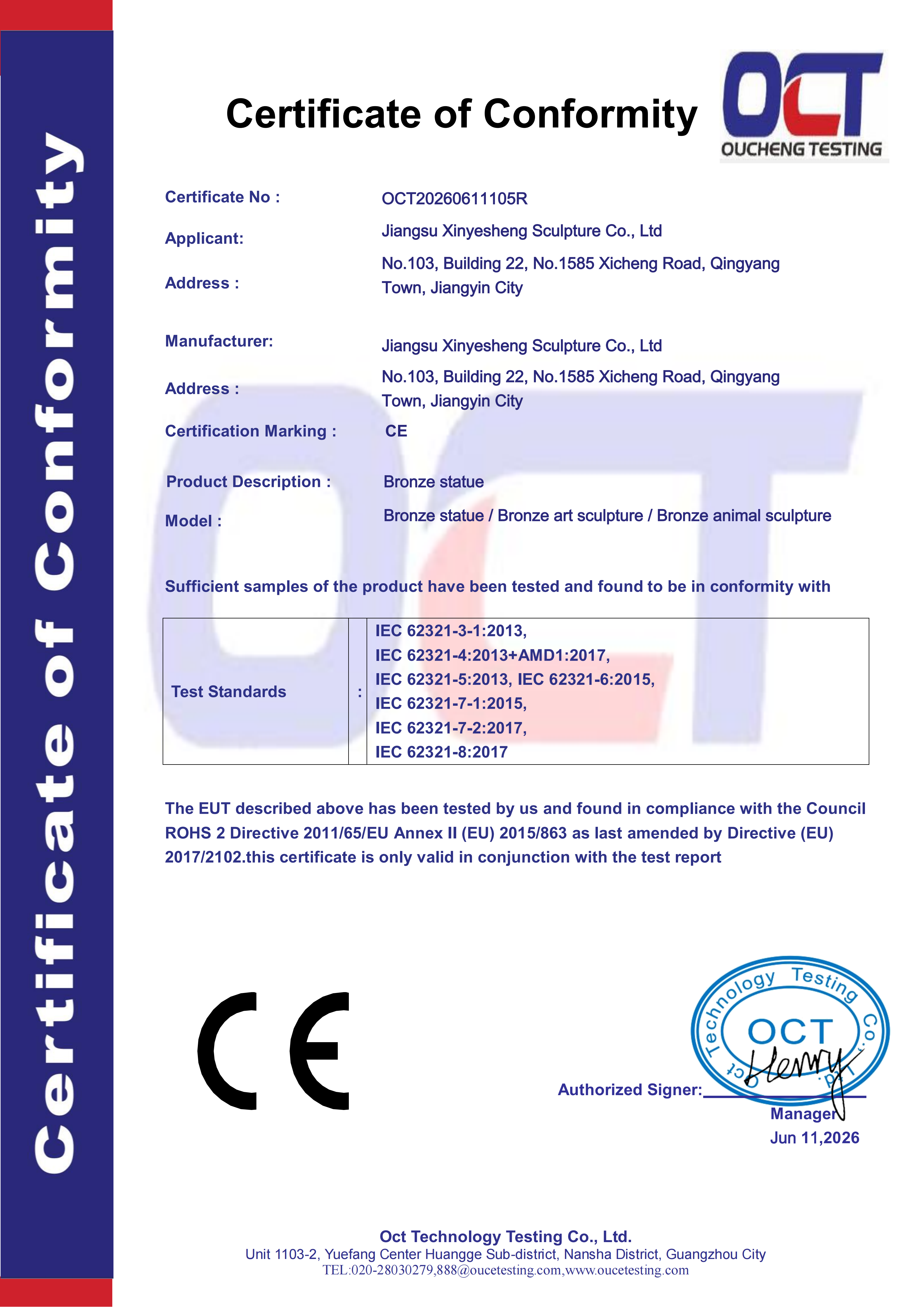
CE (RoHS) certificate OCT20260611105R covering bronze statue, bronze art sculpture and bronze animal sculpture for the EU market.
Private collections behave like interior settings rather than outdoor ones. Bronze figurines, marble pieces and brass work are the natural choices indoors, and brass in particular is recommended for interior use. Because these pieces are not exposed to weather or salt, the selection criteria shift toward detail quality, finish consistency and the visual weight of the material in a room.
Market Signals Buyers Should Read Before Specifying
The scale of the category supports the investment in getting specification right. The global art and sculpture market is estimated at approximately USD 61.83 billion in 2026, according to Business Research Insights, with the same publisher's figures covering a 2026–2035 forecast period. Published estimates differ by segment definition and methodology, so buyers should treat headline market size as a directional signal rather than a precise figure. Within that market, sculptures account for 21% of global art acquisitions by transaction volume, based on 2024 data.
Regional and sub-segment data point the same way. The United States sculpture market was estimated at between USD 5.8 and 6.2 billion in 2024, and the global bronze sculpture commission market reached USD 1.47 billion in 2024 according to Dataintelo. Public funding remains a demand driver in the United States, where federal cultural agencies were budgeted at USD 708.8 million for 2025, including USD 207 million for the National Endowment for the Arts, as reported by Regional Arts Organizations.
Budget distribution is the signal most directly relevant to material choice. CODAworx reports that 80.2% of public art open-call projects in North America fall below USD 250,000, which places most commissions in a band where a single material or installation error is not recoverable within the project budget. One further procurement consideration applies to EU-bound projects: original sculptures under HS Code 9703 often bypass EU anti-dumping duties, while mass-produced items under HS Code 8306 face higher scrutiny — a distinction reported by CloudscapeArt in 2025 and worth confirming with a customs broker before sourcing decisions are finalised.
Custom Fabrication versus Standard Catalog Pieces — and Where Each Material Stops Working
Standard catalog sculpture and custom fabrication solve different problems. A catalog piece is faster and usually cheaper, but its dimensions, finish, anchoring details and lettering layout are fixed; it is designed for a generic site, not for a specific foundation, wind exposure or planting scheme. Custom fabrication, by contrast, allows material, size, colour, surface finish, installation method and even logo elements to be set to the site — at the cost of a design approval cycle and a lead time that typically runs 30–60 days. For a project that must be installed within days, custom fabrication is not the available route, and it is worth saying plainly that custom is not automatically the better answer where a site's dimensions and anchoring requirements are already standard.
Each material family also has a boundary that should be stated before it is specified:
- Bronze: heavier and higher in material cost than steel, benefiting from protection in humid or coastal environments, with a surface tone that shifts toward greenish-brown over a long service life. Projects expecting no tonal change over time should not specify bronze.
- Stainless steel: modern and silver-toned by nature. It will not reproduce the antique warmth of bronze, and coastal specifications should use grade 316 rather than 304.
- Corten steel: a landscape-architecture material with a deliberate weathered appearance. It is the wrong specification where the brief requires a bright, uniform, highly polished surface.
- Granite and natural stone: durable and colour stable, but heavy, which makes the foundation, the lifting plan and site access part of the material decision rather than separate logistics.
Future Outlook
With the majority of public art budgets sitting below USD 250,000 and market estimates pointing to continued demand across 2026–2035, the pressure on sculpture procurement is likely to shift from material choice alone toward contract structure. Buyers increasingly need one supplier accountable for design, fabrication and installation, because interface failures between a designer, a fabricator and an installation contractor are exactly where schedule and budget overruns appear.
Two further trends are visible in the available data. Documentation is becoming part of the tender checklist rather than a post-award formality: material standards such as ASTM A242 / A588 for weathering steel and CE (RoHS) coverage for bronze, marble and stainless steel lines are increasingly requested with the quotation. And as trade classification of original versus mass-produced sculpture continues to affect EU duty treatment, sourcing decisions will be reviewed earlier in the process, alongside aesthetic and durability criteria.
A detailed company profile and production capability brochure for these product lines is available for download: Company Profile & Available Production Capabilities (PDF).
FAQ
Which custom sculpture material suits which type of site?
The material families divide by site condition rather than by preference. Granite and natural stone suit cemeteries, memorial projects and temple decoration, where weathering resistance, colour stability and engraved legibility matter. Corten (weathering) steel suits modern gardens, parks and landscape architecture where a stable weathered patina is acceptable. Stainless steel suits urban landmarks, plazas, seaside landscapes and hotel environments, with grade 316 recommended for coastal exposure. Cast bronze suits temples, religious institutions, museums and private collections where patina, gold leaf and cast figurative detail are required. Bronze is heavier and more expensive than steel and benefits from protection in humid or coastal air, while stainless steel does not reproduce bronze's antique warmth.
Can a sculpture be customized to a specific site, and what is the minimum order quantity?
Customization covers material, size, design, colour, surface finish, sculpture style, logo and installation method. The minimum order quantity is one piece or one project, and a typical workflow is: drawings or concept → 3D design confirmation → optional prototype → production → shipping, with 1:1 clay model visualization available for figurative work. Buyers should note that ordering multiple pieces in one batch is recommended because it shares mould and shipping costs, which is relevant for cemetery sections, hotel groups and multi-site landscape projects.
What production capacity and lead time should a buyer plan for?
Monthly production capacity is 50–100 sets, and standard delivery time is 30–60 days. The exact schedule depends on size, material and surface finish, and is confirmed after design approval. Quality control runs as four checkpoints: material inspection, production process inspection, surface quality inspection and final inspection before shipment.
How is a large outdoor sculpture installed, and what defines acceptance?
Installation begins by confirming the site and checking ground flatness, load-bearing capacity and the position of embedded parts against the drawings. Hoisting equipment is selected according to the size and weight of the piece, hoisting points are determined and secured, and the sculpture is aligned with the base or embedded parts before being fixed with bolts or reinforced by welding, with welds treated against corrosion. Acceptance requires alignment within drawing tolerance, with vertical deviation no greater than 5 mm, secure fixing with no loosening under a shake test, and a surface free of bumps, scratches and stains. Lifting must be carried out by certified personnel, the work area must be cordoned off, and operations must stop during strong wind, rain or thunderstorms.
How are sculptures packaged and delivered for international projects?
Exterior packaging uses sturdy wooden crates and metal strips, with shockproof plastic film protecting the piece internally, and All Risks insurance can be purchased according to the buyer's requirements. Available delivery terms include DDP, EXW, FOB, CIF, DAP and FCA, and door-to-door delivery is offered. Before loading, the manufacturer takes photos and videos so the buyer can inspect the finished piece, and the balance payment is made after that inspection and before shipping. After-sales service includes installation guidance, technical support and replacement service.
What compliance documentation supports EU market delivery for sculpture?
Three CE (RoHS) certificates were issued on 11 June 2026 by Oct Technology Testing Co., Ltd. and are valid to 10 June 2031: OCT20260611105R for bronze statue, bronze art sculpture and bronze animal sculpture; OCT20260611104R for marble statue, marble art sculpture, marble fireplace, marble bathtub and marble tombstone; and OCT20260611103R for stainless steel art sculpture and stainless steel landscape sculpture. All three reference the IEC 62321 series of standards.