
Custom Sculpture vs. Custom Monument: A Buyer Decision Guide
Custom sculpture and custom monument commissions are frequently requested through the same quotation process, but they are not the same procurement object. A sculpture is commissioned to create identity: an artistic landmark, a garden focal point, an architectural accent. A monument is commissioned to carry a fixed message across decades: a name, a date, an inscription that must remain legible in granite long after installation. Both can come from the same stone and metal fabrication base and ship in the same reinforced crates, yet the specification logic, acceptance criteria and structural interfaces differ.
This guide sets out a side-by-side buyer decision framework for memorial and landscape projects. It contrasts application fit, material selection, site interfaces, order-quantity logic and pre-shipment verification, using the published specification data behind the XYS-Corten-Custom, XYS-Stainless-Custom, XYS-Bronze-Custom, XYS-Stone-Custom and XYS-Monument-Custom model families.
Why Sculpture and Monument Requirements Get Mixed Up
Three conditions drive the confusion. First, the two categories share a fabrication base: stone carving, metal fabrication, welding and polishing equipment are used for both. Second, both are non-standard products, so neither can be ordered from a catalogue with a fixed part number alone. Third, both are installed outdoors and both must resist weather, which makes durability language sound interchangeable even when the underlying specification is not.
The practical consequence appears in RFQs. A buyer who applies monument logic to a sculpture — fixed standard sizes, granite as the default material, mirror polish as the default finish — ends up specifying a stock stone object rather than a designed artwork. A buyer who applies sculpture logic to a monument — free-form geometry, mixed materials, open tolerance on the inscription — can end up with a memorial stone that does not satisfy cemetery installation requirements or long-term legibility expectations.
The Buyer Decision Matrix: Custom Sculpture vs. Custom Monument
The table below is the core of the framework. It is not a material comparison; it is a comparison of what has to be specified, verified and accepted in each category.
| Decision dimension | Custom sculpture | Custom monument |
|---|---|---|
| Primary purpose | Artistic landmark, space identity, architectural aesthetics, cultural decoration | Memorial inscription and grave marking, memorial stone engineering |
| Applicable industries | Urban public art, modern architecture, seaside landscape, luxury hotel, shopping mall, landscape design, home and garden, temple decoration, museum, real estate | Cemetery construction, memorial stone engineering, landscape architecture, funeral industry |
| Core materials | 304 / 316 stainless steel; high-purity cast bronze (copper content >85%–95%) and brass; Natural White Marble, granite, travertine; Corten steel to ASTM A242 / A588 weathering steel | Natural granite: Shanxi Black, G603, Blue Pearl |
| Size logic | Customized height and width; stainless steel from 1 m to 20 m; bronze from 50 cm to 10 m or life size; stone to project dimensions | Standard sizes 80x60 cm or 120x80 cm, or customized |
| Surface treatment | Mirror polished (8K), brushed or satin, painted, electroplated; patina, gold leafing, antiqued; hand-carved, honed, high-gloss polished, acid-washed; natural pre-rusted stable patina | 100% mirror polished, laser engraving, sandblasting |
| Durability specification | Corrosion resistance (grade 316 recommended for coastal sites), atmospheric corrosion resistance, high-density natural stone | Acid and alkali resistance, anti-weathering, color stability |
| Installation mode | Permanent installation (stainless steel) or long-term display (bronze) | Fixed memorial installation in a cemetery or landscape setting |
| Supporting works | Installation foundations, steel structure support, internal anti-rust steel framework, LED lighting system, lifting and transportation equipment | Base and cemetery setting; lifting and transportation equipment |
| Model designation | XYS-Stainless-Custom, XYS-Bronze-Custom, XYS-Stone-Custom, XYS-Corten-Custom | XYS-Monument-Custom |
Application Fit: Where Each Category Belongs
Application fit usually decides the category before material selection begins. Sculpture-led projects include landscape architecture schemes, public art installations, urban landmarks, luxury hotel and resort projects, commercial space decoration, garden and villa decoration, religious carving and temple decoration, and museum or real estate commissions. Product-level application data supports this: the stainless steel sculpture line is specified for public art installations and private customized sculpture projects, the bronze line for private customized sculpture projects, and the stone sculpture line for resort projects, where lifting and transportation equipment and professional export packaging are required site conditions.
Monument-led projects sit in cemetery construction, memorial stone engineering and the funeral industry, with landscape architecture as a shared edge. The overlap zone is where most procurement mistakes happen: a memorial sculpture or a religious carving that combines figurative work with an inscribed stone base. In that situation the buyer has to state which criterion dominates. If expression dominates, the project is a sculpture commission with a stone component. If inscription durability and grave marking dominate, it is a monument commission with a carved element.
Material and Process Selection for Each Path
Once the category is fixed, material choice follows the site, the geometry and the acceptance criterion. The five specification families below cover both sides of the decision.
Corten steel — XYS-Corten-Custom
Authentic Corten steel to ASTM A242 / A588 weathering steel, with a natural pre-rusted finish that forms a stable patina, or a raw finish that self-weathers. The material is specified for maintenance-free performance, natural aging and atmospheric corrosion resistance, and is used for landscape sculpture, garden edging, fire pit, metal screen and planter box applications in landscape architecture, public parks, modern garden design and industrial style decor. Size range is customized, from small garden pieces to large architectural structures.
Stainless steel — XYS-Stainless-Custom
Premium 304 / 316 stainless steel in customized heights from 1 m to 20 m, with mirror polished, brushed (satin), painted or electroplated surfaces. Fabrication combines hand-forging, precision welding and an internal steel skeleton; the mirror finish is achieved through 6–8 stages of professional hand polishing, and large-scale installations rely on a heavy-duty internal anti-rust steel framework. The line is applied in urban public art, modern architecture, seaside landscape, luxury hotel and shopping mall settings. Grade 316 is the recommended specification for coastal or humid outdoor environments.
Cast bronze and brass — XYS-Bronze-Custom
High-purity cast bronze with copper content greater than 85%–95%, plus brass, produced by lost-wax casting with professional welding. Heights run from 50 cm to 10 m or life size, with patina, gold leafing, high polish or antiqued finishes, and multi-color oxidation options. Applications include bronze statue, animal sculpture, religious statue and figurine work for public art, museum, real estate, religious institutions and private collections, where long-term outdoor display is the operating mode.
Carved stone — XYS-Stone-Custom
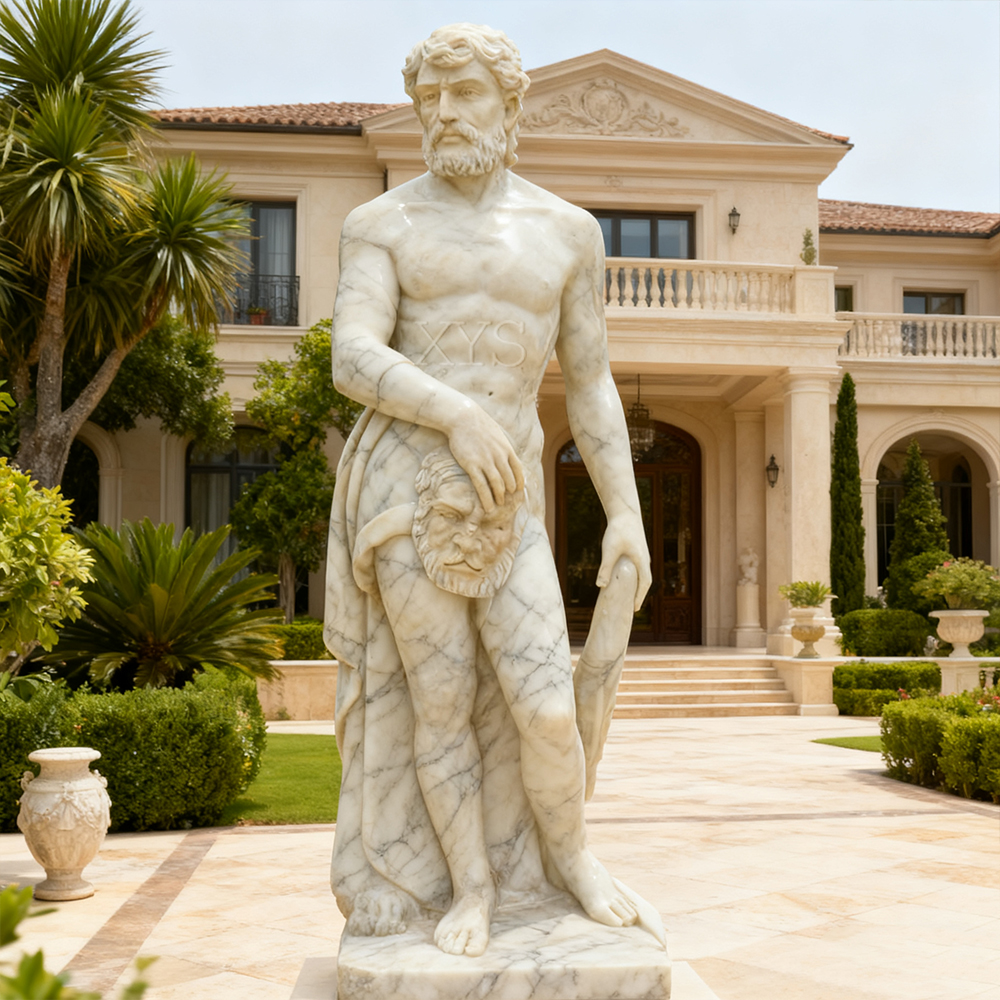
Natural White Marble, granite and travertine with customized width, height and depth, finished by hand-carving, honing, high-gloss polishing or acid-washing. The specification targets high-density natural stone and weatherproof performance, and covers garden ornaments, fireplace mantels, stone fountains, religious carving, marble statues and carved marble bathtubs in landscape design, architectural construction, home and garden, and temple decoration.
Granite monuments — XYS-Monument-Custom
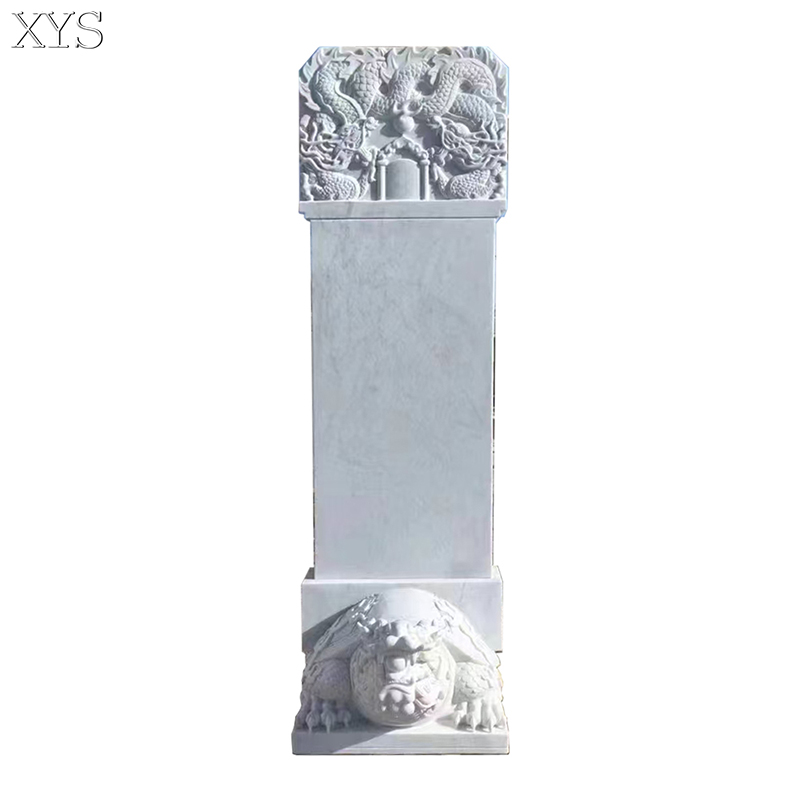
Natural granite in Shanxi Black, G603 and Blue Pearl, in standard sizes of 80x60 cm or 120x80 cm, or customized. Surface treatment is 100% mirror polishing, laser engraving and sandblasting, and the material is specified for acid and alkali resistance, anti-weathering and color stability. The product range covers granite tombstone, European style, American style and kerbset monument formats.
| Material family | Model | Typical application | Buyer verification point |
|---|---|---|---|
| Corten steel (ASTM A242 / A588) | XYS-Corten-Custom | Landscape sculpture, garden edging, fire pit, metal screen, planter box | Whether a surface that changes with the environment is acceptable for the client |
| 304 / 316 stainless steel | XYS-Stainless-Custom | Urban public art, modern architecture, seaside landscape, luxury hotel, shopping mall | Grade selection for coastal or humid sites; internal skeleton specification |
| Cast bronze / brass | XYS-Bronze-Custom | Public art, museum, real estate, religious institutions, private collection | Copper content, casting method and patina finish |
| Natural White Marble / granite / travertine | XYS-Stone-Custom | Garden ornament, fireplace mantel, stone fountain, religious carving, marble statue | Block density grade, carving detail and dimensional expectations |
| Natural granite | XYS-Monument-Custom | Cemetery construction, memorial stone engineering, funeral industry | Standard size versus custom size; laser engraving versus sandblasting |
Site Interfaces, Structure and Installation
The category decision also determines what has to exist at the site before the product arrives. In sculpture projects, supporting equipment typically includes installation foundations, steel structure support and an internal anti-rust steel framework, and in some designs an LED lighting system. In stone sculpture and monument projects, lifting and transportation equipment is a practical requirement at both the factory and the installation site, and stone items require professional export packaging to arrive undamaged.
Installation mode is a further split. Stainless steel sculpture is specified for permanent installation. Bronze sculpture is specified for long-term display. Corten steel operates in outdoor weather-resistance mode and requires steel structure support where it reaches architectural scale. Granite monuments are fixed memorial installations, where the base and setting are part of the finished appearance.
For buyers assembling a schedule, the delivery chain matters as much as the artwork: 1:1 clay model visualization for sculpture, seaworthy packaging in reinforced wooden crates and steel frames, global on-site installation guidance, and remote technical support where an installation crew is already on site. Memorial and landscape projects frequently fail at the interface between fabrication and installation rather than in the fabrication itself.
Where Supplier Capability Enters the Decision
Jiangsu Xinyesheng Sculpture Co., Ltd is a sculpture and monument manufacturer based in Jiangyin City, Jiangsu, China, whose product range covers sculpture, statue, relief, tombstone, fireplace and bathtub, with 100% of output exported to markets including the EU, USA and the Middle East. The company reports a facility of 13,320 m², 50 employees, 12 engineers in the R&D team and an annual output of 10,000 units, and works with a cooperative factory whose land area is 8,000 m².
For buyers, the relevant operational facts are the ones that affect planning. Production mode covers OEM, ODM and custom sculpture design and manufacturing, with customization available across material, size, design, color, surface finish, sculpture style, logo and installation method. Minimum order quantity is 1 piece or 1 project, monthly capacity is 50–100 sets, and lead time is 30–60 days. Quality control runs through four stages: material inspection, production process inspection, surface quality inspection, and final inspection before shipment. After-sales support covers installation guidance, technical support, replacement service and long-term customer support.
Delivered project experience spans hotel groups, landscape design companies, architectural firms, real estate developers, public art organizations and private collectors, with project scale ranging from 1 to 50 customized sculptures per project and applications including hotel decoration, landscape enhancement, public art installation, commercial space decoration, and garden and villa decoration. The recurring challenge solved in these projects is producing customized work for markets with different design and durability expectations.
Market Signals Buyers Should Weigh
Commissioned fabrication is not a marginal segment. Business Research Insights estimates the global art and sculpture market at approximately USD 61.83 billion in 2026, with a forecast period to 2035, and sculptures are reported to account for 21% of global art acquisitions by transaction volume. Within the sculpture category, Dataintelo estimated the global bronze sculpture commission market — the commissioned segment rather than resale — at USD 1.47 billion in 2024.
Regional demand is comparable in scale. One commercial industry analysis estimated the United States sculpture market at between USD 5.8 and 6.2 billion in 2024, and the same source frames customization demand as the open question for the following cycle. On the public art side, CODAworx reports that more than 80% of public art open call projects in North America fall below a budget of USD 250,000, which means most commissions are decided in a mid-range band where the number of fabricated units, not the unit price alone, drives project economics.
Trade classification deserves a line in the procurement file. A secondary trade analysis notes that original sculptures under HS Code 9703 often bypass EU anti-dumping duties, while mass-produced items classified under HS 8306 face higher scrutiny. For buyers importing into the EU, the classification of the shipment should be confirmed with the supplier and a customs broker rather than assumed. US federal cultural agencies were budgeted at USD 708.8 million for 2025, including USD 207 million for the NEA, which supports continued public-sector commissioning pipelines.
Honest Limits: Where Each Path Is the Wrong Choice
No single material or product family is optimal for both categories, and buyers should treat the following as genuine boundaries rather than objections to be negotiated away.
- Corten steel changes appearance by design. The protective rust-like layer develops and shifts with the environment. If the client requires a fixed, unchanging color, Corten is a mismatch, even though it is maintenance-free and structurally strong.
- Stainless steel grade matters more than finish. Grade 316 is the recommended choice for coastal or humid sites. Selecting by mirror polish alone, without confirming the grade and the internal anti-rust framework, is a specification gap rather than a cost saving.
- Bronze is a detail material with structural consequences. Lost-wax casting captures fine figurative detail and the copper content supports long outdoor durability, but large-scale pieces still require structural planning. A minimal geometric composition may be better served by stainless steel.
- Hand-carved natural stone is variable. Marble, travertine and granite are natural materials worked by hand. Buyers who require CNC-level dimensional consistency across multiple identical carvings should confirm tolerances at the design approval stage instead of assuming them after delivery.
- Standard monument sizes are not universal. Shanxi Black, G603 and Blue Pearl granite are available in 80x60 cm and 120x80 cm standard sizes or customized formats, but cemetery regulations and local memorial traditions can constrain the acceptable form. This should be checked before the design is frozen.
- Single-piece orders carry a cost penalty. MOQ of 1 piece or 1 project is accepted, but ordering multiple units at once is recommended because mold and shipping costs are shared across pieces.
- Capacity has a ceiling and a calendar. Monthly capacity of 50–100 sets and a lead time of 30–60 days mean that buyers with fixed installation or dedication dates should plan backward from the delivery window, not from the date of design approval.
Procurement Checklist Before Issuing a Purchase Order
- Confirm the category criterion. Decide whether expression or inscription durability is the acceptance criterion for the project, and record it in the brief.
- Approve the design before production. Submit drawings, photos or concepts and confirm the 3D design draft; for sculpture, 1:1 clay model visualization is available as a validation step.
- Lock the model and material specification. Identify the applicable model — XYS-Stainless-Custom, XYS-Bronze-Custom, XYS-Stone-Custom, XYS-Corten-Custom or XYS-Monument-Custom — and state the material standard, such as ASTM A242 / A588 for Corten steel, grade 304 or 316 for stainless steel, copper content above 85%–95% for bronze, and the granite type for monuments.
- Clarify quantity and cost sharing. Confirm that the order meets the 1 piece or 1 project minimum, and evaluate whether a multi-unit order reduces per-unit logistical cost.
- Fix the schedule in writing. Confirm the 30–60 day lead time against the required delivery window, taking size, material and surface finish into account.
- Plan the factory visit around process, not showroom. A useful visit examines welding, casting, hand-carving, polishing and monument engraving, and reviews the four inspection stages: material inspection, production process inspection, surface quality inspection and final pre-shipment inspection.
- Verify packaging quality. Reinforced wooden crates and steel frames, plus professional export packaging for stone components, are the relevant checkpoints for a long sea freight leg.
- Confirm delivery and installation responsibility. Agree on door-to-door delivery, lifting and transportation equipment at the site, foundation or structural support drawings, installation guidance, and after-sales coverage including technical support and replacement service.
- Check trade and compliance items. Confirm HS classification for the shipment and any market-specific memorial or public art requirements before dispatch.
Future Outlook
The custom sculpture and monument market is project-driven and fragmented, and the visible data gap in most industry reporting is the absence of a structured fabrication project lead dataset covering public art and commercial real estate tenders. That gap matters for buyers because it means supplier selection still depends heavily on direct verification rather than published market intelligence.
Three trends are reasonably supported by the available evidence. First, customization demand continues to define the mid-range commission segment, where most public art budgets sit below USD 250,000 and unit count drives project economics. Second, buyers increasingly evaluate one fabrication partner across both sculpture and monument scopes, which puts pressure on suppliers to document material standards, inspection stages and installation interfaces rather than present a single product line. Third, trade classification and material compliance will remain an active planning item for cross-border projects, particularly where original artwork and mass-produced metalwork are treated differently at import.
The practical implication for procurement teams is a shift in evaluation criteria: the question is no longer which supplier can produce a sculpture or a monument, but which supplier can document the specification, the inspection process and the site interface for the specific category being purchased.
FAQ: Custom Sculpture and Custom Monument Decisions
What is the main difference between a custom sculpture project and a custom monument project?
The difference is the acceptance criterion, not the material. A custom monument is a natural granite memorial product — granite tombstone, European style, American style or kerbset monument — used in cemetery construction, memorial stone engineering and the funeral industry, and it is specified by inscription method, standard size (80x60 cm or 120x80 cm, or customized) and finish (100% mirror polished, laser engraving, sandblasting). A custom sculpture is a made-to-design object in stainless steel, bronze, stone or Corten steel, sized by design, and used to create artistic landmarks, enhance architectural aesthetics and provide cultural decoration or space identity in public art, landscape, hotel, garden and commercial settings.
Which material is suitable for outdoor sculpture in coastal or humid environments?
304 / 316 stainless steel is the material family for outdoor metal sculpture, and grade 316 is recommended for coastal areas because of its corrosion resistance; the specification also includes an internal anti-rust steel framework and precision welding for large-scale installation. Corten steel to ASTM A242 / A588 is an alternative for landscape and garden work: it is maintenance-free and develops a stable protective patina, but the surface appearance changes over time. Bronze with copper content above 85%–95% is specified for long-term outdoor display where figurative detail is required.
What standard sizes and finishes are available for granite monuments?
Natural granite monuments in Shanxi Black, G603 and Blue Pearl are available in standard sizes of 80x60 cm and 120x80 cm, or in customized dimensions. Surface treatment options are 100% mirror polishing, laser engraving and sandblasting, and the material is specified for acid and alkali resistance, anti-weathering and color stability. Kerbset monument, European style and American style formats are all covered within the same product family.
What is the minimum order quantity for a custom sculpture or monument?
Minimum order quantity is 1 piece or 1 project, so single-piece commissions are accepted. Ordering multiple pieces at once is generally recommended because mold costs and shipping costs are shared across units, which lowers the effective cost per piece. Full customization covers material, size, design, color, surface finish, sculpture style, logo and installation method.
How long does production take, and what installation support is provided?
Lead time is typically 30–60 days, assessed against the specific size, material and surface finish, with monthly capacity of 50–100 sets. Installation support includes installation guidance, technical support and replacement service, plus long-term customer support. Depending on the item, the site also needs to prepare installation foundations, steel structure support, an LED lighting system, or lifting and transportation equipment.
What should a buyer verify before shipment?
Verification should cover four inspection stages — material inspection, production process inspection, surface quality inspection and final inspection before shipment — together with packaging quality. Packaging for large sculpture uses reinforced wooden crates and steel frames, and stone sculpture and monuments require professional export packaging for sea freight. Delivery planning should confirm door-to-door arrangements, the lifting equipment available at the destination, and any trade classification or market-specific requirement that applies to the shipment.
Reference
For buyers who need the full specification and production capability overview in one document, the company profile and available production capabilities file can be reviewed and downloaded here: Company Profile & Available Production Capabilities.