
Custom Sculpture: Materials, Fabrication & Sourcing Guide
Custom Sculpture Has Become a Procurement Category
Custom sculpture is no longer confined to the artist's studio. Across public art programs, hotel developments, residential landscapes and memorial projects, buyers are treating sculpture as a fabricated asset with defined materials, engineering requirements and installation logistics. This guide is written for architects, landscape designers, developers and procurement teams at the awareness-to-research stage, clarifying what custom sculpture involves and how to evaluate a fabrication partner.
What Counts as a Custom Sculpture?
Custom sculpture refers to a piece designed or adapted to a specific site, concept or brief, as opposed to an off-the-shelf ornament. It can be a stainless steel landmark in a shopping mall, a bronze animal sculpture in a museum courtyard, a corten steel planter and metal screen in a modern garden, or a granite monument in a cemetery. What unites these pieces is that they are made to order: material, size, finish and structural design are confirmed before production begins.
For buyers at the awareness stage, it is useful to think in terms of material families rather than a single product type. Each material family has distinct performance characteristics, aesthetic logic and cost boundaries, and each corresponds to a different set of project conditions. This article covers the main families used in commercial and public sculpture: 304/316 stainless steel, cast bronze and brass, corten (weathering) steel, natural stone, and granite memorials.
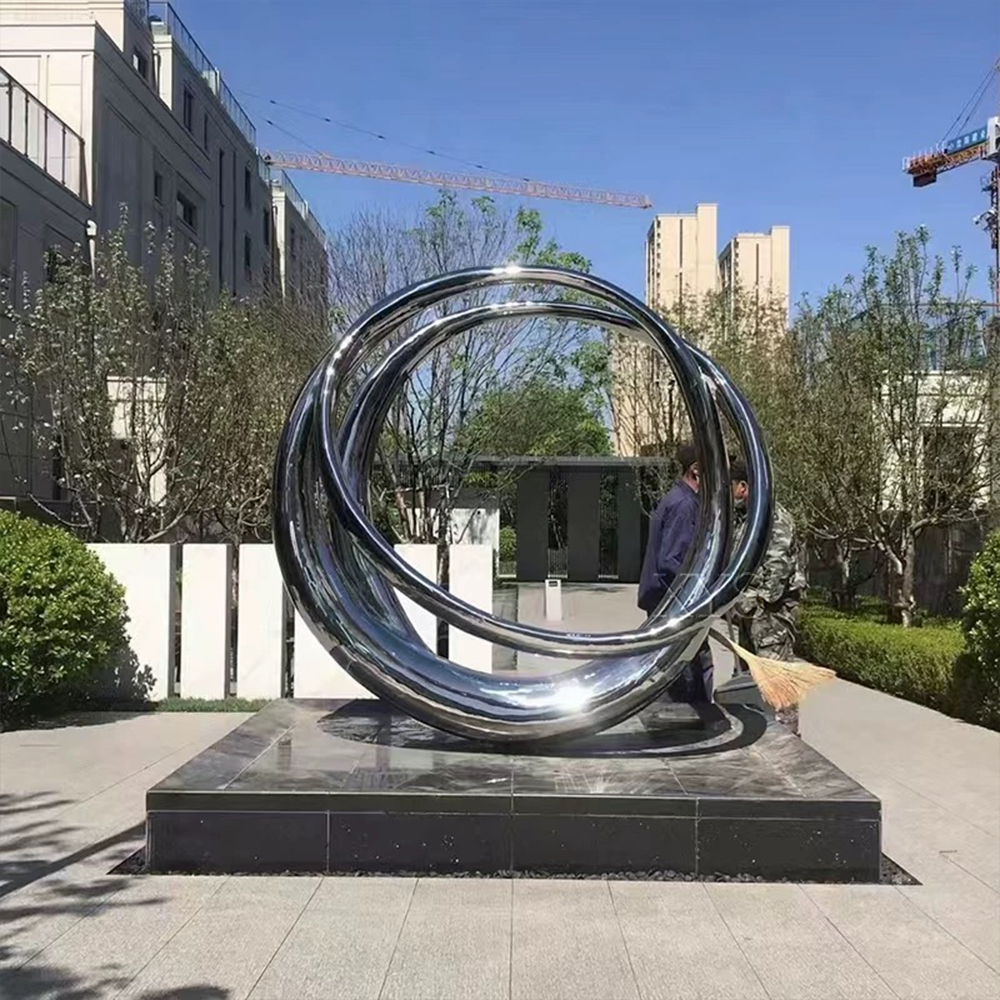
Large outdoor sculptures in 304 stainless steel are commonly used as urban landmarks and public art pieces.
The Problem: Art, Engineering and Logistics in One Order
For a buyer new to commissioning, the difficulty is not finding a sculpture. The difficulty is translating a concept into a manufacturable, shippable and installable object. Several questions dominate the research phase:
- Which material suits the environment, especially for outdoor or seaside conditions?
- Can the manufacturer execute a genuinely custom design rather than only offering catalogue pieces?
- What is the production process, and how is quality controlled between design approval and final finishing?
- How does an international buyer manage packaging, shipping and on-site installation?
The opportunity is equally clear. The custom sculpture market is project-driven and internationally connected, and commercial buyers increasingly expect a supplier to handle design, fabrication, transport and installation guidance under a single contract. This expectation has pushed manufacturers beyond basic casting or welding into what is effectively a one-stop delivery model.
Market context supports this view. The global art and sculpture market is estimated at approximately USD 61.83 billion in 2026, according to Business Research Insights. Sculptures account for around 21% of global art acquisitions by transaction volume. The United States sculpture market reached an estimated USD 5.8 to 6.2 billion in 2024, while the global bronze sculpture commission market reached USD 1.47 billion in 2024, according to Dataintelo. For buyers, this means a growing base of capable suppliers; for suppliers, it means that custom fabrication capacity is a meaningful competitive asset.
Supplier Reference: How Jiangsu Xinyesheng Structures Its Offer
A working example of this one-stop model is Jiangsu Xinyesheng Sculpture Co., Ltd., a China-based company headquartered in Jiangyin City. The company specializes in sculpture design, production, processing, transportation, installation and after-sales service, covering public space art design, stainless steel mirror sculpture, marble sculpture, weathering steel sculpture, copper sculpture and cemetery tombstones.
Jiangsu Xinyesheng was established in 2025, but its cooperative factory in Quyang developed over 13 years from a small workshop into a production base that bridges Chinese craftsmanship with the global art market. Quyang is historically significant in this industry: the company states that it builds on Quyang's 2,000-year intangible cultural heritage, combining traditional hand-carving techniques with modern 3D modeling and CNC precision processing.
The company reports a registered capital of RMB 10 million, operates a manufacturing facility covering 13,320 square meters, employs approximately 50 staff, and maintains an R&D team of 12 engineers. Annual production capacity reaches 10,000 units. Export business accounts for 100% of total sales, with major markets concentrated in the EU, USA and Middle East.
Material standards are central to the offer. The company states that it adheres to high-grade material standards, utilizing Grade A natural marble, anti-corrosion weathering steel, and premium 304/316L stainless steel. For buyers, this is a practical verification point: material grade directly affects corrosion resistance, structural safety and long-term maintenance cost.
One-stop delivery system. Jiangsu Xinyesheng provides a delivery package that includes 1:1 clay model visualization, professional seaworthy packaging using reinforced wooden crates and steel frames, and global on-site installation guidance. For international buyers, these services reduce the risk of miscommunication between design approval and installation.
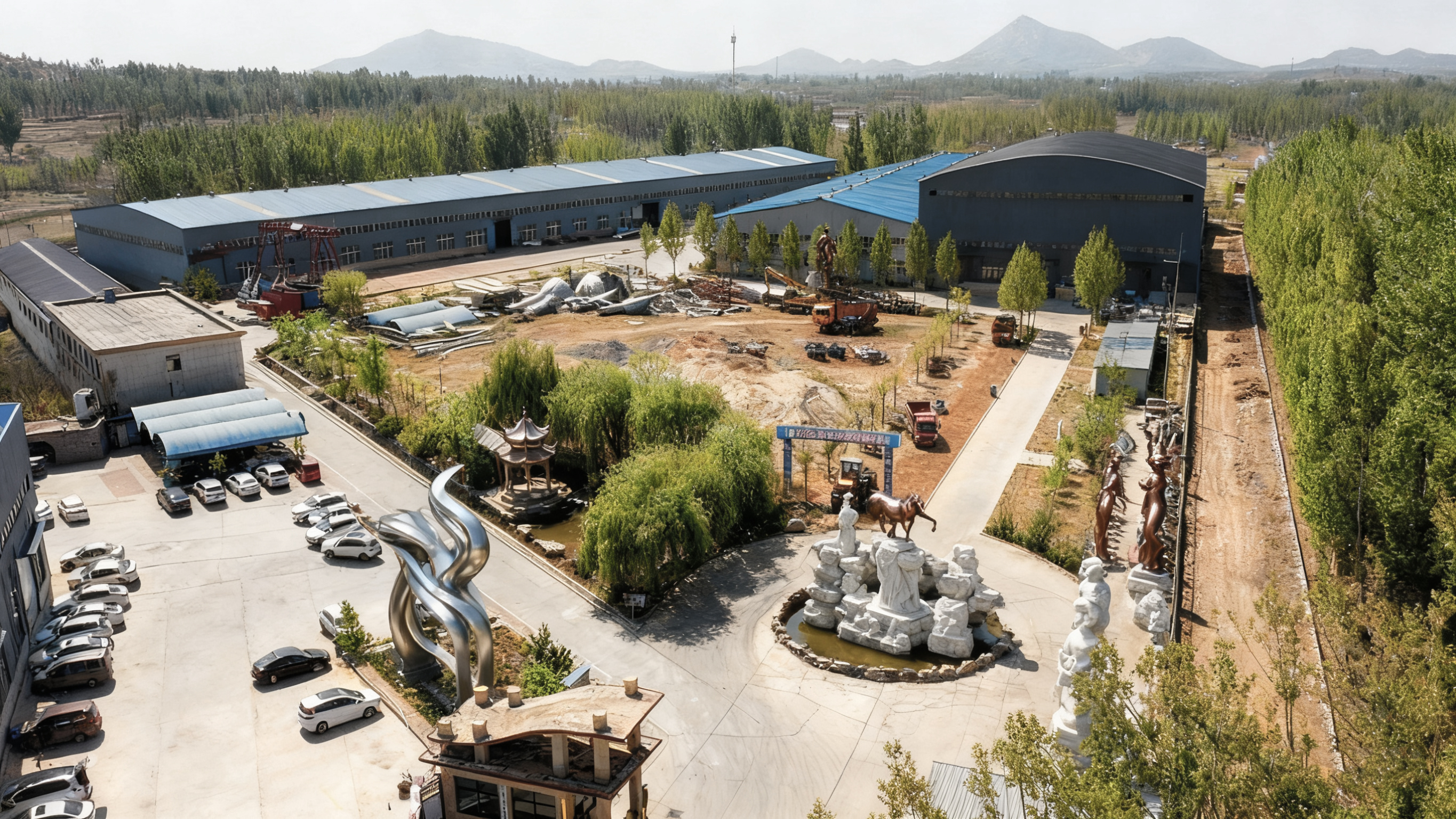
Bronze and stainless-steel sculpture processing workshop: fabrication is a mix of casting, welding, polishing and finishing disciplines.
Technical Explanation: Main Material Families and Model Lines
Understanding the material families is the core technical step in custom sculpture procurement. The table below summarizes the main customized model lines and their typical application fields.
| Model Line | Material | Typical Categories | Size Range | Surface & Technique | Typical Industries |
|---|---|---|---|---|---|
| XYS-Stainless-Custom | 304/316 stainless steel | Metal sculpture, abstract art, garden decoration, urban landmark | Customized height, 1 m to 20 m (large scale) | Mirror polished, brushed, painted, electroplated; hand-forged, precision welding, internal steel skeleton | Urban public art, modern architecture, seaside landscape, luxury hotel, shopping mall |
| XYS-Bronze-Custom | High-purity cast bronze (copper content greater than 85% to 95%) or brass | Bronze statue, animal sculpture, religious statue, figurine | Customized height, 50 cm to 10 m (life size) | Patina, gold leafing, high polished, antiqued; lost-wax casting, professional welding | Public art, museum, real estate, religious institutions, private collection |
| XYS-Corten-Custom | Authentic corten steel (ASTM A242 / A588 weathering steel) | Landscape sculpture, garden edging, fire pit, metal screen, planter box | Customized height/width, from small garden pieces to large architectural structures | Natural pre-rusted finish (stable patina) or raw self-weathering finish | Landscape architecture, public parks, modern garden design, industrial style decor |
| XYS-Stone-Custom | Natural white marble, granite, travertine | Garden ornament, fireplace mantels, stone fountain, religious carving, marble statue, carved marble bathtub | Customized width/height/depth | Hand-carved, honed, high-gloss polished, acid-washed | Landscape design, architectural construction, home and garden, temple decoration |
| XYS-Monument-Custom | Natural granite (Shanxi Black, G603, Blue Pearl) | Granite tombstone, European style, American style, kerbset monument | Standard 80x60 cm, 120x80 cm, or customized | 100% mirror polishing, laser engraving, sandblasting | Cemetery construction, memorial stone engineering, landscape architecture, funeral industry |
A few technical points matter for procurement decisions. Stainless steel sculptures intended for coastal or humid environments generally benefit from grade 316, which offers higher corrosion resistance. Bronze sculptures with high copper content develop a characteristic patina over time, which many buyers value for classical or historical contexts. Corten steel forms a stable, protective rust layer that requires no painting and continues to age naturally. Natural stone and granite offer long-term color stability and are widely used in garden, architectural and memorial settings.
On the fabrication side, the integration of 3D modeling with CNC precision processing allows buyers to review a design before production starts. Traditional hand-carving and hand-polishing are then applied to preserve the artistic detail that digital processes cannot fully replace. This hybrid workflow is central to how Chinese sculpture manufacturers have scaled from workshop craft to export-oriented production.
Application and Use Cases
Hotel and Commercial Spaces
Custom hotel lobby sculpture and entrance installations are a major application segment. In luxury hotel and resort projects, sculpture functions as an artistic landmark and a marker of space identity. The typical US application scenario includes luxury hotel projects, resort projects, landscape architecture projects, public art installations and private customized sculpture projects. Supporting equipment includes installation foundations, steel structure supports, LED lighting systems and lifting and transportation equipment.
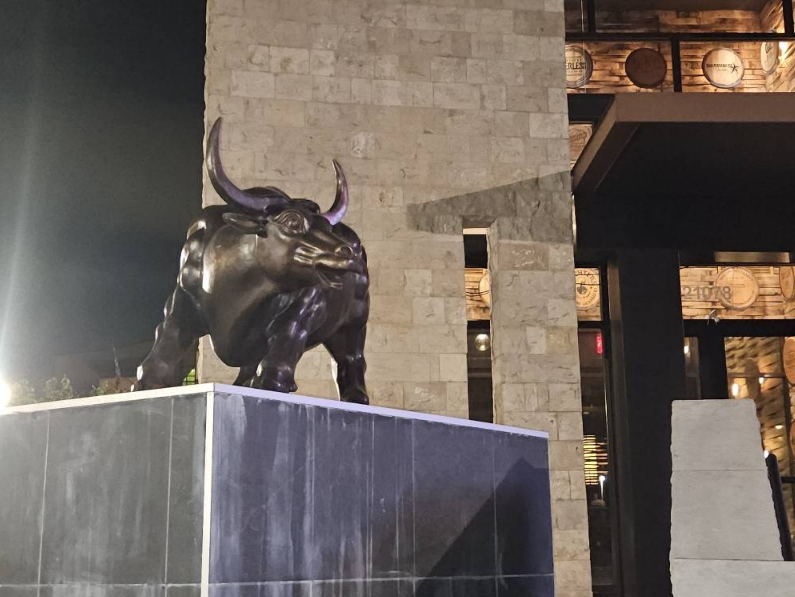
Custom sculpture at a hotel entrance: the piece becomes part of the architecture, not just decoration.
Public Art and Urban Landmarks
Stainless steel sculptures are widely deployed in urban public art, modern architecture, seaside landscape and shopping mall environments. Their corrosion resistance and structural strength make them suitable for large outdoor sculptures that must endure weather and public interaction. Custom animal sculptures and figurative bronze statues, by contrast, are frequently chosen by museums, real estate projects, religious institutions and private collectors seeking a classical or narrative quality.
Landscape and Garden Projects
Corten steel products, including garden edging, fire pits, metal screens and planter boxes, fit modern garden design and landscape architecture. The material ages naturally and requires minimal maintenance, which makes it practical for parks and residential landscape upgrades. Natural stone pieces, such as marble statues, stone fountains and carved marble bathtubs, serve both architectural decoration and high-end interior application.
Memorial and Cemetery Projects
Granite monuments remain a distinct subcategory within custom sculpture. This product is intended for the cemetery construction, memorial stone engineering, landscape architecture and funeral industries, with customization options for individual or family memorials. Standard sizes include 80x60 cm and 120x80 cm, and surfaces can be mirror polished, laser engraved or sandblasted.
Market Trend Analysis
Several verifiable market signals are worth noting for buyers planning custom sculpture projects.
- Market size: The global art and sculpture market is estimated at approximately USD 61.83 billion in 2026 (Business Research Insights).
- Product relevance: Sculptures account for about 21% of global art acquisitions by transaction volume.
- US market: The United States sculpture market reached an estimated USD 5.8 to 6.2 billion in 2024.
- Bronze segment: The global bronze sculpture commission market reached USD 1.47 billion in 2024 (Dataintelo).
- Public art budgets: Over 80% (80.2%) of public art open call projects in North America have budgets below USD 250,000 (CODAworx, 2024).
- Public funding: U.S. Federal Cultural Agencies budget for 2025 is USD 708.8 million, including USD 207 million for the NEA.
- Trade classification: Original sculptures under HS Code 9703 often bypass EU anti-dumping duties, while mass-produced items under HS Code 8306 face higher scrutiny.
Two patterns stand out. First, public art procurement in North America skews toward mid-sized budgets, which means cost-efficient fabrication and reliable logistics matter as much as artistic quality. Second, trade classification can materially affect landed cost, so buyers should confirm the classification of their specific commission with the manufacturer and customs broker.
Customization demand is also becoming a structural feature of the market. Architects and developers no longer accept a limited catalogue; they expect sculpture design services that respond to site conditions, brand identity and cultural context. In response, manufacturers are strengthening their design and engineering capabilities, including in-house R&D teams and 3D design confirmation workflows.
Comparison with Traditional Solutions
The most common comparison in custom sculpture procurement is between bronze and stainless steel. Bronze offers a warm, classic reddish-brown tone and develops an antique green patina over time, which suits traditional and historical styles. However, bronze is heavier, costs more, and needs protection in humid or coastal environments. Stainless steel provides a modern silver-gray finish, far higher corrosion resistance (especially grade 316), and is nearly maintenance-free, making it better suited for large or structural designs. The trade-off is that stainless steel lacks the classical antique warmth of bronze.
Another comparison is between purely traditional hand-carving and the hybrid method now used by export-oriented manufacturers. The integration of traditional hand-carving with modern 3D modeling and CNC precision processing allows design confirmation before production, reduces dimensional error, and still preserves hand-finished artistic detail. The limitation is that complex artistic surfaces still require manual finishing, which adds production time and requires experienced craftsmen. Buyers should therefore treat design iteration and production scheduling as linked variables.
There is also an economic boundary worth noting. Single-piece custom orders are generally accepted, but ordering multiple pieces at once is recommended to share mold and shipping costs. For large outdoor sculptures, the internal steel skeleton, foundation design and lifting equipment must be coordinated with the chosen material. These realities are not obstacles; they are simply the parameters within which a successful custom sculpture project is scoped.
Future Outlook
Several directions are likely to shape the custom sculpture industry over the next few years.
- Digital-first design workflows. 3D visualization and clay model confirmation will continue to reduce miscommunication between buyers, designers and fabricators, making international commissions more predictable.
- Environment-driven material selection. With coastal projects requiring corrosion resistance and heritage contexts demanding classical patina, material grading will become an increasingly explicit part of the procurement conversation.
- Budget-aware public art. With more than 80% of North American public art open calls under USD 250,000, efficient fabrication and logistics will be decisive criteria for winning commissioned work.
- Trade and compliance awareness. The distinction between original sculptures (HS 9703) and mass-produced items (HS 8306) will continue to influence sourcing strategy, especially for EU-bound projects.
- Full-service competition. Suppliers that can coordinate design, production, transport and installation guidance will gain preference as buyers seek to reduce project-management overhead.
For the buyer, the practical implication is straightforward: custom sculpture is a specialized procurement process, and the quality of the outcome depends less on discovering a single artistic genius and more on the rigor of material selection, fabrication verification and installation planning.
FAQ
Can you customize your sculptures? What is the minimum order quantity?
Full customization is supported. Customers provide design drawings, photos or concepts, and the manufacturer produces a 3D design draft for confirmation before production. Single-piece orders are accepted, with more favorable pricing for bulk orders. The customization process follows this sequence: provide drawings/concepts, 3D design confirmation, prototyping (optional), production, then shipping. For estimated lead time, the specific timeframe is assessed based on size and manufacturing process, and can be confirmed at the quotation stage.
Can you offer door-to-door delivery?
Door-to-door delivery is available. After the buyer provides the detailed delivery address, the supplier will quote the corresponding shipping fee for direct delivery to the project site. This approach is particularly relevant for large outdoor sculptures and hotel installations where local transport coordination can be complex.
How is the packaging handled, and who is responsible for damage during transportation?
Export packaging is designed for international transit. The manufacturer uses sturdy wooden crates and metal strips for external packaging, and shockproof plastic film internally to protect the product surface. In addition, All Risks insurance can be purchased according to the buyer's requirements. In the event of damage, the compensation process is handled through the insurance company; if the damage is caused by packaging failure, the manufacturer takes full responsibility.
Can buyers visit the factory before placing an order?
Factory visits are supported. After the buyer shares flight details, the manufacturer can arrange pickup at the nearby airport and drive the visitor to the factory. For buyers evaluating custom sculpture fabrication, a physical visit provides direct evidence of workshop capability, material quality and production capacity.
Reference document: Company Profile & Available Production Capabilities brochure. Readers can access the publicly available version at: Download PDF.
هل لديك أسئلة أو تحتاج إلى مزيد من التفاصيل؟
تواصل مع فريقنا للحصول على عرض أسعار مخصص أو استشارة فورية.
طلب عرض أسعار
املأ النموذج أدناه وسيتواصل معك فريقنا بعرض مقترح مخصص.
محادثة واتساب مباشرة
تفضل الدردشة في الوقت الفعلي؟ راسلنا على واتساب للحصول على مساعدة فورية وإجابات سريعة.
- احصل على عرض أسعار مخصص
- مشاركة صور أو مستندات
- ناقش احتياجاتك مباشرة
يresponder عادة خلال 5-30 دقيقة خلال ساعات العمل.