
Custom Shopping Bag Handles: A Buyer's Comparison of Paper, Cotton, Ribbon, and Die-Cut
Handle choice is the point where a custom shopping bag stops being a printed surface and becomes a load-bearing product. Paper twisted, flat paper, cotton rope, ribbon and die-cut handles can all appear on the same specification sheet, yet each one changes how a bag carries weight, how it stacks before packing, how it feels in the hand and how the brand reads at the counter. For buyers moving from research into evaluation, the useful question is not which handle looks most premium, but which handle fits the load, the channel and the finishing plan at the same time.
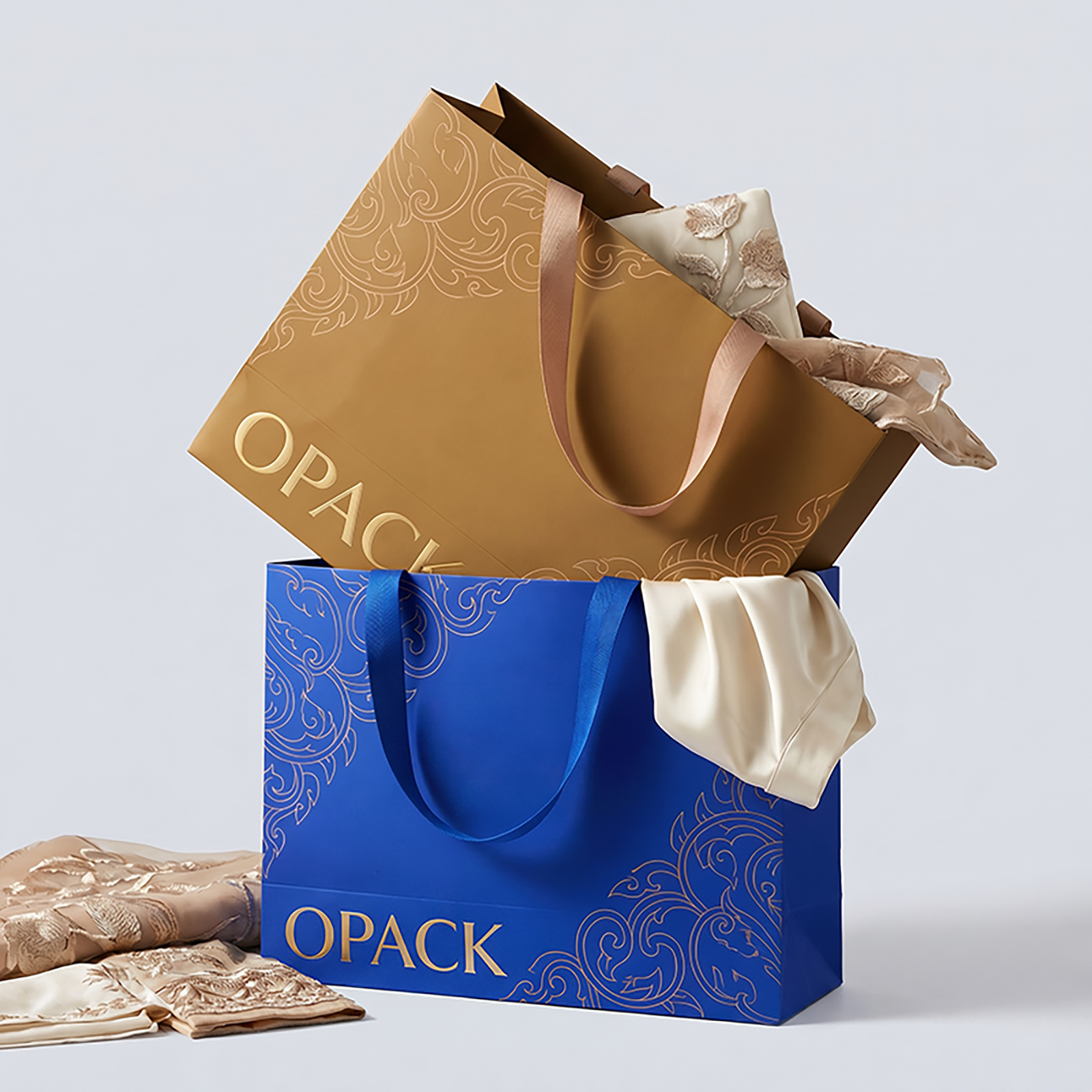
Opack is a custom packaging manufacturer based in Longgang, Wenzhou, China, founded in 2010, producing paper shopping bags, folding cartons, rigid boxes, mailer boxes and paper tubes for apparel, cosmetics, retail, gifting and jewellery buyers. Its PSB custom shopping bag range lists five handle options — paper twisted, flat paper, cotton rope, ribbon and die-cut — inside a stated weight capacity of 2–15 kg that depends on paper thickness and structure. That single specification line already contains the core of the buying decision: the handle is one variable, and the paper body it is anchored to is another.
The problem: one handle rarely fits an entire bag programme
Most retailers and brand owners do not buy a single custom paper bag. They buy a family of sizes for one season or one year, and they buy them for several touchpoints at once: the store counter, the gift-with-purchase, the trade show stand, the e-commerce pack-out. The simplest sourcing route is to standardise on one handle across the whole family, because it reduces SKU complexity, simplifies the artwork pack and keeps the reorder simple.
That simplification has a cost. A handle sized and reinforced for a bottled-goods bag is over-specified on a light cosmetics bag, and the excess shows up in material cost, carton volume and freight. A handle chosen for the lightest item in the range is under-specified on the heaviest, and the excess shows up later — at the till, in the customer's hand, and in replacement bags issued by store staff.
The opportunity sits in treating the handle as a variable inside an existing specification rather than a separate design project. Because the PSB platform is fully customisable in size, material, printing and finishing, the handle can be matched per bag size instead of per brand. A three-size range can legitimately use three different handles, provided the buyer understands what each one does.
The five handle options compared
The comparison below describes how each handle behaves in use and where it commonly fits. It is a decision aid rather than a ranking: the correct option depends on the load the bag will carry, the environment it is handed over in, and the finishing already planned for the bag face.
| Handle | How it is built | Load behaviour | Finishing interaction | Common fit |
|---|---|---|---|---|
| Paper twisted | Twisted paper cord anchored into a reinforced top fold | Spreads load across two attachment points; the familiar retail-bag grip | Can be produced in the same or a contrasting paper colour; sits above printed and laminated bag faces | Apparel, general retail, trade shows and events |
| Flat paper | Flat paper strip folded into the top edge of the bag | Lies flat, so bags stack and carton efficiently before use | Leaves the bag face unobstructed for large print areas | Retail, e-commerce pack-out, high-volume repeat programmes |
| Cotton rope | Round rope knotted through reinforced openings | Flexible round grip that follows the hand | Usually paired with reinforced eyelets and premium paper grades | Gift, cosmetics, premium retail |
| Ribbon | Flat ribbon knotted or stitched at the top edge | The strongest decorative signal of the five; a presentation-first component | Pairs naturally with hot stamping, embossing and soft touch lamination | Gift, cosmetics, luxury retail |
| Die-cut | Handle cut directly from the bag body | No added component and no separate attachment point | Depends on board stiffness; the handle becomes part of the printed surface | Gift, light retail, promotional and event bags |
Opack's published PSB specification lists these five handle options and a 2–15 kg capacity range, but it does not publish a separate load rating for each handle. During evaluation, the combination — paper grade plus handle — is what should be confirmed, ideally on a physical sample carrying the product the bag is intended for.
A four-question framework for matching handle to project
1. What is the carried load, not just the product weight?
A bag carries the product plus whatever the customer adds before leaving. The PSB range is specified at 2–15 kg depending on paper thickness and structure, which means the range is an envelope rather than a guarantee at either end. Buyers should specify the load they expect at the point of handover, then confirm the paper grade that supports it. The lightest size in a cosmetic range and the heaviest size in an apparel range rarely need the same construction.
2. How is the bag handled before the customer touches it?
Flat paper handles lie flat and stack, which affects how many bags fit in a carton and how quickly staff can open a pack at the till. Twisted handles add bulk at the top of the bag, and that bulk shows up in cartoning density and shelf storage. Die-cut handles leave the bag as a single piece with nothing protruding. For e-commerce pack-out and for trade shows and events — both named in the PSB application list — compact packing and fast assembly at the stand can matter as much as the grip itself.
3. What finishing is already planned for the bag face?
The PSB finishing list covers hot stamping, spot gloss UV, soft touch lamination, holographic foiling, embossing, debossing, matte lamination and gloss lamination, applied over CMYK, Pantone, UV, offset or screen printing. Handles are separate components, so most combinations are technically possible, but the sequence deserves early attention: heavy foil or soft touch changes the surface feel that the hand passes over on the way to the grip, and a die-cut handle places the cut edge inside the printed or laminated area rather than above it.
4. What should the handle signal about the brand?
Ribbon and cotton rope read as premium components; twisted paper reads as conventional retail; die-cut reads as minimal and product-led. That signal is a marketing decision, but it has a procurement consequence. Every added component — rope, ribbon, reinforced eyelet — is another item to specify, sample and hold consistent across production batches. Handles that cost nothing extra to add still cost something to control.
Application fit by industry
Apparel
Apparel bags are handled in high frequency, stacked in storerooms and often reused by the customer. Flat paper handles suit cartoning efficiency and high-volume repeat programmes; paper twisted handles suit the visible retail moment. For flagship or gifting tiers inside the same programme, a ribbon or cotton rope handle marks the difference without changing the rest of the bag specification.
Cosmetics and gift
Cosmetics and gift bags usually carry light loads, so the handle can lean toward presentation. Ribbon and cotton rope are the natural choices, and both sit comfortably alongside hot stamping, embossing and soft touch lamination. Die-cut handles also work here because the lighter load puts less demand on board stiffness, and the one-piece look supports a restrained design.
Retail and e-commerce
General retail covers the widest load spread, so it benefits most from handle differentiation across sizes. For e-commerce, the shopping bag is usually packed inside an outer carton, which puts a premium on handles that do not crush or tangle; flat paper handles are the practical default, with twisted handles reserved for bags that ship pre-assembled or go direct to store.
Trade shows and events
Event bags are produced in volume, stored flat until the stand opens, and handed out in a burst over a few days. Flat packing and fast assembly matter more than long-term grip comfort. Die-cut handles remove an assembly step entirely, and flat paper handles keep cartons compact — both are sensible for short-life, high-throughput distribution.
Reading the 2–15 kg range correctly
The PSB weight capacity of 2–15 kg is stated as depending on paper thickness and structure, and that qualifier carries three practical implications for buyers.
- The handle is not the only load path. The top fold and the paper grade carry the weight with it, so a heavier handle on a light board does not automatically raise capacity.
- 15 kg is the upper boundary of a range, not a starting assumption. Bags intended for the top of that range need a heavier grade and a validated structure, confirmed on a sample rather than inferred from the specification sheet.
- Changing the handle can change behaviour even when the paper stays the same, because the attachment method differs between a folded paper strip, a knotted rope and a cut-out.
There is also an environmental boundary. Opack's application guidance states that the bags operate in dry conditions for storage and shipping, and should avoid long-term high humidity, direct sunlight, rain soaking and chemical contact. This applies to the paper body rather than to any individual handle, but it matters when bags are warehoused in unheated space or handed out at outdoor events.
Market context: premium demand and traceability pressure
Two forces are shaping handle decisions at the same time. The first is premiumisation. Zion Market Research values the global paper-based consumer bags market at USD 5.29 billion in 2023 and projects a CAGR of 13.8% for the premium price segment through 2034 — the segment built on higher grammage paper, custom design, reinforced handles and certification. The second is traceability. The EU Deforestation Regulation, effective 2025, requires paper packaging to be traceable back to geolocated forest plots, which adds documentation work to every material in the bill.
Certification recognition supports the first force. FSC (Forest Stewardship Council) certification is the primary industry standard for sustainable sourcing of paper bags and is recognised by 56% of consumers worldwide, according to FSC. Opack states that its materials are FSC-compliant and that production uses eco-friendly water-based printing inks and low-VOC adhesive materials — relevant here because added components such as cotton rope or ribbon introduce another material into a specification that already has to be documented.
Where the supply side stands: Opack's specification evidence
For buyers evaluating rather than browsing, the usable evidence is the manufacturing and commercial data behind the handle list. Opack operates a 10,000 m² facility in Longgang, Wenzhou, Zhejiang, with 160 employees, a five-person R&D team, a monthly capacity of 1,000,000 units and an annual output of 10,000,000 units, exporting 80% of production to the EU, US and Middle East. The PSB range carries a MOQ of 1,000 pieces and a stated production lead time of 12–18 days, with 100% quality check and multi-channel after-sales support by online chat, WhatsApp, telephone and email.
A Panama-based brand owner case illustrates what that means across a year. The customer buys custom packaging for its own fashion and lifestyle brand — retail, gift and promotional packaging — and placed an annual purchasing partnership covering more than 30,000 paper bags, 3,000+ paper boxes and 10,000+ stickers, with a total annual purchase value above USD 12,000. The recorded outcome is consistent print quality across multiple production batches, stable lead times and zero after-sales complaints. The case does not break the handle specification down by bag, which is precisely why a component-based handle decision should be sampled rather than assumed: batches stay consistent when the component is locked into the specification.
How this compares with conventional approaches — and where it does not fit
Standardising on a single handle across a range is the conventional approach, and it remains defensible for small catalogues where the load spread is narrow. Differentiating handles by size costs more planning time but reduces the over-specification that inflates material and carton volume on light bags. Neither approach is inherently better; the deciding factor is how wide the load spread is across the range.
Relative to low-minimum suppliers, the comparison is about order size rather than capability. Teal Packaging publicly states that it makes custom paper shopping bags starting at 50 units, with standard production from about 7 business days after proof approval. Opack's 1,000-piece MOQ and 12–18 day lead time fit programme buying rather than pilot runs. Both figures are self-reported commercial terms and are not normalised across suppliers, so they indicate positioning rather than a like-for-like benchmark.
Origin preference is a separate axis. EcoEnclose states that its paper bags are made in the USA by default, while some die-cut handle bags and reusable shopping bags are made overseas by default — a reminder that the die-cut format has its own supply geography. On material language, Cubit Packaging publishes kraft paper at 70–170 GSM and recycled paper at 80–100% post-consumer content, with die-cut, twisted or flat handles, which is a useful cross-check when a buyer is comparing stock descriptions between suppliers.
Boundaries worth stating plainly. A 1,000-piece MOQ will not suit a single-store pilot. The 12–18 day figure is a production lead time and should be treated separately from transit to the EU, US or Middle East. The top of the 2–15 kg range requires a heavier paper grade and a validated structure, not simply a sturdier handle. Ribbon handles are presentation-first and are generally not the right choice for heavy contents. Die-cut handles depend on board stiffness and are typically limited to lighter loads. And paper bags as a category are specified for dry conditions, so unheated storage or outdoor distribution needs planning.
Future outlook
Three developments are likely to shape handle specification over the next buying cycles. First, traceability documentation will move from a compliance afterthought to a line item in the specification, and specifications with fewer added components will be simpler to document — an argument in favour of die-cut and paper handles in markets where EUDR evidence is required. Second, premium growth in the segment will keep pushing decorative components such as ribbon and cotton rope into ranges that previously used paper only, which raises the sampling burden rather than lowering it. Third, buyers are increasingly treating handles as a per-size variable rather than a brand-wide constant, because the cost of over-specification has become visible in freight and carton planning.
None of these changes the underlying discipline. A handle is confirmed by a paper grade, an attachment method and a tested load — in that order — and the specification sheet is the starting point, not the answer.
FAQ
Which handle type suits a custom paper bag carrying around 5 kg?
For loads in the middle of the PSB range, a paper twisted or flat paper handle anchored into a reinforced top fold is the conventional starting point, because both spread load across two attachment points and both are produced in the same paper family as the bag. The PSB range is specified at 2–15 kg depending on paper thickness and structure, so the paper grade must be confirmed alongside the handle rather than after it. On a 5 kg load, the combination matters more than either element alone.
Are die-cut handles suitable for heavy products?
Die-cut handles are cut from the bag body itself, so they rely on the stiffness of the board rather than on a separate component. That generally makes them suited to lighter contents — gift, light retail, promotional and event bags — and it also means the paper grade has to be stiff enough to hold the cut edge and any lamination applied over it. For heavier loads, a folded or knotted handle with a reinforced attachment is the safer specification, confirmed on a sample carrying the intended weight.
What MOQ and lead time apply to custom printed paper bags with a logo?
The Opack PSB custom shopping bag range carries a MOQ of 1,000 pieces and a stated production lead time of 12–18 days, with a monthly capacity of 1,000,000 units and 100% quality check. Production is exported to the EU, US and Middle East, and 80% of output is exported overall. Buyers should treat the 12–18 day figure as production time and confirm shipping transit separately for their destination.
Can cotton rope or ribbon handles be combined with hot stamping and soft touch lamination?
The PSB finishing list includes hot stamping, spot gloss UV, soft touch lamination, holographic foiling, embossing, debossing, matte lamination and gloss lamination, applied over CMYK, Pantone, UV, offset or screen printing. Handles are separate components rather than part of the printed surface, so the finishing and the handle are specified independently. The practical check is at proof stage: confirm how the finished surface interacts with the handle attachment point, particularly where a die-cut opening sits inside a laminated area.
How should custom paper bags with handles be stored before use?
Opack's application guidance specifies dry conditions for storage and shipping, and advises avoiding long-term high humidity, direct sunlight, rain soaking and chemical contact. The constraint applies to the paper body rather than to any single handle type, which means storage conditions matter for flat paper, twisted, cotton rope, ribbon and die-cut bags alike. Where bags are held in unheated warehouse space or distributed outdoors, those conditions should be planned for in advance.
Opack publishes a company profile covering its manufacturing base, product range and capability overview, available as a PDF: Opack company profile.
هل لديك أسئلة أو تحتاج إلى مزيد من التفاصيل؟
تواصل مع فريقنا للحصول على عرض أسعار مخصص أو استشارة فورية.
طلب عرض أسعار
املأ النموذج أدناه وسيتواصل معك فريقنا بعرض مقترح مخصص.
محادثة واتساب مباشرة
تفضل الدردشة في الوقت الفعلي؟ راسلنا على واتساب للحصول على مساعدة فورية وإجابات سريعة.
- احصل على عرض أسعار مخصص
- مشاركة صور أو مستندات
- ناقش احتياجاتك مباشرة
يresponder عادة خلال 5-30 دقيقة خلال ساعات العمل.