
Custom Steel Belt Manufacturing: BPS/EPS Capability Review
Steel belts are simple in operation, but rarely simple in specification. A belt that works for chocolate cooling will not automatically perform for chemical pastillation, and a belt designed for a resin flaker may not suit a food tunnel oven. When the application moves beyond standard dimensions, the supplier's manufacturing capability becomes the real purchasing criterion. This article reviews the customization range, OEM production mode, application evidence, and delivery parameters of BPS/EPS, the steel belt brand of Shanghai Biquick Process Systems Ltd., based in Shanghai, China.
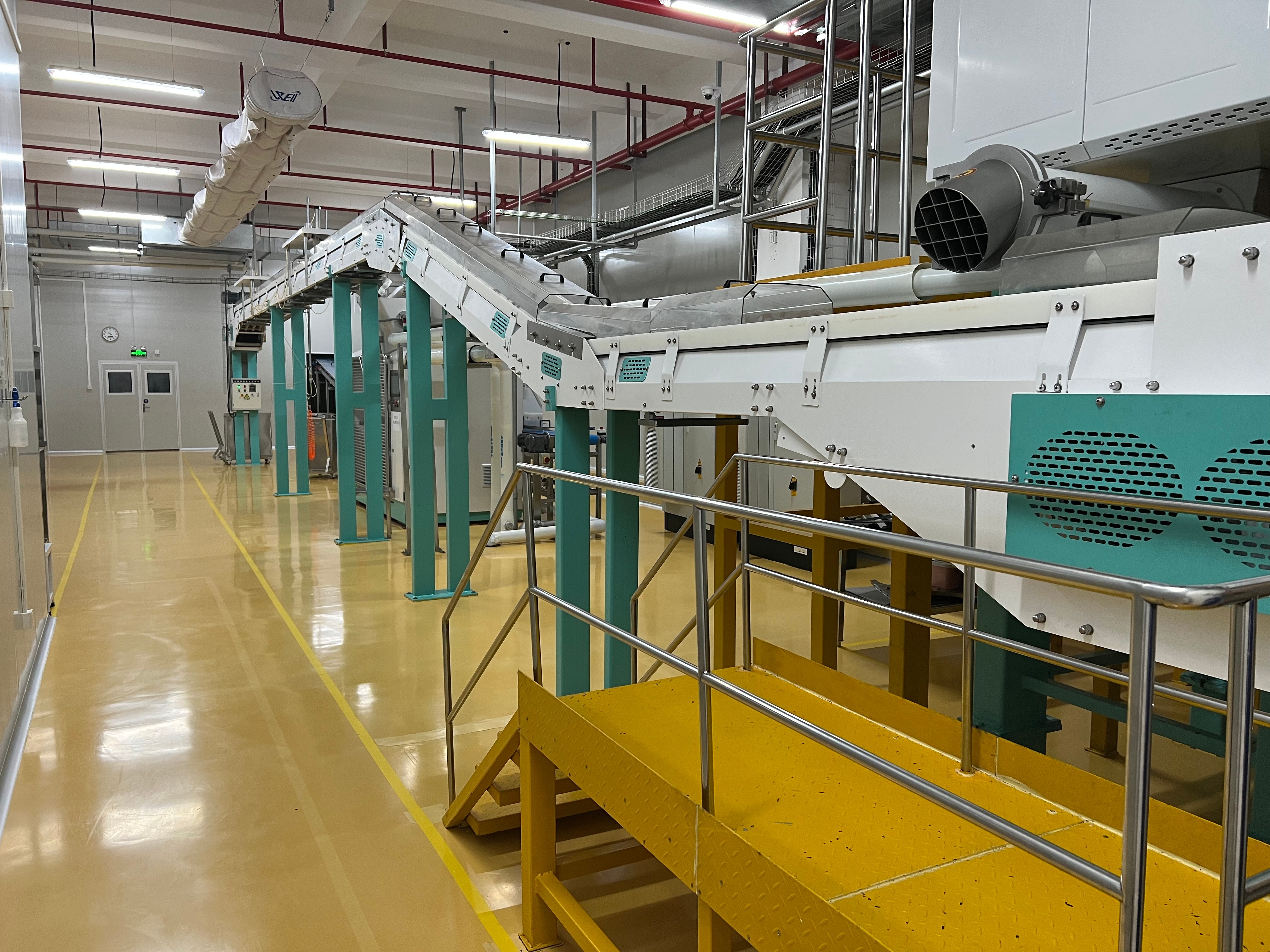
Chocolate steel belt conveyor: one example of application-matched belt engineering.
Why Standard Catalogue Specifications Are Not Enough
Most steel belt suppliers can quote standard widths, thicknesses, and surface finishes. The difficulty starts when a process requires a non-standard material, a precise hole pattern, a specific anti-stick coating, or a belt loop that exceeds typical length limits.
BPS/EPS is structured to handle such requests. The company was established in 2007 and operates a facility of about 2,000 m² in the Pudong New District of Shanghai. It employs more than 40 people, of whom 15 are in R&D, and positions itself as a supplier of steel belts plus complete process systems, including granulators, chocolate steel belt conveyors, bakery tunnel ovens, steam ovens, and resin steel belt coolers.
For a process buyer in the evaluation stage, the relevant question is not whether the supplier exists, but whether its production range, tolerances, and delivery model can support a specific line. The sections below describe what BPS/EPS actually builds and how it controls quality.
The Customization Range at BPS/EPS
BPS/EPS organizes its customization capabilities in seven areas: material, dimension, tolerance, surface, holes and attachments, process treatment, and working conditions.
Material Grades
The material options include 304/316L stainless steel for food and hygiene-sensitive lines, 718 nickel-based alloy for high-temperature and corrosive conditions, and carbon steel in food-grade, chemical-grade, and high-temperature-resistant grades. On special-requirement belts, 301, 310S, duplex steel, and high-hardness special alloys are also available, with certain custom structures rated for service up to 1,100°C.
Dimensions and Tolerances
Widths can be produced from 100 mm to 2,200 mm at any intermediate width. Thickness ranges from 0.4 mm to 3.0 mm, with 0.6, 0.8, 1.0, 1.2, 1.5, and 2.0 mm as the most frequently used values. Circumference is not limited to a standard range: belts are welded seamlessly into a circular shape, and a single belt loop can exceed 50 m in length.
Tolerance is a deciding factor for many buyers. BPS/EPS holds thickness to ±0.02 mm, length to ±0.05 mm per 10 m, and flatness to ≤0.02 mm per metre. For lines with indexing or registration requirements, positioning holes can be produced to ±0.01 mm.
Surface and Coating Options
Surface specifications include mirror, brushed, polished, and frosted finishes. Where release is critical, a food-grade anti-stick coating can be added, and PTFE-coated belts are available for chocolate, syrup, paste, colloid, and powder applications. The PTFE surface delivers a very low friction coefficient and high demoulding performance, while the steel substrate retains strength and dimensional stability.
Holes, Attachments, and Special Structures
Guide bars, baffles, fixture mounting positions, vacuum holes, and ventilation holes can be integrated during production. This range matters for automated lines where the belt must carry workpieces, register positions, or hold vacuum across the surface.
Process Treatment and Working Conditions
BPS/EPS can apply weld leveling, stabilization treatment to relieve internal stress, and anti-deviation treatment. Belts can be engineered for high-temperature service from -60°C to +250°C, for low-temperature, high-humidity, and Class 1000 dust-free environments, and for food hygiene compliance under FDA or CE requirements.
| Customization Dimension | BPS/EPS Capability |
|---|---|
| Material | 304/316L stainless; 718 nickel alloy; carbon steel (food-grade / chemical-grade / high-temperature); 301, 310S, duplex steel on special requirements |
| Width | 100–2200 mm (any width) |
| Thickness | 0.4–3.0 mm (common: 0.6 / 0.8 / 1.0 / 1.2 / 1.5 / 2.0) |
| Length | Any length; seamless circular welding; 50 m+ per single loop |
| Tolerance | Thickness ±0.02 mm; length ±0.05 mm/10 m; flatness ≤0.02 mm/m |
| Surface | Mirror / brushed / polished / frosted / food-grade anti-stick / PTFE coating |
| Holes & accessories | Positioning holes ±0.01 mm; guide bars, baffles, fixture positions, vacuum holes, ventilation holes |
| Working conditions | -60°C to +250°C; low temperature; high humidity; Class 1000 dust-free; FDA / CE food hygiene |
OEM and ODM Production: Supplying Machine Builders
BPS/EPS operates an OEM+ODM dual capability, with ODM as its primary mode. For mechanical OEMs, this means the belt is not chosen from a catalogue but designed to fit the equipment being built.
One documented example is a large baking equipment manufacturer that produces tunnel ovens and cooling lines. The company purchases 50–80 belts per year, in widths from 400 mm to 1,800 mm, and installs them as standard equipment on its own machines. The belts carry a 3–5 year warranty and reach an actual service life of 4–6 years. The OEM reports easier installation due to the integrated design, after-sales failure rates below 1%, customer satisfaction of 96% with 24–48 hour local response, and a 20% reduction in overall machine cost compared with using imported steel belts.
For other machinery builders, the implication is that production schedules, spare-part consistency, and warranty risk can be managed through the belt supplier rather than around it.
Application Evidence: Custom Belts in Real Production Lines
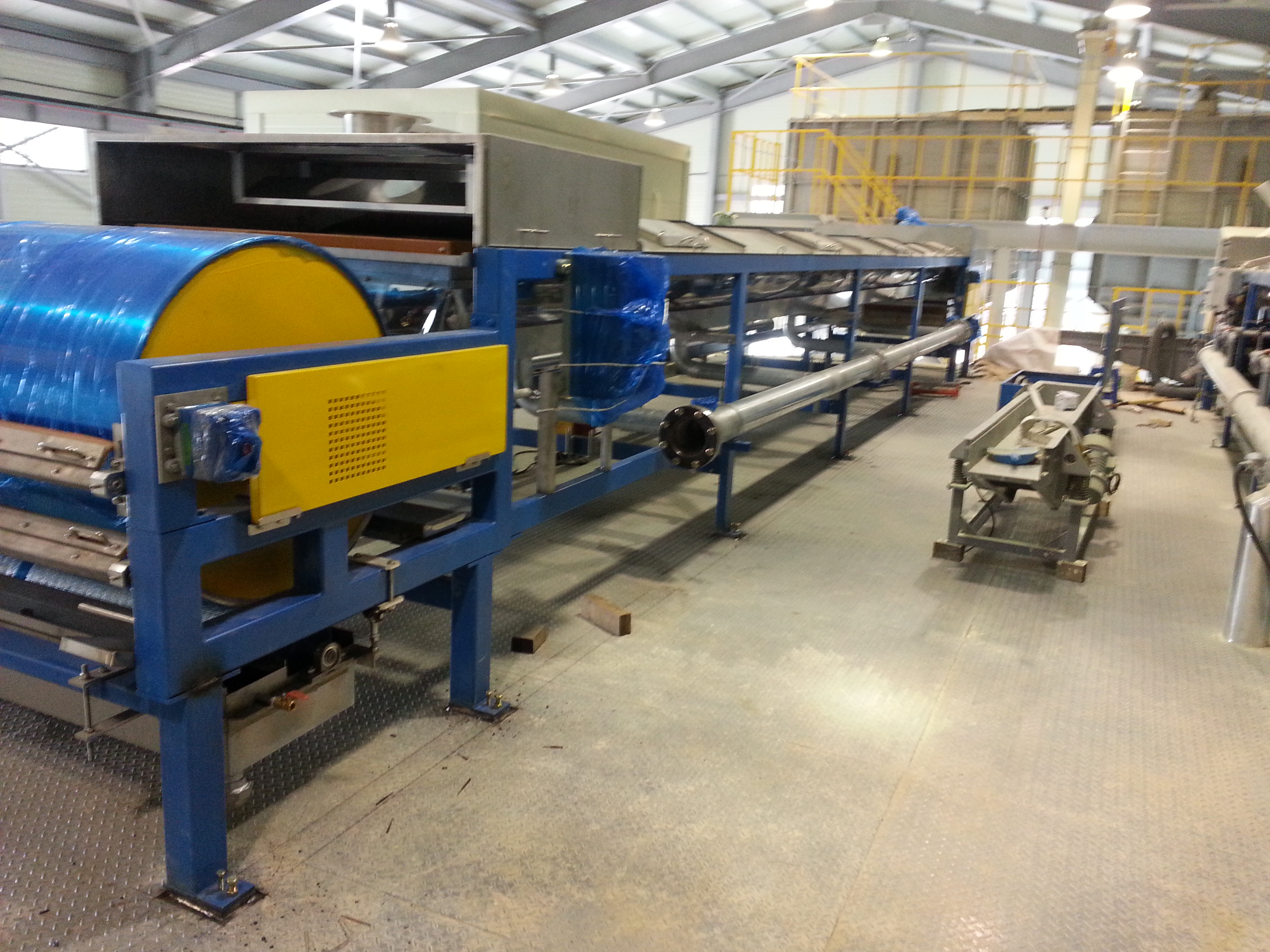
Sulphur pastillator: a chemical-process steel belt application.
Powder Coating Solidification and Flaking
An international powder coating manufacturer has accumulated more than 40 belts from BPS/EPS. The belts, 800–1,600 mm wide and 1.2–2.0 mm thick, run on melt extrusion, cooling/flaking, and conveying sections of powder coating solidification lines. Process temperature is 180–220°C, and service life is reported as 2.5–4 years. The manufacturer cites flatness ≤0.02 mm/m, uniform layer thickness, and yield improvement to 99.7%. Lifecycle cost is reported as 40% lower than imported belts and 25% lower than ordinary domestic products.
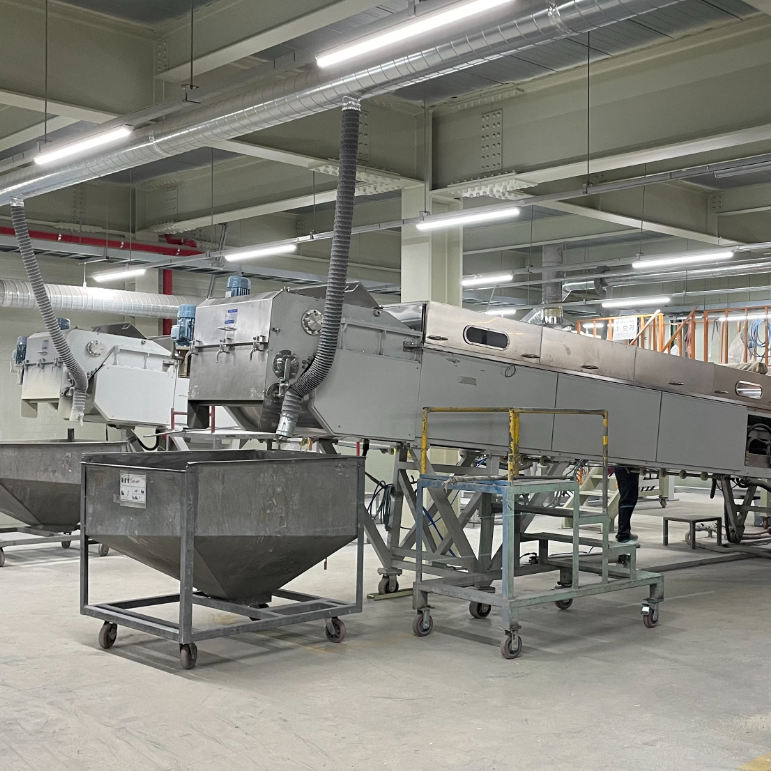
Powder steel belt flaker: used in solidification and flaking duty.
Bakery and Snack Food Processing
A leading food group in baking and snacks has accumulated more than 120 belts, with 5–15 belts per factory, in widths of 600–2,000 mm. The belts operate in tunnel ovens for cookies, bread, and pastries, in cooling lines, and on food-grade conveyors. Service life is 3–5 years, with some lines above 6 years. The reported results: cost 35–50% lower than imported belts, delivery shortened from about three months to two-to-four weeks, elongation ≤0.2%, no deviation and no debris, weld fatigue life of at least 2 million cycles, and a 60% reduction in downtime-related maintenance.
New Energy Materials: Lithium Battery and Diaphragm Lines
A new energy materials enterprise active in lithium battery and diaphragm production uses more than 10 belts in pole drying/curing lines and diaphragm cooling/conveying. Belt dimensions are 1,000–1,500 mm in width and 0.8–1.5 mm in thickness. The environment is dust-free at 160–200°C, and the belts have been in service for 2–4 years. They remain oil-free, dust-free, and easy to clean, meeting Class 1000 dust-free requirements. Thermal conductivity of 15–20 W/m·K, drying efficiency up by 25%, energy consumption down by 18%, and a 2–3% yield gain are attributed to stable dimensions and efficient heat transfer.
High-Speed Precision Conveying
A high-end cosmetics packaging group uses 15+ belts on high-speed automated assembly lines for pump heads, bottle caps, and syringe components. Belt dimensions are 8–12 m in length, 100–300 mm in width, and 0.6–1.0 mm in thickness. Reported data: hole position accuracy ±0.01 mm, cumulative tolerance over 10 m below 0.05 mm, repeat positioning accuracy ±0.05 mm, transmission efficiency ≥98%, and capacity increase of 15%. The belts replaced US-imported strips, cutting cost by 45% and delivery time from 12 weeks to 3 weeks.
| Application | Quantity / size | Key reported outcomes |
|---|---|---|
| Powder coating (chemical / new materials) | 40+ belts; 800–1600 mm; 1.2–2.0 mm | Flatness ≤0.02 mm/m; yield 99.7%; lifecycle cost 40% lower than imported |
| Bakery / snack food (leading food group) | 120+ belts; 600–2000 mm | Cost down 35–50%; delivery 3 months → 2–4 weeks; elongation ≤0.2%; weld fatigue ≥2 million cycles |
| New energy (lithium battery / diaphragm) | 10+ belts; 1000–1500 mm; 0.8–1.5 mm | Drying efficiency +25%; energy −18%; yield +2–3%; Class 1000 compatibility |
| Cosmetics packaging (precision conveying) | 15+ belts; 8–12 m; 100–300 mm | Hole accuracy ±0.01 mm; cost −45%; delivery 12 weeks → 3 weeks; transmission ≥98% |
Quality Control: From Incoming Coil to Finished Loop
Incoming inspection at BPS/EPS covers material spectral analysis, thickness, hardness and tensile strength testing, and surface defect inspection. In-process inspection covers full dimensional tolerance checking, flatness and straightness testing, and weld appearance plus non-destructive examination.
These two stages decide how predictable the belt will be in production. Consistency between belts and batches is often more important than the absolute value of a single measurement.
Capacity, Lead Time, and MOQ: Execution Parameters
Capacity is about 80–120 belts per month, based on a reference belt of 1,000 mm width and 10 m length; smaller specifications can reach 150 belts per month. Annual output also includes roughly 50–80 tons of steel strip, 10–15 steel belt laminating machines, and 5–8 cooling/forming systems.
Delivery is faster than the import route. Standard specifications with stock material take 7–10 days; customized specifications take 15–20 days; urgent orders can be completed in 5–7 days with an additional fee. Imported belts normally require 8–16 weeks, placing BPS/EPS at 4–8 times faster on custom work.
MOQ is one piece for both standard and customized belts. This supports trial orders and lowers the risk for a first-time buyer.
After-Sales Support and Maintenance Infrastructure
BPS/EPS responds online within 24 hours by phone, WeChat, or email, and provides on-site service in China within 48 hours. The service structure includes the Shanghai headquarters maintenance center, service centers in Beijing and Taiwan, China, and overseas agents in Europe and Southeast Asia.
Free services cover installation guidance, operation training, technical consultation, and drawing optimization. Repair services include belt repair, weld re-welding, and size correction, on-site or at the factory. Common spare parts are kept in stock, and emergency parts can be dispatched within 24 hours.
The standard warranty is 12 months, excluding human damage. Typical service life is 2–5 years. Value-added services include full lifecycle management, regular follow-up, operating-condition optimization, life prediction, old-belt recycling, and trade-in.
Comparison with Conventional Sourcing Routes
BPS/EPS can be understood by comparing it with two alternatives: importing from established European manufacturers and purchasing from smaller domestic workshops.
Imported belts from companies such as IPCO (formerly Sandvik Process Systems) and Berndorf Band Group remain a reference in high-end chemical plants. Their track record and brand heritage justify their position in risk-averse projects. BPS/EPS competes on documented cost differences of 20–50% across the cases above, on 15–20 day delivery instead of 8–16 weeks, and on local service response. The trade-off: BPS/EPS does not have the same decades-long installation history as the European leaders, so a buyer with an extremely conservative specification list may still prefer an imported belt.
Against ordinary domestic workshops, BPS/EPS has more defined tolerances, a wider material range, documented process treatments, and a service network. The boundary is capacity: with steel strip output around 50–80 tons per year, very large orders require advance planning and schedule coordination.
Market Context
The steel belt conveyor market is growing steadily. Research and Markets places the global steel belt conveyor market at USD 1.75 billion in 2025 and projects it to reach USD 3.15 billion by 2034, with a CAGR of 6.7% from 2026 to 2034. Another estimate, published by HTNXT, values the integrated steel belt systems market, including coolers, flakers, and pastillators, at about USD 1.2 billion in 2025.
The composition of this demand is gradually shifting from commodity conveying to process-specific systems. Buyers increasingly ask for belts that solve a temperature, release, or registration problem rather than simply carry a product from one station to the next.
Future Outlook
Three trends are visible in steel belt procurement. First, food-contact compliance is becoming stricter; FDA and EU food contact requirements push buyers toward documented material provenance. Second, automation creates demand for belts with precise holes, guide elements, and stable running behavior. Third, machinery OEMs look for suppliers that can deliver integrated design support and short lead times, not just a strip that fits a frame.
BPS/EPS has built its model around those requirements, with ODM as its core mode. The company exports 15–25% of output, with Southeast Asia, the Middle East, and Taiwan, China as growth markets. Its main constraint is capacity. If it can hold tolerances and lead times while scaling, it is positioned to grow inside the Asia-Pacific process equipment supply chain.
Technical specifications, including material grades and dimension tables, are available in the BPS/EPS English-language product brochure: View the BPS/EPS brochure.
FAQ
What steel belt materials can BPS/EPS customize?
BPS/EPS manufactures steel belts in 304/316L stainless steel, 718 nickel-based alloy, and carbon steel with food-grade, chemical-grade, or high-temperature-resistant grades. For special-requirement belts, the list expands to 301, 310S, duplex steel, and high-hardness special alloys.
What dimensional range can BPS/EPS produce?
The dimensional range covers 100–2200 mm in width, 0.4–3.0 mm in thickness, and any length with seamless circular welding. A single belt loop can be made longer than 50 m.
What tolerances does BPS/EPS hold on custom steel belts?
Thickness tolerance is ±0.02 mm. Length tolerance is ±0.05 mm per 10 m. Flatness is ≤0.02 mm per metre. Positioning holes are machined to ±0.01 mm.
Can BPS/EPS handle OEM and ODM projects?
Yes. BPS/EPS supports OEM and ODM, with ODM as the primary mode. One baking equipment manufacturer purchases 50–80 belts per year for integration into its own tunnel ovens and cooling lines.
What applications are covered by BPS/EPS steel belts?
Application coverage includes steel belts, granulators, chocolate steel belt conveyors, steel belt bakery tunnel ovens, steam ovens, resin steel belt coolers, sulphur pastillators, powder steel belt flakers, and single-belt and double-belt resin cooling flakers.
What is the lead time for custom steel belts from BPS/EPS?
Lead time is 7–10 days for standard specifications, 15–20 days for customized specifications, and 5–7 days for urgent orders with an additional fee. Imported steel belts typically require 8–16 weeks.
What is the minimum order quantity at BPS/EPS?
The MOQ is one piece for standard steel strips and one piece for customized steel strips, so buyers can run a trial order before committing to volume.