
Custom Street Light Comparison: A Verifiable Spec Framework
Custom street light procurement is a comparison problem that is usually handled as a purchase order. Two suppliers can quote the same nominal wattage, the same pole height and the same delivery window while describing two different products, because in non-standard outdoor lighting the appearance, structure, finish and control system are project variables rather than catalog constants.
The size of the category makes that distinction expensive to ignore. Grand View Research valued the global street lighting market at USD 9.1 billion in 2023 and projects USD 11.6 billion by 2030, a 3.6% CAGR, with LED fixtures accounting for 79.7% of 2023 revenue. CSIL separately notes that the ten largest lighting fixture companies together hold just over 20% of the market, which means most custom street light decisions are made among a long tail of manufacturers whose offers are not directly interchangeable.
This article reduces the comparison to four pillars, materials, electrical specifications, environmental tolerance and installation reliability, and tests each pillar against two documented model families: the BF-LSL-4000-120W custom decorative landscape street light and the BF-AGL-4000-60W ancient-style courtyard lamp.
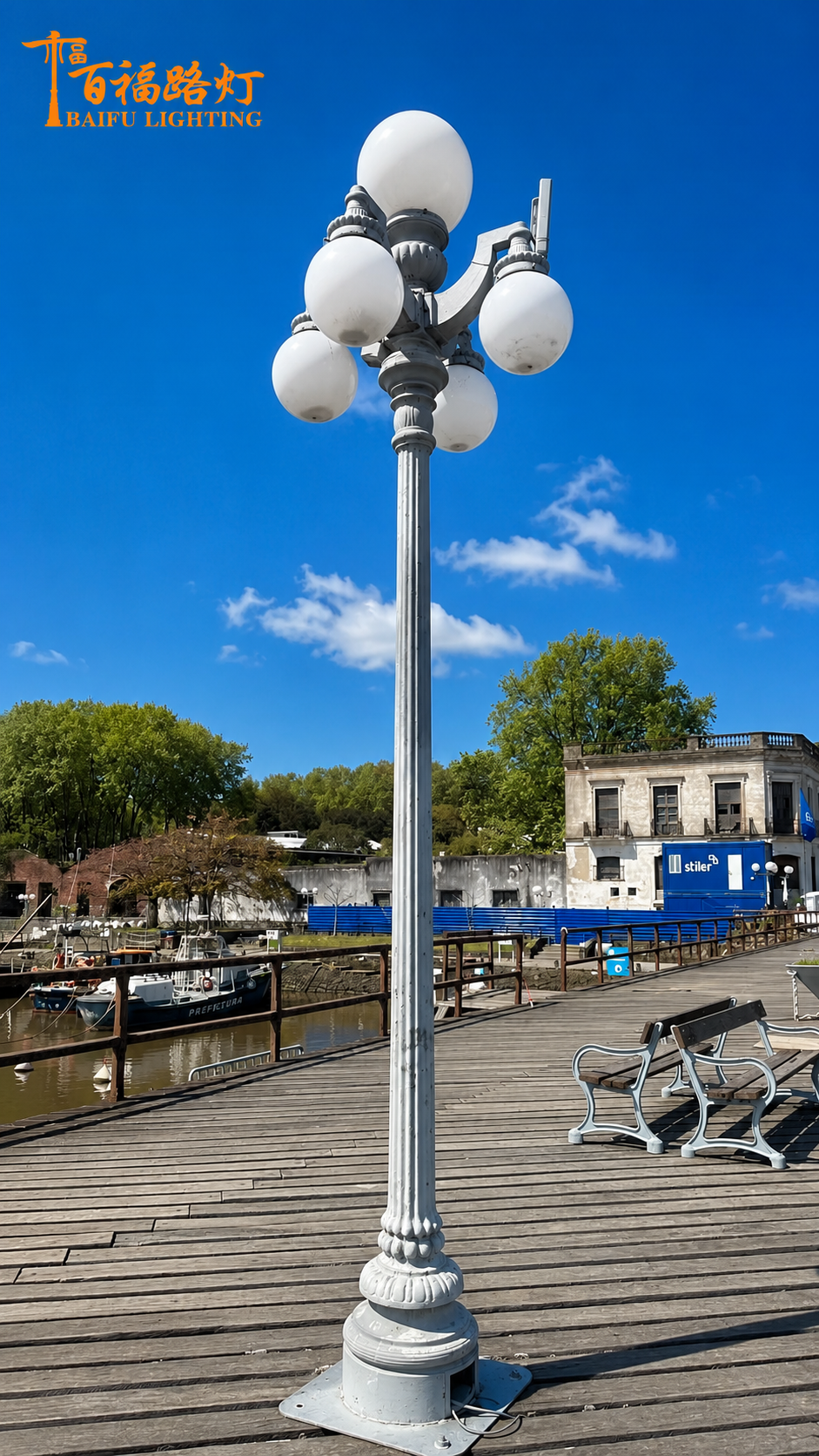
Custom decorative street lighting delivered for municipal roads and adjoining public areas.
Why Catalog Comparison Breaks Down in Custom Street Light Projects
Standardized comparison works when products are fixed. In custom work the variable list is long. BAIFU LIGHTING's stated customization scope covers lamp power and optical ratio, appearance design, surface treatment, lamp pole height and accessories, solar configuration, and control system. The BF-LSL-4000-120W data sheet lists appearance design, height, power, bracket structure, color, patterns, light source configuration and intelligent control systems as customizable items.
When eight or more parameters can move, a single wattage figure carries very little comparative information. The practical response is to define the comparison unit before comparing: decide which parameters are contractually fixed, which are constrained by the site, and which are open to supplier design. The four pillars below cover that split.
The Four-Pillar Framework at a Glance
| Pillar | Core question | Evidence to request | What fails if unchecked |
|---|---|---|---|
| Materials and structural build | What are the luminaire and pole actually made of? | Material list per component, coating process, pole structure drawing | Finish corrosion, delivered structure differing from the quoted structure |
| Electrical specifications | Do the electrical figures share a measurement basis? | Datasheet values for power range, voltage, efficacy, power factor, CRI, life | Comparing unlike numbers between two suppliers |
| Environmental tolerance | What exposure is the assembly designed for? | Operating temperature range, IP rating, wind-speed design basis | Water ingress, corrosion, structural fatigue at high-wind sites |
| Installation reliability | Will it fit the site as designed? | Foundation and anchor bolt layout, flange dimensions, mounting height, arm angle | Base rework, alignment problems, installation delays |
Pillar 1: Materials and Structural Build
Materials are the first point at which custom street light offers diverge, because the same label can describe a cast housing, a fabricated steel structure, or a combination of both.
The BF-LSL-4000-120W is a custom decorative landscape street light built from Q235 hot-dip galvanized steel, 304 stainless steel, die-cast aluminum lamp housings, high-transmittance tempered glass, stainless steel fasteners and an outdoor electrostatic powder coating. Its surface treatment is specified as hot-dip galvanized overall, followed by outdoor electrostatic powder coating, and its lamp pole structure can be conical, square, special-shaped or an artistic structure, with single-arm, double-arm, multi-arm or combined high-low lamp head brackets. Hollow patterns, luminous decorations, city logos and cultural totems are available as decorative features.
The BF-AGL-4000-60W belongs to the aluminum/steel cast outdoor lamp category. Its build uses a high-pressure cast aluminum lamp body, a Q235 hot-dip galvanized steel lamp pole, high-transparency tempered glass or a UV-resistant PC lamp cover, stainless steel fasteners and an outdoor electrostatic spray coating.
Three checks separate a verified offer from a claimed one:
- Request the material list per component, not per product: pole, lamp housing, lamp cover, fasteners.
- Ask whether hot-dip galvanizing is applied to the complete assembly before coating, and confirm the coating system to be used.
- Confirm which decorative elements are structural and which are applied, since decorative patterns and totems affect both fabrication and finish continuity.
A practical rule: if a quotation does not state the pole material, the coating system and the fastener grade separately, the comparison has not started yet.
Pillar 2: Electrical Specifications
Electrical data is where comparison is easiest to formalize, and also where headline figures can create false equivalence. The two reference models share most of their electrical baseline.
| Parameter | BF-LSL-4000-120W | BF-AGL-4000-60W |
|---|---|---|
| Product category | Custom decorative landscape street light | Aluminum/steel cast outdoor lamp |
| LED power options | 60W, 80W, 100W, 120W, 150W, 180W, 200W | 30W, 40W, 50W, 60W, 80W |
| Input voltage | AC 85-265V, 50/60Hz | AC 85-265V, 50/60Hz |
| Luminaire efficacy | ≥130 lm/W | ≥130 lm/W |
| Color temperature | 2700K, 3000K, 4000K, 5000K, 6000K | 3000K, 4000K, 5000K, 6000K |
| Color rendering index | Ra≥70; Ra≥80 optional | Ra≥70 |
| Power factor | PF≥0.95 | PF≥0.95 |
| IP rating | IP65 / IP66 | IP65 / IP66 |
| Electric shock protection class | Class I | Class I |
| Service life | ≥50,000 hours | ≥50,000 hours |
| Operating temperature | -30°C to +60°C | -30°C to +60°C |
| Mounting height | 6m, 8m, 10m, 12m; customizable | 3-4 m; customizable |
| Control | On-off standard; photocell, timer, 0-10V dimming, DALI and smart control optional | Conventional switch; optional light control, time control and intelligent control |
On voltage window, efficacy, power factor, IP rating, protection class, service life and operating temperature, the two models are identical. Identical values are not a weakness; they indicate a shared engineering baseline across the model families. They also mean electrical data alone will not separate two suppliers that both build to that baseline. The differentiators sit on the rows that differ: power range, color temperature range, CRI options, mounting height, control system and light distribution.
The comparison discipline that follows is to normalize units before scoring. Buyers should confirm whether an efficacy figure refers to the luminaire alone, whether a service-life figure is a defined lumen-maintenance point or a general rated life, and whether power factor is stated at full load. Applied consistently across suppliers, those three questions convert a data sheet into a comparable document.
Pillar 3: Environmental Tolerance
Environmental tolerance is where purchase intent meets site reality, and where a catalog figure is least able to answer the question on its own.
Both reference models operate from -30°C to +60°C, are rated IP65/IP66 and use Class I electric shock protection. The split-type solar model BF-SL-8M-100W is rated -20°C to +60°C, a narrower low-temperature boundary. Where a project combines mains-powered and solar luminaires in one scheme, the operating window of the installation is set by the narrower component, not by the more favorable data sheet.
Wind resistance is not a catalog value in either model. Both specifications state that structural design is based on lamp or pole height and the local wind speed of the project site. That wording shifts an obligation to the buyer: without site wind-speed data, the supplier cannot complete the structural design, and a supplier that issues a standard pole without asking for that data has skipped the pillar entirely.
Certification should be read with the same precision. BAIFU LIGHTING holds ISO 9001 certification number 52824Q10676R0S, issued by Guangdong Rules Certification Co., Ltd. (GRRC), against GB/T19001-2016/ISO9001:2015, issued on 2024-07-23 and valid to 2027-07-22, with a scope covering the production of road and street lighting lamps and excluding products requiring special qualification certificates. The company also holds CCC certificate number 2017011001975444 issued by the China Quality Certification Centre (CQC) for the Chinese Mainland market against GB 7000.1-2015 and GB 7000.201-2008, valid from 2022-05-15 to 2027-05-15, whose certified scope lists fixed luminaires for incandescent lamps (ground-mounted garden lamp), E14/E27 lampholder, Class I protection and IP44.
That scope is product-specific. It does not describe the IP65/IP66 assemblies in the two model data sheets, and it should not be read as covering every custom configuration. The correct use of a certificate in a comparison framework is to map it to the exact configuration being purchased, not to the brand as a whole.
Boundary to plan around: an IP65/IP66 rating applies to the luminaire enclosure as tested. It does not by itself describe water ingress at the pole base, the cable entry or the flange-to-foundation interface, which are governed by the structural design, the sealing detail and the quality of installation work.

Quality management certification is one input into a supplier comparison; its stated scope defines what it does and does not cover.
Pillar 4: Installation Reliability
Installation reliability determines whether a technically correct luminaire becomes a working installation. Both reference models are fixed with a flange base and embedded anchor bolts, which makes the foundation interface the critical comparison point.
Mounting height differs by family: the landscape model offers 6m, 8m, 10m and 12m with further customization, while the courtyard lamp is installed at 3-4 meters and can be adjusted to project requirements. Light distribution also differs: the landscape model can be specified with road lighting distribution, plaza lighting distribution or decorative landscape distribution, while the courtyard lamp uses unidirectional or multi-faceted soft lighting behind tempered glass or a UV-resistant PC cover.
Where an installation-critical value exists, it should appear as a number in the data sheet rather than as a site assumption. The split-type solar model, for example, specifies a lamp arm installation angle of 90°, a value that can be drawn, checked and installed against.
The verification list for this pillar is short and specific: foundation and anchor bolt layout drawing, flange plate dimensions and bolt spacing, cable entry position, pole base plate and weld detail, and a clear statement of who is responsible for foundation design. Recorded project data from a 68-unit municipal road installation in Malaysia shows the intended outcome, with customized landscape street lamps aligned to road greening and assessed against lighting brightness, road safety, weather resistance and landscape effect.
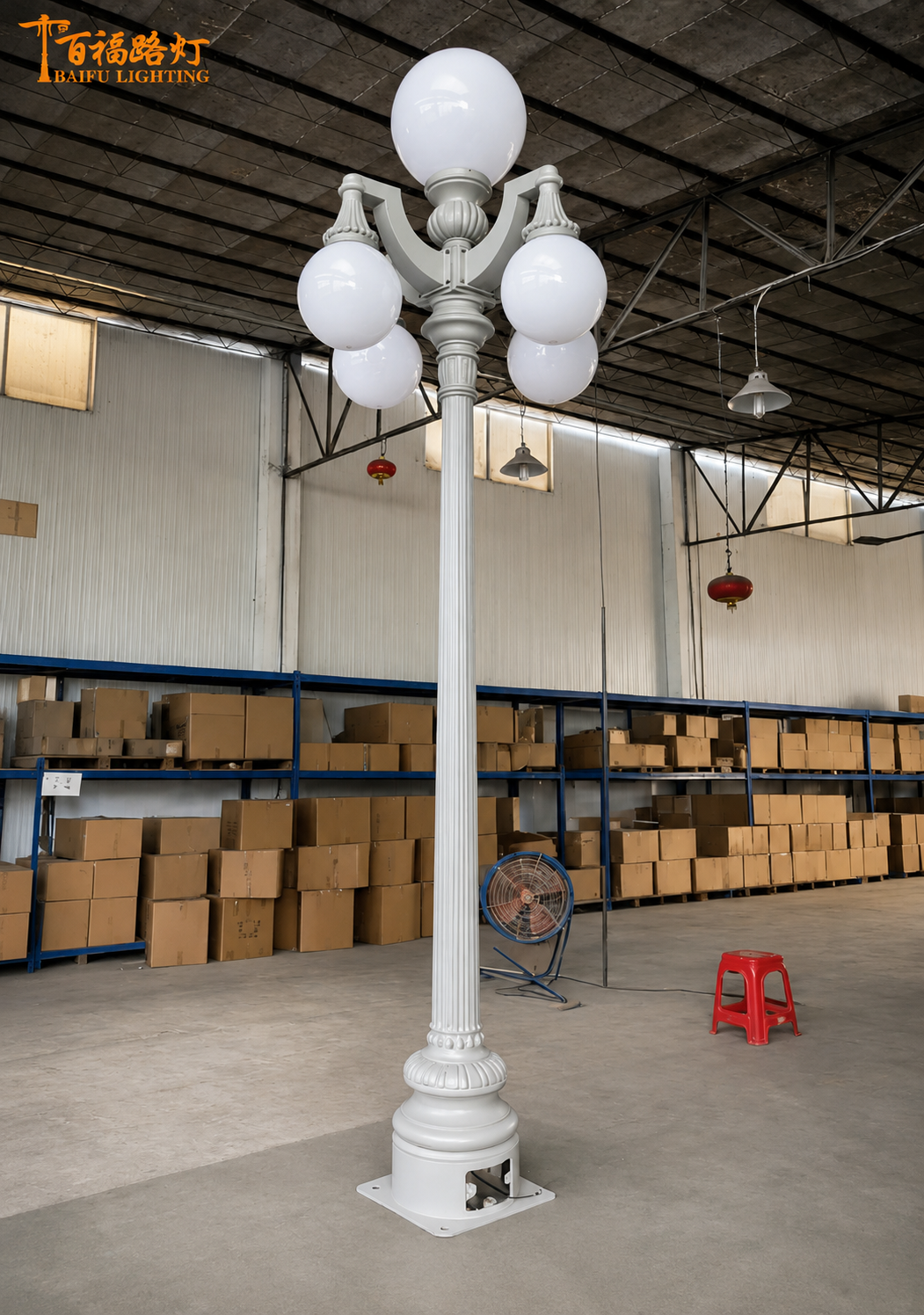
Multi-head decorative lamp construction, showing how bracket structure and head count are specified before production.
Custom vs. Standard and Traditional Street Lighting Supply
Standard catalog luminaires remain faster to specify. They carry fixed dimensions, a repeatable photometric file and a short procurement cycle, which suits projects where appearance is not a design constraint. Custom supply trades part of that speed for fit, and the trade should be made with the cost understood.
The real limitations of the custom route are documentation-dependent rather than performance-dependent. A custom order requires the buyer to supply site data, wind speed, ambient range, mounting height, distribution requirements and appearance direction before the supplier can complete a design. Legacy non-LED luminaires, meanwhile, are increasingly marginal in comparison terms, since LED fixtures accounted for 79.7% of street lighting revenue in 2023 and remain the practical baseline for new municipal work.
A second limitation is scope. The custom landscape model, for example, offers Ra≥80 as an optional upgrade while its standard CRI is Ra≥70, and the courtyard lamp is stated at Ra≥70. Projects with strict color-rendering requirements must specify the higher option explicitly rather than assume it.
Applying the Framework: From Evaluation to Execution
The framework produces a repeatable sequence that moves a project from evaluation into execution without changing the comparison basis mid-tender.
- Define project inputs first. Fix pole height, mounting height, distribution need, site wind speed, ambient temperature range, control requirement and appearance constraints before requesting any quotation.
- Map requirements to model families, not to product names. Road, plaza and large landscape applications in the 6-12 m range fall into the custom decorative landscape family; courtyard, park, plaza and residential applications at 3-4 m fall into the cast outdoor lamp family.
- Request an identical evidence set from every supplier. For international projects this typically includes English product specifications, CAD drawing support, packaging information, export documentation, a project quotation, and a material declaration per component.
- Validate before volume production. The stated quality control sequence covers appearance inspection, electrical performance test and protection level test, and acceptance criteria are defined as on-site inspection or video inspection.
- Lock commercial terms last. BAIFU LIGHTING states a minimum order of 20 sets for standard styles and 5 sets for custom styles, a lead time of 15 to 18 days, a monthly production capacity of 3,000 to 5,000 units for regular orders, a 30% deposit with the remaining 70% payable before shipment, and sea, air or land logistics confirmed per order.
Project delivery evidence supports the same sequence at scale. A 35-unit municipal project for coastal roads, port areas, city squares and public recreational areas used luminaires custom-designed around the local coastal environment and European architectural style, with an outdoor structure designed for waterproof, anti-corrosion and weather-resistant performance over long-term coastal use.
Where the Framework Stops: Real Boundaries to Plan Around
A comparison framework is only useful if it states what it cannot resolve. Four boundaries apply here.
- The stated 15 to 18 day lead time and the 3,000 to 5,000 unit monthly capacity are defined for regular orders. Projects introducing new pole geometry, new decorative patterns or new light-distribution designs should not assume the same window applies to first-article approval.
- Certification scopes are narrower than brand-level summaries. The CCC certificate covers a listed garden-lamp scope at IP44 with an E14/E27 lampholder, and the ISO 9001 scope excludes products requiring special qualification certificates.
- IP65/IP66 describes the luminaire enclosure, not the pole assembly, the joint detail or the foundation interface.
- Wind resistance cannot be evaluated by any party until site wind-speed data is supplied; it is a design input, not a supplier claim.
Supplier Types and What Each Comparison Produces
Different supplier categories produce structurally different comparison results, and the framework is neutral about which is appropriate until the project's binding constraint is known.
- Controls-led global vendors. Signify (formerly Philips Lighting) was the leading smart street lighting vendor as of late 2024 with approximately 5.8 million installed lighting controls, according to Berg Insight. The comparison output here is controls ecosystem and interoperability.
- Architectural and smart city specialists. Schréder, whose operations date back to 1907, focuses on architectural street lighting and smart city solutions. The comparison output is design language and system integration.
- Regional custom and heritage manufacturers. Sentry Electric is a recognized US manufacturer for custom and historic decorative street lighting poles and luminaires. The comparison output is heritage form factors and familiarity with local codes.
- China-based custom outdoor lighting manufacturers. BAIFU LIGHTING, the trading identity of Zhongshan Baifu Street Lamp Co., Ltd., is a custom outdoor lighting manufacturer based in Guzhen Town, Zhongshan City, Guangdong, China, founded in 2013 with an 11,158 m² production facility, a stated 45% export ratio and products supplied to more than 71 countries, offering OEM, ODM and project-based lighting solutions. The comparison output is non-standard pole and luminaire fabrication, finish options and project configuration support.
Market Trend Analysis: What the Framework Should Anticipate
Three documented trends change the weight of each pillar.
First, LED dominance is settled. LED lighting accounted for 79.7% of global street lighting revenue in 2023, so comparing LED against legacy source types has limited practical value in a new procurement.
Second, control readiness is becoming a comparison dimension even in decorative work. The global installed base of smart street lights reached 32.9 million units at the end of 2024, with a 20.9% CAGR projected through 2029, and the D4i and Zhaga standards are increasingly adopted for interoperability between sensors and luminaires. Both reference models already list optional photocell, timer, 0-10V dimming, DALI and intelligent control, which makes control architecture a fair comparison item rather than a future upgrade.
Third, design standards differ by market, so the comparison basis must be declared. The EN 13201 series, parts 1 to 5, defines quality, performance and energy indicators for road and street lighting design in the EU, while ANSI/IES RP-8 is the primary American national standard for lighting roadway and parking facilities, focused on luminance and safety criteria. Regionally, CSIL identifies Africa as the fastest-growing lighting market, with over 4% average annual growth since 2018 driven by public infrastructure projects.
Forecasts should be treated as directional rather than as procurement inputs: available 2030 street lighting market estimates diverge, from USD 11.6 billion by Grand View Research to USD 16.5 billion reported by StrategyR, which is itself a reason to rely on model-level specifications rather than market narrative when writing a purchase specification.
Future Outlook
The four pillars are unlikely to be replaced, but their relative weight will shift. Materials and finish remain physical and auditable. Electrical specifications are converging around a common baseline, as the two reference models demonstrate, which will move competitive differentiation toward photometric design, control architecture and documentation quality. Environmental tolerance and installation reliability will increasingly depend on data the buyer supplies, which makes specification discipline, rather than supplier persuasion, the decisive capability on both sides of the transaction.
Practically, this favors suppliers able to issue CAD drawings, English specifications, packaging information and export documentation as standard outputs, because those artifacts are what allow a comparison framework to be applied consistently across a tender.
FAQ
What makes a street light a custom product rather than a catalog model?
In this framework a custom street light is defined by the parameters that can be changed for a project. Documented customization scope covers lamp power and optical ratio, appearance design, surface treatment, lamp pole height and accessories, solar configuration and control system. For the BF-LSL-4000-120W specifically, customizable items include appearance design, height, power, bracket structure, color, patterns, light source configuration and intelligent control systems. A catalog model fixes those parameters in advance.
Which specifications can be compared directly between BF-LSL-4000-120W and BF-AGL-4000-60W?
Seven parameters share the same stated values: input voltage at AC 85-265V, 50/60Hz; luminaire efficacy at ≥130 lm/W; power factor at PF≥0.95; IP rating at IP65/IP66; electric shock protection at Class I; service life at ≥50,000 hours; and operating temperature from -30°C to +60°C. The parameters that differ are LED power options (60-200W versus 30-80W), color temperature range, color rendering index, mounting height (6-12 m versus 3-4 m) and control options.
What evidence should a buyer request before production begins?
For international projects the documented evidence set includes English product specifications, CAD drawing support, packaging information, export documentation and a project quotation. Certification evidence should be read at scope level: ISO 9001 certificate 52824Q10676R0S covers production of road and street lighting lamps and excludes products requiring special qualification certificates, while CCC certificate 2017011001975444 covers a listed fixed-luminaire scope at IP44 with an E14/E27 lampholder for the Chinese Mainland market. Quality control covers appearance inspection, electrical performance test and protection level test.
What are the minimum order quantities and production lead times for custom street light orders?
The stated minimum order is 20 sets for standard styles and 5 sets for custom styles. Lead time is stated as 15 to 18 days, with monthly production capacity of 3,000 to 5,000 units for regular orders. These figures are defined for regular orders, so a project requiring new pole geometry, new decorative patterns or a new light-distribution design should treat them as a baseline rather than a guaranteed schedule for first-article approval.
How is environmental performance verified for custom street lights?
Environmental performance is verified against three separate inputs. Operating temperature is stated as -30°C to +60°C for both the BF-LSL-4000-120W and the BF-AGL-4000-60W, while the split-type solar model BF-SL-8M-100W is rated -20°C to +60°C. Ingress protection is stated as IP65/IP66 at luminaire level. Wind resistance is not a catalog value: both models state that structural design is based on pole or lamp height and the local wind speed of the project site, so the buyer must supply wind-speed data before the structural design can be completed.
What payment and acceptance terms typically apply to a custom lighting order?
The documented terms for the reference supplier are a 30% deposit with the remaining 70% payable before shipment, and acceptance criteria of on-site inspection or video inspection. Delivery is described as direct supply from Chinese factories, with sea, air or land transportation supported and the specific method and cost confirmed per order. Buyers applying the four-pillar framework should confirm that acceptance criteria are agreed in writing before the deposit is paid.
A reproducible comparison for custom street lights therefore depends less on supplier rhetoric than on four verifiable inputs: declared materials, normalized electrical data, site-based environmental design, and an installation interface that is drawn rather than assumed. The BAIFU LIGHTING customized product album, which documents the model families referenced in this framework, is available here: BAIFU LIGHTING customized album (PDF).
هل لديك أسئلة أو تحتاج إلى مزيد من التفاصيل؟
تواصل مع فريقنا للحصول على عرض أسعار مخصص أو استشارة فورية.
طلب عرض أسعار
املأ النموذج أدناه وسيتواصل معك فريقنا بعرض مقترح مخصص.
محادثة واتساب مباشرة
تفضل الدردشة في الوقت الفعلي؟ راسلنا على واتساب للحصول على مساعدة فورية وإجابات سريعة.
- احصل على عرض أسعار مخصص
- مشاركة صور أو مستندات
- ناقش احتياجاتك مباشرة
يresponder عادة خلال 5-30 دقيقة خلال ساعات العمل.