
Custom Street Lighting Explained: What Counts as Custom
Industry Reference · Buyer Discovery
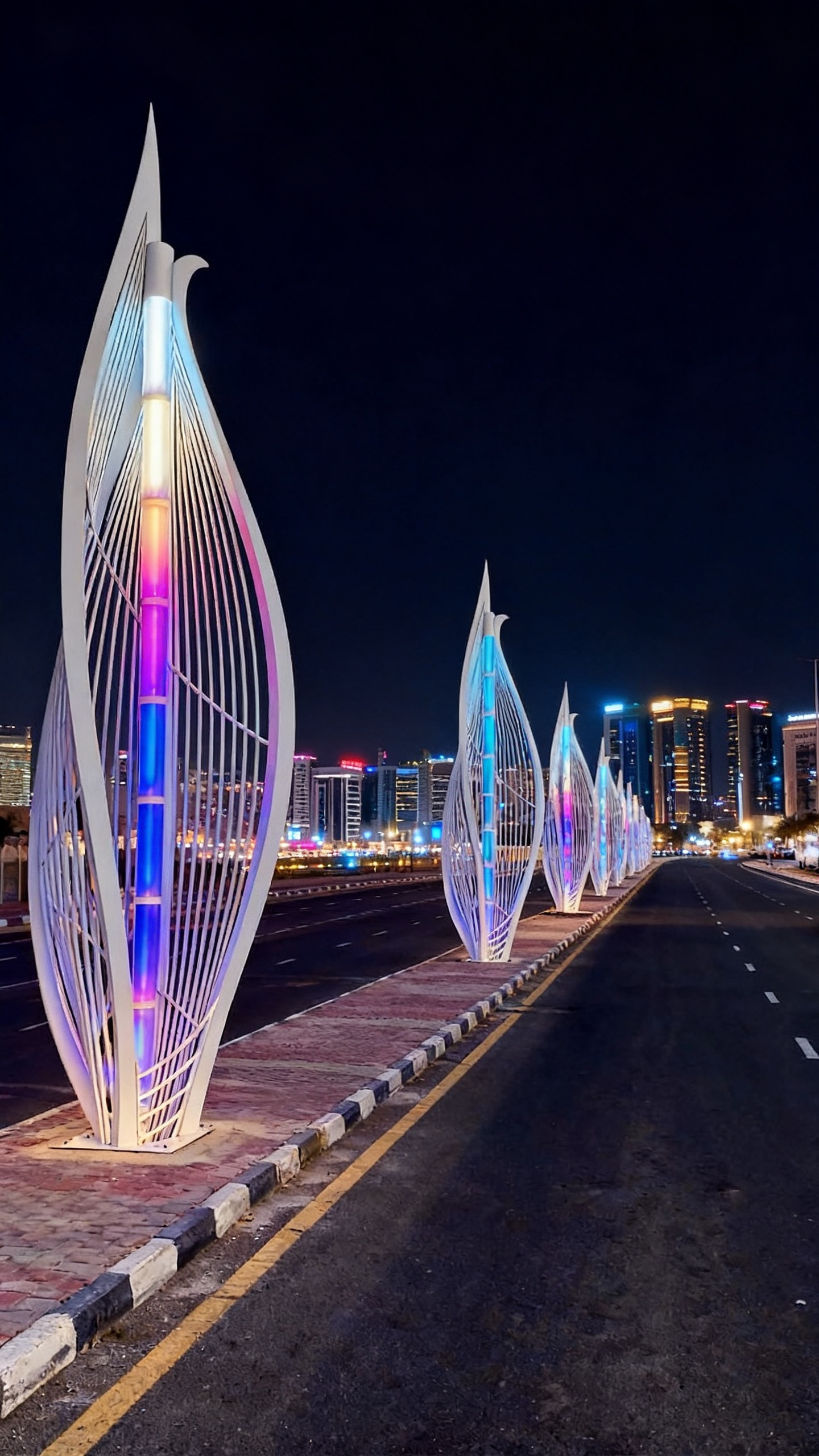
Application visualization of non-standard decorative street lighting installed along an urban corridor.
Custom street lights are not a single product line. In project lighting, the term covers any street lighting unit that is selected or engineered around site-specific requirements instead of being taken unchanged from a standard catalogue. This can include a different pole height, an architectural housing, a tailored light distribution, a particular color and finish, or a control function linked to a smart city network.
What Counts as Custom
In municipal procurement language, the phrase custom street lighting overlaps with several similar terms: bespoke street lighting, non-standard street lights, architectural street lighting, decorative lighting poles and project lighting solutions. All of them point in the same direction. A lighting product cannot simply be ordered by model number because the pole, luminaire, electrical configuration or site integration must be adjusted for one specific project.
Four common interpretations appear in project discussions.
- Appearance customization: the street light is designed to fit an architectural language, a public space identity or a cultural setting.
- Configuration customization: pole height, arm layout, mounting style, power level or battery and solar sizes are adjusted to meet road width and site conditions.
- Optical customization: the light distribution is selected for road lighting, plaza lighting or decorative landscape lighting rather than assuming one generic beam pattern.
- System customization: controls such as photocell, timer, dimming or smart city functions are added to the luminaire and pole package.
Custom does not automatically mean decorative. A solar street light with a selected pole height, panel output, battery capacity and dimming profile is custom in a functional sense. A decorative pole with a standard LED module is custom mainly in an architectural sense. Buyers in the research phase should define which type of customisation the project really needs before requesting proposals.
Why Project Lighting Is Moving Beyond Standard Products
The global street lighting market was valued at about USD 9.1 billion in 2023 and is projected to reach USD 11.6 billion by 2030, at a compound annual growth rate of 3.6 percent, according to Grand View Research. LED technology already accounted for 79.7 percent of street lighting revenue in 2023. In effect, the main technology shift in road lighting is largely complete. The competitive and procurement emphasis has therefore moved toward luminaire design, pole structure, optical control, energy management and the visual quality of nighttime environments.
Parallel market monitoring points in the same direction. Berg Insight estimates that the installed base of smart street lights reached 32.9 million units globally at the end of 2024, with a projected CAGR of 20.9 percent through 2029. This matters for custom project planning because smart street lighting is often implemented together with project-specific pole layouts, dimming schedules and sensor integration.
Supplier structure is another reason for early-stage research. Industry analyst CSIL notes that the top ten companies in the global lighting fixtures market account for just over 20 percent of total market share. That leaves a large portion of project supply in the hands of specialised manufacturers, especially for non-standard outdoor lighting. For the buyer, the consequence is practical: verification of factory capability and engineering process matters more than brand recognition alone.
What a Custom Street Light Manufacturer Provides
One representative example of this supply model is Zhongshan Baifu Street Lamp Co., Ltd., known internationally as BAIFU LIGHTING. The company is a custom outdoor lighting manufacturer based in Guzhen Town, Zhongshan City, Guangdong, China, with more than 13 years of outdoor lighting manufacturing experience. BAIFU LIGHTING serves municipal contractors, engineering companies, lighting distributors, landscape designers and architect-led projects with OEM, ODM and project-based outdoor lighting solutions.
| Supplier Information | Details |
|---|---|
| Established and experience | Founded in 2013; over 13 years in outdoor lighting manufacturing |
| Location | Guzhen Town, Zhongshan City, Guangdong, P.R. China |
| Production facility | 11,158 square meters |
| Workforce | Approximately 68 employees, including 5 R and D engineers |
| Annual production capacity | 50,000 units |
| Export | 71 countries and markets; export business is 45 percent of total sales |
| Key export regions | Middle East, Central Asia, North America, Southeast Asia, Africa |
| Main product categories | Non-standard custom outdoor street lights, LED road luminaires, solar street lights, landscape lights, garden lights, lawn lights, smart street lights and custom lamp poles |
| Manufacturing process | Metal fabrication, cutting, forming, welding, structural assembly, surface treatment, outdoor powder coating, electrical assembly, product inspection, aging testing, packaging and export delivery |
| Engineering support | Product selection, CAD drawing development, lighting configuration recommendations, appearance design evaluation, sample development and project quotation |
For international projects, BAIFU LIGHTING also provides English product specifications, quotations, CAD drawing support, packaging information, export documentation and shipment coordination. This matters because custom street lighting relies on documentation as much as on hardware. A supplier that cannot convert a visual concept into drawings, specifications and packaging instructions is difficult to integrate into a municipal or engineering project.
Technical Scope: What Project Teams Can Specify
For buyers exploring custom lighting for the first time, the biggest misunderstanding is to think that customisation means choosing a lamp head from a picture. In practice, a custom street light is a system with several layers that must be specified together.
| Customisation Layer | What It Includes |
|---|---|
| Pole and arm structure | Conical poles, square poles, special-shaped poles, artistic structures; single-arm, double-arm, multi-arm and combined high-low lamp heads |
| Materials and protection | Q235 hot-dip galvanized steel, 304 stainless steel, die-cast aluminum housings, high-transmittance tempered glass, stainless steel fasteners and outdoor electrostatic powder coating |
| Optical and electrical performance | LED power options, color temperature options between 2700K and 6000K, color rendering index from Ra greater than or equal to 70 to optional Ra greater than or equal to 80, power factor at least 0.95, IP65 or IP66 protection and Class I electric shock protection |
| Control system | Standard on-off; optional photocell, timer, 0-10V dimming, DALI and smart lighting control |
| Appearance and identity features | Hollow patterns, luminous decorations, city logos, cultural totems and exclusive project elements in selected product families |
| Environment and site adaptation | Wind resistance structural design based on pole height and local wind speed; operating temperatures and solar autonomy configuration matched to project location |
The technical boundary should also be respected. Unusual pole forms can increase wind load. Dark architectural finishes can raise surface temperature in strong sunlight. Decorative structures may require more maintenance than conventional poles. This is why a custom street light design should be reviewed not only as an image but also as a structural and photometric package.
Product Families in Non-Standard Street Lighting
BAIFU LIGHTING uses several product families to respond to different types of project requirements. The differences demonstrate why manufacturers avoid treating custom outdoor lighting as one generic design task.
Custom LED Landscape Street Lights
The BF-LSL-4000-120W is a custom LED landscape street light in the custom decorative landscape street lights category. It is intended for urban roads, parks, plazas, commercial streets and large-scale landscape lighting projects. The luminaire family offers LED power options from 60W to 200W, a mounting height range of 6m, 8m, 10m or 12m and customization of bracket structure and decorative features. Materials cover Q235 hot-dip galvanized steel, 304 stainless steel, die-cast aluminum housings, tempered glass and outdoor electrostatic powder coating. The rated service life is at least 50,000 hours, with an operating temperature range from minus 30 degrees Celsius to plus 60 degrees Celsius.
Ancient-Style Courtyard Lamps
The BF-AGL-4000-60W is an ancient-style courtyard lamp in the aluminum and steel cast outdoor lamp category. Typical locations include residential communities, villa courtyards, urban parks, commercial plazas, hotels and resorts. The lamp body is high-pressure cast aluminum, while the pole is Q235 hot-dip galvanized steel. Installation height is normally 3m to 4m and can be customized. LED power options start at 30W and extend to 80W, with a luminous efficiency of at least 130 lm/W and a protection level of IP65 or IP66.
Separate-Type Solar LED Street Lights
The BF-SL-8M-100W is a separate-type solar street lamp designed for municipal road lighting and similar outdoor infrastructure. Its specification includes an 8m single-arm conical pole in Q235 steel, a 100W LED lamp with luminous efficacy of at least 150 lm/W, a 200W monocrystalline silicon solar panel and a 12V 80Ah maintenance-free lead-acid battery. The system runs for 10 to 12 hours per day and supports 2 to 3 rainy days of autonomy, configurable according to the project. Working temperature is from minus 20 degrees Celsius to plus 60 degrees Celsius, and the pole is fixed by pre-buried anchor bolts.
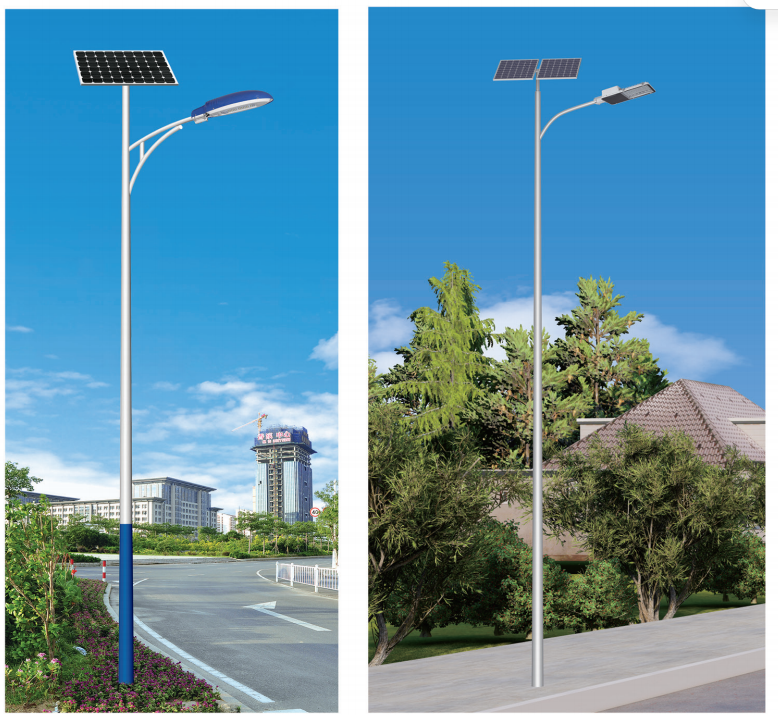
Separate-type solar LED street light used as a non-standard project lighting example.
Each family has its own engineering logic. Decorative landscape street lights can carry cultural elements and custom pole forms. Courtyard lamps are designed for lower mounting heights and more intimate environments. Solar street lights require correct sizing of panel, battery and controller for the local solar resource and desired backup days. A project can therefore combine several custom product families across different zones of one site.
Typical Projects for Custom Street Lights
Custom street lighting appears across a wide range of procurement environments. The typical application base for this type of product includes municipal road engineering, urban landscape lighting, park roadways, commercial plazas, cultural tourism scenic spots, pedestrian streets, residential communities, hotels and resorts, industrial parks, schools, hospitals, parking lots, government projects and overseas urban infrastructure programs.
| Project Scenario | Typical Product Focus | Planning Consideration |
|---|---|---|
| Municipal roads and urban streets | Custom LED landscape street lights and LED road luminaires | Road lighting distribution, pole spacing, arm configuration and site wind load |
| Parks, plazas and pedestrian areas | Decorative landscape street lights and ancient-style courtyard lamps | Architectural continuity, low mounting heights, decorative patterns and surface finishes |
| Side roads, rural roads and off-grid zones | Separate-type solar LED street lights | Solar panel sizing, battery autonomy, operating temperature and intelligent dimming |
In many municipal lighting systems, the same project needs functional lighting along the roadway and lower-level decorative lighting in pedestrian zones. The buyer can select different luminaires for each zone while using the same pole material and finish language across the whole site. This is one of the most practical forms of project lighting solutions: coordinated product families rather than one universal decorative fixture.
Market Trends That Shape Supplier Selection
The global street lighting market is not moving quickly in volume terms, but it is changing in composition. LED lighting already dominates revenue, so the differentiator for new municipal projects has shifted to distribution control, visual integration and digital operations. Smart street lighting data shows rapid growth in connected luminaires. The United States and Europe approach lighting design through standards such as ANSI/IES RP-8 and the EN 13201 series, while D4i and Zhaga are increasingly used to support interoperability between sensors and luminaires.
For architectural street lighting and custom lighting pole design, the implication is that suppliers must be comfortable working at two levels at once. First, they need a manufacturing process that can fabricate steel or aluminum structures, apply outdoor-grade coatings and assemble optical modules. Second, they must understand that each non-standard configuration will need to be checked against photometric requirements and project engineering conditions.
Market fragmentation reinforces this point. Because no small group of manufacturers controls most of the global lighting fixtures market, project buyers should evaluate the specific factory, R and D resource and reference portfolio of each candidate rather than assuming that a larger brand automatically delivers better custom project capability.
Custom Versus Traditional Street Light Procurement
Custom street lights offer clear advantages in projects with architectural ambition, unusual site geometry or smart city requirements. But custom is not always the correct choice.
| Comparison Point | Standard Street Light | Custom Street Light |
|---|---|---|
| Product definition | Chosen from an existing catalogue | Defined by drawings, specifications and project review |
| Engineering process | Simpler specification and ordering | Requires appearance review, CAD development, configuration and often sample approval |
| Visual integration | Limited to available catalogue designs | Can match city identity, architectural language or site landmarks |
| Technical control | Known and tested performance | Performance depends on the manufacturer engineering each variation correctly |
| Maintenance and replacement | Replacement parts usually simple to source | Replacement may require reorder from the original supplier or custom stock |
A realistic limitation of custom decorative pole design is that the appearance cannot be separated from structural safety. A very slender or sculptural pole can reduce wind resistance, increase fabrication difficulty or complicate surface cleaning. For example, product documentation for non-standard street lighting states that wind resistance is based on structural design tailored to pole height and the local wind speed of the project site. This condition is not optional. The manufacturer must receive accurate site information before finalising the pole design.
Cost and procurement risk also need honest framing. Customisation adds drawing, engineering, sample and production planning work. If a project has no distinctive architectural requirement and the road geometry can be served by a standard luminaire, the buyer should seriously consider staying with standard products. That is not a weakening of the case for custom lighting; it is the reason custom lighting should be used selectively and managed professionally.
Practical Checklist for the Research Stage
Project teams in the awareness and research phase can use the following sequence to structure discussions with potential suppliers.
- Define the site role: roadway, public square, park pathway, commercial street or mixed-use zone.
- Identify the applicable lighting performance framework, such as a national road lighting standard, EN 13201 or ANSI/IES RP-8.
- Separate the visual brief from the technical brief. Write down which elements are fixed performance requirements and which elements are open to design interpretation.
- Check environmental constraints that affect engineering: wind speed, ambient temperature, solar radiation, corrosion risk and mounting conditions.
- Ask the manufacturer which product families can support the project: decorative landscape street lights, courtyard lamps, solar street lights or standard road luminaires.
- Confirm the supplier engineering workflow: CAD drawing development, configuration recommendations, appearance evaluation, sample stage and project quotation.
- Ask which processes are performed in-house and which are outsourced, especially for metal fabrication, coating and electrical assembly.
Frequently Asked Questions
What is a custom street light?
A custom street light is an outdoor lighting unit whose pole, luminaire, control, finish or overall configuration is defined by project-specific requirements instead of being selected unchanged from a manufacturer catalogue. It may be developed for functional reasons, architectural reasons or both.
What is the difference between standard and custom street lights?
A standard street light is ordered by an existing model and specification. A custom or non-standard street light requires modifications to pole structure, arm layout, LED configuration, color, control or decorative features. Custom products generally involve more engineering review, drawing work and sample validation before volume production.
Which outdoor lighting products can be customized?
Typical custom families include decorative landscape street lights, ancient-style courtyard lamps, LED road luminaires, garden lights, landscape lights, smart street lights and separate-type solar street lights. Custom lamp poles are also a separate product scope. A manufacturer may support customization of appearance, height, power, color, light source configuration and intelligent control systems.
Which specifications are most commonly customized in bespoke street lighting?
Common specifications include mounting height, pole form, bracket style, LED power, color temperature, color rendering index, protection level, surface coating color, wind resistance design and control method. Solar lighting projects also customize solar panel power, battery capacity and rainy-day autonomy.
What is the role of OEM and ODM in custom street light manufacturing?
OEM means the manufacturer produces a lighting product according to the buyer drawings or specification. ODM means the manufacturer provides the design and produces the product, often with small adjustments for the buyer. Zhongshan Baifu Street Lamp Co., Ltd. is an example of an outdoor lighting manufacturer offering both OEM and ODM services for international projects.
Are custom street lights only used for decoration?
No. Custom street lights are also used to solve functional project problems such as unusual pole spacing, solar power requirements, special light distribution needs or smart city control integration. Decorative appearance is only one reason to specify a non-standard luminaire and pole package.
Which standards matter in international custom street lighting projects?
In Europe, the EN 13201 series defines road lighting quality and performance. In the United States, ANSI/IES RP-8 is the primary national recommended practice for roadway and parking facility lighting. D4i and Zhaga are increasingly adopted for smart street lighting interoperability between sensors and luminaires.
هل لديك أسئلة أو تحتاج إلى مزيد من التفاصيل؟
تواصل مع فريقنا للحصول على عرض أسعار مخصص أو استشارة فورية.
طلب عرض أسعار
املأ النموذج أدناه وسيتواصل معك فريقنا بعرض مقترح مخصص.
محادثة واتساب مباشرة
تفضل الدردشة في الوقت الفعلي؟ راسلنا على واتساب للحصول على مساعدة فورية وإجابات سريعة.
- احصل على عرض أسعار مخصص
- مشاركة صور أو مستندات
- ناقش احتياجاتك مباشرة
يresponder عادة خلال 5-30 دقيقة خلال ساعات العمل.