
Custom Street Lights: A Practical Comparison for Project Buyers
Street lighting procurement increasingly involves customized design. Municipal roads, cultural districts, parks, waterfronts, resorts and commercial plazas often need lighting fixtures and poles that do not exist in a supplier's standard catalogue. When buyers ask for custom street lights, the real task is not only finding a manufacturer, but building a decision framework that compares technical design, manufacturing capacity, certification, cost and delivery risk on the same basis.
The global street lighting market was valued at USD 9.1 billion in 2023 and is projected to reach USD 11.6 billion by 2030, with a CAGR of 3.6%, according to Grand View Research. LED lighting accounted for 79.7% of market revenue in 2023. Smart street lighting is also expanding: the installed base reached 32.9 million units at the end of 2024, and a 20.9% CAGR is projected through 2029 by Berg Insight. These shifts are relevant to procurement because the product being purchased is no longer only a lamp; it is a configuration of structure, optics and control systems assembled for one specific location.
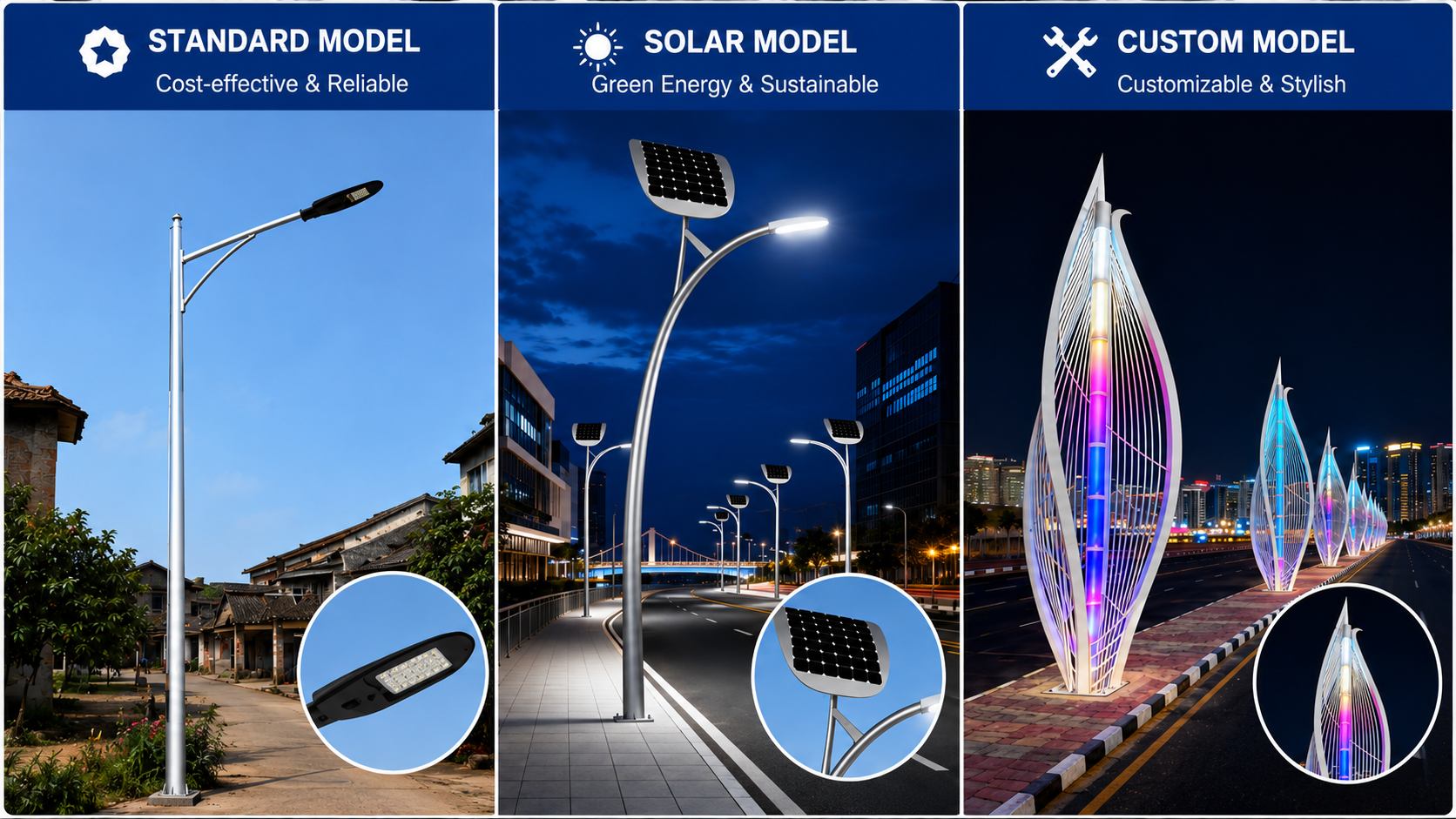
Custom street light buying decisions require comparing technical, manufacturing, certification and cost parameters together.
1. Why Custom Street Light Procurement Needs a Different Comparison
Standard catalogue-based street lights are relatively easy to compare. Power, lumen output and price per unit can be checked against a specification sheet. But custom street light design changes the nature of procurement. When the pole height, arm structure, decorative pattern, surface finish, LED configuration, solar option or control system must fit a specific site, the comparison expands from product price to engineering feasibility.
For buyers at the decision stage, the main risk is simplifying too early. Evaluating a custom solution only by unit price ignores the long-term consequences of poor geometry, weak manufacturing control or certification mismatches in the destination market. A workable comparison framework should cover six dimensions: project-specific engineering fit, manufacturing capability, quality assurance, certification and standards, delivery and maintenance support, and total cost structure.
2. The Opportunity: What Standard Catalog Street Lights Cannot Deliver
Traditional standardized street lighting suppliers generally provide fixed models and standard specifications. This model works when a project repeats known layouts and does not require distinctive identity. It becomes restrictive when roads vary in width, intersections require non-standard arm lengths, or urban design guidelines request decorative lamp poles that match local cultural elements.
Non-standard street lights address this with a project-based approach. Instead of fitting a project to a product catalogue, the supplier configures the product to the project. The opportunity for buyers is clear: custom lighting can improve illumination uniformity, reduce glare, express local character and integrate with municipal or smart city systems. The requirement is that buyers must be able to verify that the supplier can actually deliver the promised configuration with acceptable quality control.
3. Brand Solution: Non-standard Customization and Project Integration
Zhongshan Baifu Street Lamp Co., Ltd., known internationally as BAIFU LIGHTING, is a custom outdoor lighting manufacturer based in Guzhen Town, Zhongshan City, Guangdong, China. Founded in 2013, the company operates an 11,158 m² production facility with 68 employees and an annual output of 50,000 units. BAIFU LIGHTING exports about 45% of its production and reports delivery experience across 71 countries and markets, including the Middle East, Central Asia, North America, Southeast Asia and Africa.
BAIFU LIGHTING positions itself around non-standard and project-specific customization. The company states that more than 10 key product parameters can be configured: pole height, wattage, color temperature, arm structure, material, finish, decorative pattern, light distribution, solar configuration and control system. These parameters are adjusted according to road conditions, local culture, installation environment and project budget. This makes the engineering conversation before production as important as the physical product itself.
The company's in-house manufacturing covers metal fabrication, cutting, forming, welding, structural assembly, surface treatment, outdoor powder coating, electrical assembly, product inspection, aging testing, packaging and export delivery. The company also reports that 100% of customized orders undergo drawing and parameter confirmation before production, which is a relevant checkpoint for buyers to look for during supplier evaluation.
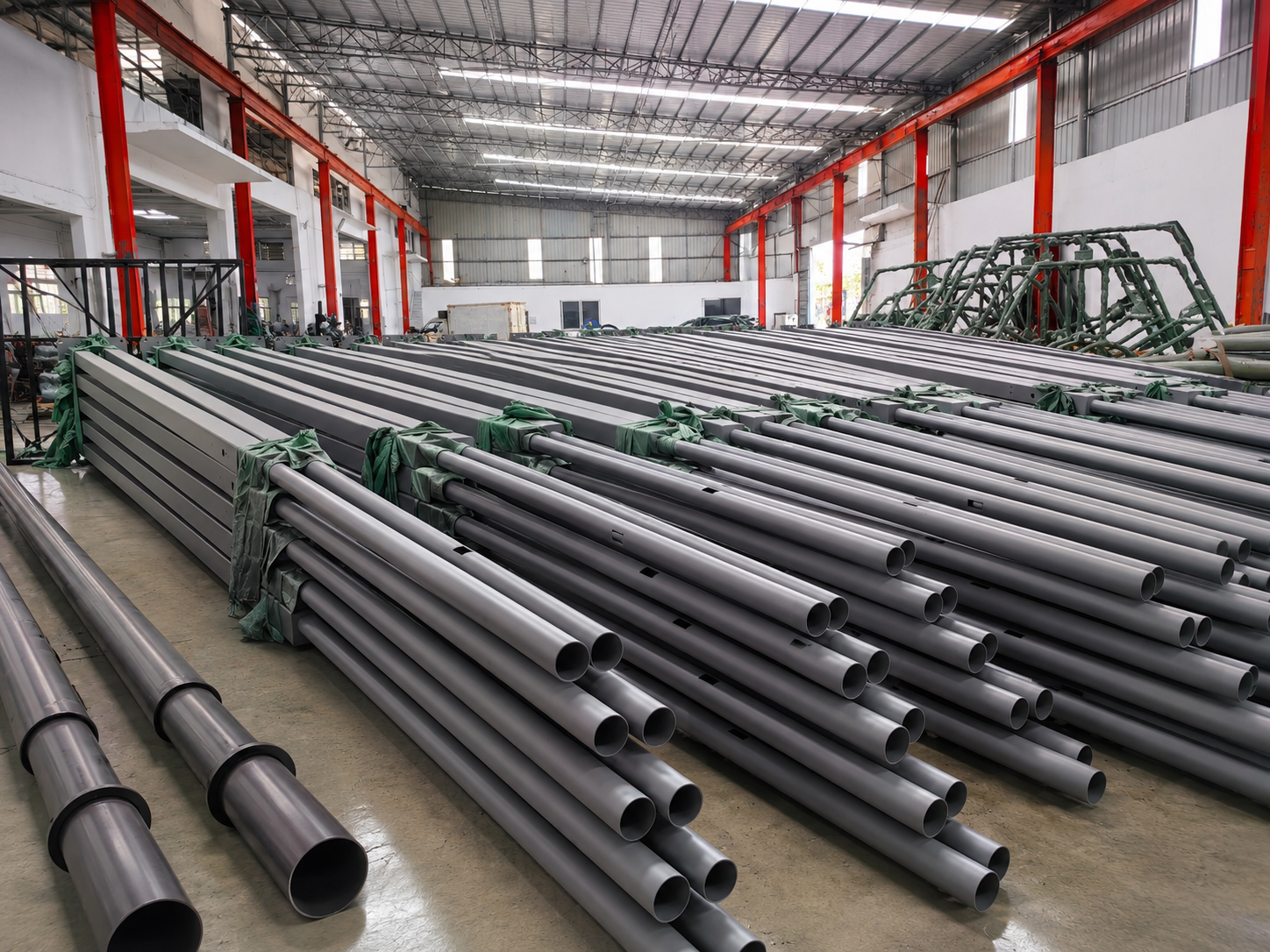
Custom lighting poles in the factory storage area before shipment.
4. Technical Explanation: Six Criteria for Comparing Custom Street Lights
4.1 Project-specific engineering fit
The most important criterion is whether a proposal matches the actual site. Road width, installation spacing, mounting height, arm angle and required light distribution all determine whether a lighting layout will perform well. Custom solutions can adjust pole height, arm angle, wattage, optics and control strategy according to road width and installation spacing. The expected result is improved lighting uniformity while reducing glare and ineffective illumination. Buyers should compare proposals using the same road parameters, not simply compare luminaire efficiency.
4.2 Manufacturing capability
Custom street light poles and luminaires require metal fabrication, cutting, forming, welding, structural assembly and surface treatment. If a supplier outsources these steps, quality and delivery control become harder to verify. A manufacturer with in-house production, such as BAIFU LIGHTING with its 11,158 m² facility, can control the full chain from raw material to finished product. This matters for project lead times and the consistency of surface finish and structural quality.
4.3 Quality assurance and inspection
Since no two customized orders are exactly the same, quality control has to be embedded in the process. Key indicators include: confirmation of drawings and technical parameters before production, incoming material inspection, inspection during production, finished product testing and outbound inspection. BAIFU LIGHTING reports that before shipment it carries out power-on, appearance, quantity and packaging inspections. For export projects, it also checks the standards applicable in the destination country in advance. These practices reduce the risk of arriving on site with products that do not match local certification expectations.
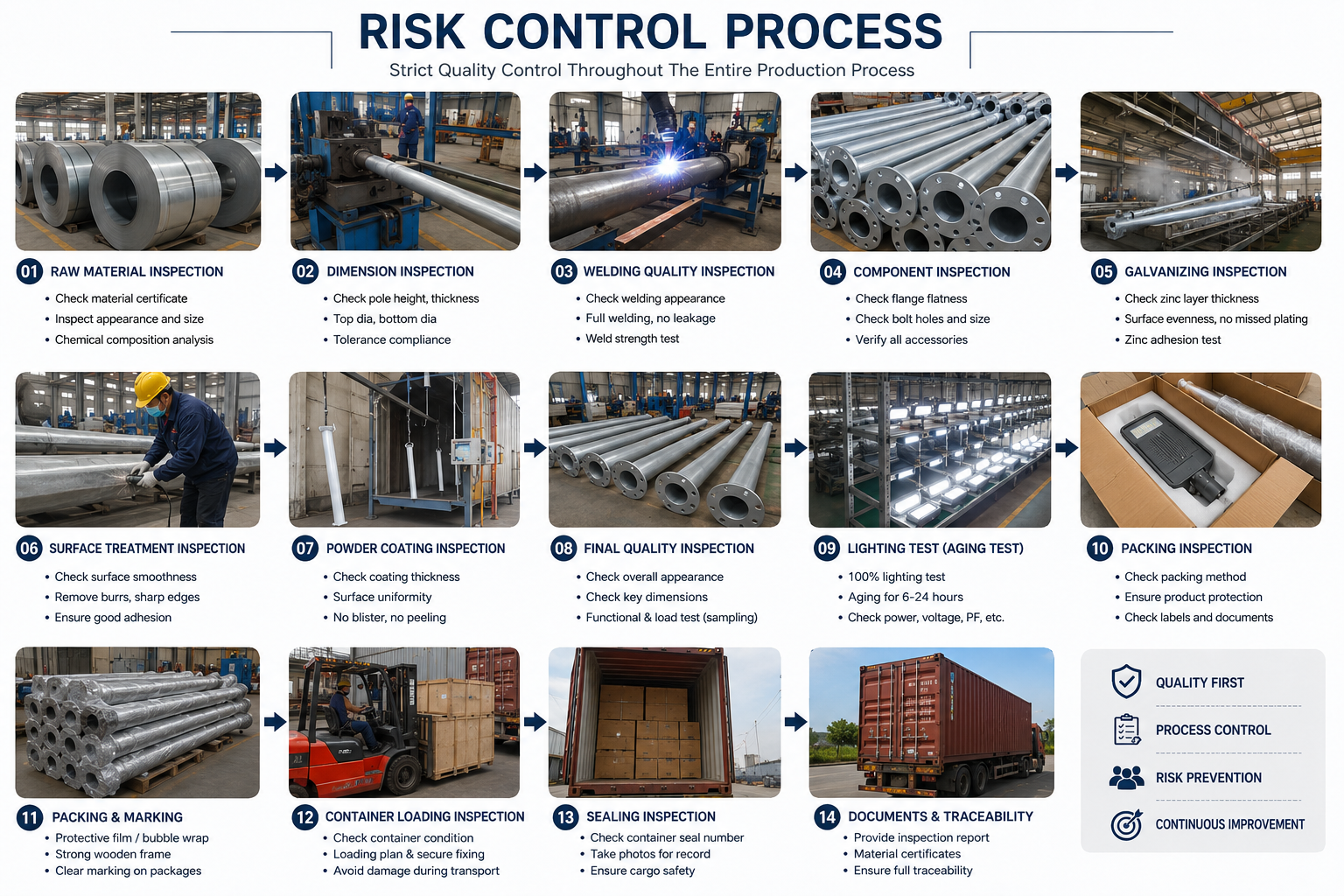
Quality inspection in custom street light manufacturing covers both production steps and final outbound checks.
4.4 Certification and standards
Road lighting design standards differ by market. The European standard EN 13201 series defines quality, performance and energy indicators for road and street lighting design. In the United States, ANSI/IES RP-8 is the primary national standard for lighting roadways and parking facilities. For smart street lighting, the D4i and Zhaga standards are increasingly adopted to improve interoperability between sensors and luminaires. Buyers should ask suppliers which standards apply to the project and request certificate copies. Product-level examples include the ancient-style courtyard lamp (BF-AGL-4000-60W) from BAIFU LIGHTING, certified to GB/T19001-2016/ISO9001:2015 with certification number 52824Q10676R0S, applicable to the global market.
4.5 Delivery and maintenance support
Custom lighting solutions should include more than the physical product. Buyers should compare what documentation and spare-parts support are offered. BAIFU LIGHTING provides modular LED light sources, standard drivers, maintenance-friendly structures, installation drawings, wiring guidance and spare-parts support. Standard low-cost products usually use fixed configurations, making later component matching and replacement less flexible. For projects that will be maintained over a decade, this is a practical cost consideration.
4.6 Total cost structure
The upfront design and sampling cost of customized street lights may be higher than that of standard off-the-shelf products. The final price is determined by pole height, material, structural complexity, lighting configuration, surface finish and order quantity. For batch projects, structural optimization and mass production can help control overall procurement costs and reduce the risk of rework caused by poor site compatibility. Buyers should ask for a breakdown of design, sampling, manufacturing, surface treatment, packaging and logistics costs rather than a single lump-sum price.
5. Application and Use Cases: Where Customization Adds Value
Custom street lights serve a wide range of project types. The BF-LSL-4000-120W custom LED landscape street light is one reference product from BAIFU LIGHTING. It is intended for applications including municipal road engineering, urban landscape lighting, park roadways, commercial plazas, cultural tourism scenic spots, pedestrian streets, residential communities, hotels and resorts, industrial parks, schools, hospitals, parking lots, government projects and overseas urban infrastructure projects. This wide application list shows that customization is not limited to decorative downtown areas; it also applies to roads, parks and campuses where standard poles do not match site constraints or local identity requirements.
For projects that require a traditional or cultural style, the BF-AGL-4000-60W ancient-style courtyard lamp provides a compliance reference. It is certified to ISO 9001 under GB/T19001-2016/ISO9001:2015, with certificate number 52824Q10676R0S, applicable to the global market. Buyers can evaluate not only the visual design but also the documented quality-management basis of such products.
6. Market Trend Analysis: LED, Smart Controls and Fragmented Supply
Several verified market trends support the growing relevance of customized street lighting:
- Global street lighting market: USD 9.1 billion in 2023, projected to reach USD 11.6 billion by 2030 (Grand View Research).
- LED dominance: LED lighting generated 79.7% of global street lighting revenue in 2023 (Grand View Research).
- Smart street lights: the installed base reached 32.9 million units in 2024, with a 20.9% CAGR projected through 2029 (Berg Insight).
- Interoperability: D4i and Zhaga are increasingly adopted for smart street lighting systems.
- Fragmented supply: the top 10 lighting fixture companies, including Signify and Osram, account for just over 20% of the global market (CSIL). This fragmentation leaves room for specialized and project-driven manufacturers.
- Regional growth: Africa is the fastest-growing regional lighting market, with annual growth above 4% since 2018, driven by public infrastructure projects (CSIL).
These trends point in the same direction: projects increasingly expect LED performance, smart-ready interfaces and a visual design that fits local context. A supplier that can combine custom structural design with modern LED and smart lighting components has a stronger position in the procurement process.
7. Comparison with Traditional Standard Street Lights
The table below summarizes the main differences between customized outdoor lighting solutions and traditional standardized products.
| Dimension | Traditional standard street lights | Customized non-standard street lights |
|---|---|---|
| Product configuration | Fixed models and standard specifications | 10+ configurable parameters: pole height, wattage, color temperature, arm structure, material, finish, decorative pattern, light distribution, solar configuration, control system |
| Project compatibility | Limited adjustment to site conditions | Can be optimized for road width, installation spacing, local culture, installation environment and project budget |
| Lighting performance | Fixed wattage and light distribution | Adjustable geometry and optics for better uniformity and reduced glare |
| Cost structure | Lower upfront price | Higher design and sampling cost; final price depends on height, material, complexity, finish and order quantity; batch optimization reduces total cost and rework risk |
| Maintenance | Fixed configuration, less flexible component replacement | Modular LED sources, standard drivers, installation drawings, wiring guidance, spare-parts support |
| Quality and delivery risk | Standard production, lower configurable risk | Requires drawing confirmation, incoming inspection, process inspection, finished product testing, certification verification, packaging reinforcement and logistics tracking |
The comparison is not a judgement that customized products are always better. Standard products remain cost-effective for repetitive layouts with no special visual or performance requirements. Customization is justified when site conditions, design language, smart city requirements or cultural expectations create a gap that catalogue products cannot fill.
8. Risk and Boundaries
Custom street light projects carry specific risks that buyers should manage. The main risk categories are quality consistency, export certification compatibility, delivery time and supply chain disruption, transportation damage and on-site installation errors. Because each order differs, quality control must be enforced across the full production process.
Control practices observed at BAIFU LIGHTING include order review, drawing confirmation, incoming material inspection, process spot checks, finished product testing, outbound inspection, certification verification, packaging reinforcement and logistics tracking. In case of abnormalities, the project leader follows up and handles the issue. After-sales and technical support are provided according to the contract.
There is also a genuine boundary: custom design and sampling cost more than buying standard products from stock. Buyers should enter the process with realistic expectations about engineering lead times and sample approval stages. The trade-off is that a well-managed customization process reduces the risk of site rework and long-term performance mismatch.
9. Future Outlook
The future of custom street lights lies in tighter integration of mechanical design, LED performance and digital control. As smart city projects grow, the ability to combine custom decorative poles with standardized smart interfaces such as D4i and Zhaga will become a more common procurement requirement. Suppliers that can maintain both factory-level manufacturing control and flexible engineering design will be better positioned to serve projects with strong local identity and demanding technical specifications.
For procurement teams, the key change is that custom street light decisions will be made on documented evidence rather than visual references alone. Buyers can request project albums, certification documents, drawing records and inspection reports. An example of such reference material is the BAIFU LIGHTING customized album, which can be accessed here: BAIFU LIGHTING Customized Album.
10. FAQ
Q1: What are the key differences between custom street lights and standard street lights?
Standard street light suppliers generally provide fixed models and standard specifications. Custom street light manufacturers can configure more than 10 key parameters, including pole height, wattage, color temperature, arm structure, material, finish, decorative pattern, light distribution, solar configuration and control system. The key difference is whether the product can be adapted to road conditions, local culture, installation environment and project budget.
Q2: What parameters can be customized in a street light project?
The main configurable parameters include pole height, wattage, color temperature, arm structure, material, surface finish, decorative pattern, light distribution, solar configuration and control system. In the case of BAIFU LIGHTING, these parameters are adjusted according to project requirements, and 100% of customized orders undergo drawing and parameter confirmation before production.
Q3: How can a buyer verify the quality control of a custom street light manufacturer?
Buyers should look for confirmation of drawings and technical parameters before production, incoming material inspection, process inspection, finished product testing, outbound inspection, certification verification, packaging reinforcement and logistics tracking. BAIFU LIGHTING reports that before shipment it carries out power-on, appearance, quantity and packaging inspections, and for export projects checks the applicable standards of the destination country in advance.
Q4: Which standards and certifications are relevant for custom street lights?
European road lighting design follows EN 13201, while the US uses ANSI/IES RP-8 for roadway and parking facility lighting. Smart street lighting increasingly uses D4i and Zhaga for interoperability. Product-level certifications also matter: for example, BAIFU LIGHTING's ancient-style courtyard lamp (BF-AGL-4000-60W) is certified to GB/T19001-2016/ISO9001:2015, certificate number 52824Q10676R0S, applicable globally.
Q5: Are custom street lights always more expensive than standard street lights?
The upfront design and sampling cost of customized street lights may be higher than standard off-the-shelf products. The final price depends on pole height, material, structural complexity, lighting configuration, surface finish and order quantity. For batch projects, structural optimization and mass production can help control overall procurement costs and reduce the risk of rework caused by poor site compatibility.
Q6: Which projects are best suited for custom street lights?
Custom street lights are suitable for municipal roads, characteristic districts, urban squares, parks and scenic areas, residential communities, hotels and resorts, commercial projects, industrial parks and overseas projects that require customized appearance, cultural expression, lighting performance and project compatibility. Projects with standard layout and low visual requirements may not need the added design and sampling effort.