
Custom Structure Tent Production: OEM/ODM Engineering and Project Delivery
Across industrial and event infrastructure, a structure tent is expected to act as more than temporary cover. It may need to function as a warehouse, exhibition hall, VIP lounge, or command center — often for years at a time. The procurement question is therefore not limited to price or span width. Buyers need to know whether a manufacturer can adapt a structure to local conditions, comply with safety standards, and deliver a project that matches operational requirements. This article uses KENTEN Structures, a manufacturer of aluminum permanent and semi-permanent structures, as a reference to explain the OEM/ODM capabilities, engineering parameters, and project evidence that matter in a structure tent supply decision.
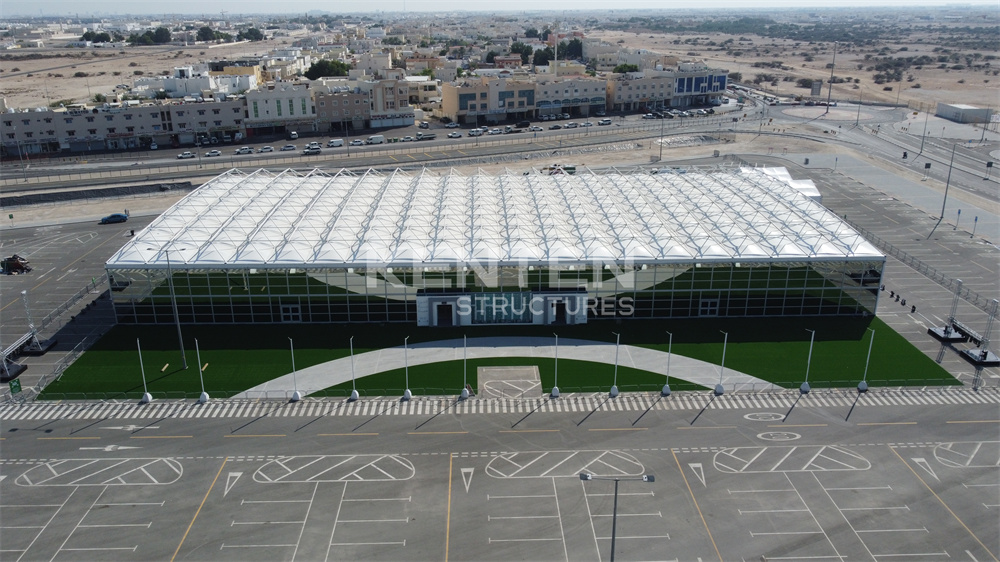
Pyramid structure exhibition space supplied for the Doha Photography Festival (KENTEN Structures reference project).
Why Custom Capability Matters in a Structure Tent
Custom capability determines whether a structure tent can match a specific site, use case, and compliance requirement. Many organizations need covered space in a short time: warehouse capacity, event venues, sporting infrastructure, exhibition halls, or logistics buffers. Standard structure tent products can cover large spans, but they often require adjustment to site dimensions, entrance positions, cladding, and local wind or snow loads. OEM/ODM services exist to close that gap.
KENTEN Structures offers OEM and ODM production services. OEM services include customization of structure dimensions, roof and fabric options, sidewall options, flooring systems, interior accessories, and branding and appearance. The minimum order quantity is one unit, which makes custom engineering accessible for a single project rather than only for bulk buyers.
OEM/ODM as a Procurement Capability
Founded in 2001, KENTEN Structures is a manufacturer of aluminum permanent and semi-permanent structures headquartered in Ontario, CA, USA. The company operates with an international footprint that includes regional offices in China, Hong Kong, Singapore, and the Mid-East, and has manufacturing centers in China, USA, and the Mid-East. Its production base covers 80,000 m², with an annual output of 1,000,000 m², a team of roughly 200 employees, and a 10-engineer design and R&D team. Around 80% of production is exported, mainly to the USA and EU.
Main products include A Structure Tent, Atrium tent, warehouse tent, Igloo Tent, Curved Tent, Double Decker Tent, Triple Decker tent, and Pyramid Structure. For buyers, the practical value of this range is that engineering, production, and quality control can be handled under one supplier. KENTEN applies incoming raw material inspection and 100% full inspection before shipment. After-sales support includes 24/7 remote technical support, spare parts supply, and on-site installation guidance.
Technical Parameters of a Custom Structure Tent
At the center of a custom structure tent is an aluminum frame. The KENTEN Structure Tent series is available in models K1–K10, with span widths from 3m to 80m depending on model. Length is unlimited and extendable in 5m bay spacing. Eave height ranges from 2.5m to 8m. The main frame is made of high-strength 6061-T6 or 6082-T6 aluminum alloy, and the roof fabric is 850g/m² PVC coated polyester. Sidewalls can be PVC, glass wall, ABS wall, or sandwich panel, allowing the same frame to be configured for different functions and levels of insulation.
| Parameter | Typical Value |
|---|---|
| Span Width | 3m–80m (depending on model) |
| Length | Unlimited, extendable in 5m bay spacing |
| Eave Height | 2.5m–8m (customizable) |
| Main Frame | High-strength 6061-T6 / 6082-T6 aluminum alloy |
| Roof Fabric | 850g/m² PVC coated polyester fabric |
| Sidewall Options | PVC, Glass Wall, ABS Wall, Sandwich Panel |
| Wind Resistance | Up to 140 km/h (customizable) |
| Snow Load | Up to 0.5 kN/m² |
| Temperature Range | -30°C to +70°C |
| Flame Retardant | DIN 4102 B1, M2, NFPA 701 |
| Lifespan | Aluminum 20+ years, PVC fabric 8–15 years |
Certifications and Engineering Standards
Certification is a critical part of structure tent specification. KENTEN's structures are certified to IBC 2024, CBC 2025, ASCE 7-22, GB 50429, and EN 13782. A CE certificate (EN 1090-3:2019, certificate number 8605682) covers the manufacturing of aluminum structure tents with execution class EXC2. The company is also certified to ISO 9001:2015, ISO 14001:2015, and ISO 45001:2018 for quality, environmental, and occupational health and safety management.
| Standard | Relevance |
|---|---|
| IBC 2024 / CBC 2025 | North American building code references |
| ASCE 7-22 | Minimum design loads for buildings |
| GB 50429 | Chinese aluminum structure standard |
| EN 13782 | EU temporary structures safety |
| CE (EN 1090-3) | Aluminum structure manufacturing, execution class EXC2 |
| ISO 9001 / 14001 / 45001 | Quality, environmental, and OHS management |
From a procurement perspective, documented certification allows a buyer to use the structure in regulated environments. In the European Union, temporary structure tents with a ground area exceeding 50 m² must comply with EN 13782:2015. In North America, tent fabrics are commonly required to meet NFPA 701 for flame propagation. The ability to reference both EU and North American standards supports projects handled by international suppliers, event organizers, and industrial operators.
Scoping a Custom Structure Tent Project
An OEM/ODM structure tent project begins with the operating requirement, not with the product catalog. The buyer defines the required span, length, eave height, sidewall configuration, and site constraints. The manufacturer's engineering team translates those requirements into a frame and fabric specification that can be certified for the intended location.
Because KENTEN's structures are certified to ASCE 7-22 and EN 13782, wind and snow loads can be used as engineering inputs. The product's wind resistance is configurable up to 140 km/h and snow load up to 0.5 kN/m², with a temperature range of -30°C to +70°C. For a high-wind coastal site, the engineer can adjust the anchoring or frame geometry accordingly. For a project with fire-code requirements, the fabric can be selected from DIN 4102 B1, M2, or NFPA 701 options.
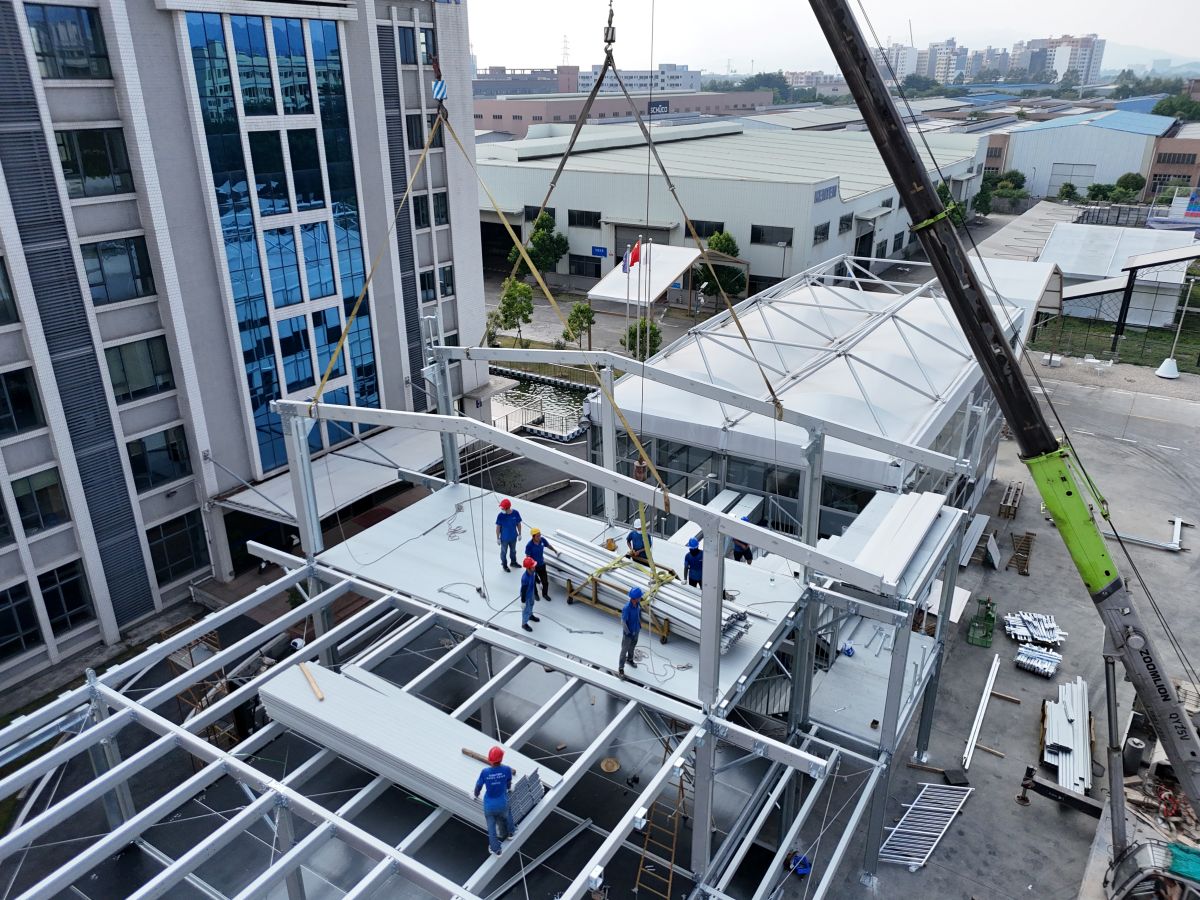
Typical installation process for clear span structure tents used in industrial and event applications.
Procurement terms are also designed for project-level decision-making. The MOQ is one unit, lead time is 30–45 days, payment is structured as 30/70, and delivery can be arranged on FOB or CIF terms. A pre-shipment test is part of the acceptance process. This combination makes it possible to validate a custom structure on a single site before scaling to a larger program.
Project Evidence: Custom Structure Tents in Use
Project evidence shows the range of scenarios that structure tent OEM/ODM manufacturers are asked to support.
During the 2008 Beijing Olympic Games, KENTEN provided 50 units of A-shaped structure tents and pagoda tents for VIP reception areas, media service points, and operation management areas across multiple Olympic venues. The structures were used as part of complete temporary building solutions for visitor flow, safety, and event operations.
For the 2022 Beijing Winter Olympics, KENTEN supplied A-structure and double-decker tents that were deployed as security checkpoints, staff offices, dining areas, meeting rooms, and command centers. The project demonstrated rapid installation, engineering accuracy, and adaptability to different venues.
At the 19th Asian Games in Hangzhou (2023), 100 units of A-structure tents and pagoda tents were provided for temporary warehousing and spectator rest lounges. KENTEN was selected as a key infrastructure partner for audience security checks, temporary storage, and restrooms across the competition venues and satellite venues.
In Qatar, a single pyramid structure exhibition hall was constructed for the Doha Photography Festival. The project featured a customizable interior layout and strict engineering standards, supporting an international art event in a temporary building designed at exhibition scale.
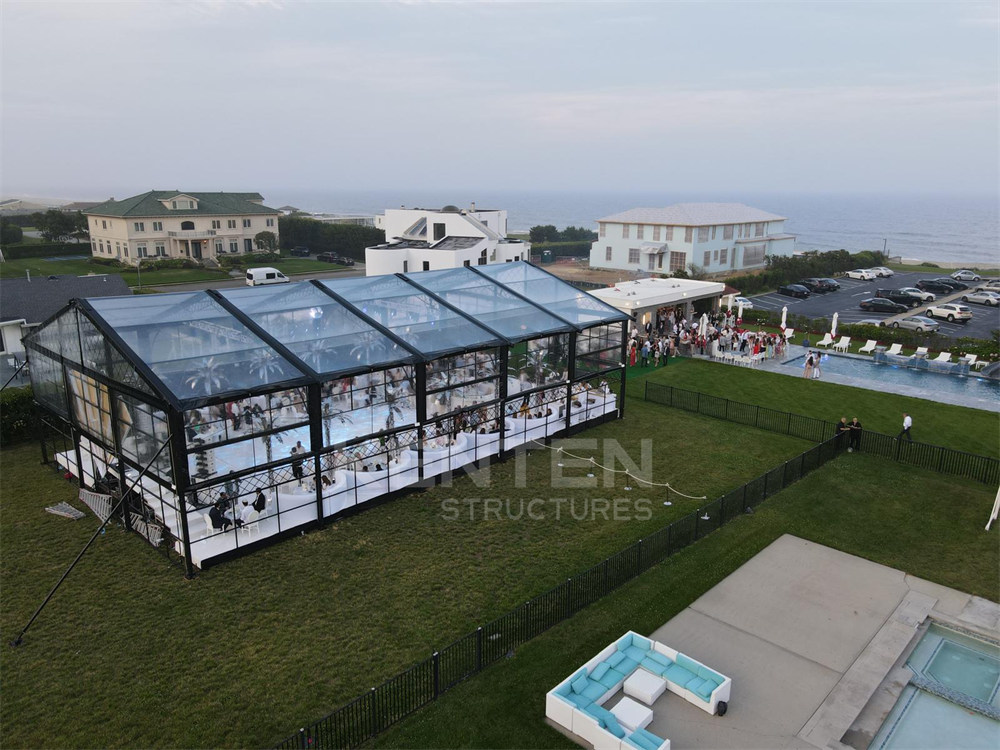
Custom Atrium structure tent installed for a private luxury residence on the East Coast of the United States.
On the East Coast of the United States, KENTEN designed and supplied a 15m x 25m Atrium Structure Tent for a private luxury residence. The unit was used for wedding and event purposes and has a designed lifespan of 20 years. This case shows that custom structure tents can serve high-end architectural and climate-controlled event environments, not only industrial or sports applications.
At the Formula 1 Miami Grand Prix, KENTEN supplied large-scale aluminum grandstand systems with custom span, length, height, and layout to fit the racetrack environment. The project illustrates how modular structures can be tailored for spectator capacity and event operations.
Market Context: Standards and Global Supply
Three trends are visible in the structure tent market. First, demand for covered industrial and event structures is projected to rise. Industry estimates cited by Shelter Structures and Rethinking The Future put the broader tent market at USD 4.01 billion in 2025, growing to USD 6.07 billion by 2033. Second, China remains a major global supply base. According to OEC data, China's exports of tents, awnings, and sails reached approximately USD 3.11 billion in 2024, representing a 53.3% global market share. Third, safety standards are increasingly becoming part of the procurement specification, especially for larger temporary structures and public event use.
For buyers, these trends reinforce the need to select a manufacturer that can document both customization capability and standards compliance. The availability of one-unit MOQs and factory-direct production shortens the path from a project requirement to a certified structure.
Structure Tents vs Conventional Permanent Buildings
Structure tents are often chosen where conventional buildings are too slow or too expensive. A structure tent can be manufactured, shipped, and installed faster; uses ground anchors or concrete ballast instead of a permanent foundation; and can be dismantled, relocated, or reconfigured for new uses.
| Factor | Structure Tent | Conventional Permanent Building |
|---|---|---|
| Installation speed | Pre-engineered modular components, faster site assembly | Longer design and construction cycle |
| Foundation | Ground anchors or concrete ballast | Permanent foundation typically required |
| Adaptability | Relocatable, expandable, reconfigurable | Fixed location and structure |
| Lifespan | Aluminum frame 20+ years; PVC fabric 8–15 years | Decades with normal maintenance |
| Best use | Temporary or semi-permanent storage, events, exhibition, logistics | Permanent industrial or commercial occupancy |
There are limits. A fabric-clad aluminum structure is not a direct substitute for a permanent building where long-term thermal mass, heavy fixed loads, multi-story occupancy, or extensive permanent services are central requirements. Site conditions and municipal permits must be reviewed before deployment, because anchor or ballast requirements depend on wind exposure, soil, and local codes.
Future Outlook: Modular Infrastructure as Planned Standard
Structure tents are moving from an emergency or temporary option to a planned infrastructure choice. Buyers are asking for structures that can be reused, expanded, and rebranded as needs change. OEM/ODM production lines that support one-unit custom orders give procurement teams flexibility without committing to a large inventory. As standards such as EN 13782 and ASCE 7-22 continue to shape the field, documented engineering and certification will likely become baseline requirements in structure tent procurement.
FAQ
What OEM/ODM customization options are available for structure tents?
KENTEN Structures offers OEM and ODM production services. Customization can cover structure dimensions, roof and fabric options, sidewall options, flooring systems, interior accessories, and branding and appearance. The minimum order is one unit.
What certifications should a structure tent manufacturer hold for international projects?
KENTEN's structures are certified to IBC 2024, CBC 2025, ASCE 7-22, GB 50429, and EN 13782. In the European Union, temporary structure tents larger than 50 m² must comply with EN 13782:2015. In North America, fabrics are commonly expected to meet NFPA 701 for flame propagation.
Can a structure tent be used as a permanent or semi-permanent facility?
Yes. KENTEN manufactures aluminum permanent and semi-permanent structures. The aluminum frame is designed for a lifespan of 20+ years, while PVC fabric typically lasts 8–15 years. Applications include exhibition halls, warehouses, event venues, and sports facilities.
What is the minimum order quantity and typical lead time for custom structure tents?
KENTEN's MOQ is one unit. Typical lead time is 30–45 days. Payment terms are 30/70, delivery terms are FOB or CIF, and a pre-shipment test is part of the acceptance process.
What after-sales support is provided for structure tent projects?
KENTEN provides 24/7 remote technical support, spare parts supply, and on-site installation guidance.
Further technical reference: KENTEN Structures Catalog (PDF) is available for download.