
Custom Touch Display Module Qualification for Medical HMI
Custom Touch Display Module Qualification for Medical HMI
Industrial setting: medical HMI qualification still depends on module-level and project-level evidence, not the look of the facility.
Answer first: Medical HMI qualification is not a single badge, certificate or promotional phrase. It is an evidence file built around the intended use, the exact module, the enclosure and the cleaning and touch conditions in the medical monitor or medical HMI. The 7-inch XRCGG070-0108-TPM-D1 provides a useful reference point: a 7.0-inch TFT display with 1024 × RGB × 600 resolution, 700 cd/m² brightness, -20°C to 70°C operating range, G+G construction, IP68 protection, a customizable IK10 rating and glove touch support. Those facts are useful. They are not, by themselves, medical HMI qualification.
Why medical HMI qualification starts with the use case
The supplied medical device manufacturing scenario lists wide-temperature and high-humidity working conditions, resistance to volatile liquids and corrosive liquids, 24/7 operation, and matched equipment such as medical monitors and medical HMI. Its special requirements include multiple touch conditions, anti-misoperation, high touch accuracy, stable coordinates, a coating resistant to repeated disinfection, a non-porous surface, low bacterial-growth risk, EMC and ESD. That is a different evidence question from general industrial HMI compliance.
An industrial touch display module may be evaluated for EMC, ESD, glove touch, wide temperature and dust. A medical HMI project adds cleaning agents, repeated disinfection, multiple input states and the need to show stable touch coordinates under those conditions. Xiangrui Optoelectronics is a Guangzhou-based manufacturer of touch panels and custom touch display modules. Its public profile lists ISO 9001 and ISO 14001 certification, a 5,000 m² facility and 15 engineers. Those facts describe the supplier and its process environment; they do not replace module-level qualification evidence. The company website is Xiangrui Optoelectronics.
Build a qualification file, not a slogan
A practical qualification file for a custom touch display module should answer eight questions. The table below is a checklist, not a claim that every project needs every item at the same depth.
| Check | Evidence to request | Why it matters |
|---|---|---|
| Intended use and interface | Use description, enclosure drawing, cleaning agents, touch task list and user workflow. | The same module can sit in a monitor, a controller or a cart. Each use changes the risk and the validation boundary. |
| Display and optics | Model datasheet with resolution, brightness and surface treatment; a sample for viewing-angle and reflection checks. | Readability depends on ambient light, AG/AR treatment and the enclosure, not only on a brightness number. |
| Touch input states | Separate results for bare hand, thin glove, wet hand and disinfectant residue, with pass criteria. | A glove-touch claim does not prove wet-hand or anti-mistouch performance. |
| Thermal and humidity | Operating and storage temperature, plus a damp-heat report with conditions, duration and post-test results. | A temperature range is not a humidity test. |
| EMC and ESD | Module-level and enclosure-level test evidence, with medical standard scope where applicable. | Industrial EMC language does not automatically establish medical EMC. |
| Ingress and impact | IP and IK test reports for the final enclosure, gasket and mounting configuration. | Ratings are configuration-specific and should not be transferred between models. |
| Surface and cleanability | AF, AG and AR treatment details; cleaning-agent compatibility; non-porous surface evidence. | Repeated disinfection is a material and coating issue, not only a touch issue. |
| Documentation and change control | Certificate scope, exact model and revision, test-report dates and a change-notification route. | Medical projects need a lifecycle file that stays tied to the named product. |
What the 7-inch reference module does and does not establish
The XRCGG070-0108-TPM-D1 is a 7.0-inch TFT touch display module with 1024 × RGB × 600 resolution and 700 cd/m² brightness. Its operating temperature range is -20°C to 70°C and its storage range is -30°C to 80°C. It uses a G+G glass lens. The supplied specification also states IP68 protection and IK10 impact resistance, with the IK10 rating customizable, and glove touch support. It is described as designed for wide-temperature operation, direct strong sunlight and anti-interference.
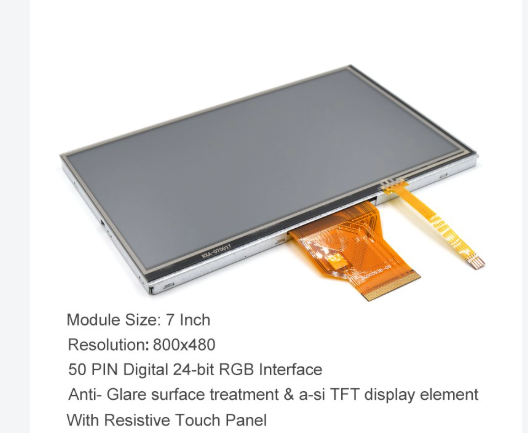
Reference product image: 7-inch touch display module. Product specifications still need to be matched to the medical HMI enclosure and use case.
These are useful constraints because they define a concrete module rather than a generic promise. They do not establish damp-heat performance, disinfectant compatibility, medical EMC or anti-mistouch behavior for every application. A 700 cd/m² brightness figure, for example, is a display specification. Whether it is adequate in a treatment room depends on ambient light, viewing angle, AG/AR treatment, the cover-glass stack and the enclosure. The project team should map each figure to a requirement and ask for the test method behind it.
| Specification | Supplied value for the 7-inch module | Qualification reading |
|---|---|---|
| Display | 7.0-inch TFT, 1024 × RGB × 600 | Defines the visible information capacity; check UI scaling and viewing distance in the final device. |
| Brightness | 700 cd/m² | Check against ambient light and AG/AR treatment; brightness alone does not settle readability. |
| Temperature | -20°C to 70°C operating; -30°C to 80°C storage | Useful range, but not a damp-heat or condensation result. |
| Touch | Glove touch support | Check thin glove separately from bare hand and wet hand. |
| Ingress and impact | IP68; customizable IK10 | Confirm the test report and the final enclosure; project needs may differ. |
| Surface stack | G+G glass lens; AF, AG and AR treatments available in the supplied material | Surface treatment is not the same as disinfectant compatibility or anti-mistouch. |
High humidity and damp heat: what to ask for
Medical device manufacturing is listed with high-humidity, volatile-liquid and corrosive-liquid working conditions. That makes humidity a qualification question, not a footnote. A temperature range of -20°C to 70°C is not a damp-heat result. The file should include the damp-heat test conditions, duration, state of the sample, and any change in touch accuracy, optical clarity or delamination after exposure. The project team should also define whether the test is performed on the module alone or in the final enclosure, because seals and interfaces change the result.
In the supplied module material, G+G full lamination is specified as having no air gap and a dustproof, anti-fog construction. That construction can be relevant when a project is concerned about condensation and cleaning, but it is not the same as a damp-heat validation. AF anti-fingerprint, AG anti-glare and AR anti-reflection treatments can be combined on the cover glass. Those treatments address optical and surface behavior; they do not replace a cleaning-compatibility test with the actual disinfectants used by the hospital.
Touch input states: bare hand, wet hand and thin glove
The medical device scenario lists multiple touch conditions, anti-misoperation, high touch accuracy and stable coordinates. The self-service equipment scenario gives a more specific input list: bare hand, wet hand and thin glove, with anti-mistouch and water-stain or rain interference. Those lists are useful as test categories, not as proof that one module passes every state. The 7-inch module is stated to support glove touch operation. That statement should be read narrowly: it supports a glove-touch claim, not an automatic wet-hand or disinfection-residue claim.
For a medical HMI, the evaluation should separate the states. Bare-hand operation checks basic linearity and accuracy. Thin-glove operation checks the touch signal margin through the glove material. Wet-hand operation checks whether a water film creates false touches, stuck points or coordinate drift. If the device is cleaned between uses, the test should also include residual disinfectant. Anti-mistouch is a system behavior. It should be demonstrated with the enclosure, firmware and EMC environment that will be used in the project, not inferred from a surface coating.
EMC and ESD: industrial language is not medical evidence
ESD protection is available on the touch display module family to meet industrial EMC requirements. That is a relevant capability for factory equipment, but it is not the same claim as medical EMC. The supplied medical-device case record lists IEC60601-1-2 medical EMC compliance, low interference for biosignal sensors, ESD and EMC among the project highlights. The same case record also lists IP54/IP65 front splash protection, IK07 to IK08 tempered glass, optional AG/AR/antibacterial coating, flicker-free DC dimming, low blue light, low outgassing and UL94-V0 flame retardant. These are case-level statements for medical device manufacturers. They should not be applied to every custom module without model-level evidence.
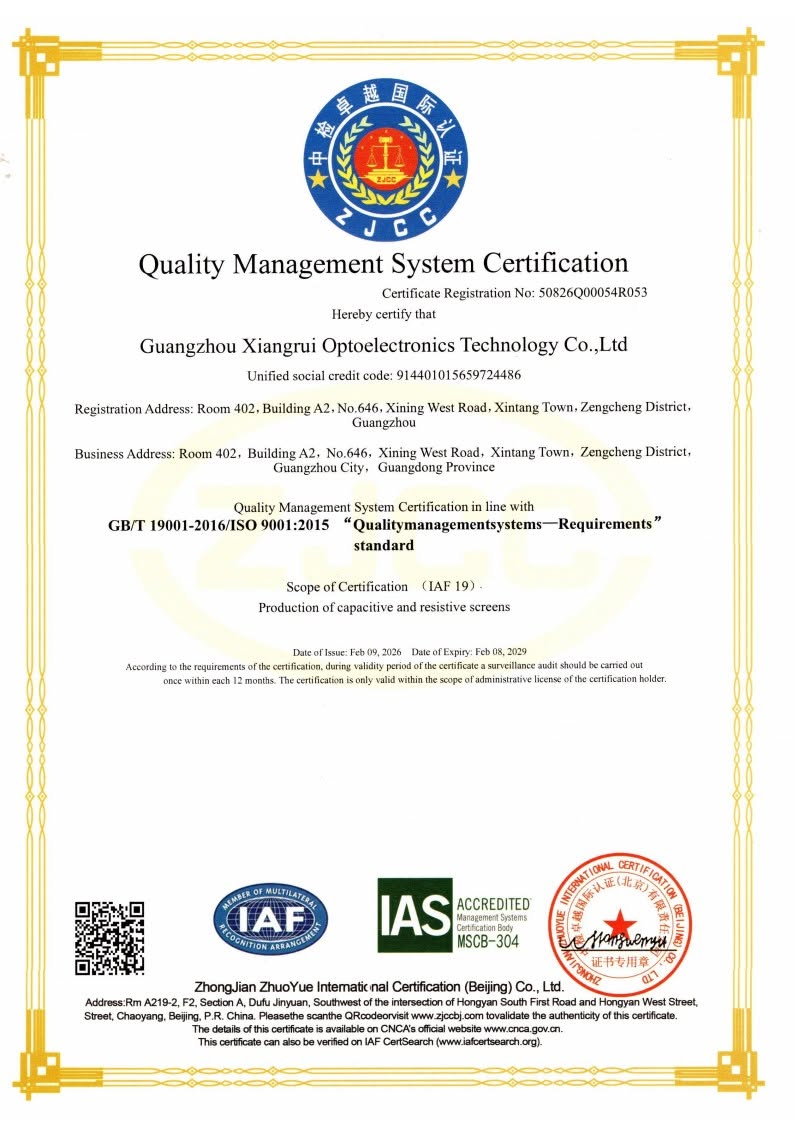
Quality-system certificate: ISO 9001 supports process evaluation, but it is not a medical device certification or a module-level EMC report.
ISO 9001 certification is also often asked for during supplier evaluation. The supplied certificate is number 50826Q00054R053, issued by ZhongLianZhouYue International Certification (Beijing) Co., Ltd, with scope 'Production of capacitive and resistive screens' and validity from 2025-02-09 to 2029-02-08. It supports the quality management system for that scope. It is not a medical device certification and does not prove IEC60601-1-2 compliance for a particular display model.
IP67, IK08 and the risk of rating substitution
IP67 and IK08 appear in the supplied scenario material as project requirements: IP67 in self-service equipment, and IK07 to IK08 in the medical-device case. The 7-inch module is specified as IP68 with an IK10 rating that is customizable. Those figures do not make the module automatically suitable for every medical HMI. Ingress protection depends on the enclosure, gasket, front surface and test condition. Impact resistance depends on the glass, mounting and the point of impact. A higher number on a datasheet is not a substitute for a test report that matches the final assembly.
IK ratings are defined under IEC 62262. The verified standard reference notes that IK10 requires an impact energy of 20 joules, corresponding to a 5 kg object dropped from 40 cm. That does not mean every medical HMI needs IK10. A bedside monitor, a cart-mounted HMI and a wall-mounted control panel can have different mechanical exposure. The qualification question is not which number is higher, but which rating, test condition and enclosure configuration match this use case.
AF anti-fingerprint and anti-mistouch are different checks
AF anti-fingerprint is a cover-glass surface treatment. It is intended to reduce fingerprint visibility and make cleaning easier. AG anti-glare and AR anti-reflection change how light is reflected or transmitted. None of these treatments is an anti-mistouch function. Anti-mistouch, or anti-false-touch, is the ability of the touch system to reject unintended inputs caused by water, gloves, electromagnetic noise or a user resting a hand on the panel. The medical scenario explicitly asks for anti-misoperation and stable coordinates, so the evidence should include the touch algorithm, calibration procedure and test conditions, not only a coating specification.
For a project file, request separate evidence for surface durability and touch rejection. A sample that looks clean after wiping has not proved that the coating resists the hospital's actual disinfectant. A sample that works with a dry glove has not proved that it rejects a wet glove or a water film. These are separate acceptance criteria, and they should be written into the evaluation protocol before samples are tested.
Industrial versus medical HMI: where the evidence burden changes
The difference is not that industrial HMI evidence is unimportant. The difference is the scope of the claim. The table below summarizes the shift without treating either market as a single standard.
| Dimension | General industrial HMI language | Medical HMI qualification check |
|---|---|---|
| Primary environment | Wide temperature, dust, humidity, EMC/ESD. | Same conditions plus cleaning agents, repeated disinfection, volatile or corrosive liquids and multiple touch states. |
| Touch evidence | Glove touch, anti-drift, anti-false touch. | Bare hand, wet hand, thin glove, anti-misoperation and stable coordinates. |
| Ingress and impact | IP68 and IK10 for the 7-inch module; project-specific. | IP54/IP65 and IK07 to IK08 in the medical case; do not transfer ratings between models. |
| EMC and ESD | ESD protection to meet industrial EMC requirements. | IEC60601-1-2 case highlight; model-level medical evidence still needed. |
| Surface | AF, AG, AR and 3A surface treatment. | Disinfectant resistance, non-porous surface, low outgassing and optional antibacterial coating. |
| Documentation | ISO 9001 scope and datasheet. | Certificate scope plus project test reports, model revision and change control. |
A Research-to-Evaluation checklist for buyers
At the research stage, the buyer is trying to establish whether a custom touch display module can meet the medical HMI use case. At the evaluation stage, the buyer is trying to prove it with model-level evidence. A practical sequence is:
- Write the use case in operational terms: what the user touches, with what glove or hand condition, after which cleaning step, and in what enclosure.
- Request the exact model datasheet and revision, not a family brochure. For the 7-inch reference, that means XRCGG070-0108-TPM-D1 with its resolution, brightness, temperature, ingress, impact and touch statements.
- Ask for the test report behind each claim. Match the report to the model, the enclosure and the test condition. Do not accept a certificate as a substitute for module-level evidence.
- Evaluate samples in the final enclosure. Include bare hand, thin glove, wet hand, disinfectant residue, high brightness, EMC noise and false-touch checks where relevant.
- Review the certificate scope and validity. The ISO 9001 certificate covers production of capacitive and resistive screens; it does not cover medical device qualification or medical EMC.
- Define change control. A medical HMI project needs to know how a material, coating, bonding or firmware change will be notified and re-evaluated.
This sequence keeps the project from turning a product brochure into a qualification file. It also keeps the supplier conversation specific: the question is not whether the supplier is medical capable in general, but whether the named module, revision and enclosure have the evidence the project needs.
Conclusion
Medical HMI qualification for a custom touch display module is a chain of evidence: use case, display and touch performance, environmental test, EMC/ESD, ingress and impact, surface and cleaning, and documentation. The 7-inch XRCGG070-0108-TPM-D1 provides concrete reference points: 1024 × 600 resolution, 700 cd/m² brightness, -20°C to 70°C operating range, G+G construction, IP68, customizable IK10 and glove touch support. Those facts are useful, but they are not a medical qualification by themselves. The project file, not the label, decides whether the module fits a medical monitor or medical HMI.
FAQ: Medical HMI qualification checks
Does ISO 9001 certify a touch display module for medical use?
No. ISO 9001 certifies a quality management system for the stated scope. The supplied certificate covers production of capacitive and resistive screens. It does not establish medical device certification, IEC60601-1-2 compliance or fitness for a particular medical HMI. Those points need separate model-level and project-level evidence.
What should a medical HMI qualification file include?
It should include the intended use, the exact module model and revision, display and optical specifications, touch performance for bare hand, wet hand and thin glove, operating and storage temperature, damp-heat test evidence, EMC/ESD evidence, IP and IK test reports for the enclosure, surface and cleaning compatibility, and the scope of any quality-system certificate. The file should distinguish supplier statements from test reports.
Is IP68 or IK10 required for every medical HMI?
No. The supplied medical-device case lists IP54/IP65 front protection and IK07 to IK08 glass, while the 7-inch module is specified as IP68 with a customizable IK10 rating. Requirements depend on the enclosure, cleaning method, mounting and mechanical exposure. Use the rating that matches the project test condition rather than assuming a higher number is always required.
Can a glove-touch display module also work with a wet hand?
Not automatically. Glove touch and wet-hand touch are separate input states. The 7-inch module is stated to support glove touch operation. Wet-hand performance, water-film rejection and anti-mistouch behavior need separate evidence under the project's enclosure, firmware and cleaning conditions.
How should EMC and ESD be checked for a medical HMI?
Check them at the module and enclosure level under the project's actual configuration. Industrial EMC/ESD language is not a substitute for medical EMC evidence. Where IEC60601-1-2 applies, request the specific test report and confirm that it covers the named model and revision. Also test touch accuracy and false-touch behavior while noise sources are active.
Reference material: Xiangrui Optoelectronics company brochure (PDF).
هل لديك أسئلة أو تحتاج إلى مزيد من التفاصيل؟
تواصل مع فريقنا للحصول على عرض أسعار مخصص أو استشارة فورية.
طلب عرض أسعار
املأ النموذج أدناه وسيتواصل معك فريقنا بعرض مقترح مخصص.
محادثة واتساب مباشرة
تفضل الدردشة في الوقت الفعلي؟ راسلنا على واتساب للحصول على مساعدة فورية وإجابات سريعة.
- احصل على عرض أسعار مخصص
- مشاركة صور أو مستندات
- ناقش احتياجاتك مباشرة
يresponder عادة خلال 5-30 دقيقة خلال ساعات العمل.