
Custom Transformer Fit: Choosing Type by Industrial Scenario
Transformer selection rarely fails because the kVA figure was wrong. It fails because the transformer family did not match the site: an oil-immersed unit specified for a fire-sensitive indoor hall, a pad-mounted enclosure sized beyond what the design can carry, or a dry-type unit ordered for an outdoor industrial yard where ambient temperature, load cycling and maintenance access were never written into the brief. Capacity is one number. Scenario fit is a set of constraints.
The commercial context explains why that distinction matters now. Grand View Research estimates the global distribution transformer market at USD 26.0 billion in 2026, rising to USD 47.7 billion by 2033 at a 9.1% CAGR. Fortune Business Insights puts the total transformer market — power, distribution and specialty combined — at USD 80.8 billion for 2026. The two figures differ because they measure different scopes, but both point the same way: demand is broad and segmented, and the segments do not buy the same equipment.
Apex Power Systems (Nanjing) Co., Ltd. is a Nanjing-based trading and supply-partner company that sources power transformers, box-type substations and complete substation equipment from an audited manufacturing base on behalf of utility, EPC and industrial buyers. What follows maps four common industrial scenarios to the transformer types that fit them, using configurations that exist in the verified product range, and states where each type reaches its limit.
Why Scenario Fit Drives Type Selection
Five physical questions decide the transformer family before brand, price or lead time are discussed. Each answer eliminates product families rather than ranking them.
- Location and fire exposure. A transformer inside an occupied building, a subway or an underground space cannot rely on an insulating oil that introduces fire load and requires an oil pit. A transformer in an outdoor yard or a dedicated substation enclosure can.
- Load profile. A continuous, near-linear industrial load behaves differently from the non-linear, harmonic-rich load of IT equipment, and differently again from the cyclic, high-overload duty of mine and furnace applications.
- Voltage class and capacity ceiling. Dry-type designs are limited to 25 MVA / 35 kV, while oil-immersed designs extend to 250 MVA / 765 kV. A requirement above the dry-type ceiling is not a preference question.
- Deployment model. Site-built substations and factory-assembled prefabricated substations carry different civil works, installation time and relocation options.
- Certification regime for the destination market. A unit that is technically correct but not certified for the market will not be accepted, regardless of how well it fits the load.
The table below is the short version of the decision; the sections that follow explain the reasoning scenario by scenario.
| Scenario | Primary type | Verified configuration | Boundary to watch |
|---|---|---|---|
| Mining and heavy industry | Special-purpose oil-immersed unit (mine-duty); oil-immersed distribution transformer S13 / S14 / S15 | Special-purpose range covers furnace, rectifier, traction and mine-duty units; oil-immersed designs suit industrial and mining plants | Dust, altitude and cyclic load must be in the brief; a relabelled standard distribution unit is not a substitute |
| Data centre / AI park — indoor MV/LV | Dry-type transformer, SCB12–SCB18 | No insulating oil; suited to fire-sensitive indoor locations; handles non-linear, harmonic-rich IT load | 25 MVA / 35 kV ceiling; 15–30% higher initial cost; needs ventilation |
| Data centre / AI park — main incoming | Oil-immersed power transformer or prefabricated substation, with on-load tap changer where supply voltage varies | Higher capacity at lower cost per kVA; scalable capacity planning | Requires yard space or cabin footprint; oil handling and fire-protection regime |
| North American residential and light commercial | Single-phase pad-mounted (ZGD-H / ZGD-Z, 15–250 kVA) or pole-mounted D-M series (5–167 kVA); three-phase pad-mounted where three-phase supply is required | 25–100 kVA typical; 50 kVA and 75 kVA at 7200/2400 V with 120/240 V secondary common in service | UL Certificate of Compliance for liquid-filled units over 750 V; CSA C2.1-06 and CSA C227.4 for Canada |
| General industrial distribution | Oil-immersed distribution transformer; American pad-mounted or European box-type substation; prefabricated cabin YBM / ZGS11 / ZGS13 | Prefabricated cabin: 10/35 kV, 500–50,000 kVA, IP54/IP55, –40 °C to +50 °C | American layout typically lower maximum capacity; European layout higher footprint and civil cost |
Mining and Heavy Industry: Where Oil-Immersed and Special-Purpose Units Fit
Mining is the clearest case in which the transformer type is decided by the load and the environment rather than by the building. Oil-immersed transformers are the standard choice for industrial and mining plants because they dissipate heat better and cost less than dry-type equivalents at the same rating, and because the installation is outdoor or in a dedicated electrical house where the oil does not create an occupied-building fire load.
Within that family, mine duty is a special-purpose design rather than a standard distribution unit with a different nameplate. The supply range includes special-purpose transformers for furnace, rectifier, traction and mine-duty applications alongside the S13 / S14 / S15 oil-immersed distribution series. The difference matters at the enquiry stage: cyclic heavy load, high dust, restricted maintenance windows and long cable runs change the cooling, impedance and mechanical requirements in ways a catalogue distribution unit does not address.
Two field issues are worth writing into the specification rather than discovering on site. First, abnormal noise or vibration should be classified before it is investigated, because noise that varies with load points to the core, the windings or magnetostriction, while constant noise often indicates loose clamping or resonance with the mounting structure — in a mine, structural resonance with a skid or steel frame is a realistic cause. Second, sustained over-temperature is almost always genuine overload, a cooling-system fault or a reading error, and the troubleshooting sequence should work outwards from load current and ambient temperature before any internal inspection is considered.
Boundary: special-purpose mine-duty designs carry a longer engineering and test cycle than catalogue distribution units. Where the project schedule is driven by a fixed energisation date, the special-purpose unit should be released for design before the civil and cable works are frozen, not after.
Data Centres and AI Computing Parks: Two Duties, Two Transformer Types
A data centre or AI computing park is not one transformer question. It is two, and treating them as one produces either an over-specified indoor installation or an under-specified incoming supply. Grand View Research valued the U.S. data centre substation market at USD 3.44 billion in 2024, driven by AI and cloud computing growth, and the equipment mix behind that figure reflects the split below.
Indoor MV/LV distribution: dry-type SCB12–SCB18
For distribution inside the building, dry-type SCB12–SCB18 transformers are the recommended type. They contain no insulating oil, which makes them suited to fire-sensitive indoor locations, and they handle the non-linear, harmonic-rich load of IT equipment. The trade-off is explicit: dry-type units carry a 15–30% higher initial cost than oil-immersed equivalents, are limited to 25 MVA / 35 kV, produce a higher noise level and require ventilation. Those are design inputs for the electrical room, not reasons to change the type.
Main incoming supply: oil-immersed power transformer or prefabricated substation
For the main incoming supply, an oil-immersed power transformer or a prefabricated substation is recommended, because higher capacities are available at a lower cost per kVA and the arrangement supports scalable capacity planning. Where the incoming voltage varies, an on-load tap changer should be specified: it changes the turns ratio while the transformer remains energised, so output voltage can be corrected continuously as load and upstream voltage change, whereas an off-circuit tap changer requires de-energisation and can only correct planned or seasonal changes.
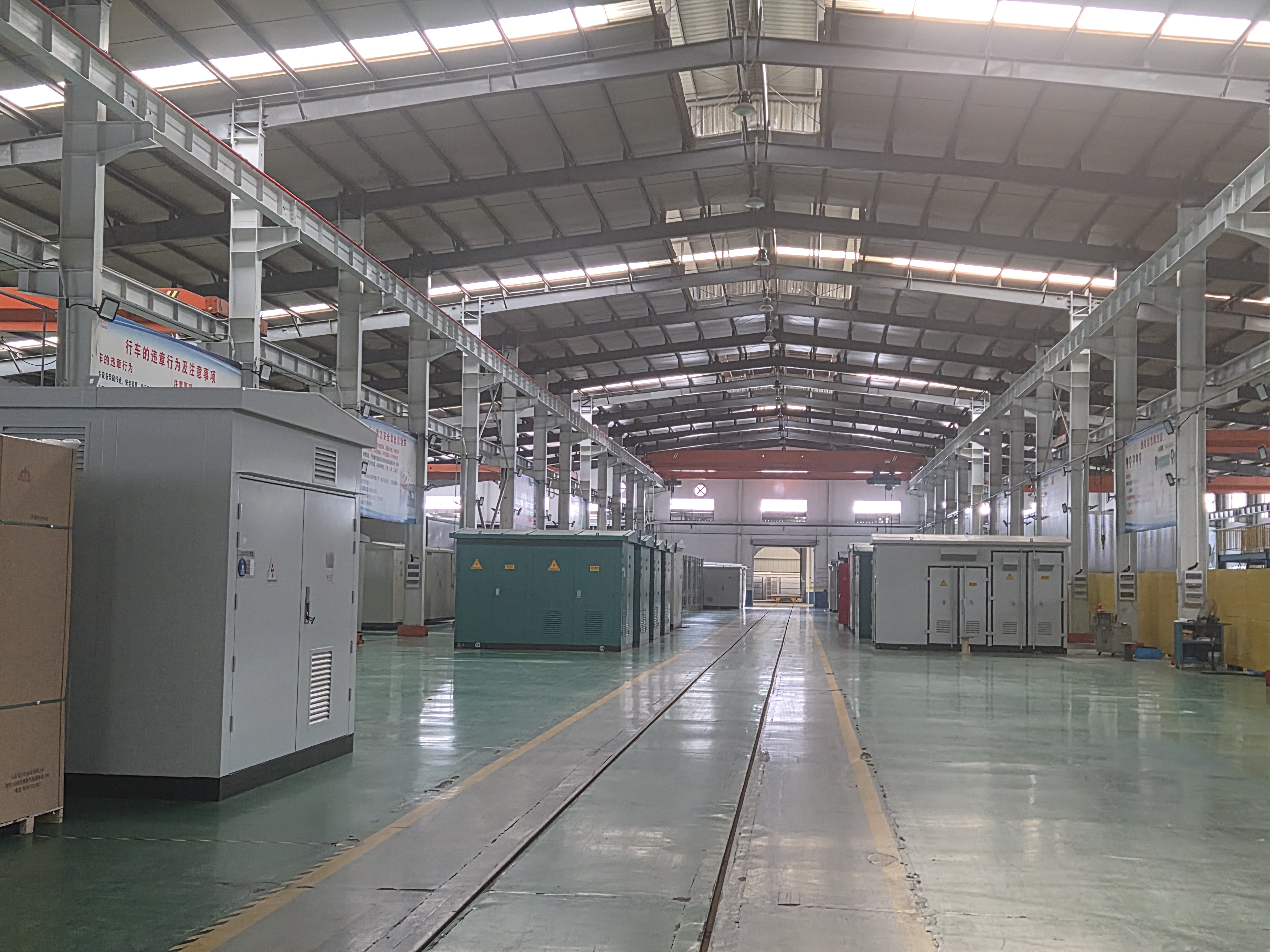
Where the site has to be energised quickly, a containerised prefabricated substation moves assembly and factory testing off the site. The prefabricated cabin substation integrates HV switchgear, transformer, LV switchgear, compensation equipment, automation system, AC/DC power supply and environmental control in one enclosure rated IP54/IP55 and –40 °C to +50 °C, with the YBM / ZGS11 / ZGS13 range covering 10/35 kV and 500 to 50,000 kVA. Because assembly and testing are completed before shipment, site civil works and installation time are reduced and quality control happens in the factory rather than at the site.
The insulation process behind an oil-immersed main transformer is part of the reliability case, not a manufacturing detail. Cellulose insulation is hygroscopic and absorbs moisture during manufacture, transport and site assembly, while insulating oil carries dissolved gas; both reduce dielectric strength and can initiate partial discharge, particularly under lightning impulse. After assembly the active part is dried, the tank is evacuated and filtered hot oil is introduced under vacuum, after which dielectric strength (BDV) and moisture content are measured on oil samples. That process supports the low-partial-discharge and high-reliability requirements of data centre, AI computing park and rail transit supply.
North American Residential and Commercial Distribution
In North America the scenario fit is settled by the distribution standard rather than by a technical preference. For residential and small commercial distribution, single-phase pad-mounted or pole-mounted units in the range of roughly 25 kVA to 100 kVA are recommended, with 50 kVA and 75 kVA units at 7200/2400 V and a 120/240 V secondary typical in service. Where commercial or light-industrial loads require three-phase supply, three-phase pad-mounted units are the appropriate type.
The verified ranges behind that recommendation are specific. The ZGD-H / ZGD-Z series single-phase pad-mounted transformer covers 15–250 kVA. The ZGS-H / ZGS-Z series three-phase pad-mounted transformer covers 75–2500 kVA with high-voltage options of 4.16 / 12.47 / 13.2 / 13.8 / 22.86 / 24.94 / 34.5 kV and low voltages of 240 / 480 / 600 / 347 V. Pole-mounted units in the D-M series cover 5–167 kVA. Typical ratings in service across the pad-mounted family range from about 25 kVA to 500 kVA.
Certification is an entry condition, not a differentiator. Units must hold a UL Certificate of Compliance for liquid-filled distribution transformers rated over 750 V, and for Canada certification to CSA C2.1-06 and CSA C227.4 applies. A pad-mounted transformer is defined as much by its enclosure as by its core: HV and LV switching, fusing and protection are enclosed with the transformer in a tamper-resistant steel enclosure installed at ground level on a concrete pad, which is what allows the unit to stand in publicly accessible areas without a fenced substation. Compartmental and dead-front construction, radial or loop feed and tamper-resistant design are the defining features, and the units are fully sealed and maintenance-free.
Planning signal: the U.S. Department of Energy 2024 rule under 10 CFR Part 431 requires distribution transformers to transition towards amorphous electrical steel starting in 2029. Buyers specifying now for delivery beyond that date should treat core material and loss grade as a forward-looking part of the specification rather than a last-minute substitution question.
General Industrial Distribution: American, European or Prefabricated Cabin
General industrial distribution is where type selection most often collapses into a price comparison, because three enclosure concepts can serve superficially similar loads. They are not interchangeable.
An American pad-mounted substation is compact, front-access, uses elbow bushing plug-in connections, has a low profile and suits residential and light commercial distribution. A European box-type substation is larger, with separate compartments for HV, LV and transformer, which makes maintenance easier and suits industrial and commercial distribution and infrastructure projects. The consequence is measurable in both directions: the American layout has a typically lower maximum capacity (generally up to about 3,000 kVA) and more limited customisation options, while the European layout has a larger footprint, a higher initial cost and more complex civil and installation requirements.
Where the site needs a substation rather than a transformer, the prefabricated cabin is the third option. The YBM / ZGS11 / ZGS13 range covers 10/35 kV and 500 to 50,000 kVA with IP54/IP55 protection and an ambient range of –40 °C to +50 °C, integrating switchgear, transformer, compensation, automation, AC/DC supply and environmental control. It applies to data centres, AI computing parks, industrial plant substations, renewable energy step-up substations and remote power supply for mines and oil and gas fields. Because it can be relocated if the network changes, it also fits projects where the load centre is expected to move.
For load-level efficiency, oil-immersed distribution transformers of the S13 / S14 / S15 series and amorphous-alloy designs are the relevant options, with amorphous cores delivering no-load losses 60–80% lower than conventional cores in grid upgrade and green building applications.
What "Custom" Actually Changes: Four Specification Levers
Choosing the type is the first decision. The second is what the custom build changes within that type — and these four levers are where most site mismatches originate.
1. Vector group. The connection symbol describes how HV and LV windings are connected — star, delta or zig-zag, and whether a neutral is brought out — together with the phase displacement in clock notation, where the number is the LV phasor lagging the HV phasor in units of 30 degrees. YNyn0 means both windings star-connected with the neutral brought out and zero displacement; Dyn11 means delta HV, star LV with neutral and a 330-degree displacement. Two transformers can only be operated in parallel if their vector groups are compatible, and an incorrect vector group on the rating plate, enquiry or drawings is one of the most common causes of a transformer arriving that cannot be paralleled with existing units on site.
2. Cooling class. The four-letter code — ONAN, ONAF and similar — combines the internal cooling medium and its circulation with the external medium and its circulation. O is oil, A is air, N is natural and F is forced circulation, so ONAN means natural oil and natural air circulation while ONAF adds fans that raise permissible loading. The same transformer often carries two ratings on its nameplate, one per cooling stage, and the class must be checked against the ambient temperature and altitude of the installation site.
3. Tap changer. An on-load tap changer regulates voltage while energised; an off-circuit tap changer cannot. The choice follows the grid, not the transformer: transmission transformers that must hold voltage within limits are specified with an on-load tap changer, and the tap-changer rating, step voltage and operating sequence are fixed in design and verified during factory testing.
4. Loss grade and insulation process. Efficiency specification has moved from preference to regulation in several markets, and the insulation process determines whether the specified losses survive transport and installation. Compliance with drying and vacuum oil-filling is demonstrated through the routine and type tests of the IEC 60076 series, and independent verification of that test capability exists through KEMA and TÜV Rheinland reports.
Comparison with Traditional Standard Selection
The oil-immersed versus dry-type decision is the most frequent comparison in industrial procurement, and it is the one where the trade-offs are most often flattened.
| Dimension | Oil-immersed | Dry-type |
|---|---|---|
| Core difference | Better heat dissipation, lower cost, mature loss design with amorphous options for ultra-low no-load losses | Flame-retardant, oil-free, compact, moderate loss level suited to indoor loads |
| Capacity ceiling | Up to 250 MVA / 765 kV | Limited to 25 MVA / 35 kV |
| Best fit | Outdoor substations, transmission and distribution networks, industrial and mining plants, renewable energy step-up stations | High-rise buildings, data centres, hospitals, subways, airports, underground spaces |
| Cost pattern | Lower initial cost; periodic oil sampling and DGA testing required | 15–30% higher initial investment; lower long-term maintenance, no oil change, no fire-protection system |
| Site requirements | Requires an oil pit; oil leak inspection and conservator/breather maintenance | Requires ventilation; higher noise level; visual inspection and fan filter replacement only |
The enclosure comparison follows the same logic at substation level. An American pad-mounted layout costs less in equipment, reduces civil works through compact installation and shortens lead time; a European box-type layout costs more in equipment and civil works but allows easier future expansion and separate maintenance access to each compartment. Neither is the better purchase in isolation — the correct one is the one whose footprint, capacity ceiling and maintenance model match the site plan for the next ten years.
Where the boundary sits. Three limits should be stated openly before a type is committed. Dry-type units carry a 15–30% price premium and cannot exceed 25 MVA / 35 kV, so a project that outgrows the ceiling has to change family rather than uprate the order. Oil-immersed units require an oil pit, periodic oil testing and a fire-protection position that an occupied building may not accept. And the American pad-mounted concept, while cheaper and faster to install, is generally capped at a lower maximum capacity with more limited customisation — a constraint that surfaces at the expansion stage rather than at the order stage.
One further boundary concerns the supplier model rather than the product. Apex Power Systems is a trading and supply partner, not a manufacturer: manufacturing, certification and test evidence belong to the audited manufacturing partners, and Apex manages factory selection, auditing, design review, witness testing, documentation, freight and commissioning support. A buyer whose procurement rules require contracting directly with the production entity should account for that distinction when the supply model is chosen.
A Procurement Checklist for Scenario-Matched Custom Transformers
The specification items below convert a scenario decision into an enquiry that a factory can quote without interpretation.
| Specification item | Why it decides the type | Where it appears |
|---|---|---|
| Vector group | Determines parallel operation with existing units and affects protection settings | Enquiry, drawings, rating plate |
| Cooling class and site ambient/altitude | Sets the rated capacity of each cooling stage and the temperature limits | Nameplate, thermal design |
| Tap changer type and range | On-load regulation is only possible with an OLTC; off-circuit taps suit planned changes only | Design review, factory test |
| Loss grade and efficiency standard | Drives total cost of ownership and compliance with market rules such as GB 20052-2024 or the U.S. DOE 2029 transition | Technical schedule, type test |
| Destination-market certification | UL, CSA, IEC and CQC coverage must exist in the correct entity name for the exact product family | Qualification package |
| Enclosure and installation concept | Pad, pole, European box or prefabricated cabin determines civil works and maintenance access | Site layout, GA drawing |
| Witness testing and documentation | Factory acceptance and third-party inspection are where the specification is proven | FAT plan, test reports |
Evidence to Require From a Custom Transformer Supply Partner
Scenario fit is an engineering argument, and engineering arguments are settled with documents. The audited manufacturing base behind Apex holds ISO 9001:2015, ISO 14001:2015 and ISO 45001:2018 management-system certification, IEC conformity for 10 kV / 35 kV power transformers and box-type substations, UL product certification, CSA certification, CQC product certification for box-type substations and switchgear lines, and a provincial metrology qualification. Independent verification includes a KEMA Labs Type I Inspection Report for a 250 MVA / 345 kV three-phase power transformer, tested in accordance with IEC 60076-1/-2/-3, IEC 60076-10, IEC 60076-11 and IEEE Std C57.12.00 / IEEE C57.12.90.
The manufacturing base covers 900+ mu (approximately 60+ hectares) with 1,700+ employees including 300+ engineering and technical personnel, and operates a dedicated test laboratory with lightning-impulse, no-load and load-loss, ratio, winding-resistance, temperature-rise and insulation test benches. Apex itself was established as a trading and supply-partner operation, with an export ratio of about 70% and main markets in the EU, the USA and the Middle East.
Reference projects coordinated through Apex include 4 × 110 kV power transformers for Azerbaijan Power Energy Company, 115 kV substations in Tajikistan, a 69 kV transformer and a commercial project in the Philippines, a 132 kV transformer for a Spanish steel-plant substation, a 40,000 kVA energy-storage project in Bulgaria, a 15 MVA pad-mounted unit in the USA, a 110 kV substation in Mongolia, a 345 kV fully insulated power transformer for the US–Georgia transmission company and a 115 kV substation for a US–Puerto Rico distribution company. For buyers matching a scenario to a type, that spread matters more than a single flagship project: it covers pad-mounted distribution, outdoor substation work, energy storage and high-voltage transmission.
Market Trend Analysis: Why Scenario Fit Is Becoming a Compliance Question
Three verified developments are reshaping how type selection is documented. First, efficiency regulation is tightening at the point of purchase: China's GB 20052-2024, "Minimum allowable values of energy efficiency and energy efficiency grades for power transformers", took effect on 1 February 2025, and the U.S. DOE 2024 rule under 10 CFR Part 431 requires distribution transformers to transition towards amorphous electrical steel starting in 2029. A loss grade that was acceptable in a 2023 specification may not be acceptable at commissioning in 2029.
Second, cross-border procurement of larger units continues to grow. Global trade of electrical transformers with power capacity above 500 kVA (HS 850434) reached USD 2.5 billion in 2024, a 12.7% year-on-year increase according to OEC data. Larger trade volumes mean more projects where the buyer, the factory and the installation site sit in three different regulatory regimes — which is precisely the condition in which an American pad-mounted, a European box-type and a prefabricated cabin are compared against each other.
Third, load profiles are shifting. The U.S. data centre substation market was valued at USD 3.44 billion in 2024 by Grand View Research, and the growth attributed to AI and cloud computing concentrates demand in the one scenario where dry-type and oil-immersed types must be combined in a single design rather than chosen between. Scenario fit, in other words, is moving from an engineering courtesy to a documented procurement requirement.
Future Outlook
The direction of travel is toward fewer generic enquiries and more scenario-qualified ones. As efficiency floors rise and certification regimes diverge, the transformer brief will increasingly resemble a site dossier: ambient and altitude data, harmonic and DC content measurements, deployment timeline, maintenance access plan and the destination market's certification path. Suppliers that can answer at that level of specificity will be shortlisted; those that reply with a kVA table will not.
The prefabricated substation is likely to absorb part of that pressure. Because assembly and factory testing happen before shipment, the compliance evidence is generated in a controlled environment rather than on a construction site, and the unit can be relocated if the network changes — an advantage in data centre campuses and grid-upgrade programmes where the load centre is not fixed for the life of the asset. The counterpart is that transport, lifting and foundation planning become part of the critical path, and that planning has to start earlier, not later.
For buyers at the decision stage, the practical conclusion is narrow. Choose the transformer family from the scenario constraints — fire exposure, load profile, capacity ceiling, deployment model and certification regime — and treat capacity, losses and price as variables inside that family. Reversing the order produces technically compliant equipment that does not fit the site.
FAQ
How do I decide between a dry-type and an oil-immersed transformer for an indoor facility?
The decision follows fire exposure and capacity. Dry-type transformers are flame-retardant and oil-free, which makes them suitable for high-rise buildings, data centres, hospitals, subways, airports and underground spaces; oil-immersed transformers are more suitable for outdoor substations, transmission and distribution networks, industrial and mining plants and renewable energy step-up stations. Capacity sets a hard ceiling: oil-immersed designs extend to 250 MVA / 765 kV, while dry-type designs are limited to 25 MVA / 35 kV. Dry-type units also carry a 15–30% higher initial investment offset by lower long-term maintenance, no oil change and no fire-protection system.
What transformer configuration is recommended for North American residential and small commercial distribution?
Single-phase pad-mounted or pole-mounted units in the range of roughly 25 kVA to 100 kVA are the recommended configuration, with 50 kVA and 75 kVA units at 7200/2400 V and a 120/240 V secondary typical in service. Three-phase pad-mounted units are recommended where commercial or light-industrial loads require three-phase supply. Whichever configuration is chosen, units must hold a UL Certificate of Compliance for liquid-filled distribution transformers rated over 750 V, and for Canada certification to CSA C2.1-06 and CSA C227.4.
Which transformer type fits a data centre or AI computing park substation?
Two duties require two types. For indoor MV/LV distribution inside the building, dry-type SCB12–SCB18 transformers are recommended because they contain no insulating oil and handle the non-linear, harmonic-rich load of IT equipment. For the main incoming supply, an oil-immersed power transformer or a prefabricated substation is recommended because higher capacities are available at a lower cost per kVA; where the incoming voltage varies, an on-load tap changer should be specified. Where the site must be energised quickly, a containerised prefabricated substation removes most on-site civil works.
What is the difference between an American pad-mounted and a European box-type substation?
The American layout is compact, front-access, uses elbow bushing plug-in connections and has a low profile, suiting residential distribution, rural grids, street lighting and small commercial loads. The European layout is larger, with separate compartments for HV, LV and transformer, which eases maintenance and suits industrial and commercial distribution and infrastructure projects. On performance, the American design has a typically lower maximum capacity, generally up to about 3,000 kVA, with more limited customisation; the European design has a larger footprint, higher initial cost and more complex civil and installation requirements.
What must be stated in a custom transformer enquiry to avoid a mismatch on site?
Two items cause the most mismatches. The vector group must be stated on every enquiry, drawing and rating plate, because two transformers can only be operated in parallel if their vector groups are compatible, and an incorrect vector group is one of the most common causes of a unit arriving that cannot be paralleled with existing equipment. The cooling class — such as ONAN or ONAF — must be checked against the ambient temperature and altitude of the installation site, because it defines the rated capacity of each cooling stage and the associated temperature limits.
Does a scenario-matched custom transformer carry a cost penalty compared with a standard unit?
It depends on which trade-off the scenario requires. Dry-type units carry a 15–30% higher initial investment than oil-immersed equivalents at comparable duty, offset by lower long-term maintenance because no oil change and no fire-protection system are required. At substation level, the American pad-mounted concept has lower equipment cost and reduced civil works with shorter lead time, while the European box-type concept has higher equipment cost and a larger footprint that increases civil cost, but allows easier future expansion and separate maintenance access.
How can a buyer verify the evidence behind a custom transformer before shipment?
Verification is document-based and should be requested before the order, not after. Certificates should be current and held in the correct entity name for the exact product family being purchased; independent type-test evidence, such as a KEMA Labs Type I Inspection Report for a 250 MVA / 345 kV transformer tested to the IEC 60076 series and IEEE C57.12.00 / C57.12.90, can be checked with the issuing body. Factory acceptance testing, witnessed testing and third-party inspection, together with the routine and type test records required by IEC 60076, provide the performance evidence for the specific unit.
For buyers who need the full product and certification scope in one document, the Apex Power Systems catalogue is available for download: Apex Power Systems Catalog (PDF).
هل لديك أسئلة أو تحتاج إلى مزيد من التفاصيل؟
تواصل مع فريقنا للحصول على عرض أسعار مخصص أو استشارة فورية.
طلب عرض أسعار
املأ النموذج أدناه وسيتواصل معك فريقنا بعرض مقترح مخصص.
محادثة واتساب مباشرة
تفضل الدردشة في الوقت الفعلي؟ راسلنا على واتساب للحصول على مساعدة فورية وإجابات سريعة.
- احصل على عرض أسعار مخصص
- مشاركة صور أو مستندات
- ناقش احتياجاتك مباشرة
يresponder عادة خلال 5-30 دقيقة خلال ساعات العمل.