
Custom Turnkey Line or Standard Machine Set? An Ice Cream Buyer's Decision Framework
Few ice cream projects fail because a single machine misses its datasheet. Most fail because a set of individually reasonable machines was never designed to behave as one plant. The choice between commissioning a custom turnkey line and buying a defined set of standard machines is therefore a procurement decision with engineering consequences, and it deserves a framework rather than a preference.
Why This Decision Now Sits at the Centre of Ice Cream Capital Planning
The global ice cream processing equipment market was valued at approximately USD 2.33 billion in 2025, with projections to reach USD 3.00 billion by 2034 at a compound annual growth rate of 2.71%, according to IMARC Group. That is steady structural growth, not a boom. Within the same market, hard ice cream processing equipment accounted for a dominant 57.8% share in 2025, with continuous freezers the leading product type, according to Future Market Insights.
A market expanding at a modest rate tends to reward operators who compete on cost per litre, product variety and uptime rather than on owning more hardware. That reframes the buying question. Instead of asking which industrial ice cream machine has the best specification sheet, buyers increasingly have to ask how a plant should be configured: how the layout absorbs the building's real constraints, how quickly formats can be changed, how the line behaves in year one versus year five, and who is accountable when one stage starves the next.
Two procurement paths dominate that conversation. One is a fully custom turnkey solution in which a single supplier designs and delivers the plant. The other is a set of standard, catalog-defined machines assembled into a line. Both are legitimate. Neither is automatically cheaper, faster or more reliable, because each shifts risk to a different party at a different moment.
The Two Paths, Defined Plainly
A custom turnkey line
A turnkey ice cream machine solution is a single-supplier scope that starts with plant design and ends with commissioned production. Process flow, equipment sequence, utility interfaces, control logic, layout and commissioning are defined together and matched to a specific product portfolio. The buyer receives one integrated system rather than a collection of units, and the supplier carries the integration risk.
A standard machine set
A standard machine set is built from machines that are defined by fixed model designations and rated outputs, such as the catalog-defined SNLF and SNFU configurations. Each unit is specified, priced and delivered against an established design. The buyer, an integrator or a consultant assembles them into a line. The advantage is comparability and speed of specification; the trade-off is that interface compatibility, layout fit and process balancing remain the buyer's engineering task.
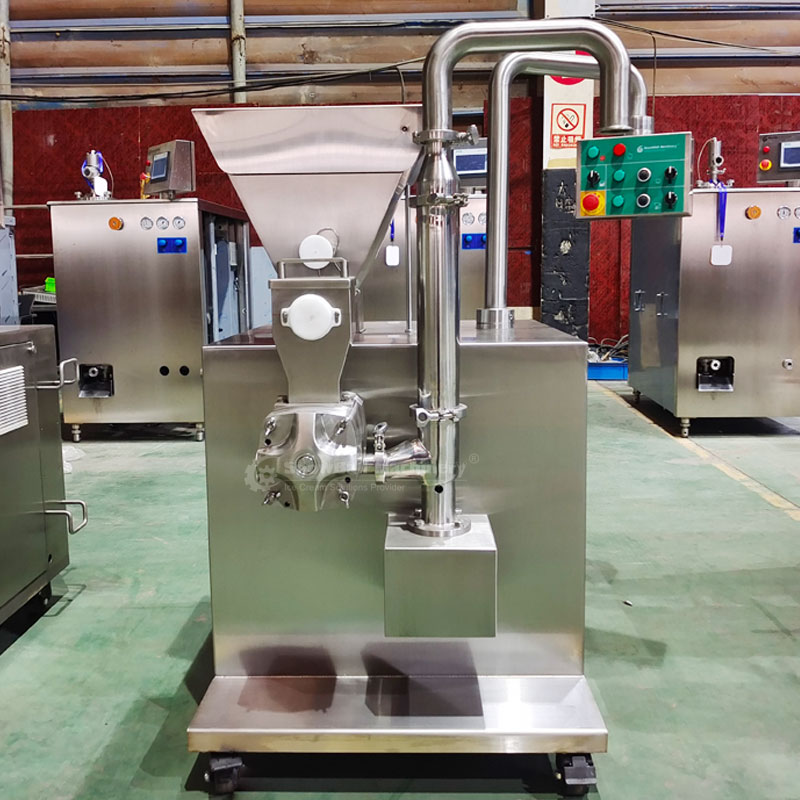
Modular stages such as an ice cream ingredient feeder can be specified as catalog units or designed as part of an integrated line. The decision usually turns on whether process balance is bought or engineered in-house.
What a Custom Turnkey Solution Actually Contains
Snowball Machinery Manufacturing Co., Ltd is an ice cream equipment manufacturer founded in 2020 that integrates research and development, manufacturing, assembly, commissioning, export, domestic sales and after-sales service. The company operates a 4,000 square metre factory with approximately 50 employees, an R&D team of 10 engineers, an annual output of 1,200 sets and a monthly production capacity of 100 sets. Its export ratio is 90%, with main markets in North America, South America, Europe, Asia and Africa, and its published company profile states that its equipment reaches more than 70 countries. The minimum order quantity is one set, and production lead time is determined according to the specific equipment plan.
What makes the turnkey scope relevant to this framework is its breadth. The company states that it is one of the few ice cream machine manufacturers providing a full line of ice cream machines from A to Z, allowing customers to use a one-stop shop service. In practice, that scope spans ice cream premix processing, HTST and batch ice cream pasteurizing systems, ageing tanks, CIP cleaning systems, ice cream continuous freezers, fruit feeder and ingredient feeding systems, ripple pumps, moulding stick ice cream machines, extrusion ice cream machines, hardening tunnels, cup filling machines, automatic cone ice cream filling machines, sandwich ice cream machines, cake ice cream machines, packing and cartoning equipment.
Two capabilities matter for the decision itself. First, personalized customization: solutions are built around the customer's product portfolio, not only around a catalog. Second, retrofit capability: the company states that it supports the upgrading and retrofitting of well-known brand equipment, helping customers reduce renovation costs by 40% to 70%. For an existing plant, that retrofit path can be a third option between a full new custom line and a straight replacement with standard sets.
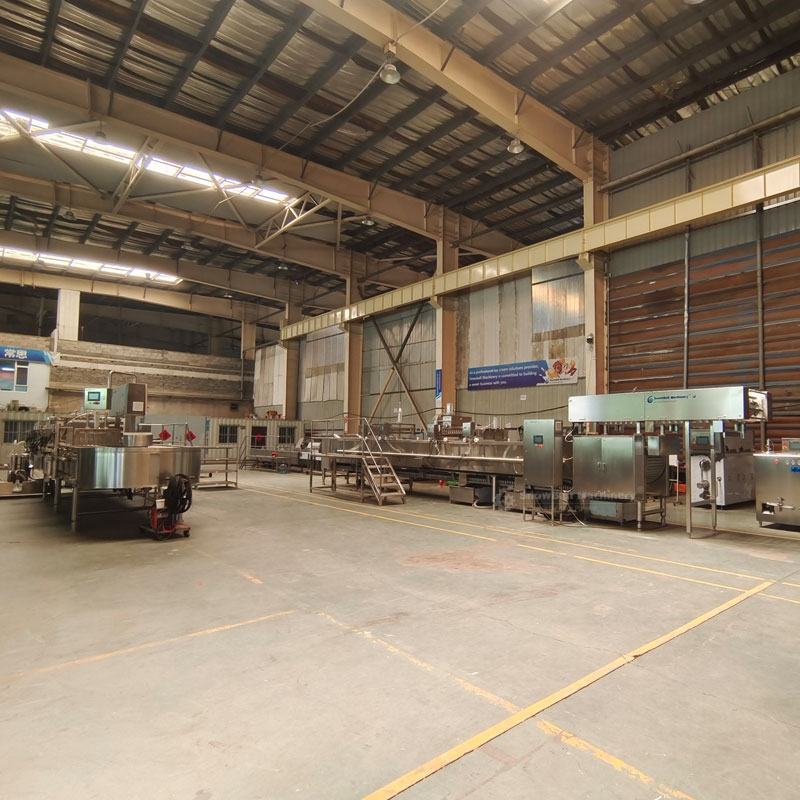
Assembly and pre-delivery commissioning capacity determines how much of a line can be de-risked before it reaches the buyer's site.
Where a Standard Machine Set Still Wins
Standard machines exist for good commercial reasons. A fixed model designation with a defined rated output is easy to quote, easy to compare across suppliers and easy to budget. For a producer who already knows the product, has settled the building layout, and retains in-house engineering or a trusted integrator, standard units can reduce the specification phase and lower the perceived risk of an unfamiliar custom design. They are also straightforward to replicate when a second or third line is added in a familiar configuration.
The constraint is structural rather than technical. When machines are selected individually, the process balance between stages, the buffer capacity between freezing and filling, the hardening tunnel loading logic and the utility placement all become coordination tasks. If any of those assumptions change later, the cost of correction usually lands on the buyer, because no single party owns the system.
The Five-Test Decision Framework
The framework below is deliberately narrow. It does not ask which path is better in general; it asks which path fits a specific project. Buyers who test their project against all five dimensions usually find that three or more point in the same direction.
| Decision test | What the buyer must establish | Typically favours |
|---|---|---|
| 1. Physical layout and site constraints | Ceiling height, drainage, utility points, distance between freezing, moulding, hardening and packing zones, and whether the building is fixed or still being designed. | Fixed or awkward existing building favours a custom line; a building designed around catalog footprints favours standard sets. |
| 2. Product portfolio and changeover | Whether the plant runs one format or a mix of stick, extrusion, cup, cone, sandwich and cake products, plus inclusions, ripple patterns and overrun targets. | Mixed or evolving portfolios favour a custom turnkey solution; a single stable format favours standard machines. |
| 3. Capacity trajectory | Where volume will be in year three and year five, and whether expansion means adding modules or replacing stages. | Planned expansion favours a custom line designed with modular, expandable units and reserved upgrade interfaces. |
| 4. Integration with existing assets | Whether existing equipment is retained, retrofitted or retired, and what the replacement cost of that decision actually is. | Retention and retrofit of existing brand equipment favours a supplier able to upgrade rather than replace. |
| 5. Lifecycle, parts and service | Parts availability, upgrade paths, remote diagnostics, response time, documentation language and operator training. | Long-horizon ownership favours a supplier with a defined after-sales ecosystem rather than a machine-only transaction. |
Decision rule: if tests 1, 2 and 3 all point the same way, the path is usually clear. If tests 1 and 3 conflict, resolve capacity first, because layout can be engineered around capacity but capacity cannot be engineered around a building that has no room to grow.
Technical Explanation: Where the Two Paths Diverge in the Process
An industrial ice cream machine system is a chain of thermally and rheologically linked stages, and the differences between the two paths appear at the interfaces.
The process sequence is broadly consistent across both paths: premix preparation, pasteurization through HTST or a batch ice cream pasteurizing system, homogenization, ageing in an ice cream ageing tank machine, freezing in an ice cream continuous freezer with overrun control, dosing of inclusions through an ice cream fruit feeder or ingredient feeding machine, forming through either a stick ice cream moulding machine or an extrusion ice cream machine, hardening, filling into cups or cones, sandwich and cake assembly, and packing. CIP cleaning runs across the wet side of the line.
In a custom turnkey line, those stages are dimensioned as one system. Overrun, viscosity, throughput and dwell time are matched across the freezer, feeder, former and hardening tunnel, so a change in one product specification propagates as a planned adjustment rather than an unplanned bottleneck. Control hardware supports this: servo systems used to control ice cream swirl patterns, high-precision sensors and intelligent control systems for filling volume and fruit particle dosage, food-grade 304 and 316 stainless steel across product-contact surfaces, and built-in intelligent monitoring that gives early warnings of abnormal operating conditions.
In a standard machine set, each unit is optimised against its own rated output. Interface compatibility, buffer sizing and control handshakes become the buyer's responsibility. The engineering is not inferior, but the accountability is distributed, which is precisely why some projects are easier to buy as a system and others are easier to buy as units.
Expandability is the second technical divide. Modular and expandable design, with upgrade interfaces reserved at the design stage, allows later capacity expansion and function upgrades without replacing the whole line. Retrofitting that capability into a fixed standard set after installation is possible but usually more disruptive, because interfaces were never provisioned.
Application Fit: Which Buyer Profile Belongs on Which Path
| Buyer profile | Recommended path | Reasoning |
|---|---|---|
| Buyer planning to build an ice cream factory with limited industry knowledge | Custom turnkey line | Plant design, process sequencing and commissioning are consolidated under one supplier, which reduces the number of decisions the buyer must make without prior process experience. |
| Experienced producer seeking one-stop procurement | Custom turnkey line, with standard units where suitable | A single sourcing scope removes multi-vendor coordination while still allowing catalog machines to fill well-understood stages. |
| Cost-performance-driven buyer with an existing plant | Retrofit and upgrade path | Upgrading existing well-known brand equipment can reduce renovation cost by 40% to 70% compared with replacement, according to the manufacturer's published comparison. |
| Producer with a fixed single format and settled layout | Standard machine set | Where product and layout are already decided, customization adds planning effort without a corresponding gain in flexibility. |
| Brand owner adapting varied inputs such as bakery or dairy bases | Custom line with configurable feeding and forming | Format flexibility, inclusion dosing and forming options matter more than unit-level price comparison. |
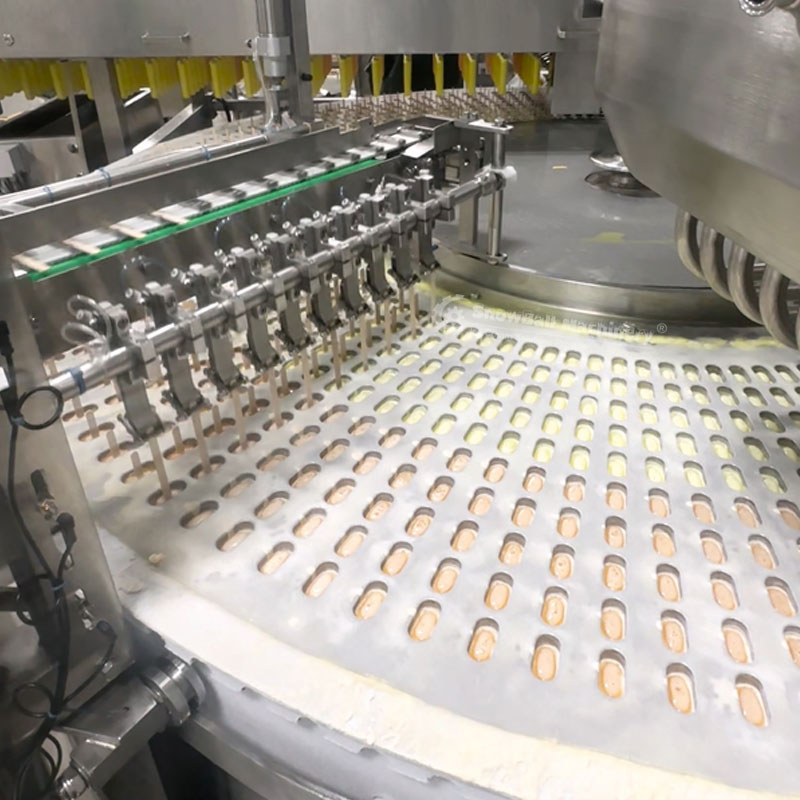
Moulded stick production is a common dividing line between projects: single-format moulded plants can often run on standard sets, while mixed-format plants usually need an integrated design.
Market Trend Analysis: What the Direction of the Market Suggests
Three observable trends support the framework rather than replace it.
Automation demand is concentrated in forming. The ice cream moulding production line segment was valued at USD 1.2 billion in 2024 and is expected to grow to USD 2.5 billion by 2034, driven by increasing automation demand, according to Reports and Data. Forming and moulding are exactly where layout, dosing precision and changeover speed converge, which is why this is the stage where turnkey versus standard decisions are most often revisited.
Continuous freezing remains the anchor technology. Hard ice cream processing equipment held a dominant 57.8% share of the ice cream equipment market in 2025, with continuous freezers as the leading product type, per Future Market Insights. Because the continuous freezer sets the rhythm for the rest of the line, its specification tends to determine whether downstream equipment can be standardized or must be customised.
Supply is concentrated but not closed. Germany, Poland and Italy were the leading exporters of dairy machinery under HS Code 843420 in 2024, with export values of USD 74.4 million, USD 64.9 million and USD 61.7 million respectively, according to the Observatory of Economic Complexity. At the same time, Tetra Pak is described as the leading manufacturer in the industrial ice cream equipment sector, with machinery used in over 75% of commercial production lines worldwide as of early 2026. For buyers, that combination means the global baseline is a highly standardised, high-volume processing model, and the alternative path is a configured solution sized to a specific plant.
Compliance is the fourth, quieter trend. Commercial ice cream appliances and ice-makers with incorporated motor-compressors are regulated under the safety standard IEC 60335-2-89:2019, which means the electrical safety envelope of a line is defined independently of whether it was custom-built or assembled from catalog units. That is one area where neither path offers an advantage: compliance must be demonstrated either way.
Comparison with Traditional Approaches, and the Limits of Each Path
The traditional approach has been to buy machines from several vendors at the best unit price and integrate them locally, or to purchase well-known international brand equipment as a package. Both remain valid, and both carry known costs: multi-vendor integration, extended commissioning, and in the second case, a higher capital base.
The manufacturer's published comparison states that its equipment offers European-grade quality with a service life 6 to 9 times longer than comparable-priced alternatives, delivery time 60% to 80% shorter than that of major well-known brands, total costs 40% to 70% lower than purchasing internationally renowned brand equipment, maintenance costs reduced by 90%, and energy efficiency increased by 20%. Those figures are first-party claims and should be treated as supplier-stated comparisons to be verified against project-specific quotations, references and acceptance testing, not as independently audited results.
Honest boundaries matter more than headline advantages, and each path has them:
- Customization extends the front end. A custom turnkey line requires product, layout and capacity decisions to be made early and together. Production lead time is determined according to the specific equipment plan rather than a catalog date, so a buyer needing immediate off-the-shelf delivery will find a standard machine set faster to specify.
- The retrofit saving is scoped. The stated 40% to 70% renovation cost reduction applies to upgrading existing well-known brand equipment. It is not a general discount on new construction, and it depends on the condition of the retained assets.
- Standardization shifts integration risk. A standard set is easier to budget, but interface compatibility, buffer sizing and control handshakes remain with the buyer or integrator, and later capacity expansion may require replacement rather than upgrade if no interfaces were reserved.
- Neither path removes compliance work. Pre-shipment testing, documentation and standards conformity are required regardless of configuration.
- Customization has a scale threshold. For a single-format plant with a settled layout and modest expansion plans, the incremental value of a bespoke design can be limited, and the additional planning effort may not be recovered in operating performance.
Future Outlook
Over the next several years, three shifts are likely to shape how this decision is made. First, forming and moulding automation will continue to absorb investment, which pushes buyers toward suppliers able to design dosing, forming and hardening as one system rather than as separate purchases. Second, modularity will become a procurement criterion in its own right: expandable design with reserved upgrade interfaces converts capacity growth from a capital event into an incremental one. Third, service ecosystems will increasingly differentiate suppliers, because remote assistance, multi-language documentation, training material and spare-part continuity determine how quickly a line returns to full output after an interruption.
Reliability data will also be tested in public. The manufacturer states that its equipment provides stable operation for 12 years while meeting high quality requirements of branded ice cream manufacturers, and that each ice cream continuous freezer undergoes a material-loaded trial run before delivery, simulating the customer's production environment. Buyers evaluating either path should ask for that level of pre-delivery evidence: trial-run records, inspection certificates and third-party verification are more decision-relevant than a specification table.
FAQ
What is the practical difference between a custom turnkey line and a standard machine set?
A custom turnkey line is a single-supplier scope covering plant design, process sequencing, equipment selection, commissioning and after-sales, matched to a specific product portfolio. A standard machine set consists of catalog-defined machines with fixed model designations and rated outputs, assembled into a line by the buyer, an integrator or a consultant. The operational difference is where integration risk sits: with the supplier in the first case, and distributed across the buyer's project team in the second.
What are the purchasing terms, minimum order quantity and acceptance criteria for industrial ice cream machines?
For the equipment described here, the minimum order quantity is one set. Delivery terms available are FOB, CIF, EXW, CFR, DAP and DDP. Acceptance criteria are a pre-shipment test, an on-site customer inspection and third-party inspection such as SGS. Payment terms are 50% advance payment by T/T, with the remaining 50% before shipment. Monthly production capacity is 100 sets, and production lead time is determined according to the specific equipment plan.
Can capacity be expanded later without replacing the entire line?
Expansion depends on how the line was specified. Equipment built with a modular and expandable design, and with upgrade interfaces reserved at the design stage, can support later capacity increases and function upgrades without full replacement. Suppliers can also provide technical support for equipment upgrades rather than complete replacement. Where a line was assembled from standard units without reserved interfaces, expansion may require replacement of specific stages instead of an incremental addition.
What happens if delivery, installation or commissioning is delayed?
Delivery and commissioning risk is typically managed through standardised delivery procedures that define time limits for production, logistics and installation, with progress updated to the customer in real time. Compliance certifications and customs clearance procedures are completed in advance for overseas customers to avoid delivery delays, and a professional installation and commissioning team plans on-site procedures ahead of arrival. A 24-hour after-sales response mechanism combining remote troubleshooting and on-site service is a common control measure.
How can buyers verify quality before shipment rather than after installation?
Verification is usually structured around three layers: a pre-shipment test, an on-site customer inspection, and third-party inspection such as SGS. Before delivery, equipment can undergo food-grade and precision testing with qualification certificates issued at that point, and ice cream continuous freezers can be trial-run with material loaded to simulate the customer's production environment. Quality systems typically reference ISO 9001 and national food machinery compliance requirements such as FDA, CE and FSC. Buyers should confirm which of these apply to their specific order and market.
What long-term support continues after commissioning?
Long-term support generally covers remote assistance functions built into the machines, a 24-hour after-sales response mechanism, multi-language operation manuals and training videos to support operator proficiency, and overseas after-sales service outlets or partner service providers. Suppliers also maintain customer files and conduct regular follow-up visits to identify product iteration and capacity upgrade needs, with technical solutions delivered in advance. Parts availability and the upgrade path are the two elements buyers should confirm explicitly in writing, since they determine the cost of the second half of the equipment's service life.
Bringing the Framework Back to the Decision
The turnkey versus standard question resolves differently for every plant, but it resolves predictably when the five tests are applied honestly. Physical layout, product portfolio and capacity trajectory define whether integration should be bought or built in-house. Existing assets and lifecycle support define whether the total cost of ownership favors a designed system or a catalog configuration. Buyers who document those five answers before issuing an enquiry will find that supplier conversations become shorter, more technical and more comparable.
A downloadable company brochure for Snowball Machinery is available at https://cdn.socialarks.com/sbsp/24826/common/2026/0521/6a0ea9122acfe.pdf.