
Custom Voltage, Gear Stages and Batch Consistency: A Supplier Longevity Test
A brushless gear motor programme rarely fails at the sample stage. It fails later, when a repeat order arrives with units that satisfy the drawing but not the behaviour the design was validated against. For a dc brushless gear motor specified into a multi-year platform, the useful sourcing question is not whether a supplier can build one good unit, but what in that supplier's specification discipline and process control keeps the ten-thousandth unit close to the first.
The GMP36-TEC3650 is a brushless planetary gear motor in the DC brushless gear motor category, manufactured by TT Motor (Shenzhen) Industrial Co., Limited, a miniature motor maker established in 2006 and based in Bao'an District, Shenzhen. Its published specification — DC 12 V to 24 V with rated voltage customizable inside that range, one to four gear stages, gearbox lengths of 26 mm, 33.5 mm, 40.5 mm and 47.5 mm, and a maximum rated torque of 30.0 kg.cm — is a compact worked example of how voltage customization, gear stage selection and batch consistency interact. It is also a useful frame for the questions buyers should keep asking long after the sample has been approved.
Why the sample stage is a weak predictor of supply performance
Samples are usually built in a narrow window: a small quantity, a known engineer, careful handling, and a short interval between build and test. Production is a different system. It involves more operators, more material lots, longer intervals between assembly and shipment, and cumulative tool wear. In miniature gear motors, the parameters that shift first are rarely the headline ones. They are the secondary characteristics — no-load current, running speed at a fixed voltage, backlash, audible noise, and the dimensional stack between shaft and flange.
This is why the classic procurement failure mode sounds so familiar: the sample was qualified, the batch was not consistent. The failure is not necessarily a supplier capability problem. It is more often an agreement problem — the purchase specification captured the rated torque and speed, but not the measurement conditions, the acceptance window, the change notification route, or the record that lets a buyer see drift before it becomes a line stop.
For long-term evaluation, the practical shift is from product specification to specification plus evidence. A supplier that can state how a parameter is measured, on what equipment, at what voltage and temperature, and how that record is retained per lot, is offering something more durable than a favourable datasheet.
Custom voltage: what DC 12 V to 24 V customization actually commits
On the GMP36-TEC3650, the rated voltage range is DC 12 V to 24 V, and the rated voltage can be customized within that range. For buyers, that sentence carries three separate obligations that should be separated in the purchase agreement.
The first is the electrical target. Changing the rated voltage inside a fixed 36 mm frame means changing the winding to reach the intended speed and current at the application voltage. The specification variant therefore needs an identifier of its own — not a note on a purchase order that disappears at the next order. The second is the performance reference point: a motor customized for a 24 V system and a motor customized for a 12 V system are different builds, and mixing the two in one qualification report is a common source of confusion later. The third is drive compatibility. A brushless motor relies on electronic commutation rather than carbon brushes, so the drive electronics are part of the system definition, not an accessory. Buyers should confirm that the qualified combination of motor variant, drive settings and load profile stays fixed through the production life of the programme.
A useful discipline at the research stage is to request performance data at both ends of the customization range, since the tolerance stack behaves differently at 12 V and 24 V. Where a supplier can only show data at one point, that is a limit worth recording rather than a disqualification.
Gear stages: a torque decision with a geometric price
The GMP36-TEC3650 gearbox has a gear module of 0.5 and is available in one, two, three or four gear stages. Gearbox length options are 26 mm, 33.5 mm, 40.5 mm and 47.5 mm, and overall length ranges from 26 mm to 47.5 mm depending on the number of reduction stages. Ten reduction ratios from 1/4 to 1/720 are available, the output speed range is 4 rpm to 1600 rpm, and maximum rated torque is 30.0 kg.cm. The motor and gearbox share a 36 mm outer diameter, the output shaft is a solid 8 mm shaft, the mounting flange has four M3 holes, and the unit weighs 420 g.
Each added stage buys reduction ratio and torque multiplication, and costs length plus a small cumulative efficiency loss. That trade is the real content of the gear stage conversation. Specifying four stages when two would reach the required torque adds 21.5 mm of gearbox length in this family and pushes the motor further into a longer envelope than the machine layout may allow. Conversely, choosing fewer stages to save space leaves torque margin thin and can force a larger frame later.
A practical decision rule for buyers in the research phase: fix the required continuous torque and the available envelope first, then let the stage count follow. Record the ratio, the stage count and the resulting gearbox length as one locked block in the specification, because these three values move together and a substitution in one silently changes the other two.
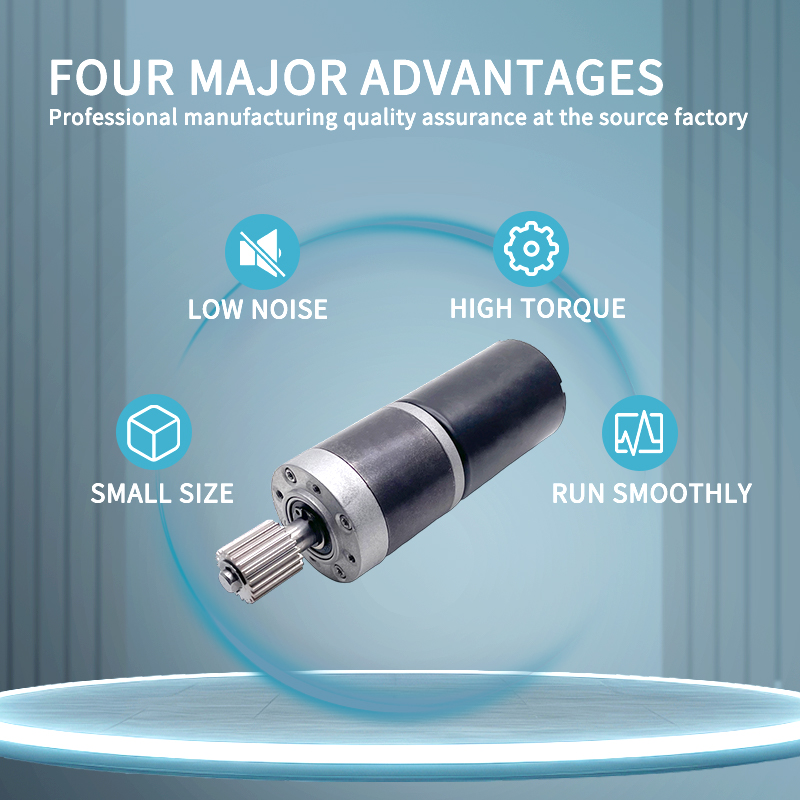
The GMP36-TEC3650 specification block: DC 12 V to 24 V customizable voltage, one to four gear stages, 30.0 kg.cm maximum rated torque, 4 to 1600 rpm.
Batch consistency: the controls that matter more than the datasheet
Consistency in a planetary gear motor is mostly a story about interfaces. Between motor and gearbox, between gear and gear, between shaft and bearing, and between what the test bench measures and what the application experiences. Precision-machined planetary gears reduce transmission backlash and keep operating noise low, and the brushless structure removes the brush and commutator wear mechanism that exists in brushed DC motors of comparable size — the manufacturer states a service life typically in the tens of thousands of hours, with no regular brush replacement. Those are the design-side reasons the architecture is attractive for long-duty equipment. They are not, by themselves, evidence of batch-to-batch stability.
Stability evidence comes from the process side. TT Motor operates an automated production process, a precision assembly system, a product testing system and a mass production management system, and produces about 8,000,000 motor units per year across a manufacturing area of roughly 9,000 m² with more than 300 employees and a 35-engineer R&D team. Those facts describe scale and infrastructure. What converts them into consistency for a specific programme is the agreement around measurement.
Four controls worth writing into the agreement
- A fixed measurement recipe. Voltage, ambient temperature, mounting, load and warm-up time all move the numbers. If the buyer's incoming inspection and the supplier's outgoing test use different recipes, the two datasets will disagree even when the product is stable.
- A golden sample held by both parties. One retained unit, sealed and dated, settles arguments about drift faster than any report.
- A change notification clause covering winding, gear lot, lubricant and shaft supplier. These are the inputs that quietly alter behaviour without altering the drawing.
- Trend reporting rather than pass or fail. A parameter that stays inside tolerance while moving steadily in one direction is a warning, and a pass or fail report hides it.
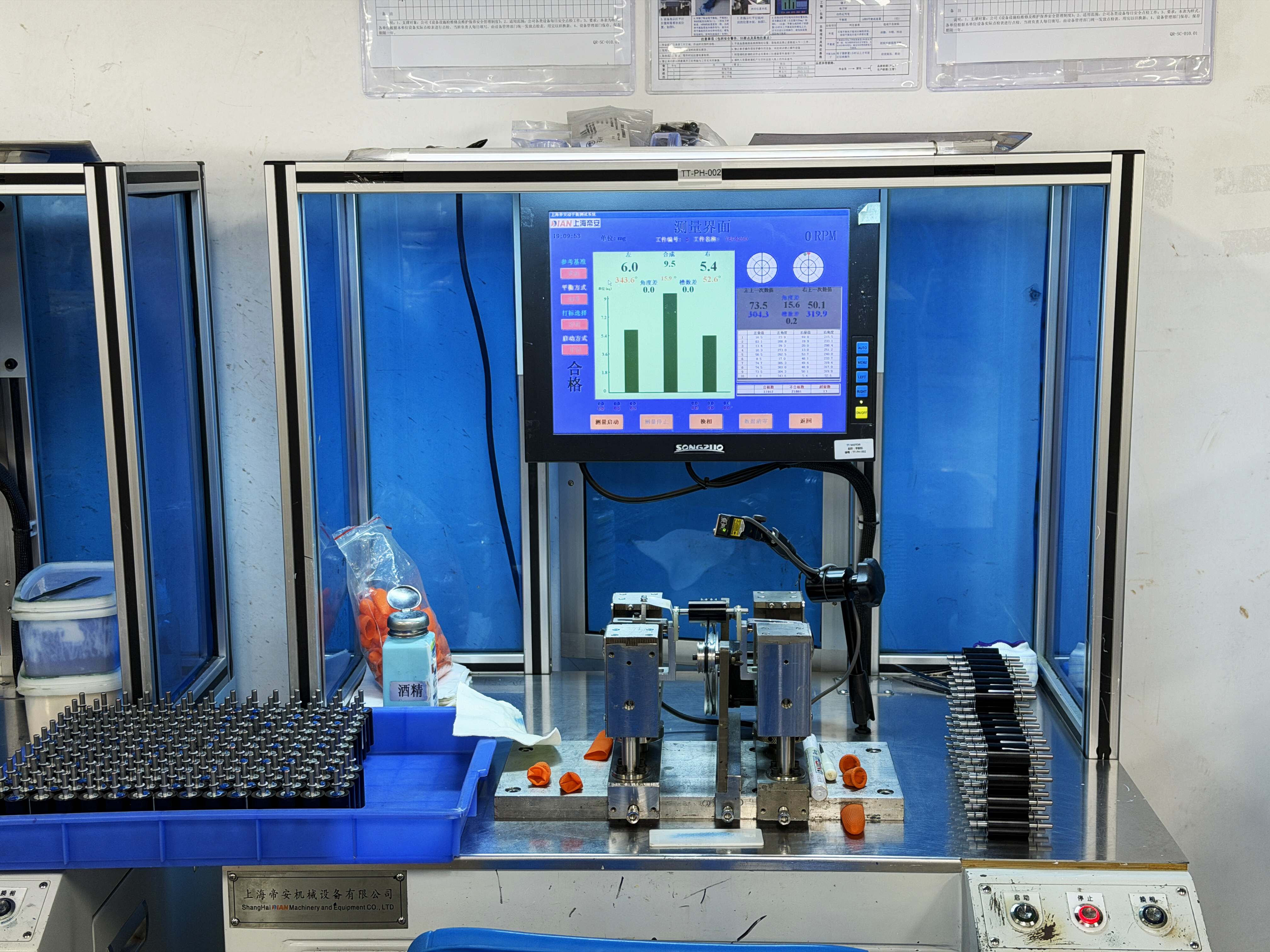
Consistency controls sit upstream of final test: balancing, gear measurement and life testing determine how much of the batch-to-batch variation reaches the customer.
What should be measured, and how often
A workable monitoring set for a brushless planetary gear motor is short enough to run routinely and broad enough to catch the drift patterns that matter. It should be agreed before the first production order, not assembled after the first complaint.
| Check | What it reveals | Suggested frequency |
|---|---|---|
| No-load current and speed at rated voltage | Winding and magnet consistency; the earliest indicator of a build change | Every lot |
| Torque at the specified operating point | Gear stage assembly quality and margin against the 30.0 kg.cm ceiling | Sample per lot |
| Backlash and audible noise | Gear machining and assembly fit; positioning accuracy in the application | Sample per lot |
| Overall length, shaft diameter, flange hole pattern | Whether the 26 to 47.5 mm stack and the 8 mm shaft still fit the fixture | Every lot, dimensional sample |
| Life test on an annual or design-change basis | Whether the stated long service life still applies to the current build | Periodic, plus after any change |
Application fit: where this specification earns its place
The GMP36-TEC3650 is intended for robotics, medical device, industrial automation equipment and intelligent logistics equipment, and is designed for compact robotic and automation equipment scenarios. Those categories are not marketing labels; each one stresses a different part of the specification.
In robot joints, the working condition is high-frequency dynamic motion with rapid start and stop, and the requirement is high power density with fast response and low inertia. There, the value of the brushless planetary architecture is the combination of a 36 mm envelope, low transmission backlash and a 30.0 kg.cm torque ceiling that absorbs short-term heavy-load impacts with margin.
In medical equipment, the working condition is low-speed precision motion over long-term operation, with low noise, low vibration and stable running as the stated requirements. Applications in that segment include analysers, pipetting equipment, infusion pumps and rehabilitation robotics. Here the four-stage option and the 4 rpm lower speed limit matter more than peak torque, and gear noise becomes a qualification criterion in its own right.
In intelligent logistics and general industrial automation, the constraint is usually envelope and duty cycle rather than precision. The 420 g mass and the shared 36 mm diameter let the motor sit inside a compact actuator without a separate adapter, and the 4 M3 flange holes simplify replacement across a fleet.
Where the GMP36-TEC3650 ends and other architectures begin
A long-term supplier evaluation is also an architecture evaluation, because no single gear motor family covers every duty. The honest comparison is not brushless versus brushed in the abstract, but four real options against four real constraints.
| Model | Architecture | Key figures | Best suited to |
|---|---|---|---|
| GMP36-TEC3650 | Brushless planetary, 36 mm | DC 12-24 V customizable; 30.0 kg.cm max; 4-1600 rpm; 1-4 stages; 26-47.5 mm; 420 g | Robot joints, medical instruments, industrial automation, logistics equipment |
| GM37-555PM | Brushed DC spur gear, 37 mm | DC 12-24 V; 8.0 kg.cm max; 5-800 rpm; 2-6 stages; 19-29 mm | Smart home devices, automated equipment, production lines where drive simplicity and system cost dominate |
| TWG3246-TEC2430 | Brushless worm gear, right-angle output | DC 12-24 V; 8.0 kg.cm max; 3-35 rpm; 3-5 stages; 46 mm gearbox | Electrically adjustable supports and miniature medical devices needing self-locking behaviour |
| GMP12T-TDC1215 | Coreless with integrated gearbox | DC 4.5-12 V; 2 kg.cm max; 8-5000 rpm; 1-4 stages; 14.9-29.3 mm | Very small envelopes needing fast dynamic response, such as handheld instruments and micro sensors |
The limitations deserve equal weight. A planetary gearbox of this type does not provide the self-locking behaviour associated with a worm gearbox, so any application that must hold position against gravity without an external brake should be reviewed against a worm architecture first. The 30.0 kg.cm maximum rated torque is a ceiling, not a design target, and short-term heavy-load impacts should be checked rather than assumed. The 36 mm shared diameter fixes the mounting envelope, which is a benefit until a machine requires a different flange geometry. And because the motor is brushless, the drive electronics form part of the specification: a supplier evaluation that stops at the motor and ignores the drive has only covered half of the system.
Market context: growing demand, and a standards boundary worth understanding
The commercial backdrop supports the emphasis on long-term supply rather than one-off purchase. Grand View Research puts the global brushless DC motor market at roughly USD 22.2 billion for 2025, with a forecast window running to 2033; Precedence Research cites USD 22.33 billion for the same baseline, and the two figures are close enough to be treated as a consistent estimate. Separately, OEC reports global export value of USD 16.3 billion in 2024 for electric motors with an output below 37.5 W under HS code 850110, the trade category that contains miniature gear motors of this class.
Regulation needs a careful reading, because it is easy to over-apply. IEC 60034-30-1:2025 introduced the IE5 ultra-premium efficiency class, and EU Ecodesign Regulation 2019/1781 requires IE3 for motors from 0.75 kW to 1000 kW and IE2 for the 0.12 kW to 0.75 kW band. The scope begins at 0.12 kW, which sits well above the ratings of a 36 mm miniature gear motor. The practical implication for buyers is the opposite of a compliance shortcut: because minimum efficiency standards do not settle the question at this size, the acceptance criteria in the purchase agreement carry the full weight. What the buyer writes down is what the supplier will be measured against.
What to monitor over the life of the agreement
Long-term supplier evaluation is less a single audit than a small set of recurring observations. Four are worth institutionalising.
Drift, not just conformity. Plot no-load current and speed by lot. A slow trend inside tolerance is the earliest warning available, and it is invisible in a pass or fail report.
Sub-tier transparency. Ask which gear lot, magnet grade and lubricant were used, and whether a substitution triggers notification. Inconsistent batch performance frequently traces to a sub-tier change that never reached the drawing.
Capacity against your forecast. A manufacturer producing about 8,000,000 units a year across three production plants has room to absorb growth, but allocation still depends on where a programme sits in the queue. It is a commercial question worth revisiting annually rather than once at onboarding.
Response to a non-conformance. The most predictive signal of long-term sustainability is not a clean audit history; it is how a supplier handles the first genuine deviation, including whether the corrective action changes a process or only a report.
Future outlook
Two shifts are likely to reshape how buyers judge suppliers of miniature brushless gear motors. The first is the move from unit-level specification to lot-level evidence: as brushless architectures extend into more compact equipment, qualification conversations are likely to include trend data and change logs alongside the datasheet. The second is documentation portability. A supplier whose test records are tied to a specific engineer rather than to a system is harder to sustain over a five-year programme, regardless of product quality.
Neither shift changes the underlying engineering. A 36 mm brushless planetary gear motor with customizable voltage, one to four gear stages and a 30.0 kg.cm ceiling will still be selected on torque, envelope and duty. What changes is the evidence required to keep that selection valid after the sample has been approved.
For readers who want the full product range in one document, TT Motor publishes a downloadable brochure covering its miniature motor lines at the company brochure page; product information is also available at www.ttmotor.com.
FAQ
What does customizable voltage mean on the GMP36-TEC3650?
The rated voltage range is DC 12 V to 24 V, and the rated voltage can be customized within that range. In practice this means the winding is adapted to the intended application voltage inside that window, so speed and current behaviour should be evaluated against the specific variant rather than against the family as a whole.
How do gear stages change torque, speed and length?
The gearbox is available in one, two, three or four stages, with gearbox lengths of 26 mm, 33.5 mm, 40.5 mm and 47.5 mm respectively. Ten reduction ratios from 1/4 to 1/720 are available, output speed spans 4 rpm to 1600 rpm, and maximum rated torque is 30.0 kg.cm. Adding a stage increases reduction and torque capability while increasing overall length from 26 mm up to 47.5 mm.
Why can samples be qualified while batch products perform inconsistently?
Samples are typically built in small quantity with close attention and short intervals between build and test. Production involves more operators, more material lots, longer intervals before shipment and cumulative tool wear. The variation usually appears in secondary characteristics such as no-load current, running speed, backlash, noise and dimensional stack rather than in the headline torque figure, which is why measurement conditions and change notification need to be agreed in writing.
Which parameters should be tracked per lot?
A practical set includes no-load current and speed at rated voltage, torque at the specified operating point, backlash and audible noise, and dimensional checks on overall length, the 8 mm shaft diameter and the four M3 flange holes. Life testing is better handled periodically and after any design or sub-tier change rather than on every lot.
Is a planetary brushless gear motor suitable where the load must hold position without power?
A planetary architecture does not offer the self-locking behaviour associated with a worm gearbox, which typically removes the need for an additional braking device. Applications that must hold position against gravity without external braking are therefore better reviewed against a worm gear motor such as the TWG3246-TEC2430, which uses a right-angle output worm gearbox with DC 12 V to 24 V input, 8.0 kg.cm maximum rated torque and 3 rpm to 35 rpm output.
Does efficiency regulation apply to miniature gear motors of this size?
EU Ecodesign Regulation 2019/1781 sets IE3 requirements for motors from 0.75 kW to 1000 kW and IE2 for the 0.12 kW to 0.75 kW band, and IEC 60034-30-1:2025 added the IE5 class. The regulated scope begins at 0.12 kW, well above the ratings of a 36 mm miniature gear motor, so acceptance criteria for this product class are set by the buyer's own specification rather than by minimum efficiency standards.
What evidence supports long-term supply continuity from TT Motor?
TT Motor (Shenzhen) Industrial Co., Limited was established in 2006 and operates a manufacturing area of approximately 9,000 m² with more than 300 employees, three production plants, a professional assembly centre and a global marketing centre. Annual output is about 8,000,000 motor units, the R&D team comprises 35 engineers, and roughly 70% of output is exported to the EU and USA. These are capacity and structure indicators; programme-specific continuity still depends on the contractual controls agreed with the buyer.
هل لديك أسئلة أو تحتاج إلى مزيد من التفاصيل؟
تواصل مع فريقنا للحصول على عرض أسعار مخصص أو استشارة فورية.
طلب عرض أسعار
املأ النموذج أدناه وسيتواصل معك فريقنا بعرض مقترح مخصص.
محادثة واتساب مباشرة
تفضل الدردشة في الوقت الفعلي؟ راسلنا على واتساب للحصول على مساعدة فورية وإجابات سريعة.
- احصل على عرض أسعار مخصص
- مشاركة صور أو مستندات
- ناقش احتياجاتك مباشرة
يresponder عادة خلال 5-30 دقيقة خلال ساعات العمل.