
Custom Wet Wipes Beyond Skin: Kitchen, Clothing, Eye-Care Fit
Custom Wet Wipes Beyond Skin: Kitchen, Clothing, Eye-Care Fit
Custom wet wipes are usually specified as skin-contact products, which is why baby and pet lines dominate most OEM catalogues. A second, less examined group works on surfaces instead: kitchen wipes for hard surfaces, clothing wipes for laundry tasks and eye-care wipes for eyewear. In the Sunfans range, three models show how far the specification shifts once the cleaning surface stops being skin — kitchen wipes CF001 at 200 × 200 mm with 80 pieces on a water-jet non-woven, clothing wipes YW01 at 150 × 180 mm with 10 cloths on a water-jet non-woven, and eye-care wipes YJ01 at 100 × 150 mm with 20 pieces on water-resistant paper. Sheet size, substrate family and pack count move together, and each move is traceable to the task rather than to a brand preference.
For buyers working through research and evaluation, the practical question is not which of the three is better. It is which combination of size, substrate and count matches the surface being wiped and the rhythm at which the pack will be consumed.
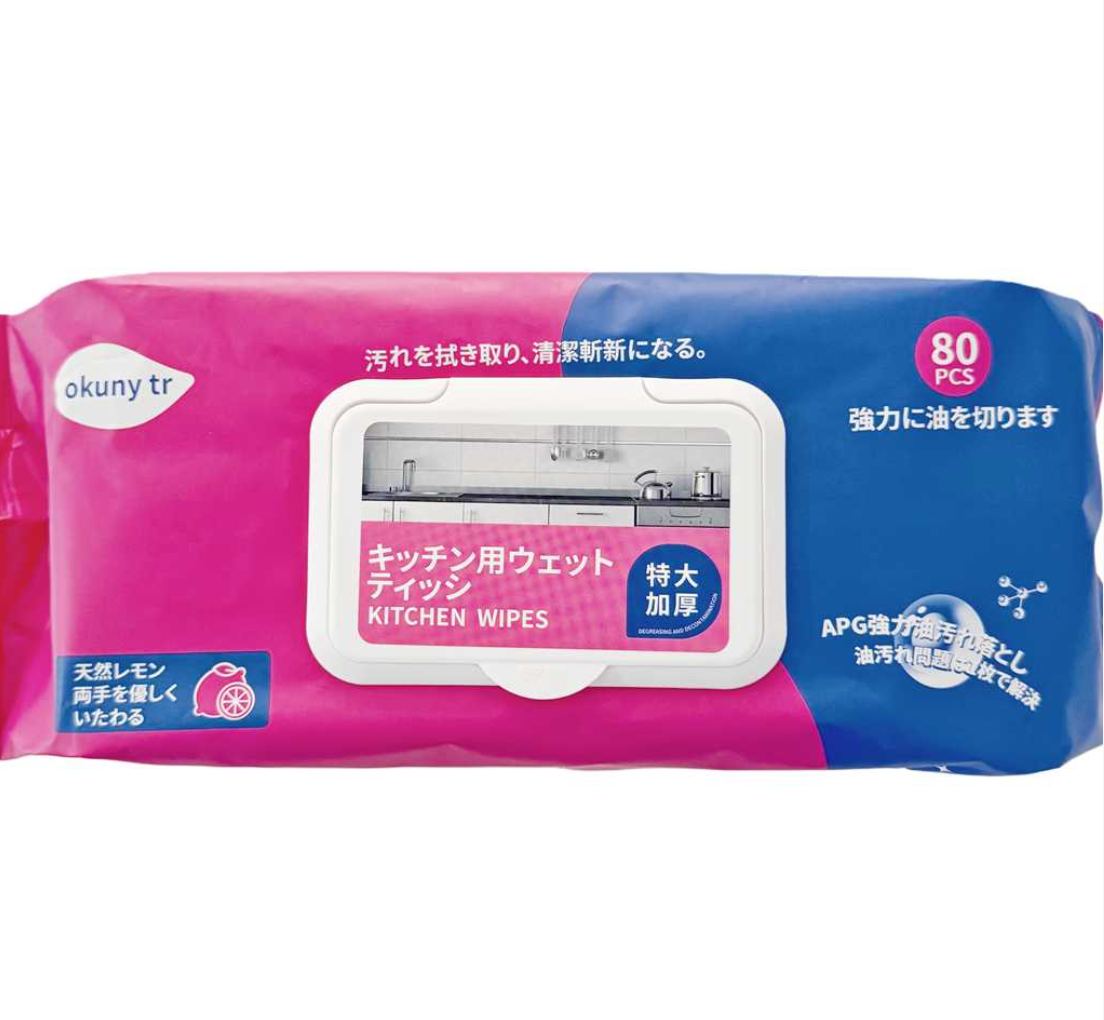
Kitchen wipes CF001: 200 × 200 mm, 80 pieces, water-jet non-woven fabric, documented for home cleaning and large retail channels.
Why “beyond skin” is a separate specification track
Intended use is the first variable in wipe procurement, because it decides the regulatory pathway before it decides anything else. The U.S. Food and Drug Administration describes skin-cleansing and skin-moisturizing wipes, including baby-care and personal-cleansing wipes, as cosmetics. Wipes making therapeutic claims, such as killing germs on the skin, are treated as drugs. Wipes intended to control germs on inanimate surfaces, or containing insect repellents, fall under Environmental Protection Agency regulation, while wipes for cleaning objects are associated with Consumer Product Safety Commission oversight.
Those four descriptions are not marketing categories. They change which label language is permissible, which documentation a distributor will request, and which claims a factory may print. A kitchen wipe and a baby wipe can share a substrate family and still sit in different regulatory positions. The guidance summarised here is market-specific: the evidence available for this analysis does not establish equivalent classifications for Japan, the EU or other destinations, so those remain open until confirmed in the destination market.
Two further variables follow. The cleaning surface determines sheet geometry, because a broad counter and a spectacle lens do not need the same area per draw. The consumption pattern determines pack architecture, because a pack drained across a month of household cleaning and a pack drained in one laundry task should not be built the same way.
The three models at a glance
The table uses documented model data only. It does not rank the three or imply that one substrate family is superior.
| Model | Sheet size | Pack count | Substrate | Documented market |
|---|---|---|---|---|
| CF001 kitchen wipes | 200 × 200 mm | 80 pieces | Water-jet non-woven fabric | Home cleaning, large retail chains, general merchandise |
| YW01 clothing wipes | 150 × 180 mm | 10 cloths for drying clothes | Water-jet non-woven fabric | Home cleaning, large retail chains, general merchandise |
| YJ01 eye-care wipes | 100 × 150 mm | 20 pieces | Water-resistant paper | Home cleaning, large retail chains, general merchandise |
Across the scenario set, the documented operating mode is the same for all three: continuous surface wiping with single-sheet one-time consumption. What differs is the surface the sheet meets and the number of episodes a pack is expected to serve.
Kitchen wipes CF001: large sheet, high count
CF001 is documented as Kitchen Wet Wipes with 80 pieces at 200 × 200 mm on water-jet non-woven fabric, for the home cleaning industry, large retail chains and general merchandise. In this set it carries both the largest sheet and the highest count, and the two facts point in the same direction: a pack built for repeated wiping of broad hard surfaces rather than for a single chore.
A 200 × 200 mm sheet covers 40,000 mm², calculated from the listed dimensions, against 27,000 mm² for YW01 and 15,000 mm² for YJ01. That arithmetic does not prove fewer sheets are drawn per task, because soil load, folding habit and user behaviour all intervene. It does mean the sheet, rather than the pack, becomes the unit of coverage — a distinction that matters when a buyer compares a large-pack format against a smaller one at similar total area.
The 80-piece count places CF001 in the replenishment segment: large pack and bulk pack merchandising for multi-surface household use, where the pack is expected to survive several weeks and where shelf presence matters more than trial-size economics. Because number of pieces is a documented customization field, 80 is a reference configuration rather than a fixed ceiling.
Claim wording deserves early attention. The application profile on file describes the function of these scenarios as cleaning and antibacterial action. For the U.S. market, however, the FDA notes that wipes intended to control germs on inanimate surfaces are regulated by the EPA, so a kitchen wipe described as antibacterial is not automatically in the same lane as a cosmetic wipe carrying the same word. Freezing the claim first, then the formula, then the artwork avoids rebuilding packaging after a compliance review.
Clothing wipes YW01: a task-bound pack
YW01 is documented as 10 cloths for drying clothes at 150 × 180 mm on water-jet non-woven fabric, again for home cleaning, large retail chains and general merchandise. It sits between the other two on sheet size and at the bottom on count, which makes it the clearest example of a pack shaped by a task rather than by a shelf slot.
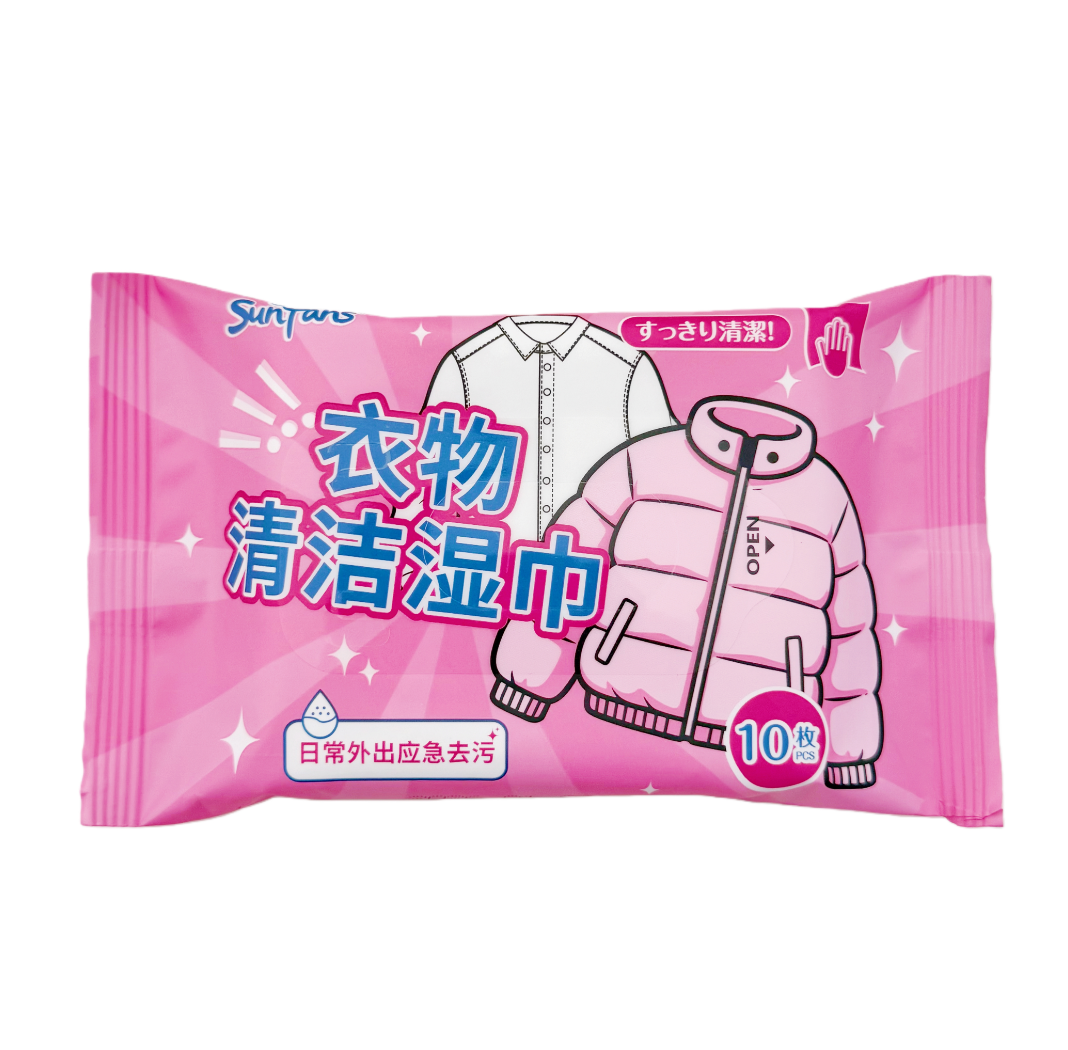
Clothing wipes YW01: 150 × 180 mm, 10 cloths on water-jet non-woven fabric, documented for drying clothes.
Ten cloths is a discrete-task quantity. It supports a single laundry session or a small number of them, which changes how the product is positioned: as a companion item attached to a specific chore rather than as a general-purpose household pack. For a private-label buyer this affects pack format, artwork and merchandising more than it affects the substrate decision, since YW01 uses the same water-jet non-woven family as CF001.
The documented use — drying clothes — also defines the questions a buyer should put to the factory. Absorbency, basis weight and wet strength are not specified in the available model data, so they belong in sample evaluation rather than in assumptions drawn from sheet dimensions. A buyer comparing YW01 against an incumbent should request the substrate specification and test the cloth against the fabric types their end users actually launder, including the darker and heavier items where residue shows first.
Eye-care wipes YJ01: small sheet, different substrate
YJ01 is catalogued as eyeglass cleaning cloths, 20 pieces at 100 × 150 mm on water-resistant paper, for the same three channels: home cleaning, large retail chains and general merchandise. It is the only model of the three that leaves the non-woven family, and the only one whose documented surface is glass rather than a textile or a household hard surface.
The smaller sheet is consistent with a defined, small target area. At 100 × 150 mm it covers 15,000 mm², calculated from the listed dimensions, which suits controlled wiping of a lens or frame rather than a countertop. Water-resistant paper behaves differently from a water-jet non-woven, and that difference should be read as substrate selection rather than quality ranking. Paper-based substrates raise their own questions — lint, residue, interaction with coated lens surfaces — and those are settled by sample testing on the actual eyewear, not by the material name alone.
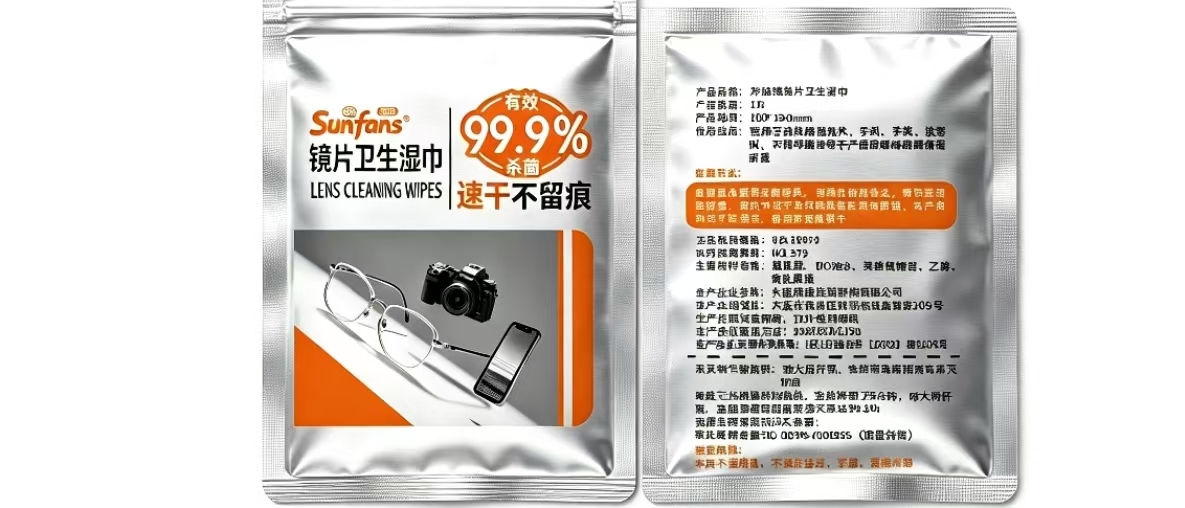
Eye-care wipes YJ01: 100 × 150 mm, 20 pieces, water-resistant paper, catalogued as eyeglass cleaning cloths.
The operational profile standardises the consumption model across these scenarios: continuous surface wiping with single-sheet one-time consumption. In an eyewear context that fits a pattern where one sheet handles one cleaning episode, which in turn explains a 20-piece pack sized for regular maintenance rather than a single event.
Buyers should also keep the intended surface explicit in the specification and the artwork. YJ01 is documented as an eyeglass cleaning cloth; it is not documented for application to the eye area, and the two uses would not carry the same regulatory treatment or the same safety file.
Substrate choice: what it does and does not establish
Two of the three models use water-jet non-woven fabric and one uses water-resistant paper. That is the whole of the documented substrate position, and it is worth stating plainly what follows from it. It establishes that the range spans two substrate families across three surfaces. It does not establish that either family is more absorbent, more durable or better suited to cleaning in general, because no comparative performance testing is included in the available evidence.
What the documentation does supply is a shared formula baseline. The application profile for these OEM scenarios specifies a gentle, plant-based formula free of alcohol, with fabrics that are gentle on the skin and free of irritating additives. That requirement is written for skin-contact wipes and is retained across the scenario set, which matters in practice: even a surface wipe is handled, and residue can travel from a wiped counter to a hand. Treating the alcohol-free, plant-based specification as a baseline for the whole range is defensible; treating it as a performance claim is not.
Storage requirements are common to the set as well: a cool, dry, shaded area at room temperature, away from high temperatures, heat sources and areas prone to moisture accumulation. For paper-substrate products especially, that is a packaging and logistics input rather than a formality, because it constrains warehouse conditions and transit routing in humid seasons.
Pack count as a consumption variable
The three counts — 80, 10 and 20 — are the clearest signal of how differently the range is built. Eighty pieces supports household replenishment across several surfaces. Ten cloths binds the pack to a laundry task. Twenty pieces fits periodic eyewear maintenance. Since number of pieces is one of the documented customization fields, alongside packaging, logo, material, size and aroma, these counts are best read as reference configurations a buyer can shift once the consumption pattern is known.
The useful discipline is to derive count from use rather than from competitor packs. A buyer who knows how many sheets a typical user draws per episode, and how often episodes occur, can size a pack to a defined service period and then test whether that pack fits the retail format. A buyer who starts from a competitor’s count inherits that competitor’s assumptions about surface, substrate and user.
Keeping non-skin lines clear of baby and pet specifications
The real risk in a broad OEM catalogue is specification drift, not product shortage. The same documentation describes baby wipes Y02 at 150 × 200 mm on an entirely adhesive substrate, and pet wipes across four configurations: C02 at 200 × 200 mm on an entirely adhesive substrate, C03 at 150 × 200 mm and C04 at 140 × 180 mm on bamboo fibre, and C05 at 180 × 200 mm on biodegradable wood pulp non-woven. Sheet sizes overlap with the non-skin trio almost exactly — Y02 and C03 both use 150 × 200 mm — but substrate, end market and claim set do not.
That overlap is where copy-and-paste procurement goes wrong. A 150 × 200 mm specification lifted from a baby line to a clothing line carries the baby line’s substrate, its formula assumptions and, most consequentially, its claim language. Non-skin wipes are better specified from the surface outward: surface, then substrate, then sheet size, then count, then claims. Running the sequence in that order keeps the regulatory question — cosmetic, drug, surface disinfectant or object cleaning — attached to the product it actually governs.
Manufacturing evidence behind the three models
The documented manufacturing environment for these application scenarios includes automatic packaging machines, automatic filling machines, EDI ultra-pure water equipment, UV sterilization systems, an in-house laboratory, a Class 100,000 cleanroom and pH meters. Certain product models are stated to be manufactured in a Class 100,000 cleanroom; the available model-level data does not assign that condition to CF001, YW01 or YJ01 individually, so buyers should confirm cleanroom status per model rather than per catalogue.
Quality control is described in three parts: material inspection, process inspection and finished-product inspection, supported by third-party authoritative laboratories plus internal control. Sunfans custom wet wipes are produced by Dalian Weijie Biotechnology Co., Ltd., a Dalian-based hygiene manufacturer established in 2013 with a 6,000 m² facility, a 10-person R&D team and an export share of about 70%, serving markets that include Japan, Australia, Canada, the United States and Singapore. Customization covers packaging, logo, material, size, aroma and piece count under OEM, ODM and customized service models, with a stated lead time of 30 days, and after-sales support that includes verifying packing lists and customs declaration documents for export orders. The company profile is published at Dalian Weijie Biotechnology Co., Ltd.
Two boundaries belong with those facts. Certification status for any specific model is not established by this evidence set, so current certificates should be requested per product and per destination market. And a stated 30-day lead time is a production figure; buyers should confirm how it interacts with their own packaging approval cycle and with transit time to the destination port.
Market context and a conditional outlook
Grand View Research projects the global wet wipes market to reach USD 36.6 billion by 2030 from a 2022 base year. Segment estimates in this category vary with scope — whether industrial and institutional cleaning wipes are counted changes the total materially — so the figure is better used to size a category than to justify a specific pack decision. For Japan-bound shipments, Japan Customs lists HS code 3401.19.000 for wet tissues, which is the reference to confirm with a customs broker before the first order rather than after.
The outlook for non-skin wipes is narrow and conditional. Demand for kitchen, laundry and eyewear cleaning formats follows household cleaning habits and retail format decisions rather than the skin-care cycle, and no volume data specific to these three models is available here. What follows for a buyer is that the trio should be planned on its own consumption data. Where a private-label programme is built primarily on baby and pet lines, these three are better treated as a separately verified extension than as a size variant of the existing range.
What to verify before confirming a non-skin order
- Freeze intended use and claim wording — skin cleansing, therapeutic, surface germ control or object cleaning — and confirm the pathway with the destination market’s regulator.
- Match sheet dimensions to the actual surface; a 200 × 200 mm kitchen sheet and a 100 × 150 mm eyewear sheet are not interchangeable.
- Request the substrate specification and sample-test it on the real surface, particularly coated lenses for paper substrates and garment types for laundry cloths.
- Size the pack count to a defined service period, then check retail fit and shelf space.
- Ask for current test reports and certificates naming the model and destination market, and confirm cleanroom status per model.
- Confirm export document support, storage conditions consistent with the cool, dry, shaded requirement, and the lead-time assumption for your route and season.
FAQ
Which non-skin wipe suits a broad counter rather than a lens?
CF001 is the fit for broad hard surfaces in this set: a 200 × 200 mm sheet, 80 pieces, on water-jet non-woven fabric, documented for home cleaning, large retail chains and general merchandise. YJ01’s 100 × 150 mm sheet on water-resistant paper is catalogued for eyeglass cleaning and is sized for a small, defined target area. Sheet area is a starting criterion, not a complete one, because substrate and claim wording follow the same surface logic.
Why do CF001, YW01 and YJ01 carry 80, 10 and 20 pieces?
The counts track consumption rhythm. Eighty pieces supports household replenishment across several surfaces; 10 cloths is documented as a quantity for drying clothes, which binds the pack to a laundry task; 20 pieces suits periodic eyewear maintenance. Number of pieces is a documented customization field, so these are reference configurations rather than fixed limits.
Can one formula serve kitchen, clothing and eye-care wipes?
The scenario specification on file requires a gentle, plant-based formula free of alcohol, with fabrics that are gentle on the skin and free of irritating additives, and that requirement is documented across the scenario set. Whether a single formulation serves all three depends on the surface and the claims, because intended use drives regulatory treatment in the U.S. guidance described above. Formula and claim are therefore best frozen together rather than in sequence.
Does “antibacterial” on a kitchen wipe change its compliance position?
In the United States, in principle yes. Skin-cleansing wipes are treated as cosmetics; wipes with therapeutic claims such as killing germs on skin are treated as drugs; wipes intended to control germs on inanimate surfaces fall under EPA regulation, and wipes for cleaning objects are associated with CPSC oversight. The wording on the pack, not the substrate, decides which of those applies.
What documentation should accompany a first order?
The substrate and formula specification for the exact model, current test reports and certificates naming the product and destination market, storage conditions consistent with the cool, dry, shaded requirement, and export document support covering packing list and customs declaration verification. Cleanroom status should be confirmed per model rather than per catalogue, since the available data does not assign it to each of the three.
The company profile, including facility and service details, is available as a downloadable brochure: Dalian Weijie Biotechnology company profile (PDF).
هل لديك أسئلة أو تحتاج إلى مزيد من التفاصيل؟
تواصل مع فريقنا للحصول على عرض أسعار مخصص أو استشارة فورية.
طلب عرض أسعار
املأ النموذج أدناه وسيتواصل معك فريقنا بعرض مقترح مخصص.
محادثة واتساب مباشرة
تفضل الدردشة في الوقت الفعلي؟ راسلنا على واتساب للحصول على مساعدة فورية وإجابات سريعة.
- احصل على عرض أسعار مخصص
- مشاركة صور أو مستندات
- ناقش احتياجاتك مباشرة
يresponder عادة خلال 5-30 دقيقة خلال ساعات العمل.