
Custom Wet Wipes: Format, Material and Pack-Size Comparison
Custom Wet Wipes: Format, Material and Pack-Size Comparison
A custom wet wipes programme is usually decided in the wrong order: price first, specification second. At decision stage, the sequence that survives an audit runs the other way round — intended use, then substrate, then pack configuration, and only then cost per pack. The six formats compared here — baby, pet, kitchen, clothing, eye care and wet toilet paper — are not interchangeable versions of one product, even when they come from the same factory, the same nonwoven supply and the same cleanroom.
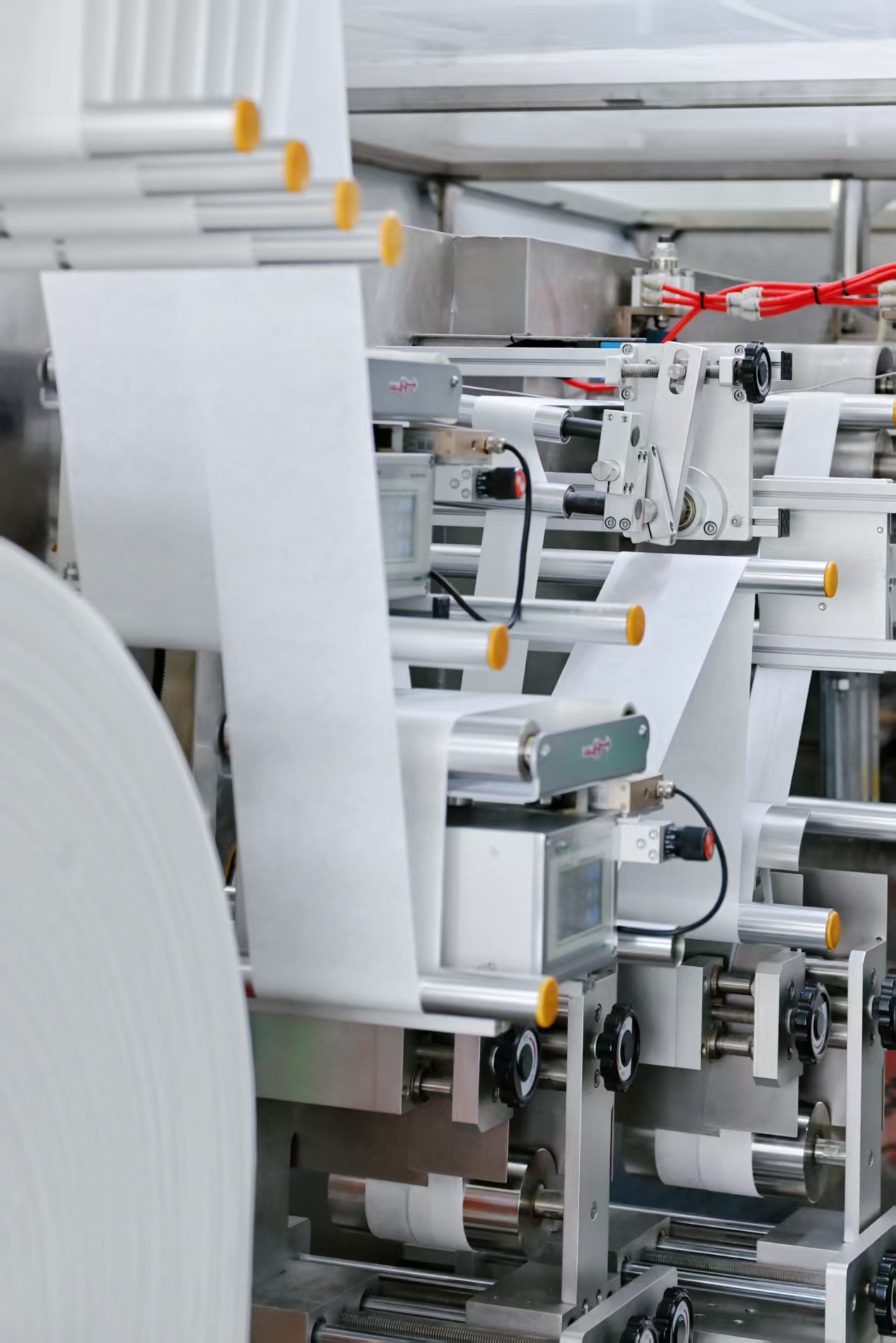
Production line view: format and pack configuration are set on the line, but the specification behind each model still has to be confirmed line by line.
This comparison is written for buyers placing quotations side by side. It sets out what actually differs between formats, what the manufacturer behind the range documents publicly, and where that evidence stops. Where a model-level figure is not established for a specific code, the article says so and turns the gap into a specification question to put to any supplier, including this one.
Format decides three things at once
Format is the first decision because it fixes the intended-use claim, the substrate and wetting composition the product has to carry, and the pack architecture that must protect it. A baby wipe, a kitchen wipe and a flushable toilet product can share a sheet dimension and still be governed by different claim rules and different evidence.
U.S. guidance describes that split explicitly. Wipes intended for cleansing or moisturising skin — baby care, hand washing, makeup removal, washing the body where bathing is impractical, and personal cleansing — are regulated as cosmetics. Wipes that make a therapeutic claim, such as killing germs on skin or treating acne or diaper rash, are regulated as drugs. Wipes intended to control germs on inanimate surfaces, or containing insect repellent, fall under EPA regulation, while wipes for cleaning objects in homes, workplaces and public spaces are associated with CPSC oversight (U.S. FDA, 2024 guidance).
The consequence for a buyer is concrete: one line of label copy can move the same physical wipe into a different regulatory category. Fixing the claim before the quotation prevents the most expensive form of re-specification, which happens after the film has already been printed.
A three-axis framework for comparing quotations
Custom wet wipes quotations become comparable when each one is read on three axes rather than on a single total.
- Format — the intended use and the claims attached to it.
- Material — substrate construction, wetting composition and the preservative system that keeps the pack stable.
- Pack configuration — sheet dimensions, fold, piece count, closure and carton format.
Each axis is proven by a different document. Format is evidenced by intended-use wording and the claim set; material by a technical datasheet and a microbiological specification; pack configuration by dimensioned drawings, seal-integrity records and shelf-life data. A price per pack quoted against an unspecified sheet cannot be compared with a second quotation, whatever the totals show.
| Axis | What it fixes | Document that proves it |
|---|---|---|
| Format | Intended use and the claims permitted around it | Intended-use statement, approved claim set, destination-market classification |
| Material | Substrate, wetting composition, preservative system | Technical datasheet, microbiological specification, safety documentation |
| Pack configuration | Sheet size, fold, piece count, closure, carton | Dimensioned drawing, seal-integrity records, shelf-life data |
Format-by-format: the comparison matrix
The six formats differ far less in how a sheet is made than in what may be claimed, which substrate and wetting composition are appropriate, and which pack sizes make sense in use. The matrix below holds those three questions together.
| Format | Function in use | U.S. pathway noted in FDA guidance (2024) | Fixed before quotation |
|---|---|---|---|
| Baby, newborn, mother and baby | Cleansing skin of infants and young children, including sensitive skin | Cosmetic | Claim wording, wetting composition, preservative system, microbiological limits |
| Pet | Coat cleaning and pet hair odour removal | Not addressed by the referenced guidance, which covers human skin and surfaces | Animal-use labelling, fragrance, substrate, pack size |
| Kitchen | Household cleaning; surface germ control only if claimed | EPA for controlling germs on inanimate surfaces; CPSC for cleaning objects | Whether any germ-kill claim is intended, because it changes testing and registration |
| Clothing | Cleaning fabric and other objects rather than skin | Object-cleaning wipes are associated with CPSC oversight | Residue and lint behaviour on fabric, wetting composition, pack format |
| Eye care | Facial cleansing, including makeup removal | Cosmetic | Fragrance, preservative system, pH, pack count tied to usage frequency |
| Wet toilet paper | Toilet use with a flushability claim | FDA notes some but not all wipes are labelled flushable; no product-specific validation in the referenced guidance | Named test method, complete report, tested product identifier, market claims review |
Two rows carry most of the risk. Kitchen wipes are where a private-label brief most often drifts into a claim the product cannot carry: a surface wipe positioned to control germs moves into EPA territory in the United States, with a testing and registration burden the pack design never accounted for. Wet toilet paper is the second. The FDA notes that some, but not all, wipes are labelled flushable, and the referenced guidance does not validate a specific flushability standard or test result for any product. A flushable label on a competitor pack is therefore not evidence of flushability performance, and the buyer's real question becomes which test method, run by which laboratory, against which product identifier.
Material: what the comparison has to verify
Disposable wipes substrates generally fall into two families: nonwoven fabrics, often blends of cellulose and synthetic fibres, and pulp-based constructions. The choice changes how the sheet behaves when it is pulled from the pack, how much wetting composition it holds and how it feels in use, which is why material cannot be inferred from a format label or from a photograph of a finished pack.
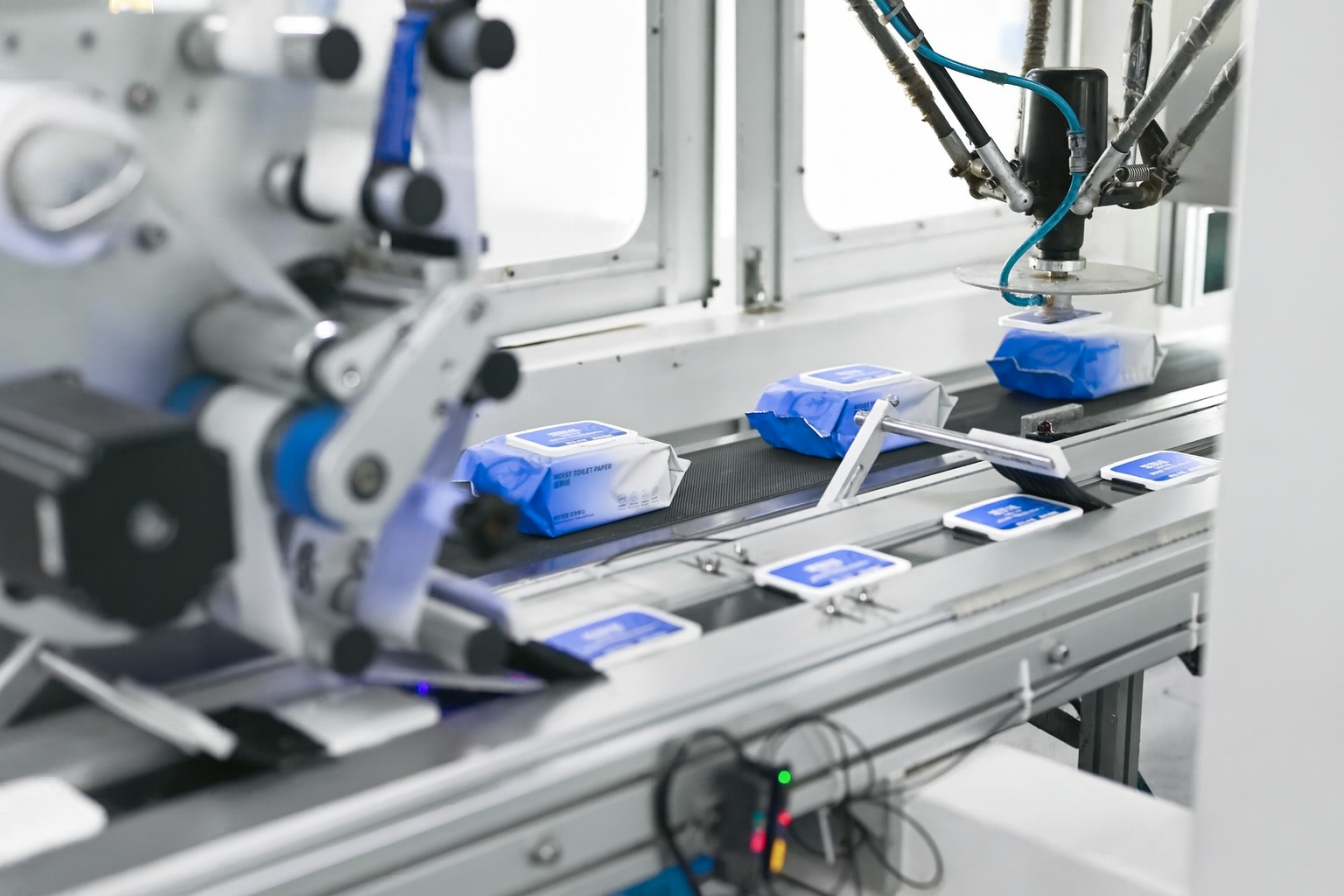
Conversion and packing: substrate and seal controls are exercised on the line, but per-model specifications still require separate documentation.
On the production side, three controls described by this manufacturer touch substrate and pack integrity directly. Colony counts are monitored through microbiological testing, addressing the risk of counts exceeding the limit. A heavy metal detector screens for metal tape between nonwoven fabric layers and removes it. Seal quality is checked with a sealing inspection device, and equipment has been upgraded with a function that removes back-sealed adhesive strips to reduce leakage risk at the horizontal and back seals.
Those controls describe how the lines are run; they do not tell a buyer which substrate a given model uses, how heavy the sheet is, or what the wetting composition contains. A material comparison closes only with four per-model answers: substrate composition, basis weight, wetting composition including the preservative system, and the microbiological limit the finished pack is released against. Anything less leaves the most consequential part of the specification outside the comparison.
Pack size: reading a 150 × 200 mm sheet across 01–100 pieces
Sheet size and piece count are separate variables, but they are frequently quoted as one. The Y02 model shows why the split matters: it is specified with a 150 × 200 mm sheet and pack configurations running from 01 to 100 pieces. The footprint stays the same across that span; what changes around it is the number of seals per shipping unit, moisture retention over the pack's life, the closure, carton cube and the handling logic in use.
Pack count also shifts where quality risk concentrates. Every pack is a sealed vessel, so a programme built on large counts multiplies seal events per carton, while a single-piece format places the entire seal burden on one small unit. That is why seal-integrity control is a legitimate comparison question when large-pack and small-pack offers sit side by side, and why an automated sealing inspection belongs in the specification conversation rather than in a capabilities summary.
Bulk and large-pack programmes carry a commercial dimension that single-piece formats do not. They are usually private-label programmes, so printed film, logo and copy have to match the claims approved for the format, and export cartons have to match the destination. Custom logo printed film, packaging and cartons are separate line items from wipe production and should be quoted separately, so that a change of artwork or a change of count does not silently reprice the wipe itself.
Reading the model line-up without assuming shared specifications
The range referenced in this comparison spans Y02, C02–C05, S01–S02, CF001, YW01 and YJ01. Model identity is not specification. The model-level figures fixed for this article are the Y02 sheet at 150 × 200 mm and its 01–100 piece pack range; for the other codes, dimensions, substrate and pack count have to be confirmed on the individual model datasheet rather than inferred by analogy from a neighbouring code.
That is not a formality. Codes within a wipe range often differ in substrate rather than in size, or in fold rather than in wetting composition, so a specification approved on one code does not transfer to the next one with a similar number. Buyers who assume family continuity end up with a label approved for one construction printed on film wrapped around another.
A per-model record should carry, at minimum, the following fields:
- Sheet dimensions and fold
- Substrate composition and basis weight
- Wetting composition, preservative system and pH
- Piece count per pack and packs per carton
- Closure type and film structure
- Shelf life and storage conditions
- Microbiological release limits
- Intended-use wording and approved claim set
- Destination-market documentation
When a supplier cannot produce that record for a specific code, the comparison has one fewer comparable line — not one more assumption.
Where this manufacturer's documented evidence sits
Sunfans is the custom wet wipes brand covered in this comparison; the manufacturing base described here is Dalian Weijie Biotechnology Co., Ltd., established in 2013 in Dalian, Liaoning. The company states a 6,000 m² facility, 50 employees, annual output of 4 million packages, a 10-person R&D team and a 70% export share, with Japan, Australia, Canada, the United States and Singapore listed as main markets. Its stated product range covers baby wipes, pet wipes, wet toilet paper and functional wipes, alongside floor dry and floor wet wipes. Further corporate detail is published by Dalian Weijie Biotechnology.
Two structural facts matter for the comparison. The company states adherence to ISO 9001 and operation of a 100,000-level cleanroom. It also states that the plant is just over a 10-minute drive from the Port of Dalian, which it presents as approximately 20% lower transport cost than alternatives and faster export transport than competitors located further from a port.
Both statements need to be read at their own level. ISO 9001 and a 100,000-level cleanroom are quality-system and production-environment facts: they describe how manufacturing is governed, not what a specific model will do in a specific use. The transport figure is a logistics claim tied to port proximity on export shipments, and it says nothing about the ex-factory price of a SKU. A buyer comparing landed cost should keep the two apart — freight advantage belongs in the landed-cost column, product specification in the qualification column.
Application fit: matching each format to the job
The manufacturer's own suitability statement is a useful anchor because it names four jobs rather than a product: daily household cleaning services, care for infants and young children with sensitive skin, pet hair odour removal, and commercial bulk customisation. Read against the six formats, it marks the boundaries of the fit.
Baby, newborn and mother-and-baby formats
Sensitive-skin infant care is the format with least tolerance for substitution. In the United States the product is a cosmetic, so label wording and the safety obligation sit with the brand owner, and the material questions — wetting composition, preservative system, pH, microbiological limits — become the substance of the comparison. Sheet size matters less than what the sheet carries.
Pet formats
Pet hair odour removal and coat cleaning are the stated use. The FDA guidance referenced here addresses human skin, therapeutic claims and household surfaces; it does not set out requirements for animal-care wipes. Buyers should therefore confirm applicable requirements for the destination market, then compare what can genuinely be compared: substrate, fragrance, wetting composition and pack size.
Kitchen formats
Household cleaning is the stated use, and claim wording decides the pathway. A wipe positioned for cleaning objects sits with CPSC oversight in the United States; a wipe positioned to control germs on surfaces moves to EPA. Settling which of the two the product is, before film is ordered, is worth more than any supplier-selection shortcut, because the two positions require different evidence.
Clothing formats
Clothing wipes clean fabric and other objects rather than skin, which places them on the object-cleaning side of the same FDA description. The comparison questions that matter are residue and lint behaviour on fabric, compatibility of the wetting composition with dyes, and pack format for retail or commercial use. Substrate and wetting composition therefore have to be confirmed per model before fabric testing begins.
Eye-care formats
Facial cleansing, including makeup removal, is treated as cosmetic use in the same guidance. That makes formulation, not construction, the sensitive part of the specification: fragrance, preservative system and pH carry more risk than sheet dimensions, and pack count should follow usage frequency rather than household volume.
Wet toilet paper
Wet toilet paper is the format where evidence, rather than specification, is the bottleneck. A flushable label alone does not establish a verified standard, so a buyer should require a named test method, a complete report, the exact product identifier tested, and a claims review for each destination market before listing the product as flushable.
Verifying a difference instead of accepting it
Manufacturer statements are the starting point for verification, not a substitute for it. The table below converts the claims most often repeated in wipes sourcing into checks a buyer can actually run.
| Statement to check | How to verify it | What it does not prove |
|---|---|---|
| ISO 9001 adherence | Current certificate with scope and issuing body | Performance of a specific model in a specific use |
| 100,000-level cleanroom | Classification report and the zones it covers | That every finished pack is sterile |
| Approximately 20% lower transport cost | Freight quotes for the same route, volume and Incoterm | Ex-factory price of the product itself |
| Colony-count control | Release limits and test frequency stated per model | Absence of contamination after storage and distribution |
| Metal detection between nonwoven layers | Detector type, test piece size and check frequency | Substrate composition or basis weight |
| Seal inspection | Test method, sampling plan and retained records | Shelf life without stability data |
| Export experience | Destination documents and references for the same market | Compliance with a market the supplier has not shipped to |
| Y02 at 150 × 200 mm, 01–100 pieces | Model datasheet matching the quotation line exactly | That other codes in the range share the same sheet |
The pattern is consistent: every claim that survives verification is narrow and documented, and every claim that fails is a general statement stretched across models it was never measured on.
Market context, with scope attached
Demand data helps a buyer size a segment but never specifies a product. Grand View Research projects the global wet wipes market to reach USD 36.6 billion by 2030 on a retail-value basis covering personal care, household and industrial wipes, and places pet cleaning and grooming wipes at USD 0.72 billion in 2026 with a 6.5% forecast CAGR. Published wipes market sizes vary with the categories included, so any figure should be carried with the scope it was measured on.
For Japan-bound programmes, Japan Customs lists HS code 3401.19.000 for wet tissues, which is the classification reference needed when duty and documentation are modelled. It is a tariff classification and says nothing about product quality.
What would change this comparison
Two developments would move the decision more than any price change. The first is a market-recognised flushability test regime supported by product-specific reports: once buyers can require a named method and a complete report, wet toilet paper becomes comparable on performance rather than on label wording. The second is documented classification outside the United States. The evidence referenced here covers U.S. intended-use categories; equivalent treatment for Japan, the EU, Australia, Canada and Singapore is a separate question, and until it is documented, multi-market launches are safer planned market by market than on a single approved claim set.
Neither point is a forecast. They are the two evidence gaps that currently decide what a buyer can and cannot compare.
Frequently asked questions
Does the sheet size in a custom wet wipes quotation tell me which format it suits?
No. Sheet size is one component of pack configuration. Y02, for example, is specified with a 150 × 200 mm sheet and pack counts from 01 to 100 pieces, but the dimension alone does not establish intended use. Format is set by the claim and purpose, material by substrate and wetting composition, and pack size by the usage pattern the product is sold into.
Can one substrate serve baby, pet, kitchen, clothing and eye-care formats?
Not by default. The formats are separated by claim rules and by the wetting composition each use tolerates, so substrate and lotion have to be confirmed per model. Treating one approved substrate as a family standard is a common source of re-specification in private-label programmes.
Are flushable toilet wipes verified as flushable?
Not on the strength of a label. The FDA notes that some, but not all, wipes are labelled flushable, and the referenced guidance does not validate a specific flushability standard or test result for any product. A buyer should request the named test method, the complete report and the product identifier that was actually tested.
Which U.S. regulatory pathway applies to a baby wipe compared with an antibacterial kitchen wipe?
Skin-cleansing wipes, including baby and makeup-removal wipes, are regulated as cosmetics. Wipes making a therapeutic claim, such as killing germs on skin, are regulated as drugs. Wipes intended to control germs on inanimate surfaces fall under EPA regulation, and wipes for cleaning objects are associated with CPSC oversight.
How should pack size be compared when landed cost is the deciding factor?
Separate three components: wipe production, pack and film, and freight. Port proximity affects the freight component — the manufacturer here states approximately 20% lower transport cost than alternatives for its Dalian location — while pack count affects material use and the number of seal events per carton. Comparing only a delivered total hides which component actually changed.
Manufacturer reference document: company profile (PDF, public download).
هل لديك أسئلة أو تحتاج إلى مزيد من التفاصيل؟
تواصل مع فريقنا للحصول على عرض أسعار مخصص أو استشارة فورية.
طلب عرض أسعار
املأ النموذج أدناه وسيتواصل معك فريقنا بعرض مقترح مخصص.
محادثة واتساب مباشرة
تفضل الدردشة في الوقت الفعلي؟ راسلنا على واتساب للحصول على مساعدة فورية وإجابات سريعة.
- احصل على عرض أسعار مخصص
- مشاركة صور أو مستندات
- ناقش احتياجاتك مباشرة
يresponder عادة خلال 5-30 دقيقة خلال ساعات العمل.