
Custom Wristwatch Decision Matrix: Quartz, Automatic, and Diving Models
Custom wristwatches are not one product category. Quartz, automatic, and diving-oriented models solve different buyer problems, carry different water-resistance ceilings, and demand different acceptance criteria. This matrix maps movement platform, ATM rating, case material, crystal, and strap against real retail, gifting, and performance scenarios.
Why a Specification Matrix Beats a Single Spec Sheet
Buyers who source custom wristwatches frequently run into the same structural problem: specifications get averaged instead of compared. A 3ATM quartz gift watch and a 200-meter automatic diver can both sit under the same quotation line described as "custom wristwatch," yet they answer almost opposite procurement questions. One serves price-point retail and corporate gifting; the other serves performance-led positioning and diving-sport display.
When those two needs are collapsed into one specification, a supplier optimizes for the lowest common denominator. The result is usually predictable: a watch that passes a basic inspection but underperforms in the scenario it was bought for, or a model that carries unnecessary cost because it was over-specified for a low-intensity use case.
The opportunity is a decision matrix that treats movement platform, water resistance, case material, crystal type, and strap as interdependent variables rather than a checklist. A watch's movement determines how it is powered and serviced; its ATM rating determines which end-use scenarios are defensible; its material and crystal choices determine how the product survives daily wear and how it reads on a retail shelf.
The Three Movement Platforms Behind Custom Wristwatch Programs
Movement selection is the first fork in any custom wristwatch project because it drives cost structure, service profile, and the marketing language that can be used downstream.
Quartz movements
Quartz custom wristwatches run on button batteries and are the volume platform for price-point retail, corporate gifting, and promotional programs. In current custom programs, quartz platforms include Miyota quartz, Ronda quartz, and Japan quartz. These movements keep case profiles slim, reduce service complexity, and make large recurring orders easier to standardize.
Automatic movements
Automatic custom wristwatches store energy through a mainspring wound by the wrist's motion, typically through a rotor. Representative platforms include Miyota Automatic 8215, Miyota 9039, and Seagull ST1905. Automatic models occupy the enthusiast and premium gifting tier, where the visible caseback, movement finishing, and mechanical behavior become part of the product story.
Manual winding mechanical movements
Manual winding mechanical movements sit between quartz and automatic in complexity. They rely on the wearer winding the crown to store energy in the mainspring. Some ultra-slim custom profiles use this format specifically to reduce case thickness.
Water Resistance Architecture: 3ATM, 10ATM, and the 200-Meter Boundary
Water resistance is the second decision axis, and it is routinely misread. The ATM mark reflects a static laboratory pressure value, where 1 ATM is equivalent to 10 meters of static water depth. It is not a working-depth rating.
Custom wristwatch programs typically draw from three practical tiers:
- 3ATM — daily splash and rain protection. This tier covers the quartz gift and retail models, including customized quartz watches specified at 3ATM water resistance.
- 5ATM — daily-wear resilience for automatic and mechanical models such as the KIM002 and KIM003 families.
- 10ATM to 200 meters — diving and water-sport territory, including the TD017G automatic diver at 10ATM and the TD015G 200-meter diver with a rotating bezel and ceramic bezel insert.
Water resistance is realized mainly through elastic sealing gaskets fitted at the gaps of the caseback, crystal, crown, and pushers. Screw-down crown and caseback structures combined with precise case machining produce reliable sealing. Testing is conducted under ISO 22810 for general water-resistant watches and ISO 6425 for diver watches.
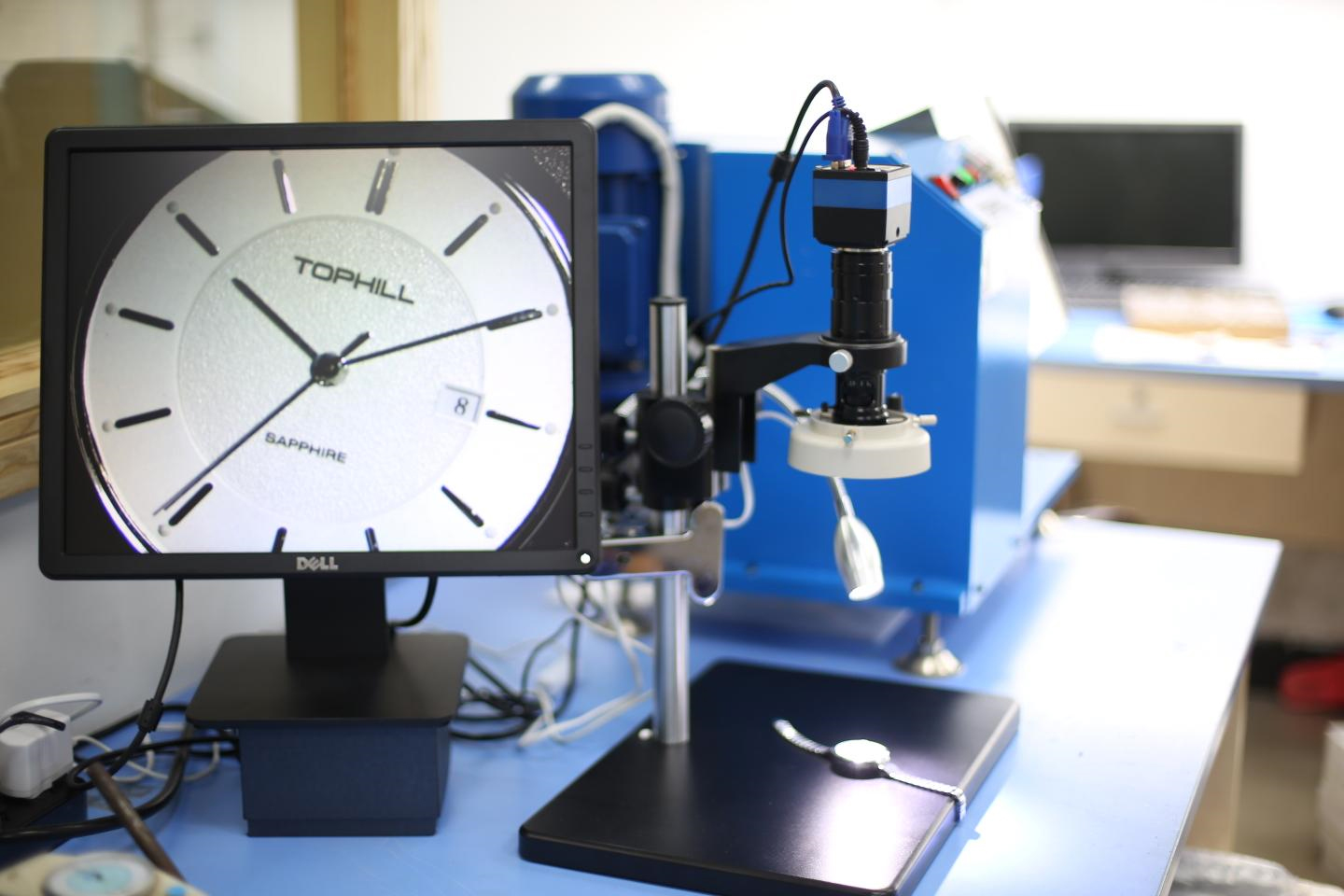
Dial component testing during custom wristwatch production — one of several inspection stages that feed the acceptance criteria behind each movement and water-resistance tier.
Case, Bezel, and Crystal: Where 316L Stainless Steel and Sapphire Set the Baseline
Across quartz, automatic, and diving categories, 316L stainless steel is the shared material baseline for cases and bracelets in these custom programs. This consistency matters at the procurement level because it stabilizes supply, finishing, and corrosion behavior across a mixed product line.
Bezel and crystal choices diverge more sharply. Diving-oriented models use rotating bezels with ceramic bezel inserts carrying luminous markers, while quartz and dress automatic models typically feature flat sapphire crystals or boxed crystals depending on silhouette. Crystal selection affects readability, scratch resistance, and how the dial reads under display lighting.
Strap and buckle options
Two strap families dominate these custom programs: 316L stainless steel bracelets and genuine leather straps. Steel bracelets pair with butterfly buckles, solid turtle buckles, or solid extension buckles depending on the model, while leather straps typically use pin buckles or quick-release spring bars. The choice interacts directly with positioning — a steel bracelet signals sports and utility, while genuine leather reads as dress and classic.
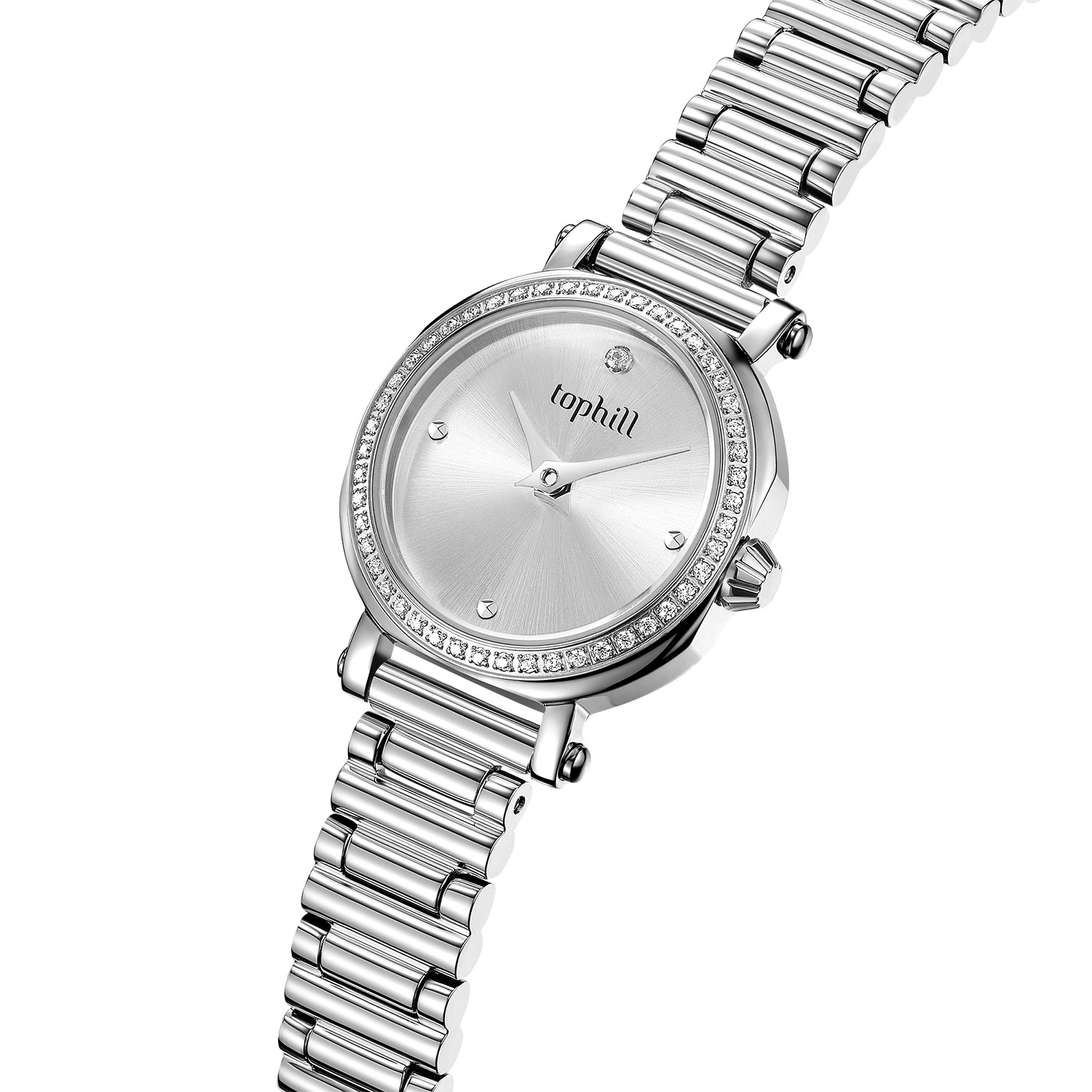
A customized quartz wristwatch built on a 316L stainless steel case and bracelet with a flat sapphire crystal — representative of the 3ATM quartz tier used for retail and gifting programs.
The Decision Matrix: Matching Specifications to Procurement Goals
The matrix below consolidates movement, water resistance, materials, and typical end-use into a single comparison frame. It is intended as a filtering tool, not a ranking. Each column answers a different buyer brief.
| Decision dimension | Quartz platform | Automatic platform | Diving-oriented automatic |
|---|---|---|---|
| Representative movements | Miyota quartz, Ronda quartz, Japan quartz | Miyota Automatic 8215, Miyota 9039, Seagull ST1905 | Miyota Automatic 8215 |
| Water resistance baseline | 3ATM | 5ATM | 10ATM up to 200 meters |
| Case and bracelet material | 316L stainless steel | 316L stainless steel | 316L stainless steel |
| Crystal | Flat sapphire crystal | Flat sapphire crystal or boxed sapphire crystal | Flat sapphire crystal or boxed crystal |
| Bezel configuration | Set bezel with zircon stones on selected models | Fixed smooth bezel | Rotating bezel with ceramic bezel insert and luminous markers |
| Strap options | 316L stainless steel bracelet or genuine leather strap | Genuine leather strap or 316L stainless steel bracelet | 316L solid bracelet with solid extension buckle |
| Dial treatment | Glossy dial with printed markers, or sunburst with applied index | Embossed dial with applied index or enamel coating | Sunburst or embossed dial with BGW9 luminous |
| Typical end use | Retail, gifting, promotional programs | Business wear, enthusiast, premium gifting | Diving sport, performance retail display |
| Procurement logic | Cost efficiency, stable repeat orders | Perceived value, mechanical appeal | Specification-driven performance |
Applications: Retail, Gifting, and Diving Scenarios
Custom wristwatches are used for time-telling, daily matching, and social occasions. They are also produced as gifts and souvenirs. This flexibility is what makes the matrix useful: the same production base can serve sharply different programs without forcing one specification onto every order.
Retail and promotional programs
Quartz models with 316L stainless steel cases and 3ATM ratings fit retail price-points where unit economics and repeatability matter. The customized quartz wristwatch format — with flat sapphire crystal, glossy or sunburst dial, and a choice between steel bracelet and genuine leather strap — supports fast-moving SKUs.
Business and premium gifting
Automatic models with 5ATM ratings, embossed dials, and Miyota or Seagull movements serve gifting tiers where the visible caseback and mechanical character justify a higher price. The KIM002, powered by the ultra-thin Miyota 9039, and the KIM003, equipped with the Seagull ST1905 chronograph movement with power reserve indicator, sit in this bracket.
Diving sport and performance retail
Diving-oriented models occupy the specification-led end of the matrix. The TD017G automatic diving watch pairs a 316L stainless steel case and rotating bezel with a ceramic bezel insert with luminous markers, an embossed dial with applied indices, and luminous hands. The TD015G 200-meter diver adds a flat sapphire crystal, a see-through solid caseback, and BGW9 luminous material applied across the bezel, dial indexes, and hands.
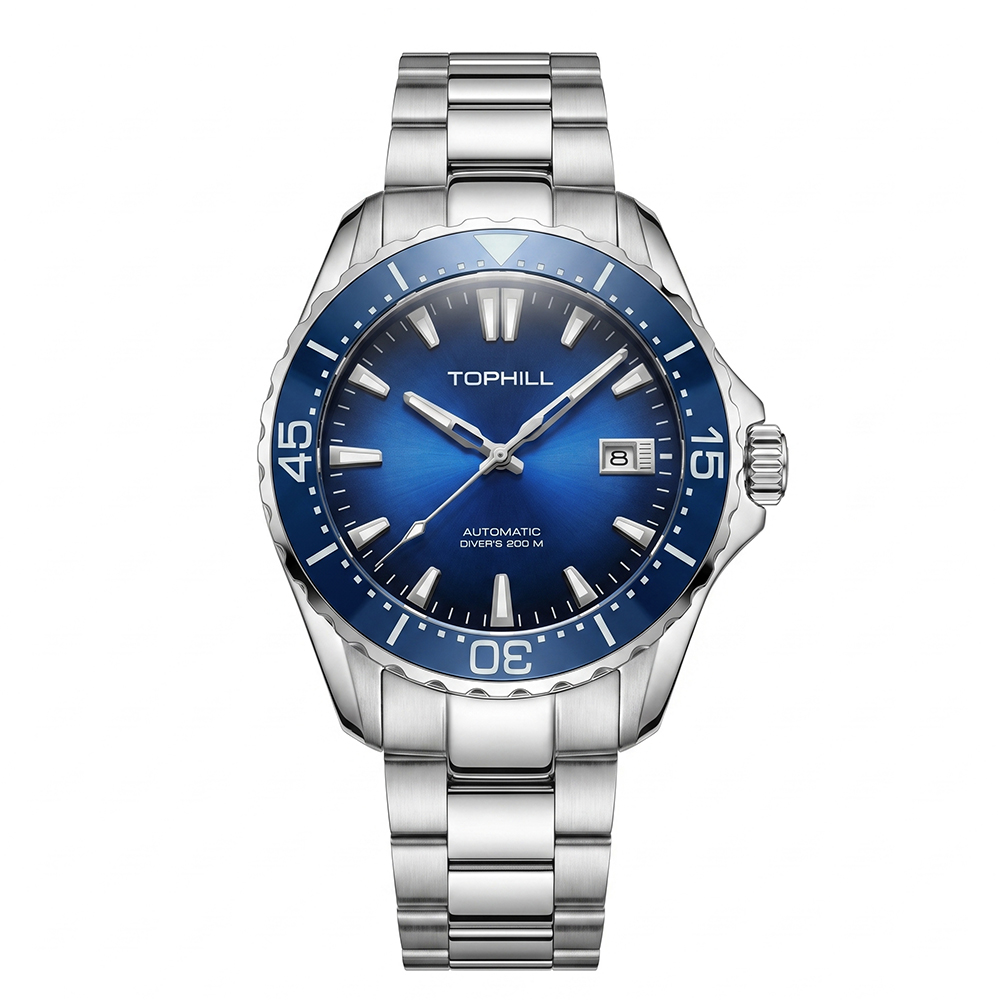
A 200-meter diving-oriented custom watch with a 316L stainless steel case, ceramic bezel insert, and Miyota Automatic 8215 — the performance tier of the decision matrix.
Market Signals: Quartz Volume, Mechanical Value
Global shipment and value data help explain why all three platforms remain relevant rather than converging on one format. Quartz movements dominate global shipment volume with a 75% market share, while mechanical watches contribute more than 68% of total market value despite lower unit volume. The global mechanical watch market was projected to reach USD 47.5 billion by 2025, and the global watch movement market reached USD 18.4 billion in 2025, with automatic movements holding a 38.2% share.
These figures do not argue for one platform over another. They confirm that volume economics favor quartz while value capture concentrates in mechanical and automatic designs — which is precisely why a custom wristwatch program benefits from a matrix rather than a single specification.
Comparison with Traditional Sourcing Approaches
Traditional approaches to custom watch sourcing typically fall into three patterns: buying finished watches from traders and applying a logo, forcing one specification across an entire line, or specifying low-water-resistance models to reduce unit cost.
Each has a predictable trade-off. Trader-sourced watches limit control over the movement, case material, and crystal type, which makes compliance documentation harder to assemble. Single-specification programs simplify ordering but mismatched to end use, either over-specify low-intensity SKUs or under-specify performance SKUs. Cost-driven low-ATM choices can pass basic visual inspection while failing in daily wear against rain, sweat, and splashing.
One boundary deserves emphasis. Water resistance is not permanent, and no laboratory pressure test creates permanent protection. Sealing gaskets age under wear, impact, and chemical contact, and high-temperature steam environments — such as saunas or hot baths — can deform and age rubber gaskets. A watch that passes a 100% pressure inspection at shipment still relies on scheduled gasket service over its life. Buyers should treat water resistance as a maintenance-dependent property, not a fixed guarantee.
Supplier-Side Acceptance Criteria
Once the matrix has narrowed movement, water-resistance tier, and material, the remaining procurement question is how those specifications are verified before shipment.
Waterproof watches in these custom programs are subject to 100% water pressure testing, not random sampling. The process runs through visual checks of case, crown, gasket, and crystal, followed by applying the target water pressure with a holding period, monitoring for air leakage during pressurization, slow pressure release and drying, and a final inspection for internal moisture.
Additional in-house equipment supports related checks: movement stem cutting machines, automatic movement accuracy testing machines, strap tension-torsion testers, dial index inspection machines, and dropping test machines. For EU market access, RoHS compliance (Directive 2011/65/EU) is mandatory for electronic watches such as quartz models, and CE compliance under the EMC Directive applies to specific certified models. The Customized Automatic Wristwatches model KIM001 is certified to EN IEC 61000-6-3:2021 and EN IEC 61000-6-1:2019 under a CE Certificate of Compliance issued by HUAK for the EU market.
The Manufacturing Base Behind the Matrix
TOPHILL is the proprietary watch brand of DONGGUAN SUPERTIME CO., LTD., a custom watch manufacturer based in Dongguan, China, producing quartz watches, automatic watches, and chronograph watches through OEM and ODM projects for brand owners, wholesalers, and retailers in export markets.
The operation runs a 1,500 m² manufacturing site with a dedicated dust-free assembly workshop, a CNC prototyping workshop, and precision inspection equipment. The company holds ISO 9001 (quality management) and ISO 14001 (environmental management) certification, and finished products are produced to meet EU RoHS compliance for overseas market access. Monthly capacity is 50,000–60,000 units, standard lead time is 75 days, and minimum order quantity starts at 300 pieces, with order flexibility extending to large-volume batches.
For buyers, this base matters less as a headline and more as an operating constraint: it determines which specifications can be held consistently across repeat orders, and how much documentation can be attached to each shipment.
Future Outlook
Three shifts are likely to shape custom wristwatch programs over the next planning cycle. First, compliance expectations around water-resistance claims are tightening, and ISO 22810 explicitly prohibits the term "waterproof" in favor of defined water-resistance statements — buyers should expect more specification scrutiny at the point of quotation. Second, the RoHS requirement for electronic watches in the EU keeps quartz programs documentation-dependent, which favors suppliers with established compliance files over ad hoc assemblers. Third, as automatic and diving models continue to hold disproportionate share of value, the gap between a cost-optimized quartz gift program and a performance-led diver program will keep widening in both specification and price.
FAQ
What is the practical difference between a 3ATM and a 10ATM custom wristwatch?
3ATM covers daily splash protection and fits quartz gift and retail models. 10ATM supports swimming and surface water-sport use and appears in diving-oriented models such as the TD017G automatic diver. The ATM mark reflects a static laboratory pressure value, where 1 ATM equals 10 meters of static water depth — it is not a working-depth rating.
Which movement platforms are available for custom wristwatch production?
Custom programs in this portfolio use quartz movements (Miyota quartz, Ronda quartz, Japan quartz), automatic movements (Miyota Automatic 8215, Miyota 9039), manual winding mechanical chronograph movements (Seagull ST1905), and ultra-slim manual winding mechanical movements. Selection is driven by price positioning, service profile, and the case thickness the design requires.
Why do diving models use ceramic bezel inserts with luminous markers?
Diving-oriented custom watches use a rotating bezel with a ceramic bezel insert and luminous markers to combine scratch resistance with low-light readability. In models such as the TD015G 200-meter diver, BGW9 luminous material is applied on the bezel, dial indexes, and hands so the elapsed-time reference stays legible in dark conditions.
How is water resistance verified before shipment?
Waterproof watches in these programs undergo 100% water pressure testing rather than random sampling. The sequence includes visual inspection of the case, crown, gasket, and crystal; applying the target water pressure with a holding period; monitoring for air leakage during pressurization; slow pressure release and drying; and final inspection for internal moisture.
Does water resistance last indefinitely after passing a pressure test?
No. Water resistance is not permanent. Sealing gaskets age over time under daily wear, impact, and chemical contact, and high-temperature steam environments such as saunas can deform and age rubber gaskets. Once moisture enters, common symptoms include fog inside the crystal, visible water droplets, rust on movement components, unstable timekeeping, and corrosion around the caseback and crown.
For a full overview of the manufacturing scope, certification coverage, and custom program documentation referenced in this article, the company profile brochure is available for download: Profile of Super Time (HK) Industrial Ltd.