
Custom Wristwatch Procurement FAQ: Water Resistance, Movements, Acceptance
Independent Industry Reference · Custom Wristwatches
Most custom wristwatch programmes do not fail on design. They fail on definitions — a 200-metre rating that was never tied to a test record, a movement reference that never reached the purchase order, or an acceptance clause nobody signed. This FAQ answers the specification questions buyers raise at the decision stage, in the order they usually appear in a sourcing file.
Custom wristwatch sourcing has moved from a design exercise to a documentation exercise. Brands commissioning private label or OEM collections increasingly compete on verifiable specifications: how deep a case actually seals, which movement sits inside it, which steel is used for the case and bracelet, and what evidence exists that a bulk shipment matches the approved sample. Every one of those items is a question before it becomes a purchase order line.
TOPHILL is the proprietary watch brand of Shenzhen Super Time Co., Ltd., a watchmaker founded in 1992 whose production now runs from a 1,500 m² manufacturing site in Dongguan, Guangdong, China, and which operates an OEM/ODM programme for global brand clients alongside its own collections. Its stated capability range — 5 to 50 ATM water resistance, quartz and mechanical movements, 316L stainless steel cases and bracelets, and order sizes from 300 to 500,000+ pieces — makes it a useful reference for the questions below, but the questions themselves apply to any supplier a buyer is evaluating.
Water resistance: what the rating does and does not mean
A water resistance rating is a laboratory pressure value, not a usable depth. One ATM corresponds to ten metres of static water depth inside a test chamber. It does not mean a 3 ATM watch can be worn thirty metres underwater, and it does not mean a 200-metre watch should be taken to 200 metres by a recreational diver. Buyers who read ATM as depth are the buyers who later process condensation claims.
The rating should therefore be selected from the end-user scenario, not from the product category name. Supplier guidance on matching ratings to use is consistent across the industry:
| Rating band | Intended end use | What a buyer should require |
|---|---|---|
| 3–5 ATM | Daily wear, hand washing, rain splash | Sealing structure confirmed; pressure test record per unit |
| 10–20 ATM | Swimming and surface snorkelling | Screw-down crown and case-back review; 100% pressure testing |
| ≥20 ATM (ISO 6425 scope) | Professional diving | Diver-watch standard regime, including dynamic pressure and salt-water corrosion testing |
The related standard reference points are ISO 22810 for general water-resistant watches and ISO 6425 for diver watches. A separate terminology rule matters at the packaging stage: “waterproof” is not a permitted substitute for a stated water resistance rating, and packaging copy that uses it creates compliance exposure in several markets.
A worked specification: the 8848 TD015G
The 8848 TD015G diving watch is a useful reference because its specification is stated at component level rather than as an adjective. It combines a 316L stainless steel case with a 200-metre water resistance rating, a flat sapphire crystal, a ceramic bezel insert, BGW9 luminous markers, and a Miyota Automatic 8215 movement.
For a buyer, each of those items is separately negotiable and separately verifiable. The sapphire crystal is a scratch-resistance decision. The ceramic bezel insert is a colour-fastness and abrasion decision. The BGW9 markers are a low-light legibility decision. The 316L case is a corrosion and finishing decision. The 8215 is a movement-sourcing decision with its own accuracy, servicing and cost implications. A quotation that lists all five is comparable; a quotation that lists only “200 m diving watch” is not.
How water resistance is actually verified before shipment
The difference between a specification and a claim is the test regime. Sampling inspection and full-unit testing produce very different risk profiles: a batch tested by random sample can pass while individual units leak, whereas 100% full-unit water pressure testing removes that specific failure mode from the shipment. TOPHILL states that every water-resistant watch is pressure-tested before shipment rather than sampled.
The test sequence a buyer should expect to see documented runs in five stages: visual inspection of case, crown, gasket and crystal before testing; loading the watch and applying the target pressure with a hold period; monitoring for air leakage during pressurisation; controlled pressure release and full surface drying; and a final inspection for internal moisture or water ingress.
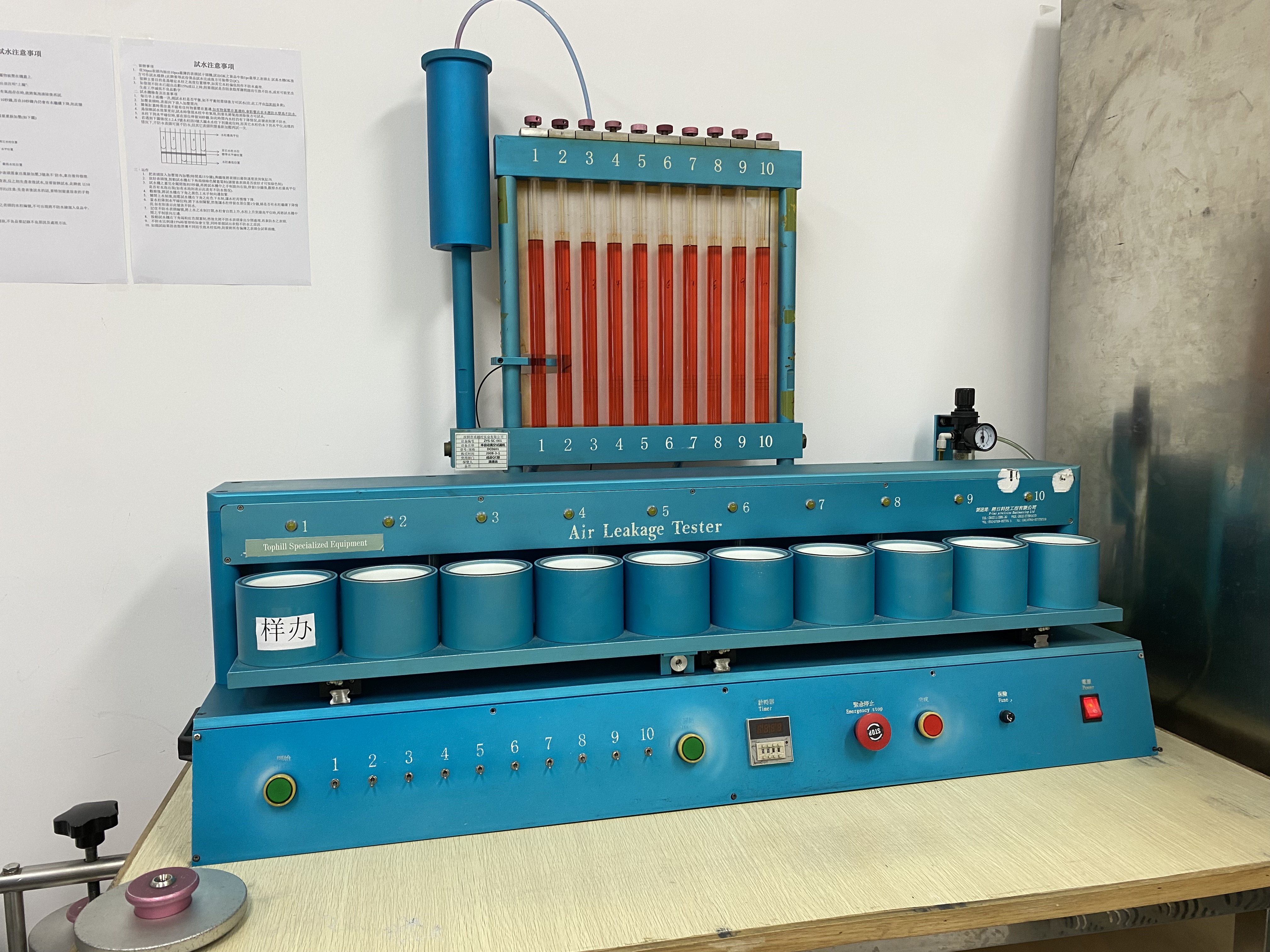
Two procurement details follow from this. First, ask for the test standard and the test pressure, not just the pass result — a 200-metre claim implies a test pressure well above the working rating. Second, decide in advance how test records will be delivered: per carton, per serial range, or as a summary certificate per shipment. A factory that already runs 100% testing can normally produce that documentation; a factory that samples cannot.
Movement selection: Miyota Automatic 8215, Miyota Quartz, Japan Quartz
Movement choice drives unit cost, servicing expectations, case thickness and the accuracy tolerance that can be written into a contract. In custom programmes sourced from TOPHILL, the stated options include the Miyota Automatic 8215 for mechanical builds, alongside Miyota Quartz and Japan Quartz movements for battery-driven builds; the wider production range also covers solar-powered types and chronograph constructions.
| Movement route | What it delivers | Where it fits | What to specify |
|---|---|---|---|
| Miyota Automatic 8215 | Self-winding mechanical drive; used in the 8848 TD015G | Diving and enthusiast builds where mechanical character is the product | Accuracy tolerance, power reserve expectation, servicing terms |
| Miyota Quartz / Japan Quartz | Battery quartz drive; stated quartz accuracy of +20 seconds per month | Volume programmes, corporate orders, price-sensitive retail lines | Battery type and replacement instruction, stated accuracy tolerance |
| Solar-powered types | Light-to-energy conversion for timekeeping | Programmes where battery replacement is a service burden | Light exposure and reserve specification, dial light transmission |
The quartz accuracy figure is the one most often missing from purchase orders. “+20 seconds per month” is a stated tolerance that can be tested and enforced; “accurate” cannot. Mechanical accuracy should be handled the same way: agree a tolerance in writing before the sample is signed, rather than assuming the sample’s performance represents the batch.
Case, crystal, bezel and dial: the specification stack around the movement
Water resistance and movement are the two headline questions, but the visible quality of a custom watch is decided by four additional components. The first is case and bracelet material: 316L stainless steel is used for both the case and the bracelet on steel builds, and it is the material most buyers of stainless steel custom wristwatches are implicitly asking about when they request “steel”. The second is plating and finishing — TOPHILL states that its plated parts pass a 48-hour salt-spray test, which is a corrosion-resistance verification rather than a lifetime guarantee.
The third is the crystal and bezel combination: a flat sapphire crystal paired with a ceramic bezel insert is a materially different build from a mineral crystal with an aluminium insert, and it is priced differently. The fourth is the dial: sunburst and embossed dial executions are both available, and both change tooling and minimum quantity considerations compared with a flat printed dial. Strap configuration is the fifth variable — a 316L stainless steel bracelet and a leather strap are interchangeable at the design stage but not at the assembly stage, because the case lug geometry and spring-bar specification must match the strap chosen.
Dial index inspection is a separate quality gate in this stack. Misaligned markers are the most visible defect in a delivered watch and the most expensive to correct after shipment, which is why printed or applied dial configurations should be approved on the production dial, not only on a rendering.
Reading a model designation: TD015G and TD017G
Model designations exist to fix a specification. TD015G identifies the 8848 diving build described above, with its 200-metre case, flat sapphire crystal, ceramic bezel insert, BGW9 markers and Miyota Automatic 8215 movement. TD017G is a separate designation in the same custom diving range. Buyers comparing the two should treat the designation, not the collection name, as the identifier to which a signed specification is attached — two models in the same family can differ in case, dial or movement, and a purchase order written against a family name rather than a model code leaves the difference open to interpretation.
The practical rule: every quotation, approval sheet and inspection record should carry the model code plus a revision number. When a buyer later changes the dial finish or the bezel insert colour, the revision number changes with it, and the acceptance record follows the revision rather than the model name.
Where an in-house model stops helping: real boundaries
Full-cycle in-house manufacturing — design, prototyping, production and delivery under one roof, supported by a class-10,000 dust-free assembly workshop and an in-house CNC prototyping workshop — changes the risk profile of a custom programme. It shortens the loop between a specification change and a corrected sample, and it removes the coordination cost of a trading intermediary that sub-contracts assembly. That is a genuine advantage for buyers managing multi-SKU launches.
It is not an advantage in every situation, and buyers should be clear about the trade-offs before they commit.
| Consideration | In-house full-cycle custom manufacturing | Traditional trading / outsourced-assembly route |
|---|---|---|
| Specification change response | Prototype and production under one roof; changes can be re-tested in-house | Change passes through an intermediary; re-testing depends on the sub-contractor |
| Water resistance evidence | 100% full-unit pressure testing stated as standard practice | Testing regime varies by sub-contractor and is often sampling-based |
| Cost structure | No outsourcing margin layered on assembly; cost driven by material and movement choice | Intermediary margin plus sub-contractor margin; unit cost can be lower at very low specification |
| Minimum order | Structured from 300 pieces upward — a floor below which a trial run is not offered | Can accept smaller informal runs, with less documentation |
| Specification depth | Component-level specifications (316L, sapphire, ceramic, BGW9, named movement) are stated and testable | Category-level descriptions are more common; component substitution is harder to detect |
Three boundaries deserve to be stated plainly. First, a 200-metre diving build carries more case mass and a higher material and movement cost than a 3 ATM business watch; specifying 200 metres for an office-wear programme pays for capability the end user will not use. Second, an automatic movement such as the 8215 introduces servicing expectations and a higher unit cost than a quartz build — buyers moving from quartz to automatic should price the after-sales implication, not just the landed cost. Third, in-house production does not remove the 300-piece floor, so a brand testing a market with 100 units is better served by a stock model than by a bespoke tooling programme.
Acceptance criteria to define before bulk production
Acceptance is the point where most disputes originate, and almost all of them are avoidable by writing the criteria before the purchase order rather than after the first shipment. The following items should be agreed and signed before bulk production starts:
- Signed golden sample. A physical, dated, model-coded reference unit retained by both parties, with the revision number that the bulk order will be built against.
- Water resistance regime. Rating band per SKU, test pressure, test standard reference, and the format of the per-unit or per-shipment test record.
- Movement specification. Exact movement reference, accuracy tolerance in a measurable unit, and battery specification where a quartz or solar movement is used.
- Material declarations. 316L stainless steel confirmed for case and bracelet, crystal type, bezel insert material, and lume grade for markers.
- Finishing and durability tests. Plating salt-spray duration, dial index alignment check, and strap tension-torsion check for both bracelet and leather configurations.
- Drop and handling test. A defined drop test on the packed unit, since shipping damage is a separate failure mode from manufacturing defect.
- Compliance documentation. RoHS declaration to Directive 2011/65/EU for electronic and quartz watches destined for the EU, plus quality and environmental management certification evidence where the buyer’s own compliance team requires it.
- Defect classification and remedy. Written definitions of critical, major and minor defects, the acceptable quality level per class, and whether the remedy is replacement, credit or rework.
Application fit: which build suits which programme
Specification choices become simpler when they are matched to the scenario rather than to the product category.
- Diving sports programmes. A 200-metre build with a 316L case, flat sapphire crystal, ceramic bezel insert and BGW9 markers, driven by a Miyota Automatic 8215 — the 8848 TD015G configuration — suits open-water and dive-sports positioning where the specification itself is the product story.
- Business and office wear. A 3 ATM or 100-metre build with a leather strap, sunburst or embossed dial and a quartz movement keeps case mass and unit cost aligned with how the watch will actually be worn.
- Corporate and gifting orders. Quartz movements with a stated +20 seconds per month tolerance, a 316L case, and a leather strap give a predictable unit cost and a low service burden across a large recipient base.
- Private label retail lines. Mixed programmes combining a 100-metre unisex build, a mechanical chronograph or diving SKU, and a smaller elegant model let a brand cover several retail price points from one supplier relationship, provided each SKU carries its own signed specification.
TOPHILL’s stated order range of 300 to 500,000+ pieces is relevant here: a single supplier can support a small trial run and a large-volume repeat on the same specification, which reduces the risk of a specification drifting between the trial batch and the volume batch.
Market context: quartz volume, mechanical value, and compliance
Two published figures explain why custom programmes are usually built around a quartz base with selected mechanical SKUs above it. Quartz movements account for roughly 75% of global shipment volume, while mechanical watches contribute over 68% of total market value despite lower unit volume, according to 2024 industry research. In other words, quartz carries the volume and mechanical carries the margin — which maps closely onto how custom catalogues are structured.
The movement market itself was reported at USD 18.4 billion in 2025, with automatic movements holding a 38.2% share, according to Dataintelo. Grand View Research projects the global mechanical watch market to reach USD 47.5 billion by 2025. These are third-party estimates rather than supplier data, but they support a practical conclusion for buyers: an automatic option in a custom range is not a niche add-on, and a quartz-only range leaves volume and value segments unaddressed.
Compliance has moved in parallel. RoHS compliance under Directive 2011/65/EU is mandatory for electronic watches, including quartz models, in the EU market, and water-resistant watches are governed by ISO 22810 with the term “waterproof” prohibited. For a buyer exporting to Europe, these are documentation requirements that should be resolved at quotation, not at customs.
Future outlook
Three developments are likely to shape custom wristwatch procurement over the next cycle. The first is the normalisation of test documentation as a purchasing requirement: buyers who currently accept a sample-level water resistance result are increasingly likely to ask for per-unit records, which favours suppliers with in-house testing capacity over intermediaries. The second is the continued splitting of catalogues into a quartz volume tier and a mechanical value tier, with the automatic movement treated as a distinct SKU rather than an upgrade option. The third is compliance scope: RoHS declarations, water resistance standard references and packaging terminology are becoming part of the purchase order rather than an afterthought.
None of these changes the underlying rule. A custom wristwatch programme is only as strong as the specification document behind it.
FAQ
Is a 200-metre rating necessary for a dive-style watch sold mainly to general consumers?
Not necessarily. The rating should follow the end-user scenario. A 3–5 ATM build covers daily wear, hand washing and rain splash; 10–20 ATM covers swimming and surface snorkelling; a rating at or above 20 ATM with ISO 6425 scope is appropriate for actual diving. Specifying 200 metres for an office-wear programme adds case mass and cost without adding usable capability for the wearer.
Does a higher ATM rating mean the watch can be used at that corresponding water depth?
No. ATM reflects static laboratory test pressure, where 1 ATM corresponds to ten metres of static water depth. It is not a usable diving depth, and it does not account for movement, impact or dynamic pressure in real use.
How can a buyer verify that every unit, not just a sample, was pressure tested?
By making the test regime a contracted deliverable. TOPHILL states that every water-resistant watch undergoes a 100% full-unit water pressure test before shipment rather than random sampling, and the resulting records can be requested per carton or per shipment. The purchase order should specify the test pressure, the standard reference and the record format, so the evidence is a delivery item rather than a verbal assurance.
Miyota Automatic 8215 or a Miyota quartz movement: how should a brand choose?
The choice follows positioning and service model rather than accuracy alone. The Miyota Automatic 8215 is used in the 8848 TD015G diving build, where mechanical character is part of the product. Miyota Quartz and Japan Quartz movements suit volume, corporate and price-sensitive retail programmes, with a stated quartz accuracy of +20 seconds per month that can be written into a specification. Automatic builds carry higher unit cost and introduce servicing expectations that should be priced before launch.
What does a 316L stainless steel case and bracelet actually change for the buyer?
It fixes a material specification that can be declared, tested and compared across quotations. 316L is used for the case on the TD015G and for steel bracelets across the range, and it is verifiable in a way that a generic “steel” description is not. Paired with a flat sapphire crystal and a ceramic bezel insert, it defines a build tier that sits above mineral-crystal and aluminium-insert constructions.
Which acceptance criteria should be written into a purchase order before bulk production?
At minimum: a signed, model-coded golden sample with a revision number; the water resistance rating, test pressure and record format; the exact movement reference and a measurable accuracy tolerance; material declarations including 316L, crystal type, bezel insert material and lume grade; plating salt-spray duration; dial index alignment and strap tension-torsion checks; a defined drop test; RoHS documentation to Directive 2011/65/EU for electronic watches; and written defect classes with acceptable quality levels and remedies.
What is the minimum order size for a custom wristwatch programme?
TOPHILL states a supported order range from 300 pieces to 500,000+ pieces. The 300-piece level is a floor rather than a target, and a brand validating a market with a smaller quantity is generally better served by a stock model than by a bespoke tooling programme.
Can one custom programme combine a 3 ATM business model and a 200-metre diving model?
Yes, provided each SKU carries its own signed specification, model code and revision number. Mixed programmes covering a 100-metre unisex build, a mechanical diving or chronograph SKU and a smaller elegant model are common, because they let a brand address several retail price points from one supplier relationship. The risk is administrative rather than technical: a purchase order written against a family name instead of a model code leaves the specification open to interpretation.
Reference material
Buyers preparing a specification sheet or a purchase order for a custom wristwatch programme can use the manufacturer profile as a starting reference for capability, certification and order-range details: TOPHILL / Shenzhen Super Time Co., Ltd. company profile (PDF).
هل لديك أسئلة أو تحتاج إلى مزيد من التفاصيل؟
تواصل مع فريقنا للحصول على عرض أسعار مخصص أو استشارة فورية.
طلب عرض أسعار
املأ النموذج أدناه وسيتواصل معك فريقنا بعرض مقترح مخصص.
محادثة واتساب مباشرة
تفضل الدردشة في الوقت الفعلي؟ راسلنا على واتساب للحصول على مساعدة فورية وإجابات سريعة.
- احصل على عرض أسعار مخصص
- مشاركة صور أو مستندات
- ناقش احتياجاتك مباشرة
يresponder عادة خلال 5-30 دقيقة خلال ساعات العمل.