
Custom Wristwatch Shortlist: Quartz, Automatic, Diving, and Elegant Options
Custom Wristwatch Shortlist: Quartz, Automatic, Diving, and Elegant Options
Custom wristwatch sourcing decisions are usually made at category level, long before a drawing or a logo placement is approved. A retail brand building a volume quartz line, a dive-watch specialist specifying a 200-meter stainless steel model, and a gifting buyer choosing an elegant ladies' piece are solving three different problems inside the same OEM/ODM process. This shortlist organizes the four families most frequently written into buyer briefs — customized quartz, lady elegant quartz, customized automatic (including mechanical chronographs), and stainless steel diving watches — and pairs each with the water-resistance class, movement logic and production constraints that decide whether a program is workable.
Two market figures frame the whole exercise. Quartz movements account for 75% of global shipment volume, while mechanical watches contribute over 68% of total market value despite lower unit volume (Industry Research, 2024). Volume and value therefore sit in different categories, and most mature custom programs carry both rather than choosing one.
Why Category-First Shortlisting Reduces Sampling Risk
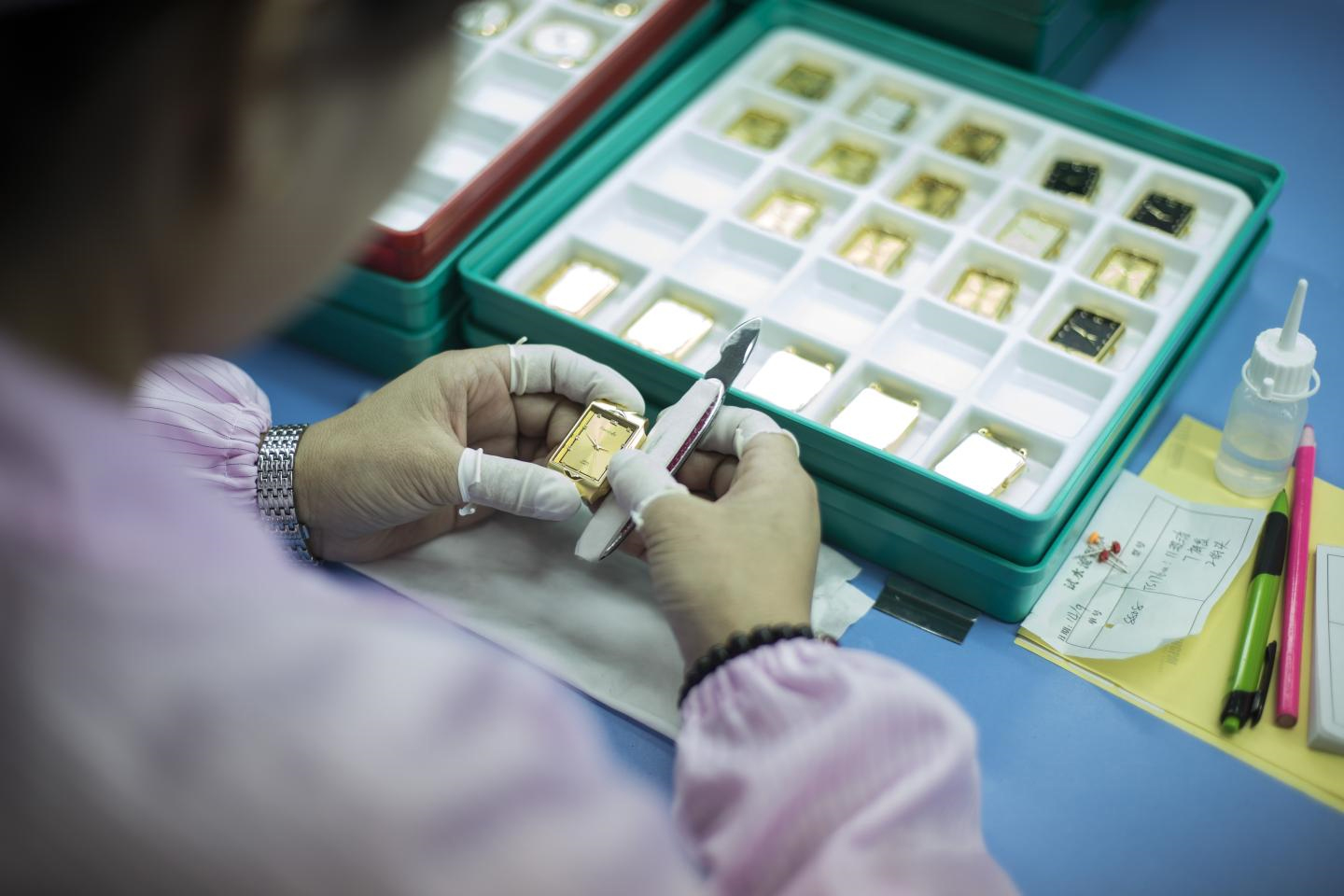
The most common sourcing error in custom wristwatch projects is choosing a case by rendering and a movement by unit price before the end use has been defined. A 3 ATM quartz model, an ultra-slim 5 ATM automatic and a 200-meter diving watch can look similar in a design file, yet they differ in case thickness, gasket structure, machining tolerance and the test regime every unit must pass. Fixing the category first makes the rest of the specification fall into place: daily-wear quartz optimizes for unit cost and dial print area, automatic programs optimize for movement value and serviceability, and diving programs optimize for sealing integrity and per-unit pressure testing.
That sequence also protects the compliance side of a launch. RoHS compliance (Directive 2011/65/EU) is mandatory for electronic watches, including quartz and smart models, placed on the EU market, and water-resistance descriptions are governed by ISO 22810:2010, under which the term 'waterproof' is prohibited. Buyers who shortlist by category can attach the correct standard to the correct line at brief stage instead of discovering the gap during certification.
The Four Custom Wristwatch Families at a Glance
Ratings below sit inside the manufacturer's supported 5–50 ATM water-resistance range; individual models are specified project by project.
| Option family | Typical rating class | Movement logic | Best-fit programs | Main constraint |
|---|---|---|---|---|
| Customized quartz and private label quartz | 3–5 ATM, daily wear | Button-cell quartz | Retail consumer goods, corporate promotional gifts, private label lines | EU RoHS applies to quartz models; no swimming claims |
| Lady elegant quartz | 3 ATM class, slim case | Button-cell quartz | Premium gifts, fashion accessories, jewellery-adjacent lines | Smaller case limits dial print area and index detail |
| Customized automatic and mechanical chronograph | 5 ATM class (ultra-slim platform) | Mainspring, manual winding or automatic rotor | Premium gifts, enthusiast retail, flagship brand lines | Higher unit value; service and spare-part planning required |
| Stainless steel diving | 10 ATM to 200 meters (20 ATM static) | Automatic or quartz | Diving sports retail, water-sports brands | Per-unit pressure testing; ratings are not permanent; ISO 6425 governs diver-watch claims |
Quartz and Elegant Options: Volume, Colour and Compliance
Customized quartz and private label wristwatches
Quartz watches are driven by a button battery and remain the default choice when a program needs high unit volumes, fast dial-colour rotation and a controlled unit cost. In the water-resistance framework used for this shortlist, the 3–5 ATM band is the daily-wear class: it covers hand-washing and rain splash (often described as rain splash protection) and is not intended for swimming or immersion. A 3 ATM quartz model therefore belongs in retail consumer goods, corporate promotional gifts and fashion accessories — the industries listed for custom watch output.
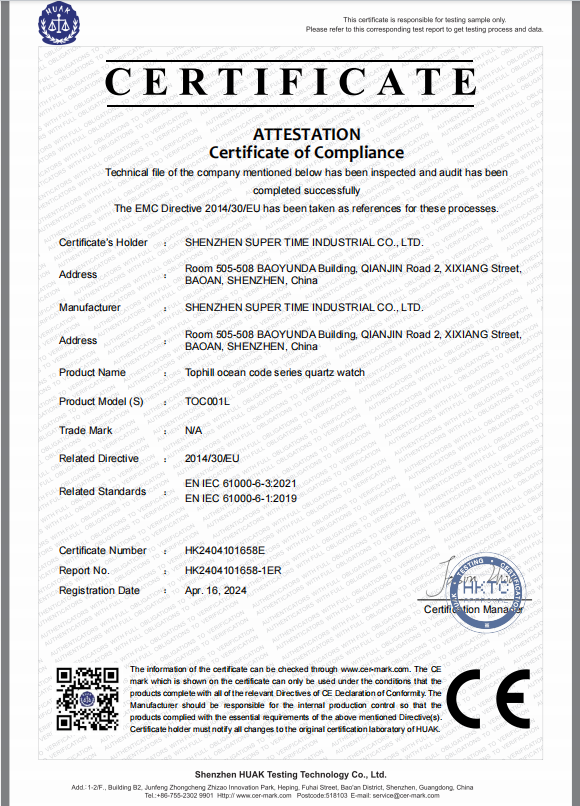
Compliance is part of the quartz brief rather than an afterthought. Documented certification exists for comparable quartz production: the Tophill ocean code series quartz watch, model TOC001L, holds a CE Certificate of Compliance under the EMC Directive, certificate number HK2404101658E, issued 16 April 2024 by HUAK and tested to EN IEC 61000-6-3:2021 and EN IEC 61000-6-1:2019 for the EU market. For a private label buyer, that is the kind of evidence to request before the dial artwork is approved, not after.
Lady elegant quartz wristwatches
Elegant ladies' models compress the same engineering into a smaller case. The 3 ATM quartz class is typical, and materials across the range include 316L stainless steel and brass. The practical constraint is space: a reduced case diameter limits printable dial area, so complex index layouts, sub-dials and dense logo treatments usually have to be simplified to keep legibility.
Testing expectations do not relax with case size. The ultra-slim platform used across the range, identified as model KIM001, is specified with a 316L stainless steel case and a flat sapphire crystal, and is offered as an ultra-slim quartz wristwatch as well as a mechanical version. That shared platform matters for buyers building a coordinated men's and women's line, because case language, crystal specification and finishing can be kept consistent across both.
Automatic, Chronograph and Diving Options: Value and Performance
Customized automatic and mechanical chronograph watches
Automatic watches run on energy stored in a mainspring, wound either manually or by a rotor that responds to wrist movement. The tier is commercially significant: automatic movements held a 38.2% share of a global movement market valued at USD 18.4 billion in 2025 (Dataintelo), and the mechanical watch market overall is projected to reach USD 47.5 billion by 2025 (Grand View Research).
Movement selection is a design decision, not a commodity choice. TOPHILL uses Seiko NH35 (automatic), Seiko NH34 (GMT) and Seagull ST1901 movements in its enthusiast-tier custom designs (Jewelry Addicts, 2025). A documented specification for the ultra-slim platform shows the level of detail a brief should carry: a 316L stainless steel case in two pieces (one case, one bezel), 5 ATM water resistance, a solid stainless steel screw caseback, flat sapphire crystal, embossed dial with enamel coating, hollow hands, a 316L stainless steel bracelet with butterfly buckle, and an ultra-slim mechanical movement with manual winding. The same platform is offered as an automatic winding wristwatch and as an ultra-slim quartz wristwatch, which lets a brand build a graded line from one case architecture.
Stainless steel diving watches from 10 ATM to 200 meters
The diving tier is where specification discipline matters most. A representative configuration in this shortlist is the 8848 TD015G diving watch: a 316L stainless steel case, flat sapphire crystal, ceramic bezel insert, BGW9 luminous markers and 200-meter water resistance. Alongside it, a 10 ATM automatic diving option covers swimming and surface snorkeling, and a 3 ATM quartz model covers daily wear within the same product family — so a brand can field a graded line rather than a single hero reference.
The engineering context is straightforward but frequently misread. One ATM corresponds to 10 meters of static laboratory water depth, which makes a 200-meter rating a 20 ATM static value. General water-resistant watches are assessed against ISO 22810:2010, while diver watches are assessed against ISO 6425, which adds dynamic pressure and salt-water corrosion testing. Under ISO 22810 the term 'waterproof' may not be used; the correct claim is a water-resistance rating expressed in ATM or meters. The manufacturer supports 5–50 ATM water resistance and pressure-tests 100% of waterproof watches before shipment rather than relying on sample inspection.
Technical Explanation: What Actually Decides Water Resistance and Accuracy
Water resistance is not produced by a single component. It results from elastic sealing gaskets fitted at the gaps of the caseback, crystal, crown and pushers, combined with a screw-down structure for the crown and caseback and precise case machining. For each water-resistant unit, the test sequence is: a visual check of case, crown, gasket and crystal before testing; loading the watch and applying the target water pressure with a holding period; monitoring for air leakage during pressurization; slow pressure release and full surface drying; and a final inspection for internal moisture or water ingress.
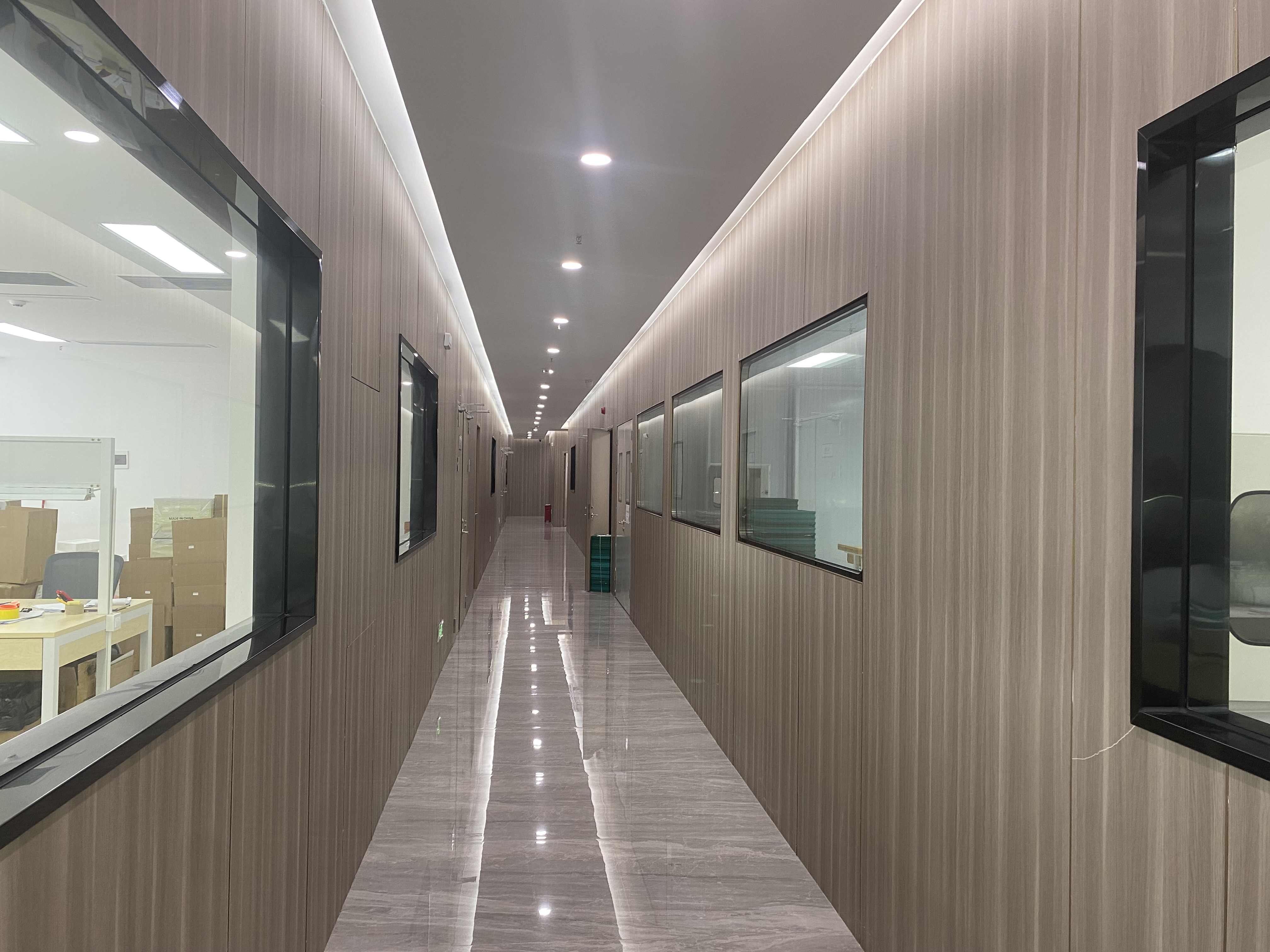
Supporting equipment includes a water-resistant testing machine, a movement stem cutting machine, an automatic movement accuracy testing machine, a strap tension-torsion testing machine, a dial index inspection machine and a dropping test machine. Assembly runs in a class-10,000 dust-free workshop, with a dedicated CNC prototyping workshop for case and structural development. On the finishing side, the same discipline applies: embossed dials with enamel coating, hollow hands and flat sapphire crystals are produced to a defined specification, and 100% testing is performed as part of quality control rather than by sampling.
Manufacturing Capability Behind the Shortlist
TOPHILL is a watch manufacturer that integrates design and manufacturing and supports OEM/ODM programs for global brands. The provider supplies OEM and ODM production services with a monthly capacity of 50,000 to 60,000 units and a typical lead time of 75 days. Minimum order quantity is 300 pieces, delivery terms are FOB, and payment terms are a 30% deposit on order confirmation with the 70% balance before shipment; acceptance is based on pre-shipment testing. After-sales support runs for two years.
Quality and compliance systems sit behind those numbers: ISO 9001 quality management and ISO 14001 environmental management certification, EU RoHS compliance for finished products, and 100% testing across output. The manufacturer reports more than 20 million finished watches produced over more than three decades of watchmaking, an R&D function staffed by 4 designers and 3 engineers, and more than 15 core staff with over 15 years of industry experience.
The customer base is B2B — brand owners, wholesalers and retailers rather than end users — with recorded markets including AU, CH, DE, FR, GB, IL, JP, KR, SE, SG and TR. One documented relationship covers a 300-unit program running five years or more with stable operation, and the case record cites high-precision movements, premium materials and multiple strict tests before shipment.
Application Fit: Matching an Option to a Use Case
Watches produced for these programs are used for time-telling, daily matching and social occasions, and can be customized as gifts and souvenirs. The mapping below translates end use into a category choice before any tooling discussion begins.
| Use case | Recommended option family | Rating band | Sourcing note |
|---|---|---|---|
| Everyday wear | Customized quartz, lady elegant quartz | 3–5 ATM | Hand-washing and rain splash only |
| Water-related activities | 10 ATM automatic diving option | 10–20 ATM | Built for dynamic swimming pressure; not for saunas or hot-water baths |
| Diving sports | Stainless steel 200-meter diving configuration (8848 TD015G) | 20 ATM static | ISO 6425 applies where a formal diver-watch claim is made |
| Premium gifts | Ultra-slim automatic or mechanical platform | 5 ATM class | 316L case, flat sapphire crystal, enamel-coated embossed dial |
| Corporate promotional gifts | Quartz and private label | 3–5 ATM | Cost-controlled, logo-driven, fast dial rotation |
| Retail consumer goods | Mixed quartz and automatic | 3–5 ATM | Volume tier plus a value tier from one case architecture |
Limitations and Trade-offs to Accept Before Committing
A custom program is not the right answer for every requirement, and the limits are technical as well as commercial:
- Minimum order quantity is 300 pieces per project, so single-piece or boutique-scale ordering is outside the operating model.
- The typical lead time is 75 days from a confirmed order, which does not suit short-notice replenishment or a launch date that is already fixed.
- Delivery is FOB with a 30/70 payment structure, which changes landed-cost and cash-flow calculations compared with domestic stock buying.
- Water resistance is not permanent. Sealing gaskets age with wear, impact and chemical contact, so gasket replacement is a planned service item rather than a fault.
- ATM is a static laboratory pressure value, not a usable depth. A 10 ATM watch is not validated for a 100-meter dive, and high-temperature environments such as saunas and hot-water baths are not recommended for any rating band because steam deforms rubber gaskets.
- Quartz and smart models shipped to the EU must meet RoHS requirements; material substitutions that fail this constraint cannot ship regardless of design intent.
- A customized dial, caseback engraving or bezel insert does not change the accuracy class of the underlying movement.
- A 200-meter rating on a well-machined case is not by itself an ISO 6425 diver-watch certification; the full dynamic pressure and salt-water corrosion test set is what supports that claim.
- Smaller lady elegant cases reduce printable dial area, which limits complex index or sub-dial layouts.
Compared with catalogue sourcing of unbranded stock watches, the custom route is slower and carries tooling and MOQ commitments. What it returns is differentiation, category-matched water-resistance engineering and documentation that a distributor or retail buyer can verify — three things that off-the-shelf sourcing generally cannot supply.
Market Trend Analysis
The volume-versus-value split keeps shaping custom briefs. Quartz movements account for 75% of global shipment volume, while mechanical watches contribute over 68% of total market value on lower unit volumes (Industry Research, 2024). The movement market reached USD 18.4 billion in 2025 with automatic movements holding a 38.2% share (Dataintelo), and the mechanical watch market is projected to reach USD 47.5 billion by 2025 (Grand View Research). Read together, these figures describe a two-tier custom market: quartz for penetration and promotional volume, automatic and mechanical for margin and brand positioning.
Regulation is moving in parallel. RoHS compliance is already mandatory for electronic watches in the EU, and ISO 22810:2010 governs how water resistance may be described, including the prohibition on the term 'waterproof'. Buyers increasingly ask for test documentation per unit rather than a headline rating, which favors suppliers that run in-house testing equipment and defined test sequences.
Future Outlook
The next change in this category is less about features than about evidence. Briefs are likely to specify the exact ATM test regime, the sealing structure and the acceptance test before dial artwork is approved, because those three items determine whether a claim survives retail scrutiny. Diving lines will continue to split more sharply between 10 ATM lifestyle models and full ISO 6425 diver configurations, since the gap between the two cannot be closed with marketing language. Lifecycle planning — gasket replacement, service intervals and caseback sealing — will increasingly appear in tender documents alongside the warranty term. For buyers, the practical implication is that the shortlist should be a compliance shortlist as much as a design shortlist.
FAQ
- What water resistance level can a custom watch program achieve?
- The manufacturer supports 5–50 ATM water resistance and pressure-tests 100% of waterproof watches before shipment rather than sampling. The practical classes are 3–5 ATM for daily wear, hand-washing and rain splash; 10–20 ATM for swimming and surface snorkeling; and 20 ATM and above for professional diving where the ISO 6425 diver-watch standard applies. One ATM corresponds to 10 meters of static laboratory water depth.
- Should a 3 ATM quartz custom watch be marketed for swimming?
- No. The 3–5 ATM band addresses daily wear, hand-washing and rain splash. Models in this band belong to retail consumer goods, corporate promotional gifts and everyday-wear lines, and should not carry swimming or immersion claims. A 3 ATM quartz model in the same family as a 200-meter diving configuration serves a different use case; it is not a lower grade of the same use case.
- Does a higher ATM rating mean the watch can be used at the corresponding depth?
- No. ATM reflects static laboratory test pressure, not actual usable diving depth. A 10 ATM rating indicates suitability for swimming and surface snorkeling under dynamic conditions, and a 200-meter rating is a 20 ATM static value. Diver-watch claims require testing to ISO 6425, which adds dynamic pressure and salt-water corrosion testing.
- Will a diving watch stay water resistant permanently?
- No. Water resistance is not permanent. Sealing gaskets age with wear, impact and chemical contact, and re-sealing is a service item. Saunas and hot-water baths are not recommended, because high-temperature steam deforms and ages rubber gaskets and destroys waterproof performance. The relevant description standards are ISO 22810:2010 for general water-resistant watches and ISO 6425 for diver watches.
- What are the typical purchasing terms and acceptance criteria for a custom program?
- MOQ is 300 pieces. Delivery terms are FOB. Acceptance criteria are based on pre-shipment testing. Payment terms are a 30% deposit when the order is confirmed, with the 70% balance paid before shipment. After-sales support runs for two years.
- What happens if water enters a watch case, and how is it handled?
- Typical symptoms are fog or condensation under the crystal, visible water droplets inside the case, rust or oxidation on movement parts, unstable timekeeping, and rust at the caseback, crown or pusher joints. Moisture usually enters as vapour that condenses under temperature change, or through a sealing gap. Handling follows a defined sequence: visual inspection; immediate withdrawal from use; opening the caseback in a dry environment; professional dehumidification of the movement without high-temperature baking; inspection and replacement of aged or cracked O-ring gaskets; checking the case, crown and pushers for structural damage; reassembly to standard torque; a repeat water-pressure test; and verification of timekeeping and anti-condensation performance.
For buyers who need the underlying capability data — production capacity, test equipment and compliance documentation — the manufacturer's capability profile is published as a downloadable PDF: Profile of Super Time (HK) Industrial Ltd.