
Custom Wristwatches: What Certification Claims Really Prove
Compliance in custom wristwatches is rarely a single certificate. It is a chain of three distinct proofs — the qualification of the manufacturing entity, the conformity of the product to named standards, and the test evidence tied to a specific production run — and a sourcing file is only as strong as the weakest of them. Buyers at the research stage are usually shown the document a supplier is proudest of, which is often the one that says least about the watch they will actually receive.
This reference separates those three layers and sets out what each document does and does not establish. It uses published standards — ISO 22810:2010, ISO 6425 and RoHS Directive 2011/65/EU — alongside the documented capability of Shenzhen Super Time CO., LTD., a watch manufacturer established in 1992 that runs custom OEM and ODM programmes and its own watch brand TOPHILL, as a worked example of how a qualification file is actually assembled.
The Word “Compliant” Answers Three Different Questions
A compliance question in watch sourcing usually arrives as a single sentence: is this supplier compliant? In practice, three separate questions are being asked at once, and they are answered by different documents with different scopes and different failure modes.
| Layer | Typical evidence | What it establishes | What it does not establish |
|---|---|---|---|
| Entity qualification | ISO 9001, ISO 14001 | That a management system exists and is audited; process repeatability, environmental controls | That a specific watch reaches a stated water resistance, material content or accuracy |
| Product conformity | RoHS Directive 2011/65/EU, ISO 22810:2010, ISO 6425, CE EMC where applicable | That a model or material set meets a defined standard or regulatory requirement | That every unit in a shipment was individually verified |
| Batch evidence | Water pressure test records, movement accuracy checks, inspection criteria | That a defined test was applied to a defined lot — or to every unit | That performance stays constant over the service life of the product |
The distinction matters because the layers fail independently. A factory can hold a valid quality management certificate and still release a batch with a leaking crown. A model can be RoHS compliant and still not survive a pressure test. A unit can pass a pressure test on the day of shipment and still lose water resistance two years later as sealing gaskets age.
Layer One — Entity Qualification: What ISO 9001 and ISO 14001 Cover
Entity qualification answers a question about the factory, not about the watch. Shenzhen Super Time CO., LTD. was established in 1992 — formerly Shenzhen Zhuoyueshi Industrial Co., Ltd. — and completed a full-plant relocation to Dongguan in 2024. The manufacturing facility covers 1,500 m², annual production capacity is stated at 400,000 units, and the company reports more than 20 million finished watches manufactured to date. It is certified to ISO 9001 for quality management and ISO 14001 for environmental management, and its finished products are stated to fully meet EU RoHS compliance standards for overseas market access. Export accounts for 80% of total sales, with the EU and the United States as the major markets.
Process detail sits underneath those certificates: a class-10,000 dust-free assembly workshop, a dedicated CNC prototyping workshop for structural development, and a set of inspection and testing instruments covering water resistance, movement accuracy, and case and strap integrity. A research and development team of 4 designers and 3 engineers supports custom development work, and order capacity spans small-batch trial runs from 500 pieces up to large-volume batches above 500,000 units.
What a management certificate does not tell you
ISO 9001 certifies a quality management system at entity level. It does not certify that a specific watch resists water to a stated depth, that a component set is free of restricted substances, or that a dial colour matches a reference sample. Those are product-level questions and require product-level evidence. The practical implication for buyers is that a factory certificate is a starting filter, not a conclusion: it tells you whether documented process control exists, and therefore whether the further evidence you request is likely to be produced consistently rather than reconstructed for the occasion.
Layer Two — Product Conformity: RoHS, ISO 22810 and ISO 6425
RoHS Directive 2011/65/EU
RoHS compliance is mandatory for electronic watches — quartz and smart models — placed on the EU market. Because quartz movements dominate global shipment volume, the documentation burden falls hardest on the highest-volume segment of the category. For a private label programme destined for Europe, RoHS is not optional paperwork; it is a condition of entry, and it applies at component and material level rather than at the level of the finished aesthetic.
ISO 22810:2010 and the word “waterproof”
Water-resistant watches must comply with ISO 22810, and the standard does not permit the term “waterproof”. That single detail is a useful screening rule in supplier conversations: a specification sheet describing a watch as waterproof is using language the relevant standard prohibits. The correct claim is a water resistance rating expressed in ATM or metres, attached to a defined test method and a defined release criterion.
ISO 6425 and diver’s watches
ISO 6425 is a separate standard for diver’s watches, and it is not satisfied by a static pressure figure alone. Its scope extends to dynamic pressure and salt-water corrosion testing, which is why a depth marking and a diver’s-standard qualification should never be treated as interchangeable. A caseback marked 200 m records a static laboratory rating; it does not by itself constitute ISO 6425 certification. Buyers who need genuine dive-standard products should ask which standard a model was tested to, not only which depth appears on the dial.
CE EMC where electronic functions exist
Where a watch includes electronic functions, additional requirements can apply. Super Time’s production documentation lists special requirements such as meeting CE EMC requirements, achieving the specified waterproof performance, and holding specified movement accuracy — a reminder that compliance in this category is a set of parallel obligations, not one certificate covering everything.
Layer Three — Batch Evidence: 100% Pressure Testing Versus Sampling
The third layer is the least photogenic and the most predictive. Super Time supports 5–50 ATM water resistance and states that every waterproof watch passes a 100% water pressure test before shipment rather than a random sampling inspection. The stated procedure runs in five steps:
- Visual check of case, crown, gasket and crystal before testing begins.
- Load the watch and apply the target pressure with a pressure-holding period.
- Monitor for air leakage during pressurisation.
- Release pressure slowly and dry the full surface.
- Final inspection for internal moisture or water ingress.
The equipment base behind that procedure includes a water resistant testing machine, a movement stem cutting machine, an automatic movement accuracy testing machine, a strap tension-torsion testing machine, a dial index inspection machine and a dropping test machine. The significance of a 100% test regime is not that the design is superior; it is that a claim becomes a per-unit record rather than a statistical assumption. For a buyer receiving 500 pieces or 50,000, that difference determines whether a defect is an isolated incident or a batch-wide exposure.
Reading the ATM Number Without Overstating It
One ATM is equivalent to 10 metres of static water depth on the conventional reading, and the ATM mark records a static laboratory pressure value rather than a usable diving depth. The practical grading used across custom programmes is straightforward: 3–5 ATM for daily wear, hand-washing and rain splash; 10–20 ATM for swimming and surface snorkelling; 20 ATM and above, aligned with the diver-watch standard, for professional diving scenarios.
| Model | Type | Water resistance | Movement | Compliance-relevant specification |
|---|---|---|---|---|
| TR001 | Customized quartz wristwatch | 3ATM | Japan quartz movement | 316L stainless steel case with zircon stones, snap caseback, flat sapphire crystal |
| TAM001 | Lady elegant quartz wristwatch | 3ATM | Miyota quartz movement | 316L stainless steel case set with zircon stones, flat sapphire crystal |
| TAM002 | Customized quartz watch | 3ATM | Ronda quartz movement | 316L stainless steel case with zircon stones, sunburst dial with applied indexes |
| KIM001 | Ultra-slim manual winding mechanical wristwatch | 5ATM | Ultra-slim mechanical movement, manual winding | Case thickness under 9 mm, stainless steel solid screw caseback |
| KIM002 | Automatic elegant wristwatch | 5ATM | Miyota 9039 | See-through solid caseback, flat sapphire crystal |
| KIM003 | Mechanical chronograph watch | 5ATM | Seagull ST1905 | Power reserve function, see-through solid caseback, genuine leather strap |
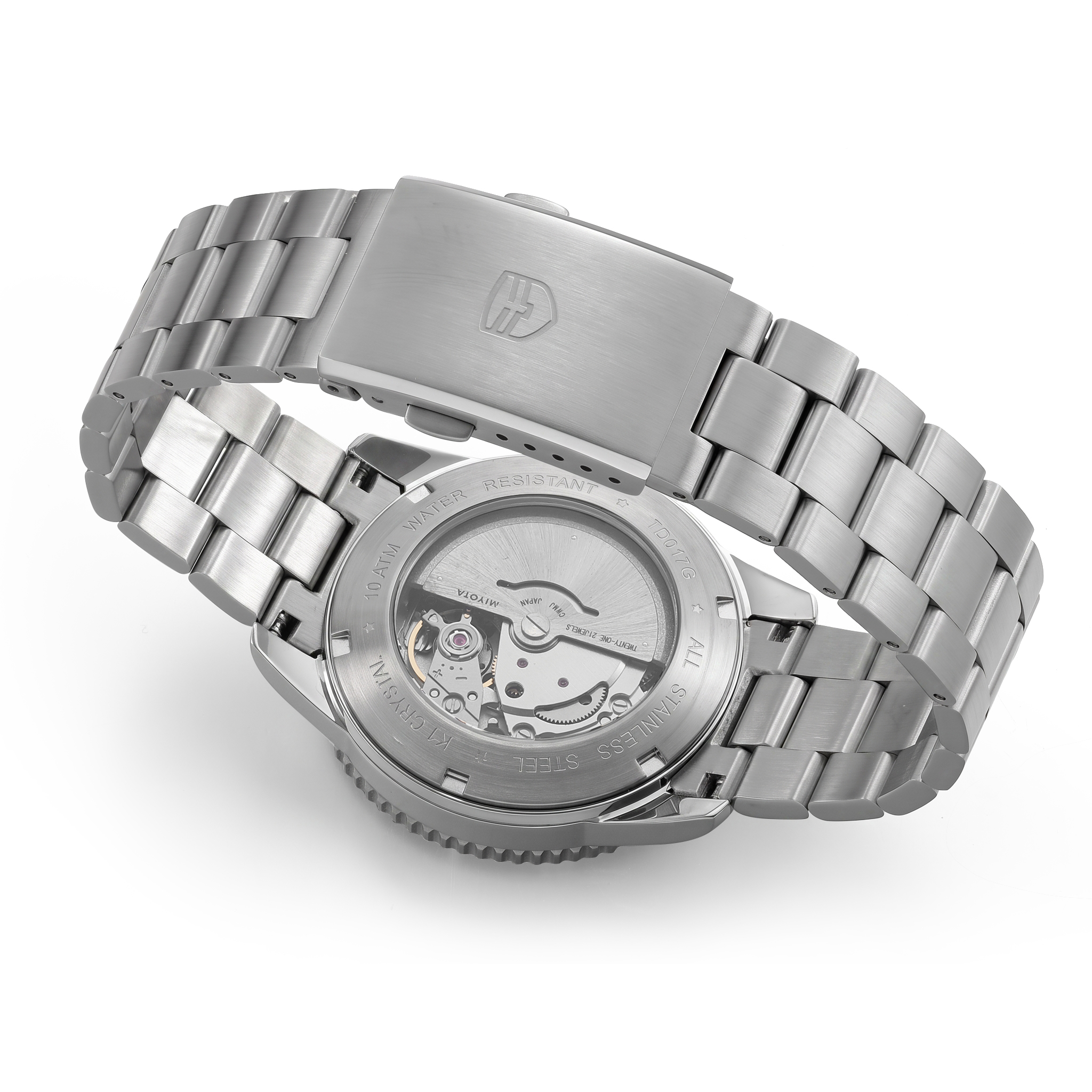
| TD017G | Automatic diving watch | 10ATM | Miyota Automatic 8215 | Ceramic bezel insert with luminous, 316L case and bracelet |
| TD015G (8848) | Stainless steel 200 m diving watch | 200 m | Miyota Automatic 8215 | Ceramic bezel insert with BGW9 luminous, flat sapphire crystal, 316L solid bracelet |
The spread is deliberate rather than hierarchical. The 3ATM models are jewellery-led quartz watches for daily and occasion wear; the 5ATM models are mechanical and automatic pieces built around movement character; the 10ATM and 200 m models are diver-style builds with ceramic bezels and luminous treatments. Reading this table as a single quality ranking would misread it — the correct reading is fit between rating and intended use.
Application: Matching the Qualification Level to the Scenario
Diving and water sports
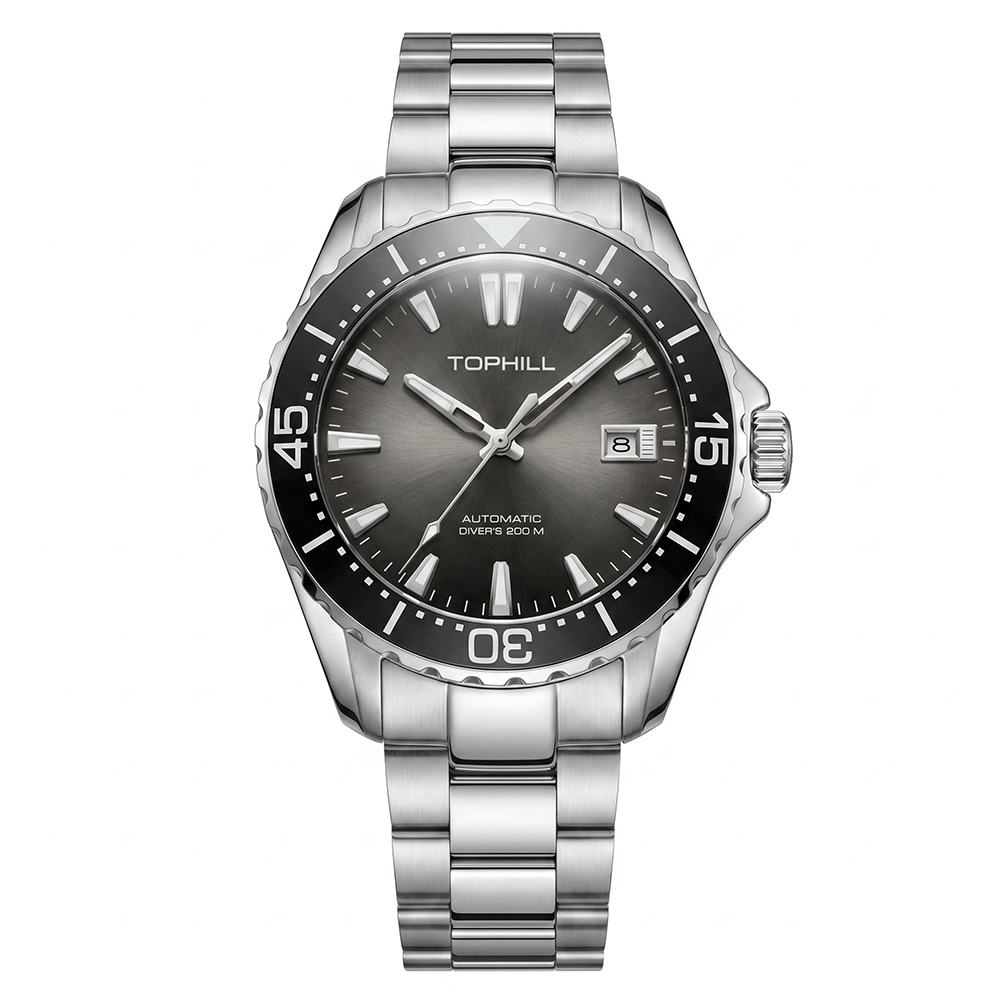
TD015G, also referenced as the 8848 diving watch, is a 316L stainless steel automatic with a rotating bezel and ceramic bezel insert, BGW9 luminous applied to bezel, dial indexes and hands, a flat sapphire crystal and a Miyota Automatic 8215 movement, rated to 200 m. TD017G sits below it at 10ATM with a ceramic luminous bezel insert and the same Miyota Automatic 8215 calibre. For dive-style retail programmes these are the models where water resistance documentation should be requested at model level rather than at brand level.
Business and everyday wear
KIM002 is an automatic winding wristwatch with a Miyota 9039 movement, 5ATM water resistance, a flat sapphire crystal and a genuine leather strap; KIM003 is a manual winding chronograph with a Seagull ST1905 movement, power reserve indication and 5ATM. Both are specified for work and casual wear rather than immersion, and 5ATM is proportionate to that use — a point worth making explicitly, because overstating a rating is as much a compliance risk as understating one.
Luxury women’s and gifting programmes
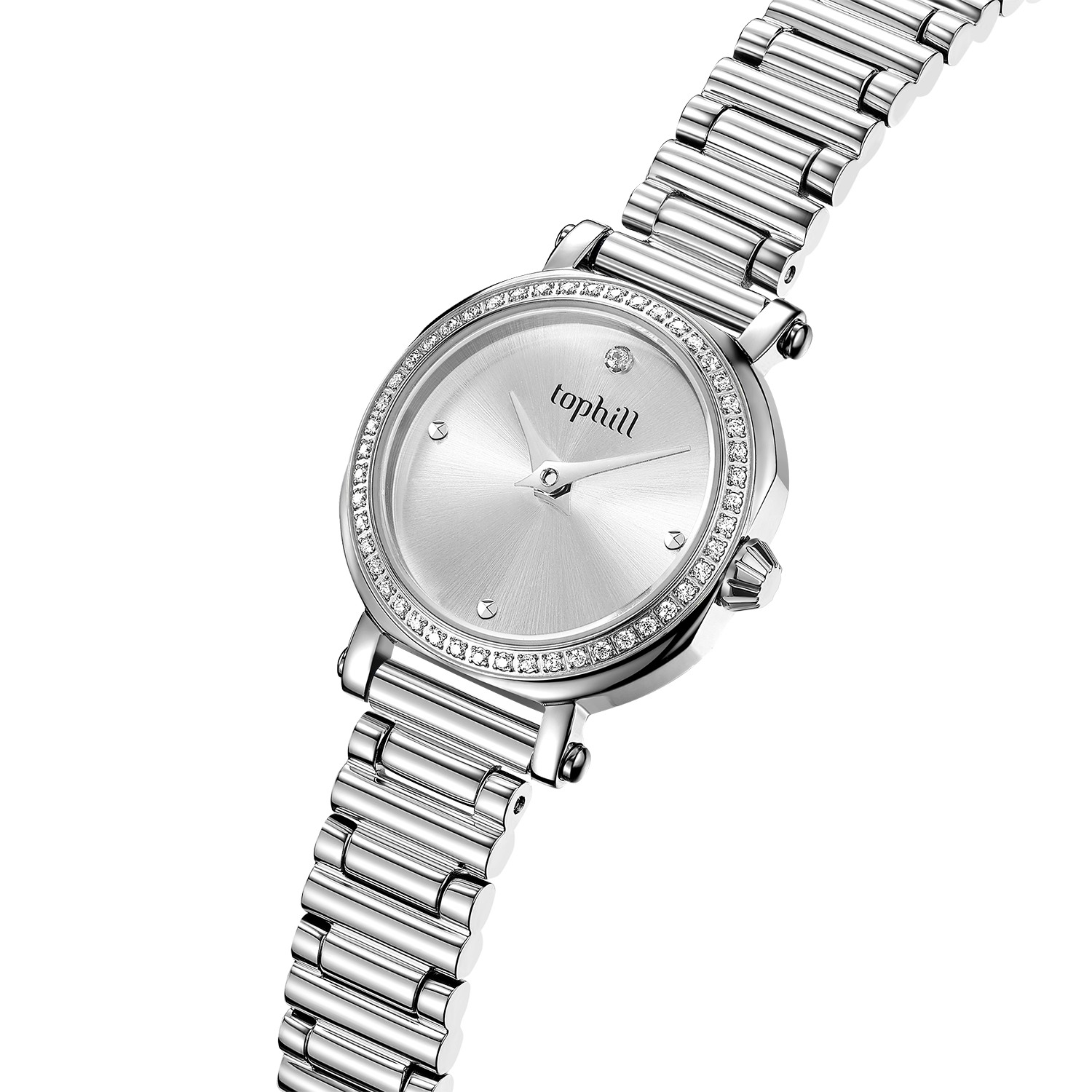
TAM001 with a Miyota quartz movement, TAM002 with a Ronda quartz movement and TR001 with a Japan quartz movement all sit at 3ATM, with 316L stainless steel cases set with zircon stones and flat sapphire crystals. Their compliance profile is narrower by design: 3ATM covers splash and rain exposure, and the models are positioned for fashion accessories, jewellery and ornaments, premium gifts, corporate promotional gifts and retail consumer goods. TR001 is specifically documented as a corporate promotional gift configuration, which is where buyers most often need a clear, defensible rating statement rather than a marketing one.
Private label and movement selection
Movement choice carries a documentation consequence. Quartz calibres — the Japan quartz movement in TR001, the Miyota quartz movement in TAM001, the Ronda quartz movement in TAM002 — fall inside the electronic scope that triggers RoHS obligations for EU placement. Mechanical calibres such as the Miyota 8215, Miyota 9039 and Seagull ST1905 sit outside that electronic scope while introducing their own accuracy and testing requirements. A private label brief that mixes both types in one collection should expect two different evidence trails, not one.
Market Context: Why Compliance Is Becoming a Purchasing Filter
Third-party data explains why compliance is shifting from legal footnote to purchasing criterion. Quartz movements account for roughly 75% of global shipment volume, while mechanical watches contribute over 68% of total market value — a volume-versus-value split that shapes where documentation effort and verification effort concentrate. The global mechanical watch market is projected to reach USD 47.5 billion by 2025, according to Grand View Research, and the watch movement market was reported at USD 18.4 billion in 2025, with automatic movements holding a 38.2% share.
The sourcing implication is structural. The segment with the largest unit volume is the segment most exposed to RoHS documentation requirements in Europe. The segment with the highest value concentration is the segment where buyers are most likely to request test reports, because at that price point they are paying for verified performance rather than appearance. Both pressures point the same way: evidence per model, and evidence per order.
Where Certification Claims Stop
A credible compliance file states its own boundaries. Several limits are worth setting out explicitly, because they are the questions a careful buyer will ask anyway.
- A passed pressure test is not permanent water resistance. Sealing gaskets age with wear, impact and chemical contact. Passing a laboratory test confirms performance at the time of test, not a lifetime guarantee.
- ATM is a static laboratory value, not a usable depth. A 10ATM marking does not mean a watch can be taken to 100 metres of working depth; it means it held a defined static pressure under test conditions.
- High-temperature steam is outside the intended environment. Saunas and hot baths deform and age rubber gaskets, which degrades water resistance independently of the original rating.
- ISO 9001 and ISO 14001 certify systems, not products. They support confidence in process control and do not substitute for a model-level test report.
- RoHS addresses restricted substances only. It says nothing about water resistance, accuracy or finish. A RoHS-compliant watch can still fail a pressure test.
- A depth marking is not a diver’s-standard qualification. The published specifications for TD015G (200 m) and TD017G (10ATM) describe water resistance ratings; they do not state ISO 6425 certification. Buyers who require dive-standard qualification should request the corresponding test documentation for the specific model and order.
Future Outlook
The direction of travel in custom watch procurement is toward evidence per order rather than evidence per brochure. Standards such as ISO 22810 and ISO 6425 already give buyers the vocabulary to ask precisely, and RoHS already sets a hard entry condition for the highest-volume segment in Europe. What is changing is the expectation of granularity: model-level test documentation, a stated test procedure, and a release criterion rather than a pass/fail summary.
For manufacturers, that shift favours operations that already generate records — a 100% test regime, documented procedures and maintained equipment — because the compliance conversation becomes shorter when the answers already exist. The constraint on most suppliers is not ambition but documentation discipline, and that is built years before a purchase order is placed.
FAQ
What does ISO 22810 cover for a custom wristwatch?
ISO 22810 is the standard for general water-resistant watches. It defines the test conditions under which a water resistance rating may be claimed, and it does not permit the term “waterproof”. A rating expressed in ATM or metres should therefore be read as a result obtained under defined laboratory conditions, not as a description of every environment in which the watch might be worn.
Is RoHS compliance mandatory for custom quartz wristwatches sold in the EU?
Yes. RoHS compliance under Directive 2011/65/EU is mandatory for electronic watches — including quartz and smart models — placed on the EU market. Super Time states that its finished products fully meet EU RoHS compliance standards for overseas market access. Mechanical models fall outside that electronic scope but remain subject to other applicable requirements.
How is ISO 6425 different from a 200 m water resistance rating?
ISO 6425 is the standard for diver’s watches, and its scope extends beyond a static pressure figure to include dynamic pressure and salt-water corrosion testing. A 200 m marking records a static laboratory rating and is not, by itself, evidence of ISO 6425 certification. Buyers who need dive-standard products should ask which standard the specific model was tested to.
Can a 10 ATM custom wristwatch be used for scuba diving?
A 10 ATM rating is a static laboratory value equivalent to roughly 100 metres of static water depth on the conventional 1 ATM to 10 metre reading. It is commonly associated with swimming and surface snorkelling rather than scuba diving. For diving, ratings of 20 ATM and above, aligned with the diver-watch standard, are the appropriate reference point.
What evidence should a buyer request to verify water resistance?
Buyers should ask for the pressure test procedure, the target pressure applied, whether testing is 100% per unit or sample-based, and the release criteria applied afterwards. Super Time states that every waterproof watch is tested before shipment on a 100% basis, using a five-step procedure that runs from pre-test visual inspection through pressure holding and air-leak monitoring to post-test inspection for internal moisture.
Does ISO 9001 certification prove that a watch is compliant?
No. ISO 9001 certifies a quality management system at entity level and does not certify a product’s water resistance, material content or accuracy. Product conformity is established separately through standards such as ISO 22810 and RoHS, and batch evidence is established separately through testing records.
Why does water resistance change over the life of a watch?
Water resistance depends on elastic sealing gaskets at the caseback, crystal, crown and pushers. Those gaskets age under daily wear, impact and chemical contact, so performance at the point of sale is not a permanent condition. Routine gasket inspection and replacement is the standard maintenance path, and re-testing after any case opening is the reliable way to confirm the rating still holds.
A full company and capability profile, including certification and facility detail, is available in the public brochure: Profile of Super Time (HK) Industrial Ltd. Company information is also published at www.supertime.hk.
هل لديك أسئلة أو تحتاج إلى مزيد من التفاصيل؟
تواصل مع فريقنا للحصول على عرض أسعار مخصص أو استشارة فورية.
طلب عرض أسعار
املأ النموذج أدناه وسيتواصل معك فريقنا بعرض مقترح مخصص.
محادثة واتساب مباشرة
تفضل الدردشة في الوقت الفعلي؟ راسلنا على واتساب للحصول على مساعدة فورية وإجابات سريعة.
- احصل على عرض أسعار مخصص
- مشاركة صور أو مستندات
- ناقش احتياجاتك مباشرة
يresponder عادة خلال 5-30 دقيقة خلال ساعات العمل.