
Custom Wristwatches: What to Look For in an OEM/ODM Partner
The custom wristwatch market sits at the intersection of craft, industrial engineering and brand strategy. For buyers evaluating private-label watch programmes, the deciding factor is rarely the design alone; it is the ability of a factory to execute design, qualification, mass production and international compliance under one roof.
The global watch industry is often described through two movement stories. According to Grand View Research, the mechanical watch market is projected to reach USD 47.5 billion by 2025. By contrast, 2024 Industry Research data shows quartz movements still dominate global shipment volume with a 75% share, while mechanical watches contribute more than 68% of total market value. In practice, this means buyers in custom wristwatches need access to both precision quartz production and mechanical watch manufacturing.
This article examines the OEM/ODM landscape through the operating profile of DONGGUAN SUPERTIME CO., LTD., a Chinese full-cycle watch manufacturer that runs the proprietary brand TOPHILL. Its setup offers a practical reference for brands, importers, retailers and corporate buyers evaluating custom wristwatch suppliers.
The Procurement Challenge in Custom Wristwatches
Custom wristwatch projects are more complex than most accessories categories. A watch combines a movement, case, crystal, dial, hands, crown, gaskets and bracelet or strap; each component carries its own tolerance and failure mode. For a brand, the difficulty is not only finding a factory, but verifying that the factory can deliver performance claims consistently.
Several issues recur in buyer evaluations:
Specification ambiguity. A stainless steel watch is not necessarily a 316L stainless steel watch. A sapphire crystal may refer to flat or boxed sapphire with different optical and cost profiles. A water-resistant label may mean 3 ATM or 200 metres, and international standards draw a clear line between them.
Regulatory exposure. For the European Union, RoHS compliance (Directive 2011/65/EU) is mandatory for electronic watches, including quartz models. The term waterproof is prohibited; ISO 22810 is the governing reference for water-resistant watches, and ISO 6425 applies to diver watches. Export-oriented manufacturers need to show more than finished product photos; they need auditable compliance evidence.
Quality verification. Watch quality cannot be judged from a rendering. Movement accuracy, water resistance, dial alignment, strap tension and drop performance require specialised test equipment and disciplined procedures. Buyers who rely on low-cost trading intermediaries often discover that these processes are absent until after the first defective batch arrives.
DONGGUAN SUPERTIME: A Full-Cycle Manufacturing Reference
DONGGUAN SUPERTIME CO., LTD. is a watch manufacturer established in 2022, with a corporate history that traces back to Shenzhen Zhuoyueshi Industrial Co., Ltd., founded in 1992. The company completed a full-plant relocation to Dongguan in 2024. It specialises in custom OEM and ODM watch projects for global brand clients and operates its proprietary watch brand TOPHILL.
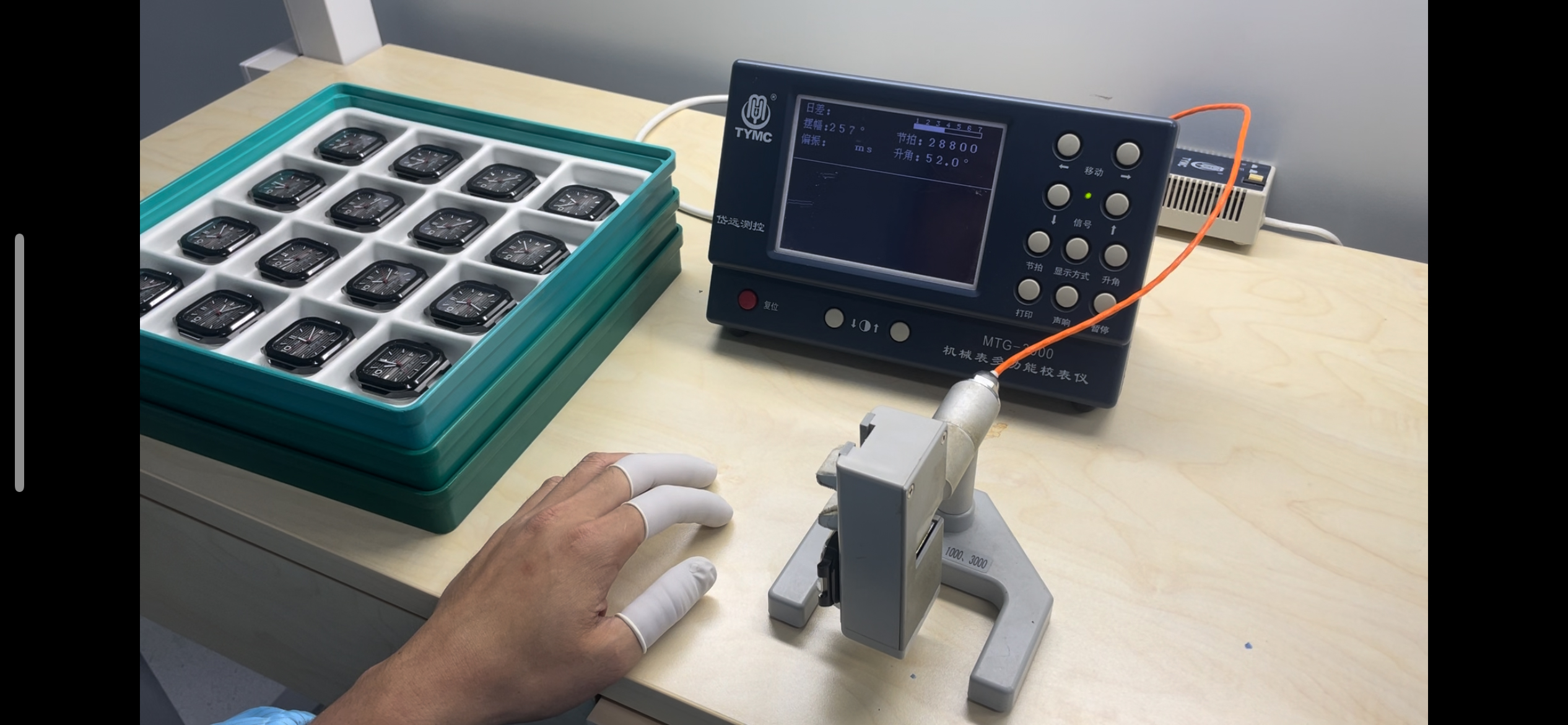 Automatic movement accuracy testing in a watch manufacturing facility.
The company's manufacturing site covers 1,500 square metres and employs approximately 80 staff. Annual production capacity is 400,000 units, and cumulative output has exceeded 20 million finished watches. Export business accounts for 80% of total sales, with the EU and the United States as the major markets.
Core manufacturing features include a class-10,000 dust-free assembly workshop, a dedicated high-efficiency CNC prototyping workshop, and a suite of high-precision inspection and testing instruments. More than 15 core staff members have over 15 years of professional experience in the watch industry. The R&D team consists of 4 designers and 3 engineers.
On the compliance side, the company is certified to ISO 9001 (quality management) and ISO 14001 (environmental management). Finished products fully meet EU RoHS compliance standards for overseas market access.
What distinguishes this kind of profile from a simple trading operation is the combination of design, prototyping, structure optimisation, production and testing under a single management system. For a custom wristwatch brand, this shortens the path from concept to shelf and reduces the risk of miscommunication between separate suppliers.
Product Portfolio: From Lady Quartz Watches to 200-Metre Diving Watches
TOPHILL's production programme covers several watch categories. Understanding the range helps buyers place orders against the right product type and specification.
| Model | Category | Key Specifications | Movement |
|---|---|---|---|
| TR001 | Quartz / lady / battery | 316L stainless steel case with zircon stones, flat sapphire crystal, glossy dial, 3 ATM | Japan quartz movement |
| TAM001 | Lady elegant quartz | 316L stainless steel case with zircon stones, sunburst dial, flat sapphire crystal, 3 ATM | Miyota quartz movement |
| TAM002 | Elegant quartz / lady / battery | 316L stainless steel case and bracelet, sunburst dial, applied index, 3 ATM | Ronda quartz movement |
| KIM001 | Ultra-slim manual winding / automatic | Ultra-slim case under 9 mm, embossed dial with enamel coating, 5 ATM | Ultra-slim manual winding mechanical movement |
| KIM002 | Automatic winding / elegant | 316L stainless steel, embossed two-layer dial, genuine leather strap, 5 ATM | Miyota 9039 automatic |
| KIM003 | Mechanical chronograph | 316L stainless steel, boxed sapphire crystal, luminous hands, genuine leather strap, 5 ATM | Seagull ST1905 manual winding chronograph |
| TD017G | Automatic diving / luminous | 316L stainless steel case and rotating bezel, ceramic bezel insert, 10 ATM | Miyota Automatic 8215 |
| TD015G | Diving / automatic winding / men | 316L stainless steel, rotating ceramic bezel with BGW9 luminous, 200-metre water resistance | Japan Miyota Automatic 8215 |
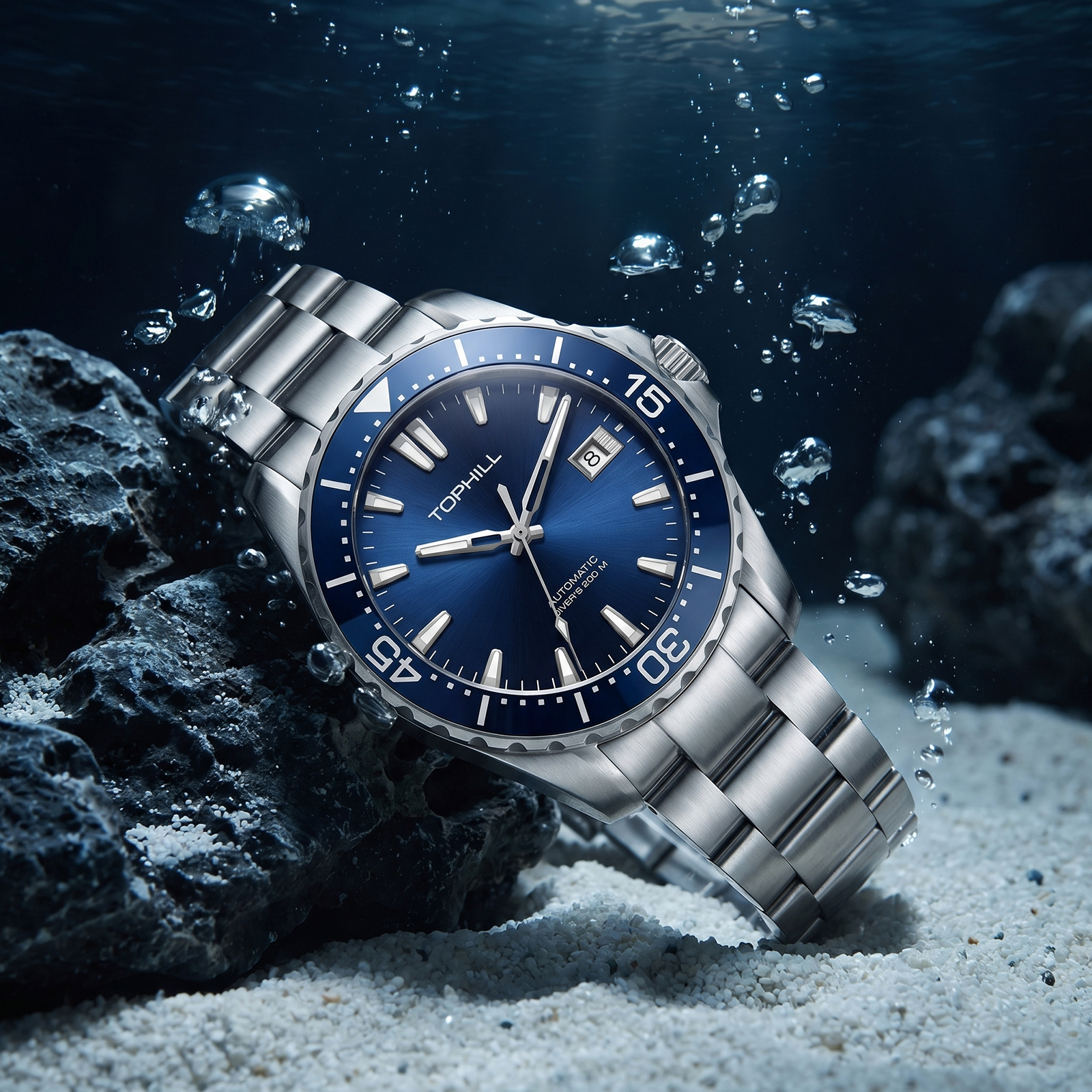 Stainless steel 200-metre diving watch model TD015G.
This portfolio shows a balanced movement strategy: Japanese quartz, Miyota and Ronda calibres for classic dress watches; Miyota automatic calibres for sports and diving lines; and a Seagull ST1905 mechanical chronograph for enthusiast-oriented pieces. The KIM001 ultra-slim model, with case thickness below 9 millimetres and a micro-rotor design, addresses the market for slim mechanical dress watches.
Technical and Quality Considerations
Movement selection
Movement choice defines both positioning and cost. In the TOPHILL range, quartz is reserved for daily and elegant watch lines, while automatic calibres appear in diving sports and minimalist automatic models. The mechanical chronograph KIM003 uses a Seagull ST1905 movement and is classified as a manual winding chronograph watch. For buyers targeting high-precision custom wristwatches, the availability of multiple movement brands inside one factory simplifies sourcing, calibration and after-sales support.
Materials and construction
Across the range, 316L stainless steel is the primary case material. Some models combine stainless steel with brass, and dress watches offer genuine leather strap options. Flat sapphire crystals are common on quartz dress models, while the diving models combine sapphire with ceramic bezel inserts, and the mechanical chronograph uses a curved boxed sapphire crystal. The TD015G diving watch applies Swiss BGW9 Super-LumiNova material on the bezel, dial indexes and hands for dark-environment readability.
Water resistance and testing
Water resistance in watches is achieved mainly through elastic sealing gaskets fitted at the gaps of the case-back, crystal, crown and pushers. ATM represents static laboratory pressure, with 1 ATM equivalent to 10 metres of static water depth, under the ISO 22810 and ISO 6425 frameworks. The manufacturer's technical knowledge base states that it supports 5–50 ATM water resistance, and each waterproof watch undergoes 100% water pressure testing before shipment rather than random sampling. On specific models, water resistance ranges from 3 ATM on quartz dress watches to 10 ATM on the TD017G and 200 metres on the TD015G.
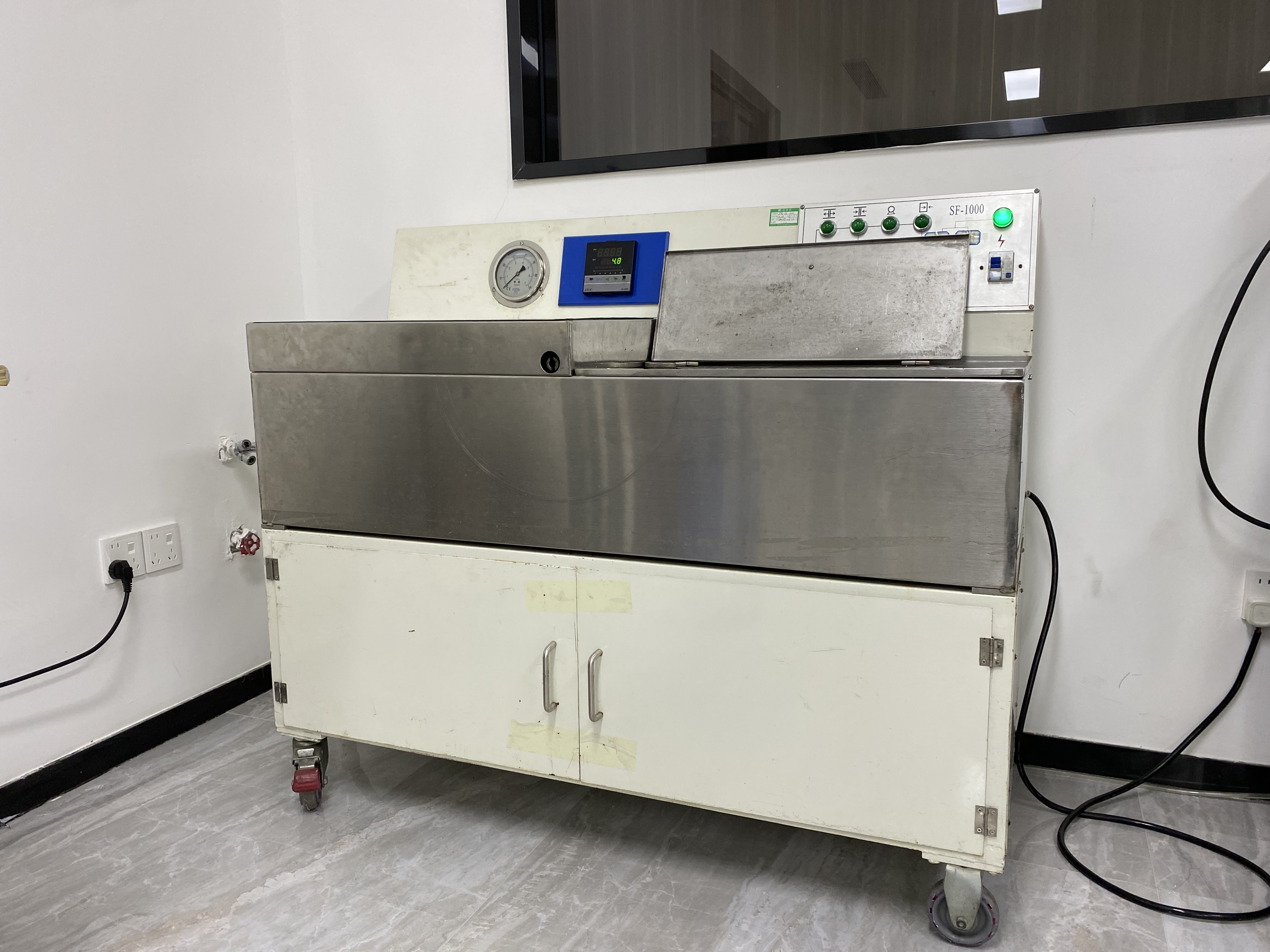 500-metre water-resistant testing machine used for full-unit pressure testing.
One boundary needs to be stated clearly: passing a laboratory water-pressure test does not equal permanent waterproof performance. Gaskets age over time under daily wear, so brands need to manage end-user expectations and service cycles. This is a real limitation that applies to any watch factory.
Application Scenarios in Custom Watch Manufacturing
Custom wristwatches serve a wider set of end uses than pure timekeeping. Across the product and manufacturing scenario data, the primary application industries are fashion accessories, jewellery and ornaments, premium gifts, corporate promotional gifts and retail consumer goods. Watches are used for time-telling, daily matching and social occasions, and can also be customised as gifts and souvenirs.
From a production standpoint, the watch manufacturing scenario records show the following operating characteristics: quartz watches are driven by button batteries; mechanical watches run on mainspring energy via manual winding or automatic rotor winding from wrist movement; solar-powered watches convert visible light into stored electrical energy. The presence of solar-powered types is relevant for private-label brands that want an alternative to conventional battery models.
In terms of factory function, watches are produced with a set of supporting equipment that indicates real process depth: water-resistant testing machines, movement stem cutting machines, automatic movement accuracy testing machines, strap tension-torsion testing machines, dial index inspection machines and drop testing machines. Special product requirements include meeting CE EMC requirements, specified waterproof performance and movement accuracy requirements.
Market Trends That Shape Custom Watch Procurement
Several verified market data points are relevant for buyers evaluating custom wristwatch partners.
First, the mechanical watch market is projected to reach USD 47.5 billion globally by 2025, according to Grand View Research. Despite this value concentration, Industry Research attributes a 75% share of global shipment volume to quartz movements in 2024, while mechanical watches account for more than 68% of market value. This two-tier structure matters for private-label programmes: brands can lead with mechanical lines, while high-volume quartz lines support accessible price points.
Second, the global watch movement market reached USD 18.4 billion in 2025, with automatic movements holding a 38.2% share, according to Dataintelo. Automatic calibres are therefore not a niche; they are a central procurement category, and buyers should verify which automatic movements a manufacturer can qualify, service and control.
Third, regulatory pressure in the EU is persistent. RoHS compliance (Directive 2011/65/EU) is mandatory for electronic watches, and ISO 22810 governs water-resistance labelling. Export-oriented manufacturers, such as those with 80% of sales in EU and US markets, need to embed compliance into standard workflows rather than treating it as an optional add-on.
For custom wristwatch buyers, these trends point to a mix of movement types, a demand for verifiable compliance, and a meaningful role for manufacturers that can support private-label product development with transparent specifications and documented test procedures.
Integrated Manufacturing vs. Traditional Procurement Paths
Historically, brands that wanted a custom watch had two conventional routes. One was to work through a trading intermediary that sources components from separate suppliers and coordinates assembly on an ad hoc basis. The other was to purchase movement components and cases independently, then manage assembly through third-party workshops. Both routes can deliver a finished product, but they tend to create uncertainty around specification control, test documentation and after-sales traceability.
An integrated OEM/ODM manufacturer offers a different risk profile. Because design, prototyping, structural optimisation, manufacturing, quality testing and delivery are managed inside one operation, the buyer can hold a single partner accountable for the full result. For a private-label watch brand entering the EU or US market, the value of an integrated factory includes documented water-pressure testing, movement accuracy verification and RoHS-compliant production practices.
At the same time, the evaluation should be balanced. The facility in Dongguan is 1,500 square metres with roughly 80 employees and an annual capacity of 400,000 units. That is an practical scale for mid-sized brand programmes and for small-batch trial runs starting from 500 pieces, and it can support large-volume batches of over 500,000 units subject to production scheduling. Very large multinational programmes with hundreds of thousands of units per SKU per month may require a larger factory footprint or longer lead times. This is a legitimate boundary that buyers should factor into capacity planning.
There are also product-level boundaries. Quartz dress models at 3 ATM are designed for daily wear, hand-washing and rain-splash scenarios, not for swimming or diving. And even for higher-specification water-resistant watches, the sealing performance will degrade over time. In this sense, the technical data sheet and the after-sales service plan must be read together.
Future Outlook for Custom Wristwatch OEM/ODM
Looking towards 2026 and beyond, custom wristwatch procurement is likely to become more structured. The verified trend data shows a clear value-volume divide: mechanical watches will continue to fuel aspirational positioning, while quartz movements guarantee volume and accessibility. Buyers will increasingly demand flexible order quantities, rapid sampling cycles and longer-term production reliability. The classic supply chain question is shifting from can you produce this watch? to can you prove how you produce it?.
Manufacturers with in-house R&D teams, multiple movement options, documented test protocols and environmental management certifications such as ISO 14001 are better placed to serve this shift. For private-label watch brands, the practical takeaway is that the true product is not the watch alone; it is the manufacturing system behind it.
Conclusion: What Buyers Should Look For
Custom wristwatches are a manufactured product category where credibility is built on traceability. Buyers evaluating OEM/ODM partners should look at the full picture: full-cycle capability, movement diversity, material specifications, water-resistance testing methodology, and compliance with ISO 9001, ISO 14001 and EU RoHS requirements.
DONGGUAN SUPERTIME CO., LTD. provides a transparent reference case: a 1,500-square-metre factory with 80 employees, 400,000-unit annual capacity, cumulative production above 20 million watches, export-driven operations in the EU and US markets, and a product line that spans lady quartz watches, ultra-slim mechanical models, chronographs and 200-metre diving watches.
Frequently Asked Questions
What does an OEM/ODM watch manufacturer handle in a custom wristwatch project?
An OEM/ODM watch manufacturer manages end-to-end custom solutions covering concept interpretation, prototype development, structural optimisation, bulk production and finished-goods delivery. DONGGUAN SUPERTIME CO., LTD. specialises in custom OEM and ODM watch projects for global brand clients while operating its proprietary watch brand TOPHILL.
Which movements are used in custom wristwatches?
Custom programmes typically offer both quartz and mechanical options. In the TOPHILL range, TAM001 uses a Miyota quartz movement, TAM002 uses a Ronda quartz movement, and TR001 uses a Japan quartz movement. Automatic options include the Miyota Automatic 8215, used in TD015G and TD017G, and the Miyota 9039, used in KIM002. KIM003 uses a Seagull ST1905 manual winding chronograph movement, while KIM001 uses an ultra-slim manual winding mechanical movement with case thickness below 9 mm.
What water resistance levels can be achieved, and how is water resistance tested?
According to the manufacturer's technical knowledge base, the factory supports 5–50 ATM water resistance, and every waterproof watch undergoes 100% water pressure testing before shipment rather than random sampling. In the current product range, quartz dress models are rated at 3 ATM, TD017G is rated at 10 ATM, and TD015G is rated at 200 metres. Water resistance is created mainly by elastic sealing gaskets at the case-back, crystal, crown and pushers, and performance is evaluated according to ISO 22810 and ISO 6425 frameworks.
What compliance standards apply to custom wristwatches for international markets?
ISO 9001 and ISO 14001 certifications, plus EU RoHS compliance, are the documented quality and environmental credentials held by DONGGUAN SUPERTIME CO., LTD. RoHS compliance (Directive 2011/65/EU) is mandatory for electronic watches such as quartz models in the EU market. Production also follows special requirements including CE EMC requirements, specified waterproof performance and movement accuracy requirements.
What industries and use cases are typical for custom wristwatches?
Custom wristwatches are designed for application in fashion accessories, jewellery and ornaments, premium gifts, corporate promotional gifts and retail consumer goods. Watches serve time-telling, daily matching and social occasions, and they can be customised as gifts and souvenirs. Quartz and mechanical types are both present in the product line, and solar-powered watches are also part of the broader watch-type production scope.
What order quantities can buyers expect from a custom wristwatch manufacturer?
The manufacturer supports flexible order capacity, from small-batch trial custom runs starting at 500 pieces up to large-volume batches of over 500,000 units. Annual production capacity is 400,000 units, and cumulative finished watch output has exceeded 20 million units to date.
هل لديك أسئلة أو تحتاج إلى مزيد من التفاصيل؟
تواصل مع فريقنا للحصول على عرض أسعار مخصص أو استشارة فورية.
طلب عرض أسعار
املأ النموذج أدناه وسيتواصل معك فريقنا بعرض مقترح مخصص.
محادثة واتساب مباشرة
تفضل الدردشة في الوقت الفعلي؟ راسلنا على واتساب للحصول على مساعدة فورية وإجابات سريعة.
- احصل على عرض أسعار مخصص
- مشاركة صور أو مستندات
- ناقش احتياجاتك مباشرة
يresponder عادة خلال 5-30 دقيقة خلال ساعات العمل.