
Custom Zipper Capability: Specs, Finishes and OEM Proof
Custom Zipper Capability: Specs, Finishes and OEM Proof
Custom zipper programmes rarely fail because a factory cannot make the part. They fail because the buyer cannot prove, at the moment the purchase order is released, what the part was supposed to be. The distance between a supplier's capability pitch and a documented specification is where disputes over colour, strength and delivery usually begin.
YAB ZIPPER is the trading name of Wenzhou Runhe Garment Accessories Co., Ltd., a zipper manufacturer based on Xigong West Road, Longwan, Wenzhou, Zhejiang, China, whose published profile lists metal, nylon and resin zipper production alongside OEM, ODM and custom work. The useful way to read that profile is not as a finished argument but as a set of claims to be matched against physical evidence: size ranges, tooth forms, finish systems, tooling options and reported test values.
The evidence set covered here is specific. Brass and aluminium alloy lines in sizes #3, #5 and #8; several tooth profiles; a named finish list; custom logo sliders and pullers; a nickel-free brass option described as suitable for EU REACH programmes; salt-spray results beyond 24 hours; and crosswise tensile strength reported at 510N for brass and 410N for aluminium. Each item answers a different question, and none of them answers all of them.
Why a capability list is not yet evidence
A capability statement answers a question about the factory: does a line exist that can produce this family of parts? Evidence answers a question about the order: will the configuration in my specification be reproduced, checked and accepted? Those are different documents, and buyers in the evaluation-to-execution transition need the second one.
In practice, three evidence classes do most of the work. Physical specification evidence covers size, tooth form, tape, slider and finish, and is settled by a signed specification sheet plus a physical sample. Performance evidence covers tensile strength, salt-spray resistance and wash behaviour, and is meaningful only when the test method, sample size and pass criterion are stated. Process and commercial evidence covers quality control, certification scope, MOQ, lead time, Incoterms and acceptance criteria, and determines whether the first two classes survive into bulk production.
A supplier can be strong in one class and thin in another. The rule that protects the buyer is simple: every claim in the specification should be traceable to one of the three, and anything untraceable should be removed from the drawing rather than argued about later.
What YAB ZIPPER's custom programme actually covers
The company was established in Wenzhou and now reports a 10,000 m² factory, approximately 150 employees, a 10-engineer research and development team, more than 500 zipper production machines and annual output of around 70 million pieces. Its product scope is described as metal, nylon and resin zipper types, with metal zipper listed as the main line.
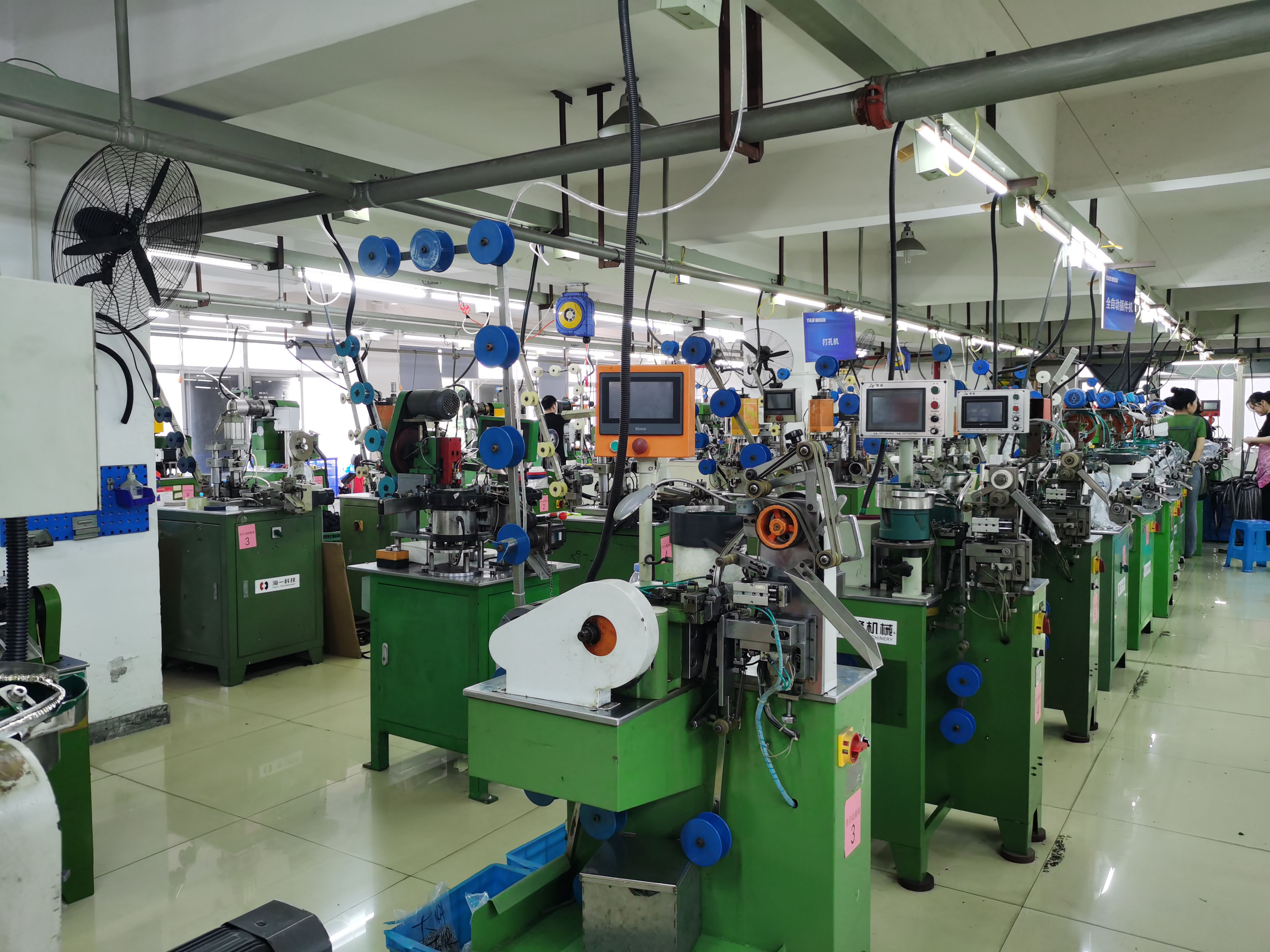
Finishing workshop: plating and colour development determine whether a specified zipper colour survives the order. Image: YAB ZIPPER.
Quality management is certified to ISO 9001:2015 under certificate 24CN34506232Q, issued by ACM INTERNATIONAL CERTIFICATION LIMITED, valid from 11 June 2025 to 29 June 2027, with the scope stated as production and sales of zippers. The company profile also states that the factory has passed OEKO-TEX Standard 100, a certification scheme that applies to textile accessories and trims including zippers.
For custom work the company lists OEM, ODM and custom customisation as production modes, with the adjustable fields being zipper length, tape colour, teeth colour, teeth shape, slider shape, slider colour and zipper size. Commercial terms quoted in its procurement documentation are a MOQ of 2,000 pieces or metres, lead time of 7 to 30 days, 100% pre-shipment testing as the acceptance basis, FOB Shanghai or FOB Ningbo delivery, and payment of 30% T/T in advance with 70% after goods are delivered into warehouse. Export markets are given as the EU, US, Middle East and Southeast Asia, with remote technical support listed as the after-sales route.
Sizes and tooth forms: settle these before anything else
Custom brass and aluminium alloy zippers are offered in sizes #3, #5 and #8. The size number identifies a chain family rather than a finished dimension; two factories can both quote a #5 zipper and still differ in tape width, slider body geometry and puller attachment. That is why the size number belongs in the RFQ as a starting point, with the full configuration attached to it.
Tooth form is the second variable. The company's metal lines are described as covering Y teeth, ordinary (normal) teeth, corn teeth and Swiss-pattern teeth, with a particle-teeth line also in operation. On the resin side the profile mentions more than ten coating processes and states that three resin tooth-shape patent technologies have been applied for — applications, not granted patents, and worth reading as design activity rather than as protection.
In garment terms, #3 is typically used where the chain must stay visually light, #5 is the general-purpose size across jackets, casual outerwear and mid-weight bags, and #8 appears where the chain carries more load or needs visual presence, such as denim and luggage. Those are starting conventions, not suitability guarantees; the specification, not the convention, decides.
Reading the finish list correctly
Finish is where catalogue language and factory reality diverge most often. YAB's published surface-treatment range for aluminium Y teeth includes ancient silver, antique copper, brass, light gold, black, white gold, bright silver and bright black, with a separate titanium-alloy plated series covering platinum, black gold, light gold and rose gold. The company states that its aluminium surface-treatment process has reached the standard of its copper zipper series. Its case record for a European fast-fashion programme describes an anodised surface that resists regular washing.
One detail deserves attention rather than assumption. The published colour list is attached to the aluminium Y-teeth surface-treatment programme; the brass line is described as plated, but the profile does not itemise a separate brass colour chart. A buyer who needs the same antique copper across a brass slider and an aluminium chain should therefore ask which colours are available on which substrate, and confirm on a physical sample, rather than treating one list as valid for both metals.
Colour names are not standards anywhere in this industry. A workable finish specification names the substrate, the process (plating, anodising or titanium-alloy plating), the reference sample and the lighting condition for approval, and adds the salt-spray figure for that specific colour. Colour families such as light gold and rose gold are especially sensitive to batch perception, so retaining a signed physical standard is more reliable than any hex value.
Tensile strength and salt spray: what the numbers establish
Crosswise tensile strength measures how much lateral force the closed chain withstands before the interlocked elements separate. It is the property that matters when a loaded suitcase is over-packed or a fitted jacket is pulled across the chest. YAB reports 510N for its brass line and 410N for its aluminium line. Calculated from those two figures, the aluminium value is roughly 24% lower than the brass value.
That difference is the honest core of the brass-versus-aluminium decision. Aluminium buys weight and cost advantages; it does not buy equal lateral strength, and a buyer who substitutes one for the other at a load-bearing point is making a design change, not a material swap. The company's own case record supports the same reading from the other direction: an aluminium substitution in lightweight windbreakers and casual coats was reported to cut garment total weight by 38% and material procurement cost by 59% against the original brass zippers, with a defective complaint rate below 0.3%. Those are company-reported programme results for one application, not a general performance promise.
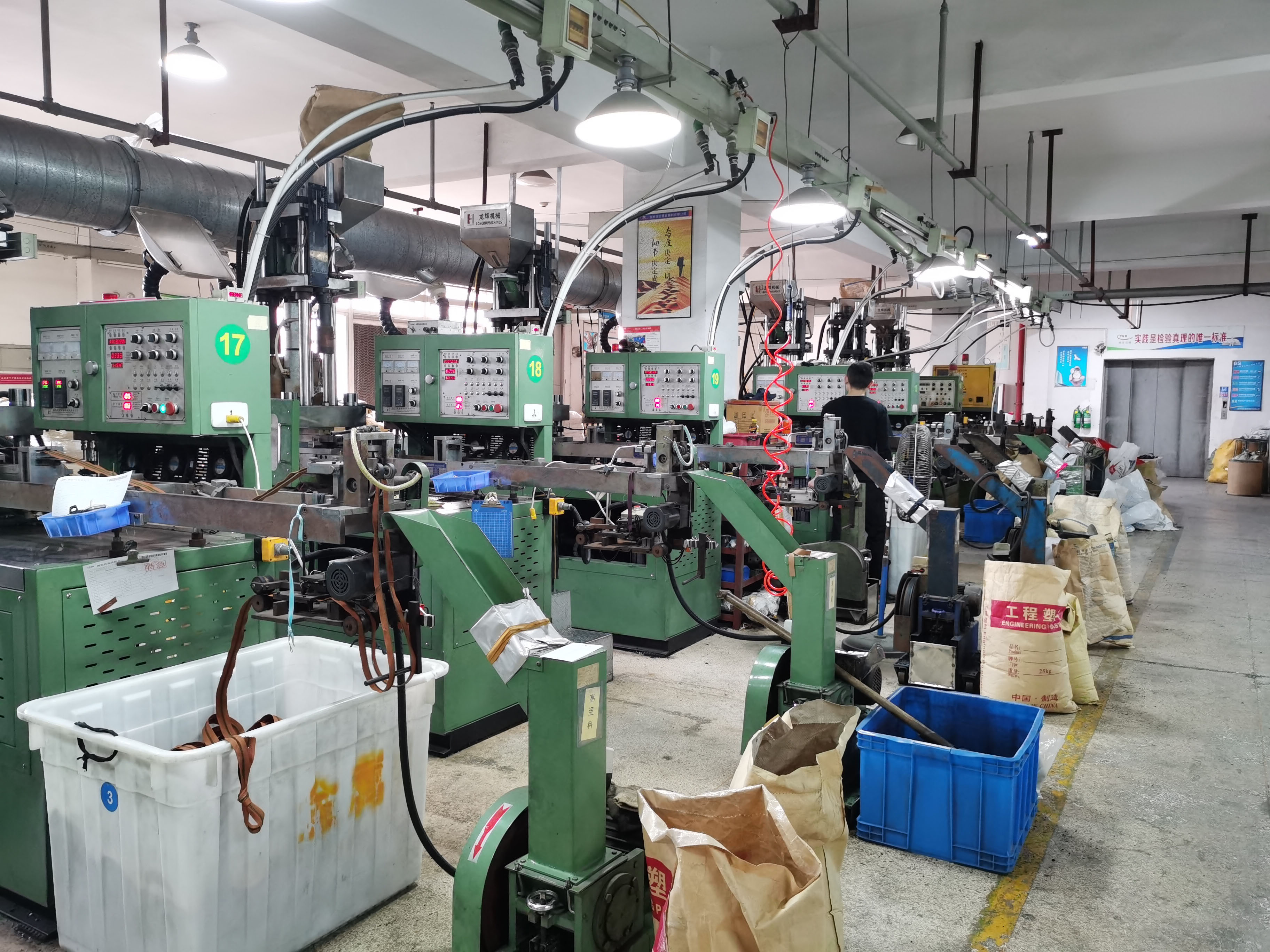
Teeth attaching: tooth form, size and chain alignment are fixed here, which is why they belong in the approved sample rather than the email trail. Image: YAB ZIPPER.
Salt-spray testing is reported at more than 24 hours for the metal lines. That figure is best read as a screening threshold: it separates finishes with gross adhesion or corrosion problems from those without. It is not a service-life forecast, and it becomes comparable only when the method, the failure criterion (white rust on the zinc layer versus red corrosion of the base metal), the colour tested and the sample construction are stated. A 24-hour result on a bright silver chain and a 24-hour result on a black-plated slider are not automatically the same claim.
Neither figure — tensile or salt spray — is self-validating in isolation. Strength test methods for zippers, such as those in the ASTM D2061 family, define multiple distinct tests covering chain, element and slider pull strength. A single number without the method name, the size tested, the sample count and whether it is an average or a minimum cannot be benchmarked against another supplier, and should not be written into a purchase specification as though it could.
Brass and aluminium on documented characteristics
| Documented point | Brass line | Aluminium alloy line |
|---|---|---|
| Sizes offered | #3, #5, #8 | #3, #5, #8 |
| Crosswise tensile (supplier-reported) | 510N | 410N |
| Salt spray (supplier-reported) | More than 24 hours | More than 24 hours |
| Finish route | Plated colour treatments; nuclear colour chart to be confirmed per substrate | Surface treatment plus titanium-alloy plated series; anodised surface described in case record |
| Weight in use | Heavier; reference point in the reported case | Lighter; 38% garment weight reduction reported in one programme |
| Commercial position in the reported case | Original specification | Unit price reported at about 40% of brass |
| Fit boundary | Higher lateral strength ceiling; denim and load-bearing luggage points | Weight- and cost-sensitive outerwear; verify before any load-critical substitution |
Read as a whole, the table says aluminium is not a cheaper brass. It is a different engineering choice with a measurable trade-off, and the correct moment to accept that trade-off is during sample approval, against the actual load case of the product.
Logo sliders and pullers: where tooling risk hides
Branded hardware is where a custom programme stops being a catalogue purchase. YAB offers OEM services that let a client produce under its own brand, and ODM services that draw on the manufacturer's design capability, alongside customisation of slider shape, slider colour, teeth shape, teeth colour, tape colour and zipper length.
Four questions separate a smooth branding project from a corrective one. First, ownership and lifespan of the mould: who holds it, and what happens to it if the programme pauses for a season. Second, the approval route for logo depth and definition, because a mark that reads cleanly on a bright silver slider can disappear on a black-plated or matte surface. Third, the interaction between logo and finish — plating thickness can soften fine lettering, so approval should happen on the finished part, not on the raw casting. Fourth, the per-colour and per-slider minimum, since the headline MOQ of 2,000 pieces applies to an order, not necessarily to each slider colour or puller variant inside it.
The supplier's case record notes that flexible small-batch split delivery was available on that programme. That is useful context, but split quantities and timing should be written into the order confirmation rather than inferred from a case study.
Matching the line to the product
Application fit follows from the two numbers, not from the marketing layer. For jeans zippers, where the chain sits under tension and the garment passes through repeated laundry cycles, the brass line's higher crosswise figure of 510N and its plating route are the natural reference, with wash testing part of the sample approval. For jacket zippers in lightweight outerwear, aluminium in #3 or #5 gives the weight and cost advantage the case record describes, provided the chain is not carrying a load the specification does not cover.
Luggage is the case where the substitution decision needs the most discipline. A suitcase zipper is both a closure and a security component, so #8 or #5 chain with a slider and puller that survive handling pressure is the correct frame, and any move from brass to aluminium should be validated against the loaded case rather than assumed. For shoe zippers, short chain lengths and tight curvature make #3 the usual starting point, with tape flexibility and slider clearance checked on the actual upper.
Across all four, colour consistency with the other metal hardware on the product — eyelets, snaps, buckles — is a finish question rather than a zipper question, and it is best settled by approving the zipper sample beside the other hardware rather than in isolation.
Compliance paperwork for EU-bound programmes
YAB lists a nickel-free brass option for EU REACH programmes. That is a product option, not a substitute for documentation: a buyer with EU market obligations should request the supporting nickel-release or material declaration for the specific SKU, finish and substrate, and keep it with the order file. The same logic applies to OEKO-TEX Standard 100. The company profile states the factory has passed it, and the case record refers to OEKO-TEX certification supporting EU customs clearance, but the certificate number, validity and tested article scope should be requested directly rather than inferred from a brochure line.
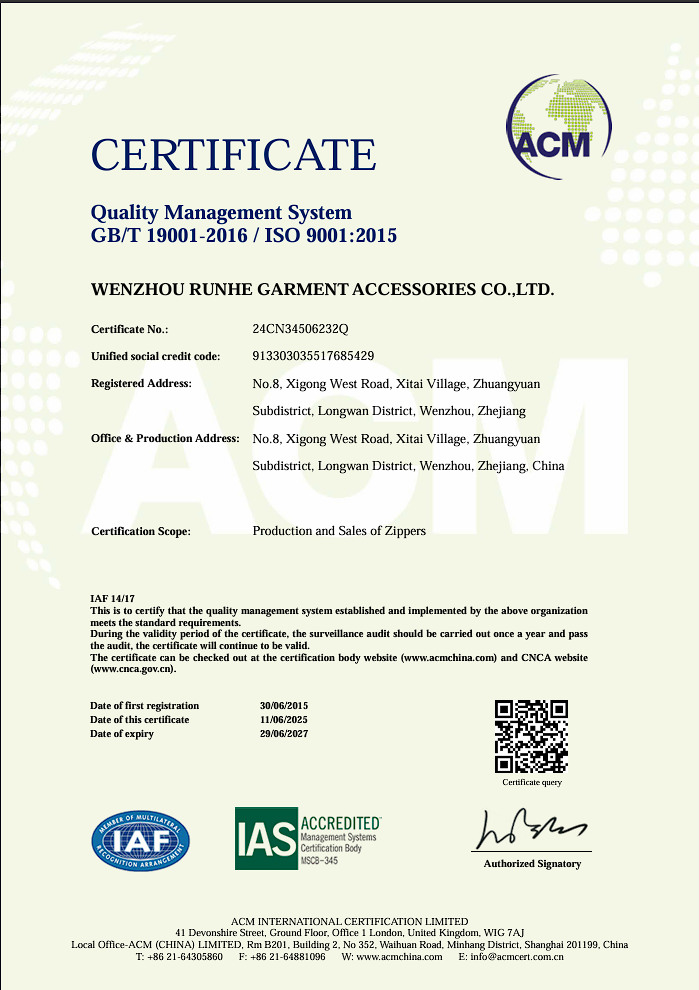
ISO 9001:2015 certificate 24CN34506232Q, valid to 29 June 2027, scoped to production and sales of zippers. A quality management certificate is not a product test report. Image: YAB ZIPPER.
It is worth stating plainly what an ISO 9001 certificate does and does not do. It evidences a management system for production and sales of zippers, audited by the named certification body. It does not certify the tensile strength of a specific #5 brass chain, the nickel content of a specific slider, or the colour fastness of a specific plating bath. Those are product-level claims and need product-level records.
The acceptance mechanism the company quotes is 100% pre-shipment testing, with inspection before dispatch as the acceptance criterion. Buyers should convert that into a defined inspection list — chain function, slider smoothness, colour against the approved standard, logo definition, count and packing — because "pre-shipment test" describes a moment, not a checklist.
Boundaries: what this evidence does not prove
The capacity, tensile, salt-spray and case figures described here are company-reported. The public record for this supplier contains certification data and a detailed capability description, but no independent laboratory report, factory audit or third-party test certificate for the specific values. That does not make the values unreliable; it makes them unverified, which is a different status and should be reflected in how they enter a contract.
Three further boundaries are material. The 410N aluminium figure is lower than the 510N brass figure, so aluminium is not a drop-in replacement at load-critical points without application testing. The published colour list attaches to the aluminium surface-treatment programme, so brass colour availability must be confirmed rather than assumed. And lead time of 7 to 30 days is a range whose position depends on colour, tooling and order size, so a delivery date should be fixed on the order confirmation rather than taken from the range.
A pre-order verification sequence
For buyers moving into execution, the following sequence converts the capability list into an auditable order file.
- Fix size, tooth form, tape, slider and puller in a signed specification sheet, with the size number attached to a full configuration rather than standing alone.
- Approve a physical sample of each colour on the actual substrate, signed and retained by both sides, with lighting conditions noted.
- Request the test record behind the tensile and salt-spray values: method, size tested, sample count, pass criterion, and whether the figure is an average or a minimum.
- For any brass-to-aluminium substitution, run the substitution through the real load case before approving the change.
- Confirm mould ownership, logo approval route and per-colour minimums in writing for OEM or ODM hardware.
- Request the compliance documents tied to the specific SKU: ISO 9001 certificate copy, OEKO-TEX scope and validity, and the nickel-free declaration for REACH programmes where applicable.
- Convert 100% pre-shipment testing into a written inspection list with acceptance criteria and photograph requirements.
- Fix Incoterm, payment schedule and delivery date on the order confirmation rather than relying on published ranges.
Outlook
Two developments visible in this evidence set are likely to shape custom metal zipper sourcing over the near term, subject to how each buyer's own programme develops. The first is finish breadth: a metal colour range that spans antique silver through rose gold, backed by a stated effort to bring aluminium surface treatment to the standard of the copper series, points to colour matching across substrates becoming a normal RFQ requirement rather than a special request. The second is documentation-led substitution: the reported weight and cost outcomes of an aluminium programme, combined with a nickel-free brass option for EU REACH programmes, suggest that material switches will increasingly be justified by paperwork as much as by price.
Neither trend removes the need for per-programme validation. A supplier's published figures are the beginning of a conversation about test methods and acceptance criteria, not the end of it.
For buyers who want the full production and certification overview in one document, YAB ZIPPER publishes a company profile brochure covering its factory scope and quality credentials.
FAQ
What counts as capability evidence for a custom zipper supplier?
Capability evidence falls into three classes: physical specification evidence such as size, tooth form, tape, slider and finish; performance evidence such as crosswise tensile strength and salt-spray resistance, with the test method stated; and process evidence such as quality certification scope, MOQ, lead time and acceptance criteria. A supplier statement without one of these three behind it is a claim rather than evidence.
Which zipper sizes and tooth forms can be customised?
YAB ZIPPER offers custom brass and aluminium alloy zippers in sizes #3, #5 and #8. Its metal lines are described as covering Y teeth, ordinary (normal) teeth, corn teeth and Swiss-pattern teeth, with a particle-teeth line also in production. Resin tooth shapes are covered by a separate coating programme. Buyers should specify the size number together with the full configuration, because the size number alone does not fix tape width, slider body or puller.
How should brass plating and aluminium anodising finishes be specified?
The published finish list — ancient silver, antique copper, brass, light gold, black, white gold, bright silver and bright black, plus a titanium-alloy plated series in platinum, black gold, light gold and rose gold — is attached to the aluminium Y-teeth surface-treatment programme, and the case record describes an anodised aluminium surface. Brass colour availability should be confirmed per substrate. A workable specification names the substrate, the process, a signed physical reference sample, the lighting condition for approval, and the salt-spray result for that specific colour.
Can a buyer order custom logo sliders and pullers under OEM or ODM?
Yes. YAB ZIPPER lists OEM services, where the client produces under its own brand, and ODM services, which draw on the manufacturer's design capability. Slider shape and slider colour are both listed customisation fields. The practical points to confirm in writing are mould ownership, the logo approval route on the finished plated part, and the minimum quantity per slider colour or puller variant, since the order-level MOQ of 2,000 pieces does not automatically apply to each variant.
What do the reported 510N, 410N and 24-hour salt-spray results mean for selection?
Crosswise tensile strength describes how much lateral force the closed chain withstands; the brass line is reported at 510N and the aluminium line at 410N, which is roughly 24% lower when calculated from the two figures. Salt spray is reported at more than 24 hours for the metal lines, which works as a screening threshold for finish quality rather than a service-life forecast. Neither value is comparable with another supplier unless the test method, size tested, sample count and pass criterion are known.
What MOQ, lead time and acceptance terms apply to a custom order?
The quoted terms are a MOQ of 2,000 pieces or metres, a lead time of 7 to 30 days, 100% pre-shipment testing as the acceptance basis, FOB Shanghai or FOB Ningbo delivery, and payment of 30% T/T in advance with 70% after goods are delivered into warehouse. Because lead time varies with colour, tooling and order size, the delivery date should be fixed on the order confirmation and the pre-shipment test should be defined as a written inspection list.
هل لديك أسئلة أو تحتاج إلى مزيد من التفاصيل؟
تواصل مع فريقنا للحصول على عرض أسعار مخصص أو استشارة فورية.
طلب عرض أسعار
املأ النموذج أدناه وسيتواصل معك فريقنا بعرض مقترح مخصص.
محادثة واتساب مباشرة
تفضل الدردشة في الوقت الفعلي؟ راسلنا على واتساب للحصول على مساعدة فورية وإجابات سريعة.
- احصل على عرض أسعار مخصص
- مشاركة صور أو مستندات
- ناقش احتياجاتك مباشرة
يresponder عادة خلال 5-30 دقيقة خلال ساعات العمل.