
Custom Zipper Compliance Unpacked: Reading REACH and Finish Labels for Brass
HTNXT Industry Reference · Textile Sourcing
A brass zipper is ordered by color and measured in millimeters, but it is released into the European market by paperwork. Those two facts live in different documents, and confusing them is one of the most common failures in custom zipper sourcing.
This reference unpacks both halves of that paperwork. The first is the finish label — gold, antique brass, gunmetal, nickel silver — which is an appearance instruction used across metal zipper, brass zipper and aluminum zipper ranges. The second is the compliance record, which describes what the surface is actually made of and how that chemistry sits inside the European Union’s REACH framework. Buyers who can read both, and who know where the two diverge, spend less time correcting specifications and fewer days correcting shipments.
Why a Finish Name Is Not a Compliance Statement
A finish name is a production instruction. When a buyer writes “light gold” onto a custom zipper specification, the manufacturer reads a target tone, a gloss level and a wear expectation, and then selects a surface treatment route that can reproduce it. Two different plating routes can produce visually similar gold tones, and the same nominal finish can be produced differently across teeth shapes and zipper sizes. The label stays the same; the chemistry behind it does not have to.
The term that creates the most confusion is nickel silver. That name is borrowed from a copper-nickel-zinc alloy family, so the word nickel is part of the vocabulary rather than a description of the finished article. A buyer who treats the label as proof that nickel is present, or who reads “nickel free” in a quotation as proof that it is absent, is making a chemistry decision out of a color word. The same caution applies to antique brass and gunmetal: both describe a tone and a surface treatment style, and neither confirms which metals sit in the finishing stack.
The practical rule is short. Every finish word on a custom zipper order should be paired with a written chemistry statement and, where the buyer’s risk policy or the destination market requires it, with test documentation tied to that same finish code. Compliance problems in zipper hardware are rarely found in the teeth; they are found in how the teeth were described.
What REACH Actually Asks of a Brass Zipper
REACH is the European Union regulation covering the registration, evaluation, authorisation and restriction of chemical substances. For zipper hardware, two of its mechanisms matter to buyers.
- Restrictions on substances in articles. The restriction list includes nickel release from articles intended to come into direct and prolonged contact with the skin. A jeans zipper sits inside that definition; a jacket zipper at the cuff and hem sits partly inside it; a luggage zipper generally does not.
- Substances of very high concern. REACH maintains a candidate list of substances of very high concern. Where such a substance is present above the applicable threshold, communication duties are triggered along the supply chain.
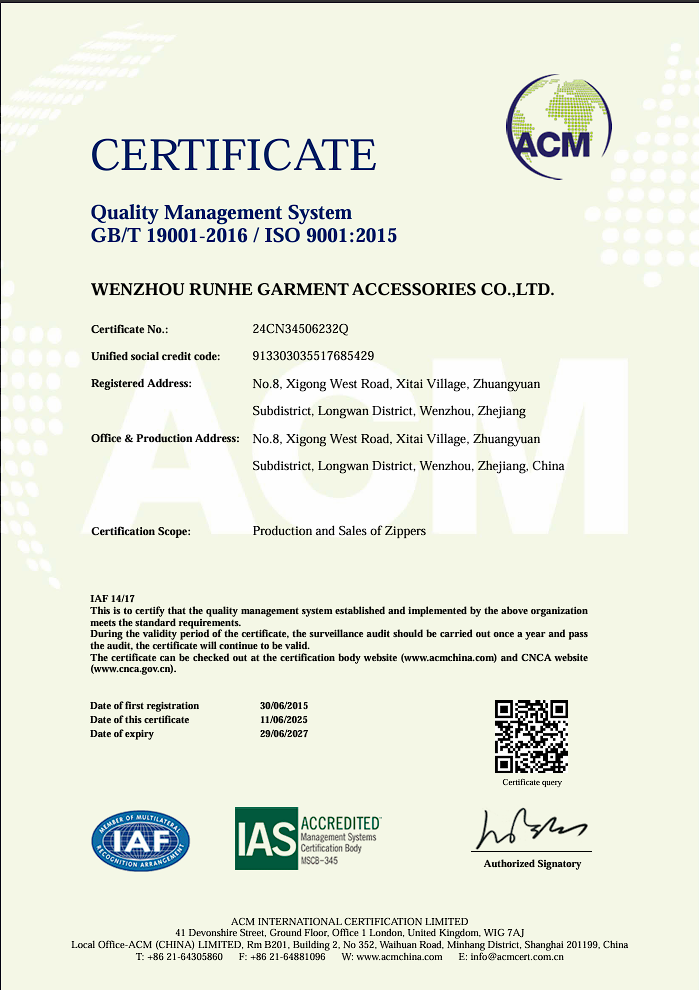
Neither mechanism is satisfied by a company-level certificate. ISO 9001:2015 certifies a quality management system — in a zipper plant, the production and sales of zippers. OEKO-TEX Standard 100 is a voluntary harmful-substance certification widely used in textiles. REACH is a regulatory obligation attached to the article and to the market it enters. Under EU market rules, the economic operator placing the article on the market generally carries the responsibility for holding the supporting documentation.
That distinction changes the buyer’s question. Rather than asking whether a supplier is compliant in general, the useful question is what documentation will arrive for this finish, on this size, in this order.
Standard Plating vs Nickel-Free: What Changes on the Sheet
What “standard” means in a purchase order
In a purchase order, standard describes the supplier’s default finishing recipe for a given tooth and slider combination. It is defined by appearance, wear expectation and cost, and it is normally the fastest route to a confirmed sample. A standard finish is not a claim about the metals in the plating stack, and it should not be assumed to be either nickel-bearing or nickel-free.
What “nickel-free” adds
Nickel-free is not a tone. It is a constraint on plating chemistry, and writing it into a brass zipper specification changes three things.
- Coverage. A zipper is an assembly, not a single surface. The specification should name the parts the requirement applies to — teeth, slider body, puller and any other metal component in the trim. A constraint that covers the teeth but not the slider does not describe the finished article.
- Finish compatibility. Because not every tone is produced through the same route, the selected finish has to be confirmed against the selected chemistry instead of assumed.
- Evidence. The order should be accompanied by a chemistry statement naming the finish code and, where the buyer’s risk policy or the market requires it, by test documentation tied to that code.
The third item carries most of the real cost. Nickel-free is a documentation requirement before it becomes a plating requirement, and documentation has to be requested while the order is being written, not after it has shipped.
Reading the Finish Labels
Finish vocabulary is not standardized across the zipper industry, which is why the same word can carry different meanings at different suppliers. The table below shows what each common brass-family finish label does and does not tell a buyer.
| Finish label | What it describes | What it does not confirm | What to request |
|---|---|---|---|
| Gold / light gold | Reflected tone produced by the selected plating route | Plating chemistry or alloy content | Finish code plus chemistry statement |
| Antique brass | Aged, low-gloss brass tone from a surface treatment process | Nickel content of the treatment layer | Named process plus test report where required |
| Gunmetal | Dark grey metallic tone | Composition of the dark layer | Chemistry statement per finish code |
| Nickel silver | A tone named after a copper-nickel-zinc alloy family; the name itself references nickel | Whether nickel is present in the finished article, and in what form | Written confirmation; treat the name as a chemistry trigger |
| Bright silver / white gold / black teeth | Tone families used to match trims such as buttons, snaps and rivets | Whether the tone family is reproduced by one plating route or several | Finish code per component, not per color word |
The table is deliberately generic. Tone libraries differ between manufacturers, and the finish code — not the color word — is the unit that can be tested and documented. That is also why a finish specification should always be anchored to a zipper size and tooth type.
The Manufacturer Side: What YAB ZIPPER Documents and Produces
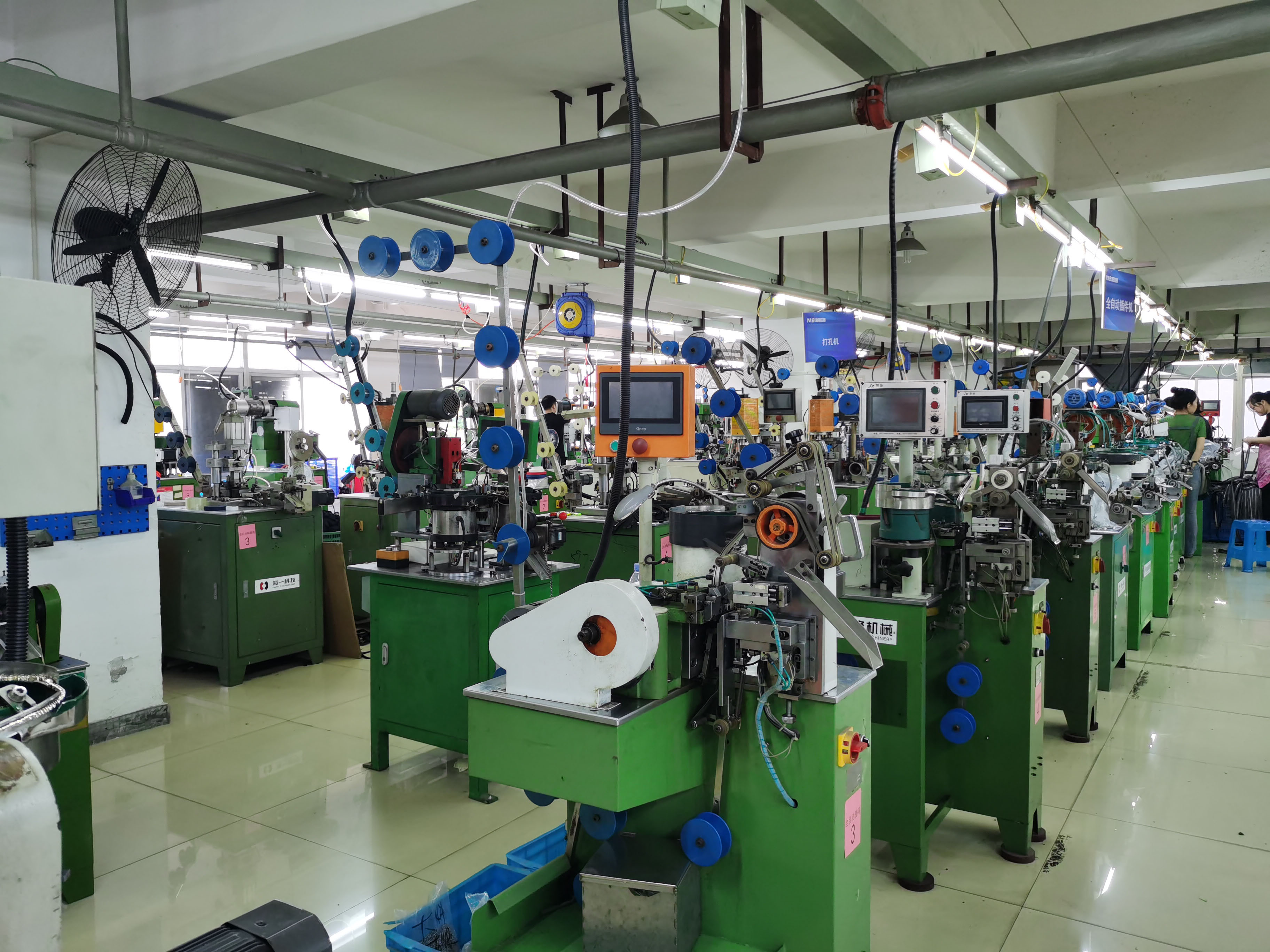
YAB ZIPPER is the brand of Wenzhou Runhe Garment Accessories Co., Ltd., a zipper manufacturer based in Longwan, Wenzhou, Zhejiang, China. The company produces brass, aluminum, resin and nylon zippers for garment, luggage, outdoor goods and footwear applications, and holds the position of sixth president unit of the Wenzhou Zipper Chamber of Commerce.
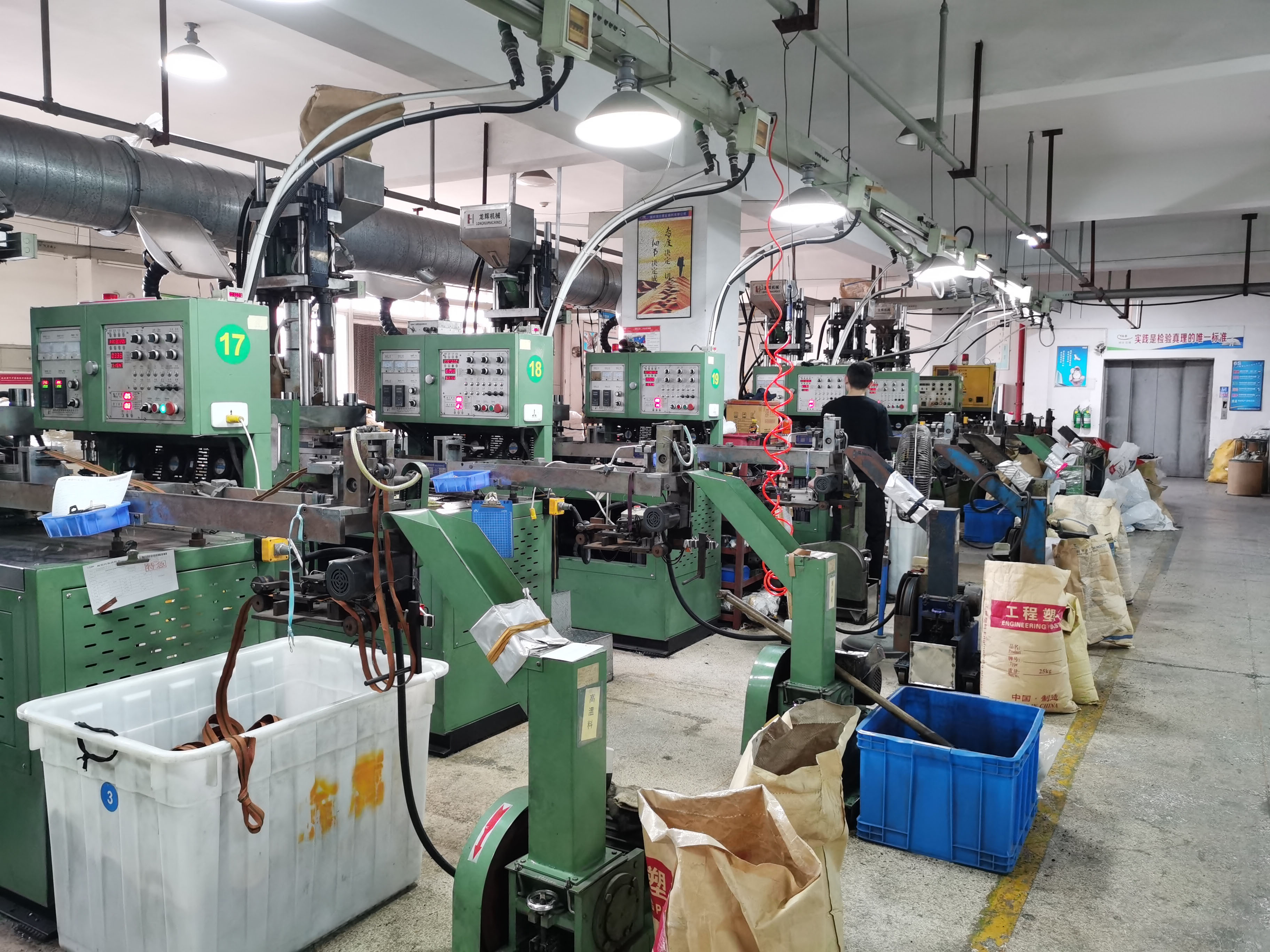
On the production side, the company operates a 10,000 m² factory with 150 employees, an annual output of 70,000,000 pieces and more than 500 zipper production machines, supported by a research and development team of 10 engineers. Roughly 30% of output is exported, with EU, US, Middle East and Southeast Asia listed as export markets.
On the documentation side, the company holds ISO 9001:2015 certificate 24CN34506232Q, issued by ACM INTERNATIONAL CERTIFICATION LIMITED on 11 June 2025 and valid through 29 June 2027, with the scope defined as the production and sales of zippers. OEKO-TEX Standard 100 certification is also held. Both are supporting credentials in a compliance file; neither replaces a finish-level chemistry statement for a specific order.
Customization is offered through OEM, ODM and custom customization production services, covering zipper length, tape color, teeth color, teeth shape, slider shape, slider color and zipper size. The stated monthly capacity is 300,000 units, lead time is 7–30 days, minimum order quantity is 2,000 pcs, quality control is a 100% pre-shipment test, and after-sales support is provided as remote technical support.
Finish capability, as the manufacturer describes it, includes aluminum Y-teeth surface treatment processes in antique silver, antique copper, brass, light gold, black teeth, white gold, bright silver and bright black, alongside a titanium-alloy plated series in platinum, black gold, light gold and rose gold. These are process and tone names — useful at the sampling stage, and meaningful at the compliance stage only once each one is mapped to a written chemistry statement.
Brass Zipper Parameters Buyers Should Attach to the Finish
A finish specification is only auditable when it sits next to a technical specification. For the brass zipper range, the stated types are Y teeth, Euro teeth, normal teeth and corn teeth, with brass and polyester as the listed materials. The stated crosswise tensile strength is 510N, sliding performance is described as smooth, and the salt spray test result is stated as greater than 24 hours. The aluminum alloy zipper range is stated at a crosswise tensile strength of 410N, with smooth sliding performance and the same salt spray boundary, in aluminum.
Zipper sizing follows the industry numbering convention in which #3, #5 and #8 refer to the width of the teeth in millimeters when the zipper is closed. That is why a compliance instruction should read as a combination — size, tooth type, finish code — rather than a color alone. It is also why the salt spray figure should be read as a stated test boundary rather than an unlimited corrosion guarantee: it describes performance under a defined test, not under every wash cycle a garment will meet.
Where Compliance Risk Concentrates by Application
The same brass zipper can carry different documentation priorities depending on where it ends up. The determining factor is contact profile, not price.
| Application | Contact profile | What to check first |
|---|---|---|
| Jacket zipper | Intermittent contact at collar, cuff and hem; visible metal hardware | Finish chemistry statement attached to the order, plus batch tone consistency |
| Jeans zipper | Direct and prolonged skin contact on a high-wear metal part | Documentation relevant to the nickel restriction, held per finish code |
| Garment zipper (general apparel) | Varies by design; often skin-adjacent | Textile-level documentation together with the finish statement |
| Luggage zipper | Low skin contact; abrasion and moisture dominate | Crosswise tensile strength and the stated salt spray boundary |
| Shoe zipper | Repeated flexing and moisture; contact varies by design | Corrosion specification plus finish wear behavior |
Brass and Aluminum in the Same Compliance File
Brass is usually the first choice where visible metal character and higher crosswise tensile strength matter; aluminum is usually the first choice where weight and cost dominate. Both are evaluated in this category on the same two stated parameters, crosswise tensile strength and salt spray performance, which makes the trade-off visible rather than theoretical.
| Parameter (as stated) | Brass zipper | Aluminum alloy zipper |
|---|---|---|
| Listed material | Brass, polyester | Aluminum |
| Stated tooth types | Y teeth, Euro teeth, normal teeth, corn teeth | Y teeth, corn teeth, normal teeth, Euro teeth |
| Crosswise tensile strength | 510N | 410N |
| Sliding performance | Smooth | Smooth |
| Salt spray test | >24h | >24h |
A four-year cooperation with an overseas fast fashion garment brand serving France and Spain shows how material choice and compliance travel together. The program supplies accessory zippers for spring and autumn lightweight windbreakers and casual coats. Aluminum replaced the original brass zippers: total garment weight fell by 38%, material procurement cost dropped by 59% against the original brass zippers, reciprocating sliding performance met the industry standard, the defective complaint rate stayed below 0.3%, and OEKO-TEX eco certification supported smooth EU customs clearance. Two of those outcomes — the certification and the complaint rate — are compliance outcomes as much as commercial ones, and they were secured at the specification stage rather than at the port.
Market Signals Behind the Paperwork
The compliance workload in this category scales with the size of the metal segment. Metal zippers accounted for a 31% share of global zipper consumption in 2025, and brass and aluminum together represented 67% of metal zipper production, according to Business Research Insights. Nylon, by contrast, accounted for 46% of global consumption in the same year — volume leadership sits in lightweight constructions, while the metal segment carries the visible-hardware and documentation load.
Trade data adds a second signal. Global trade in zippers reached USD 3.15 billion in 2024, with China exporting USD 1.52 billion, according to the Observatory of Economic Complexity. A supply base of that concentration means documentation practices in Chinese production clusters such as Wenzhou reach a large share of the world’s garment, footwear and luggage programs. Market Research Future values the global zipper market at USD 17.39 billion in 2024 with a projected path to USD 36.73 billion by 2034 and a 7.8% CAGR from 2025 to 2034 — growth that will keep finish-level documentation requests flowing into the same factories.
Boundaries and Limits Buyers Should Expect
- Company certification is not product compliance. ISO 9001:2015 certificate 24CN34506232Q covers the production and sales of zippers as a management system, and OEKO-TEX Standard 100 is a voluntary harmful-substance certification. Neither states the plating chemistry of a specific finish.
- Salt spray >24h is a boundary, not a promise. It describes performance under a defined test and should be evaluated alongside the intended wash and wear cycle.
- The aluminum advantage carries a specification trade-off. In the fast fashion case, aluminum brought a 38% weight reduction and a 59% cost reduction against the original brass zippers, but the stated crosswise tensile strength of the aluminum alloy zipper is 410N against 510N for brass.
- MOQ shapes how compliance is validated. At a minimum order quantity of 2,000 pcs, finish-level changes and their documentation are handled at order level; small exploratory runs below that threshold are not the normal route.
- Documentation adds a step inside a fixed production window. With lead times stated at 7–30 days, chemistry statements and any required test reports should be requested during specification, not after production is booked.
- Not every finish and every chemistry combine identically. Where a target tone and a specific plating constraint cannot both be met exactly as first written, the buyer has to decide which requirement moves — tone, chemistry, or both.
What Changes Next
Finish-level documentation is likely to become more granular rather than less. Customs and market-access detail is already moving in that direction: the standard HS code for plastic scoop zippers, for example, sits at 9607.19, a level of classification precision that shows how far down the component list regulatory attention reaches. If classification is that specific, chemistry documentation per finish is a reasonable next expectation.
The buyers who absorb that shift most comfortably will be the ones who standardize a compliance file per zipper family — size, tooth type, finish code, chemistry statement, test documentation — rather than rebuilding the file for every order. On the supplier side, the preparers are the factories that can map a tone library to written chemistry statements in advance, because the mapping already exists somewhere in the finishing line; it simply has to be written down and attached to the specification.
FAQ
What does a custom zipper order cover at YAB ZIPPER?
The manufacturer provides OEM, ODM and custom customization production services. Customization covers zipper length, tape color, teeth color, teeth shape, slider shape, slider color and zipper size. Stated monthly capacity is 300,000 units, lead time is 7–30 days, the minimum order quantity is 2,000 pcs, and quality control is a 100% pre-shipment test.
How should a buyer verify the finish chemistry on a brass zipper?
Ask for a chemistry statement that names the finish code and is tied to the specific order, and for test documentation where the destination market or the buyer’s risk policy requires it. The manufacturer holds ISO 9001:2015 certificate 24CN34506232Q, valid to 29 June 2027 with the scope of production and sales of zippers, and OEKO-TEX Standard 100 certification. These are management-system and textile harmful-substance credentials; they do not by themselves state the plating chemistry of a specific finish, which is why finish-level documentation is requested separately.
Does a nickel-free requirement change the stated technical parameters of a brass zipper?
The published brass zipper parameters are a crosswise tensile strength of 510N, smooth sliding performance and a salt spray test result stated as greater than 24 hours, with brass and polyester listed as materials. Finish selection is a separate customization dimension, alongside teeth color, slider color and teeth shape. A nickel-free constraint should therefore be written onto the same specification as the size, tooth type and finish code, so that appearance and chemistry are approved together rather than in sequence.
What are the purchasing terms and acceptance criteria?
Minimum order quantity is 2,000 pcs or meter. Delivery terms are FOB Shanghai and FOB Ningbo. Acceptance criteria are based on the pre-shipment test. Payment terms are 30% T/T in advance, with 70% T/T paid after the goods are delivered into the warehouse.
Which applications need the closest finish documentation?
Applications where metal hardware sits in direct and prolonged contact with the skin carry the highest documentation priority, because REACH restrictions on nickel release are framed around articles intended for such contact. A jeans zipper falls into that group; a jacket zipper, where contact is intermittent at the collar and hem, sits partly inside it. Luggage and footwear hardware is typically evaluated first on mechanical and corrosion specifications, where the stated brass figure is 510N and the aluminum alloy figure is 410N, both with a salt spray result above 24 hours.
How does aluminum compare with brass in an EU-bound program?
Both materials are stated as smooth-sliding with a salt spray result above 24 hours. The differences are material class and load: brass is listed as brass and polyester at 510N crosswise tensile strength, while the aluminum alloy zipper is listed as aluminum at 410N. In a four-year program for a fast fashion brand serving France and Spain, aluminum replacement zippers reduced total garment weight by 38% and material procurement cost by 59% against the original brass zippers, with a defective complaint rate below 0.3% and OEKO-TEX eco certification supporting EU customs clearance.